By: Prof Sathish Rajamani
HOD – Department of Psychiatric Nursing
11-12-2021
Sathish Rajamani Lectures
1
 Concepts of Cultural Diversity
 Stress and Adaptation
 Self – Concept
 Sexuality
 Spiritual Health
 Coping with loss,
 Death and Grieving
 Assessment of psycho-social needs
 Nursing interventions
11-12-2021
Sathish Rajamani Lectures 2
CULTURAL DIVERSITY
11-12-2021
Sathish Rajamani Lectures 3
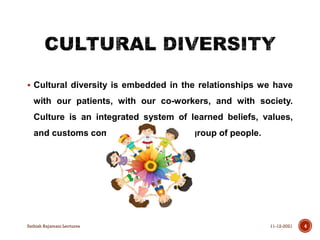
 Cultural diversity is embedded in the relationships we have
with our patients, with our co-workers, and with society.
Culture is an integrated system of learned beliefs, values,
and customs common to a particular group of people.
11-12-2021
Sathish Rajamani Lectures 4
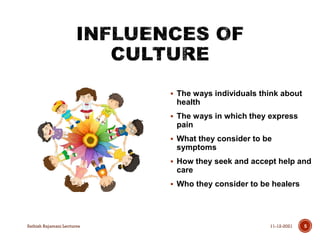
 The ways individuals think about
health
 The ways in which they express
pain
 What they consider to be
symptoms
 How they seek and accept help and
care
 Who they consider to be healers
11-12-2021
Sathish Rajamani Lectures 5
 Knowledge about cultures and their impact on interactions
within health care is essential for nurses, whether they are
practicing in a clinical setting, education, research or
administration.
 Knowledge and skills related to cultural diversity can
strengthen and broaden healthcare delivery systems.
 Concepts of illness, wellness, and treatment modalities
evolve from a cultural perspective or world view.
11-12-2021
Sathish Rajamani Lectures 6
11-12-2021
Sathish Rajamani Lectures 7
 Stress is any emotional, physical, social, economic or other
factor that requires a response or change.
 Stress can lead to a variety of psychological responses, the
most common of which is anxiety.
 Anxiety can be defined as a feeling of apprehension,
uneasiness, uncertainty or dread.
11-12-2021
Sathish Rajamani Lectures 8
 The source of the anxiety may be real and easily identified or it
may be a perceived threat and the person may not be able to
identify the cause. Everyone experiences anxiety. It may be
experienced on four different levels: mild, moderate, severe and
panic level.
 It can be classified as normal, acute or chronic and has the
potential to affect the person at a very deep level and to a point
where self-esteem can be seriously eroded (Boyd 2007; Keltner et
al 2006;Varcarolis 2006).
11-12-2021
Sathish Rajamani Lectures 9
 Stress can result in psychological and physiological effects, and
prolonged stress can result in physical illness. This is because the
immune system responds to a person’s internal and external
environments and, when exposed to excessive stress, becomes
damaged, reducing the body’s ability to combat infection and disease.
 Prolonged stress has been linked to many physical health problems,
including migraine headaches, allergies, asthma, gastric ulceration and
other disorders of the digestive tract. Scientists explain the physical
manifestations of prolonged stress as being related to chemical,
hormonal and cellular changes (deWit 2005; Rice 2000).
11-12-2021
Sathish Rajamani Lectures 10
 A stressor is the stimulus that precipitates stress. Stressors can be
classified as physical or psychological.
 Physical stressors include bodily trauma such as injury or surgery, blood
loss, pain, infection and illness.
 Psychological stressors can be defined as any stimuli that the person
interprets as challenging, demanding or threatening. These are usually
events and circumstances that demand a change or response.
 Psychological stressors relate to situations that result in emotional tension;
for example, interpersonal conflict such as might occur with divorce,
personal loss such as the death of a loved one, and changes in family or
social role such as might arise from redundancy, retirement or illness.
11-12-2021
Sathish Rajamani Lectures 11
 Stressors can also be classified as internal or external.
 Internal stressors arise from within the person. They include hunger, thirst, fatigue,
fever and the effects of pregnancy or menopause. Internal stressors also include strong
emotions such as embarrassment, shame or guilt.
 External stressors are those that originate outside a person and include environmental
conditions such as exposure to overly high or low temperatures, overcrowding, noise
and, of course, the traumatic effects of accidents or natural disasters such as fires,
floods, hurricanes and earthquakes.
 External stressors also include issues such as peer group pressure, social isolation
and the demands of study, family or work (deWit 2005; Watkins 2001).
11-12-2021
Sathish Rajamani Lectures 12
 A stressor may be perceived as positive, negative or a mixture of
both.
 Many situations are both demanding and stressful, evoking mixed
responses; a new job can be challenging and stressful but at the
same time a positive and personally rewarding experience; the
stress of a looming exam or competitive event can be very stressful
but the stimulus also provides high levels of motivating energy that
leads to positive outcomes (Varcarolis 2006; Stuart & Laraia
2004; Shives 2007).
11-12-2021
Sathish Rajamani Lectures 13
 A person’s ability to adapt to, and cope with, stress depends on
the combined aspects of the stressor itself and the
characteristics of the person. Aspects of the stressor that
influence the person’s response relate to the nature, origin,
timing and number of stressors. Specifically this relates to:
 Extent and intensity
 Duration
 Number and type of concurrent stressors
 Number of stressors within a given time period.
11-12-2021
Sathish Rajamani Lectures 14
 Background and culture
 Needs
 Desires
 Self-concept
 Internal resources
 External supports; for example, personal relationships, access to
support services, finances
 Knowledge, including past experience with similar stressors
 Skills
 Personality traits
 Maturity
11-12-2021
Sathish Rajamani Lectures 15
11-12-2021
Sathish Rajamani Lectures 16
11-12-2021
Sathish Rajamani Lectures 17

Psycho social needs

  • 1.
    By: Prof SathishRajamani HOD – Department of Psychiatric Nursing 11-12-2021 Sathish Rajamani Lectures 1
  • 2.
     Concepts ofCultural Diversity  Stress and Adaptation  Self – Concept  Sexuality  Spiritual Health  Coping with loss,  Death and Grieving  Assessment of psycho-social needs  Nursing interventions 11-12-2021 Sathish Rajamani Lectures 2
  • 3.
  • 4.
     Cultural diversityis embedded in the relationships we have with our patients, with our co-workers, and with society. Culture is an integrated system of learned beliefs, values, and customs common to a particular group of people. 11-12-2021 Sathish Rajamani Lectures 4
  • 5.
     The waysindividuals think about health  The ways in which they express pain  What they consider to be symptoms  How they seek and accept help and care  Who they consider to be healers 11-12-2021 Sathish Rajamani Lectures 5
  • 6.
     Knowledge aboutcultures and their impact on interactions within health care is essential for nurses, whether they are practicing in a clinical setting, education, research or administration.  Knowledge and skills related to cultural diversity can strengthen and broaden healthcare delivery systems.  Concepts of illness, wellness, and treatment modalities evolve from a cultural perspective or world view. 11-12-2021 Sathish Rajamani Lectures 6
  • 7.
  • 8.
     Stress isany emotional, physical, social, economic or other factor that requires a response or change.  Stress can lead to a variety of psychological responses, the most common of which is anxiety.  Anxiety can be defined as a feeling of apprehension, uneasiness, uncertainty or dread. 11-12-2021 Sathish Rajamani Lectures 8
  • 9.
     The sourceof the anxiety may be real and easily identified or it may be a perceived threat and the person may not be able to identify the cause. Everyone experiences anxiety. It may be experienced on four different levels: mild, moderate, severe and panic level.  It can be classified as normal, acute or chronic and has the potential to affect the person at a very deep level and to a point where self-esteem can be seriously eroded (Boyd 2007; Keltner et al 2006;Varcarolis 2006). 11-12-2021 Sathish Rajamani Lectures 9
  • 10.
     Stress canresult in psychological and physiological effects, and prolonged stress can result in physical illness. This is because the immune system responds to a person’s internal and external environments and, when exposed to excessive stress, becomes damaged, reducing the body’s ability to combat infection and disease.  Prolonged stress has been linked to many physical health problems, including migraine headaches, allergies, asthma, gastric ulceration and other disorders of the digestive tract. Scientists explain the physical manifestations of prolonged stress as being related to chemical, hormonal and cellular changes (deWit 2005; Rice 2000). 11-12-2021 Sathish Rajamani Lectures 10
  • 11.
     A stressoris the stimulus that precipitates stress. Stressors can be classified as physical or psychological.  Physical stressors include bodily trauma such as injury or surgery, blood loss, pain, infection and illness.  Psychological stressors can be defined as any stimuli that the person interprets as challenging, demanding or threatening. These are usually events and circumstances that demand a change or response.  Psychological stressors relate to situations that result in emotional tension; for example, interpersonal conflict such as might occur with divorce, personal loss such as the death of a loved one, and changes in family or social role such as might arise from redundancy, retirement or illness. 11-12-2021 Sathish Rajamani Lectures 11
  • 12.
     Stressors canalso be classified as internal or external.  Internal stressors arise from within the person. They include hunger, thirst, fatigue, fever and the effects of pregnancy or menopause. Internal stressors also include strong emotions such as embarrassment, shame or guilt.  External stressors are those that originate outside a person and include environmental conditions such as exposure to overly high or low temperatures, overcrowding, noise and, of course, the traumatic effects of accidents or natural disasters such as fires, floods, hurricanes and earthquakes.  External stressors also include issues such as peer group pressure, social isolation and the demands of study, family or work (deWit 2005; Watkins 2001). 11-12-2021 Sathish Rajamani Lectures 12
  • 13.
     A stressormay be perceived as positive, negative or a mixture of both.  Many situations are both demanding and stressful, evoking mixed responses; a new job can be challenging and stressful but at the same time a positive and personally rewarding experience; the stress of a looming exam or competitive event can be very stressful but the stimulus also provides high levels of motivating energy that leads to positive outcomes (Varcarolis 2006; Stuart & Laraia 2004; Shives 2007). 11-12-2021 Sathish Rajamani Lectures 13
  • 14.
     A person’sability to adapt to, and cope with, stress depends on the combined aspects of the stressor itself and the characteristics of the person. Aspects of the stressor that influence the person’s response relate to the nature, origin, timing and number of stressors. Specifically this relates to:  Extent and intensity  Duration  Number and type of concurrent stressors  Number of stressors within a given time period. 11-12-2021 Sathish Rajamani Lectures 14
  • 15.
     Background andculture  Needs  Desires  Self-concept  Internal resources  External supports; for example, personal relationships, access to support services, finances  Knowledge, including past experience with similar stressors  Skills  Personality traits  Maturity 11-12-2021 Sathish Rajamani Lectures 15
  • 16.
  • 17.