CODE OF ETHICS
According to Investopedia (2018)
• A code of ethics is a formal statement of group’s ideals and values
• A code of ethics is a guide of principles designed to help professionals
conduct business honestly and with integrity.
• A code of ethics document may outline the mission and values of the
business or organization, how professionals are supposed to approach
problems, the ethical principles based on the organization's core
values and the standards to which the professional is held.
• A code of ethics, also referred to as an "ethical code," may encompass
areas such as business ethics, a code of professional practice and an
employee code of conduct.
According to Yellowpages (2016)
• The word "ethics" comes from a Greek term meaning "duty". Thus, a
code of ethics consists of all the obligations that professionals must
respect when carrying out their duties.
• A code of ethics and conduct in financial planning stipulates that
financial planners should clearly explain to their clients all the
advantages and disadvantages of the proposed plan.
• Confidentiality and professional secrecy are obligations contained in
the code of ethics and conduct of several professions, such as doctors,
lawyers, psychologists, journalists and accountants.
A code of ethics is usually established by a professional
order as a way to protect the public and the reputation of
the professionals. Indeed, people who breach their code of
ethics incur disciplinary actions that can range from a
warning or reprimand to dismissal or expulsion from their
professional order.
 Acknowledges the rightful place of Individuals.
 Contributes towards empowerment of individuals
to become responsible
 Identifies obligations in practice, research and
relationships.
According to Walton (2015), research that involves human subjects or
participants raises unique and complex ethical, legal, social and
political issues. Research ethics is specifically interested in the analysis
of ethical issues that are raised when people are involved as
participants in research. There are three objectives in research ethics.
The first and broadest objective is to protect human participants. The
second objective is to ensure that research is conducted in a way that
serves interests of individuals, groups and/or society as a whole.
Finally, the third objective is to examine specific research activities and
projects for their ethical soundness, looking at issues such as the
management of risk, protection of confidentiality and the process of
informed consent.
According to Shamoo and Resnik (2015), The following is a rough and
general summary of some ethical principles that various codes address:
HONESTY. Strive for honesty in all scientific communications.
Honestly report data, results, methods and procedures, and
publication status. Do not fabricate, falsify, or misrepresent data. Do
not deceive colleagues, research sponsors, or the public.
OBJECTIVITY. Strive to avoid bias in experimental design,
data analysis, data interpretation, peer review, personnel decisions,
grant writing, expert testimony, and other aspects of research
where objectivity is expected or required. Avoid or minimize bias or
self-deception. Disclose personal or financial interests that may
affect research.
INTEGRITY. Keep your promises and agreements; act with sincerity;
strive for consistency of thought and action.
CAREFULNESS. Avoid careless errors and negligence; carefully and
critically examine your own work and the work of your peers. Keep good
records of research activities, such as data collection, research design,
and correspondence with agencies or journals.
OPENNESS. Share data, results, ideas, tools, resources. Be open to
criticism and new ideas.
RESPECT FOR INTELLECTUAL PROPERTY. Honour patents,
copyrights, and other forms of intellectual property. Do not use unpublished
data, methods, or results without permission. Give proper
acknowledgement or credit for all contributions to research. Never
plagiarize.
CONFIDENTIALITY. Protect confidential communications, such
as papers or grants submitted for publication, personnel records,
trade or military secrets, and patient records.
RESPONSIBLE PUBLICATION. Publish in order to advance
research and scholarship, not to advance just your own career.
Avoid wasteful and duplicative publication.
COMPETENCE. Maintain and improve your own professional
competence and expertise through lifelong education and learning;
take steps to promote competence in science as a whole.
LEGALITY. Know and obey relevant laws and institutional and
governmental policies.
COPYRIGHT
The dictionary defines copyright as "a person's exclusive right
to reproduce, publish, or sell his or her original work of authorship (as a
literary, musical, dramatic, artistic, or architectural work).“
It's important to understand that copyright law covers the "form
of material expression," not the actual concepts, ideas, techniques, or
facts in a particular work. This is the reason behind why a work must be
fixed in a tangible form in order to receive copyright protection. A couple
examples of works being fixed in a tangible form include stories written
on paper and original paintings on canvas.
http://smallbusiness.findlaw.com/intellectual-property/what-is-copyright.html
PLAGIARISM
According to the Merriam-Webster online dictionary, to "plagiarize"
means:
o to steal and pass off (the ideas or words of another) as one's own
o to use (another's production) without crediting the source
o to commit literary theft
o to present as new and original an idea or product derived from an
existing source
In other words, plagiarism is an act of fraud. It involves both stealing
someone else's work and lying about it afterward.
http://www.plagiarism.org
FABRICATION
• Fabrication is making up results and recording or reporting them.
This is sometimes referred to as "drylabbing".
• Fabrication is the construction and/or addition of data,
observations, or characterizations that never occurred in the
gathering of data or running of experiments. Fabrication can occur
when “filling out” the rest of experiment runs, for example. Claims
about results need to be made on complete data sets (as is
normally assumed), where claims made based on incomplete or
assumed results is a form of fabrication.
https://www.e-education.psu.edu
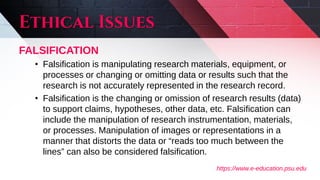
FALSIFICATION
• Falsification is manipulating research materials, equipment, or
processes or changing or omitting data or results such that the
research is not accurately represented in the research record.
• Falsification is the changing or omission of research results (data)
to support claims, hypotheses, other data, etc. Falsification can
include the manipulation of research instrumentation, materials,
or processes. Manipulation of images or representations in a
manner that distorts the data or “reads too much between the
lines” can also be considered falsification.
https://www.e-education.psu.edu
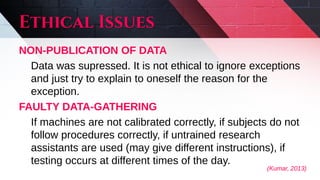
NON-PUBLICATION OF DATA
Data was supressed. It is not ethical to ignore exceptions
and just try to explain to oneself the reason for the
exception.
FAULTY DATA-GATHERING
If machines are not calibrated correctly, if subjects do not
follow procedures correctly, if untrained research
assistants are used (may give different instructions), if
testing occurs at different times of the day.
(Kumar, 2013)
POOR DATA STORAGE AND RETENTION
Should be available for verification of others.
MISLEADING AUTHORSHIP
People take credit that really makes very little
contribution to the study. If fellow graduate students
assist you they should not expect to be named .The
same is true with faculty advisors unless they have made
a significant contribution to the study.
(Kumar, 2013)
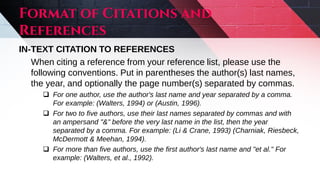
IN-TEXT CITATION TO REFERENCES
When citing a reference from your reference list, please use the
following conventions. Put in parentheses the author(s) last names,
the year, and optionally the page number(s) separated by commas.
 For one author, use the author's last name and year separated by a comma.
For example: (Walters, 1994) or (Austin, 1996).
 For two to five authors, use their last names separated by commas and with
an ampersand "&" before the very last name in the list, then the year
separated by a comma. For example: (Li & Crane, 1993) (Charniak, Riesbeck,
McDermott & Meehan, 1994).
 For more than five authors, use the first author's last name and "et al." For
example: (Walters, et al., 1992).
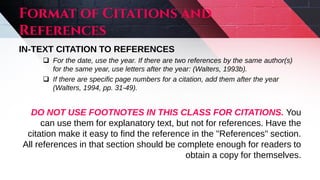
IN-TEXT CITATION TO REFERENCES
 For the date, use the year. If there are two references by the same author(s)
for the same year, use letters after the year: (Walters, 1993b).
 If there are specific page numbers for a citation, add them after the year
(Walters, 1994, pp. 31-49).
DO NOT USE FOOTNOTES IN THIS CLASS FOR CITATIONS. You
can use them for explanatory text, but not for references. Have the
citation make it easy to find the reference in the "References" section.
All references in that section should be complete enough for readers to
obtain a copy for themselves.
All of the examples given above may be summarized by citing a few
references in the form we would like you to use. Here are some
examples that would be cited in the text as (Crosley, 1988),
(Essinger, 1991, May 28, pp. 97-99), (Armstrong & Keevil, 1991, p.
103), and so forth.
PRINTED BOOK
Crosley, L.M. (1988). The architects' guide to computer-aided-
design. Toronto: John Wiley & Sons.
MAGAZINE ARTICLE
Essinger, J. (1991, May 28). Just another tool of your
trade. Accountancy 108, pp. 91-125.
JOURNAL ARTICLE
Armstrong, P. and Keevil, S. (1991). Magnetic resonance imaging-2:
Clinical uses. British Medical Journal 303(2), 105-109.
INTERVIEW
Computer, Christopher C. (1996, January 10) Professor, Computer
Science Department, University of California - Davis, 3:00 pm,
Davis, California.
WORLD WIDE WEB ADDRESS
Austin, A. (1996) Annotated List of World Wide Web Technical
Writing and Computer-Aided Composition Resources [Online].
Available: http://wwwcsif.cs.ucdavis.edu/~austina/cai.html, Accessed
19 April 2018
Investopedia (2018), Definition of Code of ethics [Online] Available: https://www.investopedia.
com/terms/c/code-of-ethics.asp, Retrieved on April 08, 2018
Yellowpages (2016), Code of Ethics [Online] Available: https://www.yellowpages.ca /tips/professional-
standards-what-is-the-purpose-of-a-code-of-ethics/, Retrieved on April 08, 2018
Walton, Nancy (2015), What is Research Ethics [Online] Available: https://researchethics.ca/what-is-
research-ethics/, Retrieved on April 08, 2018
Shamoo A and Resnik D, 2015. Responsible Conduct of Research, 3rd ed. (New York: Oxford University
Press) [Online] Available: https://www.niehs.nih.gov/research
/resources/bioethics/whatis/index.cfm, Retrieved on April 08, 2018
Kumar, Harish R. (2013), Ethical issued in research [Online] Available: https://www.slideshare.net
/HarishKumar12/ethical-issues-in-research-23190320, Retrieved on April 08, 2018
Copyright [Online] Available: http://smallbusiness.findlaw.com/intellectual-property/what-is-
copyright.html, Retrieved on April 08, 2018
Plagiarism [Online] Available: http://www.plagiarism.org/article/what-is-plagiarism, What is Plagiarism?,
Published May 18, 2017, Retrieved on April 08, 2018
https://www.e-education.psu.edu/bioet533/node/654, 2.1 Falsification, Fabrication, Plagiarism, Published
April 18, 2017, retrieved on April 08, 2018

Research Methodology Code of Ethics

  • 1.
  • 2.
    According to Investopedia(2018) • A code of ethics is a formal statement of group’s ideals and values • A code of ethics is a guide of principles designed to help professionals conduct business honestly and with integrity. • A code of ethics document may outline the mission and values of the business or organization, how professionals are supposed to approach problems, the ethical principles based on the organization's core values and the standards to which the professional is held. • A code of ethics, also referred to as an "ethical code," may encompass areas such as business ethics, a code of professional practice and an employee code of conduct.
  • 3.
    According to Yellowpages(2016) • The word "ethics" comes from a Greek term meaning "duty". Thus, a code of ethics consists of all the obligations that professionals must respect when carrying out their duties. • A code of ethics and conduct in financial planning stipulates that financial planners should clearly explain to their clients all the advantages and disadvantages of the proposed plan. • Confidentiality and professional secrecy are obligations contained in the code of ethics and conduct of several professions, such as doctors, lawyers, psychologists, journalists and accountants.
  • 4.
    A code ofethics is usually established by a professional order as a way to protect the public and the reputation of the professionals. Indeed, people who breach their code of ethics incur disciplinary actions that can range from a warning or reprimand to dismissal or expulsion from their professional order.
  • 5.
     Acknowledges therightful place of Individuals.  Contributes towards empowerment of individuals to become responsible  Identifies obligations in practice, research and relationships.
  • 6.
    According to Walton(2015), research that involves human subjects or participants raises unique and complex ethical, legal, social and political issues. Research ethics is specifically interested in the analysis of ethical issues that are raised when people are involved as participants in research. There are three objectives in research ethics. The first and broadest objective is to protect human participants. The second objective is to ensure that research is conducted in a way that serves interests of individuals, groups and/or society as a whole. Finally, the third objective is to examine specific research activities and projects for their ethical soundness, looking at issues such as the management of risk, protection of confidentiality and the process of informed consent.
  • 7.
    According to Shamooand Resnik (2015), The following is a rough and general summary of some ethical principles that various codes address: HONESTY. Strive for honesty in all scientific communications. Honestly report data, results, methods and procedures, and publication status. Do not fabricate, falsify, or misrepresent data. Do not deceive colleagues, research sponsors, or the public. OBJECTIVITY. Strive to avoid bias in experimental design, data analysis, data interpretation, peer review, personnel decisions, grant writing, expert testimony, and other aspects of research where objectivity is expected or required. Avoid or minimize bias or self-deception. Disclose personal or financial interests that may affect research.
  • 8.
    INTEGRITY. Keep yourpromises and agreements; act with sincerity; strive for consistency of thought and action. CAREFULNESS. Avoid careless errors and negligence; carefully and critically examine your own work and the work of your peers. Keep good records of research activities, such as data collection, research design, and correspondence with agencies or journals. OPENNESS. Share data, results, ideas, tools, resources. Be open to criticism and new ideas. RESPECT FOR INTELLECTUAL PROPERTY. Honour patents, copyrights, and other forms of intellectual property. Do not use unpublished data, methods, or results without permission. Give proper acknowledgement or credit for all contributions to research. Never plagiarize.
  • 9.
    CONFIDENTIALITY. Protect confidentialcommunications, such as papers or grants submitted for publication, personnel records, trade or military secrets, and patient records. RESPONSIBLE PUBLICATION. Publish in order to advance research and scholarship, not to advance just your own career. Avoid wasteful and duplicative publication. COMPETENCE. Maintain and improve your own professional competence and expertise through lifelong education and learning; take steps to promote competence in science as a whole. LEGALITY. Know and obey relevant laws and institutional and governmental policies.
  • 10.
    COPYRIGHT The dictionary definescopyright as "a person's exclusive right to reproduce, publish, or sell his or her original work of authorship (as a literary, musical, dramatic, artistic, or architectural work).“ It's important to understand that copyright law covers the "form of material expression," not the actual concepts, ideas, techniques, or facts in a particular work. This is the reason behind why a work must be fixed in a tangible form in order to receive copyright protection. A couple examples of works being fixed in a tangible form include stories written on paper and original paintings on canvas. http://smallbusiness.findlaw.com/intellectual-property/what-is-copyright.html
  • 11.
    PLAGIARISM According to theMerriam-Webster online dictionary, to "plagiarize" means: o to steal and pass off (the ideas or words of another) as one's own o to use (another's production) without crediting the source o to commit literary theft o to present as new and original an idea or product derived from an existing source In other words, plagiarism is an act of fraud. It involves both stealing someone else's work and lying about it afterward. http://www.plagiarism.org
  • 12.
    FABRICATION • Fabrication ismaking up results and recording or reporting them. This is sometimes referred to as "drylabbing". • Fabrication is the construction and/or addition of data, observations, or characterizations that never occurred in the gathering of data or running of experiments. Fabrication can occur when “filling out” the rest of experiment runs, for example. Claims about results need to be made on complete data sets (as is normally assumed), where claims made based on incomplete or assumed results is a form of fabrication. https://www.e-education.psu.edu
  • 13.
    FALSIFICATION • Falsification ismanipulating research materials, equipment, or processes or changing or omitting data or results such that the research is not accurately represented in the research record. • Falsification is the changing or omission of research results (data) to support claims, hypotheses, other data, etc. Falsification can include the manipulation of research instrumentation, materials, or processes. Manipulation of images or representations in a manner that distorts the data or “reads too much between the lines” can also be considered falsification. https://www.e-education.psu.edu
  • 14.
    NON-PUBLICATION OF DATA Datawas supressed. It is not ethical to ignore exceptions and just try to explain to oneself the reason for the exception. FAULTY DATA-GATHERING If machines are not calibrated correctly, if subjects do not follow procedures correctly, if untrained research assistants are used (may give different instructions), if testing occurs at different times of the day. (Kumar, 2013)
  • 15.
    POOR DATA STORAGEAND RETENTION Should be available for verification of others. MISLEADING AUTHORSHIP People take credit that really makes very little contribution to the study. If fellow graduate students assist you they should not expect to be named .The same is true with faculty advisors unless they have made a significant contribution to the study. (Kumar, 2013)
  • 16.
    IN-TEXT CITATION TOREFERENCES When citing a reference from your reference list, please use the following conventions. Put in parentheses the author(s) last names, the year, and optionally the page number(s) separated by commas.  For one author, use the author's last name and year separated by a comma. For example: (Walters, 1994) or (Austin, 1996).  For two to five authors, use their last names separated by commas and with an ampersand "&" before the very last name in the list, then the year separated by a comma. For example: (Li & Crane, 1993) (Charniak, Riesbeck, McDermott & Meehan, 1994).  For more than five authors, use the first author's last name and "et al." For example: (Walters, et al., 1992).
  • 17.
    IN-TEXT CITATION TOREFERENCES  For the date, use the year. If there are two references by the same author(s) for the same year, use letters after the year: (Walters, 1993b).  If there are specific page numbers for a citation, add them after the year (Walters, 1994, pp. 31-49). DO NOT USE FOOTNOTES IN THIS CLASS FOR CITATIONS. You can use them for explanatory text, but not for references. Have the citation make it easy to find the reference in the "References" section. All references in that section should be complete enough for readers to obtain a copy for themselves.
  • 18.
    All of theexamples given above may be summarized by citing a few references in the form we would like you to use. Here are some examples that would be cited in the text as (Crosley, 1988), (Essinger, 1991, May 28, pp. 97-99), (Armstrong & Keevil, 1991, p. 103), and so forth. PRINTED BOOK Crosley, L.M. (1988). The architects' guide to computer-aided- design. Toronto: John Wiley & Sons.
  • 19.
    MAGAZINE ARTICLE Essinger, J.(1991, May 28). Just another tool of your trade. Accountancy 108, pp. 91-125. JOURNAL ARTICLE Armstrong, P. and Keevil, S. (1991). Magnetic resonance imaging-2: Clinical uses. British Medical Journal 303(2), 105-109. INTERVIEW Computer, Christopher C. (1996, January 10) Professor, Computer Science Department, University of California - Davis, 3:00 pm, Davis, California.
  • 20.
    WORLD WIDE WEBADDRESS Austin, A. (1996) Annotated List of World Wide Web Technical Writing and Computer-Aided Composition Resources [Online]. Available: http://wwwcsif.cs.ucdavis.edu/~austina/cai.html, Accessed 19 April 2018
  • 21.
    Investopedia (2018), Definitionof Code of ethics [Online] Available: https://www.investopedia. com/terms/c/code-of-ethics.asp, Retrieved on April 08, 2018 Yellowpages (2016), Code of Ethics [Online] Available: https://www.yellowpages.ca /tips/professional- standards-what-is-the-purpose-of-a-code-of-ethics/, Retrieved on April 08, 2018 Walton, Nancy (2015), What is Research Ethics [Online] Available: https://researchethics.ca/what-is- research-ethics/, Retrieved on April 08, 2018 Shamoo A and Resnik D, 2015. Responsible Conduct of Research, 3rd ed. (New York: Oxford University Press) [Online] Available: https://www.niehs.nih.gov/research /resources/bioethics/whatis/index.cfm, Retrieved on April 08, 2018 Kumar, Harish R. (2013), Ethical issued in research [Online] Available: https://www.slideshare.net /HarishKumar12/ethical-issues-in-research-23190320, Retrieved on April 08, 2018 Copyright [Online] Available: http://smallbusiness.findlaw.com/intellectual-property/what-is- copyright.html, Retrieved on April 08, 2018 Plagiarism [Online] Available: http://www.plagiarism.org/article/what-is-plagiarism, What is Plagiarism?, Published May 18, 2017, Retrieved on April 08, 2018 https://www.e-education.psu.edu/bioet533/node/654, 2.1 Falsification, Fabrication, Plagiarism, Published April 18, 2017, retrieved on April 08, 2018