By: Robert L.
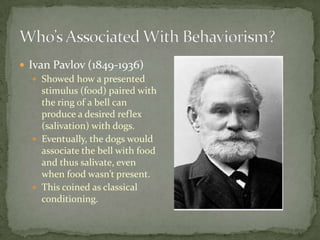
 Ivan Pavlov (1849-1936)
    Showed how a presented
     stimulus (food) paired with
     the ring of a bell can
     produce a desired reflex
     (salivation) with dogs.
    Eventually, the dogs would
     associate the bell with food
     and thus salivate, even
     when food wasn’t present.
    This coined as classical
     conditioning.
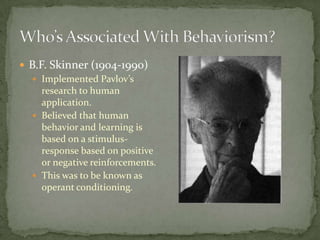
 B.F. Skinner (1904-1990)
   Implemented Pavlov’s
     research to human
     application.
   Believed that human
     behavior and learning is
     based on a stimulus-
     response based on positive
     or negative reinforcements.
   This was to be known as
     operant conditioning.
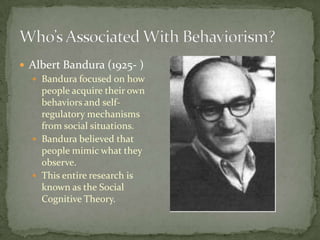
 Albert Bandura (1925- )
   Bandura focused on how
    people acquire their own
    behaviors and self-
    regulatory mechanisms
    from social situations.
   Bandura believed that
    people mimic what they
    observe.
   This entire research is
    known as the Social
    Cognitive Theory.
 Essentially, Behaviorism is the prediction and control
  of human behavior whereas introspection or
  independent thinking play no role.
 In other words, students will learn through a system of
  positive and negative rewards.
 Technology such as PowerPoint quizzes and web-
  based programs can provide instant feedback on
  retention of knowledge.
 Essentially without technology, a teacher can provide
  both positive and negative reinforcement by rewarding
  or punishing specific behaviors.
 Examples could be referrals for bad behavior, or green
  bands for good behavior.
 Essentially, with or without technology, students will
  be affected by the implementation of Behaviorism
  within the classroom.
 Students will try harder to achieve positive rewards,
  and avoid the negative punishments.
 I’d love to implement some of the basics of
  Behaviorism in my classroom. This theory has the
  opportunity to motivate students through external
  factors. Essentially, through the use of my own ideas
  and technology, my students will slowly but surely
  become more motivated.
 Essentially, I will use visual grades, candy for the best
  grades, and PowerPoint quizzes to provide positive and
  negative feedback to my students.
 Ivan Pavlov Image
  http://www.nobelprize.org/nobel_prizes/medicine/la
  ureates/1904/pavlov-bio.html
 B.F. Skinner Image
  http://www.muskingum.edu/~psych/psycweb/history
  /skinner.htm
 Albert Bandura Image
  http://webspace.ship.edu/cgboer/bandura.html

Behaviorism presentation

  • 1.
  • 2.
     Ivan Pavlov(1849-1936)  Showed how a presented stimulus (food) paired with the ring of a bell can produce a desired reflex (salivation) with dogs.  Eventually, the dogs would associate the bell with food and thus salivate, even when food wasn’t present.  This coined as classical conditioning.
  • 3.
     B.F. Skinner(1904-1990)  Implemented Pavlov’s research to human application.  Believed that human behavior and learning is based on a stimulus- response based on positive or negative reinforcements.  This was to be known as operant conditioning.
  • 4.
     Albert Bandura(1925- )  Bandura focused on how people acquire their own behaviors and self- regulatory mechanisms from social situations.  Bandura believed that people mimic what they observe.  This entire research is known as the Social Cognitive Theory.
  • 5.
     Essentially, Behaviorismis the prediction and control of human behavior whereas introspection or independent thinking play no role.  In other words, students will learn through a system of positive and negative rewards.
  • 6.
     Technology suchas PowerPoint quizzes and web- based programs can provide instant feedback on retention of knowledge.  Essentially without technology, a teacher can provide both positive and negative reinforcement by rewarding or punishing specific behaviors.  Examples could be referrals for bad behavior, or green bands for good behavior.
  • 7.
     Essentially, withor without technology, students will be affected by the implementation of Behaviorism within the classroom.  Students will try harder to achieve positive rewards, and avoid the negative punishments.
  • 8.
     I’d loveto implement some of the basics of Behaviorism in my classroom. This theory has the opportunity to motivate students through external factors. Essentially, through the use of my own ideas and technology, my students will slowly but surely become more motivated.  Essentially, I will use visual grades, candy for the best grades, and PowerPoint quizzes to provide positive and negative feedback to my students.
  • 9.
     Ivan PavlovImage http://www.nobelprize.org/nobel_prizes/medicine/la ureates/1904/pavlov-bio.html  B.F. Skinner Image http://www.muskingum.edu/~psych/psycweb/history /skinner.htm  Albert Bandura Image http://webspace.ship.edu/cgboer/bandura.html