CognitivismMegan
The Cognitive Theory of Learning in EducationCognitive theory defines learning as a “semi-permanent change in mental processes or associations”.
Cognitivists do not require an outward exhibition of learning, but focus more on the internal processes and connections that take place during learning.
Important classroom principles from cognitive psychology include meaningful learning, organization, and elaboration.www.innovativelearning.com/educational_psychology/cognitivism/index.htm
Cognitivism as a reaction to Behaviorism-Cognitivist theory developed as a reaction to Behaviorism.-Cognitivists objected to behaviorists because they felt that behaviorists thought learning was simply reactionary and ignored the idea that thinking plays a role.-Paivio, Gagne, and Gardner are a few of the cognitivists who have contributed to developing the cognitive theory.Text p. 371
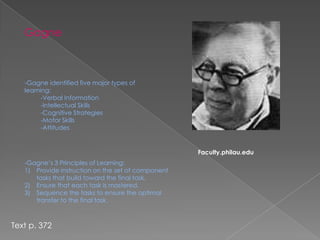
GagneGagne identified five major types of learning:
Verbal Information
Intellectual Skills

Cognitivism

  • 1.
  • 2.
    The Cognitive Theoryof Learning in EducationCognitive theory defines learning as a “semi-permanent change in mental processes or associations”.
  • 3.
    Cognitivists do notrequire an outward exhibition of learning, but focus more on the internal processes and connections that take place during learning.
  • 4.
    Important classroom principlesfrom cognitive psychology include meaningful learning, organization, and elaboration.www.innovativelearning.com/educational_psychology/cognitivism/index.htm
  • 5.
    Cognitivism as areaction to Behaviorism-Cognitivist theory developed as a reaction to Behaviorism.-Cognitivists objected to behaviorists because they felt that behaviorists thought learning was simply reactionary and ignored the idea that thinking plays a role.-Paivio, Gagne, and Gardner are a few of the cognitivists who have contributed to developing the cognitive theory.Text p. 371
  • 6.
    GagneGagne identified fivemajor types of learning:
  • 7.
  • 8.
  • 9.
  • 10.
  • 11.
    AttitudesFaculty.philau.edu-Gagne’s 3 Principlesof Learning:Provide instruction on the set of component tasks that build toward the final task.Ensure that each task is mastered.Sequence the tasks to ensure the optimal transfer to the final task.Text p. 372
  • 12.
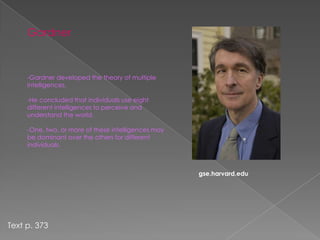
    GardnerGardner developed thetheory of multiple intelligences.
  • 13.
    He concluded thatindividuals use eight different intelligences to perceive and understand the world.
  • 14.
    One, two, ormore of these intelligences may be dominant over the others for different individuals. gse.harvard.edu Text p. 373
  • 15.
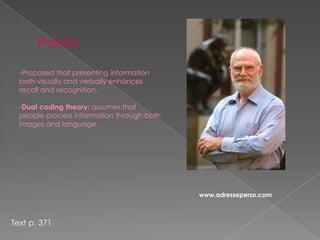
    PaivioProposed that presentinginformation both visually and verbally enhances recall and recognition.
  • 16.
    Dual coding theory:assumes that people process information through both images and language. www.adresseperso.comText p. 371
  • 17.
    Teaching and LearningUnder the Cognitivist TheoryTeachers should create an environment with lots of tools for developing an understanding of the topic. Teachers should monitor students progress and ask lots of questions. Teachers should provide use visual and verbal teaching methods. Teachers can read aloud to students. Using technology, they can provide pictures, videos, and charts to enhance learning (i.e. computer video clip, topic-related images from the web, etc.)
  • 18.
    Students should thinkdeeply and answer questions about the topic to further develop their understanding. Failure can be a good thing. It helps the student recognize that they need to learn more to achieve mastery of the topic. www.innovativelearning.com/educational_psychology/cognitivism/index.htm
  • 19.
    I think thatthe cognitivist theory is a great theory to follow when teaching. I think that is always a good idea to provide different ways of learning. Some students are visual learners and will do better learning through pictures, videos, or visually looking at a text book. Some students are audio learners and will do better listening to a lecture, or listening to a teacher read aloud to them. Some students are audio-visual learners and will do better with either technique!