
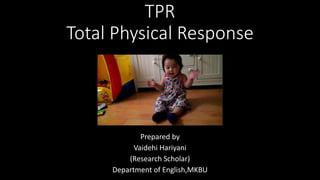

TPR
Total Physical Response
Prepared by
Vaidehi Hariyani
(Research Scholar)
Department of English,MKBU
Total physical response
(TPR) is a language teaching
method developed by
James Asher, a professor of
psychology at San José
State University.
What is it?
• This method is based on learning through physical activities.
• Students develop physically first. And, then they produce the
language.
• Language teaching method which built around the coordination of
speech and action; it attempts to teach language through activities.
• The basic view is to create fun atmosphere of learning which could
help student memorize and understand the material better.
Principles:-
• The importance of listening on language development, and do not
require spoken output in the early stages of learning.
• Instead, teachers wait until students acquire enough language
through listening that they start to speak spontaneously.
• At the beginning stages of instruction students can respond to the
instructor in their native language.
• Feedback and Correction is important, but in this method teacher
should only give it when it is demanding and after the students end.
• TPR aims the same principle; learning through physical activities will
reduce stress level, in which will enhance our memory and brain
capability to perform better learning.
“We tend to do physical
activities to make our body
healthy”
Advantages
• It is fun and easy.
• It does not require a great deal of preparation on the part of the
teacher.
• It is a good tool for learning vocabulary.
• Class size does not need to be a problem.
• There is no age barrier.
Disadvantages
• It is not a very creative method. Students are not given the
opportunity to express their own views and thoughts in a creative
way.
• It is easy to overuse TPR.
• It is limited, since everything cannot be explained with this method. It
must be combined with other approaches.
Suggestopedia
Prepared by
Vaidehi Hariyani
(Research Scholar)
Department of English,MKBU
What is it?
• Suggestopedia is developed by the Bulgarian psychiatrist educator
Georgi Lozanov.
• Suggestopedia is an innovative method that promises great effective
language learning results. Lozanov claimed that by using this method
one can teach languages approximately three to five times as quickly
as conventional methods.
• The name of Suggestopedia is from the words “suggestion” and
“pedagogy.”
• The method also draws from insights from yoga and the Soviet
psychology.
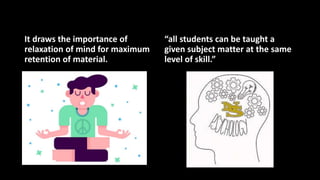
It draws the importance of
relaxation of mind for maximum
retention of material.
“all students can be taught a
given subject matter at the same
level of skill.”
Principle theoretical components:
Authority
Infantilization (to treat someone as if that person were a child)
Double-Plannedness
Intonation
Rhythm
Key Facts
• Learning is facilitated in an environment that is as comfortable as
possible, featuring soft cushioned seating and dim lighting.
• “Peripheral” learning is encouraged through the presence in the
learning environment of posters and decoration featuring the target
language and various grammatical items.
• Teachers are at the authoritative role and students behave like child.
• Baroque music is played softly at the background to increase mental
relaxation and to take in and create new material/understanding
during the class.
Cont…
• Errors are tolerated, the emphasis being on content not structure.
• Homework is limited to students. They re-read the dialogues once
done in their class, at night before sleeping and early in the morning.
• Music and drama are integrated into learning process as often as
possible.
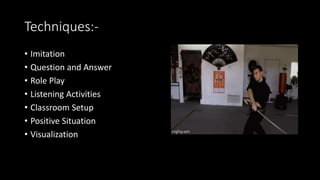
Techniques:-
• Imitation
• Question and Answer
• Role Play
• Listening Activities
• Classroom Setup
• Positive Situation
• Visualization
Teacher’s Role
• Show absolute confidence in this
method.
• Display fastidious conduct in
manners and dress.
• Maintain a modest enthusiasm.
• Punctuality.
Student’s Role
• The Students should not be critical but
simply absorb what is presented to them.
• They should follow their parent/teacher.
Works Cited:-
• Richards, Jack c. and Theodore s
Rodgers. Approaches and
Methods in Language teaching.
Cambridge university press, 2001.

Total Physical Response and Suggestopedia

  • 2.
    TPR Total Physical Response Preparedby Vaidehi Hariyani (Research Scholar) Department of English,MKBU
  • 3.
    Total physical response (TPR)is a language teaching method developed by James Asher, a professor of psychology at San José State University.
  • 4.
    What is it? •This method is based on learning through physical activities. • Students develop physically first. And, then they produce the language. • Language teaching method which built around the coordination of speech and action; it attempts to teach language through activities. • The basic view is to create fun atmosphere of learning which could help student memorize and understand the material better.
  • 5.
    Principles:- • The importanceof listening on language development, and do not require spoken output in the early stages of learning. • Instead, teachers wait until students acquire enough language through listening that they start to speak spontaneously. • At the beginning stages of instruction students can respond to the instructor in their native language. • Feedback and Correction is important, but in this method teacher should only give it when it is demanding and after the students end.
  • 6.
    • TPR aimsthe same principle; learning through physical activities will reduce stress level, in which will enhance our memory and brain capability to perform better learning. “We tend to do physical activities to make our body healthy”
  • 7.
    Advantages • It isfun and easy. • It does not require a great deal of preparation on the part of the teacher. • It is a good tool for learning vocabulary. • Class size does not need to be a problem. • There is no age barrier.
  • 8.
    Disadvantages • It isnot a very creative method. Students are not given the opportunity to express their own views and thoughts in a creative way. • It is easy to overuse TPR. • It is limited, since everything cannot be explained with this method. It must be combined with other approaches.
  • 10.
    Suggestopedia Prepared by Vaidehi Hariyani (ResearchScholar) Department of English,MKBU
  • 11.
    What is it? •Suggestopedia is developed by the Bulgarian psychiatrist educator Georgi Lozanov. • Suggestopedia is an innovative method that promises great effective language learning results. Lozanov claimed that by using this method one can teach languages approximately three to five times as quickly as conventional methods. • The name of Suggestopedia is from the words “suggestion” and “pedagogy.” • The method also draws from insights from yoga and the Soviet psychology.
  • 12.
    It draws theimportance of relaxation of mind for maximum retention of material. “all students can be taught a given subject matter at the same level of skill.”
  • 13.
    Principle theoretical components: Authority Infantilization(to treat someone as if that person were a child) Double-Plannedness Intonation Rhythm
  • 14.
    Key Facts • Learningis facilitated in an environment that is as comfortable as possible, featuring soft cushioned seating and dim lighting. • “Peripheral” learning is encouraged through the presence in the learning environment of posters and decoration featuring the target language and various grammatical items. • Teachers are at the authoritative role and students behave like child. • Baroque music is played softly at the background to increase mental relaxation and to take in and create new material/understanding during the class.
  • 15.
    Cont… • Errors aretolerated, the emphasis being on content not structure. • Homework is limited to students. They re-read the dialogues once done in their class, at night before sleeping and early in the morning. • Music and drama are integrated into learning process as often as possible.
  • 16.
    Techniques:- • Imitation • Questionand Answer • Role Play • Listening Activities • Classroom Setup • Positive Situation • Visualization
  • 17.
    Teacher’s Role • Showabsolute confidence in this method. • Display fastidious conduct in manners and dress. • Maintain a modest enthusiasm. • Punctuality.
  • 18.
    Student’s Role • TheStudents should not be critical but simply absorb what is presented to them. • They should follow their parent/teacher.
  • 19.
    Works Cited:- • Richards,Jack c. and Theodore s Rodgers. Approaches and Methods in Language teaching. Cambridge university press, 2001.