Human Resource University
MA. in TESOL
Course: Educational
Psychology
Mr. Vath Vary
Phone: 017 47 111 7
Email: varyvath@gmail.com
Chapter 7:
Behavioral and social
cognitive approaches
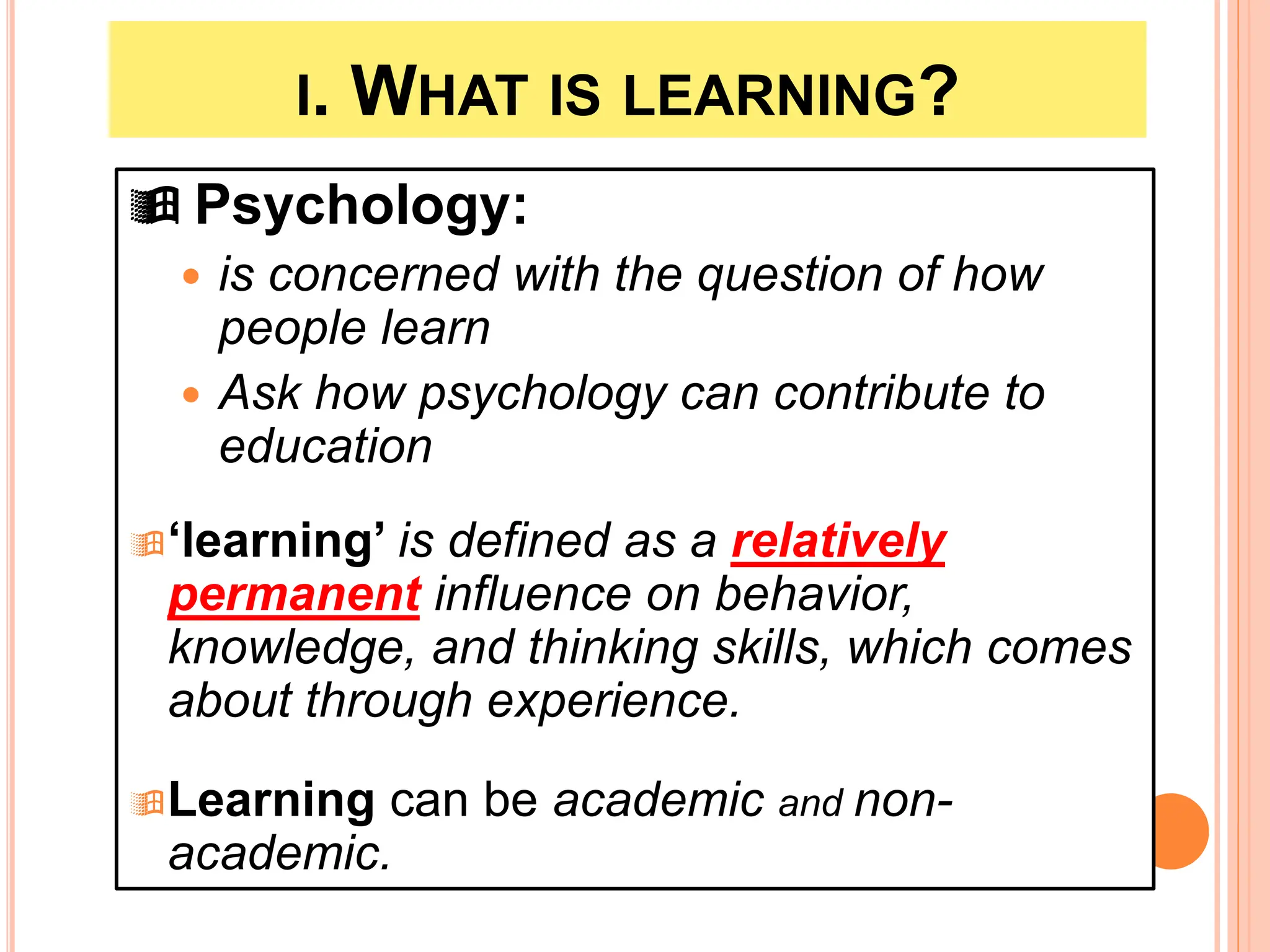
Chapter
Outline
What Is
Learning?
What
Learning Is
and Is Not;
Approaches
to Learning
Behavioral
Approaches
to Learning
Classical
Conditioning;
Operant
Conditioning
Applied
Behavior
Analysis in
Education
What Is Applied
Behavior Analysis?;
Increasing Desirable
Behaviors;
Decreasing
Undesirable
Behaviors;
Evaluating Operant
Conditioning and
Applied Behavior
Analysis
What Is Applied Behavior
Analysis?;
Increasing Desirable
Behaviors;
Decreasing Undesirable
Behaviors;
Evaluating Operant
Conditioning and Applied
Behavior Analysis
Bandura’s Social
Cognitive Theory;
Observational
Learning;
Cognitive-Behavioral
Approaches and Self-
Regulation;
Evaluating the Social
Cognitive Approaches
I. WHAT IS LEARNING?
 Psychology:
 is concerned with the question of how
people learn
 Ask how psychology can contribute to
education
‘learning’ is defined as a relatively
permanent influence on behavior,
knowledge, and thinking skills, which comes
about through experience.
Learning can be academic and non-
academic.
WHAT LEARNING IS AND IS NOT?
 What does “relatively permanent” mean?
And how does experience change what we
do?
 The “relatively permanent” part of the definition
refers to the fact that when people learn anything,
some part of their brain is physically changed to
record what they’ve learned
 This is actually a process of memory, for without the
ability to remember what happens, people cannot
learn anything.
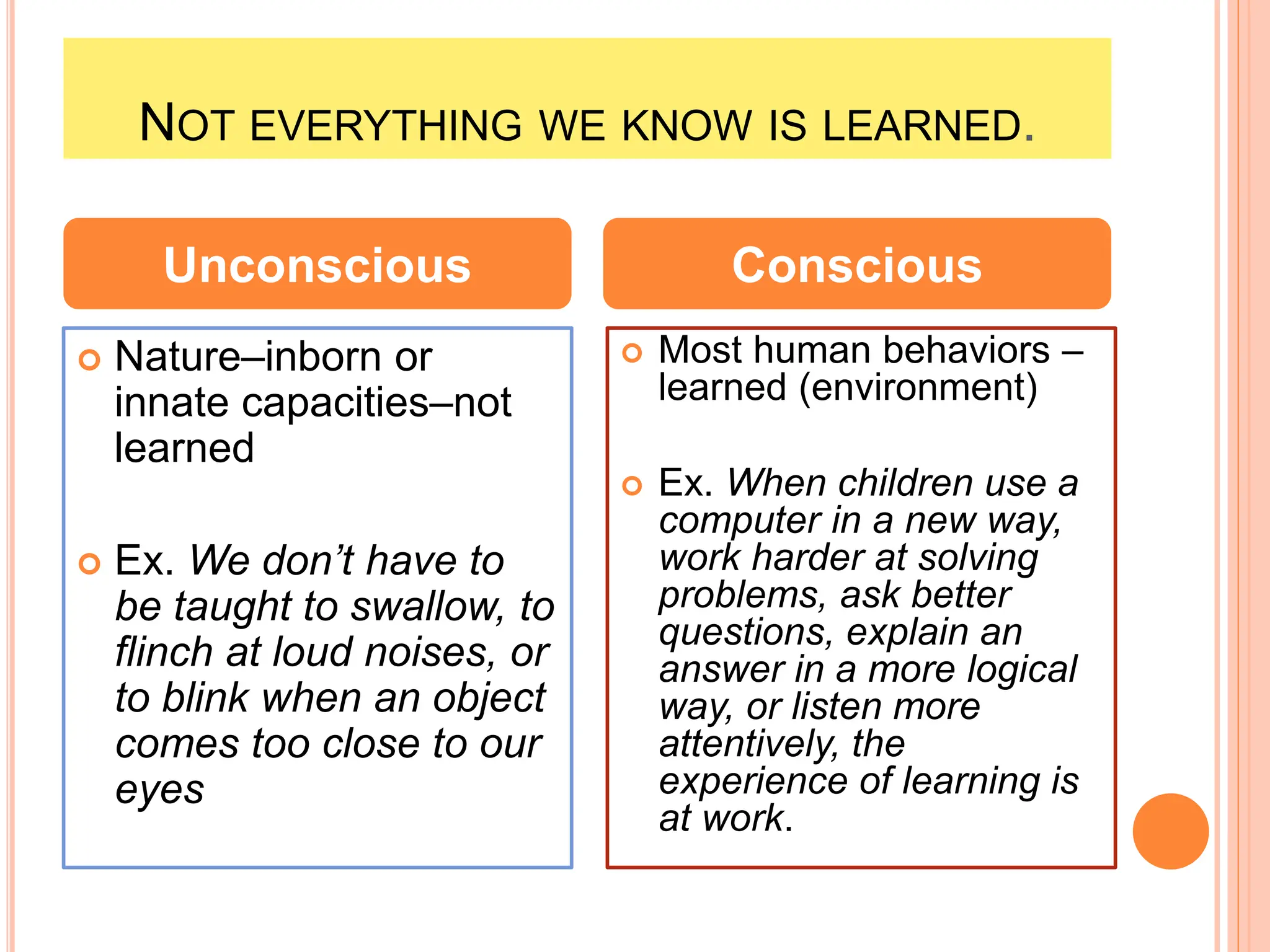
NOT EVERYTHING WE KNOW IS LEARNED.
 Nature–inborn or
innate capacities–not
learned
 Ex. We don’t have to
be taught to swallow, to
flinch at loud noises, or
to blink when an object
comes too close to our
eyes
 Most human behaviors –
learned (environment)
 Ex. When children use a
computer in a new way,
work harder at solving
problems, ask better
questions, explain an
answer in a more logical
way, or listen more
attentively, the
experience of learning is
at work.
Unconscious Conscious
 WHY STUDY LEARNING?
 If we had not been able to learn, we would have
died out as a species long ago.
 Learning is the process that allows us to adapt
to the changing conditions of the world around
us.
 We can alter our actions until we find the
behavior that leads us to survival and rewards,
and we can eliminate actions that have been
unsuccessful in the past.
 Without learning, there would be no buildings, no
agriculture, no lifesaving medicines, and no
human civilization.
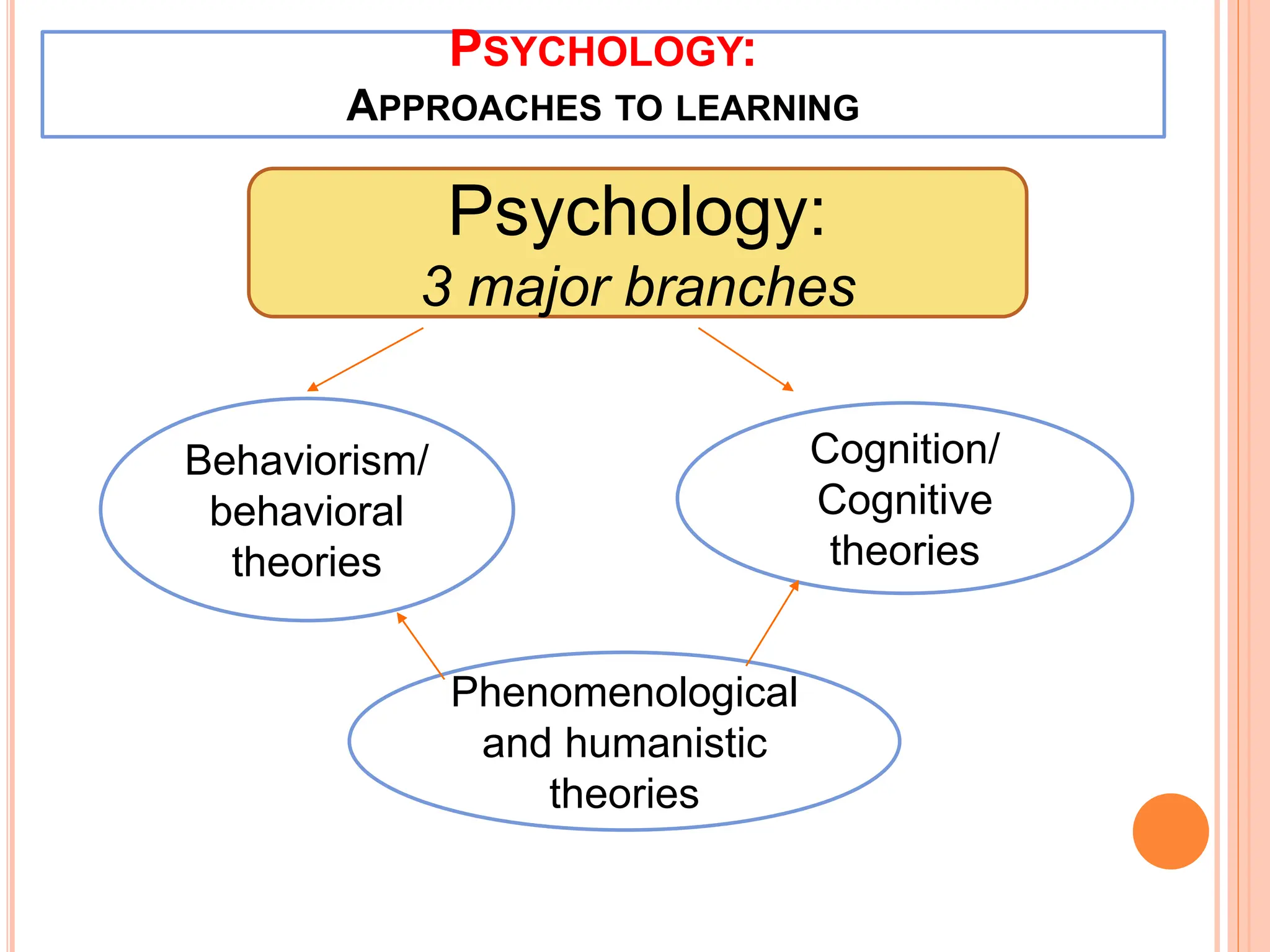
PSYCHOLOGY:
APPROACHES TO LEARNING
Psychology:
3 major branches
Behaviorism/
behavioral
theories
Cognition/
Cognitive
theories
Phenomenological
and humanistic
theories
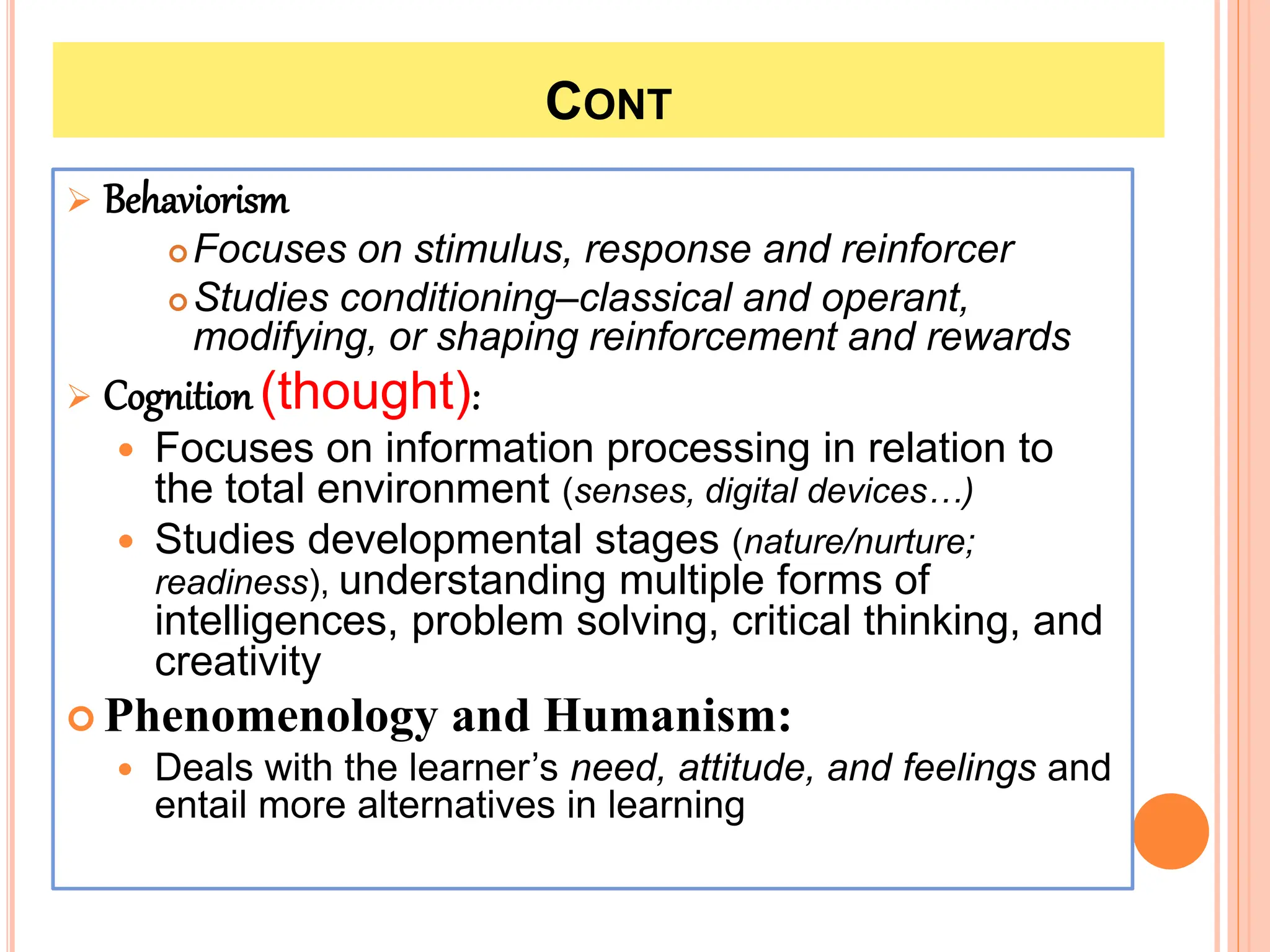
CONT
 Behaviorism
 Focuses on stimulus, response and reinforcer
 Studies conditioning–classical and operant,
modifying, or shaping reinforcement and rewards
 Cognition(thought):
 Focuses on information processing in relation to
the total environment (senses, digital devices…)
 Studies developmental stages (nature/nurture;
readiness), understanding multiple forms of
intelligences, problem solving, critical thinking, and
creativity
 Phenomenology and Humanism:
 Deals with the learner’s need, attitude, and feelings and
entail more alternatives in learning
1- BEHAVIORISM
 emphasize on experiences, especially
reinforcement and punishment, as determinants of
learning and behavior
view that behavior should be explained by
observable experiences, not by mental
processes.
 Mental processes–are defined as the
thoughts, feelings, and motives that each of us
experiences but that cannot be observed by
others.
CONT.
 Behavior–verbal and nonverbal–can be directly seen
or heard.
 Ex. a child creating a poster, a teacher explaining
something to a child, one student picking on
another student, and so on.
 associative learning, which consists of learning
that two events are connected or associated
(classical and operant conditioning)
 Ex. occurs when a student associates a pleasant
event with learning something in school, such as
the teacher smiling when the student asks a good
question.
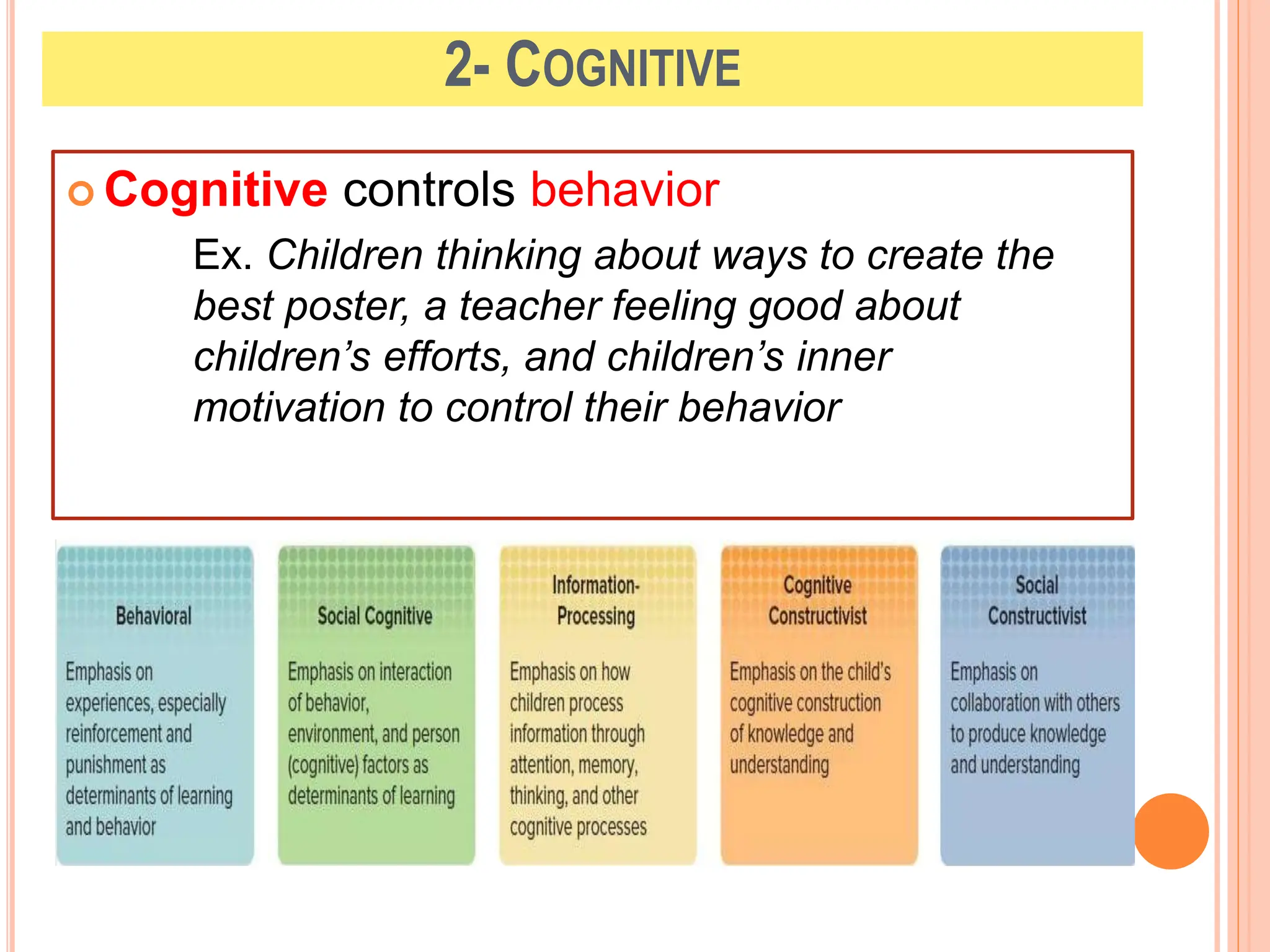
2- COGNITIVE
 Cognitive controls behavior
Ex. Children thinking about ways to create the
best poster, a teacher feeling good about
children’s efforts, and children’s inner
motivation to control their behavior
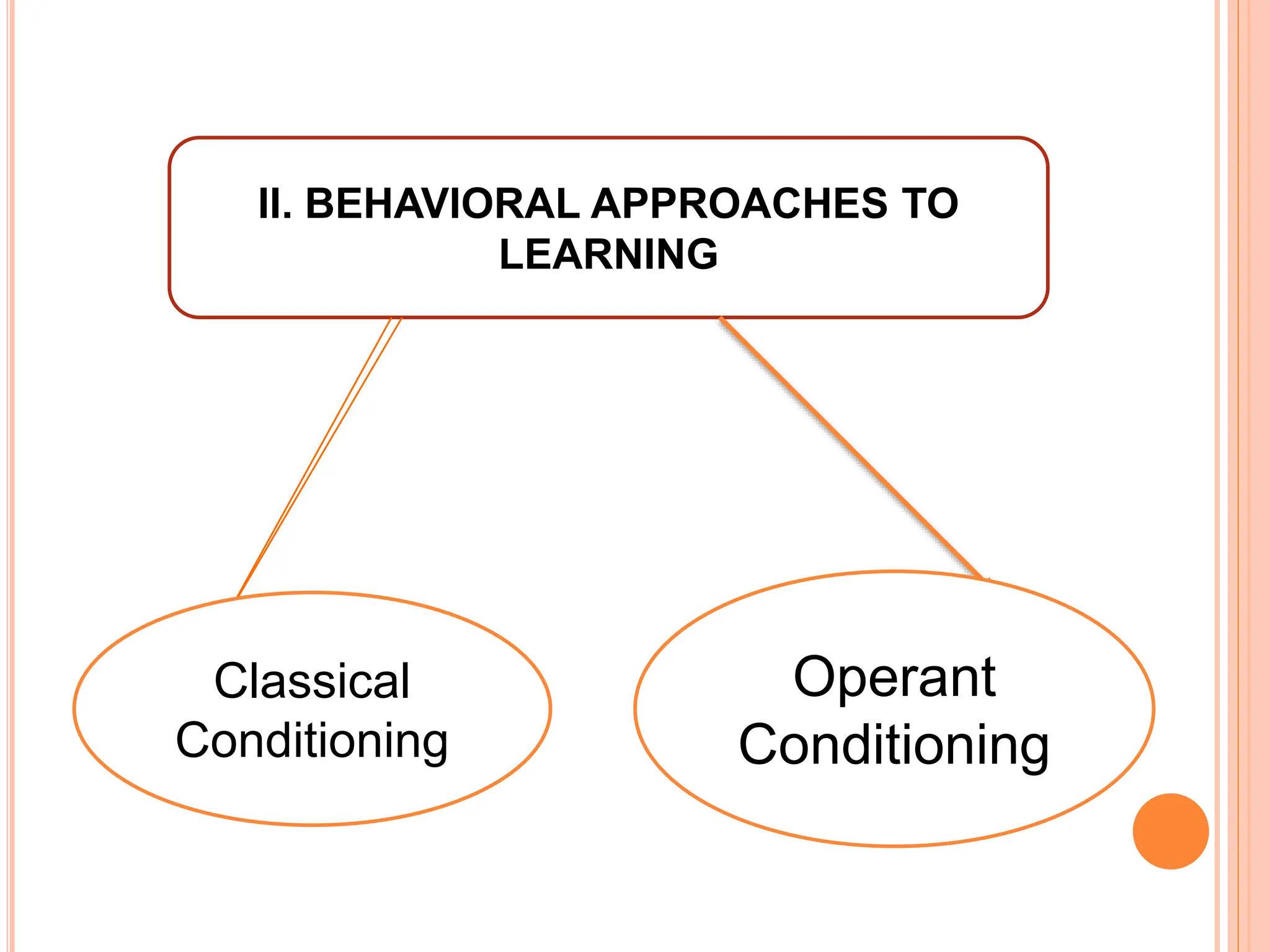
II. BEHAVIORAL APPROACHES TO
LEARNING
Classical
Conditioning
Operant
Conditioning
PREREQUISITE KEY TERMS
 A stimulus can be defined as any object,
event, or experience that causes
 Response refers to the reaction of an
organism
 neutral stimulus (NS) in classical
conditioning, a stimulus that has no effect
on the desired response prior to
conditioning.
II. A. CLASSICAL CONDITIONING
(IVAN PAVLOV, 1927)
 Two types of stimuli/response
 Unconditioned stimulus (UCS) is a stimulus that
automatically produces a response without any prior
learning.
 Unconditioned response (UCR) is an unlearned
response that is automatically elicited by the UCS.
 Two types of stimuli/response
 conditioned stimulus (CS)–is a previously neutral
stimulus that eventually elicits a conditioned
response after being associated with the UCS.
 conditioned response (CR)–is a learned response
to the conditioned stimulus that occurs after UCS-CS
pairing.
CONT
Classical conditioning:
 the organism learns to connect, or
associate, stimuli.
 a form of associative learning in which
a neutral stimulus becomes
associated with a meaningful stimulus
and acquires the capacity to elicit a
similar response
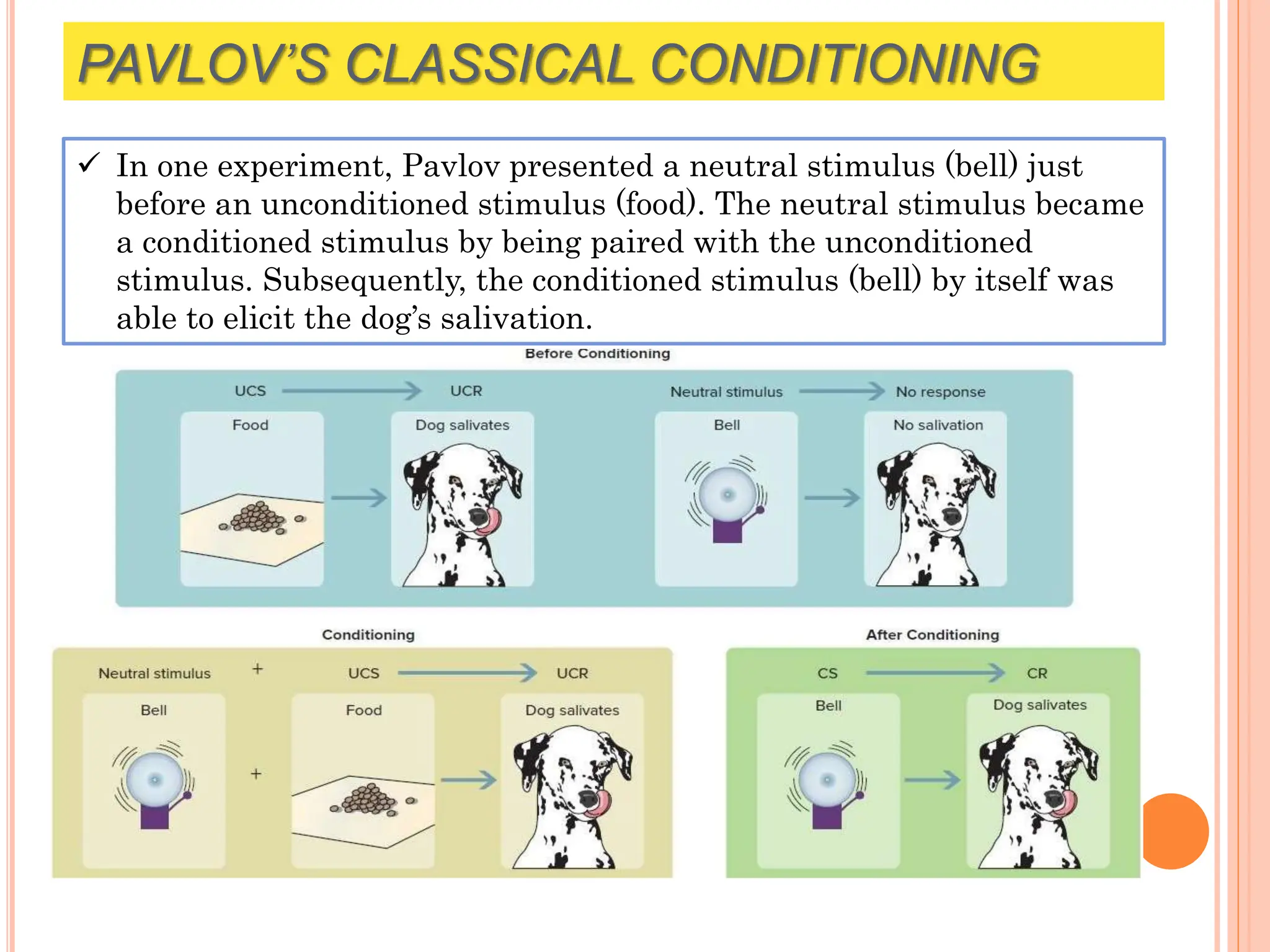
PAVLOV’S DOGS
 Ivan Palvov was the first to demonstrate
classical conditioning
 He is best know for his experiment with
salivating dog
 Dogs were trained to salivate at the sound of a
bell.
 Dogs naturally salivated with food (UCR)
 A bell (NS) was run every time the dogs were fed
over a period of time creating the
association/connection of the bell with food
 After time, the dogs salivated at the sound of the
bell alone
PAVLOV’S CLASSICAL CONDITIONING
 In one experiment, Pavlov presented a neutral stimulus (bell) just
before an unconditioned stimulus (food). The neutral stimulus became
a conditioned stimulus by being paired with the unconditioned
stimulus. Subsequently, the conditioned stimulus (bell) by itself was
able to elicit the dog’s salivation.
CONT.
 In classroom: Classical conditioning:
 Positive experiences–a favorite song and feelings
that the classroom is a safe and fun place to be
 Ex. a song–neutral stimulus–until the child joins in
with other classmates to sing it with accompanying
positive feelings.
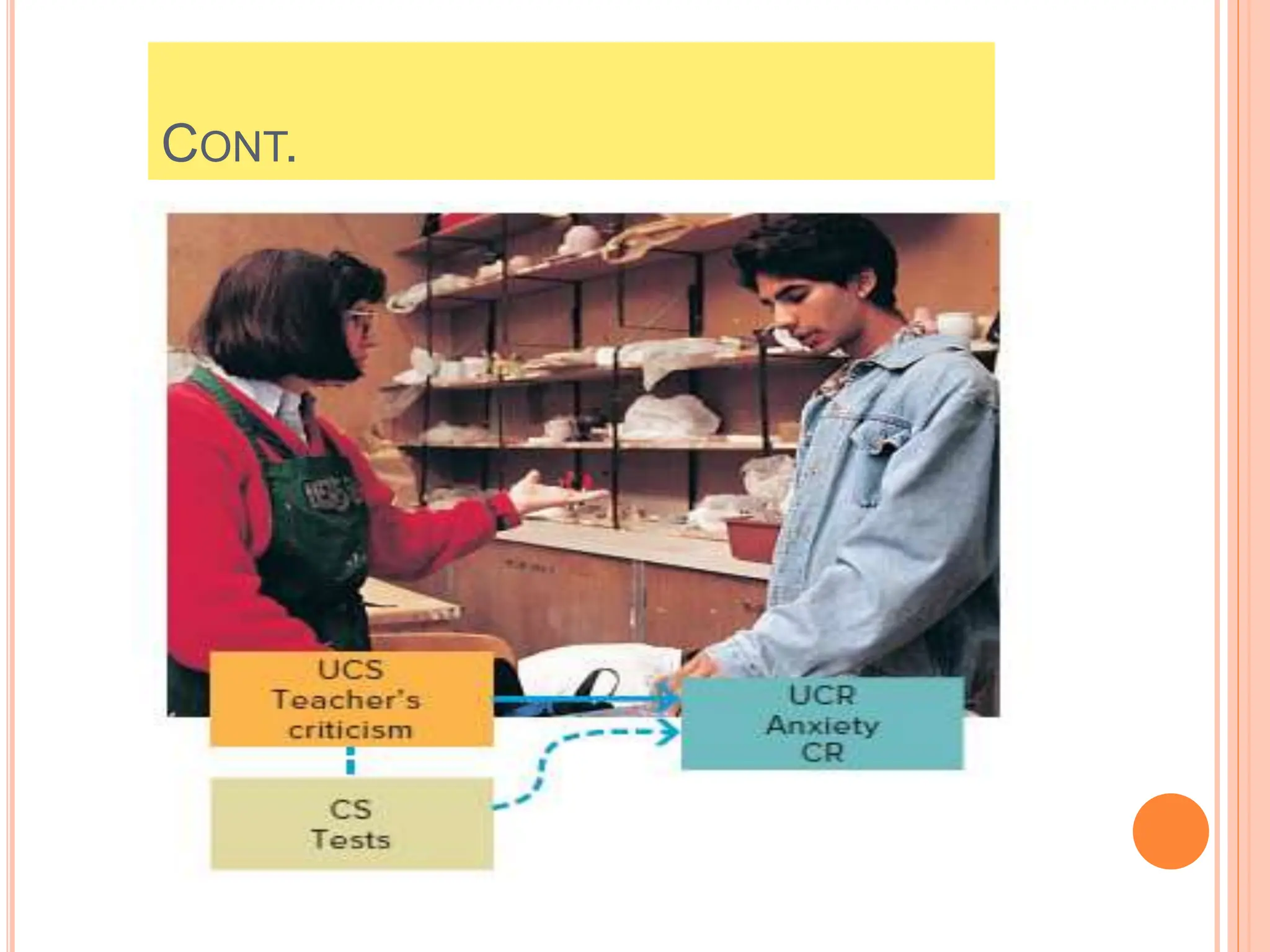
 negative experiences–criticism > fear (=test anxiety)
 Ex. a child fails and is criticized, which produces
anxiety; thereafter, the child associates tests with
anxiety, so they then can become a CS for anxiety
CONT.
CLASSICAL CONDITIONING PRINCIPLES
 Generalization:
 tendency of a new stimulus similar to the original
conditioned stimulus to produce a similar response
 Discrimination:
 occurs when the organism responds to certain stimuli
but not others.
 Extinction:
 involves the weakening of the conditioned response (CR)
in the absence of the unconditioned stimulus (UCS).
 Systematic desensitization:
 is a method based on classical conditioning that:
reduces anxiety by getting the individual to associate
deep relaxation with successive visualizations of
increasingly anxiety-provoking situations.
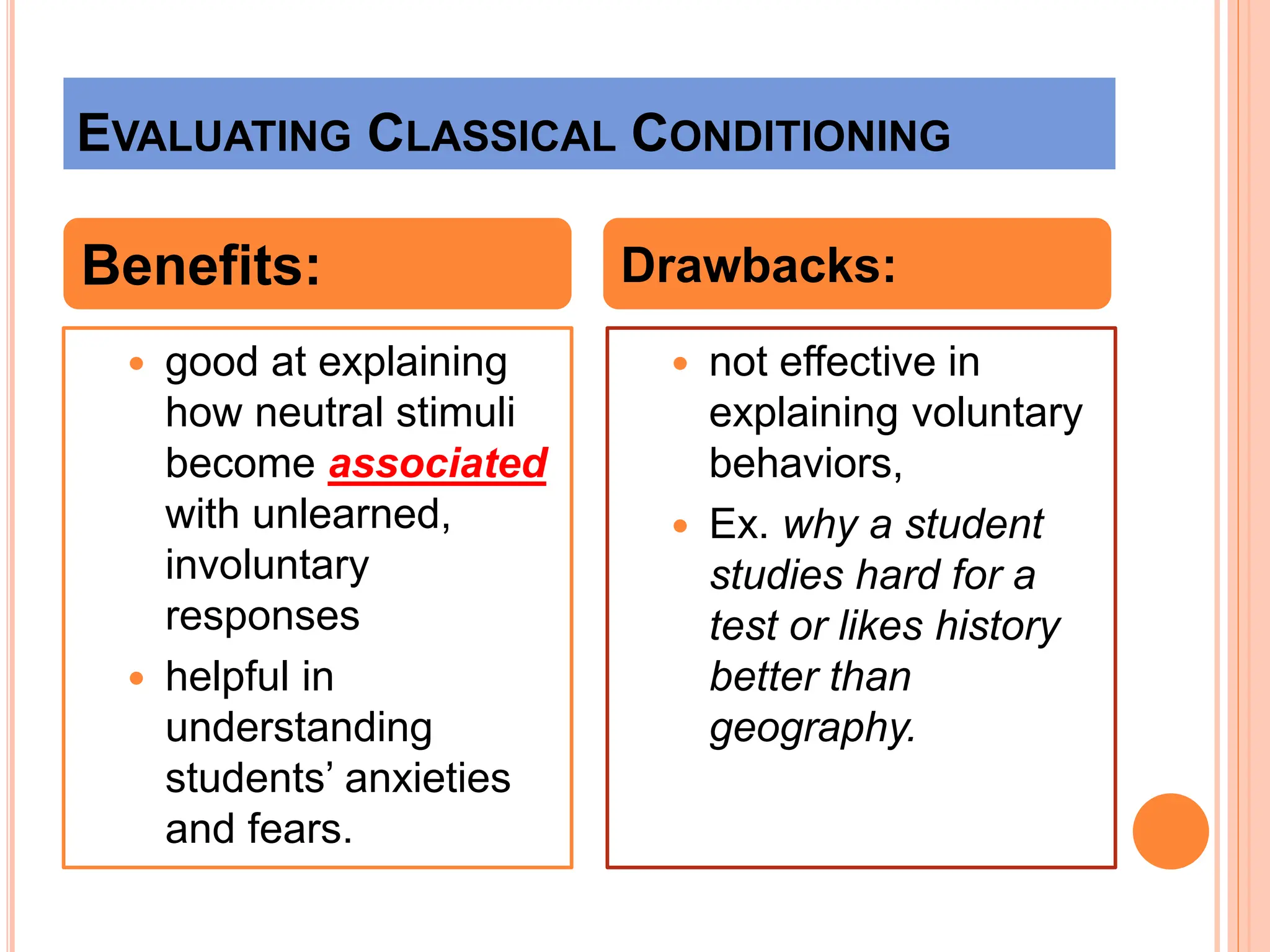
EVALUATING CLASSICAL CONDITIONING
 good at explaining
how neutral stimuli
become associated
with unlearned,
involuntary
responses
 helpful in
understanding
students’ anxieties
and fears.
 not effective in
explaining voluntary
behaviors,
 Ex. why a student
studies hard for a
test or likes history
better than
geography.
Benefits: Drawbacks:
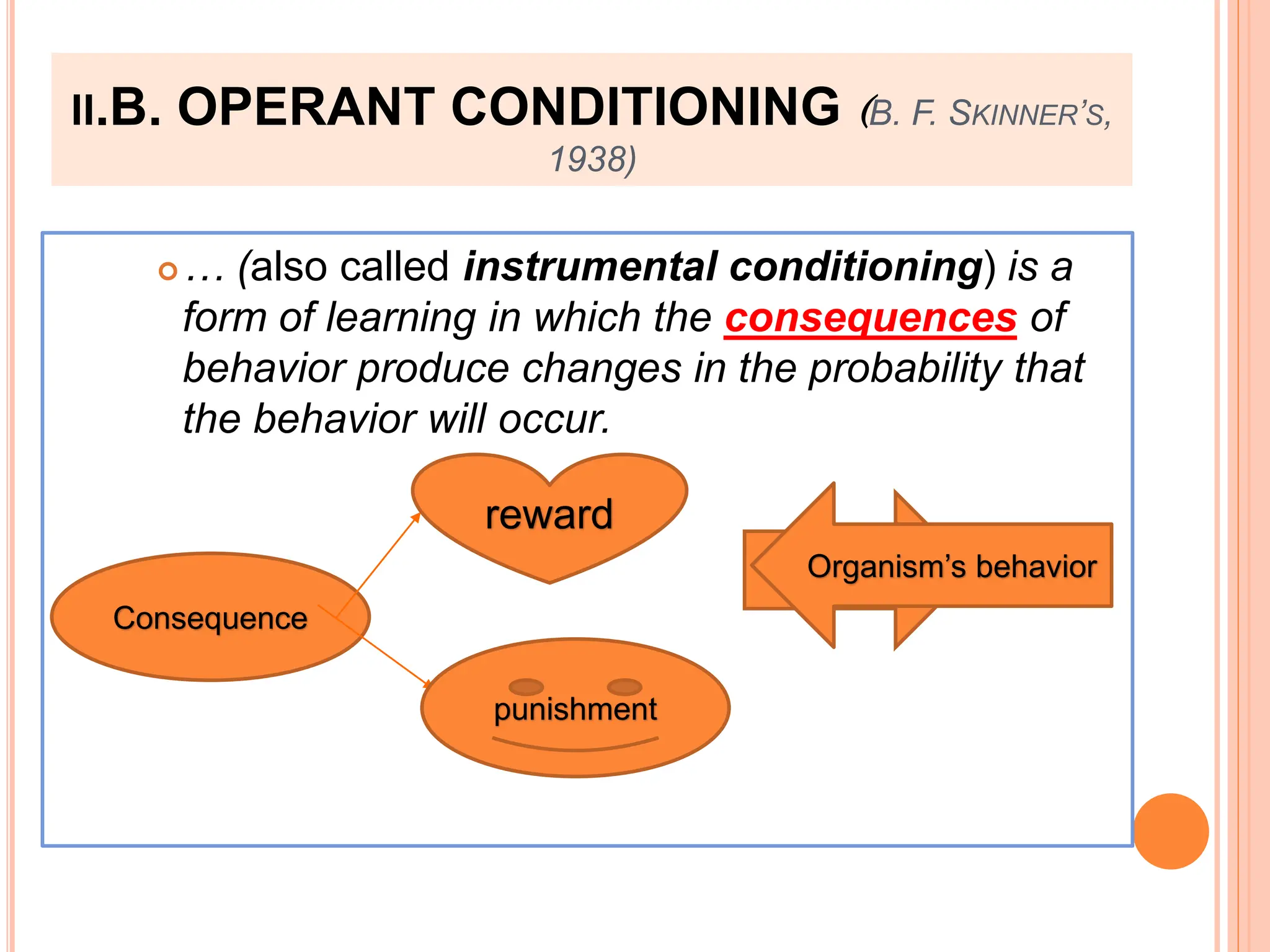
II.B. OPERANT CONDITIONING (B. F. SKINNER’S,
1938)
… (also called instrumental conditioning) is a
form of learning in which the consequences of
behavior produce changes in the probability that
the behavior will occur.
Consequence
punishment
reward
Behavior
Organism’s behavior
CONT
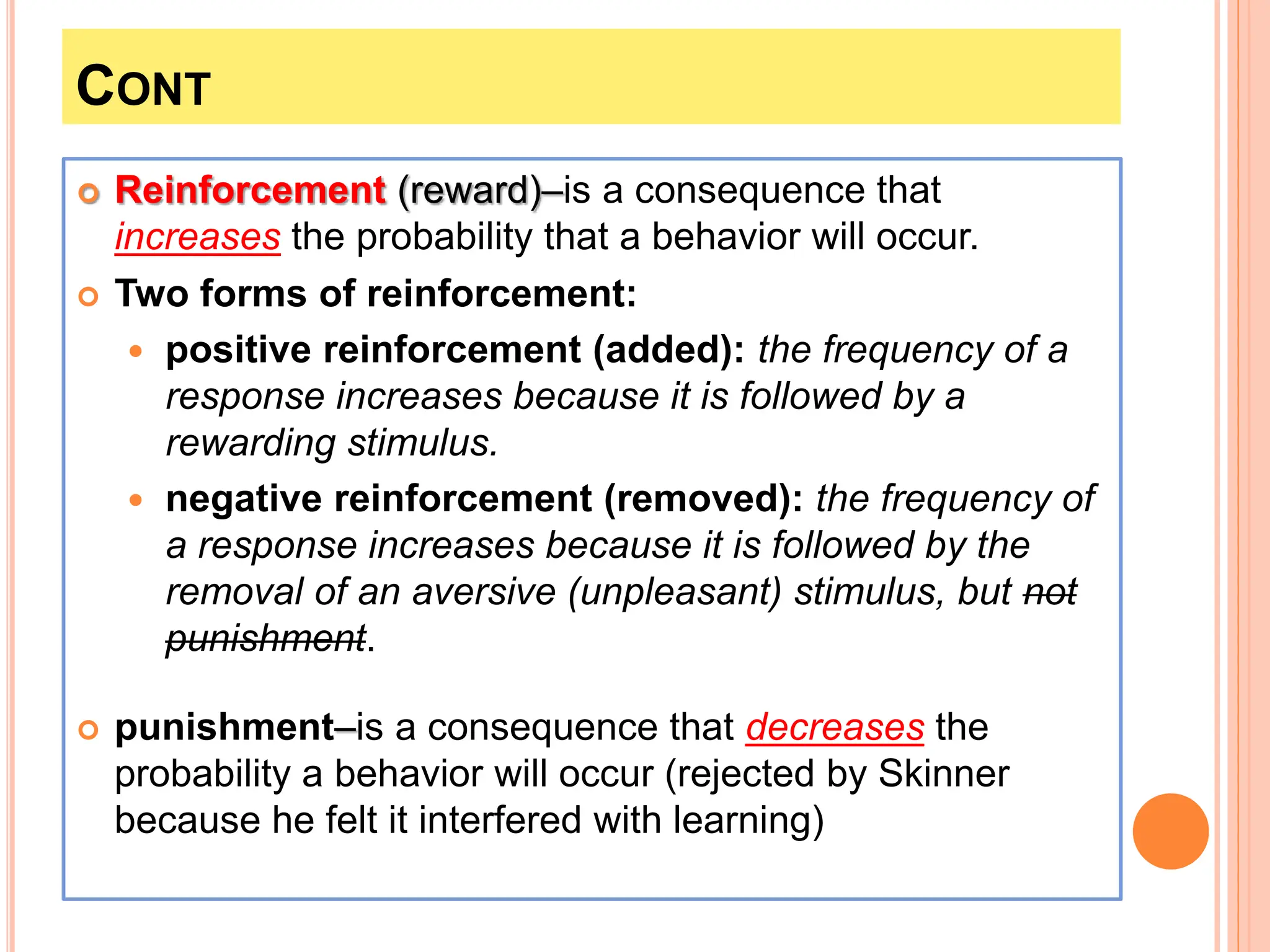
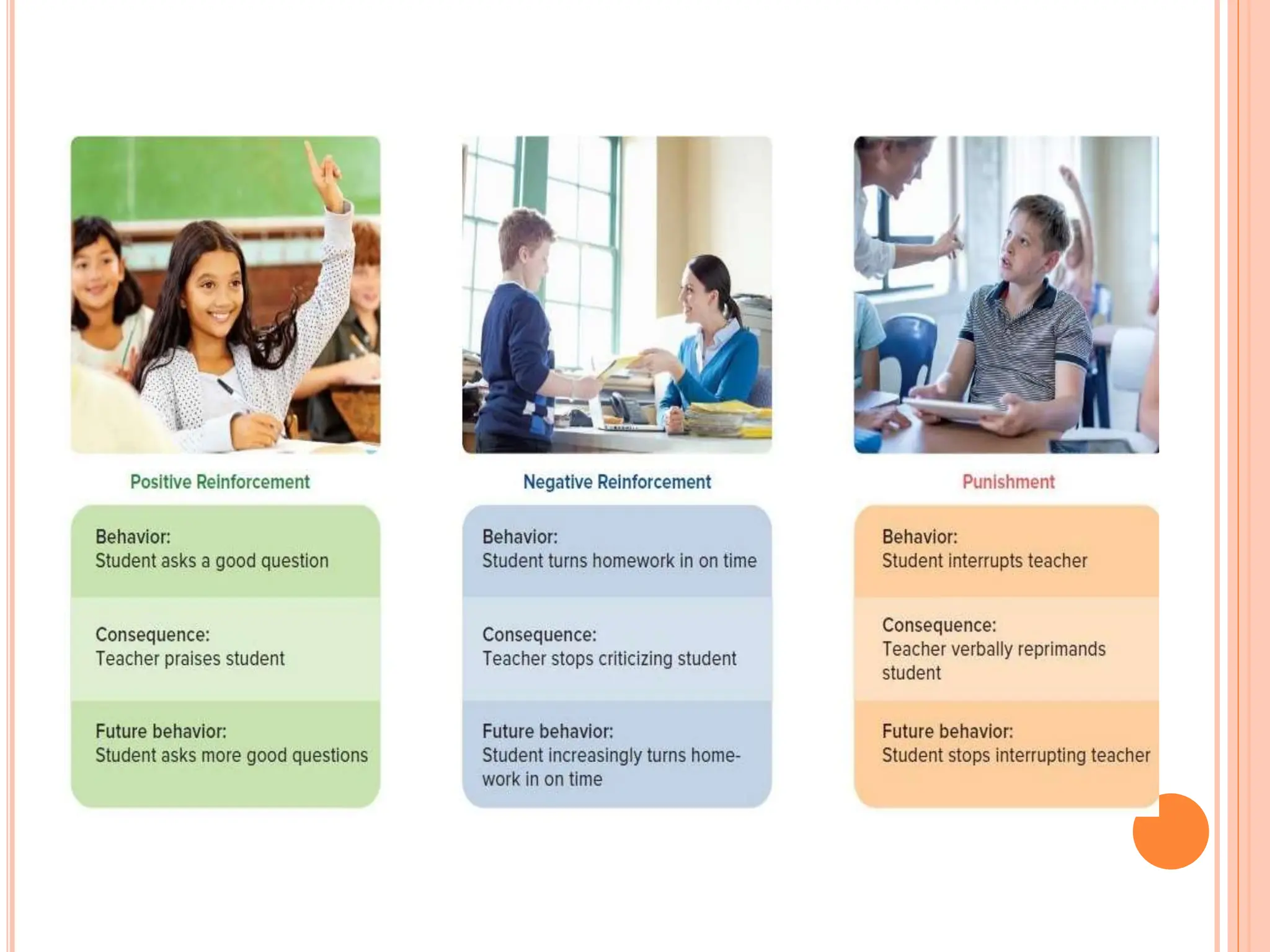
 Reinforcement (reward)–is a consequence that
increases the probability that a behavior will occur.
 Two forms of reinforcement:
 positive reinforcement (added): the frequency of a
response increases because it is followed by a
rewarding stimulus.
 negative reinforcement (removed): the frequency of
a response increases because it is followed by the
removal of an aversive (unpleasant) stimulus, but not
punishment.
 punishment–is a consequence that decreases the
probability a behavior will occur (rejected by Skinner
because he felt it interfered with learning)
CONT
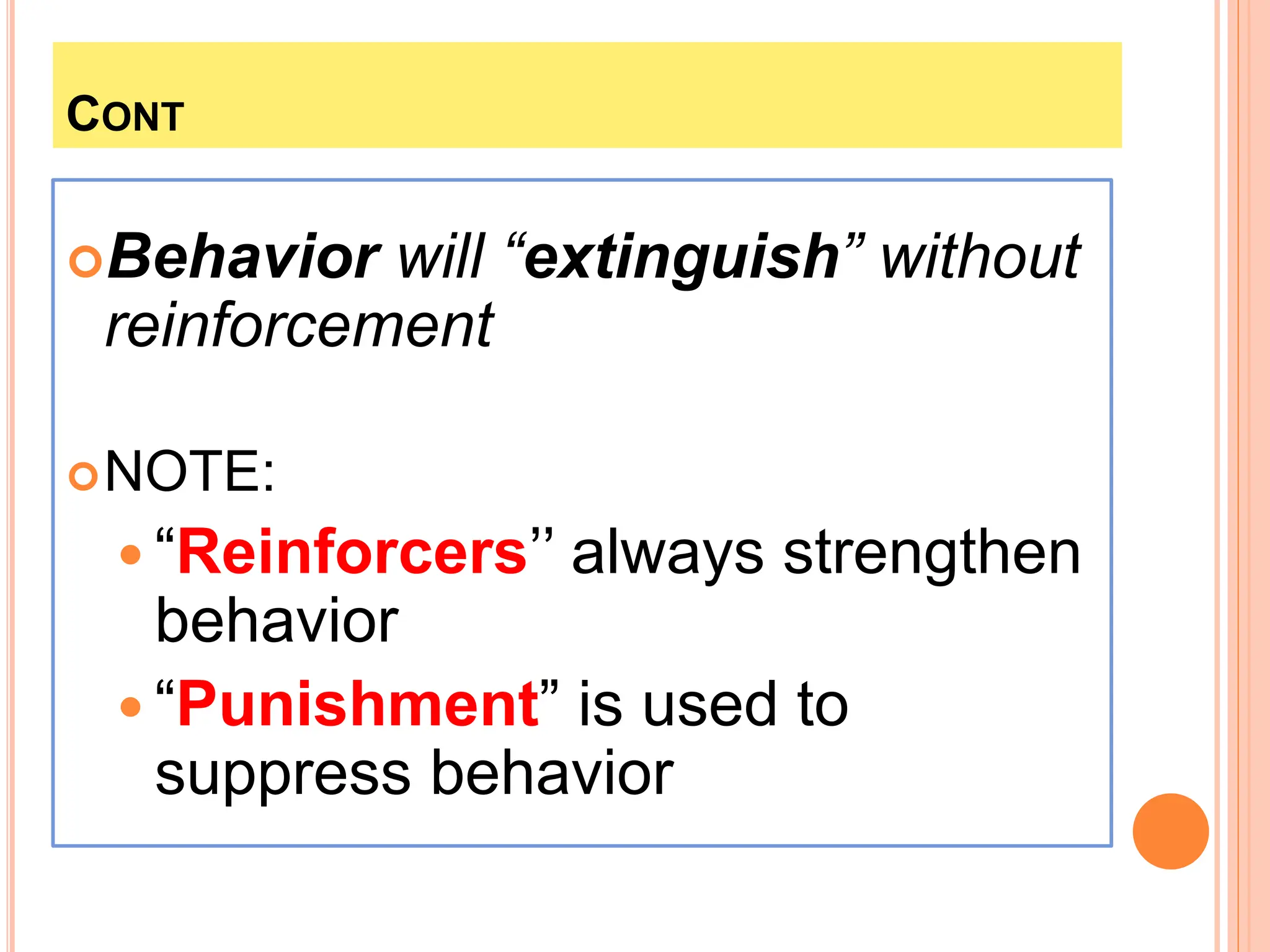
Behavior will “extinguish” without
reinforcement
NOTE:
 “Reinforcers’’ always strengthen
behavior
 “Punishment” is used to
suppress behavior
OPERANT CONDITIONING
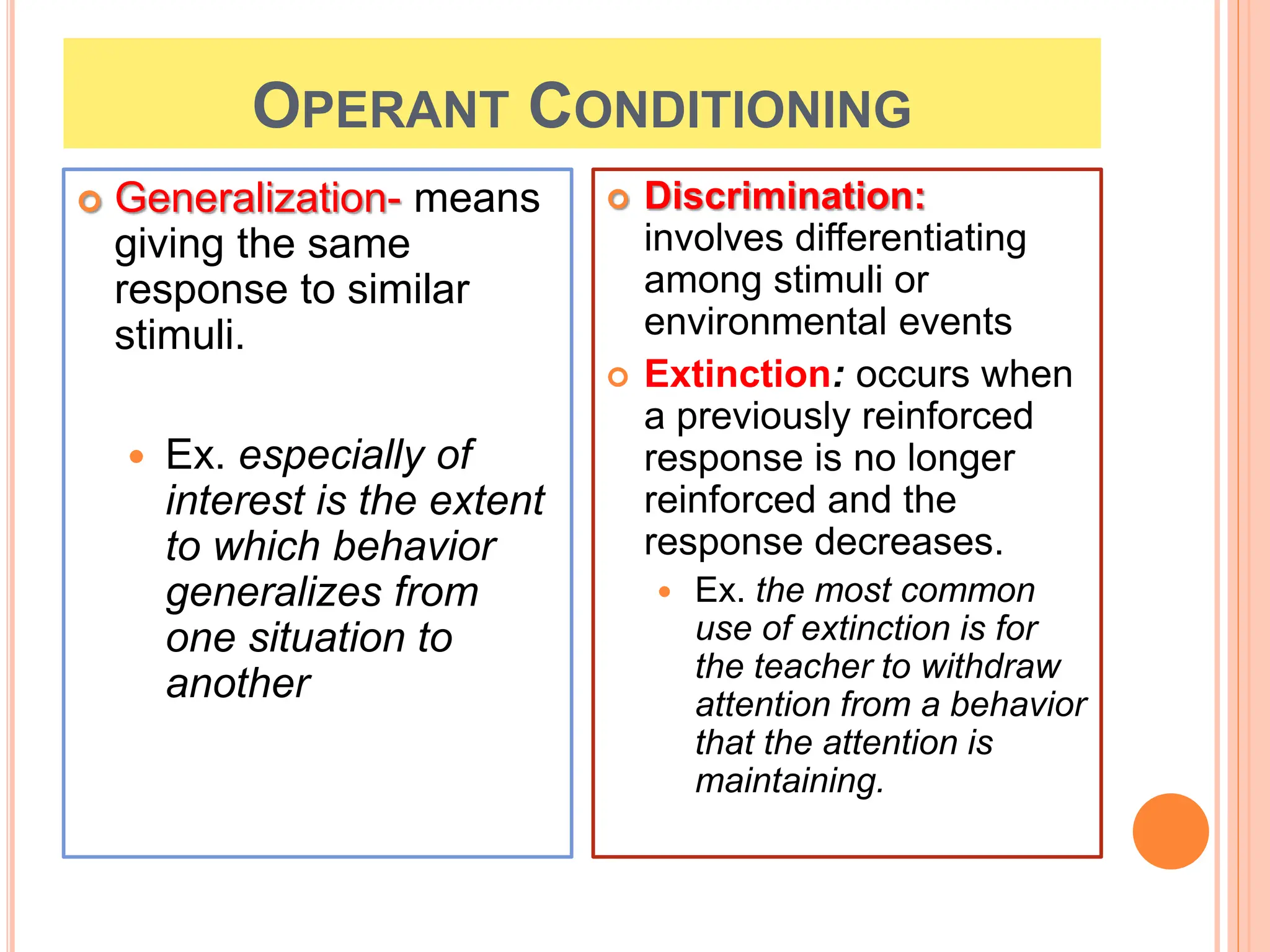
 Generalization- means
giving the same
response to similar
stimuli.
 Ex. especially of
interest is the extent
to which behavior
generalizes from
one situation to
another
 Discrimination:
involves differentiating
among stimuli or
environmental events
 Extinction: occurs when
a previously reinforced
response is no longer
reinforced and the
response decreases.
 Ex. the most common
use of extinction is for
the teacher to withdraw
attention from a behavior
that the attention is
maintaining.
APPLIED BEHAVIOR ANALYSIS IN EDUCATION
 Applied behavior analysis: involves applying the
principles of operant conditioning to change human
behavior.
 Three are especially important in education:
 Applications of applied behavior analysis often use a series
of steps (i.e. general observation > target behavior
determination & antecedent conditions)
 (1) increasing desirable behavior,
 (2) using prompts and shaping, and
 (3) decreasing undesirable behavior
 Applications of ABA often use a series of steps:
 general observation > target behavior determination & observe its
antecedent conditions)
INCREASING DESIRABLE
BEHAVIORS
Six operant conditioning
strategies–increase a child’s
desirable behaviors:
(1) choose effective reinforcers;
(2) make reinforcers contingent and timely;
(3) select the best schedule of reinforcement;
(4) consider contracting;
(5) use negative reinforcement effectively; and
(6) use prompts and shaping.
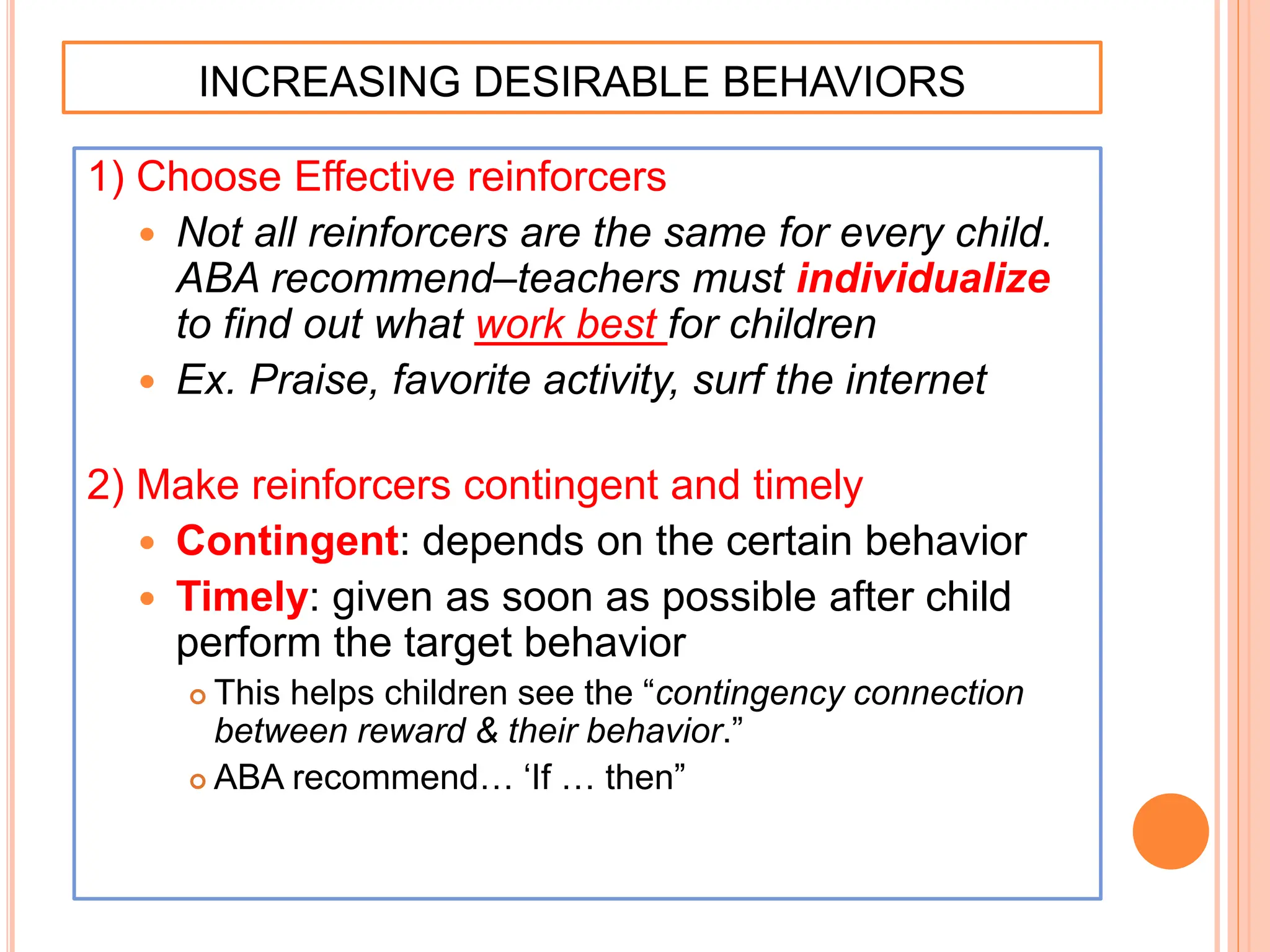
INCREASING DESIRABLE BEHAVIORS
1) Choose Effective reinforcers
 Not all reinforcers are the same for every child.
ABA recommend–teachers must individualize
to find out what work best for children
 Ex. Praise, favorite activity, surf the internet
2) Make reinforcers contingent and timely
 Contingent: depends on the certain behavior
 Timely: given as soon as possible after child
perform the target behavior
 This helps children see the “contingency connection
between reward & their behavior.”
 ABA recommend… ‘If … then”
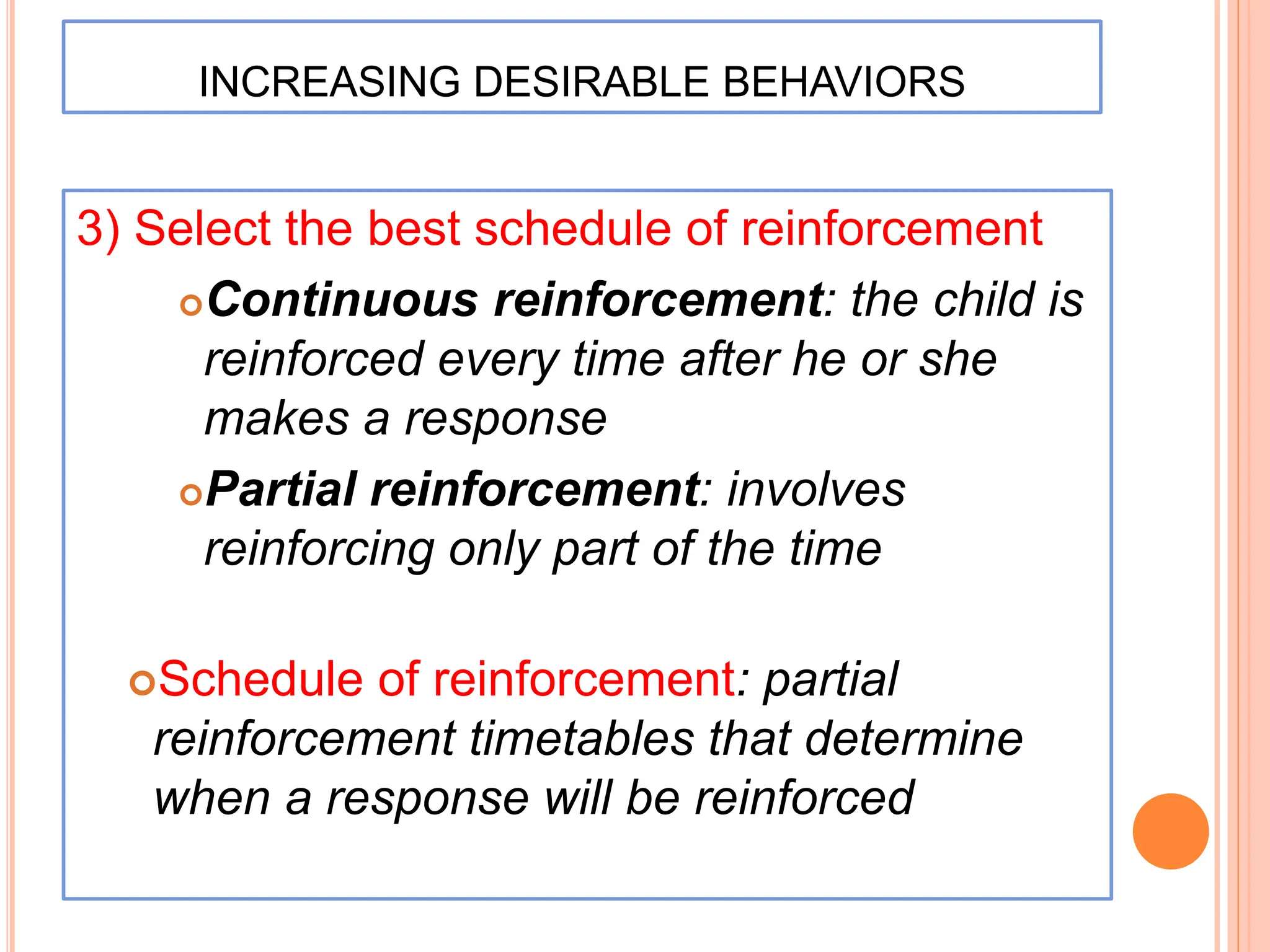
INCREASING DESIRABLE BEHAVIORS
3) Select the best schedule of reinforcement
Continuous reinforcement: the child is
reinforced every time after he or she
makes a response
Partial reinforcement: involves
reinforcing only part of the time
Schedule of reinforcement: partial
reinforcement timetables that determine
when a response will be reinforced
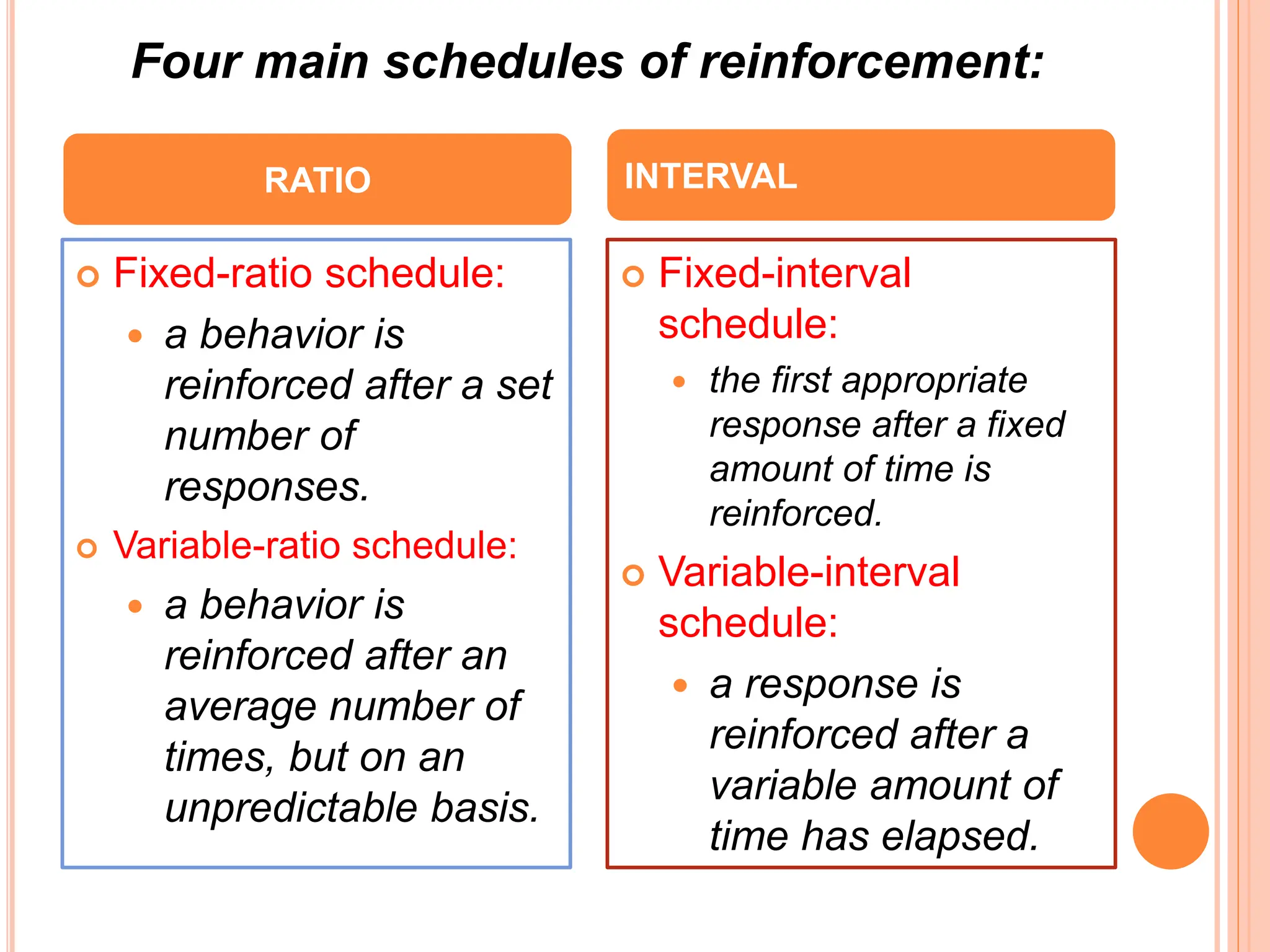
Four main schedules of reinforcement:
 Fixed-ratio schedule:
 a behavior is
reinforced after a set
number of
responses.
 Variable-ratio schedule:
 a behavior is
reinforced after an
average number of
times, but on an
unpredictable basis.
 Fixed-interval
schedule:
 the first appropriate
response after a fixed
amount of time is
reinforced.
 Variable-interval
schedule:
 a response is
reinforced after a
variable amount of
time has elapsed.
RATIO INTERVAL
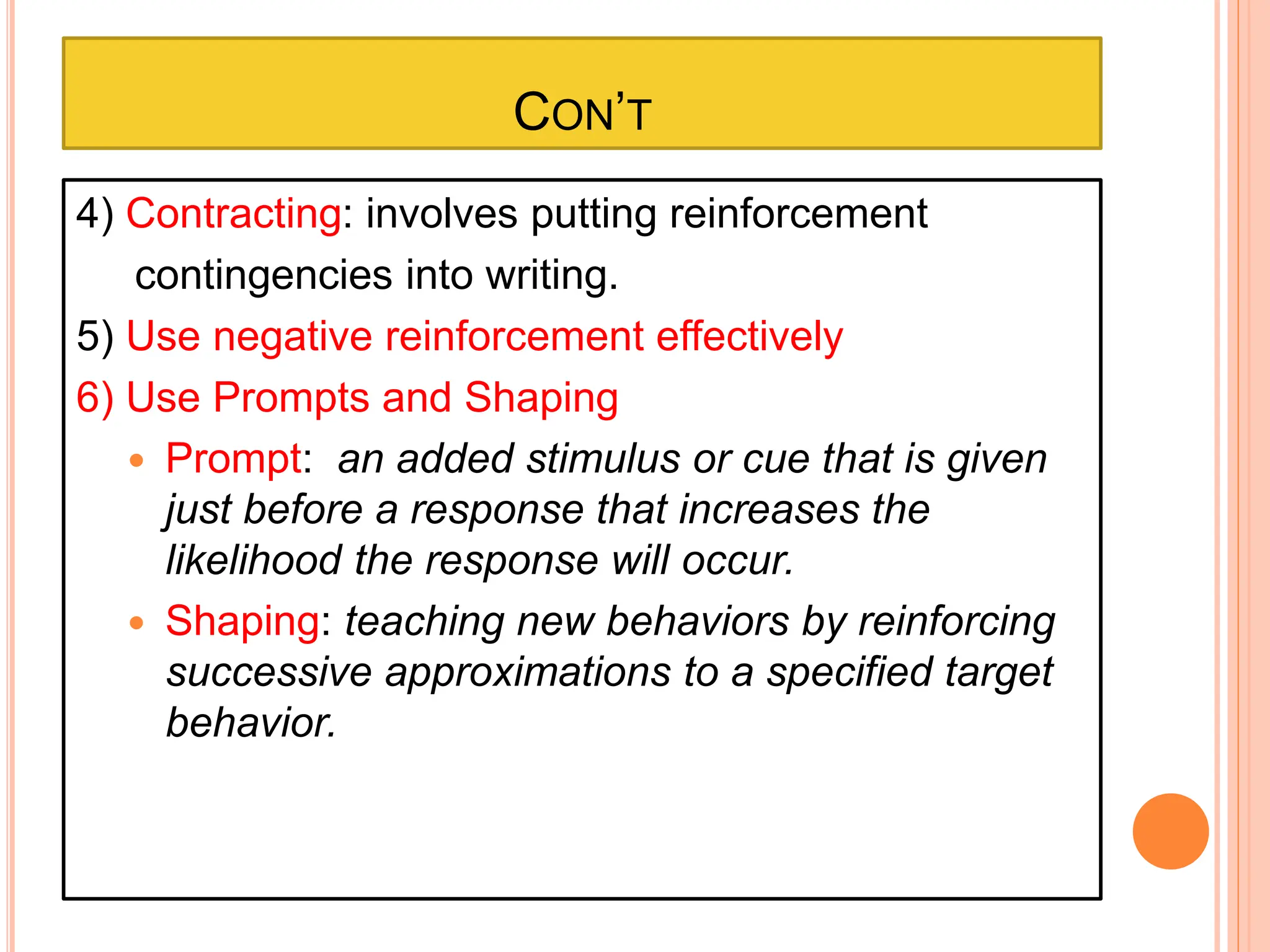
CON’T
4) Contracting: involves putting reinforcement
contingencies into writing.
5) Use negative reinforcement effectively
6) Use Prompts and Shaping
 Prompt: an added stimulus or cue that is given
just before a response that increases the
likelihood the response will occur.
 Shaping: teaching new behaviors by reinforcing
successive approximations to a specified target
behavior.
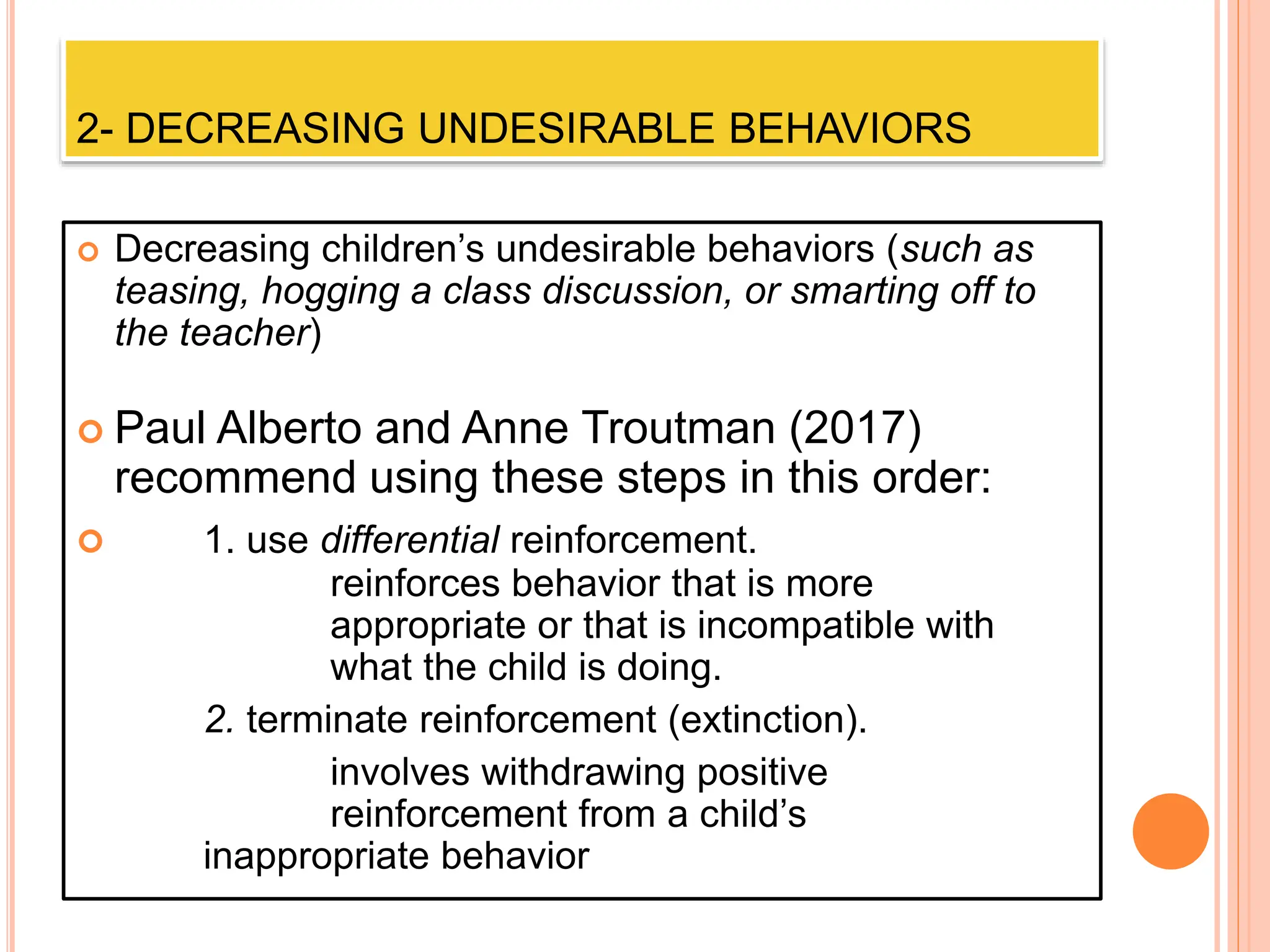
2- DECREASING UNDESIRABLE BEHAVIORS
 Decreasing children’s undesirable behaviors (such as
teasing, hogging a class discussion, or smarting off to
the teacher)
 Paul Alberto and Anne Troutman (2017)
recommend using these steps in this order:
 1. use differential reinforcement.
reinforces behavior that is more
appropriate or that is incompatible with
what the child is doing.
2. terminate reinforcement (extinction).
involves withdrawing positive
reinforcement from a child’s
inappropriate behavior
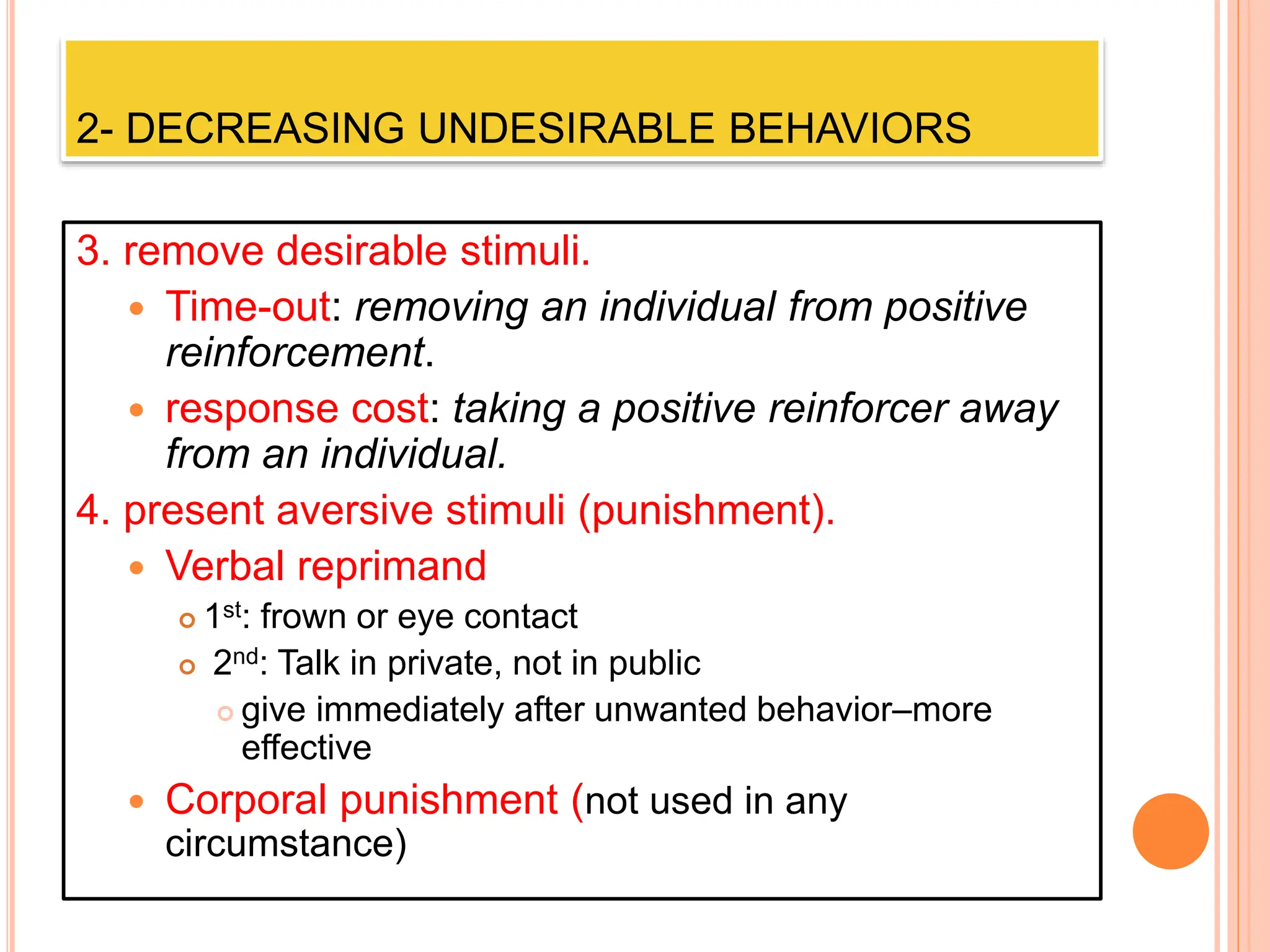
2- DECREASING UNDESIRABLE BEHAVIORS
3. remove desirable stimuli.
 Time-out: removing an individual from positive
reinforcement.
 response cost: taking a positive reinforcer away
from an individual.
4. present aversive stimuli (punishment).
 Verbal reprimand
 1st: frown or eye contact
 2nd: Talk in private, not in public
 give immediately after unwanted behavior–more
effective
 Corporal punishment (not used in any
circumstance)
EVALUATING OPERANT CONDITIONING AND
APPLIED BEHAVIOR ANALYSIS-CONTRIBUTION TO
EDUCATION
 Disadvantages:
 Reinforcing and punishing consequences are
part of teachers’ and students’ lives. Teachers
give grades, praise and reprimand, smile and
frown.
 Learning about how such consequences affect
students’ behavior improves your capabilities as
a teacher.
 Used effectively, behavioral techniques can help
you manage your classroom.
EVALUATING OPERANT CONDITIONING AND ABA-
CONTRIBUTION TO EDUCATION
 Advantages:
 ABA still places too much emphasis on external
control of students’ behavior
 not the reward or punishment that changes
behavior but, rather, the belief or expectation that
certain actions will be rewarded or punished
 not give adequate attention to cognitive processes
involved in learning
EVALUATING OPERANT CONDITIONING AND
APPLIED BEHAVIOR ANALYSIS
 Anyway, critics of operant conditioning and applied
behavior analysis argue that the whole approach
places too much emphasis on external control of
students’ behavior—a better strategy is to help
students learn to control their own behavior and
become internally motivated.
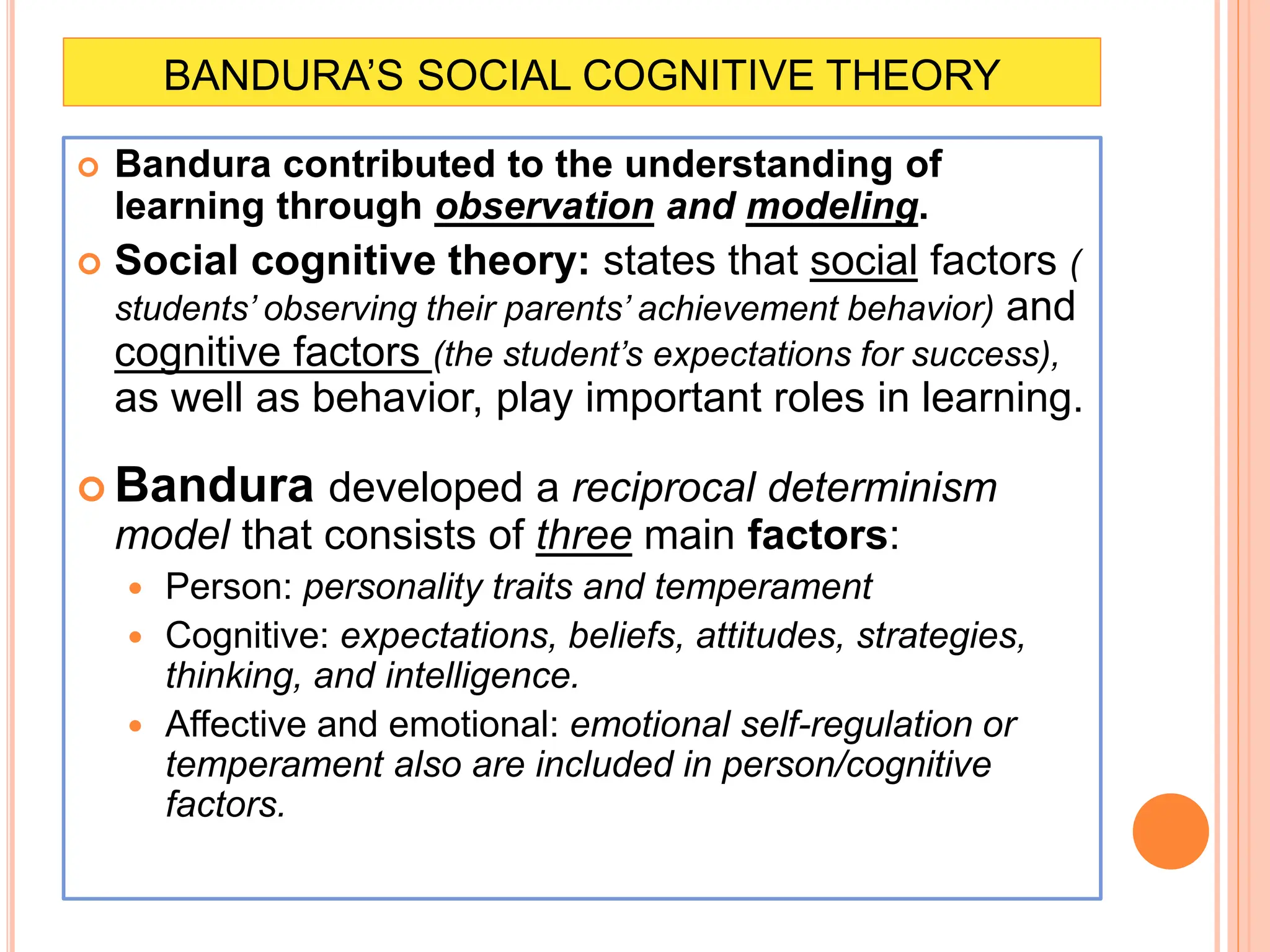
BANDURA’S SOCIAL COGNITIVE THEORY
 Bandura contributed to the understanding of
learning through observation and modeling.
 Social cognitive theory: states that social factors (
students’ observing their parents’ achievement behavior) and
cognitive factors (the student’s expectations for success),
as well as behavior, play important roles in learning.
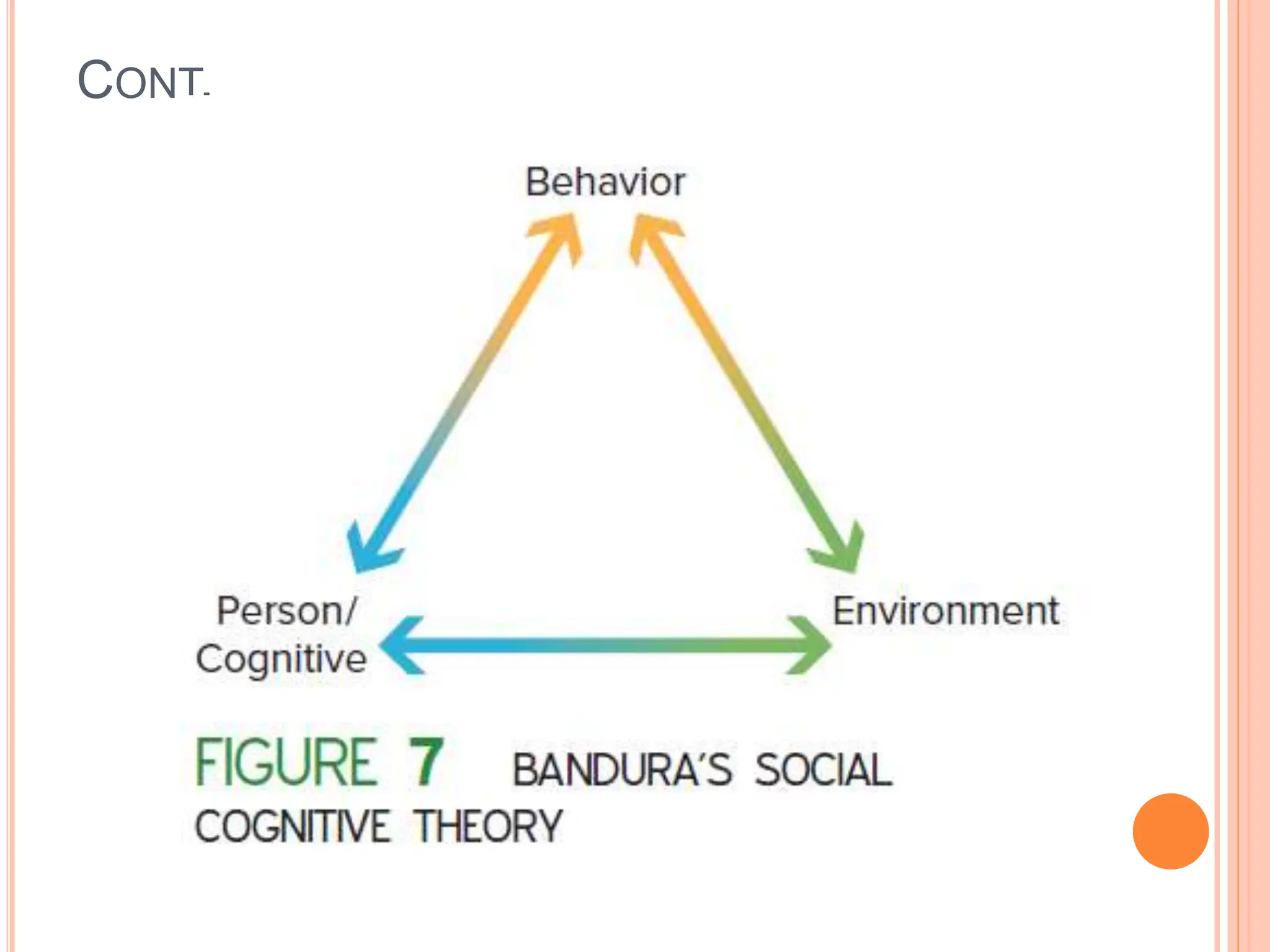
 Bandura developed a reciprocal determinism
model that consists of three main factors:
 Person: personality traits and temperament
 Cognitive: expectations, beliefs, attitudes, strategies,
thinking, and intelligence.
 Affective and emotional: emotional self-regulation or
temperament also are included in person/cognitive
factors.
CONT.
CONT.
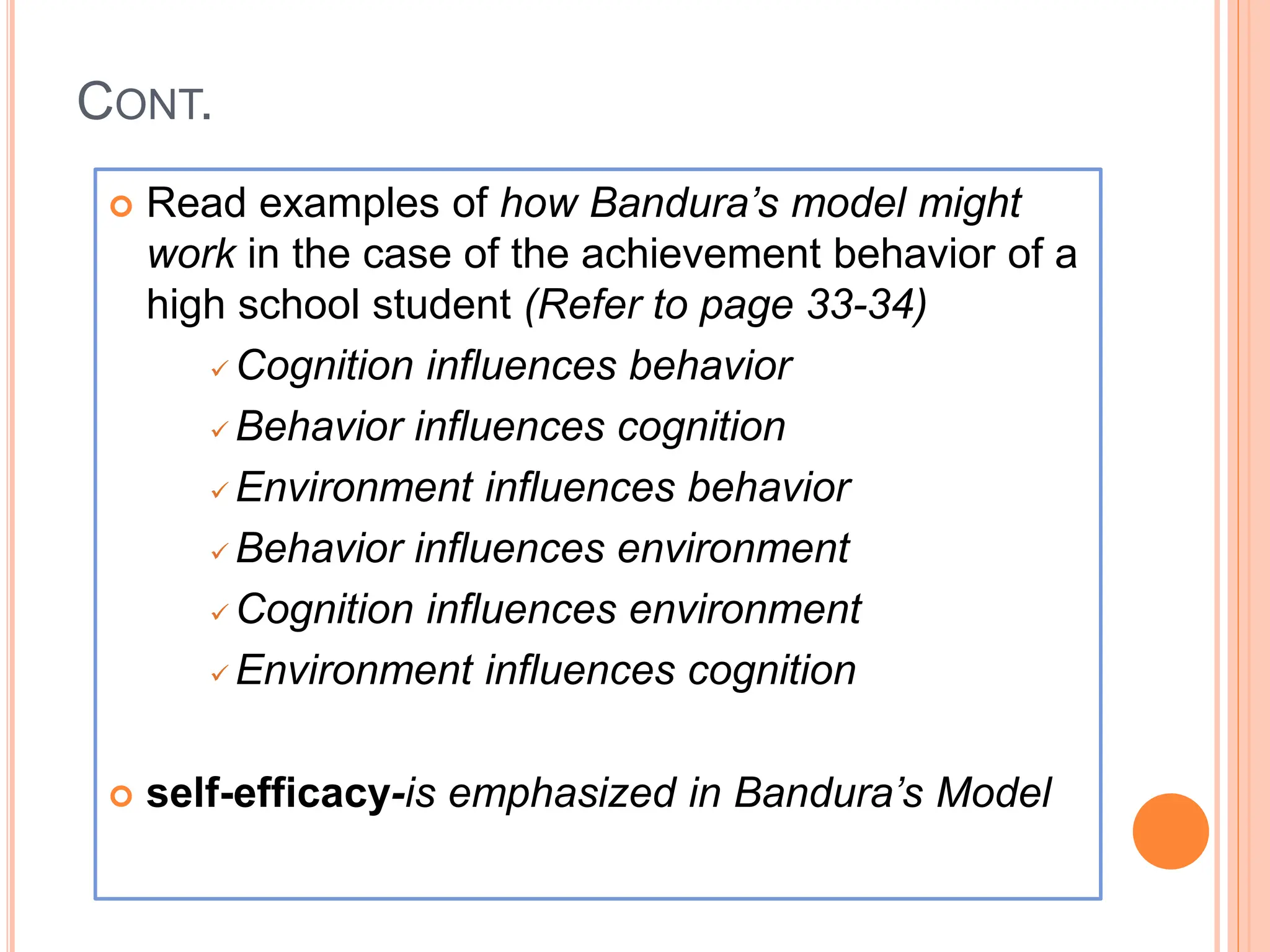
 Read examples of how Bandura’s model might
work in the case of the achievement behavior of a
high school student (Refer to page 33-34)
 Cognition influences behavior
 Behavior influences cognition
 Environment influences behavior
 Behavior influences environment
 Cognition influences environment
 Environment influences cognition
 self-efficacy-is emphasized in Bandura’s Model
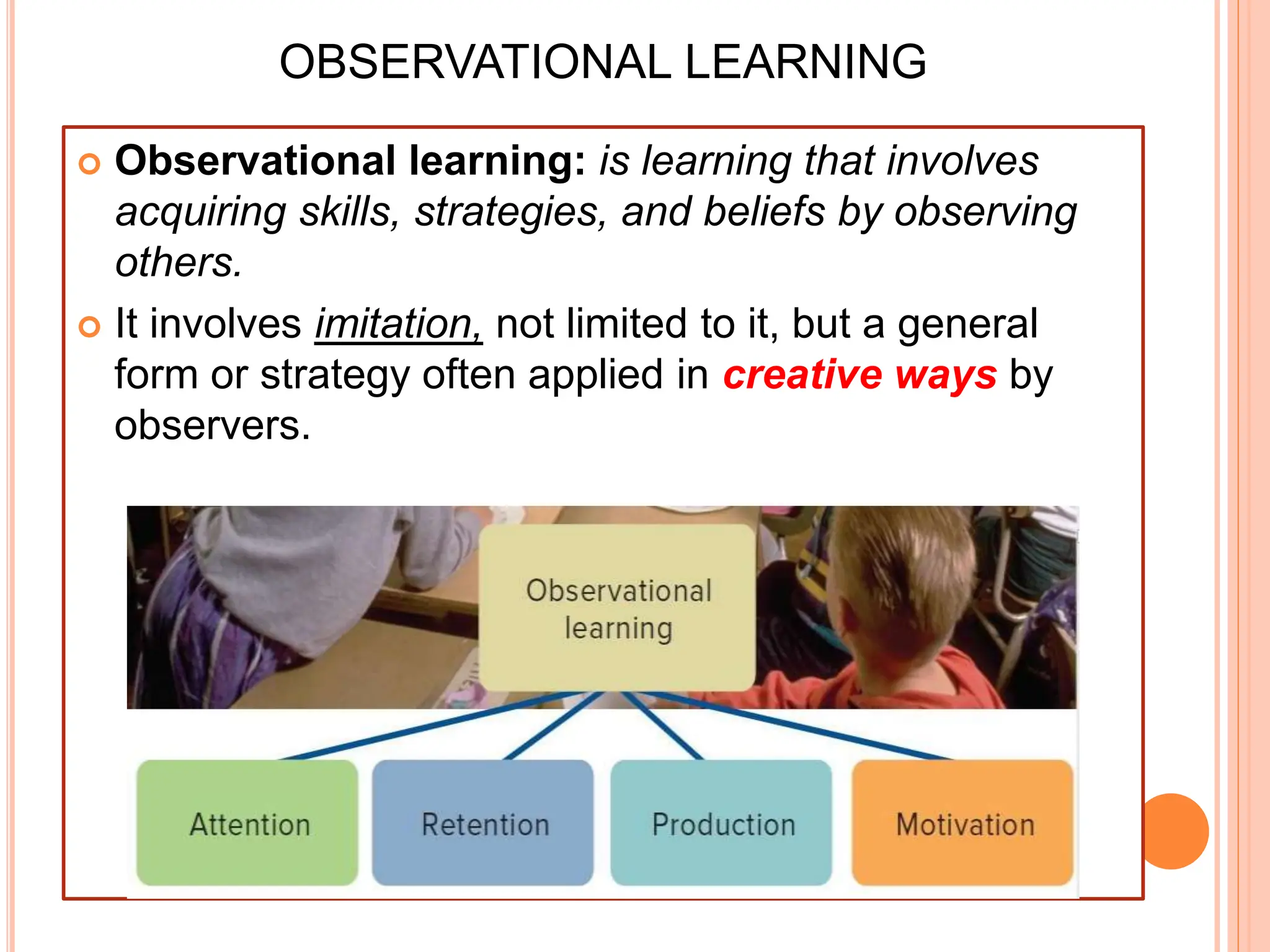
OBSERVATIONAL LEARNING
 Observational learning: is learning that involves
acquiring skills, strategies, and beliefs by observing
others.
 It involves imitation, not limited to it, but a general
form or strategy often applied in creative ways by
observers.
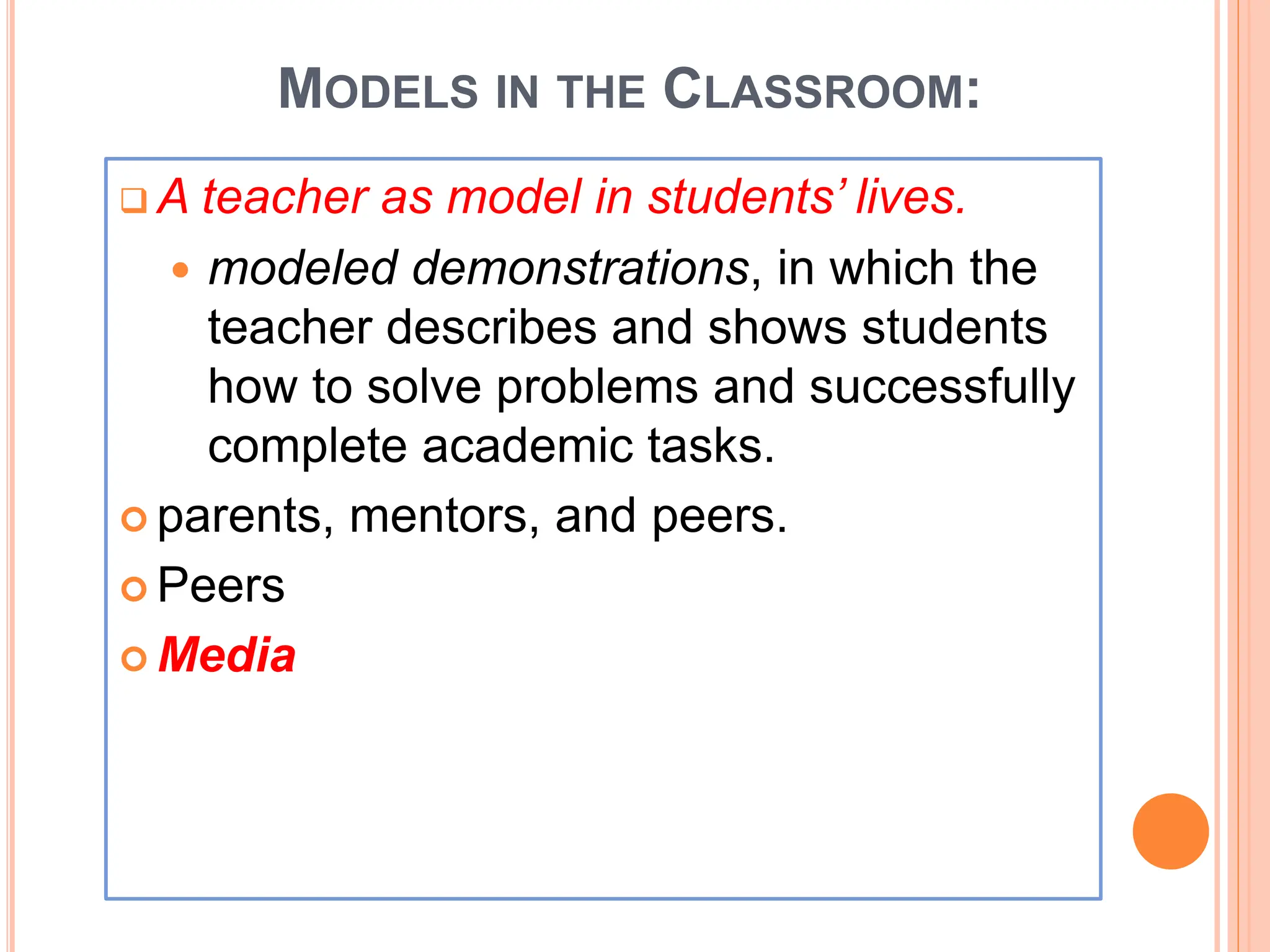
MODELS IN THE CLASSROOM:
 A teacher as model in students’ lives.
 modeled demonstrations, in which the
teacher describes and shows students
how to solve problems and successfully
complete academic tasks.
 parents, mentors, and peers.
 Peers
 Media
COGNITIVE-BEHAVIORAL
APPROACHES
AND SELF-REGULATION
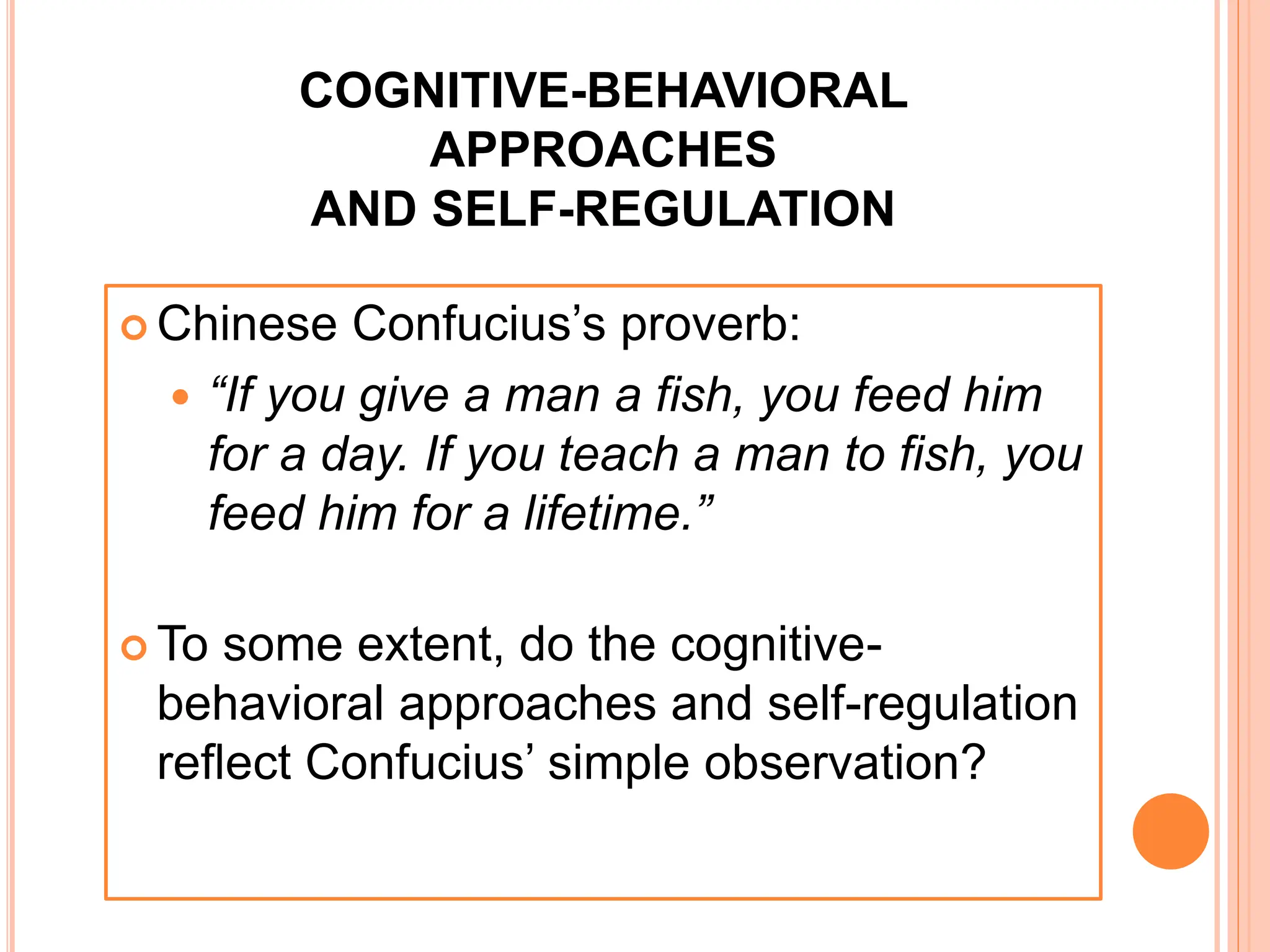
 Chinese Confucius’s proverb:
 “If you give a man a fish, you feed him
for a day. If you teach a man to fish, you
feed him for a lifetime.”
 To some extent, do the cognitive-
behavioral approaches and self-regulation
reflect Confucius’ simple observation?
CONT.
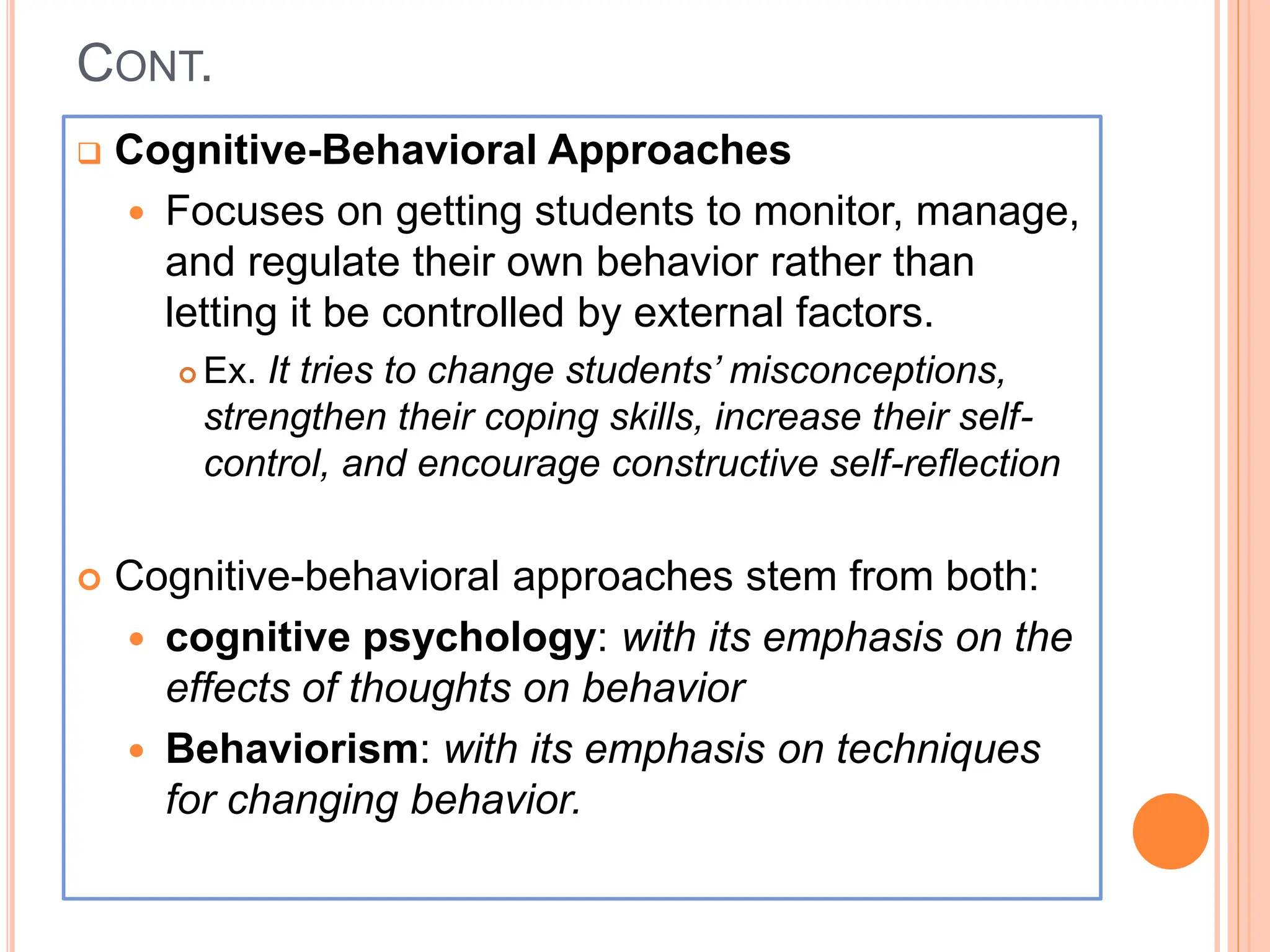
 Cognitive-Behavioral Approaches
 Focuses on getting students to monitor, manage,
and regulate their own behavior rather than
letting it be controlled by external factors.
 Ex. It tries to change students’ misconceptions,
strengthen their coping skills, increase their self-
control, and encourage constructive self-reflection
 Cognitive-behavioral approaches stem from both:
 cognitive psychology: with its emphasis on the
effects of thoughts on behavior
 Behaviorism: with its emphasis on techniques
for changing behavior.
CONT.
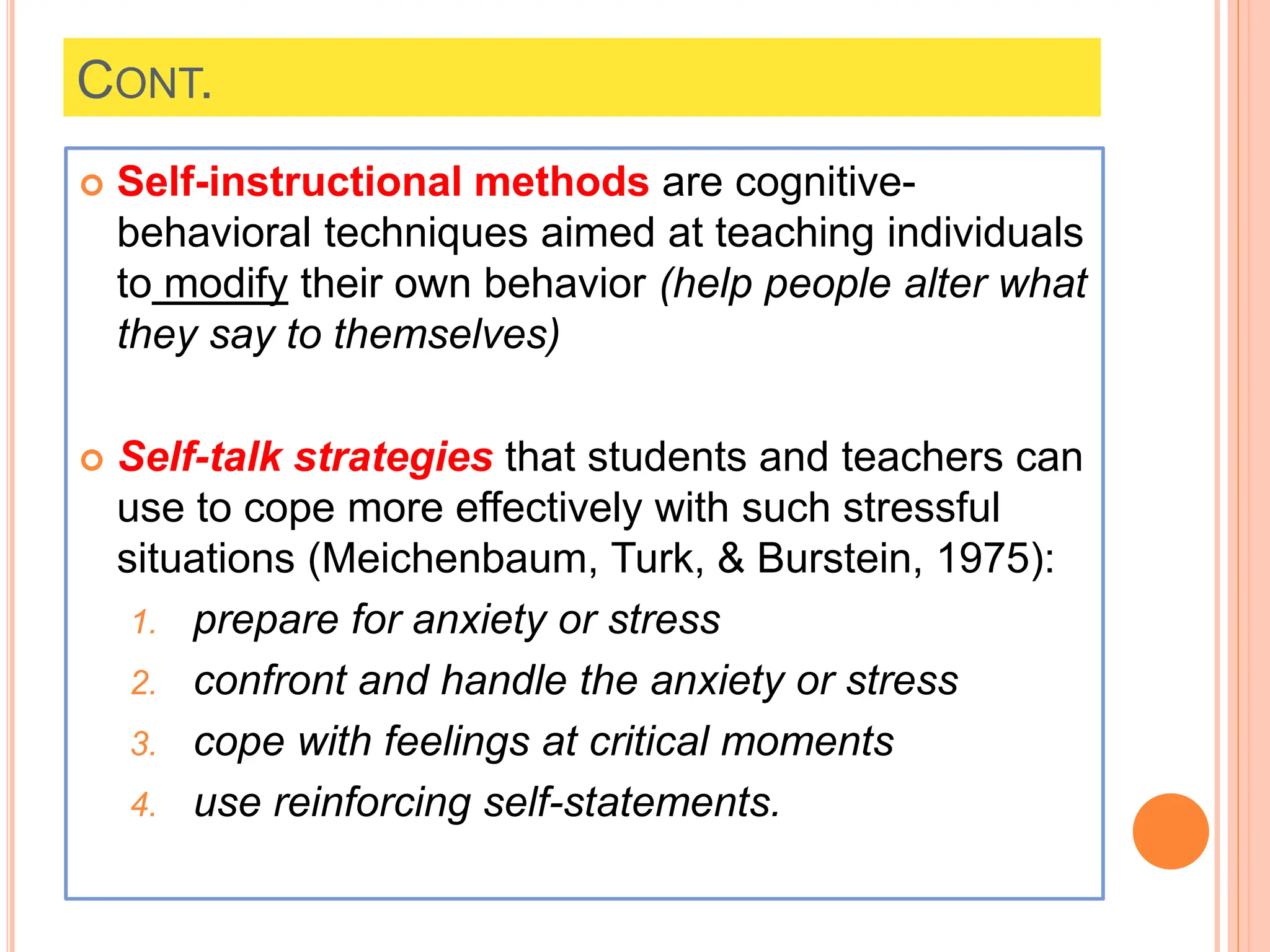
 Self-instructional methods are cognitive-
behavioral techniques aimed at teaching individuals
to modify their own behavior (help people alter what
they say to themselves)
 Self-talk strategies that students and teachers can
use to cope more effectively with such stressful
situations (Meichenbaum, Turk, & Burstein, 1975):
1. prepare for anxiety or stress
2. confront and handle the anxiety or stress
3. cope with feelings at critical moments
4. use reinforcing self-statements.
CONT.
 replacing negative self-statements with positive ones.
 Ex.
 a student might say to herself, “I’ll never get this work done
by tomorrow.” This can be replaced with positive self-
statements such as these: “” This is going to be tough, but I
think I can do it.” “I’m going to look at this as a challenge
rather than a stressor.” “If I work really hard, I might be able
to get it done.
 Or in having to participate in a class discussion, a student
might replace the negative thought “Everyone else knows
more than I do, so what’s the use of saying anything?” with
positive self-statements such as these: “I have as much to
say as anyone else.” “My ideas may be different, but they
are still good.” “It’s okay to be a little nervous; I’ll relax and
start talking.”
 Talking positively to oneself can help teachers and
reach their full potential.
SELF-REGULATORY LEARNING
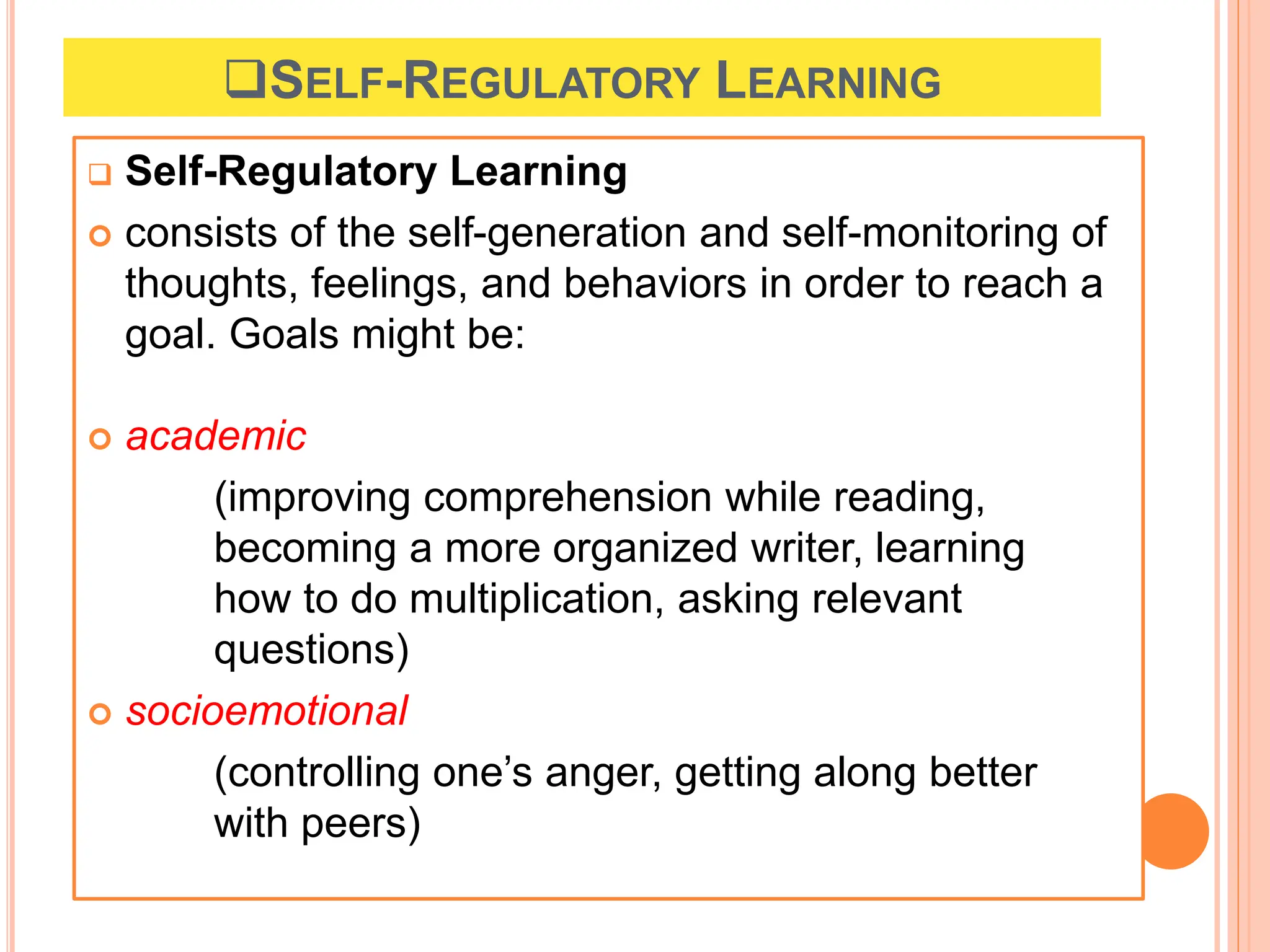
 Self-Regulatory Learning
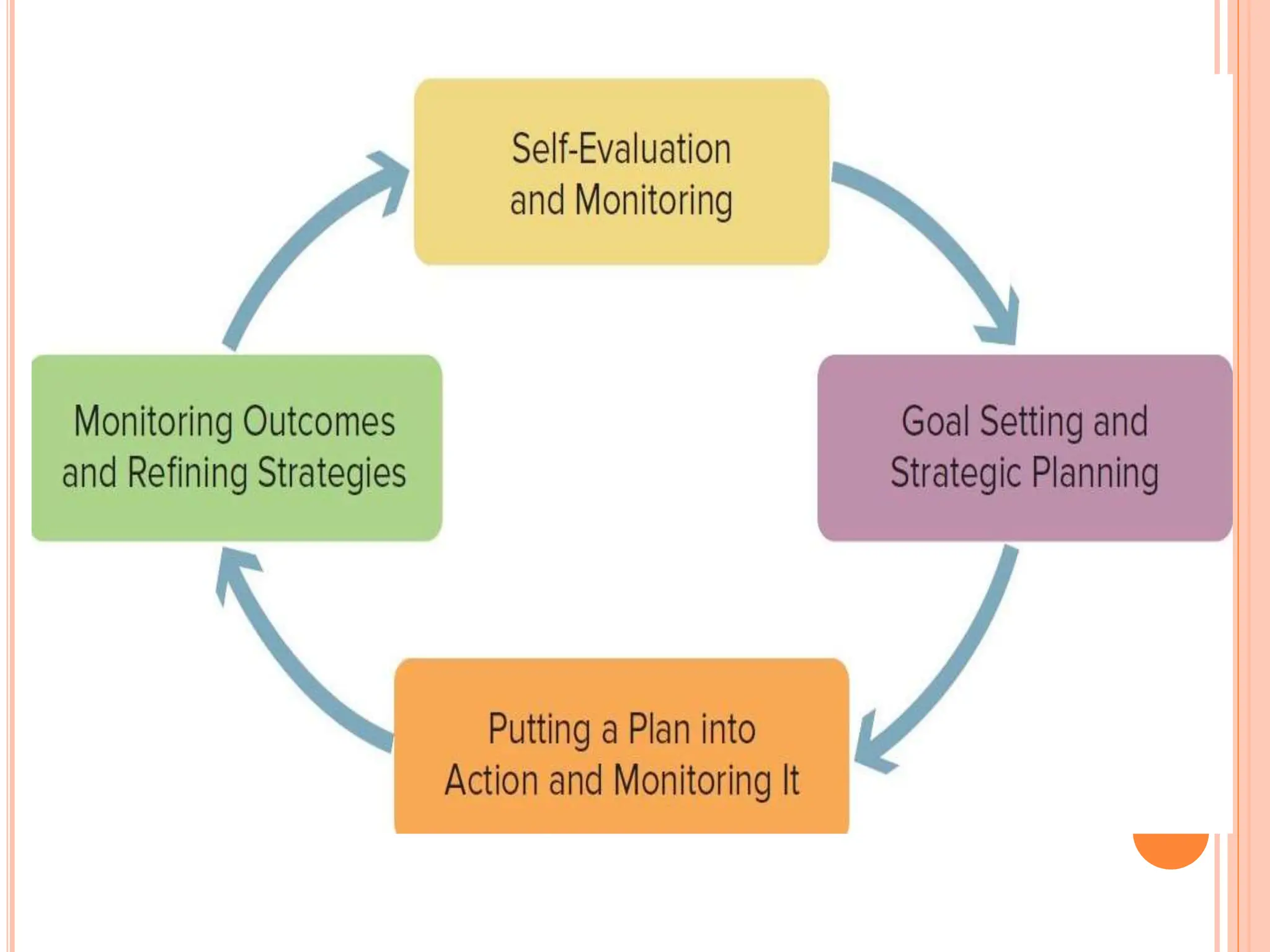
 consists of the self-generation and self-monitoring of
thoughts, feelings, and behaviors in order to reach a
goal. Goals might be:
 academic
(improving comprehension while reading,
becoming a more organized writer, learning
how to do multiplication, asking relevant
questions)
 socioemotional
(controlling one’s anger, getting along better
with peers)
CHARACTERISTICS OF SELF-REGULATED LEARNERS
(WINNE, 2001, 2005):
 Set goals for extending their knowledge and
sustaining their motivation
 Are aware of their emotional makeup and have
strategies for managing their emotions
 Periodically monitor their progress toward a goal
 Fine-tune or revise their strategies based on the
progress they are making
 Evaluate obstacles that may arise and make the
necessary adaptations
 Self-regulation is an important aspect of school
readiness
EVALUATING THE SOCIAL COGNITIVE APPROACHES
 Benefits:
 Considerable learning occurs through watching and
listening to competent models and then imitating what
they do.
 emphasizes on self-instruction, self-talk, and self-
regulatory learning provides an important shift from
learning that is controlled by others to taking responsibility
for one’s own learning
 Drawbacks:
 still focus too much on overt behavior and external factors
and not enough on the details of how cognitive processes
such as thinking, memory, and problem solving actually
take place.
 nondevelopmental (specify age-related, sequential
changes in learning)
 Humanistic–not placing enough attention on self-esteem
and caring, supportive relationships.
REFERENCES
Ciccarelli, S. K., & White, J. N. (2017). Psychology.
Pearson Education India.
Hunkins, F. P., & Ornstein, A. C. 2016). Curriculum:
Foundations, principles, and issues. Pearson
Education.

CH 7_Behaviorial And Cogntive Approaches.pptx

  • 1.
    Human Resource University MA.in TESOL Course: Educational Psychology Mr. Vath Vary Phone: 017 47 111 7 Email: varyvath@gmail.com Chapter 7: Behavioral and social cognitive approaches
  • 2.
    Chapter Outline What Is Learning? What Learning Is andIs Not; Approaches to Learning Behavioral Approaches to Learning Classical Conditioning; Operant Conditioning Applied Behavior Analysis in Education What Is Applied Behavior Analysis?; Increasing Desirable Behaviors; Decreasing Undesirable Behaviors; Evaluating Operant Conditioning and Applied Behavior Analysis What Is Applied Behavior Analysis?; Increasing Desirable Behaviors; Decreasing Undesirable Behaviors; Evaluating Operant Conditioning and Applied Behavior Analysis Bandura’s Social Cognitive Theory; Observational Learning; Cognitive-Behavioral Approaches and Self- Regulation; Evaluating the Social Cognitive Approaches
  • 3.
    I. WHAT ISLEARNING?  Psychology:  is concerned with the question of how people learn  Ask how psychology can contribute to education ‘learning’ is defined as a relatively permanent influence on behavior, knowledge, and thinking skills, which comes about through experience. Learning can be academic and non- academic.
  • 4.
    WHAT LEARNING ISAND IS NOT?  What does “relatively permanent” mean? And how does experience change what we do?  The “relatively permanent” part of the definition refers to the fact that when people learn anything, some part of their brain is physically changed to record what they’ve learned  This is actually a process of memory, for without the ability to remember what happens, people cannot learn anything.
  • 5.
    NOT EVERYTHING WEKNOW IS LEARNED.  Nature–inborn or innate capacities–not learned  Ex. We don’t have to be taught to swallow, to flinch at loud noises, or to blink when an object comes too close to our eyes  Most human behaviors – learned (environment)  Ex. When children use a computer in a new way, work harder at solving problems, ask better questions, explain an answer in a more logical way, or listen more attentively, the experience of learning is at work. Unconscious Conscious
  • 6.
     WHY STUDYLEARNING?  If we had not been able to learn, we would have died out as a species long ago.  Learning is the process that allows us to adapt to the changing conditions of the world around us.  We can alter our actions until we find the behavior that leads us to survival and rewards, and we can eliminate actions that have been unsuccessful in the past.  Without learning, there would be no buildings, no agriculture, no lifesaving medicines, and no human civilization.
  • 7.
    PSYCHOLOGY: APPROACHES TO LEARNING Psychology: 3major branches Behaviorism/ behavioral theories Cognition/ Cognitive theories Phenomenological and humanistic theories
  • 8.
    CONT  Behaviorism  Focuseson stimulus, response and reinforcer  Studies conditioning–classical and operant, modifying, or shaping reinforcement and rewards  Cognition(thought):  Focuses on information processing in relation to the total environment (senses, digital devices…)  Studies developmental stages (nature/nurture; readiness), understanding multiple forms of intelligences, problem solving, critical thinking, and creativity  Phenomenology and Humanism:  Deals with the learner’s need, attitude, and feelings and entail more alternatives in learning
  • 9.
    1- BEHAVIORISM  emphasizeon experiences, especially reinforcement and punishment, as determinants of learning and behavior view that behavior should be explained by observable experiences, not by mental processes.  Mental processes–are defined as the thoughts, feelings, and motives that each of us experiences but that cannot be observed by others.
  • 10.
    CONT.  Behavior–verbal andnonverbal–can be directly seen or heard.  Ex. a child creating a poster, a teacher explaining something to a child, one student picking on another student, and so on.  associative learning, which consists of learning that two events are connected or associated (classical and operant conditioning)  Ex. occurs when a student associates a pleasant event with learning something in school, such as the teacher smiling when the student asks a good question.
  • 11.
    2- COGNITIVE  Cognitivecontrols behavior Ex. Children thinking about ways to create the best poster, a teacher feeling good about children’s efforts, and children’s inner motivation to control their behavior
  • 12.
    II. BEHAVIORAL APPROACHESTO LEARNING Classical Conditioning Operant Conditioning
  • 13.
    PREREQUISITE KEY TERMS A stimulus can be defined as any object, event, or experience that causes  Response refers to the reaction of an organism  neutral stimulus (NS) in classical conditioning, a stimulus that has no effect on the desired response prior to conditioning.
  • 14.
    II. A. CLASSICALCONDITIONING (IVAN PAVLOV, 1927)  Two types of stimuli/response  Unconditioned stimulus (UCS) is a stimulus that automatically produces a response without any prior learning.  Unconditioned response (UCR) is an unlearned response that is automatically elicited by the UCS.  Two types of stimuli/response  conditioned stimulus (CS)–is a previously neutral stimulus that eventually elicits a conditioned response after being associated with the UCS.  conditioned response (CR)–is a learned response to the conditioned stimulus that occurs after UCS-CS pairing.
  • 15.
    CONT Classical conditioning:  theorganism learns to connect, or associate, stimuli.  a form of associative learning in which a neutral stimulus becomes associated with a meaningful stimulus and acquires the capacity to elicit a similar response
  • 16.
    PAVLOV’S DOGS  IvanPalvov was the first to demonstrate classical conditioning  He is best know for his experiment with salivating dog  Dogs were trained to salivate at the sound of a bell.  Dogs naturally salivated with food (UCR)  A bell (NS) was run every time the dogs were fed over a period of time creating the association/connection of the bell with food  After time, the dogs salivated at the sound of the bell alone
  • 17.
    PAVLOV’S CLASSICAL CONDITIONING In one experiment, Pavlov presented a neutral stimulus (bell) just before an unconditioned stimulus (food). The neutral stimulus became a conditioned stimulus by being paired with the unconditioned stimulus. Subsequently, the conditioned stimulus (bell) by itself was able to elicit the dog’s salivation.
  • 18.
    CONT.  In classroom:Classical conditioning:  Positive experiences–a favorite song and feelings that the classroom is a safe and fun place to be  Ex. a song–neutral stimulus–until the child joins in with other classmates to sing it with accompanying positive feelings.  negative experiences–criticism > fear (=test anxiety)  Ex. a child fails and is criticized, which produces anxiety; thereafter, the child associates tests with anxiety, so they then can become a CS for anxiety
  • 19.
  • 20.
    CLASSICAL CONDITIONING PRINCIPLES Generalization:  tendency of a new stimulus similar to the original conditioned stimulus to produce a similar response  Discrimination:  occurs when the organism responds to certain stimuli but not others.  Extinction:  involves the weakening of the conditioned response (CR) in the absence of the unconditioned stimulus (UCS).  Systematic desensitization:  is a method based on classical conditioning that: reduces anxiety by getting the individual to associate deep relaxation with successive visualizations of increasingly anxiety-provoking situations.
  • 21.
    EVALUATING CLASSICAL CONDITIONING good at explaining how neutral stimuli become associated with unlearned, involuntary responses  helpful in understanding students’ anxieties and fears.  not effective in explaining voluntary behaviors,  Ex. why a student studies hard for a test or likes history better than geography. Benefits: Drawbacks:
  • 22.
    II.B. OPERANT CONDITIONING(B. F. SKINNER’S, 1938) … (also called instrumental conditioning) is a form of learning in which the consequences of behavior produce changes in the probability that the behavior will occur. Consequence punishment reward Behavior Organism’s behavior
  • 23.
    CONT  Reinforcement (reward)–isa consequence that increases the probability that a behavior will occur.  Two forms of reinforcement:  positive reinforcement (added): the frequency of a response increases because it is followed by a rewarding stimulus.  negative reinforcement (removed): the frequency of a response increases because it is followed by the removal of an aversive (unpleasant) stimulus, but not punishment.  punishment–is a consequence that decreases the probability a behavior will occur (rejected by Skinner because he felt it interfered with learning)
  • 24.
    CONT Behavior will “extinguish”without reinforcement NOTE:  “Reinforcers’’ always strengthen behavior  “Punishment” is used to suppress behavior
  • 26.
    OPERANT CONDITIONING  Generalization-means giving the same response to similar stimuli.  Ex. especially of interest is the extent to which behavior generalizes from one situation to another  Discrimination: involves differentiating among stimuli or environmental events  Extinction: occurs when a previously reinforced response is no longer reinforced and the response decreases.  Ex. the most common use of extinction is for the teacher to withdraw attention from a behavior that the attention is maintaining.
  • 27.
    APPLIED BEHAVIOR ANALYSISIN EDUCATION  Applied behavior analysis: involves applying the principles of operant conditioning to change human behavior.  Three are especially important in education:  Applications of applied behavior analysis often use a series of steps (i.e. general observation > target behavior determination & antecedent conditions)  (1) increasing desirable behavior,  (2) using prompts and shaping, and  (3) decreasing undesirable behavior  Applications of ABA often use a series of steps:  general observation > target behavior determination & observe its antecedent conditions)
  • 28.
    INCREASING DESIRABLE BEHAVIORS Six operantconditioning strategies–increase a child’s desirable behaviors: (1) choose effective reinforcers; (2) make reinforcers contingent and timely; (3) select the best schedule of reinforcement; (4) consider contracting; (5) use negative reinforcement effectively; and (6) use prompts and shaping.
  • 29.
    INCREASING DESIRABLE BEHAVIORS 1)Choose Effective reinforcers  Not all reinforcers are the same for every child. ABA recommend–teachers must individualize to find out what work best for children  Ex. Praise, favorite activity, surf the internet 2) Make reinforcers contingent and timely  Contingent: depends on the certain behavior  Timely: given as soon as possible after child perform the target behavior  This helps children see the “contingency connection between reward & their behavior.”  ABA recommend… ‘If … then”
  • 30.
    INCREASING DESIRABLE BEHAVIORS 3)Select the best schedule of reinforcement Continuous reinforcement: the child is reinforced every time after he or she makes a response Partial reinforcement: involves reinforcing only part of the time Schedule of reinforcement: partial reinforcement timetables that determine when a response will be reinforced
  • 31.
    Four main schedulesof reinforcement:  Fixed-ratio schedule:  a behavior is reinforced after a set number of responses.  Variable-ratio schedule:  a behavior is reinforced after an average number of times, but on an unpredictable basis.  Fixed-interval schedule:  the first appropriate response after a fixed amount of time is reinforced.  Variable-interval schedule:  a response is reinforced after a variable amount of time has elapsed. RATIO INTERVAL
  • 32.
    CON’T 4) Contracting: involvesputting reinforcement contingencies into writing. 5) Use negative reinforcement effectively 6) Use Prompts and Shaping  Prompt: an added stimulus or cue that is given just before a response that increases the likelihood the response will occur.  Shaping: teaching new behaviors by reinforcing successive approximations to a specified target behavior.
  • 33.
    2- DECREASING UNDESIRABLEBEHAVIORS  Decreasing children’s undesirable behaviors (such as teasing, hogging a class discussion, or smarting off to the teacher)  Paul Alberto and Anne Troutman (2017) recommend using these steps in this order:  1. use differential reinforcement. reinforces behavior that is more appropriate or that is incompatible with what the child is doing. 2. terminate reinforcement (extinction). involves withdrawing positive reinforcement from a child’s inappropriate behavior
  • 34.
    2- DECREASING UNDESIRABLEBEHAVIORS 3. remove desirable stimuli.  Time-out: removing an individual from positive reinforcement.  response cost: taking a positive reinforcer away from an individual. 4. present aversive stimuli (punishment).  Verbal reprimand  1st: frown or eye contact  2nd: Talk in private, not in public  give immediately after unwanted behavior–more effective  Corporal punishment (not used in any circumstance)
  • 35.
    EVALUATING OPERANT CONDITIONINGAND APPLIED BEHAVIOR ANALYSIS-CONTRIBUTION TO EDUCATION  Disadvantages:  Reinforcing and punishing consequences are part of teachers’ and students’ lives. Teachers give grades, praise and reprimand, smile and frown.  Learning about how such consequences affect students’ behavior improves your capabilities as a teacher.  Used effectively, behavioral techniques can help you manage your classroom.
  • 36.
    EVALUATING OPERANT CONDITIONINGAND ABA- CONTRIBUTION TO EDUCATION  Advantages:  ABA still places too much emphasis on external control of students’ behavior  not the reward or punishment that changes behavior but, rather, the belief or expectation that certain actions will be rewarded or punished  not give adequate attention to cognitive processes involved in learning
  • 37.
    EVALUATING OPERANT CONDITIONINGAND APPLIED BEHAVIOR ANALYSIS  Anyway, critics of operant conditioning and applied behavior analysis argue that the whole approach places too much emphasis on external control of students’ behavior—a better strategy is to help students learn to control their own behavior and become internally motivated.
  • 38.
    BANDURA’S SOCIAL COGNITIVETHEORY  Bandura contributed to the understanding of learning through observation and modeling.  Social cognitive theory: states that social factors ( students’ observing their parents’ achievement behavior) and cognitive factors (the student’s expectations for success), as well as behavior, play important roles in learning.  Bandura developed a reciprocal determinism model that consists of three main factors:  Person: personality traits and temperament  Cognitive: expectations, beliefs, attitudes, strategies, thinking, and intelligence.  Affective and emotional: emotional self-regulation or temperament also are included in person/cognitive factors.
  • 39.
  • 40.
    CONT.  Read examplesof how Bandura’s model might work in the case of the achievement behavior of a high school student (Refer to page 33-34)  Cognition influences behavior  Behavior influences cognition  Environment influences behavior  Behavior influences environment  Cognition influences environment  Environment influences cognition  self-efficacy-is emphasized in Bandura’s Model
  • 41.
    OBSERVATIONAL LEARNING  Observationallearning: is learning that involves acquiring skills, strategies, and beliefs by observing others.  It involves imitation, not limited to it, but a general form or strategy often applied in creative ways by observers.
  • 42.
    MODELS IN THECLASSROOM:  A teacher as model in students’ lives.  modeled demonstrations, in which the teacher describes and shows students how to solve problems and successfully complete academic tasks.  parents, mentors, and peers.  Peers  Media
  • 43.
    COGNITIVE-BEHAVIORAL APPROACHES AND SELF-REGULATION  ChineseConfucius’s proverb:  “If you give a man a fish, you feed him for a day. If you teach a man to fish, you feed him for a lifetime.”  To some extent, do the cognitive- behavioral approaches and self-regulation reflect Confucius’ simple observation?
  • 44.
    CONT.  Cognitive-Behavioral Approaches Focuses on getting students to monitor, manage, and regulate their own behavior rather than letting it be controlled by external factors.  Ex. It tries to change students’ misconceptions, strengthen their coping skills, increase their self- control, and encourage constructive self-reflection  Cognitive-behavioral approaches stem from both:  cognitive psychology: with its emphasis on the effects of thoughts on behavior  Behaviorism: with its emphasis on techniques for changing behavior.
  • 45.
    CONT.  Self-instructional methodsare cognitive- behavioral techniques aimed at teaching individuals to modify their own behavior (help people alter what they say to themselves)  Self-talk strategies that students and teachers can use to cope more effectively with such stressful situations (Meichenbaum, Turk, & Burstein, 1975): 1. prepare for anxiety or stress 2. confront and handle the anxiety or stress 3. cope with feelings at critical moments 4. use reinforcing self-statements.
  • 46.
    CONT.  replacing negativeself-statements with positive ones.  Ex.  a student might say to herself, “I’ll never get this work done by tomorrow.” This can be replaced with positive self- statements such as these: “” This is going to be tough, but I think I can do it.” “I’m going to look at this as a challenge rather than a stressor.” “If I work really hard, I might be able to get it done.  Or in having to participate in a class discussion, a student might replace the negative thought “Everyone else knows more than I do, so what’s the use of saying anything?” with positive self-statements such as these: “I have as much to say as anyone else.” “My ideas may be different, but they are still good.” “It’s okay to be a little nervous; I’ll relax and start talking.”  Talking positively to oneself can help teachers and reach their full potential.
  • 47.
    SELF-REGULATORY LEARNING  Self-RegulatoryLearning  consists of the self-generation and self-monitoring of thoughts, feelings, and behaviors in order to reach a goal. Goals might be:  academic (improving comprehension while reading, becoming a more organized writer, learning how to do multiplication, asking relevant questions)  socioemotional (controlling one’s anger, getting along better with peers)
  • 49.
    CHARACTERISTICS OF SELF-REGULATEDLEARNERS (WINNE, 2001, 2005):  Set goals for extending their knowledge and sustaining their motivation  Are aware of their emotional makeup and have strategies for managing their emotions  Periodically monitor their progress toward a goal  Fine-tune or revise their strategies based on the progress they are making  Evaluate obstacles that may arise and make the necessary adaptations  Self-regulation is an important aspect of school readiness
  • 50.
    EVALUATING THE SOCIALCOGNITIVE APPROACHES  Benefits:  Considerable learning occurs through watching and listening to competent models and then imitating what they do.  emphasizes on self-instruction, self-talk, and self- regulatory learning provides an important shift from learning that is controlled by others to taking responsibility for one’s own learning  Drawbacks:  still focus too much on overt behavior and external factors and not enough on the details of how cognitive processes such as thinking, memory, and problem solving actually take place.  nondevelopmental (specify age-related, sequential changes in learning)  Humanistic–not placing enough attention on self-esteem and caring, supportive relationships.
  • 51.
    REFERENCES Ciccarelli, S. K.,& White, J. N. (2017). Psychology. Pearson Education India. Hunkins, F. P., & Ornstein, A. C. 2016). Curriculum: Foundations, principles, and issues. Pearson Education.