Y5E02 BIOPROCESS
TECHNOLOGY – Unit IV –
Beer Production
Dr. S. SIVASANKARA NARAYANI
ASSISTANT PROFESSOR
DEPARTMENT OF MICROBIOLOGY
AYYA NADAR JANAKI AMMAL COLLEGE
SIVAKASI
Alcoholic beverages
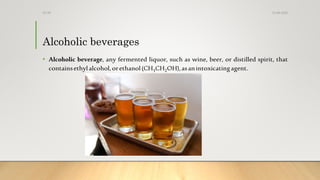
• Alcoholic beverage, any fermented liquor, such as wine, beer, or distilled spirit, that
containsethylalcohol,orethanol(CH3CH2OH),asanintoxicatingagent.
13-08-2020Dr.SS
Beer
• Fundamentally beer is the product of the alcoholic fermentation by yeast of extracts of malted barley.
• Whilst malt and yeast contribute substantially to the character of beers, the quality of beer is at least as much a function of the
water and, especially, of the hops used in its production
13-08-2020Dr.SS
Cont..
• Barley starch supplies most of the sugars from which the alcohol is derived in the majority of the world’s beers.
• This starch is enclosed in the cell wall and proteins within the barley, and these wrappings are stripped away in the malting
process (essentially a limited germination of the barley grains), leaving the starch preserved.
13-08-2020Dr.SS
13-08-2020Dr.SS
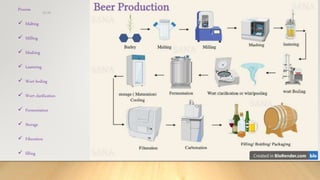
Process
 Malting
 Milling
 Mashing
 Lautering
 Wort boiling
 Wort clarification
 Fermentation
 Storage
 Filteration
 filling
Malting
• Fresh barley – soaked in water – germinate
• Amylase formation
• Optimal stage – drying (Kilning)
• Green malt – dried at 80ºC – slightly sweet – dried
• Malt sugar – feed for yeast culture
13-08-2020Dr.SS
Milling
• Finished malt – milled – flour
• Malt mills – crushed malt: husks, groats, meal, semolina and powder
13-08-2020Dr.SS
Mashing
• In the brewery, the malted grain must first be milled to produce relatively fine particles, which are for the most part starch.
• The particles are then intimately mixed with hot water in a process called mashing.
• The water must possess the right mix of salts.
• For example fine ales are produced from waters with high levels of calcium.
• Famous pilsners are from waters with low levels of calcium.
• Starch in the grist dissolves – sugar, protein and tannin are released – Malt extract
13-08-2020Dr.SS
Cont…
• Mash tun – mashing - in.
• Some brewers will have added starch from other sources, such as maize or rice, to supplement that from malt. These other
sources are called adjuncts
13-08-2020Dr.SS
Lautering
• Mash is filtered in the lauter tun as the husks sinks
• The liquid portion of the mash, known as wort, is recovered, either by straining through the residual spent grains or by
filtering through plates.
• Spent grains are usually used as cattle fodder..
13-08-2020Dr.SS
Wort boiling
• The wort is run to the kettle or brewing pan (sometimes known as the copper, even though they are nowadays fabricated from
stainless steel) where it is boiled, usually for I hour.
• Boiling serves various functions, including sterilisation of wort, precipitation of proteins (which would otherwise come out of
solution in the finished beer and cause cloudiness), and the driving away of unpleasant grainy characters originating in the
barley.
• Many brewers also add some adjunct sugars at this stage and at least a proportion of their hops
13-08-2020Dr.SS
Wort Boiling - Hops
• In that boiled wort – hops are added
• The hops have two principal components: resins and essential oils.
• The resins (so-called a-acids) are changed (‘isomerised’) during boiling to yield iso-a-acids, which provide the bitterness to beer.
• This process is rather inefficient.
• Nowadays, hops oils are often extracted with liquefied carbon dioxide and the extract is either added to the kettle or extensively
isomerised outside the brewery for addition to the finished beer (thereby avoiding losses due to the tendency of the bitter substance
to stick on to yeast).
13-08-2020Dr.SS
Cont..
• The oils are responsible for the ‘hoppy nose’ on beer. They are very volatile and if the hops are all added at the start of the boil
then much of the aroma will be blown up the chimney.
• In traditional lager brewing a proportion of the hops are held back and only added towards the end of boiling, which allows
the oils to remain in the wort.
• For obvious reasons, this process is called late hopping..
• Beer taste – type and amount of hops
13-08-2020Dr.SS
Cont..
• In traditional ale production, a handful of hops is added to the cask at the end of the process, enabling a complex mixture of
oils to give a distinctive character to such products.
• This is called dry hopping.
• Liquid carbon dioxide can be used to extract oils as well as resins and these extracts can also be added late in the process to
make modifications to beer flavour.
• Water evaporates from wort – concentrated to the original wort – malt enzymes are deactivated
13-08-2020Dr.SS
cont..
• The precipitate (protein elements and tannin) produced during boiling has been removed, the hopped wort is cooled and
pitched with yeast.
• There are many strains of brewing yeast (Saccharomyces cerevisiae), and brewers jealously guard and look after their own
strains because of their importance in determining brand identity.
13-08-2020Dr.SS
Wort clarification
• Wort clarification or drawing off
• Wort – whorlpool – rotate
• Hops particles that have not dissolved and protein – the so called trub – form a cone in the middle of the container
• Clear wort – tapped off at the side
• Cooled to temperature between 10ºC and 20ºC – wort cooler
13-08-2020Dr.SS
Fermentation – alcoholic fermentation
• Add Special brewing yeast
• Yeast – malt sugar - alcohol + carbondioxide
• Malt sugar fermented – yeast sinks – collect
• Depend on the type of yeast – wort preparation- top or bottom fermented beer produce
13-08-2020Dr.SS
Cont..
• Fundamentally brewing yeast can be divided into ale and lager strains
• The former type collecting at the surface of the fermenting wort and the latter settling to the bottom of a fermentation
(although this differentiation is becoming blurred with modern fermenters).
• Both types need a little oxygen to trigger off their metabolism, but otherwise the alcoholic fermentation is anaerobic.
13-08-2020Dr.SS
Cont..
• Ale fermentations are usually complete within a few days at temperatures as high as 20°C.
• lager fermentations at as low as 6°C can take several weeks.
• Fermentation is complete when the desired alcohol content has been reached
• when an unpleasant butterscotch flavour which develops during all fermentations has been mopped up by yeast.
• The yeast is harvested for use in the next fermentation.
13-08-2020Dr.SS
Storage
• Young beer is stored – three weeks to three months – storage tank – 1º C and 2ºC.
• Secondary fermentation - remaining yeast particle & protein tannin sink at the bottom.
• Beer clear - characteristic colour
• In traditional ale brewing the beer is now mixed with hops, some priming sugars and with isinglass finings from the swim bladders
of certain fish, which settle out the solids in the cask.
• In traditional lager brewing the ‘green beer’ is matured by several weeks of cold storage, prior to filtering.
13-08-2020Dr.SS
Storage
• Nowadays, the majority of beers, both ales and lagers, receive a relatively short conditioning period after fermentation and
before filtration.
• This conditioning is ideally performed at -1°C for a minimum of three days, under which conditions more proteins drop out
of solution, making the beer less likely to go cloudy in the package or glass.
13-08-2020Dr.SS
Filteration
• Yeast particles , resins and protein – extracted remains – filtered
• Beer – final clear colour
13-08-2020Dr.SS
Carbonation
• Bottled beer and cans – counter pressure – to prevent excape of c02
13-08-2020Dr.SS
Filling
• The filtered beer is adjusted to the required carbonation before packaging into cans, kegs or glass or plastic bottles.
• Barrels are directly filled
• Distributed for marketing
13-08-2020Dr.SS
Clarification
13-08-2020Dr.SS
sivasan91@gmail.com
sivasan_sf549@anjaconline.org
Questions to think
• What are the steps involved in the beer production?
• What is lautering?
• What is wort?
• Role of hops
• Pointout the use of beer
• What is alcholic fermentation?
• Kilning
13-08-2020Dr.SS
13-08-2020Dr.SS

Beer production

  • 1.
    Y5E02 BIOPROCESS TECHNOLOGY –Unit IV – Beer Production Dr. S. SIVASANKARA NARAYANI ASSISTANT PROFESSOR DEPARTMENT OF MICROBIOLOGY AYYA NADAR JANAKI AMMAL COLLEGE SIVAKASI
  • 2.
    Alcoholic beverages • Alcoholicbeverage, any fermented liquor, such as wine, beer, or distilled spirit, that containsethylalcohol,orethanol(CH3CH2OH),asanintoxicatingagent. 13-08-2020Dr.SS
  • 3.
    Beer • Fundamentally beeris the product of the alcoholic fermentation by yeast of extracts of malted barley. • Whilst malt and yeast contribute substantially to the character of beers, the quality of beer is at least as much a function of the water and, especially, of the hops used in its production 13-08-2020Dr.SS
  • 4.
    Cont.. • Barley starchsupplies most of the sugars from which the alcohol is derived in the majority of the world’s beers. • This starch is enclosed in the cell wall and proteins within the barley, and these wrappings are stripped away in the malting process (essentially a limited germination of the barley grains), leaving the starch preserved. 13-08-2020Dr.SS
  • 5.
    13-08-2020Dr.SS Process  Malting  Milling Mashing  Lautering  Wort boiling  Wort clarification  Fermentation  Storage  Filteration  filling
  • 6.
    Malting • Fresh barley– soaked in water – germinate • Amylase formation • Optimal stage – drying (Kilning) • Green malt – dried at 80ºC – slightly sweet – dried • Malt sugar – feed for yeast culture 13-08-2020Dr.SS
  • 7.
    Milling • Finished malt– milled – flour • Malt mills – crushed malt: husks, groats, meal, semolina and powder 13-08-2020Dr.SS
  • 8.
    Mashing • In thebrewery, the malted grain must first be milled to produce relatively fine particles, which are for the most part starch. • The particles are then intimately mixed with hot water in a process called mashing. • The water must possess the right mix of salts. • For example fine ales are produced from waters with high levels of calcium. • Famous pilsners are from waters with low levels of calcium. • Starch in the grist dissolves – sugar, protein and tannin are released – Malt extract 13-08-2020Dr.SS
  • 9.
    Cont… • Mash tun– mashing - in. • Some brewers will have added starch from other sources, such as maize or rice, to supplement that from malt. These other sources are called adjuncts 13-08-2020Dr.SS
  • 10.
    Lautering • Mash isfiltered in the lauter tun as the husks sinks • The liquid portion of the mash, known as wort, is recovered, either by straining through the residual spent grains or by filtering through plates. • Spent grains are usually used as cattle fodder.. 13-08-2020Dr.SS
  • 11.
    Wort boiling • Thewort is run to the kettle or brewing pan (sometimes known as the copper, even though they are nowadays fabricated from stainless steel) where it is boiled, usually for I hour. • Boiling serves various functions, including sterilisation of wort, precipitation of proteins (which would otherwise come out of solution in the finished beer and cause cloudiness), and the driving away of unpleasant grainy characters originating in the barley. • Many brewers also add some adjunct sugars at this stage and at least a proportion of their hops 13-08-2020Dr.SS
  • 12.
    Wort Boiling -Hops • In that boiled wort – hops are added • The hops have two principal components: resins and essential oils. • The resins (so-called a-acids) are changed (‘isomerised’) during boiling to yield iso-a-acids, which provide the bitterness to beer. • This process is rather inefficient. • Nowadays, hops oils are often extracted with liquefied carbon dioxide and the extract is either added to the kettle or extensively isomerised outside the brewery for addition to the finished beer (thereby avoiding losses due to the tendency of the bitter substance to stick on to yeast). 13-08-2020Dr.SS
  • 13.
    Cont.. • The oilsare responsible for the ‘hoppy nose’ on beer. They are very volatile and if the hops are all added at the start of the boil then much of the aroma will be blown up the chimney. • In traditional lager brewing a proportion of the hops are held back and only added towards the end of boiling, which allows the oils to remain in the wort. • For obvious reasons, this process is called late hopping.. • Beer taste – type and amount of hops 13-08-2020Dr.SS
  • 14.
    Cont.. • In traditionalale production, a handful of hops is added to the cask at the end of the process, enabling a complex mixture of oils to give a distinctive character to such products. • This is called dry hopping. • Liquid carbon dioxide can be used to extract oils as well as resins and these extracts can also be added late in the process to make modifications to beer flavour. • Water evaporates from wort – concentrated to the original wort – malt enzymes are deactivated 13-08-2020Dr.SS
  • 15.
    cont.. • The precipitate(protein elements and tannin) produced during boiling has been removed, the hopped wort is cooled and pitched with yeast. • There are many strains of brewing yeast (Saccharomyces cerevisiae), and brewers jealously guard and look after their own strains because of their importance in determining brand identity. 13-08-2020Dr.SS
  • 16.
    Wort clarification • Wortclarification or drawing off • Wort – whorlpool – rotate • Hops particles that have not dissolved and protein – the so called trub – form a cone in the middle of the container • Clear wort – tapped off at the side • Cooled to temperature between 10ºC and 20ºC – wort cooler 13-08-2020Dr.SS
  • 17.
    Fermentation – alcoholicfermentation • Add Special brewing yeast • Yeast – malt sugar - alcohol + carbondioxide • Malt sugar fermented – yeast sinks – collect • Depend on the type of yeast – wort preparation- top or bottom fermented beer produce 13-08-2020Dr.SS
  • 18.
    Cont.. • Fundamentally brewingyeast can be divided into ale and lager strains • The former type collecting at the surface of the fermenting wort and the latter settling to the bottom of a fermentation (although this differentiation is becoming blurred with modern fermenters). • Both types need a little oxygen to trigger off their metabolism, but otherwise the alcoholic fermentation is anaerobic. 13-08-2020Dr.SS
  • 19.
    Cont.. • Ale fermentationsare usually complete within a few days at temperatures as high as 20°C. • lager fermentations at as low as 6°C can take several weeks. • Fermentation is complete when the desired alcohol content has been reached • when an unpleasant butterscotch flavour which develops during all fermentations has been mopped up by yeast. • The yeast is harvested for use in the next fermentation. 13-08-2020Dr.SS
  • 20.
    Storage • Young beeris stored – three weeks to three months – storage tank – 1º C and 2ºC. • Secondary fermentation - remaining yeast particle & protein tannin sink at the bottom. • Beer clear - characteristic colour • In traditional ale brewing the beer is now mixed with hops, some priming sugars and with isinglass finings from the swim bladders of certain fish, which settle out the solids in the cask. • In traditional lager brewing the ‘green beer’ is matured by several weeks of cold storage, prior to filtering. 13-08-2020Dr.SS
  • 21.
    Storage • Nowadays, themajority of beers, both ales and lagers, receive a relatively short conditioning period after fermentation and before filtration. • This conditioning is ideally performed at -1°C for a minimum of three days, under which conditions more proteins drop out of solution, making the beer less likely to go cloudy in the package or glass. 13-08-2020Dr.SS
  • 22.
    Filteration • Yeast particles, resins and protein – extracted remains – filtered • Beer – final clear colour 13-08-2020Dr.SS
  • 23.
    Carbonation • Bottled beerand cans – counter pressure – to prevent excape of c02 13-08-2020Dr.SS
  • 24.
    Filling • The filteredbeer is adjusted to the required carbonation before packaging into cans, kegs or glass or plastic bottles. • Barrels are directly filled • Distributed for marketing 13-08-2020Dr.SS
  • 25.
  • 26.
    Questions to think •What are the steps involved in the beer production? • What is lautering? • What is wort? • Role of hops • Pointout the use of beer • What is alcholic fermentation? • Kilning 13-08-2020Dr.SS
  • 27.