Production of Beer
MOHIT ROY
2ND
YeaR BIOTecHNOlOgY STuDeNT
ST.XavIeR’S cOllege, BuRDwaN
Key Points
Raw Materials
Production Process
Clarification of the Beer
Bottling
Opportunities
Raw Materials
Malt
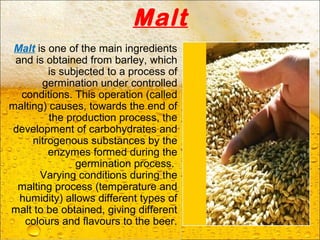
Malt is one of the main ingredients
and is obtained from barley, which
is subjected to a process of
germination under controlled
conditions. This operation (called
malting) causes, towards the end of
the production process, the
development of carbohydrates and
nitrogenous substances by the
enzymes formed during the
germination process.
Varying conditions during the
malting process (temperature and
humidity) allows different types of
malt to be obtained, giving different
colours and flavours to the beer.
Other unmalted
cereals
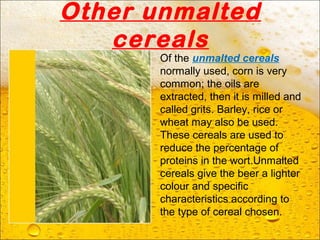
Of the unmalted cereals
normally used, corn is very
common; the oils are
extracted, then it is milled and
called grits. Barley, rice or
wheat may also be used.
These cereals are used to
reduce the percentage of
proteins in the wort.Unmalted
cereals give the beer a lighter
colour and specific
characteristics according to
the type of cereal chosen.
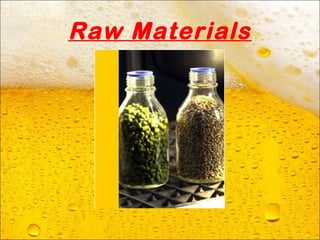
Hops (Humulus
lupulus)
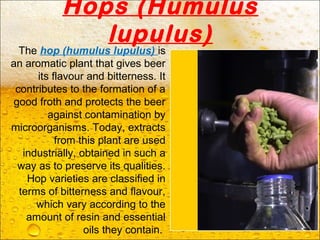
The hop (humulus lupulus) is
an aromatic plant that gives beer
its flavour and bitterness. It
contributes to the formation of a
good froth and protects the beer
against contamination by
microorganisms. Today, extracts
from this plant are used
industrially, obtained in such a
way as to preserve its qualities.
Hop varieties are classified in
terms of bitterness and flavour,
which vary according to the
amount of resin and essential
oils they contain.
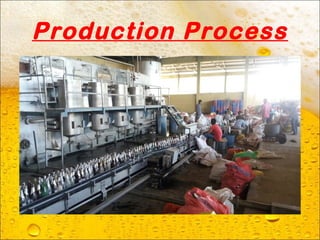
Production Process
Upstream & Downstream
Processing
• The entire process is divided into 2 parts:
Upstream processing & Downstream
processing .
• Upstream processing involves all the
steps required for preparing the crude
beer & Downstream processing involves
the steps required for preparing the
finished product.
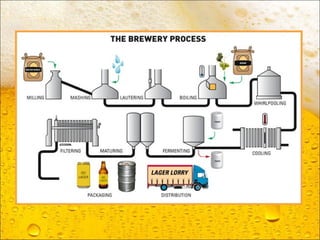
• The basic upstream & downstream
processing varies from breweries to
breweries, also varies depending upon the
equipments ,the types of machinery
,weather condition etc.Which affect the
taste.
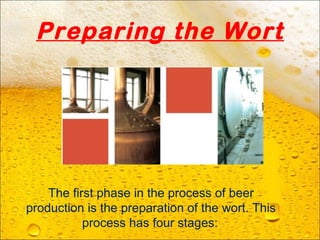
Preparing the Wort
The first phase in the process of beer
production is the preparation of the wort. This
process has four stages:
   Milling: In order for
the malt
components to be
rapidly extracted
and converted, the
malt is milled to
obtain coarse flour.
The other
unmalted cereals
are also milled to
varying degrees.
  Mashing: The flour from the
cereals (malt and other unmalted
cereals) is mixed with water and
subjected to certain processes to
obtain a wort of a suitable
composition for the kind of beer
being produced (varying times,
temperatures and PH). These
conditions encourage the
development of complex starch
molecules and proteins in other
simpler ones by means of
enzymes formed during the
production of the malt. Mashing
lasts 2 to 4 hours and finishes
with a temperature of
approximately 75 ºC.
Boiling the wort: The diluted and filtered wort is boiled for around 2
hours. Hops are added at this stage. The purpose of boiling is to:
•Transform and make soluble the bitter substances in the hops;
•Eliminate undesirable volatile substances;
•Sterilise the wort;
•Provoke the precipitation of proteins of high molecular weight;
•Establish the final concentration of wort.
After boiling, it is necessary to separate the precipitated protein and the
insoluble hop components from the hot wort. Separation may be carried
out in a decanter using gravity or with centripetal force in a "whirlpool".
Before the hopped wort goes into the fermentation tanks, it is cooled to
a temperature of around 9 ºC and aired in sterile conditions.
Filtration of the wort: After mashing, the whole volume is filtered in
order to separate the spent grains (which is an excellent animal feed)
from the wort itself. This is done by passing water through the mash at
the right temperature in a filter press or lauter tun, which lasts around 2-
3 hours, conducted at a temperature of 75-80 ºC.
Fermentation/Maturation/Stabilis
ation
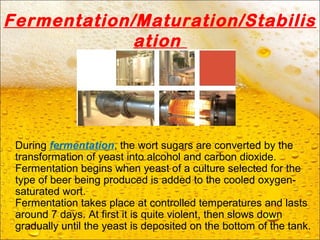
During fermentation, the wort sugars are converted by the
transformation of yeast into alcohol and carbon dioxide.
Fermentation begins when yeast of a culture selected for the
type of beer being produced is added to the cooled oxygen-
saturated wort.
Fermentation takes place at controlled temperatures and lasts
around 7 days. At first it is quite violent, then slows down
gradually until the yeast is deposited on the bottom of the tank.
Maturation, the
phase after
fermentation, is
the period in
which the beer
is allowed to
rest at suitable
temperatures in
order for the
undesirable
volatile
components,
which might
affect the final
«bouquet» of
the beer, to be
released.
The next operation is
stabilisation. This
consists of letting the
beer stabilise at
temperatures of
between 0ºC and -
2ºC, to permit colloidal
stabilisation.
Clarification of the
Beer
Clarification is the operation that gives the beer its clear
limpid quality, eliminating the last remaining traces of
clouding still in suspension. It consists of pumping the
liquid through a suitable filter. The filtered beer is then
stored in tanks, now ready to be bottled.
Bottling
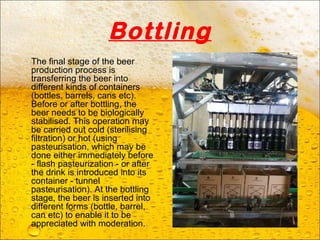
The final stage of the beer
production process is
transferring the beer into
different kinds of containers
(bottles, barrels, cans etc).
Before or after bottling, the
beer needs to be biologically
stabilised. This operation may
be carried out cold (sterilising
filtration) or hot (using
pasteurisation, which may be
done either immediately before
- flash pasteurization - or after
the drink is introduced into its
container - tunnel
pasteurisation). At the bottling
stage, the beer is inserted into
different forms (bottle, barrel,
can etc) to enable it to be
appreciated with moderation.
Alcohol Amount
• Beer is incompletely fermented alcoholic
drink made of malt, hop and water. The
most consumed beer is 10° and 12° where
1° doesn’t express alcohol ratio but the
fermented sugar percentage. 1° is
approximately 0.35% of alcohol.
Opportunities for
you?
• profit generators
• higher margins
• incremental sales
• added ring totals
• impulse purchases
• selection
• value add for your
consumers
• point of difference from
competition
• become more of a
destination
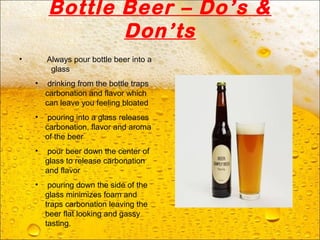
Bottle Beer – Do’s &
Don’ts
• Always pour bottle beer into a
glass
• drinking from the bottle traps
carbonation and flavor which
can leave you feeling bloated
• pouring into a glass releases
carbonation, flavor and aroma
of the beer
• pour beer down the center of
glass to release carbonation
and flavor
• pouring down the side of the
glass minimizes foam and
traps carbonation leaving the
beer flat looking and gassy
tasting.
References
• http://www.bierengezondheid.be
• http://www.umm.edu/altmed/
ConsLookups/Supplements.html
• http://infowebz.com/pivo/
• http://www.tourismvictoria.com/ Content/EN/348.asp
• https://www.google.com/search?
q=beer&dcr=0&source=lnms&tbm=isch&sa=X&ved=0ahUKEwjRionrp43XA
hUIMhoKHa3EBHIQ_AUICygC#imgrc
• https://www.google.co.in/search?
q=bear+production+process&dcr=0&source=lnms&tbm=isch&sa=X&ved=0a
hUKEwj-
jdPjto3XAhUTUI8KHVgTDqsQ_AUICygC&biw=1366&bih=662#imgrc=_
Children, don’t drink beer – drinking beer
you’ll go dotty slowly!!!
…doesn’t matter, we have time enough!
Beer Production

Beer Production

  • 1.
    Production of Beer MOHITROY 2ND YeaR BIOTecHNOlOgY STuDeNT ST.XavIeR’S cOllege, BuRDwaN
  • 2.
    Key Points Raw Materials ProductionProcess Clarification of the Beer Bottling Opportunities
  • 3.
  • 4.
    Malt Malt is oneof the main ingredients and is obtained from barley, which is subjected to a process of germination under controlled conditions. This operation (called malting) causes, towards the end of the production process, the development of carbohydrates and nitrogenous substances by the enzymes formed during the germination process. Varying conditions during the malting process (temperature and humidity) allows different types of malt to be obtained, giving different colours and flavours to the beer.
  • 5.
    Other unmalted cereals Of theunmalted cereals normally used, corn is very common; the oils are extracted, then it is milled and called grits. Barley, rice or wheat may also be used. These cereals are used to reduce the percentage of proteins in the wort.Unmalted cereals give the beer a lighter colour and specific characteristics according to the type of cereal chosen.
  • 6.
    Hops (Humulus lupulus) The hop(humulus lupulus) is an aromatic plant that gives beer its flavour and bitterness. It contributes to the formation of a good froth and protects the beer against contamination by microorganisms. Today, extracts from this plant are used industrially, obtained in such a way as to preserve its qualities. Hop varieties are classified in terms of bitterness and flavour, which vary according to the amount of resin and essential oils they contain.
  • 7.
  • 8.
    Upstream & Downstream Processing •The entire process is divided into 2 parts: Upstream processing & Downstream processing . • Upstream processing involves all the steps required for preparing the crude beer & Downstream processing involves the steps required for preparing the finished product.

  • 9.
    • The basicupstream & downstream processing varies from breweries to breweries, also varies depending upon the equipments ,the types of machinery ,weather condition etc.Which affect the taste.
  • 10.
    Preparing the Wort Thefirst phase in the process of beer production is the preparation of the wort. This process has four stages:
  • 11.
       Milling: In orderfor the malt components to be rapidly extracted and converted, the malt is milled to obtain coarse flour. The other unmalted cereals are also milled to varying degrees.   Mashing: The flour from the cereals (malt and other unmalted cereals) is mixed with water and subjected to certain processes to obtain a wort of a suitable composition for the kind of beer being produced (varying times, temperatures and PH). These conditions encourage the development of complex starch molecules and proteins in other simpler ones by means of enzymes formed during the production of the malt. Mashing lasts 2 to 4 hours and finishes with a temperature of approximately 75 ºC.
  • 12.
    Boiling the wort:The diluted and filtered wort is boiled for around 2 hours. Hops are added at this stage. The purpose of boiling is to: •Transform and make soluble the bitter substances in the hops; •Eliminate undesirable volatile substances; •Sterilise the wort; •Provoke the precipitation of proteins of high molecular weight; •Establish the final concentration of wort. After boiling, it is necessary to separate the precipitated protein and the insoluble hop components from the hot wort. Separation may be carried out in a decanter using gravity or with centripetal force in a "whirlpool". Before the hopped wort goes into the fermentation tanks, it is cooled to a temperature of around 9 ºC and aired in sterile conditions. Filtration of the wort: After mashing, the whole volume is filtered in order to separate the spent grains (which is an excellent animal feed) from the wort itself. This is done by passing water through the mash at the right temperature in a filter press or lauter tun, which lasts around 2- 3 hours, conducted at a temperature of 75-80 ºC.
  • 13.
    Fermentation/Maturation/Stabilis ation During fermentation, thewort sugars are converted by the transformation of yeast into alcohol and carbon dioxide. Fermentation begins when yeast of a culture selected for the type of beer being produced is added to the cooled oxygen- saturated wort. Fermentation takes place at controlled temperatures and lasts around 7 days. At first it is quite violent, then slows down gradually until the yeast is deposited on the bottom of the tank.
  • 14.
    Maturation, the phase after fermentation,is the period in which the beer is allowed to rest at suitable temperatures in order for the undesirable volatile components, which might affect the final «bouquet» of the beer, to be released. The next operation is stabilisation. This consists of letting the beer stabilise at temperatures of between 0ºC and - 2ºC, to permit colloidal stabilisation.
  • 15.
    Clarification of the Beer Clarificationis the operation that gives the beer its clear limpid quality, eliminating the last remaining traces of clouding still in suspension. It consists of pumping the liquid through a suitable filter. The filtered beer is then stored in tanks, now ready to be bottled.
  • 16.
    Bottling The final stageof the beer production process is transferring the beer into different kinds of containers (bottles, barrels, cans etc). Before or after bottling, the beer needs to be biologically stabilised. This operation may be carried out cold (sterilising filtration) or hot (using pasteurisation, which may be done either immediately before - flash pasteurization - or after the drink is introduced into its container - tunnel pasteurisation). At the bottling stage, the beer is inserted into different forms (bottle, barrel, can etc) to enable it to be appreciated with moderation.
  • 17.
    Alcohol Amount • Beeris incompletely fermented alcoholic drink made of malt, hop and water. The most consumed beer is 10° and 12° where 1° doesn’t express alcohol ratio but the fermented sugar percentage. 1° is approximately 0.35% of alcohol.
  • 19.
    Opportunities for you? • profitgenerators • higher margins • incremental sales • added ring totals • impulse purchases • selection • value add for your consumers • point of difference from competition • become more of a destination
  • 20.
    Bottle Beer –Do’s & Don’ts • Always pour bottle beer into a glass • drinking from the bottle traps carbonation and flavor which can leave you feeling bloated • pouring into a glass releases carbonation, flavor and aroma of the beer • pour beer down the center of glass to release carbonation and flavor • pouring down the side of the glass minimizes foam and traps carbonation leaving the beer flat looking and gassy tasting.
  • 21.
    References • http://www.bierengezondheid.be • http://www.umm.edu/altmed/ ConsLookups/Supplements.html •http://infowebz.com/pivo/ • http://www.tourismvictoria.com/ Content/EN/348.asp • https://www.google.com/search? q=beer&dcr=0&source=lnms&tbm=isch&sa=X&ved=0ahUKEwjRionrp43XA hUIMhoKHa3EBHIQ_AUICygC#imgrc • https://www.google.co.in/search? q=bear+production+process&dcr=0&source=lnms&tbm=isch&sa=X&ved=0a hUKEwj- jdPjto3XAhUTUI8KHVgTDqsQ_AUICygC&biw=1366&bih=662#imgrc=_
  • 22.
    Children, don’t drinkbeer – drinking beer you’ll go dotty slowly!!! …doesn’t matter, we have time enough!