CHEMISTRY IN BREWING
PRIYA. S
ASST PROFESSOR
FPT
AMET
Beer! This foamy, refreshing, sparkling
alcoholic beverage conjures images of
parties, festivals, sporting events, and
generally fun stuff.
.
• Beer has been brewed since the ancient
civilizations of Egypt and Mesopotamia.
• Beer is a very old drink discovered almost
5000 years back .
• Louis Pasteur also provided valuable
knowledge which is still valid today, about
fermentation and the essential
requirements to make beer stable
The Art of Brewing
Water 92.9%
Ethanol 3.9%
Carbohydrates 2.5%
Protein 0.2%
Carbon dioxide 0.5%
BEER COMPOSITION
•BARLEY – the body & soul of beer
• YEAST – the life of beer
• HOPS – the spice of beer
• WATER – the integrity & purity of
beer
• ADJUNCTS – Additive grains like
rice or corn, fruit or spices
What’s in Beer?
Malted Barley
• Two types of barley
 2-rowed
 6-rowed
• Provides fermentable sugars,
flavor, and color.
• Malting process:
 Steeping
 Germination
 Kilning
• Purpose:
 Activate enzyme
systems
 Preserve for brewhouse
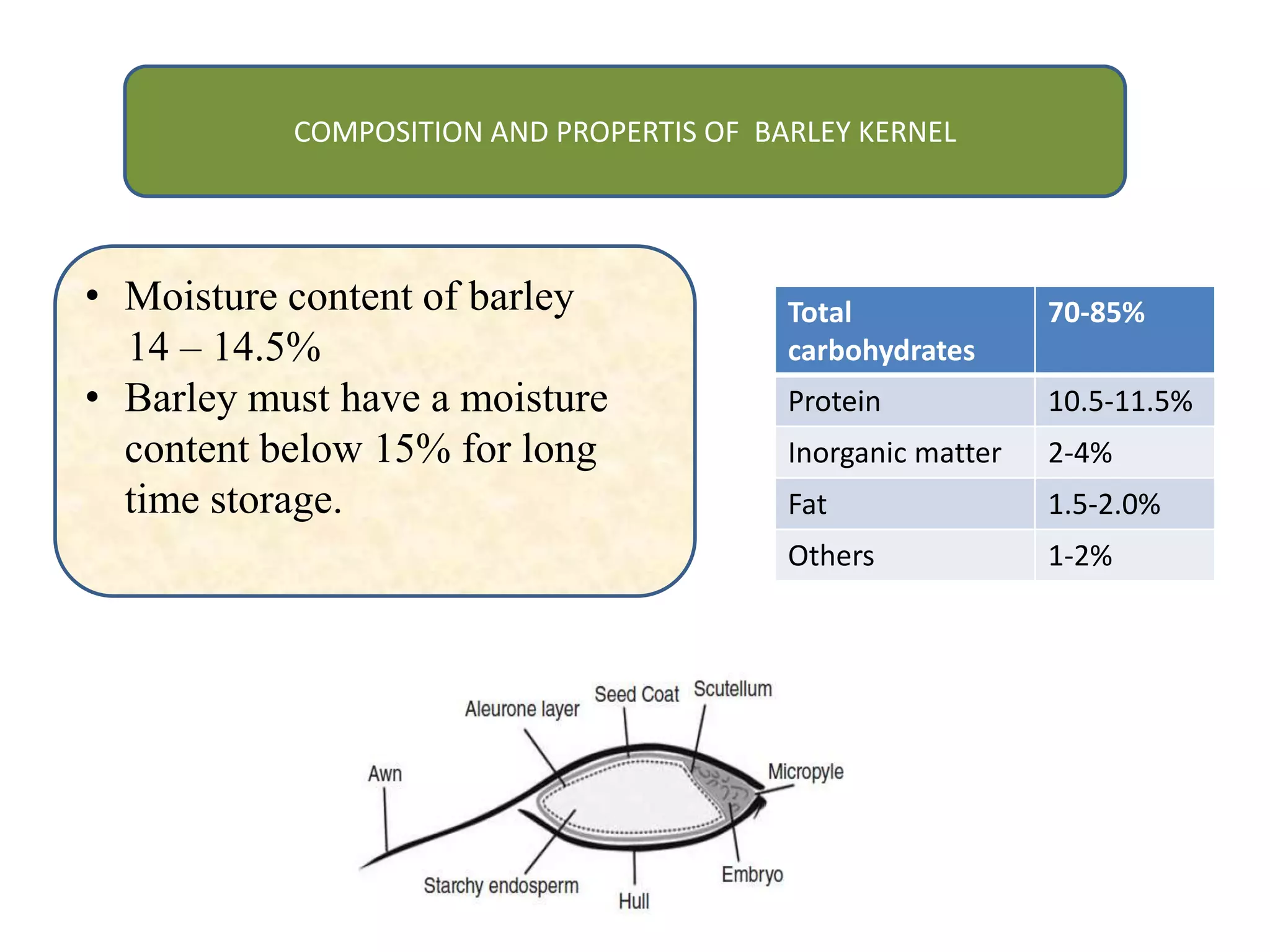
COMPOSITION AND PROPERTIS OF BARLEY KERNEL
• Moisture content of barley
14 – 14.5%
• Barley must have a moisture
content below 15% for long
time storage.
Total
carbohydrates
70-85%
Protein 10.5-11.5%
Inorganic matter 2-4%
Fat 1.5-2.0%
Others 1-2%
STEEPING
MALTING PROCESS
1. Water uptake depends on the
steeping time, temperature, kernel
size, barley variety and the barley
harvest year.
2. Water content of the steeped
barley is called the degree of
steeping expressed in percentage.
eg: for pale or Pilsner malt
– water content 42-44%
For dark malt
– a water content of 44-47%
Kernel size in
mm
Water content
In %
2.9 43.7
2.8 43.3
2.5 43.6
2.2 48.9
2.0 49.0
GERMINATION
PROCESS DURING
GERMINATION
- Growth processes
- Enzyme formation
- Metabolic changes
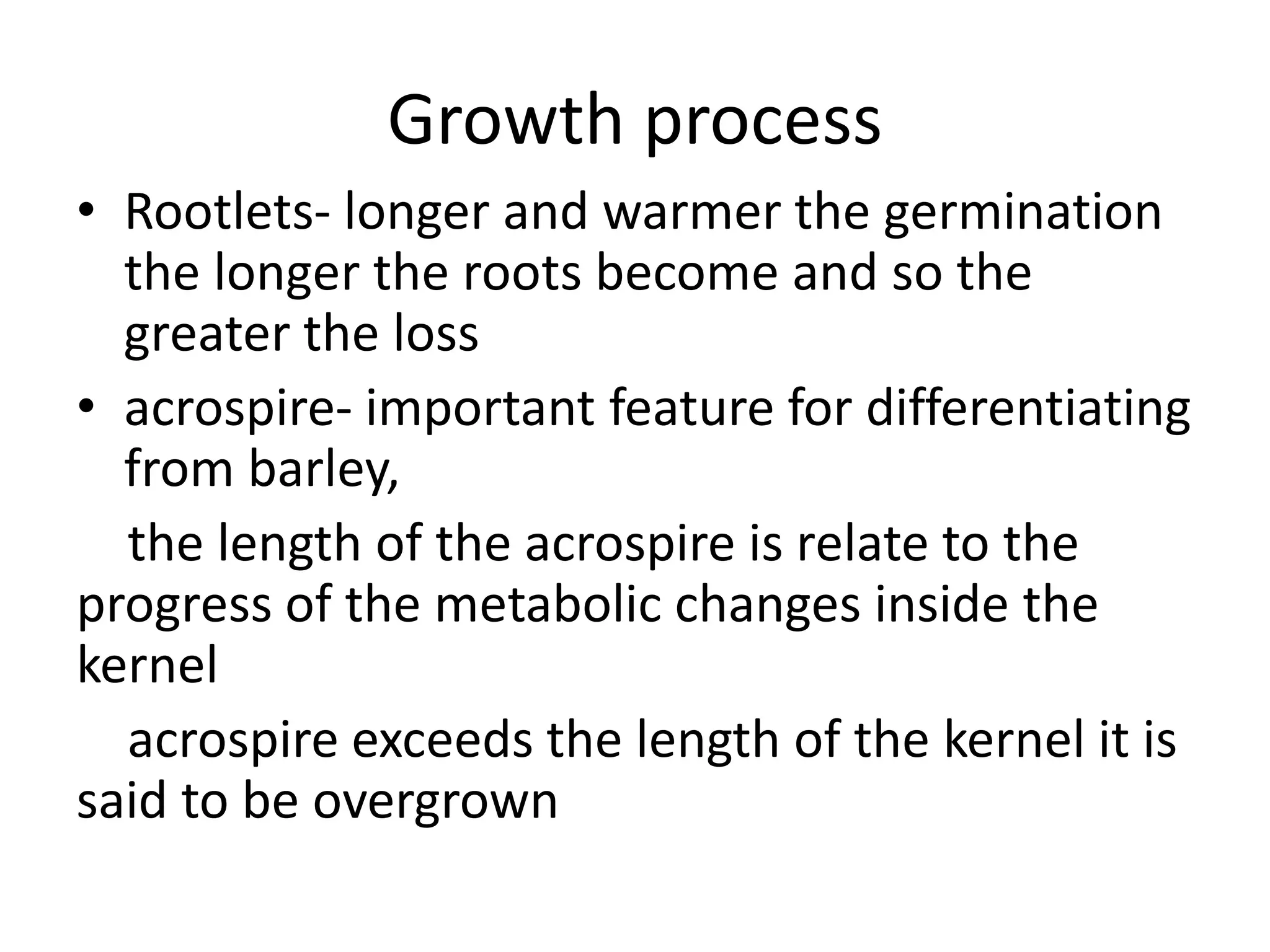
Growth process
• Rootlets- longer and warmer the germination
the longer the roots become and so the
greater the loss
• acrospire- important feature for differentiating
from barley,
the length of the acrospire is relate to the
progress of the metabolic changes inside the
kernel
acrospire exceeds the length of the kernel it is
said to be overgrown
Enzyme formation
• Abundant in barley
• They are increased during the time of
germination
- starch degrading enzymes
• α and β amylases.
• Cytolytic enzymes
• β glucanases and cytase
kilning
• Water is removed from the green malt. The
malt then become stable and storable.
Changes during kilning
1. The water content is lowered
2. Germination and modidfication are
stopped
3. Color and flavour compounds are
formed
DMS Formation during germination
and kilning
• A volatile sulphur compound gives beer a
flavour referred to as cabbagey or cooked
vegetable
• The higher th kilning temperature more
DMS-P is converted into DMS.
The flavour threshold of DMS is
considered to be 50-60μg/l
HOPS – the spice of beer
- Germany is the largest
producer.
- Humulus lupulus
(dioecious)
- only female plant is used
in brewery because they
contain bitter resins
ethereal oils which supply
bittering and aroma
components to beer.
-Used as:
Whole cones
Pellets
Extracts
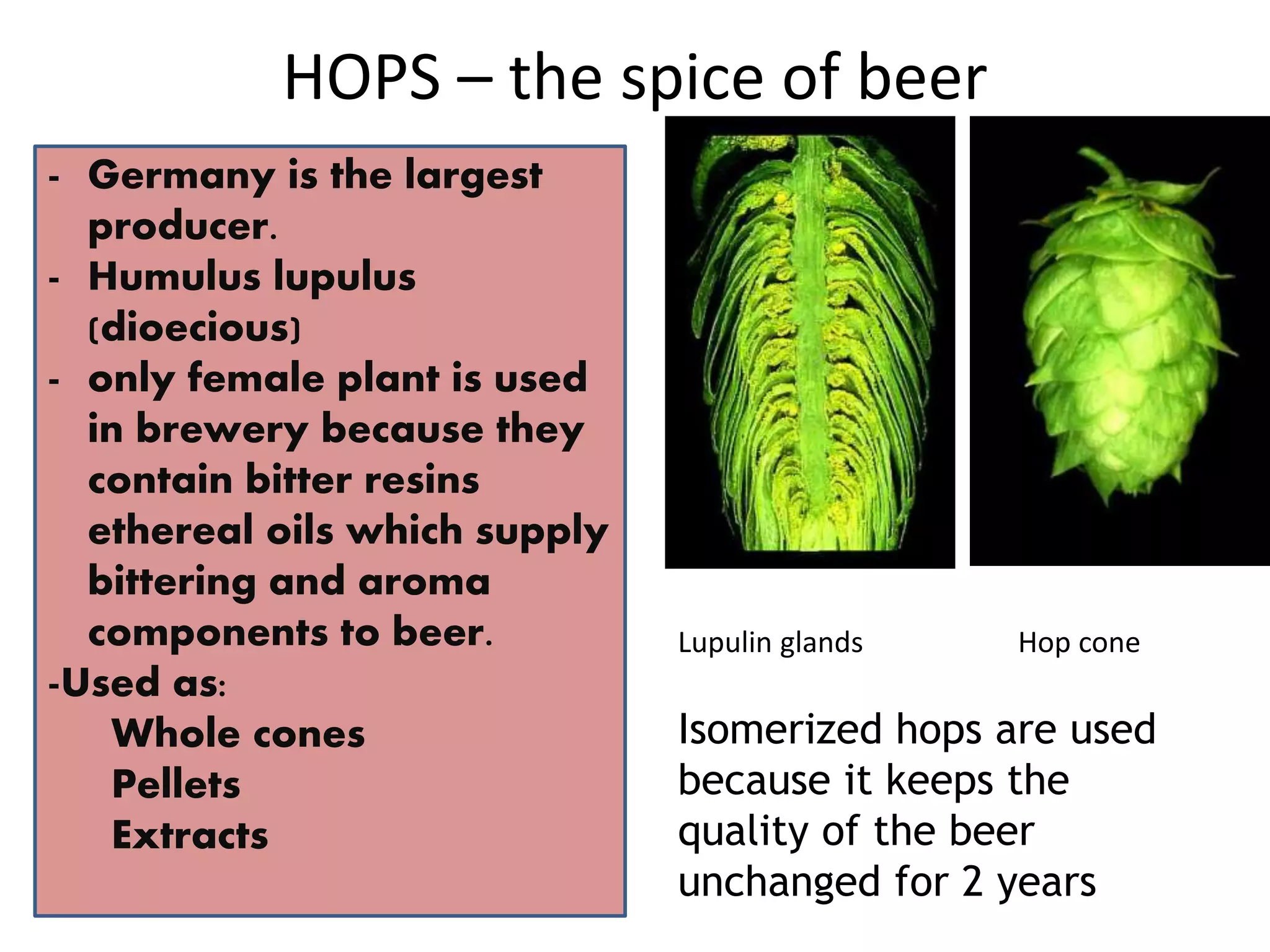
Lupulin glands Hop cone
Isomerized hops are used
because it keeps the
quality of the beer
unchanged for 2 years
Alpha Acid Isomerization
humulone
isohumulone
Cont…
• MICROBIAL STABILIZATION hops have antiseptic qualities
• HOP AROMA fruity flowery characteristics
• BITTERNESS balances malt sweetness
• FOAM STABILIZATION enhances head properties
• There are two primary hop styles:
Aroma Hops – Saaz, Fuggle & Hallertua
Bitter Hops – Brewer’s Gold & Unique
• Hops contain 14-21% hop resin
• Hops contain 0.5 – 1.5% hop oil. Oils are fromed in the lupulin
glands and give hops a characteristic aroma.
• Hop oil is not a single compound. It contains about 200 cmpounds.
Water – “Integrity & Purity”
• Water usage in a brewery is substantial and varies
between 3.7-10.9 hl of water per hl of sales beer, on
average it is 6hl
• water makes up 92% of beer
• through filtration or boiling; impurities, aromas &
flavor differences can be mitigated
Water treatment depends on
Removal of suspended matter
Removal of dissolved materials
Removal of microorganisms
Yeast – “Life of Beer”
• Unicellular microorganisms- Sacchomyces
cerevisiae
• produces carbon dioxide and alcohol
• Two types of yeast are used to produce beer:
• ALE – top fermenting
• LAGER – bottom fermenting
Lager ale
Adjuncts
• Unmalted cereal which is cheaper is referred
to as adjunct.
• Maize, maize grits, maize flakes, corn syrup,
broken rice, wheat, barley, caramel,
sugar(crystalline sugar)
• adjuncts are added to change the flavor,
character or profile of beer.
• used to supplement main starch source to
provide better foam retention, color or aroma
Brewhouse
Fermentation
Lagering
Starch Sugars
EthanolSugars
Carbonation
Flavor maturation
Wort production
Flavor production
The brewing process
PROCEDURE FOR BREWING BEER
mashing
• Most important proces in wort
production.
• Grist and water are mashed and the
contents of the malt are brought into
soultion and extract is obtained.
• The degradation process includes
1.starch degradation
. 2. β glucan degradation
3. protein degradation
Starch degradation occurs in 3 stages
1. gelatinisation
2. liquefaction
. 3. saccharification
Gelatinisation varies fro each type of cereal
malt & barley starch gelatinise in the
presence of amylases at 60°C and rice starch
at 80-85°C
pH of the mash should be 5.4-5.6
• Break down carbohydrates into fermentable
sugars
• Break down proteins into usable amino acids
• Choose temperature range where different
enzymes are highly active for various
processes
• Amylases (α and β) can only break down 1,4
linkages
• α amylase breaks down the long starch to smaller
dextrins at 72-75°C and destroys at 80°C. pH -5.6-
5.8
• β amylase splits maltose of from the non
reducing ends of chains but it also produces
glucose and maltotriose
• Acts optimally at 60-65°C and sensitive at higher
temperatures . pH- 5.4-5.5
• Starch breakdown should be monitored because
residues of undegraded starch and larger dextrins
cause starch hazes in beer
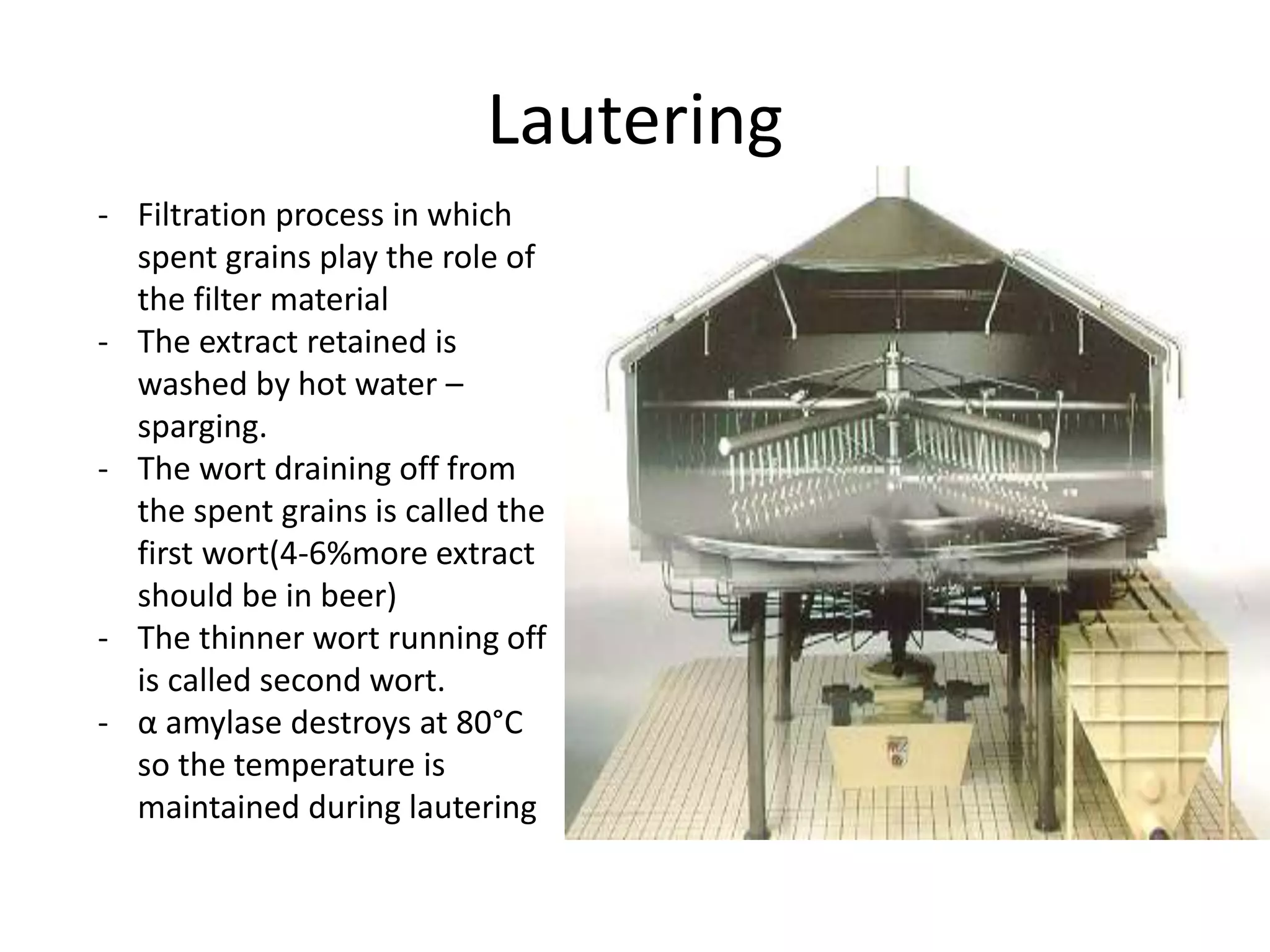
Lautering
- Filtration process in which
spent grains play the role of
the filter material
- The extract retained is
washed by hot water –
sparging.
- The wort draining off from
the spent grains is called the
first wort(4-6%more extract
should be in beer)
- The thinner wort running off
is called second wort.
- α amylase destroys at 80°C
so the temperature is
maintained during lautering
Brew kettle
-.
1.Extraction and
transformation of hop
components.
2. Evaporation of water.
3. Wort sterilization.
3. Destruction of all
enzymes.
4. Increased coloration
of the wort
5. Acidification of the
wort
6. Formation of reducing
substances
7. Effects on the DMS
content of the wort.
Wort boiling operations
The zinc content of the wort
• Important trace element in wort is zinc atleast
0.10-0.15 mg/l
• Zinc assists protein synthesis in yeast cells and
controls their nucleic acid and carbohydrate
metabolism.
• Zinc deficiency causes fermentation problems.
• Foam stability is worse when zinc is deficent.
• Wort should be boiled in copper vessels because
copper vessels always contain a small amount of
admixed zinc.
• Zinc chloride is added when stainless steel is used
for wort boiling since stainless steel don’t contain
zinc.
The chemistry of wort boiling
• turning-point in the brewing of beers
• Boiled for 1-2 hours
• Boiling results in the formation of melanoidins
and oxidation of polyphenols
• Hop resins , hop oils and hop polyphenols –
important components of hops in beer
production
Hop resins- bitter taste to the beer
Hop oil- volatile during boiling, its added at the end of boiling i.e., 15-
20 mins before casting
Hop polyphenols- water soluble , includes anthocyanogens, tannins
and catechins
Polyphenols – palate-fullness and bitterness of beer
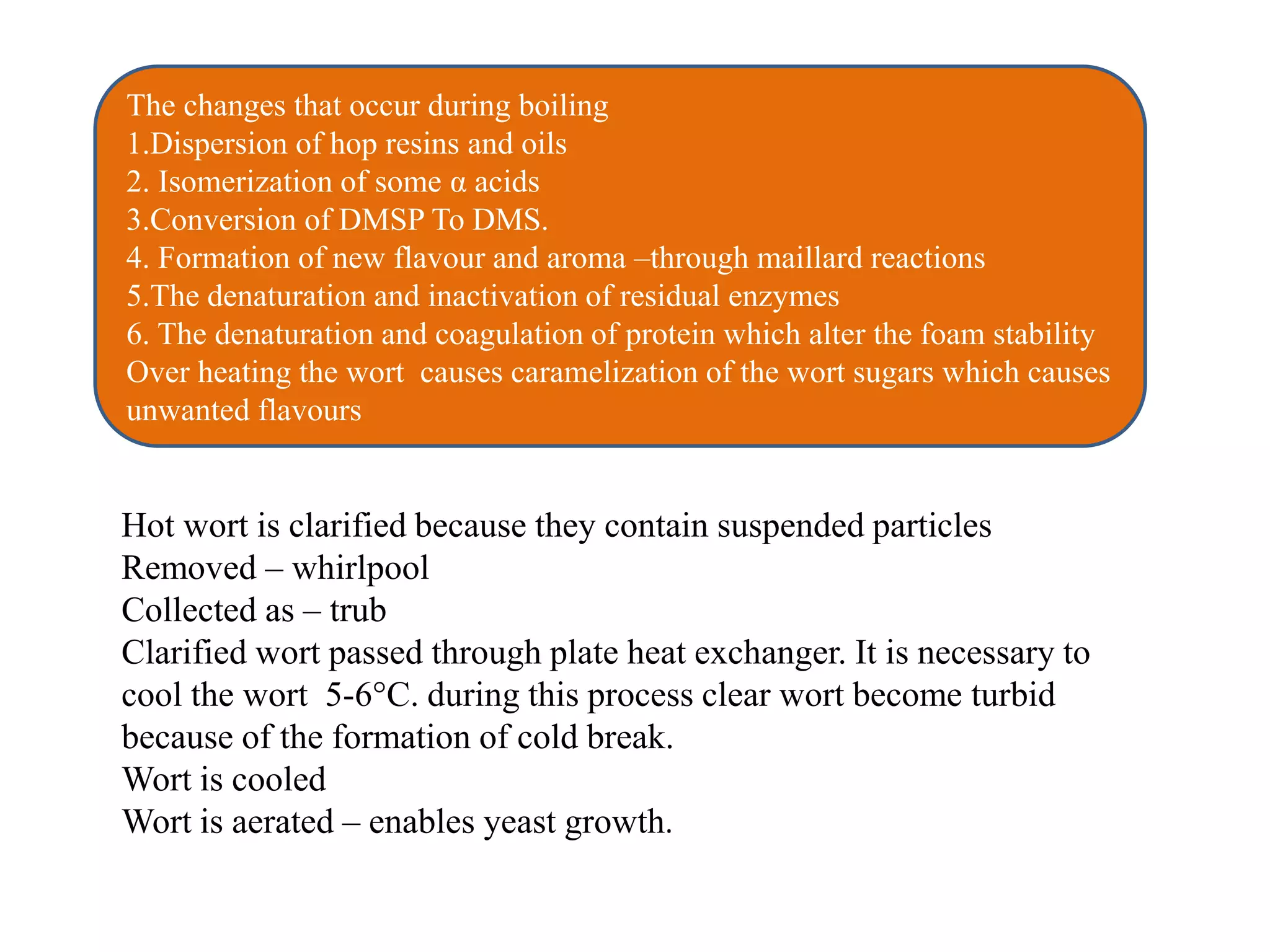
The changes that occur during boiling
1.Dispersion of hop resins and oils
2. Isomerization of some α acids
3.Conversion of DMSP To DMS.
4. Formation of new flavour and aroma –through maillard reactions
5.The denaturation and inactivation of residual enzymes
6. The denaturation and coagulation of protein which alter the foam stability
Over heating the wort causes caramelization of the wort sugars which causes
unwanted flavours
Hot wort is clarified because they contain suspended particles
Removed – whirlpool
Collected as – trub
Clarified wort passed through plate heat exchanger. It is necessary to
cool the wort 5-6°C. during this process clear wort become turbid
because of the formation of cold break.
Wort is cooled
Wort is aerated – enables yeast growth.
Fermentation
• Uses single strand of yeast-
Saccharomyces cereviaciae
• Follows Emden-Meyerhoff-Parnas
pathway (glycolysis) ending in ethanol
• Must Avoid bacterial / wild yeast
infection
• Requires steady temperature
EMP Pathway(glycolytic pathway)
ATP ADP
Hexokinase
Phosphoglucose
isomerase
ATP
ADP
Fructose
Bisphosphate
aldolase
+
Glycolysis
Triosephosphate
isomerase
Glyceraldehyde
phosphate
dehydrogenase
NAD+ NADH
NAD+ NADH
ADP
ATP
ADP
ATP
Phosphoglycerate
mutase
H2O
H2O
Enolase
Formation of Ethanol
ADP ATP
Pyruvate
kinase
CO2
NADH NAD+
Typical concentrations of ethanol formed: 40 to 60 g/L
Growth phase of yeast
• Lag phase- cell mobilize actively
• Exponential phase or log phase- the cells
divide at a constant rate
• Stationary phase- the growth rate remains
constant.
• Death phase
• Fermentation by-products have a great effect
on beer.
• Contribute to the full-bodied tast of the beer
• Effect on aroma and foam stability
Fermentation by-products
1. Diacetyl
2. Higher alcohols
3. Esters
4. Aldehydes
5. Sulphur compounds
Yeast metabolism during fermentation
Flavour-aroma wheel for beer
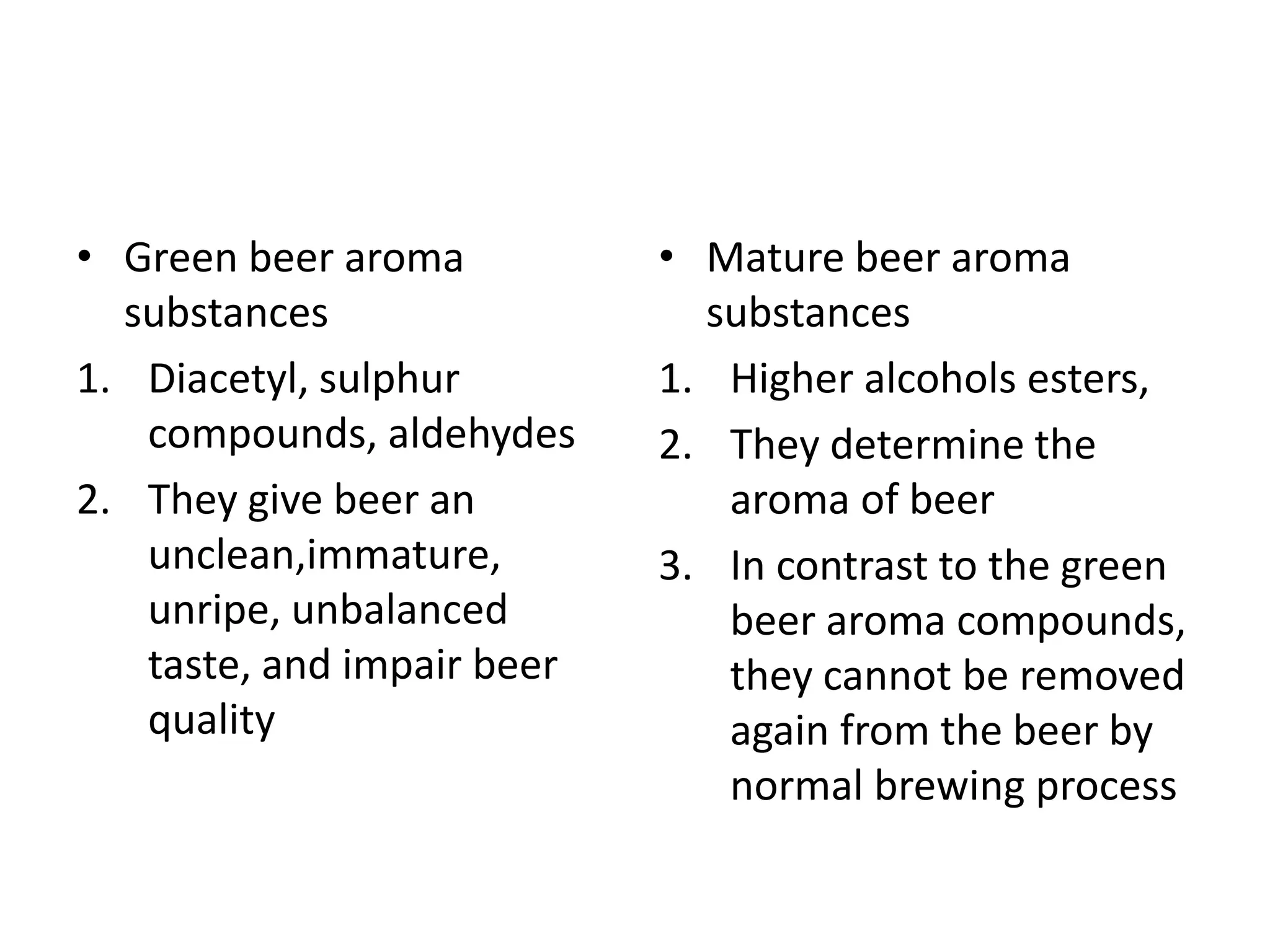
• Green beer aroma
substances
1. Diacetyl, sulphur
compounds, aldehydes
2. They give beer an
unclean,immature,
unripe, unbalanced
taste, and impair beer
quality
• Mature beer aroma
substances
1. Higher alcohols esters,
2. They determine the
aroma of beer
3. In contrast to the green
beer aroma compounds,
they cannot be removed
again from the beer by
normal brewing process
Higher alcohols
• Formed by the decarboxylation and reduction of a-
keto acids.
– From amino acid anabolism and catabolism.
esters
• Closely linked to lipid metabolism - growth.
• Reaction of an alcohol and fatty acid
intermediate
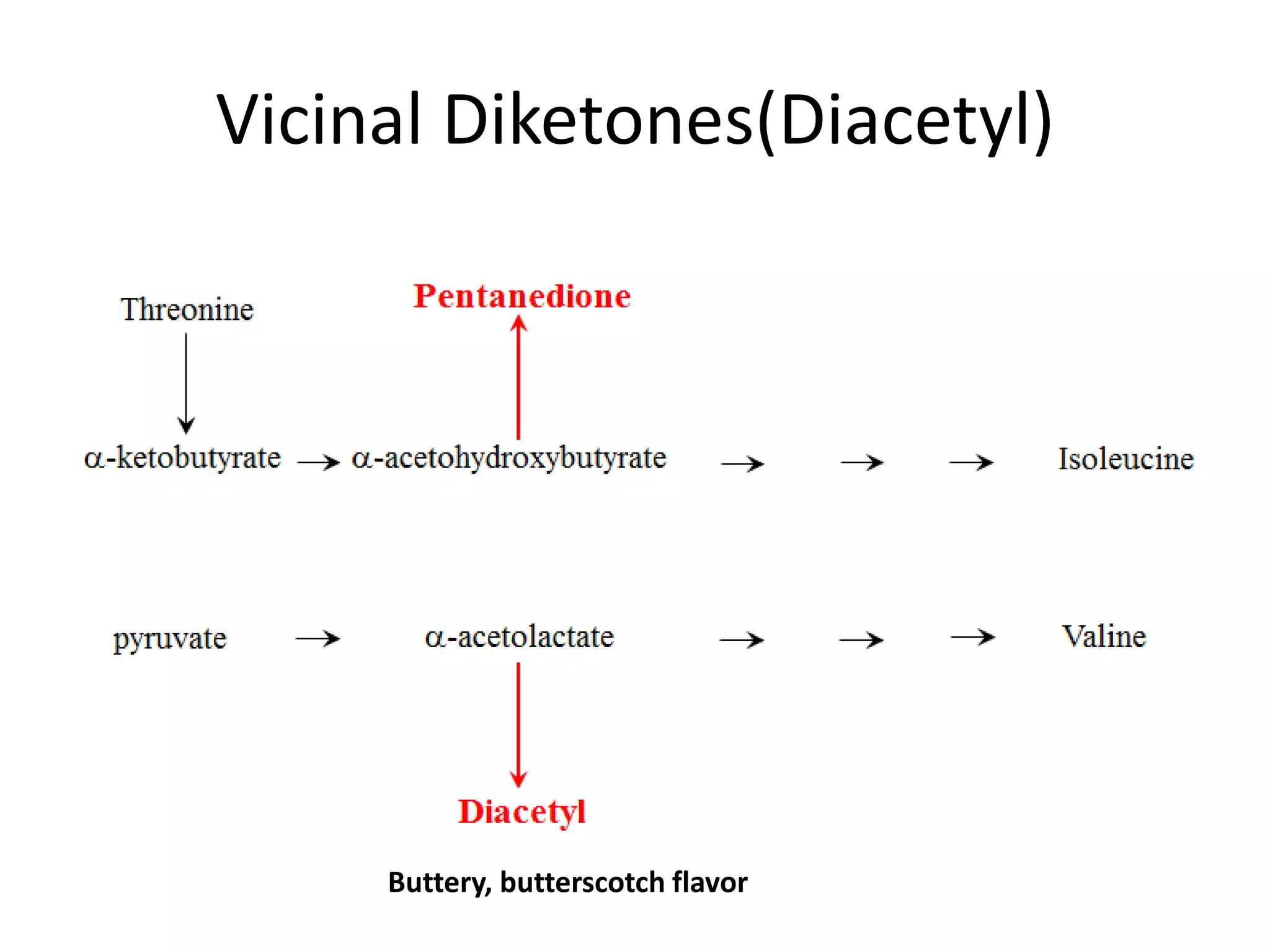
Vicinal Diketones(Diacetyl)
Buttery, butterscotch flavor
Beer treatment
• Carbonation
• Flavour/aroma changes
• Additions of colouring and flavouring
materials
• Stabilization against non-biological haze
• Clarification
• Biological stabilization
Taste Perception
• Bitterness* - on the back of the tongue
• Sweetness - on the tip
• Sourness* - on the sides of the tongue
• Saltiness - just to rear and sides of tip
Taste
• Bitterness - Hops, Tannins, Malt, Minerals
• Sweetness- Malt, Hops, Esters, Diacetyl
• Sourness- Carbonation, Contamination
• Saltiness - Minerals
Touch and Feel
• Texture - creamy, over/under carbonated
• Body - full bodied or thin...
• Astringency - Dry, puckery feeling (Not really a
flavor)
• Others - Oily, menthol-like, burning, etc
Beer quality
• Flavour-taste and aroma
• Alcoholic content-food value
• Color
• Head retention
• Clarity- absence of haze
• Absence of gushing
Chemistry in Brewing- Beer

Chemistry in Brewing- Beer

  • 1.
    CHEMISTRY IN BREWING PRIYA.S ASST PROFESSOR FPT AMET Beer! This foamy, refreshing, sparkling alcoholic beverage conjures images of parties, festivals, sporting events, and generally fun stuff.
  • 2.
    . • Beer hasbeen brewed since the ancient civilizations of Egypt and Mesopotamia. • Beer is a very old drink discovered almost 5000 years back . • Louis Pasteur also provided valuable knowledge which is still valid today, about fermentation and the essential requirements to make beer stable
  • 3.
    The Art ofBrewing
  • 4.
    Water 92.9% Ethanol 3.9% Carbohydrates2.5% Protein 0.2% Carbon dioxide 0.5% BEER COMPOSITION
  • 5.
    •BARLEY – thebody & soul of beer • YEAST – the life of beer • HOPS – the spice of beer • WATER – the integrity & purity of beer • ADJUNCTS – Additive grains like rice or corn, fruit or spices What’s in Beer?
  • 6.
    Malted Barley • Twotypes of barley  2-rowed  6-rowed • Provides fermentable sugars, flavor, and color. • Malting process:  Steeping  Germination  Kilning • Purpose:  Activate enzyme systems  Preserve for brewhouse
  • 7.
    COMPOSITION AND PROPERTISOF BARLEY KERNEL • Moisture content of barley 14 – 14.5% • Barley must have a moisture content below 15% for long time storage. Total carbohydrates 70-85% Protein 10.5-11.5% Inorganic matter 2-4% Fat 1.5-2.0% Others 1-2%
  • 8.
    STEEPING MALTING PROCESS 1. Wateruptake depends on the steeping time, temperature, kernel size, barley variety and the barley harvest year. 2. Water content of the steeped barley is called the degree of steeping expressed in percentage. eg: for pale or Pilsner malt – water content 42-44% For dark malt – a water content of 44-47% Kernel size in mm Water content In % 2.9 43.7 2.8 43.3 2.5 43.6 2.2 48.9 2.0 49.0
  • 9.
    GERMINATION PROCESS DURING GERMINATION - Growthprocesses - Enzyme formation - Metabolic changes
  • 10.
    Growth process • Rootlets-longer and warmer the germination the longer the roots become and so the greater the loss • acrospire- important feature for differentiating from barley, the length of the acrospire is relate to the progress of the metabolic changes inside the kernel acrospire exceeds the length of the kernel it is said to be overgrown
  • 11.
    Enzyme formation • Abundantin barley • They are increased during the time of germination - starch degrading enzymes • α and β amylases. • Cytolytic enzymes • β glucanases and cytase
  • 12.
    kilning • Water isremoved from the green malt. The malt then become stable and storable. Changes during kilning 1. The water content is lowered 2. Germination and modidfication are stopped 3. Color and flavour compounds are formed
  • 13.
    DMS Formation duringgermination and kilning • A volatile sulphur compound gives beer a flavour referred to as cabbagey or cooked vegetable • The higher th kilning temperature more DMS-P is converted into DMS. The flavour threshold of DMS is considered to be 50-60μg/l
  • 14.
    HOPS – thespice of beer - Germany is the largest producer. - Humulus lupulus (dioecious) - only female plant is used in brewery because they contain bitter resins ethereal oils which supply bittering and aroma components to beer. -Used as: Whole cones Pellets Extracts Lupulin glands Hop cone Isomerized hops are used because it keeps the quality of the beer unchanged for 2 years
  • 15.
  • 16.
    Cont… • MICROBIAL STABILIZATIONhops have antiseptic qualities • HOP AROMA fruity flowery characteristics • BITTERNESS balances malt sweetness • FOAM STABILIZATION enhances head properties • There are two primary hop styles: Aroma Hops – Saaz, Fuggle & Hallertua Bitter Hops – Brewer’s Gold & Unique • Hops contain 14-21% hop resin • Hops contain 0.5 – 1.5% hop oil. Oils are fromed in the lupulin glands and give hops a characteristic aroma. • Hop oil is not a single compound. It contains about 200 cmpounds.
  • 17.
    Water – “Integrity& Purity” • Water usage in a brewery is substantial and varies between 3.7-10.9 hl of water per hl of sales beer, on average it is 6hl • water makes up 92% of beer • through filtration or boiling; impurities, aromas & flavor differences can be mitigated Water treatment depends on Removal of suspended matter Removal of dissolved materials Removal of microorganisms
  • 18.
    Yeast – “Lifeof Beer” • Unicellular microorganisms- Sacchomyces cerevisiae • produces carbon dioxide and alcohol • Two types of yeast are used to produce beer: • ALE – top fermenting • LAGER – bottom fermenting
  • 19.
  • 20.
    Adjuncts • Unmalted cerealwhich is cheaper is referred to as adjunct. • Maize, maize grits, maize flakes, corn syrup, broken rice, wheat, barley, caramel, sugar(crystalline sugar) • adjuncts are added to change the flavor, character or profile of beer. • used to supplement main starch source to provide better foam retention, color or aroma
  • 21.
  • 22.
  • 23.
    mashing • Most importantproces in wort production. • Grist and water are mashed and the contents of the malt are brought into soultion and extract is obtained. • The degradation process includes 1.starch degradation . 2. β glucan degradation 3. protein degradation Starch degradation occurs in 3 stages 1. gelatinisation 2. liquefaction . 3. saccharification Gelatinisation varies fro each type of cereal malt & barley starch gelatinise in the presence of amylases at 60°C and rice starch at 80-85°C pH of the mash should be 5.4-5.6
  • 24.
    • Break downcarbohydrates into fermentable sugars • Break down proteins into usable amino acids • Choose temperature range where different enzymes are highly active for various processes • Amylases (α and β) can only break down 1,4 linkages
  • 25.
    • α amylasebreaks down the long starch to smaller dextrins at 72-75°C and destroys at 80°C. pH -5.6- 5.8 • β amylase splits maltose of from the non reducing ends of chains but it also produces glucose and maltotriose • Acts optimally at 60-65°C and sensitive at higher temperatures . pH- 5.4-5.5 • Starch breakdown should be monitored because residues of undegraded starch and larger dextrins cause starch hazes in beer
  • 26.
    Lautering - Filtration processin which spent grains play the role of the filter material - The extract retained is washed by hot water – sparging. - The wort draining off from the spent grains is called the first wort(4-6%more extract should be in beer) - The thinner wort running off is called second wort. - α amylase destroys at 80°C so the temperature is maintained during lautering
  • 27.
    Brew kettle -. 1.Extraction and transformationof hop components. 2. Evaporation of water. 3. Wort sterilization. 3. Destruction of all enzymes. 4. Increased coloration of the wort 5. Acidification of the wort 6. Formation of reducing substances 7. Effects on the DMS content of the wort. Wort boiling operations
  • 28.
    The zinc contentof the wort • Important trace element in wort is zinc atleast 0.10-0.15 mg/l • Zinc assists protein synthesis in yeast cells and controls their nucleic acid and carbohydrate metabolism. • Zinc deficiency causes fermentation problems. • Foam stability is worse when zinc is deficent. • Wort should be boiled in copper vessels because copper vessels always contain a small amount of admixed zinc. • Zinc chloride is added when stainless steel is used for wort boiling since stainless steel don’t contain zinc.
  • 29.
    The chemistry ofwort boiling • turning-point in the brewing of beers • Boiled for 1-2 hours • Boiling results in the formation of melanoidins and oxidation of polyphenols • Hop resins , hop oils and hop polyphenols – important components of hops in beer production Hop resins- bitter taste to the beer Hop oil- volatile during boiling, its added at the end of boiling i.e., 15- 20 mins before casting Hop polyphenols- water soluble , includes anthocyanogens, tannins and catechins Polyphenols – palate-fullness and bitterness of beer
  • 30.
    The changes thatoccur during boiling 1.Dispersion of hop resins and oils 2. Isomerization of some α acids 3.Conversion of DMSP To DMS. 4. Formation of new flavour and aroma –through maillard reactions 5.The denaturation and inactivation of residual enzymes 6. The denaturation and coagulation of protein which alter the foam stability Over heating the wort causes caramelization of the wort sugars which causes unwanted flavours Hot wort is clarified because they contain suspended particles Removed – whirlpool Collected as – trub Clarified wort passed through plate heat exchanger. It is necessary to cool the wort 5-6°C. during this process clear wort become turbid because of the formation of cold break. Wort is cooled Wort is aerated – enables yeast growth.
  • 31.
    Fermentation • Uses singlestrand of yeast- Saccharomyces cereviaciae • Follows Emden-Meyerhoff-Parnas pathway (glycolysis) ending in ethanol • Must Avoid bacterial / wild yeast infection • Requires steady temperature
  • 32.
    EMP Pathway(glycolytic pathway) ATPADP Hexokinase Phosphoglucose isomerase ATP ADP Fructose Bisphosphate aldolase +
  • 33.
  • 34.
    Formation of Ethanol ADPATP Pyruvate kinase CO2 NADH NAD+ Typical concentrations of ethanol formed: 40 to 60 g/L
  • 35.
    Growth phase ofyeast • Lag phase- cell mobilize actively • Exponential phase or log phase- the cells divide at a constant rate • Stationary phase- the growth rate remains constant. • Death phase
  • 36.
    • Fermentation by-productshave a great effect on beer. • Contribute to the full-bodied tast of the beer • Effect on aroma and foam stability Fermentation by-products 1. Diacetyl 2. Higher alcohols 3. Esters 4. Aldehydes 5. Sulphur compounds
  • 37.
  • 38.
  • 39.
    • Green beeraroma substances 1. Diacetyl, sulphur compounds, aldehydes 2. They give beer an unclean,immature, unripe, unbalanced taste, and impair beer quality • Mature beer aroma substances 1. Higher alcohols esters, 2. They determine the aroma of beer 3. In contrast to the green beer aroma compounds, they cannot be removed again from the beer by normal brewing process
  • 40.
    Higher alcohols • Formedby the decarboxylation and reduction of a- keto acids. – From amino acid anabolism and catabolism.
  • 41.
    esters • Closely linkedto lipid metabolism - growth. • Reaction of an alcohol and fatty acid intermediate
  • 42.
  • 43.
    Beer treatment • Carbonation •Flavour/aroma changes • Additions of colouring and flavouring materials • Stabilization against non-biological haze • Clarification • Biological stabilization
  • 44.
    Taste Perception • Bitterness*- on the back of the tongue • Sweetness - on the tip • Sourness* - on the sides of the tongue • Saltiness - just to rear and sides of tip
  • 45.
    Taste • Bitterness -Hops, Tannins, Malt, Minerals • Sweetness- Malt, Hops, Esters, Diacetyl • Sourness- Carbonation, Contamination • Saltiness - Minerals
  • 46.
    Touch and Feel •Texture - creamy, over/under carbonated • Body - full bodied or thin... • Astringency - Dry, puckery feeling (Not really a flavor) • Others - Oily, menthol-like, burning, etc
  • 47.
    Beer quality • Flavour-tasteand aroma • Alcoholic content-food value • Color • Head retention • Clarity- absence of haze • Absence of gushing

Editor's Notes

  • #47 Bitterness - The degree of bitterness can be influenced by: Hops - The most assertive influence on bitterness in beer. A dry bitterness Tannins - Tannins from husks and grains can contribute an astringency taste Malt - Roasted malts can contribute to bitterness Minerals - Mineral salts can influence the extraction of bitterness from hops and malt, influencing flavor. Sweetness - The degree of sweetness can be influenced by: Malt - Malt has the most influence on the percetion of sweetness. It can contribute unfermented sugars and unfermentable dextrins. The dextrins give beer a fuller body that can help perception of sweetness. Hops - The flowery and floral nature of hops can sometimes be interpreted as a sweetness. Esters - Esters are by-products of fermentation, are fruity in nature and can lend to the perception of sweetness. Diacetyl - Diacetyl, a by-product of fermentation, is butter-scotch flavored in nature and can lend to the perception of sweetness. Sourness - The degree of sourness is proportional to the acidity of the beer and can be influenced by Carbonation - Carbon dioxide when dissolved in beer takes the form of carbonic acid. An excessive amount of carbonation will contribute an acidic flavor to the beer Contamination - Bacterial and wild yeasts can produce acids such ans acetic acid (vinegar) and lactic acid. Saltiness - The degree of saltiness is influenced by Minerals - An excessive amount of certain minerals can contribute to a salt flavor in beer. Calcium, magnesium and sodium are usually the culprits.