BEER
Production
PRESENTED BY
Niranjan Rana
M.Sc Biotechnology
Third Semester
National College
Contents
History
Introductions
Types
Raw materials
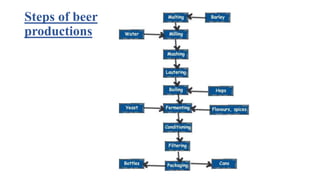
Steps of beer productions
Benefits
History
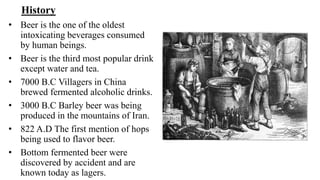
• Beer is the one of the oldest
intoxicating beverages consumed
by human beings.
• Beer is the third most popular drink
except water and tea.
• 7000 B.C Villagers in China
brewed fermented alcoholic drinks.
• 3000 B.C Barley beer was being
produced in the mountains of Iran.
• 822 A.D The first mention of hops
being used to flavor beer.
• Bottom fermented beer were
discovered by accident and are
known today as lagers.
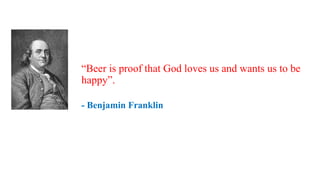
“Beer is proof that God loves us and wants us to be
happy”.
- Benjamin Franklin
Introductions
The word “BEER” derived from the Latin word “BIBERE” meaning to Drink. The old
German word for beer was “BOER” or “BIER” corresponding to the old english word
beer.
Beer is a fermented beverage principally made from four ingredients; water, malted
barley (cereals), hops, and yeast. Each one of these ingredients will impart its own
flavour characteristics to the finished product, one which is almost as old as
civilization itself.
Beer and Ale (type of beer) are important malt beverages manufactured by the
process of alcoholic fermentation of malt, malt adjuncts (maize, rice, wheat, potato,
cassava, barley, rye) hops, yeasts, water.
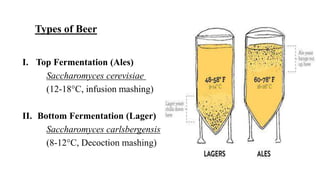
Types of Beer
I. Top Fermentation (Ales)
Saccharomyces cerevisiae
(12-18°C, infusion mashing)
II. Bottom Fermentation (Lager)
Saccharomyces carlsbergensis
(8-12°C, Decoction mashing)
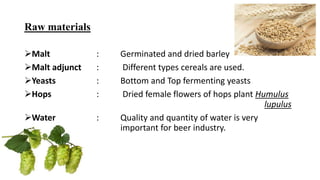
Raw materials
Malt : Germinated and dried barley
Malt adjunct : Different types cereals are used.
Yeasts : Bottom and Top fermenting yeasts
Hops : Dried female flowers of hops plant Humulus
lupulus
Water : Quality and quantity of water is very
important for beer industry.
Types of yeasts used for beer making
• Ale yeast – They can ferment at a higher temperature and form more
esters. Saccharomyces cerevisiae (12-18°C, infusion mashing)
• Lager yeast– They ferment at lower temperature and produce more
crispy taste. Saccharomyces carlsbergensis(8-12°C, Decoction
mashing)
• Wild yeast – they impart more acidic taste to the beer
Steps of beer
productions
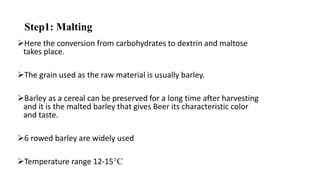
Step1: Malting
Here the conversion from carbohydrates to dextrin and maltose
takes place.
The grain used as the raw material is usually barley.
Barley as a cereal can be preserved for a long time after harvesting
and it is the malted barley that gives Beer its characteristic color
and taste.
6 rowed barley are widely used
Temperature range 12-15°C
Step2: Milling
The malt is then mixed with water to complete the conversion of
starches in the grain to sugar.
After that the grain is milled to create the proper consistency to the
malt.
Step3: Mashing
This process converts the starches released during the malting stage,
into sugars that can be fermented.
To reduce protein and cost.
Step4 : Lautering
The liquid containing the sugar extracted during mashing is now
separated from the grains. It is then generally termed as wort.
Boiling with stirring for about 2 hours.
Sterilization, enzymes inactivation and denaturation of protein
occurs.
Step5 : Boiling and Hoping
Boiling the wort, ensures its sterility, and thus prevents a lot of
infections.
Hops are added during this stage of boiling.
Hops are used to add flavor and aroma to balance the sweetness of
the malt.
Step6 : Fermenting
The yeast is now added and the Beer is fermented.
The yeast breaks down the sugars extracted from the malt to form alcohol
and CO2.
Yeast like S. cerevisia and S. carlsbergensis are uses
Carbohydrate is converted to ethanol and carbon dioxide along with
enzymes
Temperature is reduced to almost 6-15 and take 8-14 days
Step7 : Conditioning
Fermented Beer contains suspended particles, lacks sufficient
carbonation, lacks taste and aroma, and less stable.
 Conditioning reduces the levels of these undesirable compounds to
produce a more finished product.
Step8: Filtering
Filtration helps to remove excess of the yeast and any solids, like
hops or grain particles, remaining in the Beer.
 Filtering is the process which produces the clear, bright and stable
Beer.
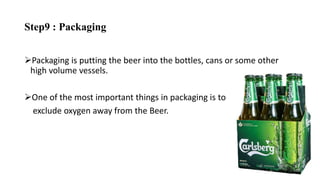
Step9 : Packaging
Packaging is putting the beer into the bottles, cans or some other
high volume vessels.
One of the most important things in packaging is to
exclude oxygen away from the Beer.
Thank You…

Beer production

  • 1.
    BEER Production PRESENTED BY Niranjan Rana M.ScBiotechnology Third Semester National College
  • 2.
  • 3.
    History • Beer isthe one of the oldest intoxicating beverages consumed by human beings. • Beer is the third most popular drink except water and tea. • 7000 B.C Villagers in China brewed fermented alcoholic drinks. • 3000 B.C Barley beer was being produced in the mountains of Iran. • 822 A.D The first mention of hops being used to flavor beer. • Bottom fermented beer were discovered by accident and are known today as lagers.
  • 4.
    “Beer is proofthat God loves us and wants us to be happy”. - Benjamin Franklin
  • 5.
    Introductions The word “BEER”derived from the Latin word “BIBERE” meaning to Drink. The old German word for beer was “BOER” or “BIER” corresponding to the old english word beer. Beer is a fermented beverage principally made from four ingredients; water, malted barley (cereals), hops, and yeast. Each one of these ingredients will impart its own flavour characteristics to the finished product, one which is almost as old as civilization itself. Beer and Ale (type of beer) are important malt beverages manufactured by the process of alcoholic fermentation of malt, malt adjuncts (maize, rice, wheat, potato, cassava, barley, rye) hops, yeasts, water.
  • 6.
    Types of Beer I.Top Fermentation (Ales) Saccharomyces cerevisiae (12-18°C, infusion mashing) II. Bottom Fermentation (Lager) Saccharomyces carlsbergensis (8-12°C, Decoction mashing)
  • 7.
    Raw materials Malt :Germinated and dried barley Malt adjunct : Different types cereals are used. Yeasts : Bottom and Top fermenting yeasts Hops : Dried female flowers of hops plant Humulus lupulus Water : Quality and quantity of water is very important for beer industry.
  • 8.
    Types of yeastsused for beer making • Ale yeast – They can ferment at a higher temperature and form more esters. Saccharomyces cerevisiae (12-18°C, infusion mashing) • Lager yeast– They ferment at lower temperature and produce more crispy taste. Saccharomyces carlsbergensis(8-12°C, Decoction mashing) • Wild yeast – they impart more acidic taste to the beer
  • 9.
  • 10.
    Step1: Malting Here theconversion from carbohydrates to dextrin and maltose takes place. The grain used as the raw material is usually barley. Barley as a cereal can be preserved for a long time after harvesting and it is the malted barley that gives Beer its characteristic color and taste. 6 rowed barley are widely used Temperature range 12-15°C
  • 11.
    Step2: Milling The maltis then mixed with water to complete the conversion of starches in the grain to sugar. After that the grain is milled to create the proper consistency to the malt.
  • 12.
    Step3: Mashing This processconverts the starches released during the malting stage, into sugars that can be fermented. To reduce protein and cost.
  • 13.
    Step4 : Lautering Theliquid containing the sugar extracted during mashing is now separated from the grains. It is then generally termed as wort. Boiling with stirring for about 2 hours. Sterilization, enzymes inactivation and denaturation of protein occurs.
  • 14.
    Step5 : Boilingand Hoping Boiling the wort, ensures its sterility, and thus prevents a lot of infections. Hops are added during this stage of boiling. Hops are used to add flavor and aroma to balance the sweetness of the malt.
  • 15.
    Step6 : Fermenting Theyeast is now added and the Beer is fermented. The yeast breaks down the sugars extracted from the malt to form alcohol and CO2. Yeast like S. cerevisia and S. carlsbergensis are uses Carbohydrate is converted to ethanol and carbon dioxide along with enzymes Temperature is reduced to almost 6-15 and take 8-14 days
  • 16.
    Step7 : Conditioning FermentedBeer contains suspended particles, lacks sufficient carbonation, lacks taste and aroma, and less stable.  Conditioning reduces the levels of these undesirable compounds to produce a more finished product.
  • 17.
    Step8: Filtering Filtration helpsto remove excess of the yeast and any solids, like hops or grain particles, remaining in the Beer.  Filtering is the process which produces the clear, bright and stable Beer.
  • 18.
    Step9 : Packaging Packagingis putting the beer into the bottles, cans or some other high volume vessels. One of the most important things in packaging is to exclude oxygen away from the Beer.
  • 20.