Consumer Behaviour
Concepts and
Applications
Not a simple picture !!!
1
To consider
 influences on consumer buying processes
 problem-solving: pleasure seeking (irrational) vs.
rational views of buying
 how we construe our buying/spending: perceptions,
attitudes & motivations
 pre-exchange, in the exchange itself & post exchange
 categories of influence:
 environmental and cultural
 individual and reference groups
 Insights from learning theory
 B2C and B2B organisational buying behaviours
 marketing strategy & communications design
implications
22
Obviously
 Individual customers & organisational
customers buy goods & services
 They are stimulated & prompted to buy
Marketers
 are interested in their decision behaviour
 try to stimulate & influence this behaviour to
get better responses from the customer
33
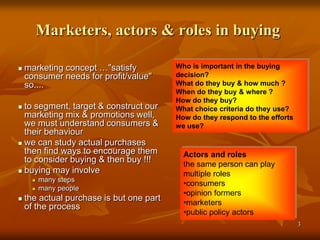
Marketers, actors & roles in buying
 marketing concept …"satisfy
consumer needs for profit/value"
so....
 to segment, target & construct our
marketing mix & promotions well,
we must understand consumers &
their behaviour
 we can study actual purchases
then find ways to encourage them
to consider buying & then buy !!!
 buying may involve
 many steps
 many people
 the actual purchase is but one part
of the process
Actors and roles
the same person can play
multiple roles
•consumers
•opinion formers
•marketers
•public policy actors
Who is important in the buying
decision?
What do they buy & how much ?
When do they buy & where ?
How do they buy?
What choice criteria do they use?
How do they respond to the efforts
we use?
4
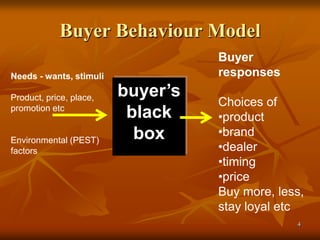
Buyer Behaviour Model
4
buyer’s
black
box
Needs - wants, stimuli
Product, price, place,
promotion etc
Environmental (PEST)
factors
Buyer
responses
Choices of
•product
•brand
•dealer
•timing
•price
Buy more, less,
stay loyal etc
55
Information search
How we buy (a rational view)
Need recognition,
problem-awareness
Evaluate alternatives
Information search
Buy
Post-purchase
evaluation
Shape desire, want
Evaluate alternatives (against evoked set)
Window-shop – simmering interests
Buy
Post-purchase
evaluation
• functional
• emotional ?
• current vs desired situation
• relative importance
• need inhibitors
• are they aware of need ?
• can we mediate need inhibitors?
• can we stimulate awareness &
action
• internal search (memory)
• external search (personal
sources, commercial sources
• third party reports (e.g. Which)
• personal observation/testing
Evoked
set
Operant (or instrumental) conditioning
 Learning based upon the consequences of
behaviour
 the chance of a specific behaviour goes  or 
thru +ve or -ve reinforcement each time the
behaviour happens
 we associate the pleasure or displeasure of the
reinforcement with the behaviour
 Consequences of responding that increase
behaviour are “reinforcers”
 Marketers want to know the “reinforcers”
6
Responses are reinforced, punished,
or extinguished 1
Reinforcement is …
 a consequence that  more frequent behaviour
Positive reinforcement
 a behaviour (response)  a favourable stimulus
(commonly pleasant)  increasing the frequency
of the behaviour
Negative reinforcement
 a behaviour (response)  lessening of an aversive
stimulus (commonly unpleasant) increasing that
behaviours frequency
7
Responses are reinforced, punished,
or extinguished 2
Punishment
 a consequence that causes a behaviour to occur less
often
Positive punishment ("P. by contingent stimulation")
 a behaviour (response)  an aversive stimulus 
a decrease in the behaviour.
Negative punishment ("P. by contingent withdrawal")
 a behaviour (response)  removal of a favourable
stimulus e.g. taking away a naughty child's toy, resulting
in less of that behaviour
8
Responses are reinforced,
punished, or extinguished 3
Avoidance learning
 a behaviour r  ending of an aversive
stimulus e.g. we no longer contact someone &
so avoid their unpleasantness.
Extinction
 a behaviour (response) that had previously been
reinforced is no longer effective
 the lack of any consequence following a
behaviour
9
1010
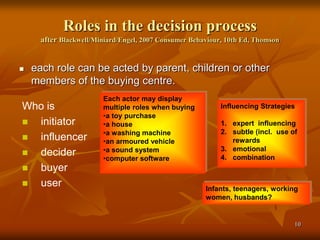
Roles in the decision process
after Blackwell/Miniard/Engel, 2007 Consumer Behaviour, 10th Ed, Thomson
 each role can be acted by parent, children or other
members of the buying centre.
Each actor may display
multiple roles when buying
•a toy purchase
•a house
•a washing machine
•an armoured vehicle
•a sound system
•computer software
Infants, teenagers, working
women, husbands?
Influencing Strategies
1. expert influencing
2. subtle (incl. use of
rewards
3. emotional
4. combination
Who is
 initiator
 influencer
 decider
 buyer
 user
11
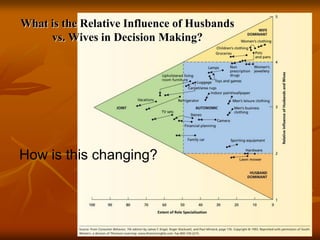
What is the Relative Influence of Husbands
vs. Wives in Decision Making?
How is this changing?
1212
Influences on Consumer
Behaviour
Cultural
 broadest & deepest influence
 cultures & subculture
 social classes
Social
 Family
 Social roles and status (multiple)
 Reference groups
 Membership - primary vs. secondary
 Aspirational vs. dissociative
Personal
 Age
 Life cycle stage
 Occupation
 Economic circumstances
 Lifestyle
 Personality
 Self-concept
Psychological
 Motivation
 Perception
 Learning
 Beliefs
 Attitudes
1313
Personal influences
Perception
 "mind" processes - selection, association,
organisation & interpretation. We
 only note some things (selective) i.e. what
grabs attention + distortion & retention
 associate & categorise information into
meaningful wholes
 interpret/make inferences
 information framing e.g.
 good news or bad news first ?
 accentuate the positives, eliminate the
negatives
Learning
 classical & operant conditioning
 cognitive learning
by rote
vicarious (from others)
reasoning
 what motivates us
 what we believe in
 real knowledge, opinion or
faith
 Our attitudes
 relatively consistent
evaluations, feelings,
tendencies towards something
 Three components
 cognitive (belief),
 affective (feeling),
 conative (behavioural)
 personality
 self-concept, lifestyle
& life cycle stages
14
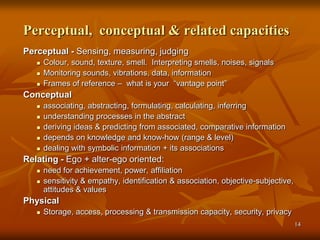
Perceptual, conceptual & related capacities
Perceptual - Sensing, measuring, judging
 Colour, sound, texture, smell. Interpreting smells, noises, signals
 Monitoring sounds, vibrations, data, information
 Frames of reference – what is your “vantage point”
Conceptual
 associating, abstracting, formulating, calculating, inferring
 understanding processes in the abstract
 deriving ideas & predicting from associated, comparative information
 depends on knowledge and know-how (range & level)
 dealing with symbolic information + its associations
Relating - Ego + alter-ego oriented:
 need for achievement, power, affiliation
 sensitivity & empathy, identification & association, objective-subjective,
attitudes & values
Physical
 Storage, access, processing & transmission capacity, security, privacy
15
Concepts in socio-cultural
examination
Culture
 a socially constructed complex of
values, ideas, attitudes, institutions,
meanings & symbols that shape
and are shaped by behaviour &
maybe passed on thru generations
Social Class
 relatively permanent divisions in a
society into which individuals or
families may be categorized
 based on perceived status &
prestige.
Sub- or Micro-culture
 a sub-group with its own
distinguishing modes of behaviour.
Role
 Behaviours, rights, duties expected
of an individual in a group by other
members
Reference groups
 structures & standards
influence behaviour.
Membership
 groups we actually belong to
Aspirational
 We wish to associate with
this group.
Disassociative
 We do not want to be
identified with this group.
Power studies
 how roles, groups & norms
influence individual
behaviour.
16
Opinion formers
 Trendsetters
 influential people in a group who
 purchase new products early
 serve as information sources for others
 The Media
 TV, newspapers, magazines, Internet communication
 commentators
 the media need "stories"
 Sellers & Marketers
 "seeding" the media. Pay media producers for product
placement in "publication channels"
 From a Fashion house to Primark
 Advertising, promotions & incentives
 Word-of-mouth - viral
19
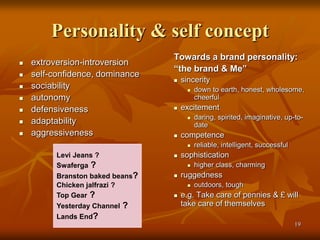
Personality & self concept
 extroversion-introversion
 self-confidence, dominance
 sociability
 autonomy
 defensiveness
 adaptability
 aggressiveness
Towards a brand personality:
“the brand & Me”
 sincerity
 down to earth, honest, wholesome,
cheerful
 excitement
 daring, spirited, imaginative, up-to-
date
 competence
 reliable, intelligent, successful
 sophistication
 higher class, charming
 ruggedness
 outdoors, tough
 e.g. Take care of pennies & £ will
take care of themselves
Levi Jeans ?
Swaferga ?
Branston baked beans?
Chicken jalfrazi ?
Top Gear ?
Yesterday Channel ?
Lands End?
20
Components of Attitude
Attitude
(overall orientation
toward object or idea)
Cognitive
(knowledge & beliefs
about a subject/object)
Affective
(overall feelings or
emotive reactions)
Behavioural
(how we tend to behave)
A person’s enduring
favourable or
unfavourable evaluation
of some object or idea
21
Choice criteria
 attributes & variables a
consumer uses when
evaluating products &
services
 different members of
buying centre obviously
may use different criteria
 e.g. a teenager or a WAG
(self-image), a parent (for
the baby), an OAP (price
or risk reduction)
Social
status
social
belonging
fashion
Personal
self-image
risk reduction
morals
emotion
Technical
reliability
durability
performance
style/looks
comfort
delivery
convenience
taste
Economic
price, VfM
running costs
residual
value
life cycle
costs
22
Consumer Problem-Solving
Categories
 Routinised (habitual)
 repeat buys.
 Advertising may influence a change – also
promotions (2 for 1), branding to keep product in
customer’s mind
 Limited problem solving (LPS)
 buyer has some experience, may check prices
etc. Buyers can advertise to stimulate & compare
or reduce risk of brand switching
 Extended problem solving (EPS)
23
Extended problem-solving
 Research all choice
alternatives + examine
solutions
alternatives are
differentiated &
numerous
high deliberation &
involvement time
personally relevant
(risks)
 high potential for
cognitive dissonance
self-image
risks
social
factors
24
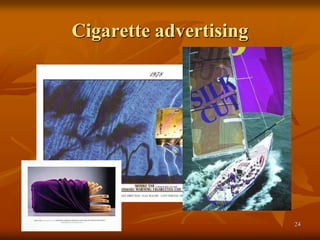
Cigarette advertising
Cognitive dissonance
(after Festinger)
 discomfort when facing logical inconsistencies in our
thinking (cognitions) e.g. a belief in animal rights may be
seen as inconsistent with eating meat or wearing fur.
 We may feel anxiety assoc. with bad decisions: guilt,
shame, anger, embarrassment, stress or other. This can
lead to rationalisation: justifications to support our
choices or change in attitudes, beliefs & behaviours.
 When ideas are consistent … harmony or consonance.
 If cognitions are unrelated, they are "irrelevant" not
dissonant. 25
Aesop's "The Fox and the Grapes"
A fox sees some tasty, grapes high on the
vine but can't think how to reach them. He
concludes that the grapes are probably not
worth eating anyway (not yet ripe, too
sour).
Nb. dissonance in the desire for something
unattainable & so the fox irrationally
decides that the "thing" must be flawed
(Sour Grapes).
26
Smoking
 we know that cigarettes cause lung cancer
 we want to live a long and healthy life
 we can
 quit smoking & reduce the tension between the contradictory
ideas or
 deny conclusions about lung cancer or justify our smoking
 “Only a few smokers become ill". "It only happens to very
heavy smokers“. "If smoking does not kill me, something
else will." "I am a smart, reasonable person who makes
good decisions." Easier to make excuses than to change
behaviour. Humans are rationalizing and not always
rational.
27
28
Social classes
 Upper Uppers
 Lower Uppers
 Upper Middles
 Middle Class
 Working Class
 Upper Lowers
 Lower Lowers
Chavs
• slang (UK) for a subcultural stereotype
• Aspirants who want to be in a "class"
above their actual class.
• spend on fashion for upward social
mobility.
• fixated on fashion 'designer' clothing,
handbags, gold jewelery e.g.
Burberry,
• trying to adopt lifestyle of admired,
referent class but not seen as
successful.
• considered to be in poor taste,
ignorant,
• labelled as "trying too hard, not worthy
enough".
29
VALS2 psychographic groups
 Actualizers
 Fulfilleds
 Achievers
 Experiencers
 Believers
 Strivers
 Makers
 Strugglers
 How do you see
each category
behaving as
buyers?
30
Forrester Technographics
customer segments by motivation, desire & ability to
invest in technology
30
31
Start here
Explain the customer behaviour appeals being
used by … each of the following …
 a selected product group within e.g. Gillette
 a company within the earth-moving equipment industry e.g.
JCB, Caterpillar, Komatsu etc
 A group within the hotel sector including: Hilton, Accor,
Travelodge, Townhouse
 HMV
What common or different customer behaviour appeals are being
used by
 http://www.wickes.co.uk/
 http://www.screwfix.com
 http://www.diy.com/
 http://www.homebase.co.uk
32
Explain the following in terms of consumer
behaviour debate
 fitting rooms
 return of goods policies e.g. B&Q, Next on-line
 2-for-1, 20% bigger
 interest free for
 3 months (over £300)
 3-years (DFS)
 "Never knowingly undersold" - John Lewis Partnership
 free delivery over £15 (Amazon)
 main dealer trade in values, old car-new car
 easy financing terms
 free insurance
 mobile phone automatic new model + cheaper contract + extras
 home deliveries e.g. Tesco
 £15 (21 days in advance), £26 (7 days), £55 – with on-line booking -
Travelodge
 4x Tesco Club Card points value for Cafe Rouge vouchers (£8 = £32)
33
Post-purchase evaluation
 We want customer to have positive experiences
from purchase but they may experience
Cognitive Dissonance
Pre-purchase, purchase or post-purchase
 attitudes & behaviour should be consistent with one
another. If you buy a car & your friend thinks that it is
rubbish …..
 uncertainty – "Have I made the right decision?"
 feel anxiety, disappointment, remorse
 discrepancy between expectation & experience
 reflect on opportunity cost and lost - difficult
decision, many alternatives
 irrevocable decision
 neurotic customer (impulse buy)
 post-purchase remorse
What can
marketer &
seller do?
34
Post-purchase Behaviour
 expectations are compared to performance
 post-purchase satisfaction influences future
behaviour
 future purchasing behaviour
 word-of-mouth communication
 Marketers try to influence post-purchase
behaviour. How ?
 Post-purchase communication to reduce dissonance,
returns & order cancellations
 Talk with customers:
 discover new uses for existing products
 etc
35
Evaluate Harley-Davidson Consumer Behaviour
 Hells Angels ? Burly,
leathers, bikers, rebels
 New breed:
 older
 more affluent
 better educated
 rubbies (rich urbans)
 Showrooms + sales
approaches
 Customer types from HD
research
 adventure-loving traditionalists
 sensitive pragmatists
 stylish status seekers
 laid-back campers
 classy capitalists
 cool-headed loners
 cocky misfits
 all loved their Harleys because
 independence, freedom, power
 more than a machine – part of
self-expression
 classic look, throaty sound
 American legend
36
Scope of B2B Market
 Agriculture
 Mining
 Construction
 Manufacturing
 Transport
 Wholesale & retail
 Finance, insurance,
property
 Government
 Non-profit & voluntary
organisations
 different needs & buying
patterns e.g. medical from
rubber gloves vs body scanner
 buy raw materials/inputs to
make other goods/services e.g.
sugar & flavouring as inputs for
Pepsi
 sell on to other business users
or consumers e.g. Argos
 use purchases to conduct
business e.g. stationery, legal
services, IT/systems
consultancy, marketing services
37
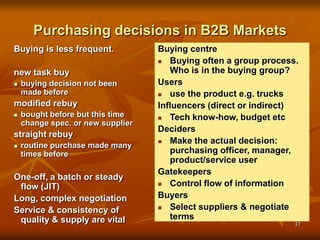
Purchasing decisions in B2B Markets
Buying is less frequent.
new task buy
 buying decision not been
made before
modified rebuy
 bought before but this time
change spec. or new supplier
straight rebuy
 routine purchase made many
times before
One-off, a batch or steady
flow (JIT)
Long, complex negotiation
Service & consistency of
quality & supply are vital
Buying centre
 Buying often a group process.
Who is in the buying group?
Users
 use the product e.g. trucks
Influencers (direct or indirect)
 Tech know-how, budget etc
Deciders
 Make the actual decision:
purchasing officer, manager,
product/service user
Gatekeepers
 Control flow of information
Buyers
 Select suppliers & negotiate
terms
38
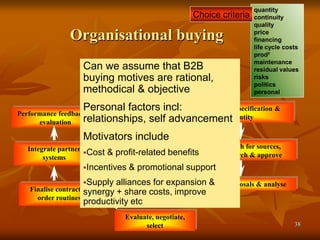
Organisational buying
Need recognition,
problem-awareness
Evaluate, negotiate,
select
Search for sources,
research & approve
Finalise contract &
order routines
Performance feedback &
evaluation
Determine specification &
quantity
Receive proposals & analyse
Integrate partner
systems
competition
legal steps
financing
JIT
logistics
conflict
outsourcing
quantity
continuity
quality
price
financing
life cycle costs
prody
maintenance
residual values
risks
politics
personal
Choice criteria
Can we assume that B2B
buying motives are rational,
methodical & objective
Personal factors incl:
relationships, self advancement
Motivators include
Cost & profit-related benefits
Incentives & promotional support
Supply alliances for expansion &
synergy + share costs, improve
productivity etc
39
Relationship Marketing
establishing & developing successful exchanges with customers.
Influences
global competition & defensive strategies. Growth in services
(direct relationships). Focus on the ‘value chain’ + the ‘value
proposition’ incl offering specific competencies
Customer relationship management (CRM)
maximise customer retention & share of customer’s business
past behaviour is important
The future involves
increased WWW use – direct marketing & personalisation
costs of servicing unprofitable customers
focus on better servicing of other customers

Consumer Behaviour Concepts & Applications {Lecture Notes}

  • 1.
  • 2.
    1 To consider  influenceson consumer buying processes  problem-solving: pleasure seeking (irrational) vs. rational views of buying  how we construe our buying/spending: perceptions, attitudes & motivations  pre-exchange, in the exchange itself & post exchange  categories of influence:  environmental and cultural  individual and reference groups  Insights from learning theory  B2C and B2B organisational buying behaviours  marketing strategy & communications design implications
  • 3.
    22 Obviously  Individual customers& organisational customers buy goods & services  They are stimulated & prompted to buy Marketers  are interested in their decision behaviour  try to stimulate & influence this behaviour to get better responses from the customer
  • 4.
    33 Marketers, actors &roles in buying  marketing concept …"satisfy consumer needs for profit/value" so....  to segment, target & construct our marketing mix & promotions well, we must understand consumers & their behaviour  we can study actual purchases then find ways to encourage them to consider buying & then buy !!!  buying may involve  many steps  many people  the actual purchase is but one part of the process Actors and roles the same person can play multiple roles •consumers •opinion formers •marketers •public policy actors Who is important in the buying decision? What do they buy & how much ? When do they buy & where ? How do they buy? What choice criteria do they use? How do they respond to the efforts we use?
  • 5.
    4 Buyer Behaviour Model 4 buyer’s black box Needs- wants, stimuli Product, price, place, promotion etc Environmental (PEST) factors Buyer responses Choices of •product •brand •dealer •timing •price Buy more, less, stay loyal etc
  • 6.
    55 Information search How webuy (a rational view) Need recognition, problem-awareness Evaluate alternatives Information search Buy Post-purchase evaluation Shape desire, want Evaluate alternatives (against evoked set) Window-shop – simmering interests Buy Post-purchase evaluation • functional • emotional ? • current vs desired situation • relative importance • need inhibitors • are they aware of need ? • can we mediate need inhibitors? • can we stimulate awareness & action • internal search (memory) • external search (personal sources, commercial sources • third party reports (e.g. Which) • personal observation/testing Evoked set
  • 7.
    Operant (or instrumental)conditioning  Learning based upon the consequences of behaviour  the chance of a specific behaviour goes  or  thru +ve or -ve reinforcement each time the behaviour happens  we associate the pleasure or displeasure of the reinforcement with the behaviour  Consequences of responding that increase behaviour are “reinforcers”  Marketers want to know the “reinforcers” 6
  • 8.
    Responses are reinforced,punished, or extinguished 1 Reinforcement is …  a consequence that  more frequent behaviour Positive reinforcement  a behaviour (response)  a favourable stimulus (commonly pleasant)  increasing the frequency of the behaviour Negative reinforcement  a behaviour (response)  lessening of an aversive stimulus (commonly unpleasant) increasing that behaviours frequency 7
  • 9.
    Responses are reinforced,punished, or extinguished 2 Punishment  a consequence that causes a behaviour to occur less often Positive punishment ("P. by contingent stimulation")  a behaviour (response)  an aversive stimulus  a decrease in the behaviour. Negative punishment ("P. by contingent withdrawal")  a behaviour (response)  removal of a favourable stimulus e.g. taking away a naughty child's toy, resulting in less of that behaviour 8
  • 10.
    Responses are reinforced, punished,or extinguished 3 Avoidance learning  a behaviour r  ending of an aversive stimulus e.g. we no longer contact someone & so avoid their unpleasantness. Extinction  a behaviour (response) that had previously been reinforced is no longer effective  the lack of any consequence following a behaviour 9
  • 11.
    1010 Roles in thedecision process after Blackwell/Miniard/Engel, 2007 Consumer Behaviour, 10th Ed, Thomson  each role can be acted by parent, children or other members of the buying centre. Each actor may display multiple roles when buying •a toy purchase •a house •a washing machine •an armoured vehicle •a sound system •computer software Infants, teenagers, working women, husbands? Influencing Strategies 1. expert influencing 2. subtle (incl. use of rewards 3. emotional 4. combination Who is  initiator  influencer  decider  buyer  user
  • 12.
    11 What is theRelative Influence of Husbands vs. Wives in Decision Making? How is this changing?
  • 13.
    1212 Influences on Consumer Behaviour Cultural broadest & deepest influence  cultures & subculture  social classes Social  Family  Social roles and status (multiple)  Reference groups  Membership - primary vs. secondary  Aspirational vs. dissociative Personal  Age  Life cycle stage  Occupation  Economic circumstances  Lifestyle  Personality  Self-concept Psychological  Motivation  Perception  Learning  Beliefs  Attitudes
  • 14.
    1313 Personal influences Perception  "mind"processes - selection, association, organisation & interpretation. We  only note some things (selective) i.e. what grabs attention + distortion & retention  associate & categorise information into meaningful wholes  interpret/make inferences  information framing e.g.  good news or bad news first ?  accentuate the positives, eliminate the negatives Learning  classical & operant conditioning  cognitive learning by rote vicarious (from others) reasoning  what motivates us  what we believe in  real knowledge, opinion or faith  Our attitudes  relatively consistent evaluations, feelings, tendencies towards something  Three components  cognitive (belief),  affective (feeling),  conative (behavioural)  personality  self-concept, lifestyle & life cycle stages
  • 15.
    14 Perceptual, conceptual &related capacities Perceptual - Sensing, measuring, judging  Colour, sound, texture, smell. Interpreting smells, noises, signals  Monitoring sounds, vibrations, data, information  Frames of reference – what is your “vantage point” Conceptual  associating, abstracting, formulating, calculating, inferring  understanding processes in the abstract  deriving ideas & predicting from associated, comparative information  depends on knowledge and know-how (range & level)  dealing with symbolic information + its associations Relating - Ego + alter-ego oriented:  need for achievement, power, affiliation  sensitivity & empathy, identification & association, objective-subjective, attitudes & values Physical  Storage, access, processing & transmission capacity, security, privacy
  • 16.
    15 Concepts in socio-cultural examination Culture a socially constructed complex of values, ideas, attitudes, institutions, meanings & symbols that shape and are shaped by behaviour & maybe passed on thru generations Social Class  relatively permanent divisions in a society into which individuals or families may be categorized  based on perceived status & prestige. Sub- or Micro-culture  a sub-group with its own distinguishing modes of behaviour. Role  Behaviours, rights, duties expected of an individual in a group by other members Reference groups  structures & standards influence behaviour. Membership  groups we actually belong to Aspirational  We wish to associate with this group. Disassociative  We do not want to be identified with this group. Power studies  how roles, groups & norms influence individual behaviour.
  • 17.
    16 Opinion formers  Trendsetters influential people in a group who  purchase new products early  serve as information sources for others  The Media  TV, newspapers, magazines, Internet communication  commentators  the media need "stories"  Sellers & Marketers  "seeding" the media. Pay media producers for product placement in "publication channels"  From a Fashion house to Primark  Advertising, promotions & incentives  Word-of-mouth - viral
  • 18.
    19 Personality & selfconcept  extroversion-introversion  self-confidence, dominance  sociability  autonomy  defensiveness  adaptability  aggressiveness Towards a brand personality: “the brand & Me”  sincerity  down to earth, honest, wholesome, cheerful  excitement  daring, spirited, imaginative, up-to- date  competence  reliable, intelligent, successful  sophistication  higher class, charming  ruggedness  outdoors, tough  e.g. Take care of pennies & £ will take care of themselves Levi Jeans ? Swaferga ? Branston baked beans? Chicken jalfrazi ? Top Gear ? Yesterday Channel ? Lands End?
  • 19.
    20 Components of Attitude Attitude (overallorientation toward object or idea) Cognitive (knowledge & beliefs about a subject/object) Affective (overall feelings or emotive reactions) Behavioural (how we tend to behave) A person’s enduring favourable or unfavourable evaluation of some object or idea
  • 20.
    21 Choice criteria  attributes& variables a consumer uses when evaluating products & services  different members of buying centre obviously may use different criteria  e.g. a teenager or a WAG (self-image), a parent (for the baby), an OAP (price or risk reduction) Social status social belonging fashion Personal self-image risk reduction morals emotion Technical reliability durability performance style/looks comfort delivery convenience taste Economic price, VfM running costs residual value life cycle costs
  • 21.
    22 Consumer Problem-Solving Categories  Routinised(habitual)  repeat buys.  Advertising may influence a change – also promotions (2 for 1), branding to keep product in customer’s mind  Limited problem solving (LPS)  buyer has some experience, may check prices etc. Buyers can advertise to stimulate & compare or reduce risk of brand switching  Extended problem solving (EPS)
  • 22.
    23 Extended problem-solving  Researchall choice alternatives + examine solutions alternatives are differentiated & numerous high deliberation & involvement time personally relevant (risks)  high potential for cognitive dissonance self-image risks social factors
  • 23.
  • 24.
    Cognitive dissonance (after Festinger) discomfort when facing logical inconsistencies in our thinking (cognitions) e.g. a belief in animal rights may be seen as inconsistent with eating meat or wearing fur.  We may feel anxiety assoc. with bad decisions: guilt, shame, anger, embarrassment, stress or other. This can lead to rationalisation: justifications to support our choices or change in attitudes, beliefs & behaviours.  When ideas are consistent … harmony or consonance.  If cognitions are unrelated, they are "irrelevant" not dissonant. 25
  • 25.
    Aesop's "The Foxand the Grapes" A fox sees some tasty, grapes high on the vine but can't think how to reach them. He concludes that the grapes are probably not worth eating anyway (not yet ripe, too sour). Nb. dissonance in the desire for something unattainable & so the fox irrationally decides that the "thing" must be flawed (Sour Grapes). 26
  • 26.
    Smoking  we knowthat cigarettes cause lung cancer  we want to live a long and healthy life  we can  quit smoking & reduce the tension between the contradictory ideas or  deny conclusions about lung cancer or justify our smoking  “Only a few smokers become ill". "It only happens to very heavy smokers“. "If smoking does not kill me, something else will." "I am a smart, reasonable person who makes good decisions." Easier to make excuses than to change behaviour. Humans are rationalizing and not always rational. 27
  • 27.
    28 Social classes  UpperUppers  Lower Uppers  Upper Middles  Middle Class  Working Class  Upper Lowers  Lower Lowers Chavs • slang (UK) for a subcultural stereotype • Aspirants who want to be in a "class" above their actual class. • spend on fashion for upward social mobility. • fixated on fashion 'designer' clothing, handbags, gold jewelery e.g. Burberry, • trying to adopt lifestyle of admired, referent class but not seen as successful. • considered to be in poor taste, ignorant, • labelled as "trying too hard, not worthy enough".
  • 28.
    29 VALS2 psychographic groups Actualizers  Fulfilleds  Achievers  Experiencers  Believers  Strivers  Makers  Strugglers  How do you see each category behaving as buyers?
  • 29.
    30 Forrester Technographics customer segmentsby motivation, desire & ability to invest in technology 30
  • 30.
    31 Start here Explain thecustomer behaviour appeals being used by … each of the following …  a selected product group within e.g. Gillette  a company within the earth-moving equipment industry e.g. JCB, Caterpillar, Komatsu etc  A group within the hotel sector including: Hilton, Accor, Travelodge, Townhouse  HMV What common or different customer behaviour appeals are being used by  http://www.wickes.co.uk/  http://www.screwfix.com  http://www.diy.com/  http://www.homebase.co.uk
  • 31.
    32 Explain the followingin terms of consumer behaviour debate  fitting rooms  return of goods policies e.g. B&Q, Next on-line  2-for-1, 20% bigger  interest free for  3 months (over £300)  3-years (DFS)  "Never knowingly undersold" - John Lewis Partnership  free delivery over £15 (Amazon)  main dealer trade in values, old car-new car  easy financing terms  free insurance  mobile phone automatic new model + cheaper contract + extras  home deliveries e.g. Tesco  £15 (21 days in advance), £26 (7 days), £55 – with on-line booking - Travelodge  4x Tesco Club Card points value for Cafe Rouge vouchers (£8 = £32)
  • 32.
    33 Post-purchase evaluation  Wewant customer to have positive experiences from purchase but they may experience Cognitive Dissonance Pre-purchase, purchase or post-purchase  attitudes & behaviour should be consistent with one another. If you buy a car & your friend thinks that it is rubbish …..  uncertainty – "Have I made the right decision?"  feel anxiety, disappointment, remorse  discrepancy between expectation & experience  reflect on opportunity cost and lost - difficult decision, many alternatives  irrevocable decision  neurotic customer (impulse buy)  post-purchase remorse What can marketer & seller do?
  • 33.
    34 Post-purchase Behaviour  expectationsare compared to performance  post-purchase satisfaction influences future behaviour  future purchasing behaviour  word-of-mouth communication  Marketers try to influence post-purchase behaviour. How ?  Post-purchase communication to reduce dissonance, returns & order cancellations  Talk with customers:  discover new uses for existing products  etc
  • 34.
    35 Evaluate Harley-Davidson ConsumerBehaviour  Hells Angels ? Burly, leathers, bikers, rebels  New breed:  older  more affluent  better educated  rubbies (rich urbans)  Showrooms + sales approaches  Customer types from HD research  adventure-loving traditionalists  sensitive pragmatists  stylish status seekers  laid-back campers  classy capitalists  cool-headed loners  cocky misfits  all loved their Harleys because  independence, freedom, power  more than a machine – part of self-expression  classic look, throaty sound  American legend
  • 35.
    36 Scope of B2BMarket  Agriculture  Mining  Construction  Manufacturing  Transport  Wholesale & retail  Finance, insurance, property  Government  Non-profit & voluntary organisations  different needs & buying patterns e.g. medical from rubber gloves vs body scanner  buy raw materials/inputs to make other goods/services e.g. sugar & flavouring as inputs for Pepsi  sell on to other business users or consumers e.g. Argos  use purchases to conduct business e.g. stationery, legal services, IT/systems consultancy, marketing services
  • 36.
    37 Purchasing decisions inB2B Markets Buying is less frequent. new task buy  buying decision not been made before modified rebuy  bought before but this time change spec. or new supplier straight rebuy  routine purchase made many times before One-off, a batch or steady flow (JIT) Long, complex negotiation Service & consistency of quality & supply are vital Buying centre  Buying often a group process. Who is in the buying group? Users  use the product e.g. trucks Influencers (direct or indirect)  Tech know-how, budget etc Deciders  Make the actual decision: purchasing officer, manager, product/service user Gatekeepers  Control flow of information Buyers  Select suppliers & negotiate terms
  • 37.
    38 Organisational buying Need recognition, problem-awareness Evaluate,negotiate, select Search for sources, research & approve Finalise contract & order routines Performance feedback & evaluation Determine specification & quantity Receive proposals & analyse Integrate partner systems competition legal steps financing JIT logistics conflict outsourcing quantity continuity quality price financing life cycle costs prody maintenance residual values risks politics personal Choice criteria Can we assume that B2B buying motives are rational, methodical & objective Personal factors incl: relationships, self advancement Motivators include Cost & profit-related benefits Incentives & promotional support Supply alliances for expansion & synergy + share costs, improve productivity etc
  • 38.
    39 Relationship Marketing establishing &developing successful exchanges with customers. Influences global competition & defensive strategies. Growth in services (direct relationships). Focus on the ‘value chain’ + the ‘value proposition’ incl offering specific competencies Customer relationship management (CRM) maximise customer retention & share of customer’s business past behaviour is important The future involves increased WWW use – direct marketing & personalisation costs of servicing unprofitable customers focus on better servicing of other customers