In The Name of Allah
Chapter 01
Consumer Behavior and
Marketing Strategy
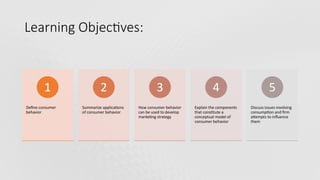
Learning Objectives:
Define consumer
behavior
1
Summarize applications
of consumer behavior
2
How consumer behavior
can be used to develop
marketing strategy
3
Explain the components
that constitute a
conceptual model of
consumer behavior
4
Discuss issues involving
consumption and firm
attempts to influence
them
5
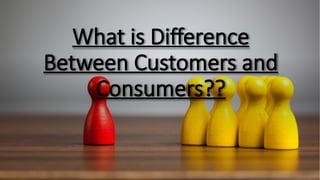
What is Difference
Between Customers and
Consumers??
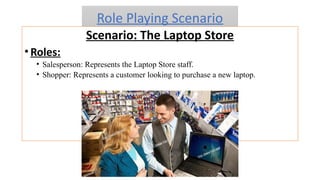
Role Playing Scenario
Scenario: The Laptop Store
•Roles:
• Salesperson: Represents the Laptop Store staff.
• Shopper: Represents a customer looking to purchase a new laptop.
Learning outcomes of the Role Play Activity
• Typical interaction between a shopper and a salesperson in a retail setting
• Focusing on understanding the shopper's needs
• Recommending suitable products
• Addressing questions and concerns
• Closing the sale
Situation
Can you share your consumption
experience of any product that you have
consumed/used recently?
What is Consumer Behavior?
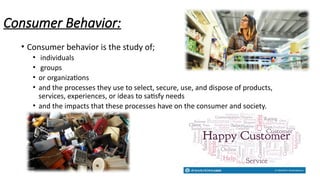
Consumer Behavior:
• Consumer behavior is the study of;
• individuals
• groups
• or organizations
• and the processes they use to select, secure, use, and dispose of products,
services, experiences, or ideas to satisfy needs
• and the impacts that these processes have on the consumer and society.
Consumer Behavior
continues..
• Traditionally, consumer behavior focused only on
buyers and buyers’ purchase processes.
• But today Consumer behaviour is a complex,
multidimensional process.
• Consumer decisions often involve numerous steps
and
• are influenced by a host of factors including;
• Demographics
• Lifestyles
• Cultural values
Consumer decisions are further
complicated.
But when????
Answer
• When the needs and wants of multiple individuals or
groups are considered.
• Example:
• when families must make decisions about where
to eat for dinner or where to go on vacation
• Clutter
But You Know What!!!!!
• Marketers face exciting and daunting challenges as the forces that
drive and shape consumer behavior rapidly evolve.
• Let’s analyze reasons and some example;
Reasons#1: Evolution of Marketing
and Customer Experience
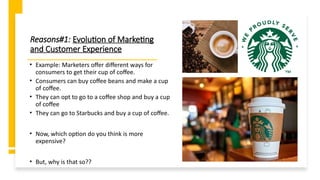
• Example: Marketers offer different ways for
consumers to get their cup of coffee.
• Consumers can buy coffee beans and make a cup
of coffee.
• They can opt to go to a coffee shop and buy a cup
of coffee
• They can go to Starbucks and buy a cup of coffee.
• Now, which option do you think is more
expensive?
• But, why is that so??
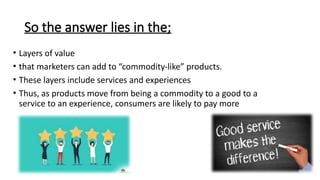
So the answer lies in the;
• Layers of value
• that marketers can add to “commodity-like” products.
• These layers include services and experiences
• Thus, as products move from being a commodity to a good to a
service to an experience, consumers are likely to pay more
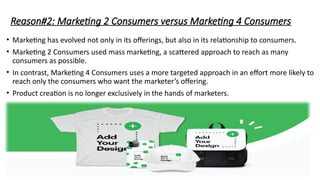
Reason#2: Marketing 2 Consumers versus Marketing 4 Consumers
• Marketing has evolved not only in its offerings, but also in its relationship to consumers.
• Marketing 2 Consumers used mass marketing, a scattered approach to reach as many
consumers as possible.
• In contrast, Marketing 4 Consumers uses a more targeted approach in an effort more likely to
reach only the consumers who want the marketer’s offering.
• Product creation is no longer exclusively in the hands of marketers.
APPLICATIONS OF
CONSUMER
BEHAVIOR
• Consumer behavior plays a critical role in
various aspects of business and society
• MARKETING STRATEGY
• REGULATORY POLICY
• SOCIAL MARKETING
• INFORMED INDIVIDUALS
Social
Marketing:
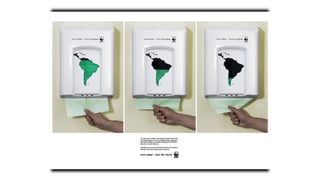
Social marketing is the process of creating a change
in the behaviors and attitudes of people through
consistent marketing development activities
The purpose of social marketing is to benefit the
whole society, instead of just profiting the brand.
For Example
• Plastic Bags Kill
• Save the Paper, Save the Planet
• Water – Use it wisely
• Save Food
Save Paper
Regulatory Policy
• Various regulatory bodies exist
• CRCP (Consumer rights commission of Pakistan).
• To develop, interpret, and/or implement policies
designed to protect and aid consumers
• For example;
• Food and Drug Administration (FDA) administers the
Nutrition Labeling and Education Act (NLEA)
• Among other things, NLEA requires that packaged
foods prominently display nutrition information in
the form of the Nutrition Facts panel
• Clearly, effective regulation of many marketing
practices requires an extensive knowledge of
consumer behavior
Informed Individuals
• Most economically developed societies are
legitimately referred to as consumption
societies
• Most individuals in these societies spend more
time engaged in consumption
• Marketers spend billions to influence consumer
decisions
• These attempts occur in ads, in websites, on
packages, as product features, in sales pitches,
and in store environments
• It is important that consumers accurately
understand the strategies and tactics being
used
• So, they can be more effective consumers
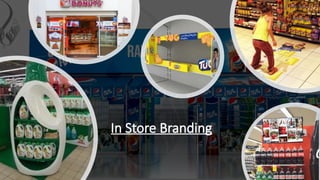
In Store Branding
MARKETING STRATEGY AND
CONSUMER BEHAVIOR
• The applications of consumer
behavior involve the
development, regulation, and
effects of marketing strategy.
• Let us examine marketing
strategy in more depth.
MARKET
ANALYSIS
COMPONENTS
• The Consumers
• It is not possible to anticipate and react to customers’
needs and desires without a complete understanding of
consumer behavior
• Discovering customers’ needs is a complex process
• But it often can be accomplished by marketing research
• Knowing the consumer requires understanding the
behavioral principles that guide consumption behaviors
MARKET
ANALYSIS
COMPONENT
S
• The Company
• A firm must fully understand its own ability to
meet customer needs
• This involves evaluating all aspects such as;
• financial condition, general managerial skills,
production capabilities, research and
development capabilities, technological
sophistication, reputation, and marketing skills
• Marketing skills would include;
• New product development capabilities, channel
strength, advertising abilities, service
capabilities, marketing research abilities, market
and consumer knowledge, and so forth
MARKET
ANALYSIS
COMPONENTS
• The Competitors
• Thorough understanding of the competition’s capabilities
and strategies is must.
• In addition, for any significant marketing action, the
following questions must be answered:
• If we are successful, which firms will be hurt (lose sales
or sales opportunities)?
• Of those firms that are injured, which have the capability
(financial resources, marketing strengths) to respond?
• How are they likely to respond (reduce prices, increase
advertising, introduce a new product)?
• Is our strategy (planned action) robust enough to
withstand the likely actions of our competitors, or do we
need additional contingency plans?
M
A
R
K
E
T
A
N
A
L
Y
S
I
S
C
O
M
P
O
N
E
N
T
S
The Conditions
• a firm cannot develop a sound marketing strategy
without anticipating the conditions under which that
strategy will be implemented.
• Conditions like;
• The state of the economy,
• the physical environment,
• government regulations,
• and technological developments
These conditions affect consumer needs and
expectations, company and competitors.
What is Market
Segmentation
Market Segmentation
• A market segment is a portion of a larger
market whose needs differ somewhat from the
larger market
• The most important marketing decision a firm
makes is the selection of one or more market
segments on which to focus
• a segment must be large enough to be served
profitably
• However, firm that offers customized products
can target smaller segments and even
individuals profitably
Market Segmentation
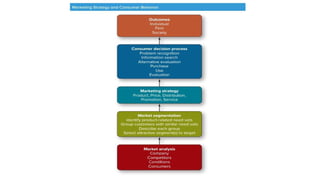
• Market segmentation involves four steps:
1. Identifying product-related need sets
2. Grouping customers with similar need
sets
3. Describing each group (Demographics,
lifestyles and media usage)
4. Selecting an attractive segment(s) to
serve- after thorough understanding,
select target market
Marketing Strategy
• Marketing strategy is basically the answer to the
question, How will we provide superior customer
value to our target market?
• The answer to this question requires the
formulation of a consistent marketing mix.
• It is the combination of elements of marketing
mix that meets customer needs and provide
customer value.
Marketing
Strategy
• The Product
• A product is anything a consumer
acquires to meet a perceived need
• Consumers are generally buying need
satisfaction, not physical product
attributes
• “In the factory we make cosmetics, in
the store we sell hope” – Revlon’s
head.
Marketing Strategy
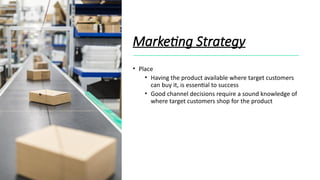
• Place
• Having the product available where target customers
can buy it, is essential to success
• Good channel decisions require a sound knowledge of
where target customers shop for the product
Marketing Strategy
• Price
• Price is the amount of money one must pay to obtain
the right to use the product
• Price brings psychological impacts related to products
• Pricing Strategies
Marketing Strategy
• Promotion or Communication
• Advertising, the sales force, public relations, packaging, and any
other signal that the firm provides about itself and its products
• Effective communication requires answers to the following
questions.
• With whom, exactly, do we want to communicate?
• What effect do we want our communications to have on the
target audience?
• What message will achieve the desired effect on our audience?
• What means and media should we use to reach the target
audience?
• When should we communicate with the target audience?
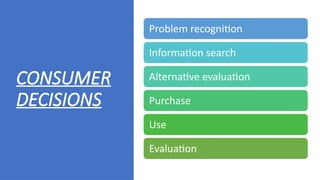
CONSUMER
DECISIONS
Problem recognition
Information search
Alternative evaluation
Purchase
Use
Evaluation
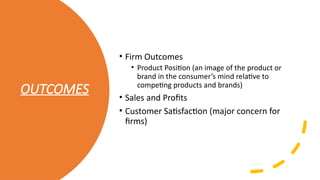
OUTCOMES
• Firm Outcomes
• Product Position (an image of the product or
brand in the consumer’s mind relative to
competing products and brands)
• Sales and Profits
• Customer Satisfaction (major concern for
firms)
OUTCOMES
• Individual Outcomes
• Need Satisfaction
• Injurious consumption-dark side of consumer behaviour
• consumption that affects the ability to fulfill other
needs such as financial needs, health needs etc.
OUTCOMES
• Society Outcomes
• Physical Environment Outcomes
• Social Welfare
• Economic Outcomes
THE NATURE OF CONSUMER
BEHAVIOR
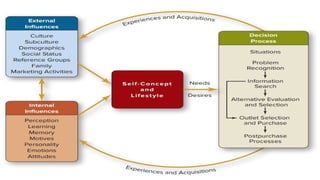
• Based on a variety of internal (mainly psychological and
physical) and external (mainly sociological and demographic)
influences
• Individuals develop self-concepts-
• The totality of an individual’s thoughts and feelings about
him- or herself
• and subsequent lifestyles-
• How they live
• These self-concepts and lifestyles produce needs and desires
• Many of these needs and desires require consumption decision
to satisfy
• Let us look at the conceptual model
Can Organizations
or Businesses be
Consumers?
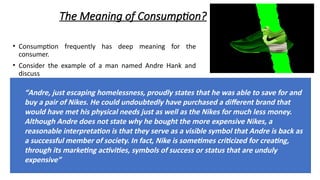
The Meaning of Consumption?
• Consumption frequently has deep meaning for the
consumer.
• Consider the example of a man named Andre Hank and
discuss
“Andre, just escaping homelessness, proudly states that he was able to save for and
buy a pair of Nikes. He could undoubtedly have purchased a different brand that
would have met his physical needs just as well as the Nikes for much less money.
Although Andre does not state why he bought the more expensive Nikes, a
reasonable interpretation is that they serve as a visible symbol that Andre is back as
a successful member of society. In fact, Nike is sometimes criticized for creating,
through its marketing activities, symbols of success or status that are unduly
expensive”
Let us explore some of the factors driving consumer purchases that drive at
the deeper meaning of consumption beyond mere function and necessity.
END
ASSIGNMENT
01
What are some products or services that are
widely used by your social group?
• Do these products or services help you
form bonds with your group? If yes, give
examples.
• Are there any product or services you
would avoid because of the social group
you belong to?

Chapter Consumer Behaviour for Business.pptx

  • 1.
    In The Nameof Allah
  • 2.
    Chapter 01 Consumer Behaviorand Marketing Strategy
  • 3.
    Learning Objectives: Define consumer behavior 1 Summarizeapplications of consumer behavior 2 How consumer behavior can be used to develop marketing strategy 3 Explain the components that constitute a conceptual model of consumer behavior 4 Discuss issues involving consumption and firm attempts to influence them 5
  • 4.
    What is Difference BetweenCustomers and Consumers??
  • 5.
    Role Playing Scenario Scenario:The Laptop Store •Roles: • Salesperson: Represents the Laptop Store staff. • Shopper: Represents a customer looking to purchase a new laptop.
  • 6.
    Learning outcomes ofthe Role Play Activity • Typical interaction between a shopper and a salesperson in a retail setting • Focusing on understanding the shopper's needs • Recommending suitable products • Addressing questions and concerns • Closing the sale
  • 7.
    Situation Can you shareyour consumption experience of any product that you have consumed/used recently?
  • 8.
  • 9.
    Consumer Behavior: • Consumerbehavior is the study of; • individuals • groups • or organizations • and the processes they use to select, secure, use, and dispose of products, services, experiences, or ideas to satisfy needs • and the impacts that these processes have on the consumer and society.
  • 10.
    Consumer Behavior continues.. • Traditionally,consumer behavior focused only on buyers and buyers’ purchase processes. • But today Consumer behaviour is a complex, multidimensional process. • Consumer decisions often involve numerous steps and • are influenced by a host of factors including; • Demographics • Lifestyles • Cultural values
  • 11.
    Consumer decisions arefurther complicated. But when????
  • 12.
    Answer • When theneeds and wants of multiple individuals or groups are considered. • Example: • when families must make decisions about where to eat for dinner or where to go on vacation • Clutter
  • 13.
    But You KnowWhat!!!!! • Marketers face exciting and daunting challenges as the forces that drive and shape consumer behavior rapidly evolve. • Let’s analyze reasons and some example;
  • 14.
    Reasons#1: Evolution ofMarketing and Customer Experience • Example: Marketers offer different ways for consumers to get their cup of coffee. • Consumers can buy coffee beans and make a cup of coffee. • They can opt to go to a coffee shop and buy a cup of coffee • They can go to Starbucks and buy a cup of coffee. • Now, which option do you think is more expensive? • But, why is that so??
  • 15.
    So the answerlies in the; • Layers of value • that marketers can add to “commodity-like” products. • These layers include services and experiences • Thus, as products move from being a commodity to a good to a service to an experience, consumers are likely to pay more
  • 16.
    Reason#2: Marketing 2Consumers versus Marketing 4 Consumers • Marketing has evolved not only in its offerings, but also in its relationship to consumers. • Marketing 2 Consumers used mass marketing, a scattered approach to reach as many consumers as possible. • In contrast, Marketing 4 Consumers uses a more targeted approach in an effort more likely to reach only the consumers who want the marketer’s offering. • Product creation is no longer exclusively in the hands of marketers.
  • 17.
    APPLICATIONS OF CONSUMER BEHAVIOR • Consumerbehavior plays a critical role in various aspects of business and society • MARKETING STRATEGY • REGULATORY POLICY • SOCIAL MARKETING • INFORMED INDIVIDUALS
  • 18.
    Social Marketing: Social marketing isthe process of creating a change in the behaviors and attitudes of people through consistent marketing development activities The purpose of social marketing is to benefit the whole society, instead of just profiting the brand. For Example • Plastic Bags Kill • Save the Paper, Save the Planet • Water – Use it wisely • Save Food
  • 22.
  • 24.
    Regulatory Policy • Variousregulatory bodies exist • CRCP (Consumer rights commission of Pakistan). • To develop, interpret, and/or implement policies designed to protect and aid consumers • For example; • Food and Drug Administration (FDA) administers the Nutrition Labeling and Education Act (NLEA) • Among other things, NLEA requires that packaged foods prominently display nutrition information in the form of the Nutrition Facts panel • Clearly, effective regulation of many marketing practices requires an extensive knowledge of consumer behavior
  • 25.
    Informed Individuals • Mosteconomically developed societies are legitimately referred to as consumption societies • Most individuals in these societies spend more time engaged in consumption • Marketers spend billions to influence consumer decisions • These attempts occur in ads, in websites, on packages, as product features, in sales pitches, and in store environments • It is important that consumers accurately understand the strategies and tactics being used • So, they can be more effective consumers
  • 26.
  • 27.
    MARKETING STRATEGY AND CONSUMERBEHAVIOR • The applications of consumer behavior involve the development, regulation, and effects of marketing strategy. • Let us examine marketing strategy in more depth.
  • 29.
    MARKET ANALYSIS COMPONENTS • The Consumers •It is not possible to anticipate and react to customers’ needs and desires without a complete understanding of consumer behavior • Discovering customers’ needs is a complex process • But it often can be accomplished by marketing research • Knowing the consumer requires understanding the behavioral principles that guide consumption behaviors
  • 30.
    MARKET ANALYSIS COMPONENT S • The Company •A firm must fully understand its own ability to meet customer needs • This involves evaluating all aspects such as; • financial condition, general managerial skills, production capabilities, research and development capabilities, technological sophistication, reputation, and marketing skills • Marketing skills would include; • New product development capabilities, channel strength, advertising abilities, service capabilities, marketing research abilities, market and consumer knowledge, and so forth
  • 31.
    MARKET ANALYSIS COMPONENTS • The Competitors •Thorough understanding of the competition’s capabilities and strategies is must. • In addition, for any significant marketing action, the following questions must be answered: • If we are successful, which firms will be hurt (lose sales or sales opportunities)? • Of those firms that are injured, which have the capability (financial resources, marketing strengths) to respond? • How are they likely to respond (reduce prices, increase advertising, introduce a new product)? • Is our strategy (planned action) robust enough to withstand the likely actions of our competitors, or do we need additional contingency plans?
  • 32.
    M A R K E T A N A L Y S I S C O M P O N E N T S The Conditions • afirm cannot develop a sound marketing strategy without anticipating the conditions under which that strategy will be implemented. • Conditions like; • The state of the economy, • the physical environment, • government regulations, • and technological developments These conditions affect consumer needs and expectations, company and competitors.
  • 33.
  • 34.
    Market Segmentation • Amarket segment is a portion of a larger market whose needs differ somewhat from the larger market • The most important marketing decision a firm makes is the selection of one or more market segments on which to focus • a segment must be large enough to be served profitably • However, firm that offers customized products can target smaller segments and even individuals profitably
  • 35.
    Market Segmentation • Marketsegmentation involves four steps: 1. Identifying product-related need sets 2. Grouping customers with similar need sets 3. Describing each group (Demographics, lifestyles and media usage) 4. Selecting an attractive segment(s) to serve- after thorough understanding, select target market
  • 36.
    Marketing Strategy • Marketingstrategy is basically the answer to the question, How will we provide superior customer value to our target market? • The answer to this question requires the formulation of a consistent marketing mix. • It is the combination of elements of marketing mix that meets customer needs and provide customer value.
  • 37.
    Marketing Strategy • The Product •A product is anything a consumer acquires to meet a perceived need • Consumers are generally buying need satisfaction, not physical product attributes • “In the factory we make cosmetics, in the store we sell hope” – Revlon’s head.
  • 38.
    Marketing Strategy • Place •Having the product available where target customers can buy it, is essential to success • Good channel decisions require a sound knowledge of where target customers shop for the product
  • 39.
    Marketing Strategy • Price •Price is the amount of money one must pay to obtain the right to use the product • Price brings psychological impacts related to products • Pricing Strategies
  • 40.
    Marketing Strategy • Promotionor Communication • Advertising, the sales force, public relations, packaging, and any other signal that the firm provides about itself and its products • Effective communication requires answers to the following questions. • With whom, exactly, do we want to communicate? • What effect do we want our communications to have on the target audience? • What message will achieve the desired effect on our audience? • What means and media should we use to reach the target audience? • When should we communicate with the target audience?
  • 41.
  • 42.
    OUTCOMES • Firm Outcomes •Product Position (an image of the product or brand in the consumer’s mind relative to competing products and brands) • Sales and Profits • Customer Satisfaction (major concern for firms)
  • 43.
    OUTCOMES • Individual Outcomes •Need Satisfaction • Injurious consumption-dark side of consumer behaviour • consumption that affects the ability to fulfill other needs such as financial needs, health needs etc.
  • 44.
    OUTCOMES • Society Outcomes •Physical Environment Outcomes • Social Welfare • Economic Outcomes
  • 45.
    THE NATURE OFCONSUMER BEHAVIOR • Based on a variety of internal (mainly psychological and physical) and external (mainly sociological and demographic) influences • Individuals develop self-concepts- • The totality of an individual’s thoughts and feelings about him- or herself • and subsequent lifestyles- • How they live • These self-concepts and lifestyles produce needs and desires • Many of these needs and desires require consumption decision to satisfy • Let us look at the conceptual model
  • 47.
  • 48.
    The Meaning ofConsumption? • Consumption frequently has deep meaning for the consumer. • Consider the example of a man named Andre Hank and discuss “Andre, just escaping homelessness, proudly states that he was able to save for and buy a pair of Nikes. He could undoubtedly have purchased a different brand that would have met his physical needs just as well as the Nikes for much less money. Although Andre does not state why he bought the more expensive Nikes, a reasonable interpretation is that they serve as a visible symbol that Andre is back as a successful member of society. In fact, Nike is sometimes criticized for creating, through its marketing activities, symbols of success or status that are unduly expensive”
  • 49.
    Let us exploresome of the factors driving consumer purchases that drive at the deeper meaning of consumption beyond mere function and necessity.
  • 50.
  • 51.
    ASSIGNMENT 01 What are someproducts or services that are widely used by your social group? • Do these products or services help you form bonds with your group? If yes, give examples. • Are there any product or services you would avoid because of the social group you belong to?