Consumer Behaviour
Dr. D. Moorthy
Head & Asso. Prof.
Dept. of Commerce – BPS
SRCAS, CBE
Consumer behavior is the study of consumers’ action during searching
for, purchasing, using, evaluating and disposing of products and
services they expect will satisfy their need. It helps marketers in
understanding consumer decision-making process.
Consumer behaviour can be defined as “activities people undertake
when obtaining, consuming, and disposing of products and services” is
provided and detailed.
Obtaining “activities leading up to and including the purchase or
receipt of a product”.
Consuming “how, where, when, and under what circumstances
consumers use products”.
Disposing “how consumers get rid of products and packaging”.
Consumer Behaviour Definition
Consumer behavior is the process whereby individuals decide what, when, where, how
and from whom to purchase goods and services.
Walters and Paul
Consumer behaviour as “The dynamic interaction of cognition, behaviour and
environmental events by which human beings conduct the exchange aspect of their lives.
American Marketing Association (AMA)
Consumer behaviour refers to the actions and decision processes of people who purchase
goods and services for personal consumption.
Peter D. Bennett, ed. Dictionary of Marketing Terms, 2nd ed. 1995
Consumer behaviour refers to “the mental and emotional processes and the observable
behaviour of consumers during searching for, purchasing and post consumption of a
product or service.
James F. Engel, Roger D. Blackwell and Paul W. Miniard, “Consumer Behaviour” (1990)
Consumer Behaviour Meaning
The “consumer” more generally refers to anyone engaging
in any of the activities (evaluating, acquiring, using or
disposing of goods and services) used in the definition of
consumer behaviour.
Consumer behaviour is a decision process and physical
activity individuals engage in when evaluating, acquiring,
using or disposing of goods and services.
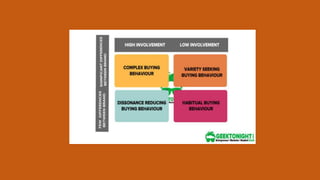
Types of Buying Decision Behavior
Different consumers follow different steps in making their choice of
products and services.
There is a substantial degree of variation in the choice processes depending
upon two key factors, namely the level of involvement and degree of the
perceived difference between different alternatives in the market.
There are basically 4 types of buying decision behavior which is discussed
below:
Dissonance Reducing Buying Behaviour
Complex Buying Behaviour
Variety Seeking Buying Behaviour
Habitual buying Behaviour
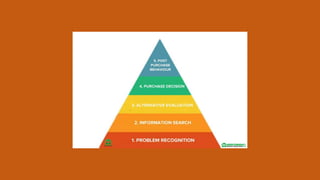
Consumer Buying Process
In consumer buying process, generally, the purchaser
passes through five distinct stages in consumer buying
process namely need or problem recognition, information
search, alternative evaluation, purchase decision and
post-purchase behaviour.
Stage of Problem Recognition
Stage of Information Search
Stage of Alternative Evaluation
Stage of Purchase Decision
Stage of Post Purchase Behaviour
Consumer Buying Process
Stage of Problem Recognition
The recognition of a need is likely to occur when a consumer is
faced with a ‘problem’. A buying process starts when a consumer
recognises that there is a substantial discrepancy between his
current state of satisfaction and expectations in a consumption
situation.
Stage of Information Search
After need arousal, the behaviour of the consumer leads towards
a collection of available information about various stimuli i.e.
products and services in this case from various sources (personal,
public, commercial, experiential) for further processing and
decision-making.
Stage of Alternative Evaluation
Once interest in a product(s) is aroused, a consumer enters the
subsequent stage of evaluation of alternatives.
When evaluating potential alternatives, consumers tend to use
two types of information:
a list of brands (or models) from which they plan to make their
selection (the evoked set)
the criteria they will use to evaluate each brand (or model).
Cognitive evaluation: When the consumer uses objective choice
criteria.
Affective evaluation: Using emotional reasons for evaluating t
Stage of Purchase Decision
Finally, the consumer arrives at a purchase decision.
Purchase decisions can be one of the three viz. no buying,
buying later and buy now.
No buying takes the consumer to the problem recognition
stage. A postponement of buying can be due to a lesser
motivation or evolving personal and economic situation. If
positive attitudes are formed towards the decided
alternative, the consumer will make a purchase.
There are three more important considerations in taking
the buying decision:
Attitude of others such as wife, relatives and friends.
Anticipated situational factors such as expected family
income, expected total cost of the product and the
expected benefits from the product.
Unanticipated situational factors, like accidents, illness
etc.
Stage of Post Purchase Behaviour
Post-purchase behaviour refers to the behaviour of
a consumer after his commitment to a product has
been made.
So post-purchase behaviour leads to three
situations, namely customer is satisfied; customer is
delighted and the customer is dissatisfied.
Cognitive dissonance: Buyer discomfort caused by
postpurchase conflict.
Participant in Buying Process
Consumer behaviour is influenced not only by consumer personali- ties
and motivations, but also by the various participant in the buying process.
Consumer decision making is an intricate process.
To understand how consumers actually take the decision to buy a product,
it is important for marketers to identify who makes and has input in the
decision-making process. In a buying process there are various participants
involved, their roles are explained as follows:
Initiator
Influencer
Gatekeeper
Decider
Buyer
Users
7 O’s Framework of Consumer Behaviour
A framework is developed to understand consumer behaviour by
addressing various issues involved in consumer behaviour. This framework
is popularly known as 7 O’s Framework and is used for a basic
understanding of consumer behaviour 7 Os Framework of Consumer
Behaviour
Occupants: Who is the Consumer
Object of Purchase: What does the Consumer Buy
Objective: Why is the Consumer Buying
Occasion: When do they Buy or How Often do they Buy and Use
Outlets: Where do they Buy
Operations: How do they Buy
Organisation: Who is Involved
Importance of Consumer Behaviour
It is important for marketers to study consumer behaviour. This helps marketers to
investigate and understand the way in which consumers behave.
Below are some of the importance of consumer behaviour is given below:
Identifying market opportunity
The study of consumer behaviour helps in identifying the unmet needs and wants of
consumers. This demands evaluating the prevailing trends in the marketplace,
consumers’ lifestyles, income levels and emerging influences.
Selecting target market
A review of market opportunities often helps in identifying distinct consumer segments
with very distinct wants and need. Identifying these groups, learning how they behave
and how they form purchase decisions enables the marketer to design and market
products /services particularly suited to consumers wants and needs.
For example, an FMCG company conducted a consumer behaviour study and found out
that many existing and potential shampoo users preferred buying low-priced sachets
containing enough quantity for one or two washes rather than big bottles of hair
shampoo. Based on the research the company introduced shampoo sachets to gain
foothold in market.
Customer retention
Organisations lay emphasis on retaining customers than merely on
customer acquisition. Customer retention is the process of maintaining
existing customers by catering to their needs and even exceeding their
expectations. Study of consumer behaviour helps to convert a casual
customer into a committed loyal customer.
Dynamic nature of market
Consumer behaviour lays emphasis on dynamic nature of the market. It
helps the manager to be dynamic and proactive in satisfying consumers
ahead of its competitors. If the organisation is not able to keep up with the
current market trends it will find it arduous to survive in the industry.
Marketing-mix decisions
Once unsatisfied needs and wants are identified, the organisation has to
evaluate the right mix of product, price, distribution and promotion. In this
context, consumer behaviour study is pivotal to resolve many challenging
questions.
Effective use of productive resources
The study of consumer behaviour assists the manager to make the organisational
efforts consumer-oriented. It ensures optimum utilisation of resources for achieving
maximum efficiency.
Fulfil varied consumer preferences
With the onset of globalisation customers have wide range of alternatives in contrast to
pre 1991 era. So, in order to cater to diverse customer preferences, it is pertinent for
marketers to study customer behaviour.
For example, in the current scenario customers have various car manufacturers to
choose from such as Hyundai, Honda, Mercedes, BMW etc. Every automobile maker
leverages a certain segment of customers.
Address custom needs
Consumer opt for differentiated products that depict their special needs, personalities
and lifestyles. The study of consumer behaviour enables organisations to gratify the
peculiar needs.
For example, when Onida 21 was first introduced, it was advertised on television ‘for
the elite class’. Likewise, Maggi introduced its tomato sauce with emphasis on “It’s
different”.
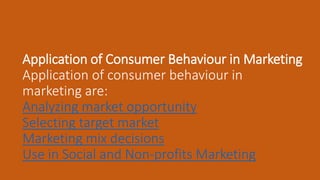
Application of Consumer Behaviour in Marketing
Application of consumer behaviour in
marketing are:
Analyzing market opportunity
Selecting target market
Marketing mix decisions
Use in Social and Non-profits Marketing

E-content - Consumer Behaviour- meaning and etc.pdf

  • 1.
    Consumer Behaviour Dr. D.Moorthy Head & Asso. Prof. Dept. of Commerce – BPS SRCAS, CBE
  • 3.
    Consumer behavior isthe study of consumers’ action during searching for, purchasing, using, evaluating and disposing of products and services they expect will satisfy their need. It helps marketers in understanding consumer decision-making process. Consumer behaviour can be defined as “activities people undertake when obtaining, consuming, and disposing of products and services” is provided and detailed. Obtaining “activities leading up to and including the purchase or receipt of a product”. Consuming “how, where, when, and under what circumstances consumers use products”. Disposing “how consumers get rid of products and packaging”.
  • 4.
    Consumer Behaviour Definition Consumerbehavior is the process whereby individuals decide what, when, where, how and from whom to purchase goods and services. Walters and Paul Consumer behaviour as “The dynamic interaction of cognition, behaviour and environmental events by which human beings conduct the exchange aspect of their lives. American Marketing Association (AMA) Consumer behaviour refers to the actions and decision processes of people who purchase goods and services for personal consumption. Peter D. Bennett, ed. Dictionary of Marketing Terms, 2nd ed. 1995 Consumer behaviour refers to “the mental and emotional processes and the observable behaviour of consumers during searching for, purchasing and post consumption of a product or service. James F. Engel, Roger D. Blackwell and Paul W. Miniard, “Consumer Behaviour” (1990)
  • 5.
    Consumer Behaviour Meaning The“consumer” more generally refers to anyone engaging in any of the activities (evaluating, acquiring, using or disposing of goods and services) used in the definition of consumer behaviour. Consumer behaviour is a decision process and physical activity individuals engage in when evaluating, acquiring, using or disposing of goods and services.
  • 6.
    Types of BuyingDecision Behavior Different consumers follow different steps in making their choice of products and services. There is a substantial degree of variation in the choice processes depending upon two key factors, namely the level of involvement and degree of the perceived difference between different alternatives in the market. There are basically 4 types of buying decision behavior which is discussed below: Dissonance Reducing Buying Behaviour Complex Buying Behaviour Variety Seeking Buying Behaviour Habitual buying Behaviour
  • 8.
    Consumer Buying Process Inconsumer buying process, generally, the purchaser passes through five distinct stages in consumer buying process namely need or problem recognition, information search, alternative evaluation, purchase decision and post-purchase behaviour. Stage of Problem Recognition Stage of Information Search Stage of Alternative Evaluation Stage of Purchase Decision Stage of Post Purchase Behaviour
  • 10.
    Consumer Buying Process Stageof Problem Recognition The recognition of a need is likely to occur when a consumer is faced with a ‘problem’. A buying process starts when a consumer recognises that there is a substantial discrepancy between his current state of satisfaction and expectations in a consumption situation. Stage of Information Search After need arousal, the behaviour of the consumer leads towards a collection of available information about various stimuli i.e. products and services in this case from various sources (personal, public, commercial, experiential) for further processing and decision-making.
  • 11.
    Stage of AlternativeEvaluation Once interest in a product(s) is aroused, a consumer enters the subsequent stage of evaluation of alternatives. When evaluating potential alternatives, consumers tend to use two types of information: a list of brands (or models) from which they plan to make their selection (the evoked set) the criteria they will use to evaluate each brand (or model). Cognitive evaluation: When the consumer uses objective choice criteria. Affective evaluation: Using emotional reasons for evaluating t
  • 12.
    Stage of PurchaseDecision Finally, the consumer arrives at a purchase decision. Purchase decisions can be one of the three viz. no buying, buying later and buy now. No buying takes the consumer to the problem recognition stage. A postponement of buying can be due to a lesser motivation or evolving personal and economic situation. If positive attitudes are formed towards the decided alternative, the consumer will make a purchase.
  • 13.
    There are threemore important considerations in taking the buying decision: Attitude of others such as wife, relatives and friends. Anticipated situational factors such as expected family income, expected total cost of the product and the expected benefits from the product. Unanticipated situational factors, like accidents, illness etc.
  • 14.
    Stage of PostPurchase Behaviour Post-purchase behaviour refers to the behaviour of a consumer after his commitment to a product has been made. So post-purchase behaviour leads to three situations, namely customer is satisfied; customer is delighted and the customer is dissatisfied. Cognitive dissonance: Buyer discomfort caused by postpurchase conflict.
  • 15.
    Participant in BuyingProcess Consumer behaviour is influenced not only by consumer personali- ties and motivations, but also by the various participant in the buying process. Consumer decision making is an intricate process. To understand how consumers actually take the decision to buy a product, it is important for marketers to identify who makes and has input in the decision-making process. In a buying process there are various participants involved, their roles are explained as follows: Initiator Influencer Gatekeeper Decider Buyer Users
  • 16.
    7 O’s Frameworkof Consumer Behaviour A framework is developed to understand consumer behaviour by addressing various issues involved in consumer behaviour. This framework is popularly known as 7 O’s Framework and is used for a basic understanding of consumer behaviour 7 Os Framework of Consumer Behaviour Occupants: Who is the Consumer Object of Purchase: What does the Consumer Buy Objective: Why is the Consumer Buying Occasion: When do they Buy or How Often do they Buy and Use Outlets: Where do they Buy Operations: How do they Buy Organisation: Who is Involved
  • 17.
    Importance of ConsumerBehaviour It is important for marketers to study consumer behaviour. This helps marketers to investigate and understand the way in which consumers behave. Below are some of the importance of consumer behaviour is given below: Identifying market opportunity The study of consumer behaviour helps in identifying the unmet needs and wants of consumers. This demands evaluating the prevailing trends in the marketplace, consumers’ lifestyles, income levels and emerging influences. Selecting target market A review of market opportunities often helps in identifying distinct consumer segments with very distinct wants and need. Identifying these groups, learning how they behave and how they form purchase decisions enables the marketer to design and market products /services particularly suited to consumers wants and needs. For example, an FMCG company conducted a consumer behaviour study and found out that many existing and potential shampoo users preferred buying low-priced sachets containing enough quantity for one or two washes rather than big bottles of hair shampoo. Based on the research the company introduced shampoo sachets to gain foothold in market.
  • 18.
    Customer retention Organisations layemphasis on retaining customers than merely on customer acquisition. Customer retention is the process of maintaining existing customers by catering to their needs and even exceeding their expectations. Study of consumer behaviour helps to convert a casual customer into a committed loyal customer. Dynamic nature of market Consumer behaviour lays emphasis on dynamic nature of the market. It helps the manager to be dynamic and proactive in satisfying consumers ahead of its competitors. If the organisation is not able to keep up with the current market trends it will find it arduous to survive in the industry. Marketing-mix decisions Once unsatisfied needs and wants are identified, the organisation has to evaluate the right mix of product, price, distribution and promotion. In this context, consumer behaviour study is pivotal to resolve many challenging questions.
  • 19.
    Effective use ofproductive resources The study of consumer behaviour assists the manager to make the organisational efforts consumer-oriented. It ensures optimum utilisation of resources for achieving maximum efficiency. Fulfil varied consumer preferences With the onset of globalisation customers have wide range of alternatives in contrast to pre 1991 era. So, in order to cater to diverse customer preferences, it is pertinent for marketers to study customer behaviour. For example, in the current scenario customers have various car manufacturers to choose from such as Hyundai, Honda, Mercedes, BMW etc. Every automobile maker leverages a certain segment of customers. Address custom needs Consumer opt for differentiated products that depict their special needs, personalities and lifestyles. The study of consumer behaviour enables organisations to gratify the peculiar needs. For example, when Onida 21 was first introduced, it was advertised on television ‘for the elite class’. Likewise, Maggi introduced its tomato sauce with emphasis on “It’s different”.
  • 20.
    Application of ConsumerBehaviour in Marketing Application of consumer behaviour in marketing are: Analyzing market opportunity Selecting target market Marketing mix decisions Use in Social and Non-profits Marketing