energy, power
& intelligent control
Battery technology and QUB EV lab
1
Dr Jing Deng, Mr Cheng Zhang, Prof Kang Li
Electric Vehicle Laboratory, EEECS, QUB
energy, power
& intelligent control
Content
 Lead Acid Battery
 Mechanism
 Category
 Characterization
 Life cycle
 Other Batteries
 Advanced Lead Acid
 Li-Ion
 Lead Acid + Supercapacitor
 QUB EV lab
 Our research
2
energy, power
& intelligent control
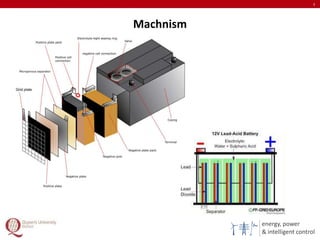
Machnism
3
energy, power
& intelligent control
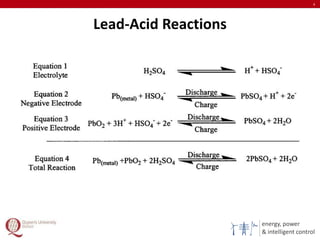
Lead-Acid Reactions
4
energy, power
& intelligent control
Background of lead acid battery
5
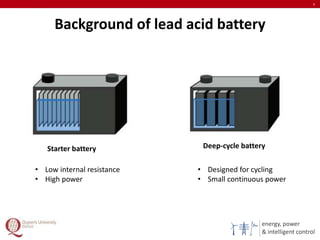
Starter battery Deep-cycle battery
• Low internal resistance
• High power
• Designed for cycling
• Small continuous power
energy, power
& intelligent control
Lead Acid Battery Categories
6
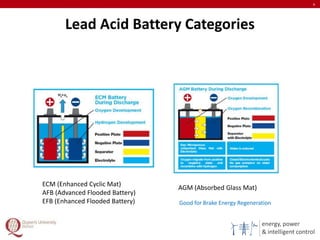
ECM (Enhanced Cyclic Mat)
AFB (Advanced Flooded Battery)
EFB (Enhanced Flooded Battery)
AGM (Absorbed Glass Mat)
Good for Brake Energy Regeneration
energy, power
& intelligent control
Background of lead acid battery
7
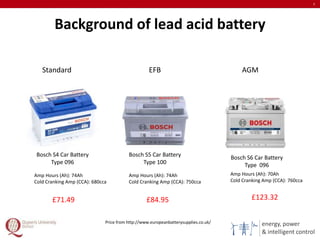
Bosch S5 Car Battery
Type 100
Amp Hours (Ah): 74Ah
Cold Cranking Amp (CCA): 750cca
£84.95
Bosch S4 Car Battery
Type 096
Amp Hours (Ah): 74Ah
Cold Cranking Amp (CCA): 680cca
£71.49
Bosch S6 Car Battery
Type 096
£123.32
Amp Hours (Ah): 70Ah
Cold Cranking Amp (CCA): 760cca
Price from http://www.europeanbatterysupplies.co.uk/
Standard EFB AGM
energy, power
& intelligent control
Standard Charging
8
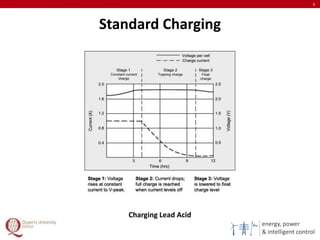
Charging Lead Acid
energy, power
& intelligent control
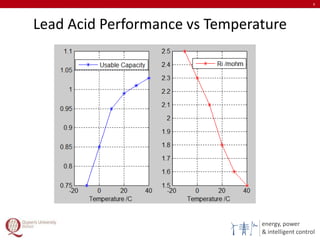
Lead Acid Performance vs Temperature
9
energy, power
& intelligent control
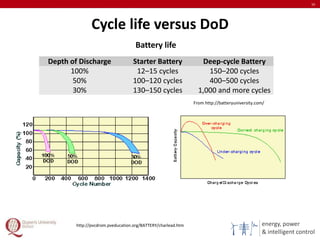
Cycle life versus DoD
10
Depth of Discharge Starter Battery Deep-cycle Battery
100%
50%
30%
12–15 cycles
100–120 cycles
130–150 cycles
150–200 cycles
400–500 cycles
1,000 and more cycles
From http://batteryuniversity.com/
Battery life
http://pvcdrom.pveducation.org/BATTERY/charlead.htm
energy, power
& intelligent control
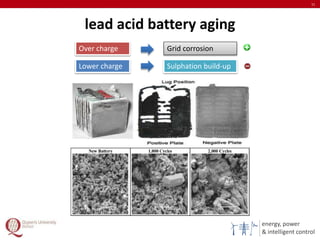
lead acid battery aging
11
Over charge
Lower charge
Grid corrosion
Sulphation build-up
energy, power
& intelligent control
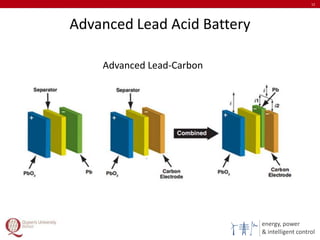
Advanced Lead Acid Battery
12
Advanced Lead-Carbon
energy, power
& intelligent control
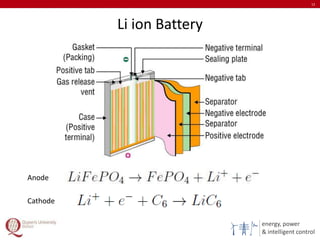
Li ion Battery
13
Cathode
Anode
energy, power
& intelligent control
Li ion Battery Characterization
14
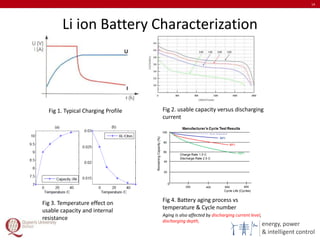
Fig 1. Typical Charging Profile Fig 2. usable capacity versus discharging
current
Fig 3. Temperature effect on
usable capacity and internal
resistance
Fig 4. Battery aging process vs
temperature & Cycle number
Aging is also affected by discharging current level,
discharging depth,
energy, power
& intelligent control
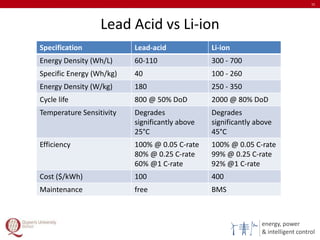
Lead Acid vs Li-ion
15
Specification Lead-acid Li-ion
Energy Density (Wh/L) 60-110 300 - 700
Specific Energy (Wh/kg) 40 100 - 260
Energy Density (W/kg) 180 250 - 350
Cycle life 800 @ 50% DoD 2000 @ 80% DoD
Temperature Sensitivity Degrades
significantly above
25°C
Degrades
significantly above
45°C
Efficiency 100% @ 0.05 C-rate
80% @ 0.25 C-rate
60% @1 C-rate
100% @ 0.05 C-rate
99% @ 0.25 C-rate
92% @1 C-rate
Cost ($/kWh) 100 400
Maintenance free BMS
energy, power
& intelligent control
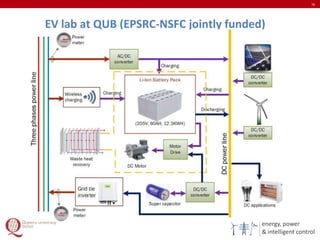
EV lab at QUB (EPSRC-NSFC jointly funded)
16
energy, power
& intelligent control
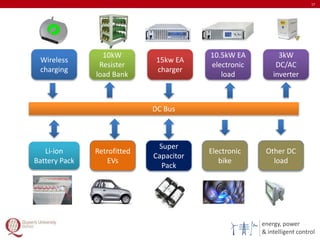
17
DC Bus
Wireless
charging
Li-ion
Battery Pack
10kW
Resister
load Bank
Retrofitted
EVs
15kw EA
charger
Super
Capacitor
Pack
10.5kW EA
electronic
load
Electronic
bike
3kW
DC/AC
inverter
Other DC
load
energy, power
& intelligent control
EV Lab
18
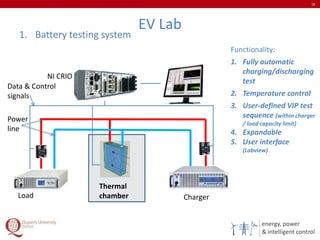
1. Battery testing system
Thermal
chamber ChargerLoad
NI CRIO
Power
line
Data & Control
signals
Functionality:
1. Fully automatic
charging/discharging
test
2. Temperature control
3. User-defined VIP test
sequence (within charger
/ load capacity limit)
4. Expandable
5. User interface
(Labview)
energy, power
& intelligent control
EV Lab
19
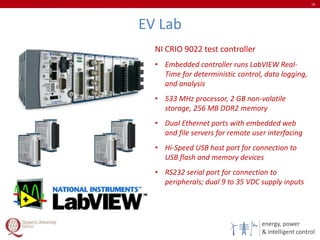
NI CRIO 9022 test controller
• Embedded controller runs LabVIEW Real-
Time for deterministic control, data logging,
and analysis
• 533 MHz processor, 2 GB non-volatile
storage, 256 MB DDR2 memory
• Dual Ethernet ports with embedded web
and file servers for remote user interfacing
• Hi-Speed USB host port for connection to
USB flash and memory devices
• RS232 serial port for connection to
peripherals; dual 9 to 35 VDC supply inputs
energy, power
& intelligent control
EV lab
20
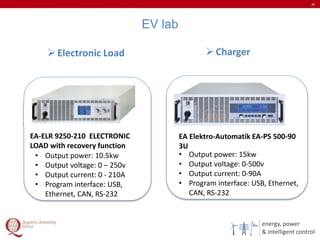
EA Elektro-Automatik EA-PS 500-90
3U
• Output power: 15kw
• Output voltage: 0-500v
• Output current: 0-90A
• Program interface: USB, Ethernet,
CAN, RS-232
Charger
• Output power: 10.5kw
• Output voltage: 0 – 250v
• Output current: 0 - 210A
• Program interface: USB,
Ethernet, CAN, RS-232
EA-ELR 9250-210 ELECTRONIC
LOAD with recovery function
Electronic Load
energy, power
& intelligent control
EV lab
21
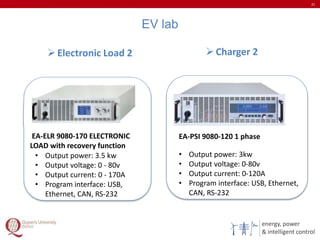
EA-PSI 9080-120 1 phase
• Output power: 3kw
• Output voltage: 0-80v
• Output current: 0-120A
• Program interface: USB, Ethernet,
CAN, RS-232
Charger 2
• Output power: 3.5 kw
• Output voltage: 0 - 80v
• Output current: 0 - 170A
• Program interface: USB,
Ethernet, CAN, RS-232
EA-ELR 9080-170 ELECTRONIC
LOAD with recovery function
Electronic Load 2
energy, power
& intelligent control
EV lab
22
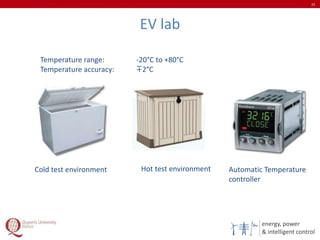
Cold test environment
Temperature range: -20°C to +80°C
Temperature accuracy: ∓2°C
Hot test environment Automatic Temperature
controller
energy, power
& intelligent control
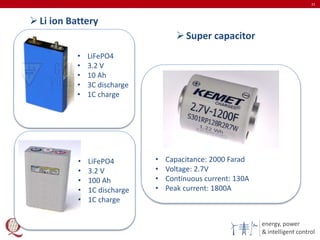
• Capacitance: 2000 Farad
• Voltage: 2.7V
• Capacitance: 2000 Farad
• Voltage: 2.7V
23
• Capacitance: 2000 Farad
• Voltage: 2.7V
• Continuous current: 130A
• Peak current: 1800A
Super capacitor
• LiFePO4
• 3.2 V
• 10 Ah
• 3C discharge
• 1C charge
Li ion Battery
• LiFePO4
• 3.2 V
• 100 Ah
• 1C discharge
• 1C charge
energy, power
& intelligent control
EV lab
24
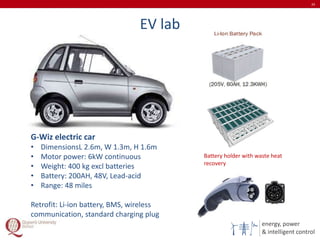
Battery holder with waste heat
recovery
G-Wiz electric car
• DimensionsL 2.6m, W 1.3m, H 1.6m
• Motor power: 6kW continuous
• Weight: 400 kg excl batteries
• Battery: 200AH, 48V, Lead-acid
• Range: 48 miles
Retrofit: Li-ion battery, BMS, wireless
communication, standard charging plug
energy, power
& intelligent control
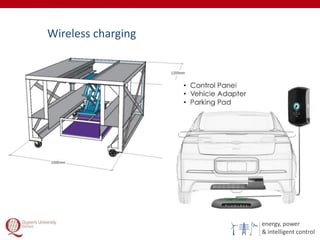
Wireless charging
energy, power
& intelligent control
26
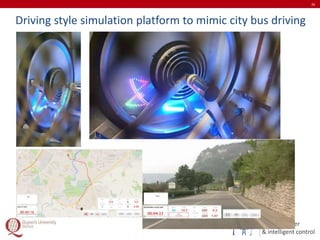
Driving style simulation platform to mimic city bus driving
energy, power
& intelligent control
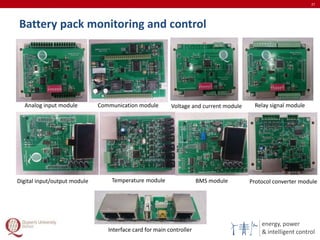
Battery pack monitoring and control
27
Analog input module Communication module Voltage and current module Relay signal module
Digital input/output module Temperature module BMS module Protocol converter module
Interface card for main controller
energy, power
& intelligent control
Test data
HPPC tests at different temperatures:
[0, 10, 23, 32, 39, 52]℃
Thermal test
energy, power
& intelligent control
Our Research
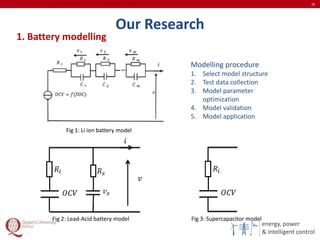
1. Battery modelling
29
Fig 1: Li ion battery model
Fig 2: Lead-Acid battery model Fig 3: Supercapacitor model
Modelling procedure
1. Select model structure
2. Test data collection
3. Model parameter
optimization
4. Model validation
5. Model application
energy, power
& intelligent control
Our Research
30
2. Battery State estimation
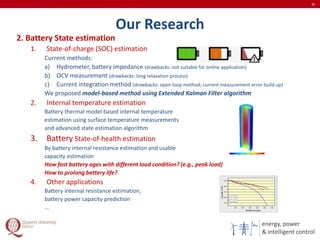
1. State-of-charge (SOC) estimation
Current methods:
a) Hydrometer, battery impedance (drawbacks: not suitable for online application)
b) OCV measurement (drawbacks: long relaxation process)
c) Current integration method (drawbacks: open loop method; current measurement error build up)
We proposed model-based method using Extended Kalman Filter algorithm
2. Internal temperature estimation
Battery thermal model based internal temperature
estimation using surface temperature measurements
and advanced state estimation algorithm
3. Battery State-of-health estimation
By battery internal resistance estimation and usable
capacity estimation
How fast battery ages with different load condition? (e.g., peak load)
How to prolong battery life?
4. Other applications
Battery internal resistance estimation,
battery power capacity prediction
…
energy, power
& intelligent control
Our Research
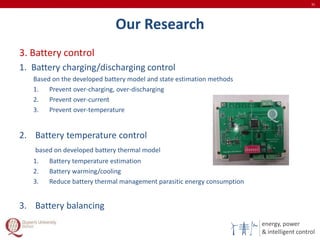
3. Battery control
1. Battery charging/discharging control
Based on the developed battery model and state estimation methods
1. Prevent over-charging, over-discharging
2. Prevent over-current
3. Prevent over-temperature
2. Battery temperature control
based on developed battery thermal model
1. Battery temperature estimation
2. Battery warming/cooling
3. Reduce battery thermal management parasitic energy consumption
3. Battery balancing
31
energy, power
& intelligent control
QUB support
How can we contribute?
1. Battery test
a) Charging/discharging, regenerative break; deep
recycling, …
b) Different temperature settings
c) Any user defined VIP test sequence
2. Data analysis
a) Load analysis
b) Battery life analysis
3. System design improvement
4. Charging/discharging control
a) Model, state estimation, control
b) To prolong battery life
32
energy, power
& intelligent control
Questions ?
33
Prof Kang Li
(K.LI@QUB.AC.UK)

Battery report - FirstGroup

  • 1.
    energy, power & intelligentcontrol Battery technology and QUB EV lab 1 Dr Jing Deng, Mr Cheng Zhang, Prof Kang Li Electric Vehicle Laboratory, EEECS, QUB
  • 2.
    energy, power & intelligentcontrol Content  Lead Acid Battery  Mechanism  Category  Characterization  Life cycle  Other Batteries  Advanced Lead Acid  Li-Ion  Lead Acid + Supercapacitor  QUB EV lab  Our research 2
  • 3.
    energy, power & intelligentcontrol Machnism 3
  • 4.
    energy, power & intelligentcontrol Lead-Acid Reactions 4
  • 5.
    energy, power & intelligentcontrol Background of lead acid battery 5 Starter battery Deep-cycle battery • Low internal resistance • High power • Designed for cycling • Small continuous power
  • 6.
    energy, power & intelligentcontrol Lead Acid Battery Categories 6 ECM (Enhanced Cyclic Mat) AFB (Advanced Flooded Battery) EFB (Enhanced Flooded Battery) AGM (Absorbed Glass Mat) Good for Brake Energy Regeneration
  • 7.
    energy, power & intelligentcontrol Background of lead acid battery 7 Bosch S5 Car Battery Type 100 Amp Hours (Ah): 74Ah Cold Cranking Amp (CCA): 750cca £84.95 Bosch S4 Car Battery Type 096 Amp Hours (Ah): 74Ah Cold Cranking Amp (CCA): 680cca £71.49 Bosch S6 Car Battery Type 096 £123.32 Amp Hours (Ah): 70Ah Cold Cranking Amp (CCA): 760cca Price from http://www.europeanbatterysupplies.co.uk/ Standard EFB AGM
  • 8.
    energy, power & intelligentcontrol Standard Charging 8 Charging Lead Acid
  • 9.
    energy, power & intelligentcontrol Lead Acid Performance vs Temperature 9
  • 10.
    energy, power & intelligentcontrol Cycle life versus DoD 10 Depth of Discharge Starter Battery Deep-cycle Battery 100% 50% 30% 12–15 cycles 100–120 cycles 130–150 cycles 150–200 cycles 400–500 cycles 1,000 and more cycles From http://batteryuniversity.com/ Battery life http://pvcdrom.pveducation.org/BATTERY/charlead.htm
  • 11.
    energy, power & intelligentcontrol lead acid battery aging 11 Over charge Lower charge Grid corrosion Sulphation build-up
  • 12.
    energy, power & intelligentcontrol Advanced Lead Acid Battery 12 Advanced Lead-Carbon
  • 13.
    energy, power & intelligentcontrol Li ion Battery 13 Cathode Anode
  • 14.
    energy, power & intelligentcontrol Li ion Battery Characterization 14 Fig 1. Typical Charging Profile Fig 2. usable capacity versus discharging current Fig 3. Temperature effect on usable capacity and internal resistance Fig 4. Battery aging process vs temperature & Cycle number Aging is also affected by discharging current level, discharging depth,
  • 15.
    energy, power & intelligentcontrol Lead Acid vs Li-ion 15 Specification Lead-acid Li-ion Energy Density (Wh/L) 60-110 300 - 700 Specific Energy (Wh/kg) 40 100 - 260 Energy Density (W/kg) 180 250 - 350 Cycle life 800 @ 50% DoD 2000 @ 80% DoD Temperature Sensitivity Degrades significantly above 25°C Degrades significantly above 45°C Efficiency 100% @ 0.05 C-rate 80% @ 0.25 C-rate 60% @1 C-rate 100% @ 0.05 C-rate 99% @ 0.25 C-rate 92% @1 C-rate Cost ($/kWh) 100 400 Maintenance free BMS
  • 16.
    energy, power & intelligentcontrol EV lab at QUB (EPSRC-NSFC jointly funded) 16
  • 17.
    energy, power & intelligentcontrol 17 DC Bus Wireless charging Li-ion Battery Pack 10kW Resister load Bank Retrofitted EVs 15kw EA charger Super Capacitor Pack 10.5kW EA electronic load Electronic bike 3kW DC/AC inverter Other DC load
  • 18.
    energy, power & intelligentcontrol EV Lab 18 1. Battery testing system Thermal chamber ChargerLoad NI CRIO Power line Data & Control signals Functionality: 1. Fully automatic charging/discharging test 2. Temperature control 3. User-defined VIP test sequence (within charger / load capacity limit) 4. Expandable 5. User interface (Labview)
  • 19.
    energy, power & intelligentcontrol EV Lab 19 NI CRIO 9022 test controller • Embedded controller runs LabVIEW Real- Time for deterministic control, data logging, and analysis • 533 MHz processor, 2 GB non-volatile storage, 256 MB DDR2 memory • Dual Ethernet ports with embedded web and file servers for remote user interfacing • Hi-Speed USB host port for connection to USB flash and memory devices • RS232 serial port for connection to peripherals; dual 9 to 35 VDC supply inputs
  • 20.
    energy, power & intelligentcontrol EV lab 20 EA Elektro-Automatik EA-PS 500-90 3U • Output power: 15kw • Output voltage: 0-500v • Output current: 0-90A • Program interface: USB, Ethernet, CAN, RS-232 Charger • Output power: 10.5kw • Output voltage: 0 – 250v • Output current: 0 - 210A • Program interface: USB, Ethernet, CAN, RS-232 EA-ELR 9250-210 ELECTRONIC LOAD with recovery function Electronic Load
  • 21.
    energy, power & intelligentcontrol EV lab 21 EA-PSI 9080-120 1 phase • Output power: 3kw • Output voltage: 0-80v • Output current: 0-120A • Program interface: USB, Ethernet, CAN, RS-232 Charger 2 • Output power: 3.5 kw • Output voltage: 0 - 80v • Output current: 0 - 170A • Program interface: USB, Ethernet, CAN, RS-232 EA-ELR 9080-170 ELECTRONIC LOAD with recovery function Electronic Load 2
  • 22.
    energy, power & intelligentcontrol EV lab 22 Cold test environment Temperature range: -20°C to +80°C Temperature accuracy: ∓2°C Hot test environment Automatic Temperature controller
  • 23.
    energy, power & intelligentcontrol • Capacitance: 2000 Farad • Voltage: 2.7V • Capacitance: 2000 Farad • Voltage: 2.7V 23 • Capacitance: 2000 Farad • Voltage: 2.7V • Continuous current: 130A • Peak current: 1800A Super capacitor • LiFePO4 • 3.2 V • 10 Ah • 3C discharge • 1C charge Li ion Battery • LiFePO4 • 3.2 V • 100 Ah • 1C discharge • 1C charge
  • 24.
    energy, power & intelligentcontrol EV lab 24 Battery holder with waste heat recovery G-Wiz electric car • DimensionsL 2.6m, W 1.3m, H 1.6m • Motor power: 6kW continuous • Weight: 400 kg excl batteries • Battery: 200AH, 48V, Lead-acid • Range: 48 miles Retrofit: Li-ion battery, BMS, wireless communication, standard charging plug
  • 25.
    energy, power & intelligentcontrol Wireless charging
  • 26.
    energy, power & intelligentcontrol 26 Driving style simulation platform to mimic city bus driving
  • 27.
    energy, power & intelligentcontrol Battery pack monitoring and control 27 Analog input module Communication module Voltage and current module Relay signal module Digital input/output module Temperature module BMS module Protocol converter module Interface card for main controller
  • 28.
    energy, power & intelligentcontrol Test data HPPC tests at different temperatures: [0, 10, 23, 32, 39, 52]℃ Thermal test
  • 29.
    energy, power & intelligentcontrol Our Research 1. Battery modelling 29 Fig 1: Li ion battery model Fig 2: Lead-Acid battery model Fig 3: Supercapacitor model Modelling procedure 1. Select model structure 2. Test data collection 3. Model parameter optimization 4. Model validation 5. Model application
  • 30.
    energy, power & intelligentcontrol Our Research 30 2. Battery State estimation 1. State-of-charge (SOC) estimation Current methods: a) Hydrometer, battery impedance (drawbacks: not suitable for online application) b) OCV measurement (drawbacks: long relaxation process) c) Current integration method (drawbacks: open loop method; current measurement error build up) We proposed model-based method using Extended Kalman Filter algorithm 2. Internal temperature estimation Battery thermal model based internal temperature estimation using surface temperature measurements and advanced state estimation algorithm 3. Battery State-of-health estimation By battery internal resistance estimation and usable capacity estimation How fast battery ages with different load condition? (e.g., peak load) How to prolong battery life? 4. Other applications Battery internal resistance estimation, battery power capacity prediction …
  • 31.
    energy, power & intelligentcontrol Our Research 3. Battery control 1. Battery charging/discharging control Based on the developed battery model and state estimation methods 1. Prevent over-charging, over-discharging 2. Prevent over-current 3. Prevent over-temperature 2. Battery temperature control based on developed battery thermal model 1. Battery temperature estimation 2. Battery warming/cooling 3. Reduce battery thermal management parasitic energy consumption 3. Battery balancing 31
  • 32.
    energy, power & intelligentcontrol QUB support How can we contribute? 1. Battery test a) Charging/discharging, regenerative break; deep recycling, … b) Different temperature settings c) Any user defined VIP test sequence 2. Data analysis a) Load analysis b) Battery life analysis 3. System design improvement 4. Charging/discharging control a) Model, state estimation, control b) To prolong battery life 32
  • 33.
    energy, power & intelligentcontrol Questions ? 33 Prof Kang Li (K.LI@QUB.AC.UK)

Editor's Notes

  • #4 The battery cell consists of positive electrode, negative electrode, separator and electrolyte. The 12V lead acid battery pack is made up of six cells in series.
  • #5 The reactions occur at the surface between battery electrode and electrolyte.
  • #6 Starter batteries has thinner plates and thus lower internal resistance. Deep-cycle batteries have thicker plates for long-term usage applications.
  • #7 The AGM is a newer type sealed lead-acid that uses absorbed glass mats between the plates. It is sealed, maintenance-free and the plates are rigidly mounted to withstand extensive shock and vibration. Nearly all AGM batteries are recombinant, meaning they can recombine 99% of the oxygen and hydrogen. There is almost no water is loss. The low self-discharge of 1-3% per month allows long storage before recharging The AGM costs twice that of the flooded version of the same capacity Q. What are the differences between GEL and AGM (starved) batteries? A. Both are recombinant batteries (i.e. under normal operating conditions they recombine the gases given off during charging to form water) and both are classified as sealed valve regulated. The major difference is that in the AGM, the electrolyte is fully soaked into a special absorbed glass mat separator which immobilises the acid, whereas in the GEL batteries the acid is mixed with Silica to form a GEL also immobilising the acid. The benefits of AGM over GEL are that with the use of absorbed glass mat, the battery pack can be operated under a greater operating pressure so improving cyclic durability. With GEL, similar pack pressure can not be used so durability is usually provided by increased paste density which is good for life but not as good for high rate startability performance as required for automotive applications.
  • #8 EFB technology relies on improvements to existing flooded technology through the addition of Carbon additives in the plate manufacturing process. AGM batteries benefit from the inclusion of unique design features not found in wet-flooded batteries. These include glass mat separators, recombinant lid technology and higher pack pressures to facilitate improved cyclic lifespan. AGM batteries are better suited to meeting the demands of higher specification vehicles that include one or more of the following technologies: Start Stop, Regenerative Braking and Passive Boost.
  • #9 The standard charging procedure includes three stages: constant current (till voltage reaches a set value, 70% SOC), constant voltage (till current falls below a cut-off level), and float charge to compensates for the loss caused by self-discharge and maintain battery at fully charged states. A regular fully charging procedure is helpful to prolong battery life, otherwise capacity will gradually decrease due to sulfation. The voltage limit ranges from 2.30 – 2.45 V/cell, which is 27.6 – 29.4 V for a 24V battery pack. A higher voltage reduce sulfation level on negative plate, but might cause corrosion at the positive plate. The proper voltage setting values also depend on various factors, such as temperature, battery SOH. -3mV/C/cell temperature compensation is typically used, which means higher voltage setting at low temperature. After fully charged, battery voltage should be reduced to float voltage, which is 2.25 – 2.27 V/cell to prevent gassing. Much has been said about pulse charging of lead acid batteries to reduce sulfation. The results are inconclusive and manufacturers as well as service technicians are divided on the benefit.
  • #10 Battery performance decreases noticeably at low temperature, such as usable capacity and internal resistance.
  • #11 DoD: Depth of discharge, The battery cycle life is gradely affected by the DoD level. A shadow cycle is helpful to prolong battery life. On the other hand, over-charge and under-charge are both harmful to battery life.
  • #13 Although larger and heavier than Li-ion, the ALC is low-cost, operates at subfreezing temperatures and does not need active cooling, advantages Li-ion cannot claim. Unlike regular lead acid, lead carbon can operate between 30 to 70 percent state-of-charge without fear of becoming sulfated. The ALC is said to outlive the regular lead acid battery but the negative is a rapid voltage drop on discharge resembling that of a supercapacitor.
  • #14 The advantage is Li ion battery is high performance, i.e., high capacity, high power, small size and low weight A battery pack needs a battery management system, a high maintenance level Widely used in performance-sensitive applications, such as portable devices, pure battery car
  • #15 Li ion Battery cell/pack characterization Fig 1 typical CCCV charging profile Fig 2 capacity drops as current increases Fig 3 Low Temperature reduces battery performance Fig 4 Battery ageing rates at different temperature, high temperature ages battery much faster. Therefore, battery characterization needs to cover VIP test, typical load, peak load, user-defined sequence Power capacity at different state of charge levels Performance at different temperature Battery ageing speed, i.e., s service life under different load profile and operation conditions
  • #16  Differences between Li-ion and Lead Acid battery operation include Lead acid should be operated at high SOC level and keep fully-charged, while battery should be operated in a limited range, 30-80% SOC
  • #17 Our EV lab is centred around EV, including EV, battery cell/pack (10Ah, 100Ah), supercapacitor, battery test system (charger, electronic load, controller unit), wireless charging system, and battery management system developed ourself. We also study battery integration with renewable energy generation, such as wind power, PV panels, using a DC bus network and DCDC controller. The DC bus is connected with the grid using DCAC converter A waste heat recovery prototype is also studied.
  • #18 A list of our lab equipment EV, battery, battery test system, road condition simulator, wireless charger
  • #19 The battery test system include thermal chamber, charger, load, and test controller. An NI Compact RIO system is adopted as the controller for user-interface, test sequence control, data logging, protection, etc. The system is expandable to handle different current/voltage/power levels. The test system can be run automatically for long time test.
  • #21 These are the currently used charger and load. When necessary, we can expand the system charging/discharging current/power capacity by incorporating more chargers and loads.
  • #22 We have another set of load and charger, and these loads and chargers can be connected together to provide higher test capacity.
  • #23 The temperature chambers include a cooling chamber, and a warming chamber. Altogether, they can provide a test temperature range of -20 –-- +80 C.
  • #24 Some component we have already tested. We can test cell and pack battery, and also a hybridized pack of different types of batteries.
  • #25 This is our EV car, some specifications are listed here. This is the battery, and the charging interface which includes both power flow and information flow. The charging/discharging data is transferred to our data centre wirelessly.
  • #26 Wireless charging system includes two separate parts: power transfer and receiver. We also study how to control the wireless charging system to achieve maximum power and efficiency, as the wireless charging power and efficiency depend on the distance, angle between the power transfer and reciever. On road charging scenario is studied, where the transfer is embedded beneath read, and receiver is installed on car, which is running on road.
  • #27 Road condition simulator, which simulate various acceleration, speed, and friction level.
  • #28 Our battery management system include data acquisition (voltage of hundreds of cells), temperature sensor, analog/digital input/output, communication and control algorithms.
  • #29 A sample of our test data. Including both voltage-current test data, and temperature data, Our test system can test any user-defined VIP sequence at different temperature levels.
  • #30 Our research covers battery modelling, state estimation and control. Model is usually the first step for system design. Model procedure include test data acquisition, model structure selection, model parameter optimization, and model validation and application. For different components, the model structures are different.
  • #31 Since battery is a sealed object, its internal states are not directly measurable, such as SOC, internal temperature, SOH, etc. These internal states, however, are very important to real-time battery monitoring and protection. For example to prevent over-charging and over discharging, over temperature, etc. Therefore, these internal states need to be estimated in real-time. We have proposed battery electrical model and thermal model, and model-based state estimation methods using Extended kalman filter methods. We are also studying battery aging model, and online diagnosis methods.
  • #32 Battery control includes battery charging/discharging control and temperature control, and balancing. The model and state estimation method are used to design proper battery charging/discharging control algorithms, using model-predictive control, optimal control, PID controller etc.
  • #33 This is how we can contribute. Our expertise ranges from theoretical study to practical prototyping. Theory part: model, state estimation, control, optimization, data analysis, system various-level simulation, component, module, system Practical part: cell/pack test, BMS circuit design, system design prototyping. Idea validation, Answer to the key questions: How to choose a battery? Li ion, Lead Acid, Supercapacitor, hybridization Sizing How to test a battery? VIP profile, Temperature setting How to operate a battery? Charging/discharging Temperature management