SCHOOL OF
ELECTRONICS,
ELECTRICAL
ENGINEERING AND
COMPUTER SCIENCE
(EEECS)
OVERVIEW OF SCHOOL
Undergraduate and Postgraduate
Programmes
Research
EEECS – Key Strengths
Highly Ranked
Regularly ranked among top 10 in UK and top 100 in the world for Electrical & Electronic
Engineering
Strong Research Profile - Top 10 in UK for EEE
REF 2014: 100% of School’s research impact judged to be internationally excellent/world
leading. EEE research among top 10 in UK (see later slide).
UK’s Largest Cyber Security Lab
EEECS is home to the Centre for Secure Information Technologies (CSIT) –
The UK’s largest university cyber security research lab.
Top 10 for Electric Power Engineering
One of only 8 UK universities in the IET Power Academy
Excellent Facilities
Clean Room, Power Lab, Virtual Reality Cave, Fully equipped computer labs, Anechoic
Chamber, Specialist Software etc.
Spin-out Companies
EEECS has a large number of successful spin-out companies. Queen’s was the UK’s
Entrepreneurial University of the Year in 2009 (Times Higher Education).
Location
There are more software companies located here than any other part of the
UK outside of London – offers opportunities for industry engagement.
Ref 2014 (results released Dec’14)
Highlights from the School's performance –
• 100 per cent of the School's research impact was judged to be either
world-leading or internationally excellent. This is a measure of the
worthwhile effects achieved by the research outside of academia in areas
such as business, the economy, civil society etc.
• 93 per cent of research in Electrical and Electronic Engineering was
judged to be either world-leading (4*) or internationally excellent (3*).
Ranked among Top 10 in UK.
• 72 per cent of research in Computer Science was judged to be either
world-leading (4*) or internationally excellent (3*).
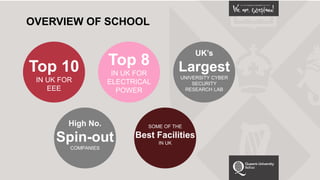
OVERVIEW OF SCHOOL
Top 10
IN UK FOR
EEE
High No.
Spin-out
COMPANIES
Top 8
IN UK FOR
ELECTRICAL
POWER
UK’s
Largest
UNIVERSITY CYBER
SECURITY
RESEARCH LAB
SOME OF THE
Best Facilities
IN UK
OVERVIEW OF SCHOOL
• 2000 students
• 180 employees
• Students from over 30 countries
(15% international)
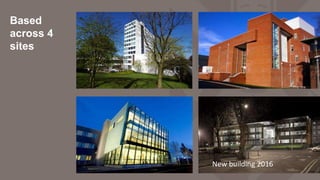
Based
across 4
sites
New building 2016
OVERVIEW OF SCHOOL
COMPUTING DEGREES
• Computer Science
• Computing & Information Technology
• Business Information Technology
• Software Engineering
Joint courses –
• Computer Science with Mathematics
• Computer Science with Physics
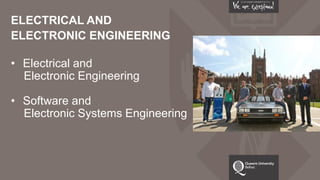
ELECTRICAL AND
ELECTRONIC ENGINEERING
• Electrical and
Electronic Engineering
• Software and
Electronic Systems Engineering
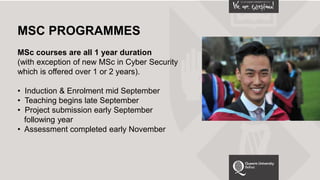
MSC PROGRAMMES
MSc courses are all 1 year duration
(with exception of new MSc in Cyber Security
which is offered over 1 or 2 years).
• Induction & Enrolment mid September
• Teaching begins late September
• Project submission early September
following year
• Assessment completed early November
MSC PROGRAMMES
MSc Electronics
MSc Wireless Communications
MSc Cyber Security
MSc SmartGrids (for Electric Power Systems)
MSc Educational Multimedia
MSc Software Development
MSC ELECTRONICS
Practical project of a research nature and
6 modules selected from following -
• Computer Architecture and Organisation
• Computer Graphics
• Digital Signal Processing
• Digital System Design
• Microelectronic T Devices and Technology
• MEMS Devices and Technology
• Programming in C and C++
• Telecommunication Systems
• High Frequency Communication Design Techniques
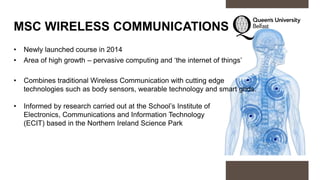
MSC WIRELESS COMMUNICATIONS
• Newly launched course in 2014
• Area of high growth – pervasive computing and ‘the internet of things’
• Combines traditional Wireless Communication with cutting edge
technologies such as body sensors, wearable technology and smart grids.
• Informed by research carried out at the School’s Institute of
Electronics, Communications and Information Technology
(ECIT) based in the Northern Ireland Science Park
MSC WIRELESS COMMUNICATIONS
Compulsory Modules -
• Wireless Communication Systems
• Wireless Sensor Systems
• Digital Signal Processing
Optional Modules – choose 3
• High Frequency Communication Design Techniques
• Digital System Design
• Computer Architecture and Organisation
• Network Security and Monitoring
• Smart Grids
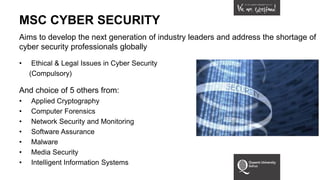
MSC CYBER SECURITY
Aims to develop the next generation of industry leaders and address the shortage of
cyber security professionals globally
• Ethical & Legal Issues in Cyber Security
(Compulsory)
And choice of 5 others from:
• Applied Cryptography
• Computer Forensics
• Network Security and Monitoring
• Software Assurance
• Malware
• Media Security
• Intelligent Information Systems
MSC CYBER SECURITY (contd.)
Offered in 1-year and 2-year formats
• to include industry placement –
Work Placements
Once accepted for the course students will be eligible to apply
for opportunities made available via the programme for work
placements with CSIT industry partners and others.
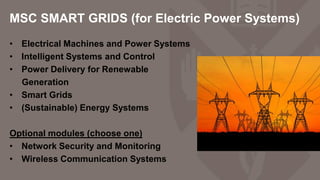
MSC SMART GRIDS (for Electric Power Systems)
• Electrical Machines and Power Systems
• Intelligent Systems and Control
• Power Delivery for Renewable
Generation
• Smart Grids
• (Sustainable) Energy Systems
Optional modules (choose one)
• Network Security and Monitoring
• Wireless Communication Systems
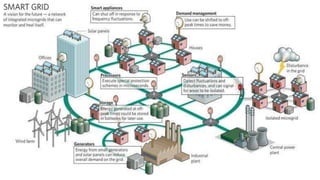
Electric Power at Queen’s –
Ranked among top 8 in the UK for Electric Power
(Member of IET Power Academy)
One of the few universities to have an MSc in SmartGrids
Researchers in the School have a research project with HIT –
www.i-give.org.uk This involves looking at Smart Grids and the
integration of electric vehicles onto the Grid
MSC EDUCATIONAL MULTIMEDIA
• Open to graduates of any discipline
• Attracts a range of graduates –
teachers, careers changers, new graduates, trainers
• Current theories of e-learning and the practical skills
necessary to create effective multimedia teaching
materials
• Classes are held in evenings (f/t & p/t options)
The four taught modules are:
Interactive Design, Multimedia Authoring, Teaching with Technology
Web of Learning
MSC SOFTWARE DEVELOPMENT
(CONVERSION)
• Popular course due to demand for software developers
(80+ students)
• Open to graduates of non-IT disciplines
• Required to sit an aptitude test for entry (2.2 degree or above)
The programme has three parts:
• basics of software development and programming
• an advanced element where students can tailor their area of specialism
• a substantial individual project
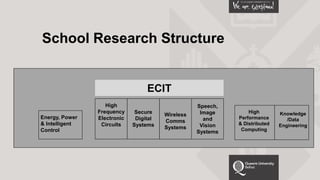
RESEARCH IN EEECS
7 Research Clusters:
• High Frequency Electronic Circuits
• Energy, Power and Intelligent Control (EPIC)
• High Performance and Distributed Computing
• Speech, Image and Vision Systems
• Knowledge and Data Engineering
• Secure Digital Systems
• Wireless Communication Systems
Energy, Power
& Intelligent
Control
Secure
Digital
Systems
High
Frequency
Electronic
Circuits
Wireless
Comms
Systems
Speech,
Image
and
Vision
Systems
High
Performance
& Distributed
Computing
Knowledge
/Data
Engineering
ECIT
School Research Structure
NETWORK SECURITY
DATA SECURITY
CYBER PHYSICAL
SYSTEMS
MOBILE SECURITY
OPEN INNOVATION
TIERED
MEMBERSHIP
KNOWLEDGE
TRANSFER
VENTURE CREATION
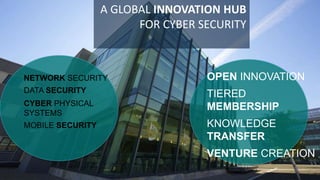
A GLOBAL INNOVATION HUB
FOR CYBER SECURITY
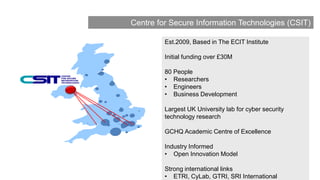
Est.2009, Based in The ECIT Institute
Initial funding over £30M
80 People
• Researchers
• Engineers
• Business Development
Largest UK University lab for cyber security
technology research
GCHQ Academic Centre of Excellence
Industry Informed
• Open Innovation Model
Strong international links
• ETRI, CyLab, GTRI, SRI International
Centre for Secure Information Technologies (CSIT)
Open Innovation - MembersOpen Innovation / Tiered Membership
For further information:
visit: www.qub.ac.uk/eeecs
e-mail: eeecs@qub.ac.uk
tel:+44 (0)28 9097 1194

School corporate talk jan'15

  • 2.
  • 3.
    OVERVIEW OF SCHOOL Undergraduateand Postgraduate Programmes Research
  • 4.
    EEECS – KeyStrengths Highly Ranked Regularly ranked among top 10 in UK and top 100 in the world for Electrical & Electronic Engineering Strong Research Profile - Top 10 in UK for EEE REF 2014: 100% of School’s research impact judged to be internationally excellent/world leading. EEE research among top 10 in UK (see later slide). UK’s Largest Cyber Security Lab EEECS is home to the Centre for Secure Information Technologies (CSIT) – The UK’s largest university cyber security research lab. Top 10 for Electric Power Engineering One of only 8 UK universities in the IET Power Academy
  • 5.
    Excellent Facilities Clean Room,Power Lab, Virtual Reality Cave, Fully equipped computer labs, Anechoic Chamber, Specialist Software etc. Spin-out Companies EEECS has a large number of successful spin-out companies. Queen’s was the UK’s Entrepreneurial University of the Year in 2009 (Times Higher Education). Location There are more software companies located here than any other part of the UK outside of London – offers opportunities for industry engagement.
  • 6.
    Ref 2014 (resultsreleased Dec’14) Highlights from the School's performance – • 100 per cent of the School's research impact was judged to be either world-leading or internationally excellent. This is a measure of the worthwhile effects achieved by the research outside of academia in areas such as business, the economy, civil society etc. • 93 per cent of research in Electrical and Electronic Engineering was judged to be either world-leading (4*) or internationally excellent (3*). Ranked among Top 10 in UK. • 72 per cent of research in Computer Science was judged to be either world-leading (4*) or internationally excellent (3*).
  • 7.
    OVERVIEW OF SCHOOL Top10 IN UK FOR EEE High No. Spin-out COMPANIES Top 8 IN UK FOR ELECTRICAL POWER UK’s Largest UNIVERSITY CYBER SECURITY RESEARCH LAB SOME OF THE Best Facilities IN UK
  • 8.
    OVERVIEW OF SCHOOL •2000 students • 180 employees • Students from over 30 countries (15% international)
  • 9.
  • 10.
  • 11.
    COMPUTING DEGREES • ComputerScience • Computing & Information Technology • Business Information Technology • Software Engineering Joint courses – • Computer Science with Mathematics • Computer Science with Physics
  • 12.
    ELECTRICAL AND ELECTRONIC ENGINEERING •Electrical and Electronic Engineering • Software and Electronic Systems Engineering
  • 13.
    MSC PROGRAMMES MSc coursesare all 1 year duration (with exception of new MSc in Cyber Security which is offered over 1 or 2 years). • Induction & Enrolment mid September • Teaching begins late September • Project submission early September following year • Assessment completed early November
  • 14.
    MSC PROGRAMMES MSc Electronics MScWireless Communications MSc Cyber Security MSc SmartGrids (for Electric Power Systems) MSc Educational Multimedia MSc Software Development
  • 15.
    MSC ELECTRONICS Practical projectof a research nature and 6 modules selected from following - • Computer Architecture and Organisation • Computer Graphics • Digital Signal Processing • Digital System Design • Microelectronic T Devices and Technology • MEMS Devices and Technology • Programming in C and C++ • Telecommunication Systems • High Frequency Communication Design Techniques
  • 16.
    MSC WIRELESS COMMUNICATIONS •Newly launched course in 2014 • Area of high growth – pervasive computing and ‘the internet of things’ • Combines traditional Wireless Communication with cutting edge technologies such as body sensors, wearable technology and smart grids. • Informed by research carried out at the School’s Institute of Electronics, Communications and Information Technology (ECIT) based in the Northern Ireland Science Park
  • 17.
    MSC WIRELESS COMMUNICATIONS CompulsoryModules - • Wireless Communication Systems • Wireless Sensor Systems • Digital Signal Processing Optional Modules – choose 3 • High Frequency Communication Design Techniques • Digital System Design • Computer Architecture and Organisation • Network Security and Monitoring • Smart Grids
  • 18.
    MSC CYBER SECURITY Aimsto develop the next generation of industry leaders and address the shortage of cyber security professionals globally • Ethical & Legal Issues in Cyber Security (Compulsory) And choice of 5 others from: • Applied Cryptography • Computer Forensics • Network Security and Monitoring • Software Assurance • Malware • Media Security • Intelligent Information Systems
  • 19.
    MSC CYBER SECURITY(contd.) Offered in 1-year and 2-year formats • to include industry placement – Work Placements Once accepted for the course students will be eligible to apply for opportunities made available via the programme for work placements with CSIT industry partners and others.
  • 20.
    MSC SMART GRIDS(for Electric Power Systems) • Electrical Machines and Power Systems • Intelligent Systems and Control • Power Delivery for Renewable Generation • Smart Grids • (Sustainable) Energy Systems Optional modules (choose one) • Network Security and Monitoring • Wireless Communication Systems
  • 22.
    Electric Power atQueen’s – Ranked among top 8 in the UK for Electric Power (Member of IET Power Academy) One of the few universities to have an MSc in SmartGrids Researchers in the School have a research project with HIT – www.i-give.org.uk This involves looking at Smart Grids and the integration of electric vehicles onto the Grid
  • 23.
    MSC EDUCATIONAL MULTIMEDIA •Open to graduates of any discipline • Attracts a range of graduates – teachers, careers changers, new graduates, trainers • Current theories of e-learning and the practical skills necessary to create effective multimedia teaching materials • Classes are held in evenings (f/t & p/t options) The four taught modules are: Interactive Design, Multimedia Authoring, Teaching with Technology Web of Learning
  • 24.
    MSC SOFTWARE DEVELOPMENT (CONVERSION) •Popular course due to demand for software developers (80+ students) • Open to graduates of non-IT disciplines • Required to sit an aptitude test for entry (2.2 degree or above) The programme has three parts: • basics of software development and programming • an advanced element where students can tailor their area of specialism • a substantial individual project
  • 25.
  • 26.
    7 Research Clusters: •High Frequency Electronic Circuits • Energy, Power and Intelligent Control (EPIC) • High Performance and Distributed Computing • Speech, Image and Vision Systems • Knowledge and Data Engineering • Secure Digital Systems • Wireless Communication Systems
  • 27.
  • 28.
    NETWORK SECURITY DATA SECURITY CYBERPHYSICAL SYSTEMS MOBILE SECURITY OPEN INNOVATION TIERED MEMBERSHIP KNOWLEDGE TRANSFER VENTURE CREATION A GLOBAL INNOVATION HUB FOR CYBER SECURITY
  • 29.
    Est.2009, Based inThe ECIT Institute Initial funding over £30M 80 People • Researchers • Engineers • Business Development Largest UK University lab for cyber security technology research GCHQ Academic Centre of Excellence Industry Informed • Open Innovation Model Strong international links • ETRI, CyLab, GTRI, SRI International Centre for Secure Information Technologies (CSIT)
  • 30.
    Open Innovation -MembersOpen Innovation / Tiered Membership
  • 31.
    For further information: visit:www.qub.ac.uk/eeecs e-mail: eeecs@qub.ac.uk tel:+44 (0)28 9097 1194