Battery
Supervisor:DREssam Nabil
Made by: Nourhan Selem Salm
What is the battery?
When did the story of battery begin?
Types of the battery
• Lead Acid Battery
• Lithium – Ion Battery
How much do batteries weigh?
What does mAh mean in a battery?
Battery Technical Specifications
How to make automatic battery charger?
How do we improve the battery charging speed?
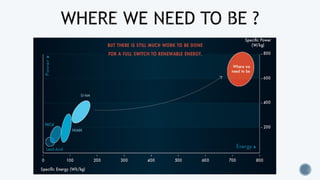
batteries in the future
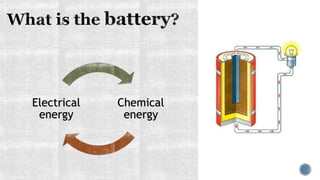
Chemical
energy
Electrical
energy
When did
the story
of battery
begin?
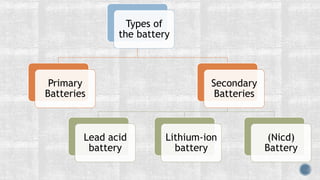
Types of
the battery
Primary
Batteries
Secondary
Batteries
Lead acid
battery
Lithium-ion
battery
(Nicd)
Battery
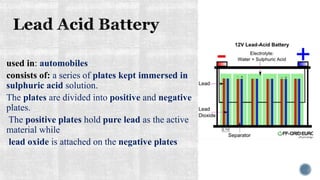
used in: automobiles
consists of: a series of plates kept immersed in
sulphuric acid solution.
The plates are divided into positive and negative
plates.
The positive plates hold pure lead as the active
material while
lead oxide is attached on the negative plates
01 02 03
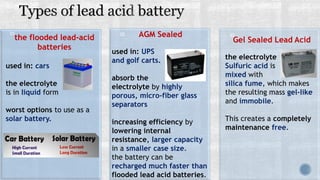
the flooded lead-acid
batteries
used in: cars
the electrolyte
is in liquid form
worst options to use as a
solar battery.
AGM Sealed
used in: UPS
and golf carts.
absorb the
electrolyte by highly
porous, micro-fiber glass
separators
increasing efficiency by
lowering internal
resistance, larger capacity
in a smaller case size.
the battery can be
recharged much faster than
flooded lead acid batteries.
Gel Sealed Lead Acid
the electrolyte
Sulfuric acid is
mixed with
silica fume, which makes
the resulting mass gel-like
and immobile.
This creates a completely
maintenance free.
▪ used in: electronic portable devices like Mobile phone, Laptop, Digital Camera, etc.
▪ Advantages:
1. Light weight compared to other batteries of similar size.
2. Available in different shape including Flat shape
3. High open circuit voltage that increases the power transfer at low current.
4. Very low self-discharge rate of 5-10% per month. Self-discharge is around 30% in
NiCd and NiMh batteries.
▪ Disadvantages:
1. The deposits inside the electrolyte over time will inhibit the flow of charge. This
increases the internal resistance of the battery and the cell’s capacity to deliver
current gradually decreases.
2. High charging and high temperature may leads to capacity loss
3. When overheated, Li-Ion battery may suffer thermal run away and cell rupture.
How much
do
batteries
weigh?
▪weight is usually proportional to its voltage and
capacity, regardless of whether they’re lithium
ion or lead-acid.
▪batteries in an automobile weigh 20 to 28 kg.
▪larger unit like Tesla’s PowerWall can weigh
well over 100kg.
▪a 6 kg lead-acid battery produces the same
amount of energy that a 1 kg lithium ion battery
can produce.
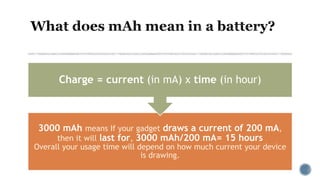
3000 mAh means If your gadget draws a current of 200 mA,
then it will last for, 3000 mAh/200 mA= 15 hours
Overall your usage time will depend on how much current your device
is drawing.
Charge = current (in mA) x time (in hour)
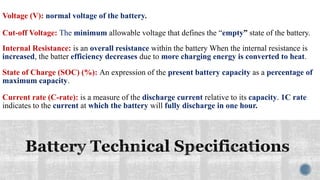
Voltage (V): normal voltage of the battery.
Cut-off Voltage: The minimum allowable voltage that defines the “empty” state of the battery.
Internal Resistance: is an overall resistance within the battery When the internal resistance is
increased, the batter efficiency decreases due to more charging energy is converted to heat.
State of Charge (SOC) (%): An expression of the present battery capacity as a percentage of
maximum capacity.
Current rate (C-rate): is a measure of the discharge current relative to its capacity. 1C rate
indicates to the current at which the battery will fully discharge in one hour.
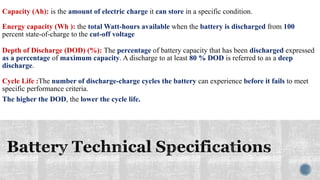
Capacity (Ah): is the amount of electric charge it can store in a specific condition.
Energy capacity (Wh ): the total Watt-hours available when the battery is discharged from 100
percent state-of-charge to the cut-off voltage
Depth of Discharge (DOD) (%): The percentage of battery capacity that has been discharged expressed
as a percentage of maximum capacity. A discharge to at least 80 % DOD is referred to as a deep
discharge.
Cycle Life :The number of discharge-charge cycles the battery can experience before it fails to meet
specific performance criteria.
The higher the DOD, the lower the cycle life.
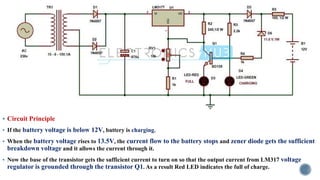
▪ Circuit Principle
▪ If the battery voltage is below 12V, battery is charging.
▪ When the battery voltage rises to 13.5V, the current flow to the battery stops and zener diode gets the sufficient
breakdown voltage and it allows the current through it.
▪ Now the base of the transistor gets the sufficient current to turn on so that the output current from LM317 voltage
regulator is grounded through the transistor Q1. As a result Red LED indicates the full of charge.
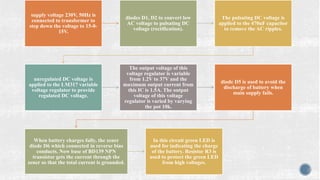
supply voltage 230V, 50Hz is
connected to transformer to
step down the voltage to 15-0-
15V.
diodes D1, D2 to convert low
AC voltage to pulsating DC
voltage (rectification).
The pulsating DC voltage is
applied to the 470uF capacitor
to remove the AC ripples.
unregulated DC voltage is
applied to the LM317 variable
voltage regulator to provide
regulated DC voltage.
The output voltage of this
voltage regulator is variable
from 1.2V to 37V and the
maximum output current from
this IC is 1.5A. The output
voltage of this voltage
regulator is varied by varying
the pot 10k.
diode D5 is used to avoid the
discharge of battery when
main supply fails.
When battery charges fully, the zener
diode D6 which connected in reverse bias
conducts. Now base of BD139 NPN
transistor gets the current through the
zener so that the total current is grounded.
In this circuit green LED is
used for indicating the charge
of the battery. Resistor R3 is
used to protect the green LED
from high voltages.
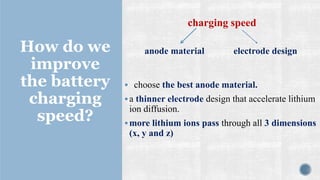
How do we
improve
the battery
charging
speed?
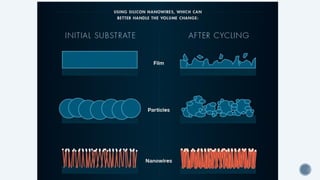
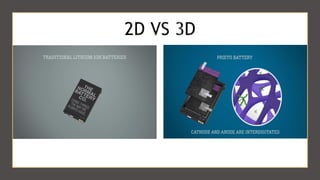
▪ choose the best anode material.
▪a thinner electrode design that accelerate lithium
ion diffusion.
▪more lithium ions pass through all 3 dimensions
(x, y and z)
anode material electrode design
charging speed
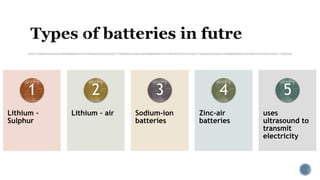
Lithium –
Sulphur
1
Lithium – air
2
Sodium-ion
batteries
3
Zinc-air
batteries
4
uses
ultrasound to
transmit
electricity
5
6
[1] Buchari, A. Maimulyanti, and Y. A. Winarko, “Preparation and potentiometric performance
of micro Ag/AgCl reference electrode,” Asahi Garasu Zaidan Josei Kenkyu Seika Hokoku, no.
December, p. 06 02 07/1-06 02 07/33, 2006.
[2] “Tesla Inc And The Future Of Battery Technology [INFOGRAPHIC],” 2017. [Online].
Available: https://www.valuewalk.com/2017/02/tesla-inc-future-battery-tech/. [Accessed: 08-
Mar-2019].
[3] “Automatic 12v Portable Battery Charger Circuit using LM317,” 2016. [Online]. Available:
https://www.electronicshub.org/automatic-battery-charger-circuit/. [Accessed: 08-Mar-2019].
[4] Adam Jacobson, “How batteries work,” TED-ED, 2015. [Online]. Available:
https://www.youtube.com/watch?v=9OVtk6G2TnQ. [Accessed: 08-Mar-2019].
Battery

Battery

  • 1.
  • 2.
    What is thebattery? When did the story of battery begin? Types of the battery • Lead Acid Battery • Lithium – Ion Battery How much do batteries weigh? What does mAh mean in a battery? Battery Technical Specifications How to make automatic battery charger? How do we improve the battery charging speed? batteries in the future
  • 3.
  • 4.
    When did the story ofbattery begin?
  • 5.
    Types of the battery Primary Batteries Secondary Batteries Leadacid battery Lithium-ion battery (Nicd) Battery
  • 6.
    used in: automobiles consistsof: a series of plates kept immersed in sulphuric acid solution. The plates are divided into positive and negative plates. The positive plates hold pure lead as the active material while lead oxide is attached on the negative plates
  • 7.
    01 02 03 theflooded lead-acid batteries used in: cars the electrolyte is in liquid form worst options to use as a solar battery. AGM Sealed used in: UPS and golf carts. absorb the electrolyte by highly porous, micro-fiber glass separators increasing efficiency by lowering internal resistance, larger capacity in a smaller case size. the battery can be recharged much faster than flooded lead acid batteries. Gel Sealed Lead Acid the electrolyte Sulfuric acid is mixed with silica fume, which makes the resulting mass gel-like and immobile. This creates a completely maintenance free.
  • 8.
    ▪ used in:electronic portable devices like Mobile phone, Laptop, Digital Camera, etc. ▪ Advantages: 1. Light weight compared to other batteries of similar size. 2. Available in different shape including Flat shape 3. High open circuit voltage that increases the power transfer at low current. 4. Very low self-discharge rate of 5-10% per month. Self-discharge is around 30% in NiCd and NiMh batteries. ▪ Disadvantages: 1. The deposits inside the electrolyte over time will inhibit the flow of charge. This increases the internal resistance of the battery and the cell’s capacity to deliver current gradually decreases. 2. High charging and high temperature may leads to capacity loss 3. When overheated, Li-Ion battery may suffer thermal run away and cell rupture.
  • 9.
    How much do batteries weigh? ▪weight isusually proportional to its voltage and capacity, regardless of whether they’re lithium ion or lead-acid. ▪batteries in an automobile weigh 20 to 28 kg. ▪larger unit like Tesla’s PowerWall can weigh well over 100kg. ▪a 6 kg lead-acid battery produces the same amount of energy that a 1 kg lithium ion battery can produce.
  • 10.
    3000 mAh meansIf your gadget draws a current of 200 mA, then it will last for, 3000 mAh/200 mA= 15 hours Overall your usage time will depend on how much current your device is drawing. Charge = current (in mA) x time (in hour)
  • 12.
    Voltage (V): normalvoltage of the battery. Cut-off Voltage: The minimum allowable voltage that defines the “empty” state of the battery. Internal Resistance: is an overall resistance within the battery When the internal resistance is increased, the batter efficiency decreases due to more charging energy is converted to heat. State of Charge (SOC) (%): An expression of the present battery capacity as a percentage of maximum capacity. Current rate (C-rate): is a measure of the discharge current relative to its capacity. 1C rate indicates to the current at which the battery will fully discharge in one hour.
  • 13.
    Capacity (Ah): isthe amount of electric charge it can store in a specific condition. Energy capacity (Wh ): the total Watt-hours available when the battery is discharged from 100 percent state-of-charge to the cut-off voltage Depth of Discharge (DOD) (%): The percentage of battery capacity that has been discharged expressed as a percentage of maximum capacity. A discharge to at least 80 % DOD is referred to as a deep discharge. Cycle Life :The number of discharge-charge cycles the battery can experience before it fails to meet specific performance criteria. The higher the DOD, the lower the cycle life.
  • 15.
    ▪ Circuit Principle ▪If the battery voltage is below 12V, battery is charging. ▪ When the battery voltage rises to 13.5V, the current flow to the battery stops and zener diode gets the sufficient breakdown voltage and it allows the current through it. ▪ Now the base of the transistor gets the sufficient current to turn on so that the output current from LM317 voltage regulator is grounded through the transistor Q1. As a result Red LED indicates the full of charge.
  • 16.
    supply voltage 230V,50Hz is connected to transformer to step down the voltage to 15-0- 15V. diodes D1, D2 to convert low AC voltage to pulsating DC voltage (rectification). The pulsating DC voltage is applied to the 470uF capacitor to remove the AC ripples. unregulated DC voltage is applied to the LM317 variable voltage regulator to provide regulated DC voltage. The output voltage of this voltage regulator is variable from 1.2V to 37V and the maximum output current from this IC is 1.5A. The output voltage of this voltage regulator is varied by varying the pot 10k. diode D5 is used to avoid the discharge of battery when main supply fails. When battery charges fully, the zener diode D6 which connected in reverse bias conducts. Now base of BD139 NPN transistor gets the current through the zener so that the total current is grounded. In this circuit green LED is used for indicating the charge of the battery. Resistor R3 is used to protect the green LED from high voltages.
  • 17.
    How do we improve thebattery charging speed? ▪ choose the best anode material. ▪a thinner electrode design that accelerate lithium ion diffusion. ▪more lithium ions pass through all 3 dimensions (x, y and z) anode material electrode design charging speed
  • 23.
    Lithium – Sulphur 1 Lithium –air 2 Sodium-ion batteries 3 Zinc-air batteries 4 uses ultrasound to transmit electricity 5
  • 24.
  • 25.
    [1] Buchari, A.Maimulyanti, and Y. A. Winarko, “Preparation and potentiometric performance of micro Ag/AgCl reference electrode,” Asahi Garasu Zaidan Josei Kenkyu Seika Hokoku, no. December, p. 06 02 07/1-06 02 07/33, 2006. [2] “Tesla Inc And The Future Of Battery Technology [INFOGRAPHIC],” 2017. [Online]. Available: https://www.valuewalk.com/2017/02/tesla-inc-future-battery-tech/. [Accessed: 08- Mar-2019]. [3] “Automatic 12v Portable Battery Charger Circuit using LM317,” 2016. [Online]. Available: https://www.electronicshub.org/automatic-battery-charger-circuit/. [Accessed: 08-Mar-2019]. [4] Adam Jacobson, “How batteries work,” TED-ED, 2015. [Online]. Available: https://www.youtube.com/watch?v=9OVtk6G2TnQ. [Accessed: 08-Mar-2019].