BATTERIES
BATTERY - cell - power packs - power sources
Is a source of energy, obtained by
the conversion of chemical energy
from chemical reaction into
electrical energy
Thus BATTERIES represent a silent
form of energy producing chemical
devices, which generate electricity on
demand
Hype on Batteries…?
The rapidity with which energy resources and oil fields are consumed
at present and in the future will depend on the rapidity with which
regions of the world industrialize, the rate of population growth, the
ultimate level of human desires to possess material goods and the
effort that is made to accelerate production
The growing concern with managing the costs of military,
space crafts, portable electronics, implantable medical devices,
communication technology etc.,
The importance of preserving our green environment mainly
because of the very high rate of industrialization,
modernization and partly due to population explosion etc.,
has placed an increased emphasis on efficient power sources
SO…. BATTERIES…. Boon….. For energy re-regeneration
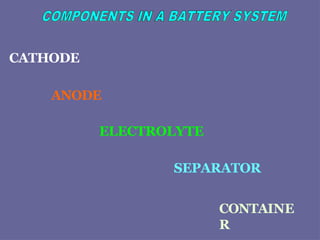
CATHODE
ANODE
ELECTROLYTE
SEPARATOR
CONTAINE
R
CELL CONSTRUCTION
ELECTROLYTE
SEPARATOR
CONTAINER
ANODE
CATHODE
CELL REACTIONS
IN A BATTERY SYSTEM
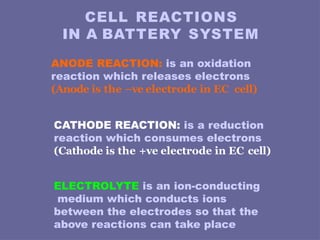
ANODE REACTION: is an oxidation
reaction which releases electrons
(Anode is the –ve electrode in EC cell)
CATHODE REACTION: is a reduction
reaction which consumes electrons
(Cathode is the +ve electrode in EC cell)
ELECTROLYTE is an ion-conducting
medium which conducts ions
between the electrodes so that the
above reactions can take place
V
A
e-
_
+
WORKING PRINCIPLE
CLASSIFICATION OF
BATTERIES
1.PRIMARY BATTERY
- for single use only
2. SECONDARY BATTERY
- for repeated use
1. PRIMARY BATTERY
- Non-rechargeable (cell
reactions are irreversible)
- Self-discharges whether used or not
LECLANCHE CELLS (Zn/C) - Popular low-
cost system
Applications: Torch light, portable radios,
toys, novelties, etc.
Mg/MnO2 CELLS - High capacity
system
RESERVE BATTERY
- one of the cell components, usually the
electrolyte, is kept isolated from the rest and
is added at the time of need
Mg/Cu2Cl2, Mg/AgCl (sea water activated battery)
Applications: Torpedoes, Sea beacons
(Mainly in Meteorology and Defence fields)
Li/FeS2 (Thermally activated battery)
Applications: In Missiles
2. SECONDARY BATTERY
- Rechargeable (cell reactions are reversible)
Lead-Acid Battery (Pb/H+)
Nickel-Cadmium Battery (Ni-Cd)
Nickel-Iron Battery (Ni-Fe)
Nickel-Metal hydride Battery (Ni-MH)
Lithium battery (Li-LiMxOy)
Lithium-Ion battery (C-LiMxOy)
Lithium-Ion Polymer Battery (C-
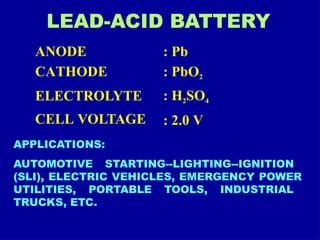
LEAD-ACID BATTERY
: Pb
: PbO2
: H2SO4
: 2.0 V
ANODE
CATHODE
ELECTROLYTE
CELL VOLTAGE
APPLICATIONS:
AUTOMOTIVE STARTING--LIGHTING--IGNITION
(SLI), ELECTRIC VEHICLES, EMERGENCY POWER
UTILITIES, PORTABLE TOOLS, INDUSTRIAL
TRUCKS, ETC.
NICKEL-CADMIUM BATTERY
ANODE
CATHODE
ELECTROLYTE
CELL VOLTAGE
: Cd
: NiOOH
: KOH
: 1.2 V
APPLICATIONS:
AIRCRAFT BATTERIES, COMMUNICATION
EQUIPMENT, MEMORY BACKUP,
PHOTOGRAPHY EQUIPMENT, ETC.
NICKEL-METAL HYDRIDE
BATTERY
ANODE
CATHODE
ELECTROLYTE
CELL VOLTAGE
: MH
: NiOOH
: KOH
: 1.2 V
APPLICATIONS:
PORTABLE ELECTRONIC DEVICES, ETC.
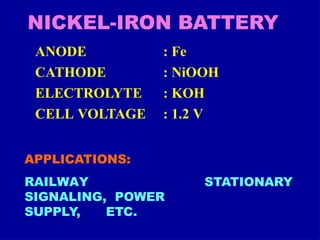
NICKEL-IRON BATTERY
ANODE
CATHODE
ELECTROLYTE
CELL VOLTAGE
: Fe
: NiOOH
: KOH
: 1.2 V
STATIONARY
APPLICATIONS:
RAILWAY
SIGNALING, POWER
SUPPLY, ETC.
LITHIUM SECONDARY BATTERY
ANODE
CATHODE
ELECTROLYTE
CELL VOLTAGE
: Li METAL
: LiCoO2
: LiPF6 in EC:PC
: 4 V
APPLICATIONS:
ELECTRIC VEHICLES, PORTABLE
ELECTRONIC DEVICES, ETC.
LITHIUM-ION BATTERY
ANODE
CATHODE
ELECTROLYTE
CELL VOLTAGE
: CARBON
: LiCoO2
: LiPF6 in EC:PC
: 4 V
APPLICATIONS:
ELECTRIC VEHICLES, CELL PHONES,
CAMCORDERS, LAP-TOP AND PALM-
TOP COMPUTERS, PORTABLE
ELECTRONIC DEVICES, ETC.
LITHIUM-POLYMER BATTERY
ANODE
CATHODE
: Li
: LiCoO2
ELECTROLYTE : SOLID POLYMER
FILMS CELL VOLTAGE : 4 V
APPLICATIONS:
ELECTRIC VEHICLES, CREDIT
CARDS, SLIM ELECTRONIC DEVICES,
ETC.
LITHIUM-ION POLYMER
BATTERY
ANODE
CATHODE
: CARBON
: LiCoO2
ELECTROLYTE : SOLID POLYMER
FILMS CELL VOLTAGE : 4 V
APPLICATIONS:
ELECTRIC VEHICLES,
PORTABLE ELECTRONIC DEVICES,
ETC.
LEAD-ACID BATTERY
ANODE
CATHODE
ELECTROLYTE
CELL VOLTAGE
: Pb
: PbO2
: H2SO4
: 2.0 V
At positive plate:
2PbSO4 + 2H2O Pb + 2H2SO4 + PbO2
REACTIONS DURING CHARGING
Discharge
PbSO4 + 2H2O PbO2 + 4H+
+ SO4
2-
+ 2e-
2H2O O2 + 4H+ + 4e-
At negative plate:
PbSO4 + 2e-  Pb + SO4
2-
2H+ + 2e-  H2
OVERALL
CELL
Raw material is cheap and also can be recovered
from scrap (spent batteries)
Supply of high power over a wide range of
temp. Very high reversibility
Availability of mass production techniques
Availability of multifarious battery configurations
Maintenance free
The success of Pb/H+ battery is due to:
BATTERY TESTING METHODS FOR Pb/H+ BATTERIES
 Air Pressure test (A check for cell sealing)
 Capacity test
 High rate discharge test
 Charge retention test
 Over charge resistance test (determining the life or
health of the grid materials)
 Life test (determining life or health of the +ve or
-ve plate active material)
Constant current or galvanostatic charging
(single step, two step, multistep
galvanostatic charging)
Constant voltage charging
Controlled current-voltage charging
Modified constant-voltage charging
Tapered charging
Boost charging
Trickle charging
Float charging
Equalizing charging
Pulse charging
Gas controlled
charging
CHARGING PROCEDURES
FACTORS AFFECTING BATTERY PERFORMANCE
AND LIFE
***
The cathode/anode composition, its design, nature and
characteristics of the oxide, composition of paste, curing,
formation and initial charging methods, concentration
of the acid, the separators, rate of discharge and
temperature of operation
Particle size, surface area, water and acid absorption
rate, plate porosity, crystallography of the oxide
etc.,
 Long standing in discharged condition
 Too high acid concentration
 Prolonged under-charging
 Increased self-discharge
 Continuous operation between 40 & 50C
Failure of Pb/H+ batteries due to:
Positive plate corrosion
Shedding of active materials
Short circuting
Sulfation
Lagging of cells
Failure of
separator
Growth and buckling of plates
PROBABLE TYPES OF DEFECTS
IN Pb/H+
BATTERIES
Wiping off the dirt (can lead to self discharge)
Checking the containers and sealing components for crack or
seepage
Checking the cables for ensuring good contact with
the terminals
Checking and cleaning of the vent holes in the plugs
Checking the electrolyte level
Checking the temperature of theelectrolyte
Measurement of specific gravity of the electrolyte, cell
voltages, plate potentials by using cadmium electrode
and
temperature of the electrolyte particularly at the end of
MAINTENACE AND HEALTH MONITORING
PROCEDURES FOR Pb/H+
BATTERIES
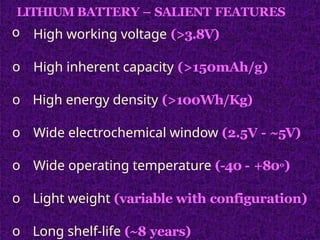
LITHIUM BATTERY – SALIENT FEATURES
o High working voltage (>3.8V)
o High inherent capacity (>150mAh/g)
o High energy density (>100Wh/Kg)
o Wide electrochemical window (2.5V - ~5V)
o Wide operating temperature (-40 - +80o)
o Light weight (variable with configuration)
o Long shelf-life (~8 years)
CATHODE MATERIALS FOR
RECHARGEABLE LITHIUM/LITHIUM-ION
BATTERIES
***
3 volt (e.g. LiMnO2)
4volt (e.g. LiCoO2, LiNiO2, LiMn2O4)
5-volt (e.g. LiNiVO4)
1 Li-ion battery = 3 Ni-Cd / Ni-MH
INTERCALATION
SOLID POLYMER ELECTROLYTES
FOR Li-ION CELLS
***
HOMOPOLYMERS e.g.,
PVdF
BLEND POLYMERS e.g., PVC-PVdF
COPOLYMERS e.g., PVdF-HFP (KYNAR)
GLOVE BOX
MOISTURE and OXYGEN LEVEL < 20ppm
 For conserving natural fuel sources
 Decreased air & noise pollution
Battery driven vehicles provide
efficient transportation in the
near future
NEED FOR BATTERY OPERATED VEHICLES
(Electric Vehicles - EV)
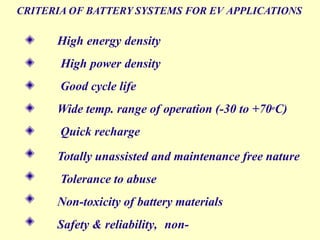
High energy density
High power density
Good cycle life
Wide temp. range of operation (-30 to +70o
C)
Quick recharge
Totally unassisted and maintenance free nature
Tolerance to abuse
Non-toxicity of battery materials
Safety & reliability, non-
CRITERIA OF BATTERY SYSTEMS FOR EV APPLICATIONS
EV PARAMETERS DECIDING THE BATTERY
SPECIFICATIONS AND POWER REQUIREMENTS
 Vehicle range
 Vehicle acceleration
 Gross vehicle weight
 Tyre rolling resistance
 Electric motor efficiency
 Hill climbing capacity
RECENT TRIALS WITH Ni-MH BATTERY
UNDER APPROPRIATE DRIVING CONDITIONS
Sp. Energy = 70-80Wh/Kg
Range = 200miles
peak speed = 90miles/h
ELECTRIC VEHICLE
NISSAN ALTRA ELECTRIC CAR
POWERED BY SONY LITHIUM- ION
BATTERY 120 MILES/CHARGE;
MATSUSHITA
HITACHI-MAXEL
EVEREADY
MAKERS OF POWER SYSTEMS – ALL
TYPES SANYO
TOSHIBA
JAPAN
SONY, PANASONIC, GEC, OVONIC —
USA
EAGLE-PICHER, VARTA -
THANK YOU ALL

BATTERIES classification and types .pptx

  • 1.
  • 2.
    BATTERY - cell- power packs - power sources Is a source of energy, obtained by the conversion of chemical energy from chemical reaction into electrical energy Thus BATTERIES represent a silent form of energy producing chemical devices, which generate electricity on demand
  • 3.
    Hype on Batteries…? Therapidity with which energy resources and oil fields are consumed at present and in the future will depend on the rapidity with which regions of the world industrialize, the rate of population growth, the ultimate level of human desires to possess material goods and the effort that is made to accelerate production The growing concern with managing the costs of military, space crafts, portable electronics, implantable medical devices, communication technology etc., The importance of preserving our green environment mainly because of the very high rate of industrialization, modernization and partly due to population explosion etc., has placed an increased emphasis on efficient power sources SO…. BATTERIES…. Boon….. For energy re-regeneration
  • 4.
  • 5.
  • 6.
    CELL REACTIONS IN ABATTERY SYSTEM ANODE REACTION: is an oxidation reaction which releases electrons (Anode is the –ve electrode in EC cell) CATHODE REACTION: is a reduction reaction which consumes electrons (Cathode is the +ve electrode in EC cell) ELECTROLYTE is an ion-conducting medium which conducts ions between the electrodes so that the above reactions can take place
  • 7.
  • 8.
    CLASSIFICATION OF BATTERIES 1.PRIMARY BATTERY -for single use only 2. SECONDARY BATTERY - for repeated use
  • 9.
    1. PRIMARY BATTERY -Non-rechargeable (cell reactions are irreversible) - Self-discharges whether used or not LECLANCHE CELLS (Zn/C) - Popular low- cost system Applications: Torch light, portable radios, toys, novelties, etc. Mg/MnO2 CELLS - High capacity system
  • 10.
    RESERVE BATTERY - oneof the cell components, usually the electrolyte, is kept isolated from the rest and is added at the time of need Mg/Cu2Cl2, Mg/AgCl (sea water activated battery) Applications: Torpedoes, Sea beacons (Mainly in Meteorology and Defence fields) Li/FeS2 (Thermally activated battery) Applications: In Missiles
  • 11.
    2. SECONDARY BATTERY -Rechargeable (cell reactions are reversible) Lead-Acid Battery (Pb/H+) Nickel-Cadmium Battery (Ni-Cd) Nickel-Iron Battery (Ni-Fe) Nickel-Metal hydride Battery (Ni-MH) Lithium battery (Li-LiMxOy) Lithium-Ion battery (C-LiMxOy) Lithium-Ion Polymer Battery (C-
  • 12.
    LEAD-ACID BATTERY : Pb :PbO2 : H2SO4 : 2.0 V ANODE CATHODE ELECTROLYTE CELL VOLTAGE APPLICATIONS: AUTOMOTIVE STARTING--LIGHTING--IGNITION (SLI), ELECTRIC VEHICLES, EMERGENCY POWER UTILITIES, PORTABLE TOOLS, INDUSTRIAL TRUCKS, ETC.
  • 13.
    NICKEL-CADMIUM BATTERY ANODE CATHODE ELECTROLYTE CELL VOLTAGE :Cd : NiOOH : KOH : 1.2 V APPLICATIONS: AIRCRAFT BATTERIES, COMMUNICATION EQUIPMENT, MEMORY BACKUP, PHOTOGRAPHY EQUIPMENT, ETC.
  • 14.
    NICKEL-METAL HYDRIDE BATTERY ANODE CATHODE ELECTROLYTE CELL VOLTAGE :MH : NiOOH : KOH : 1.2 V APPLICATIONS: PORTABLE ELECTRONIC DEVICES, ETC.
  • 15.
    NICKEL-IRON BATTERY ANODE CATHODE ELECTROLYTE CELL VOLTAGE :Fe : NiOOH : KOH : 1.2 V STATIONARY APPLICATIONS: RAILWAY SIGNALING, POWER SUPPLY, ETC.
  • 16.
    LITHIUM SECONDARY BATTERY ANODE CATHODE ELECTROLYTE CELLVOLTAGE : Li METAL : LiCoO2 : LiPF6 in EC:PC : 4 V APPLICATIONS: ELECTRIC VEHICLES, PORTABLE ELECTRONIC DEVICES, ETC.
  • 17.
    LITHIUM-ION BATTERY ANODE CATHODE ELECTROLYTE CELL VOLTAGE :CARBON : LiCoO2 : LiPF6 in EC:PC : 4 V APPLICATIONS: ELECTRIC VEHICLES, CELL PHONES, CAMCORDERS, LAP-TOP AND PALM- TOP COMPUTERS, PORTABLE ELECTRONIC DEVICES, ETC.
  • 18.
    LITHIUM-POLYMER BATTERY ANODE CATHODE : Li :LiCoO2 ELECTROLYTE : SOLID POLYMER FILMS CELL VOLTAGE : 4 V APPLICATIONS: ELECTRIC VEHICLES, CREDIT CARDS, SLIM ELECTRONIC DEVICES, ETC.
  • 19.
    LITHIUM-ION POLYMER BATTERY ANODE CATHODE : CARBON :LiCoO2 ELECTROLYTE : SOLID POLYMER FILMS CELL VOLTAGE : 4 V APPLICATIONS: ELECTRIC VEHICLES, PORTABLE ELECTRONIC DEVICES, ETC.
  • 20.
  • 21.
    At positive plate: 2PbSO4+ 2H2O Pb + 2H2SO4 + PbO2 REACTIONS DURING CHARGING Discharge PbSO4 + 2H2O PbO2 + 4H+ + SO4 2- + 2e- 2H2O O2 + 4H+ + 4e- At negative plate: PbSO4 + 2e-  Pb + SO4 2- 2H+ + 2e-  H2 OVERALL CELL
  • 22.
    Raw material ischeap and also can be recovered from scrap (spent batteries) Supply of high power over a wide range of temp. Very high reversibility Availability of mass production techniques Availability of multifarious battery configurations Maintenance free The success of Pb/H+ battery is due to:
  • 23.
    BATTERY TESTING METHODSFOR Pb/H+ BATTERIES  Air Pressure test (A check for cell sealing)  Capacity test  High rate discharge test  Charge retention test  Over charge resistance test (determining the life or health of the grid materials)  Life test (determining life or health of the +ve or -ve plate active material)
  • 24.
    Constant current orgalvanostatic charging (single step, two step, multistep galvanostatic charging) Constant voltage charging Controlled current-voltage charging Modified constant-voltage charging Tapered charging Boost charging Trickle charging Float charging Equalizing charging Pulse charging Gas controlled charging CHARGING PROCEDURES
  • 25.
    FACTORS AFFECTING BATTERYPERFORMANCE AND LIFE *** The cathode/anode composition, its design, nature and characteristics of the oxide, composition of paste, curing, formation and initial charging methods, concentration of the acid, the separators, rate of discharge and temperature of operation Particle size, surface area, water and acid absorption rate, plate porosity, crystallography of the oxide etc.,
  • 26.
     Long standingin discharged condition  Too high acid concentration  Prolonged under-charging  Increased self-discharge  Continuous operation between 40 & 50C Failure of Pb/H+ batteries due to:
  • 27.
    Positive plate corrosion Sheddingof active materials Short circuting Sulfation Lagging of cells Failure of separator Growth and buckling of plates PROBABLE TYPES OF DEFECTS IN Pb/H+ BATTERIES
  • 28.
    Wiping off thedirt (can lead to self discharge) Checking the containers and sealing components for crack or seepage Checking the cables for ensuring good contact with the terminals Checking and cleaning of the vent holes in the plugs Checking the electrolyte level Checking the temperature of theelectrolyte Measurement of specific gravity of the electrolyte, cell voltages, plate potentials by using cadmium electrode and temperature of the electrolyte particularly at the end of MAINTENACE AND HEALTH MONITORING PROCEDURES FOR Pb/H+ BATTERIES
  • 29.
    LITHIUM BATTERY –SALIENT FEATURES o High working voltage (>3.8V) o High inherent capacity (>150mAh/g) o High energy density (>100Wh/Kg) o Wide electrochemical window (2.5V - ~5V) o Wide operating temperature (-40 - +80o) o Light weight (variable with configuration) o Long shelf-life (~8 years)
  • 30.
    CATHODE MATERIALS FOR RECHARGEABLELITHIUM/LITHIUM-ION BATTERIES *** 3 volt (e.g. LiMnO2) 4volt (e.g. LiCoO2, LiNiO2, LiMn2O4) 5-volt (e.g. LiNiVO4) 1 Li-ion battery = 3 Ni-Cd / Ni-MH
  • 31.
  • 32.
    SOLID POLYMER ELECTROLYTES FORLi-ION CELLS *** HOMOPOLYMERS e.g., PVdF BLEND POLYMERS e.g., PVC-PVdF COPOLYMERS e.g., PVdF-HFP (KYNAR)
  • 33.
    GLOVE BOX MOISTURE andOXYGEN LEVEL < 20ppm
  • 35.
     For conservingnatural fuel sources  Decreased air & noise pollution Battery driven vehicles provide efficient transportation in the near future NEED FOR BATTERY OPERATED VEHICLES (Electric Vehicles - EV)
  • 36.
    High energy density Highpower density Good cycle life Wide temp. range of operation (-30 to +70o C) Quick recharge Totally unassisted and maintenance free nature Tolerance to abuse Non-toxicity of battery materials Safety & reliability, non- CRITERIA OF BATTERY SYSTEMS FOR EV APPLICATIONS
  • 37.
    EV PARAMETERS DECIDINGTHE BATTERY SPECIFICATIONS AND POWER REQUIREMENTS  Vehicle range  Vehicle acceleration  Gross vehicle weight  Tyre rolling resistance  Electric motor efficiency  Hill climbing capacity
  • 38.
    RECENT TRIALS WITHNi-MH BATTERY UNDER APPROPRIATE DRIVING CONDITIONS Sp. Energy = 70-80Wh/Kg Range = 200miles peak speed = 90miles/h
  • 39.
    ELECTRIC VEHICLE NISSAN ALTRAELECTRIC CAR POWERED BY SONY LITHIUM- ION BATTERY 120 MILES/CHARGE;
  • 40.
    MATSUSHITA HITACHI-MAXEL EVEREADY MAKERS OF POWERSYSTEMS – ALL TYPES SANYO TOSHIBA JAPAN SONY, PANASONIC, GEC, OVONIC — USA EAGLE-PICHER, VARTA -
  • 41.