Patent issues of
INDIA
PRAVIN D. SAPATE,
MPBT151713,
MGM’s INSTITUTE OF BIOSCIENCES AND TECHNOLOGY,
AURANGABAD.
OUTLINE
 TERMINOLOGIES
 INTRODUCTION
 PATENT ISSUES
• BASMATI
• TURMERIC
• DIAMOND V. CHAKRABARTY
 INDIA’S FOOTSTEP
 CONCLUSION
2
TERMINOLOGIES
 INTELLUCTUAL PROPERTY
 PATENT
 GEOGRAPHICAL INDICATIONS
 TRADITIONAL KNOWLEDGE
 PRIOR ART
 BIOPIRACY
 WTO
 TRIPS
3
INTRODUCTION
 India, unlike most developing countries, is gifted with
wide range of biodiversity.
 Indian culture utilizing this biodiversity from thousands
of year which is documented in ayurveda.
 This has generated traditional knowledge which passed
from year to year, generation to generation.
 Many developing countries still did not documented this
valuable knowledge due to lack of awareness, its need,
technology.
 Developed countries like USA exploiting its scientific
base, patenting it, making it their own property.
4
 It has caused great economic loss to developing
countries.
 E.g. Yoga positions, Neem case - INDIA,
Apple case – Japan
Apple Vs Samsung case (South Korea).
5
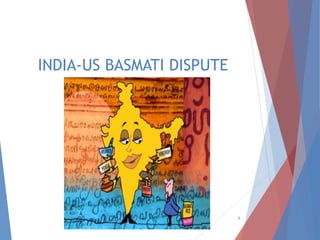
INDIA-US BASMATI DISPUTE
6
Basmati – India’s Heritage
Bas – aroma and Mati – earth [in Sanskrit].
 Basmati is a slender, aromatic long-grain rice with a
nutty taste and delicate texture.
Basmati is
originally
cultivated in INDIA
and pakistan.
Major areas in
India were
PUNJAB,
HARYAYANA,
Himalayan regions.
7
Characteristics of Basmati :-
Serial
No. Characteristics
Basmati
(in-mm)
Basmati
(Para
boiled)
Parmal
(PR-106)
1
Average Length of
uncooked rice 7.3 7.5 7.0
2
Average breadth of
uncooked rice 1.9 1.9 2.1
3
Average L/B ratio
of uncooked rice 3.8 3.9 3.3
4
Average length of
cooked rice 8.9 8.9 5.6
5
Average breadth
of cooked rice 2.2 2.2 3.1
8
Patent details
 US PATENT NO. – 5663484
 ORGNISATION – RICETEC INC., TEXAS,USA
 Scientist - Eugenio S. Surreal, John A. Mann, James
Edward Stroike, Robin D. Andrews
 PATENT FILED – 8 JULY 1994
 PATENT GRANTED – 2 SEPT,1997
 TOTAL CLAIMS – 20
 RICE LINES DEVELOPED – 3 (Bas 867, RT1117,RT1121)
 RIGHTS ALLOTTED - Use of the term ‘basmati’,
- Proprietary rights on the seeds and
grains from any crosses.
9
Case
 Commercial names for there rice – Texmati, Kasmati
(before allowing patent).
 Claims to overcome inherent deficiencies of “traditional
Basmati” including
 photoperiod sensitive - long maturity period
 low-yielding
 disease - susceptible
 tall plant prone to lodging.
 Ricetec crossed native American variety with basmati, and
invented new rice lines.
10
Claims of Ricetec Inc.
11
 Impact on Indian economy-
i) Displacement of basmati exports from India and Pakistan ;
ii) Monopolization of basmati seed supplies ;
iii) Research work involving basmati.
 To tackle this, India formed committee comprises of
ICAR, APEDA, CSIR, AIREA.
12
 India initially objected for following claims (Claim
no.1,15 and 16)
a. Starch index = 27-35.
b. Length = 6.2-8 mm, width = 1.6-1.9 mm, l/w= 3.5-4.5 .
c. Length increase in 75 to 150 % when cooked.
d. Burst index= 1-4.
e. 2 acetyle-L-pyrroline content =150-2000 ppb.
 After its successful revocation, India again filed
application for re-examination of other claims.
13
 US National agricultural services (1998) states that-
"Almost 75 per cent of the US rice imports are the
Jasmine rice from Thailand and most of the remainder
are from India and Pakistan, varieties that currently
cannot be grown in the US."
 An Indian company Khushi Ram Behari Lal Ltd., in their
profile, claim that four generations of the family have
been in the rice business since 1889.
 This further supports the argument that Basmati has
existed in India and Pakistan for centuries and as such
cannot be patented by the US.
14
 Finally USPTO, on 14 august 2001, accepted India's
challenge and changed 15 claims (claims 1-7, 12 to 20).
 Same case was fought by India with countries like UK,
brazil, Greece, Colombia and successfully revoked.
15
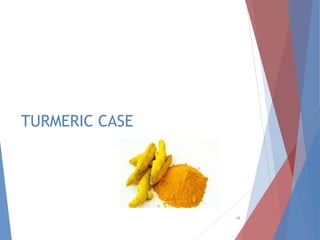
TURMERIC CASE
16
Importance to INDIA
 Turmeric (Curcuma longa) is a perennial plant, which is
native to the tropical regions of Southern Asia.
 It is a plant that is frequently used in regional cooking as
well as having a central place in Ayurvedic and Chinese
medicine to treat various ailments.
 Its use within the medicinal field has been found to help
against among other things inflammations, digestive
disorders, liver diseases and cancer.
 It is also indefinite part of Indian kitchen.
17
Patent details
 US patent no. – 5401504
 Organization – University of Mississippi Medical Center
 Scientist - Suman K. Das and Hari Har P. Cohly
 Patent filed – December 18, 1993
 Patent granted - March 28, 1995
 Claims – Use of turmeric in wound healing
 Rights allotted - To sell and distribute turmeric .
18
Case
 The patent claimed that the administration of an
effective amount of turmeric locally and orally to
enhance the wound healing process.
 Council of scientific and industrial research (CSIR), India
filed an application for reexamination of patent on the
basis of evidence of “prior art”. (in 1996)
 Total 32 reference given by CSIR and literature from
Ayurvedic and other historic sources stating its use as
medicine.
 University agreed to stepped back.
19
Prior art in URDU
20
Prior art in ENGLISH
21
 University again challenged by stating
“The powder and paste had different physical
properties, i.e. bio-availability and absorbability, and
therefore, one of ordinary skill in the art would not expect,
with any reasonable degree of certainty, that a powdered
material would be useful in the same application as a paste
of the same material. The inventors, further, mentioned
that oral administration was available only with honey and
honey itself was considered to have wound healing
properties.”
 Again in 1997, USPTO rejected the application stating that
both powder and paste has the same effect on wound
healing.
 Finally the case was OVER.
22
Dr. Raghunath Mashelkar,
former Director of CSIR,
1996-2007 23
Diamond v. Chakrabarty
Case
Ananda Mohan Chakrabarty 24
Patent details
 US patent No. – 4259444
 Organization – General Electric
 Scientist- Ananda Mohan Chakrabarty
 Patent filed -7 June,1972
 Patent Granted – 31 March, 1980
 Product - Pseudomonas putida
 Claims –The method of producing the bacterium.
-An inoculums composed of a carrier material
and the bacterium.
-The genetically engineered bacterium itself.
25
Need arises due to……
 Petro-chemical industries has a big issue after them
“How to recycle or process waste oil?”
 They came to know about some bacterial strains which
having that ability.
 These strains degrade hydrocarbons from oils and
convert it to useful product that is edible for fishes and
other marine organisms.
 They tried the different mixture of these strains but
none of them found much effective to degrade oil spills.
 This may be due surveillance, hydrocarbon specificity,
environmental conditions.
26
What Chakrabarty done?????
 He developed this bacterium by engineering a way for
multiple plasmids, each of which is able to break down
different hydrocarbon components of the crude oil, to
be incorporated into a single bacterium.
 This genetically engineered bacterium was capable of
breaking down oil spills at a much faster rate than
naturally occurring bacteria.
 As importantly, it was not affected by varying
environmental conditions.
 Targeted hydrocarbons :- Camphor, octane, salicylate,
naphthalene.
27
Case
 Two claims accepted but the main issue is on 3rd claims
which is on “Genetically engineered Bacteria”.
 USPTO rejected stating that “natural living organism are
not patentable” under Section 101 of Title 35 U.S.C.
 Then Chakrabarty and his team decided to go to US
court.
 The question before the Court was whether the claimed
microorganism constituted a “manufacture” or
“composition of matter” within the meaning of the US
Patent Act.
28
 The Supreme Court disagreed, deciding by a five-to-four
majority that a patent may be obtained on “anything
under the sun that is made by man.”
 USPTO forced to change there rule and grant patent to
Chakrabarty.
29
INDIA’S footstep:-
India has initiated an attempt to document traditional
knowledge in written as well as electronic form by means of
People’s Biodiversity Registers (PBR):-
 Foundation for Revitalization of Local Health Traditions
(FRLHT) and supported by the Centre for Ecological
Sciences (CES).
 To build an open and transparent information system on
biodiversity resources from the village level upwards.
 To promote the sustainable management of biodiversity
resources.
30
Traditional Knowledge Digital Library (TKDL):-
 Controller General of Patents, Design and Trade Marks;
CSIR through its National Institute of Science
Communication And Information Resources (NISCAIR);
and Department of Ayurveda, Yoga & Naturopathy, Unani,
Siddha and Homeopathy (AYUSH).
 Translate Indian traditional knowledge originally
available in native Languages to five international
languages namely English, French, German, Spanish and
Japanese.
 Access to ‘prior art’ to international patent offices.
31
http://nbaindia.org/content
/105/30/1/pbr.html
http://www.tkdl.res.in/
INDIA is the only
country in the
world to have
set up an
institutional
mechanism.
32
CONCLUSION
 India is one of the huge markets for global investors,
because of its great diversity and abundance of natural
resources.
 In the era of globalization, we, the citizens of India,
must contribute to protect our this traditional
knowledge.
 It will bring huge amount of foreign exchange which will
push Indian economy significantly.
 This traditional knowledge can also be utilized for
producing GMO’s.
 So, our focus should be on more desired transgenic
events to be patented.
33
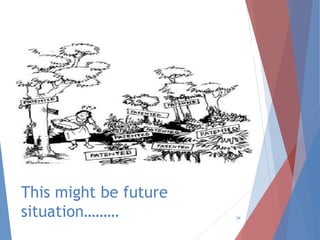
This might be future
situation……… 34
ThanQ?????
35

Mpbt151713 patent issues'

  • 1.
    Patent issues of INDIA PRAVIND. SAPATE, MPBT151713, MGM’s INSTITUTE OF BIOSCIENCES AND TECHNOLOGY, AURANGABAD.
  • 2.
    OUTLINE  TERMINOLOGIES  INTRODUCTION PATENT ISSUES • BASMATI • TURMERIC • DIAMOND V. CHAKRABARTY  INDIA’S FOOTSTEP  CONCLUSION 2
  • 3.
    TERMINOLOGIES  INTELLUCTUAL PROPERTY PATENT  GEOGRAPHICAL INDICATIONS  TRADITIONAL KNOWLEDGE  PRIOR ART  BIOPIRACY  WTO  TRIPS 3
  • 4.
    INTRODUCTION  India, unlikemost developing countries, is gifted with wide range of biodiversity.  Indian culture utilizing this biodiversity from thousands of year which is documented in ayurveda.  This has generated traditional knowledge which passed from year to year, generation to generation.  Many developing countries still did not documented this valuable knowledge due to lack of awareness, its need, technology.  Developed countries like USA exploiting its scientific base, patenting it, making it their own property. 4
  • 5.
     It hascaused great economic loss to developing countries.  E.g. Yoga positions, Neem case - INDIA, Apple case – Japan Apple Vs Samsung case (South Korea). 5
  • 6.
  • 7.
    Basmati – India’sHeritage Bas – aroma and Mati – earth [in Sanskrit].  Basmati is a slender, aromatic long-grain rice with a nutty taste and delicate texture. Basmati is originally cultivated in INDIA and pakistan. Major areas in India were PUNJAB, HARYAYANA, Himalayan regions. 7
  • 8.
    Characteristics of Basmati:- Serial No. Characteristics Basmati (in-mm) Basmati (Para boiled) Parmal (PR-106) 1 Average Length of uncooked rice 7.3 7.5 7.0 2 Average breadth of uncooked rice 1.9 1.9 2.1 3 Average L/B ratio of uncooked rice 3.8 3.9 3.3 4 Average length of cooked rice 8.9 8.9 5.6 5 Average breadth of cooked rice 2.2 2.2 3.1 8
  • 9.
    Patent details  USPATENT NO. – 5663484  ORGNISATION – RICETEC INC., TEXAS,USA  Scientist - Eugenio S. Surreal, John A. Mann, James Edward Stroike, Robin D. Andrews  PATENT FILED – 8 JULY 1994  PATENT GRANTED – 2 SEPT,1997  TOTAL CLAIMS – 20  RICE LINES DEVELOPED – 3 (Bas 867, RT1117,RT1121)  RIGHTS ALLOTTED - Use of the term ‘basmati’, - Proprietary rights on the seeds and grains from any crosses. 9
  • 10.
    Case  Commercial namesfor there rice – Texmati, Kasmati (before allowing patent).  Claims to overcome inherent deficiencies of “traditional Basmati” including  photoperiod sensitive - long maturity period  low-yielding  disease - susceptible  tall plant prone to lodging.  Ricetec crossed native American variety with basmati, and invented new rice lines. 10
  • 11.
  • 12.
     Impact onIndian economy- i) Displacement of basmati exports from India and Pakistan ; ii) Monopolization of basmati seed supplies ; iii) Research work involving basmati.  To tackle this, India formed committee comprises of ICAR, APEDA, CSIR, AIREA. 12
  • 13.
     India initiallyobjected for following claims (Claim no.1,15 and 16) a. Starch index = 27-35. b. Length = 6.2-8 mm, width = 1.6-1.9 mm, l/w= 3.5-4.5 . c. Length increase in 75 to 150 % when cooked. d. Burst index= 1-4. e. 2 acetyle-L-pyrroline content =150-2000 ppb.  After its successful revocation, India again filed application for re-examination of other claims. 13
  • 14.
     US Nationalagricultural services (1998) states that- "Almost 75 per cent of the US rice imports are the Jasmine rice from Thailand and most of the remainder are from India and Pakistan, varieties that currently cannot be grown in the US."  An Indian company Khushi Ram Behari Lal Ltd., in their profile, claim that four generations of the family have been in the rice business since 1889.  This further supports the argument that Basmati has existed in India and Pakistan for centuries and as such cannot be patented by the US. 14
  • 15.
     Finally USPTO,on 14 august 2001, accepted India's challenge and changed 15 claims (claims 1-7, 12 to 20).  Same case was fought by India with countries like UK, brazil, Greece, Colombia and successfully revoked. 15
  • 16.
  • 17.
    Importance to INDIA Turmeric (Curcuma longa) is a perennial plant, which is native to the tropical regions of Southern Asia.  It is a plant that is frequently used in regional cooking as well as having a central place in Ayurvedic and Chinese medicine to treat various ailments.  Its use within the medicinal field has been found to help against among other things inflammations, digestive disorders, liver diseases and cancer.  It is also indefinite part of Indian kitchen. 17
  • 18.
    Patent details  USpatent no. – 5401504  Organization – University of Mississippi Medical Center  Scientist - Suman K. Das and Hari Har P. Cohly  Patent filed – December 18, 1993  Patent granted - March 28, 1995  Claims – Use of turmeric in wound healing  Rights allotted - To sell and distribute turmeric . 18
  • 19.
    Case  The patentclaimed that the administration of an effective amount of turmeric locally and orally to enhance the wound healing process.  Council of scientific and industrial research (CSIR), India filed an application for reexamination of patent on the basis of evidence of “prior art”. (in 1996)  Total 32 reference given by CSIR and literature from Ayurvedic and other historic sources stating its use as medicine.  University agreed to stepped back. 19
  • 20.
    Prior art inURDU 20
  • 21.
    Prior art inENGLISH 21
  • 22.
     University againchallenged by stating “The powder and paste had different physical properties, i.e. bio-availability and absorbability, and therefore, one of ordinary skill in the art would not expect, with any reasonable degree of certainty, that a powdered material would be useful in the same application as a paste of the same material. The inventors, further, mentioned that oral administration was available only with honey and honey itself was considered to have wound healing properties.”  Again in 1997, USPTO rejected the application stating that both powder and paste has the same effect on wound healing.  Finally the case was OVER. 22
  • 23.
    Dr. Raghunath Mashelkar, formerDirector of CSIR, 1996-2007 23
  • 24.
  • 25.
    Patent details  USpatent No. – 4259444  Organization – General Electric  Scientist- Ananda Mohan Chakrabarty  Patent filed -7 June,1972  Patent Granted – 31 March, 1980  Product - Pseudomonas putida  Claims –The method of producing the bacterium. -An inoculums composed of a carrier material and the bacterium. -The genetically engineered bacterium itself. 25
  • 26.
    Need arises dueto……  Petro-chemical industries has a big issue after them “How to recycle or process waste oil?”  They came to know about some bacterial strains which having that ability.  These strains degrade hydrocarbons from oils and convert it to useful product that is edible for fishes and other marine organisms.  They tried the different mixture of these strains but none of them found much effective to degrade oil spills.  This may be due surveillance, hydrocarbon specificity, environmental conditions. 26
  • 27.
    What Chakrabarty done????? He developed this bacterium by engineering a way for multiple plasmids, each of which is able to break down different hydrocarbon components of the crude oil, to be incorporated into a single bacterium.  This genetically engineered bacterium was capable of breaking down oil spills at a much faster rate than naturally occurring bacteria.  As importantly, it was not affected by varying environmental conditions.  Targeted hydrocarbons :- Camphor, octane, salicylate, naphthalene. 27
  • 28.
    Case  Two claimsaccepted but the main issue is on 3rd claims which is on “Genetically engineered Bacteria”.  USPTO rejected stating that “natural living organism are not patentable” under Section 101 of Title 35 U.S.C.  Then Chakrabarty and his team decided to go to US court.  The question before the Court was whether the claimed microorganism constituted a “manufacture” or “composition of matter” within the meaning of the US Patent Act. 28
  • 29.
     The SupremeCourt disagreed, deciding by a five-to-four majority that a patent may be obtained on “anything under the sun that is made by man.”  USPTO forced to change there rule and grant patent to Chakrabarty. 29
  • 30.
    INDIA’S footstep:- India hasinitiated an attempt to document traditional knowledge in written as well as electronic form by means of People’s Biodiversity Registers (PBR):-  Foundation for Revitalization of Local Health Traditions (FRLHT) and supported by the Centre for Ecological Sciences (CES).  To build an open and transparent information system on biodiversity resources from the village level upwards.  To promote the sustainable management of biodiversity resources. 30
  • 31.
    Traditional Knowledge DigitalLibrary (TKDL):-  Controller General of Patents, Design and Trade Marks; CSIR through its National Institute of Science Communication And Information Resources (NISCAIR); and Department of Ayurveda, Yoga & Naturopathy, Unani, Siddha and Homeopathy (AYUSH).  Translate Indian traditional knowledge originally available in native Languages to five international languages namely English, French, German, Spanish and Japanese.  Access to ‘prior art’ to international patent offices. 31
  • 32.
    http://nbaindia.org/content /105/30/1/pbr.html http://www.tkdl.res.in/ INDIA is theonly country in the world to have set up an institutional mechanism. 32
  • 33.
    CONCLUSION  India isone of the huge markets for global investors, because of its great diversity and abundance of natural resources.  In the era of globalization, we, the citizens of India, must contribute to protect our this traditional knowledge.  It will bring huge amount of foreign exchange which will push Indian economy significantly.  This traditional knowledge can also be utilized for producing GMO’s.  So, our focus should be on more desired transgenic events to be patented. 33
  • 34.
    This might befuture situation……… 34
  • 35.