A Presentation On B.tech Agriculture
Engineering & Industry revolution
4.0
By Surjeet singh rana.
What is Agriculture
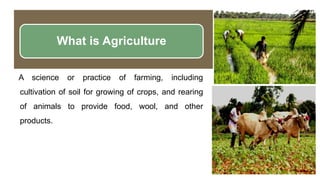
A science or practice of farming, including
cultivation of soil for growing of crops, and rearing
of animals to provide food, wool, and other
products.
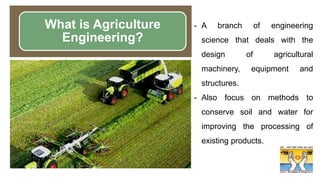
- A branch of engineering
science that deals with the
design of agricultural
machinery, equipment and
structures.
- Also focus on methods to
conserve soil and water for
improving the processing of
existing products.
What is Agriculture
Engineering?
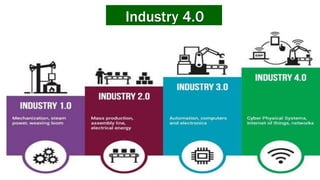
Industry 4.0
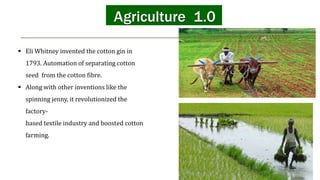
Agriculture 1.0
 Eli Whitney invented the cotton gin in
1793. Automation of separating cotton
seed from the cotton fibre.
 Along with other inventions like the
spinning jenny, it revolutionized the
factory-
based textile industry and boosted cotton
farming.
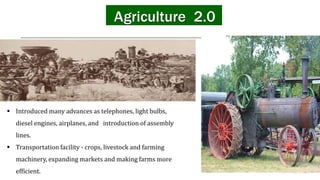
Agriculture 2.0
 Introduced many advances as telephones, light bulbs,
diesel engines, airplanes, and introduction of assembly
lines.
 Transportation facility - crops, livestock and farming
machinery, expanding markets and making farms more
efficient.
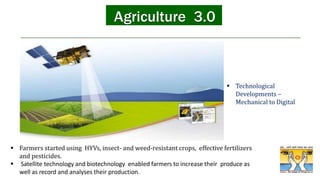
• The third industrial revolution, also
called the digital revolution, saw
Agriculture 3.0
 Farmers started using HYVs, insect- and weed-resistant crops, effective fertilizers
and pesticides.
 Satellite technology and biotechnology enabled farmers to increase their produce as
well as record and analyses their production.
 Technological
Developments –
Mechanical to Digital
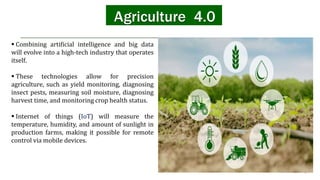
Agriculture 4.0
 Combining artificial intelligence and big data
will evolve into a high-tech industry that operates
itself.
 These technologies allow for precision
agriculture, such as yield monitoring, diagnosing
insect pests, measuring soil moisture, diagnosing
harvest time, and monitoring crop health status.
 Internet of things (IoT) will measure the
temperature, humidity, and amount of sunlight in
production farms, making it possible for remote
control via mobile devices.
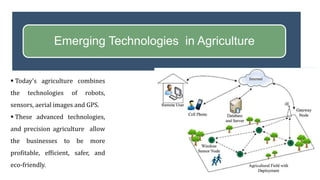
Emerging Technologies in Agriculture
 Today’s agriculture combines
the technologies of robots,
sensors, aerial images and GPS.
 These advanced technologies,
and precision agriculture allow
the businesses to be more
profitable, efficient, safer, and
eco-friendly.
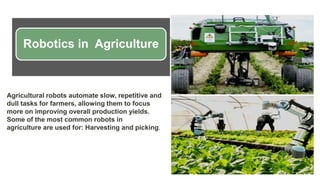
Robotics in Agriculture
Agricultural robots automate slow, repetitive and
dull tasks for farmers, allowing them to focus
more on improving overall production yields.
Some of the most common robots in
agriculture are used for: Harvesting and picking.
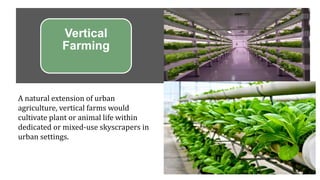
Vertical
Farming
A natural extension of urban
agriculture, vertical farms would
cultivate plant or animal life within
dedicated or mixed-use skyscrapers in
urban settings.
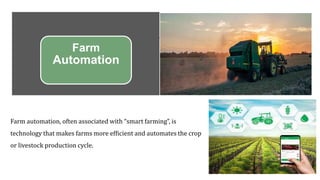
Farm
Automation
Farm automation, often associated with “smart farming”, is
technology that makes farms more efficient and automates the crop
or livestock production cycle.
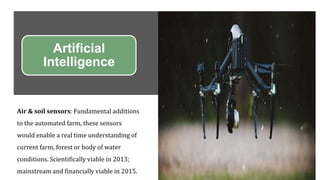
Artificial
Intelligence
Air & soil sensors: Fundamental additions
to the automated farm, these sensors
would enable a real time understanding of
current farm, forest or body of water
conditions. Scientifically viable in 2013;
mainstream and financially viable in 2015.
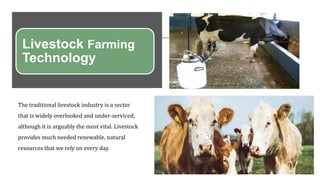
Livestock Farming
Technology
The traditional livestock industry is a sector
that is widely overlooked and under-serviced,
although it is arguably the most vital. Livestock
provides much needed renewable, natural
resources that we rely on every day.
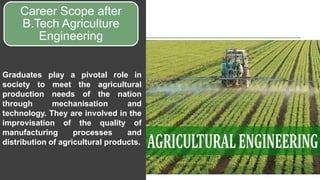
Career Scope after
B.Tech Agriculture
Engineering
Graduates play a pivotal role in
society to meet the agricultural
production needs of the nation
through mechanisation and
technology. They are involved in the
improvisation of the quality of
manufacturing processes and
distribution of agricultural products.
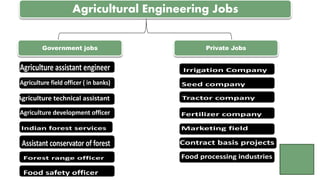
Agricultural Engineering Jobs
Government jobs Private Jobs
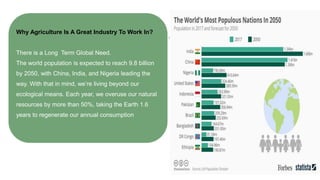
Why Agriculture Is A Great Industry To Work In?
There is a Long Term Global Need.
The world population is expected to reach 9.8 billion
by 2050, with China, India, and Nigeria leading the
way. With that in mind, we’re living beyond our
ecological means. Each year, we overuse our natural
resources by more than 50%, taking the Earth 1.6
years to regenerate our annual consumption
Food Processing in India
• 100% FDI for Food Processing Industries – Manufacture, and trading in domestic and
international market.
• India has a target of USD 60 billion to export the agricultural products by 2022.
• Food processing machineries of worth USD 51.2 billion (global – USD 51.2 billion ) are
planned to be deployed by 2024 – 25.
• By 2024, the Food Processing industry will potentially attract $33 bn investments and generate
employment for 9 million people.
• By 2025, India’s food processing sector is expected to be worth over half a trillion dollars.
• By 2030, Indian annual household consumption to treble, making India 5th largest consumer
Food Processing in India

Agriculture engineering & industry revolution 4.0

  • 1.
    A Presentation OnB.tech Agriculture Engineering & Industry revolution 4.0 By Surjeet singh rana.
  • 2.
    What is Agriculture Ascience or practice of farming, including cultivation of soil for growing of crops, and rearing of animals to provide food, wool, and other products.
  • 3.
    - A branchof engineering science that deals with the design of agricultural machinery, equipment and structures. - Also focus on methods to conserve soil and water for improving the processing of existing products. What is Agriculture Engineering?
  • 4.
  • 5.
    Agriculture 1.0  EliWhitney invented the cotton gin in 1793. Automation of separating cotton seed from the cotton fibre.  Along with other inventions like the spinning jenny, it revolutionized the factory- based textile industry and boosted cotton farming.
  • 6.
    Agriculture 2.0  Introducedmany advances as telephones, light bulbs, diesel engines, airplanes, and introduction of assembly lines.  Transportation facility - crops, livestock and farming machinery, expanding markets and making farms more efficient.
  • 7.
    • The thirdindustrial revolution, also called the digital revolution, saw Agriculture 3.0  Farmers started using HYVs, insect- and weed-resistant crops, effective fertilizers and pesticides.  Satellite technology and biotechnology enabled farmers to increase their produce as well as record and analyses their production.  Technological Developments – Mechanical to Digital
  • 8.
    Agriculture 4.0  Combiningartificial intelligence and big data will evolve into a high-tech industry that operates itself.  These technologies allow for precision agriculture, such as yield monitoring, diagnosing insect pests, measuring soil moisture, diagnosing harvest time, and monitoring crop health status.  Internet of things (IoT) will measure the temperature, humidity, and amount of sunlight in production farms, making it possible for remote control via mobile devices.
  • 9.
    Emerging Technologies inAgriculture  Today’s agriculture combines the technologies of robots, sensors, aerial images and GPS.  These advanced technologies, and precision agriculture allow the businesses to be more profitable, efficient, safer, and eco-friendly.
  • 10.
    Robotics in Agriculture Agriculturalrobots automate slow, repetitive and dull tasks for farmers, allowing them to focus more on improving overall production yields. Some of the most common robots in agriculture are used for: Harvesting and picking.
  • 11.
    Vertical Farming A natural extensionof urban agriculture, vertical farms would cultivate plant or animal life within dedicated or mixed-use skyscrapers in urban settings.
  • 12.
    Farm Automation Farm automation, oftenassociated with “smart farming”, is technology that makes farms more efficient and automates the crop or livestock production cycle.
  • 13.
    Artificial Intelligence Air & soilsensors: Fundamental additions to the automated farm, these sensors would enable a real time understanding of current farm, forest or body of water conditions. Scientifically viable in 2013; mainstream and financially viable in 2015.
  • 14.
    Livestock Farming Technology The traditionallivestock industry is a sector that is widely overlooked and under-serviced, although it is arguably the most vital. Livestock provides much needed renewable, natural resources that we rely on every day.
  • 15.
    Career Scope after B.TechAgriculture Engineering Graduates play a pivotal role in society to meet the agricultural production needs of the nation through mechanisation and technology. They are involved in the improvisation of the quality of manufacturing processes and distribution of agricultural products.
  • 16.
  • 17.
    Why Agriculture IsA Great Industry To Work In? There is a Long Term Global Need. The world population is expected to reach 9.8 billion by 2050, with China, India, and Nigeria leading the way. With that in mind, we’re living beyond our ecological means. Each year, we overuse our natural resources by more than 50%, taking the Earth 1.6 years to regenerate our annual consumption
  • 18.
    Food Processing inIndia • 100% FDI for Food Processing Industries – Manufacture, and trading in domestic and international market. • India has a target of USD 60 billion to export the agricultural products by 2022. • Food processing machineries of worth USD 51.2 billion (global – USD 51.2 billion ) are planned to be deployed by 2024 – 25. • By 2024, the Food Processing industry will potentially attract $33 bn investments and generate employment for 9 million people. • By 2025, India’s food processing sector is expected to be worth over half a trillion dollars. • By 2030, Indian annual household consumption to treble, making India 5th largest consumer
  • 19.
  • 20.