Intellectual Property Rights –
Implications on Agriculture &
Food Enterprises
Prof. V. Swapna
Associate Faculty Member
Indian Patent Agent
swapnaipfc@nimsme.org
Intellectual property Rights
IP refers to “creations” of the human mind.
It gives the creator an exclusive right over the use of his/her creation
for a certain period of time to inventions, literary and artistic works, and
symbols, names, images, and designs used in commerce.
IP is used as
Defensive strategy: Protecting yourself from others using your assets for their
benefit without giving you a recognition
Offensive strategy: Selling the IP and retaining the morals, licensing of IP for use
by others but retaining the ownership
History
GATT : General Agreement on Tariffs and Trade.
Objective:
Reduction of barriers to international trade.
(This was achieved through the reduction of tariff
barriers, quantitative restrictions and subsidies on trade through a series of agreements.)
Functions of the GATT were taken over by the World Trade Organization
(WTO)which was established during the final round of negotiations in the early 1990s
WIPO
WIPO is an intergovernmental organization, which administers a number
of international treaties in the field of intellectual property.
Mission: To promote innovation and creativity for the economic, social
and cultural development of all countries, through a balanced and
effective international intellectual property system.
Member states: 185
Role:
• Establish and harmonize rules and practices for the protection of
intellectual property rights
• Provides global registration systems for trademarks, industrial designs
and appellations of origin, and a global filing system for patents.
Trade Related Aspects of Intellectual Property
Rights (TRIPS)
International Agreement administered by the World Trade
Organization (WTO).
Sets down minimum standards for many forms of intellectual
Property (IP) regulation.
Seven Forms of IP:
Patents
Plant Variety protection or Plant Breeders’ Rights
Copyrights
Geographical Indications
Trademarks
Layout designs for integrated circuits
Trade secrets
Patents
A patent is an exclusive right granted for an invention, which is a product or a
process that provides a new way of doing something, or offers a new technical
solution to a problem
The limited monopoly right granted by the state enables an inventor to
prohibit another person from manufacturing, using or selling the patented
product or from using the patented process, without permission
Period of Patents - 20 Years Examples: Process related to agrochemicals,
growth promoters and regulators, vaccines,
drugs, hides and wool, dairy technology, food
technology, fuel and biogas production,
bioreactors etc
What can be Patented?
Inventions in all fields of technology, whether products or processes, if they meet
the criteria of
 Novelty : Not known to public prior to claim by inventor
 Non-obviousness (inventive step): Should not be obvious to a person with
ordinary skill in the art
 Industrial application (utility).
Patents
Non Patentable Inventions
1. Frivolous inventions
2. An invention the primary or intended use or commercial exploitation of which could be
contrary to public order or morality or which causes serious prejudice to human, animal
or plant life or health or to the environment
3. The mere discovery of a scientific principle or the formulation of an abstract theory or
discovery of any living thing or non-living substances occurring in nature;
4. The mere discovery of a new form of a known substance which does not result in the
enhancement of the known efficacy of that substance or the mere discovery of any new
property or new use for a known substance or of the mere use of a known process,
machine or apparatus unless such known process results in a new product or employs at
least one new reactant.
5. A substance obtained by a mere admixture resulting only in the aggregation of the
properties of the components thereof or a process for producing such substance
Patents
Non Patentable Inventions (contd…)
6. The mere arrangement or re-arrangement or duplication of known devices each
functioning independently of one another in a known way
7. A method of agriculture or horticulture.
8. Any process for the medicinal, surgical, curative, prophylactic diagnostic therapeutic or
other treatment of human being or any process for a similar treatment of animals to
render them free of disease or to increase their economic value or that of their products.
Plant or animal varieties, or essentially biological processes for the production of such,
other than microbiological process
9. A mere scheme or rule or method of performing mental act or method of playing game;
10. A presentation of information
11. Topography of integrated circuits
Patents
Patent filing procedure in India
Plant Variety protection or Plant Breeders’ Rights
Rights granted to the breeder of a new variety of plant.
These laws typically grant the plant breeder control of the propagating
material (including seed, cuttings, divisions, tissue culture) and harvested
material (cut flowers, fruit, foliage) of a new variety for a number of years.
International Rights
International Convention for the Protection of New Varieties of Plants
(UPOV Convention).
Purpose of the Convention was to ensure that the member states party to
the Convention acknowledge the achievements of breeders of new plant
varieties by making available to them an exclusive property right, on the basis
of a set of uniform and clearly defined principles.
The main objectives of the PVP Act are
• To recognize and protect the rights of farmers for their contribution
made at any time in conserving, improving and making available plant
genetic resources for the development of new plant varieties.
• To encourage the development of new varieties of plants for
accelerated agricultural development.
• To accelerate the agricultural development in the country and protect
Plant Breeders Rights (PBR) and to stimulate investment in research and
development (R&D) both in public and private sector, for breeding new
plant varieties.
• To facilitate the growth of the seed industry, which will ensure the
availability of good quality seed and plant material to the farmers.
Registration of all the plant varieties
• It is Mandatory.
• Time period.( 15-18 years).
Type of varieties that can be registered
• New Varieties
• Farmers’ Varieties
• Extant Varieties
Persons eligible for Registration of plant varieties
•Breeders, farmers, universities, agricultural institutes
Rights of Breeders
• Production
• Sale
• Marketing
• Distribution
• Export
• Import
Farmers Rights
• To save, use, sow, re-sow, exchange, share or sell his farm produce including
seed in the same manner as he was entitled earlier (Seeds for sale should not
be branded)
• To full disclosure of the expected performance of the Seeds or planting
material by the plant breeder.
Researchers Rights
Free and complete access to protected materials for research use in developing
new varieties of plants.
Geographical Indications
The marks associated with products originating from country, region or locality
where the quality, reputation or other characteristics of the product are essentially
attributable to its geographical origin.
Most of the GIs derived relate to agriculture products.
Plant Varieties developed with traditional knowledge and associated with particular
region can be protected as GI
Examples
 Café de Colombia
“Café de Colombia” was recognized as an appellation of origin in
Colombia.
First non-European Protected Geographical Indication (PGI) registered in
the European Union (EU).
Two new appellations of origin for coffee from specific regions of
Colombia were recognized, namely “Café de Nariño” and “Café del Cauca”
“Café de Colombia” enjoys a worldwide reputation and has become one of
Colombia’s most valuable brands
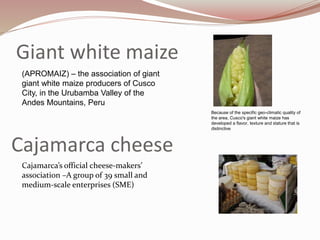
Giant white maize
(APROMAIZ) – the association of giant
giant white maize producers of Cusco
City, in the Urubamba Valley of the
Andes Mountains, Peru
Because of the specific geo-climatic quality of
the area, Cusco's giant white maize has
developed a flavor, texture and stature that is
distinctive
Cajamarca’s official cheese-makers’
association –A group of 39 small and
medium-scale enterprises (SME)
Cajamarca cheese
Geographical indications as a means to preserve traditional knowledge (TK) and
traditional cultural expressions (TCEs)
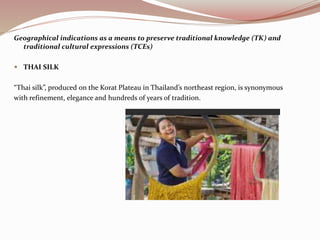
 THAI SILK
“Thai silk”, produced on the Korat Plateau in Thailand’s northeast region, is synonymous
with refinement, elegance and hundreds of years of tradition.
Sui generis systems of protection
 In certain jurisdictions, GIs may be protected through a
system that applies specifically and exclusively to them
– a sui generis system of protection.
 A sui generis protection system exists in the EU with
regard to GIs for wines and spirits, agricultural
products and foodstuffs.
India, Switzerland, the Andean Community countries and the African Intellectual
Property Organization (OAPI), among others, also have sui generis systems of
protection
ARGAN OIL for an oil from the
kernels of the argan tree, grown in
Morocco
GRUYÈRE for a cheese from a specific
region in Switzerland
Examples of GI – A Sui Generis Right
Rooibos
 Rooibos is one of more than two hundred species of aspalathus that only grow in
South Africa, but it is the only one with recognized health benefits
Farmers in the region use their traditional knowledge
to process Rooibos into tea
Prohibitions to registration of certain GI in India
the use of which would be likely to deceive or cause confusion; or
the use of which would be contrary to any law for the time being in force; or
which comprises or contains scandalous or obscene matter; or
which comprises or contains any matter likely to hurt the religious susceptibilities
of any class or section of the citizens of India; or
which would otherwise be disentitled to protection in a court; or
which are determined to generic names or indications of goods and are, therefore,
not or ceases to be protected in their country of origin, or which have fallen in to
disuse in that country; or
which, although literally true as to the territory, region or locality in which the
goods originate, but falsely represent to the persons that the goods originate in
another territory, region or locality, as the case may be.
GI Registry at Chennai having all India jurisdiction
Registry maintains a Register of GI which is divided in to two parts
Part A: Details of distinguishing characteristics of the goods and of the
registered proprietor which would be an association of persons or producers
or a body representing interest of such producers like for instance the Tea
Board, Coffee Board, Spices Board etc. To include all producers a collective
reference may be made in the application.
Part B: contains particulars of ‘authorised users’ of GI such as those
producers (traders and dealers) who have not been included in the original
application for registration. (this provision included due to socio economic
factors)
GI Registration process in India
•Registration is valid for ten years but can be renewed from time to time on
payment of renewal fee.
• Similar procedure followed for registration as an ‘authorised user’.
Registered GIs in India- Sector Wise
Examples:
Agricultural: Basmati Rice; Coorg Orange; Mysore Betal
Leaf;Nanjanagud Banana…etc
Foodstuff:Tirupathi Laddu; Hyderabadi Biryani;Ganjam Goat
Ghee;Hyderabad Haleem..et
Hyderabad Haleem
Food Specially prepared delicacy using meat, wheat and
ghee during the holy month of Ramzan
Haleem Makers' Association of Hyderabad (HMAH) filed
for the GI tag.
Haleem makers outside Hyderabad will not be able to sell
their product as Hyderabadi Haleem and the ones that are
made within the city, will be subjected to strict quality
standards.
Hyderabad Biryani
It is likely to get a Geographical Indication (GI) status soon
Case study
Trademark
A trade mark is one or more words, designs or symbols that are used to distinguish
goods and services of one person or firm from those of others in the marketplace.
It is identified by the symbols ™ and ®.
Examples : Coco Cola®, Nike®, IBM and McDonalds®
Period of registration : 10 years (Renewable indefinitely)
Kinds of Trademarks:
 Marks on goods
 Service Marks
 Certification trademark
 Collective Marks
 Well known marks
 Trade Names (Brand name)
TM, SM © -when to use
™
 may be used for unregistered marks.
 Has no legal effect
SM may be used for unregistered ‘service marks’ in place of TM, but there is
not really a legal distinction
© relates to copyright, not trademark rights.
Trademark
Forms of TradeMark
Visual
Audio
Olfactory
What’s not Protected under Trademark?
State Emblems,
Official Hallmarks,
Emblems of Intergovernmental Organizations
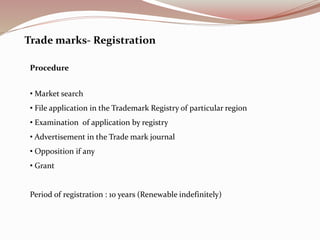
Trade marks- Registration
Procedure
• Market search
• File application in the Trademark Registry of particular region
• Examination of application by registry
• Advertisement in the Trade mark journal
• Opposition if any
• Grant
Period of registration : 10 years (Renewable indefinitely)
The Value of a Trademark
• Interbrand conducts an annual survey of the most
valuable trademarks in the world:
Coca-cola: US$ 79,213 millon Microsoft : 59,546 Million. IBM: 78,808 Million.
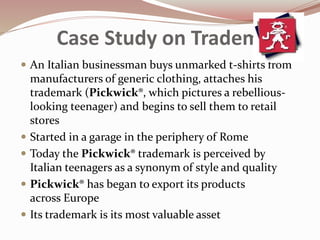
Case Study on Trademarks
 An Italian businessman buys unmarked t-shirts from
manufacturers of generic clothing, attaches his
trademark (Pickwick®, which pictures a rebellious-
looking teenager) and begins to sell them to retail
stores
 Started in a garage in the periphery of Rome
 Today the Pickwick® trademark is perceived by
Italian teenagers as a synonym of style and quality
 Pickwick® has began to export its products
across Europe
 Its trademark is its most valuable asset
Layout Designs of Integrated circuits
A “layout-design (topography)” is defined as the three-dimensional disposition,
however expressed, of the elements, at least one of which is an active element, and of
some or all of the interconnections of an integrated circuit, or such a three-
dimensional disposition prepared for an integrated circuit
Registration is valid for 10 years
The exclusive rights include the right of reproduction and the right of importation,
sale and other distribution for commercial purposes
Non-registrable Layout-Designs
• Not original
• Has been commercially exploited anywhere in India or in a convention country
• Not inherently distinctive
• Not inherently capable of being distinguishable from any other registered
layout-design
Copyrights
• Original Literary, Dramatic, Musical and Artistic Works
• Work: Ideas expressed in material form
• No copyright in ideas or facts
• Cinematograph Films
• Sound Recordings
Two Kinds of Rights
Moral Rights
• To protect personality of author
Economic Rights
• To bring economic benefits
Protection Period : life of the author plus 50 years
Examples: Registered for
databases, bioinformatics,
genes and gene sequences,
amino acid sequences,
antibodies, etc
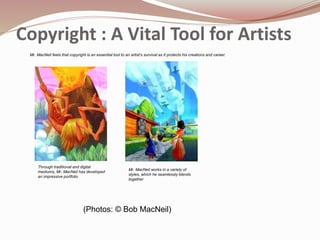
Copyright : A Vital Tool for Artists
Through traditional and digital
mediums, Mr. MacNeil has developed
an impressive portfolio
Mr. MacNeil works in a variety of
styles, which he seamlessly blends
together
(Photos: © Bob MacNeil)
Mr. MacNeil feels that copyright is an essential tool to an artist’s survival as it protects his creations and career.
Refers to the product’s overall form and function.
Ornamental & Aesthetic aspects of the product
It consists of shape, ornamentation, patterns, lines or color of the product or
combinations
Owner of registered design has the exclusive right to prevent its unauthorized
copying or imitation by others .
Period of protection is 10 years extendable by 5 years.
Criteria for registering Industrial design:
• New or original
• Not disclosed to the public anywhere
in the world prior to the filing
• Significantly distinguishable
• Does not contain scandalous or obscene matter
• Not contrary to public order or morality
Industrial Designs
Examples: Agriculture
Machinery
Examples
 Myanmar traditional knowledge and medicine is
believed to be able to cure all of these diseases by
using ingredients such as fresh or dried roots,
stems, leaves, buds, and flowers
 FAME Pharmaceutical Company (Fame), a
privately owned Yangoon based manufacturer and
marketer of traditional herbal medicines
 Fame Pluvimin multivitamin – Registered
Trademark
 Registered all package designs with the Myanmar
Office of Trademark Registration (MOTR).
Traditional medicine - Myanmar
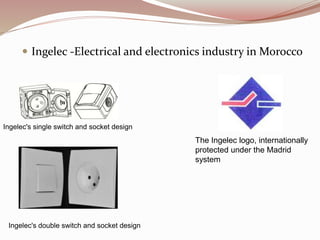
 Ingelec -Electrical and electronics industry in Morocco
The Ingelec logo, internationally
protected under the Madrid
system
Ingelec's single switch and socket design
Ingelec's double switch and socket design
Intellectual property protection of traditional knowledge
The Convention on Biological Diversity (CBD)
First international environmental convection to develop measures for the use and
protection of traditional knowledge, related to the conservation and sustainable use
of biodiversity.
Significant provisions include
 Countries have sovereign rights over their biological resources within their legal
boundaries
 Use of biological diversity should not endanger the environment or the biodiversity
 Piracy of biological diversity & traditional knowledge of another country is immoral and
illegal act
 Sustainable use of biological resources
 Each country has a right to enact laws to establish the sovereignity over its biodiversity
India- Biological Diversity Act 2002
 Conservation and sustainable use of Indian biodiversity and traditional
Knowledge
 To ensure equitable sharing of benefits arising out of commercialization of
biological and knowledge resources
 All Indians have a right to use biodiversity for research purpose within the
country
 For commercialization it needs the approval of State Bio Diversity Board (SBB)
Non citizens of India or institutions not wholly incorporated in India or
incorporated in India with any non-indian participation in share capital or
management do not have the right to access or use of Indian biodiversity with our
prior approval from NBA (National biodiversity authority)
Trade secret
Some inventions, data, information cannot be protected by any of the available
means of IPRs. Such information is held confidential as a trade secret.
Technical matters, such as the composition or design of a product, a method of
manufacture or the know-how necessary to perform a particular operation.
Trade secret can be
• Invention,
• Idea,
• survey method,
• manufacturing process,
• experiment results,
• chemical formula,
• recipe,
• financial strategy,
• client database…etc
When Trade Secrets are preferred?
When Invention is not a patentable subject matter
Patent protection is limited to 20 years, when secret can be kept beyond that
period
When it is difficult to reverse engineer
Examples: Hybrid plant varieties;
Coco cola formula; Pan parag;
Perfumes; Flavor recipes
Categorisation Matrix
of Technologies
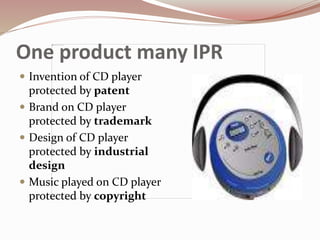
One product many IPR
 Invention of CD player
protected by patent
 Brand on CD player
protected by trademark
 Design of CD player
protected by industrial
design
 Music played on CD player
protected by copyright
The inventor licensed the system to Coca-Cola at 1/10 of a penny per
can. During the period of validity of the patent the inventor
obtained 148,000 UK pounds a day on royalties
IMPORTANCE OF IP FOR SMES
IP can enable a small enterprises to:
• Reap profits from its ideas and creations and from licensing its rights
• Preserve a market niche and thereby compete effectively with larger
companies
• Establish and grow its reputation and goodwill in the marketplace
• Enhance the worth of a small business in the eyes of investors and financing
institutions
• Raise the value of a small business in the event of a sale or merger
Statergic Options for developing Enterprises
• Raise awareness on the role of IPR.
• Setting up the IP & Managing it
• Use of IP as Offensive or Defensive tool
• Licensing strategy options
• Joint Developments
Thanks

Ipr 17022014

  • 1.
    Intellectual Property Rights– Implications on Agriculture & Food Enterprises Prof. V. Swapna Associate Faculty Member Indian Patent Agent swapnaipfc@nimsme.org
  • 2.
    Intellectual property Rights IPrefers to “creations” of the human mind. It gives the creator an exclusive right over the use of his/her creation for a certain period of time to inventions, literary and artistic works, and symbols, names, images, and designs used in commerce. IP is used as Defensive strategy: Protecting yourself from others using your assets for their benefit without giving you a recognition Offensive strategy: Selling the IP and retaining the morals, licensing of IP for use by others but retaining the ownership
  • 3.
    History GATT : GeneralAgreement on Tariffs and Trade. Objective: Reduction of barriers to international trade. (This was achieved through the reduction of tariff barriers, quantitative restrictions and subsidies on trade through a series of agreements.) Functions of the GATT were taken over by the World Trade Organization (WTO)which was established during the final round of negotiations in the early 1990s
  • 4.
    WIPO WIPO is anintergovernmental organization, which administers a number of international treaties in the field of intellectual property. Mission: To promote innovation and creativity for the economic, social and cultural development of all countries, through a balanced and effective international intellectual property system. Member states: 185 Role: • Establish and harmonize rules and practices for the protection of intellectual property rights • Provides global registration systems for trademarks, industrial designs and appellations of origin, and a global filing system for patents.
  • 5.
    Trade Related Aspectsof Intellectual Property Rights (TRIPS) International Agreement administered by the World Trade Organization (WTO). Sets down minimum standards for many forms of intellectual Property (IP) regulation. Seven Forms of IP: Patents Plant Variety protection or Plant Breeders’ Rights Copyrights Geographical Indications Trademarks Layout designs for integrated circuits Trade secrets
  • 6.
    Patents A patent isan exclusive right granted for an invention, which is a product or a process that provides a new way of doing something, or offers a new technical solution to a problem The limited monopoly right granted by the state enables an inventor to prohibit another person from manufacturing, using or selling the patented product or from using the patented process, without permission Period of Patents - 20 Years Examples: Process related to agrochemicals, growth promoters and regulators, vaccines, drugs, hides and wool, dairy technology, food technology, fuel and biogas production, bioreactors etc
  • 7.
    What can bePatented? Inventions in all fields of technology, whether products or processes, if they meet the criteria of  Novelty : Not known to public prior to claim by inventor  Non-obviousness (inventive step): Should not be obvious to a person with ordinary skill in the art  Industrial application (utility). Patents
  • 8.
    Non Patentable Inventions 1.Frivolous inventions 2. An invention the primary or intended use or commercial exploitation of which could be contrary to public order or morality or which causes serious prejudice to human, animal or plant life or health or to the environment 3. The mere discovery of a scientific principle or the formulation of an abstract theory or discovery of any living thing or non-living substances occurring in nature; 4. The mere discovery of a new form of a known substance which does not result in the enhancement of the known efficacy of that substance or the mere discovery of any new property or new use for a known substance or of the mere use of a known process, machine or apparatus unless such known process results in a new product or employs at least one new reactant. 5. A substance obtained by a mere admixture resulting only in the aggregation of the properties of the components thereof or a process for producing such substance Patents
  • 9.
    Non Patentable Inventions(contd…) 6. The mere arrangement or re-arrangement or duplication of known devices each functioning independently of one another in a known way 7. A method of agriculture or horticulture. 8. Any process for the medicinal, surgical, curative, prophylactic diagnostic therapeutic or other treatment of human being or any process for a similar treatment of animals to render them free of disease or to increase their economic value or that of their products. Plant or animal varieties, or essentially biological processes for the production of such, other than microbiological process 9. A mere scheme or rule or method of performing mental act or method of playing game; 10. A presentation of information 11. Topography of integrated circuits Patents
  • 10.
  • 11.
    Plant Variety protectionor Plant Breeders’ Rights Rights granted to the breeder of a new variety of plant. These laws typically grant the plant breeder control of the propagating material (including seed, cuttings, divisions, tissue culture) and harvested material (cut flowers, fruit, foliage) of a new variety for a number of years. International Rights International Convention for the Protection of New Varieties of Plants (UPOV Convention). Purpose of the Convention was to ensure that the member states party to the Convention acknowledge the achievements of breeders of new plant varieties by making available to them an exclusive property right, on the basis of a set of uniform and clearly defined principles.
  • 12.
    The main objectivesof the PVP Act are • To recognize and protect the rights of farmers for their contribution made at any time in conserving, improving and making available plant genetic resources for the development of new plant varieties. • To encourage the development of new varieties of plants for accelerated agricultural development. • To accelerate the agricultural development in the country and protect Plant Breeders Rights (PBR) and to stimulate investment in research and development (R&D) both in public and private sector, for breeding new plant varieties. • To facilitate the growth of the seed industry, which will ensure the availability of good quality seed and plant material to the farmers.
  • 13.
    Registration of allthe plant varieties • It is Mandatory. • Time period.( 15-18 years). Type of varieties that can be registered • New Varieties • Farmers’ Varieties • Extant Varieties Persons eligible for Registration of plant varieties •Breeders, farmers, universities, agricultural institutes
  • 14.
    Rights of Breeders •Production • Sale • Marketing • Distribution • Export • Import Farmers Rights • To save, use, sow, re-sow, exchange, share or sell his farm produce including seed in the same manner as he was entitled earlier (Seeds for sale should not be branded) • To full disclosure of the expected performance of the Seeds or planting material by the plant breeder. Researchers Rights Free and complete access to protected materials for research use in developing new varieties of plants.
  • 15.
    Geographical Indications The marksassociated with products originating from country, region or locality where the quality, reputation or other characteristics of the product are essentially attributable to its geographical origin. Most of the GIs derived relate to agriculture products. Plant Varieties developed with traditional knowledge and associated with particular region can be protected as GI
  • 16.
    Examples  Café deColombia “Café de Colombia” was recognized as an appellation of origin in Colombia. First non-European Protected Geographical Indication (PGI) registered in the European Union (EU). Two new appellations of origin for coffee from specific regions of Colombia were recognized, namely “Café de Nariño” and “Café del Cauca” “Café de Colombia” enjoys a worldwide reputation and has become one of Colombia’s most valuable brands
  • 17.
    Giant white maize (APROMAIZ)– the association of giant giant white maize producers of Cusco City, in the Urubamba Valley of the Andes Mountains, Peru Because of the specific geo-climatic quality of the area, Cusco's giant white maize has developed a flavor, texture and stature that is distinctive Cajamarca’s official cheese-makers’ association –A group of 39 small and medium-scale enterprises (SME) Cajamarca cheese
  • 18.
    Geographical indications asa means to preserve traditional knowledge (TK) and traditional cultural expressions (TCEs)  THAI SILK “Thai silk”, produced on the Korat Plateau in Thailand’s northeast region, is synonymous with refinement, elegance and hundreds of years of tradition.
  • 19.
    Sui generis systemsof protection  In certain jurisdictions, GIs may be protected through a system that applies specifically and exclusively to them – a sui generis system of protection.  A sui generis protection system exists in the EU with regard to GIs for wines and spirits, agricultural products and foodstuffs. India, Switzerland, the Andean Community countries and the African Intellectual Property Organization (OAPI), among others, also have sui generis systems of protection
  • 20.
    ARGAN OIL foran oil from the kernels of the argan tree, grown in Morocco GRUYÈRE for a cheese from a specific region in Switzerland Examples of GI – A Sui Generis Right
  • 21.
    Rooibos  Rooibos isone of more than two hundred species of aspalathus that only grow in South Africa, but it is the only one with recognized health benefits Farmers in the region use their traditional knowledge to process Rooibos into tea
  • 22.
    Prohibitions to registrationof certain GI in India the use of which would be likely to deceive or cause confusion; or the use of which would be contrary to any law for the time being in force; or which comprises or contains scandalous or obscene matter; or which comprises or contains any matter likely to hurt the religious susceptibilities of any class or section of the citizens of India; or which would otherwise be disentitled to protection in a court; or which are determined to generic names or indications of goods and are, therefore, not or ceases to be protected in their country of origin, or which have fallen in to disuse in that country; or which, although literally true as to the territory, region or locality in which the goods originate, but falsely represent to the persons that the goods originate in another territory, region or locality, as the case may be.
  • 23.
    GI Registry atChennai having all India jurisdiction Registry maintains a Register of GI which is divided in to two parts Part A: Details of distinguishing characteristics of the goods and of the registered proprietor which would be an association of persons or producers or a body representing interest of such producers like for instance the Tea Board, Coffee Board, Spices Board etc. To include all producers a collective reference may be made in the application. Part B: contains particulars of ‘authorised users’ of GI such as those producers (traders and dealers) who have not been included in the original application for registration. (this provision included due to socio economic factors)
  • 24.
    GI Registration processin India •Registration is valid for ten years but can be renewed from time to time on payment of renewal fee. • Similar procedure followed for registration as an ‘authorised user’.
  • 25.
    Registered GIs inIndia- Sector Wise Examples: Agricultural: Basmati Rice; Coorg Orange; Mysore Betal Leaf;Nanjanagud Banana…etc Foodstuff:Tirupathi Laddu; Hyderabadi Biryani;Ganjam Goat Ghee;Hyderabad Haleem..et
  • 26.
    Hyderabad Haleem Food Speciallyprepared delicacy using meat, wheat and ghee during the holy month of Ramzan Haleem Makers' Association of Hyderabad (HMAH) filed for the GI tag. Haleem makers outside Hyderabad will not be able to sell their product as Hyderabadi Haleem and the ones that are made within the city, will be subjected to strict quality standards. Hyderabad Biryani It is likely to get a Geographical Indication (GI) status soon Case study
  • 27.
    Trademark A trade markis one or more words, designs or symbols that are used to distinguish goods and services of one person or firm from those of others in the marketplace. It is identified by the symbols ™ and ®. Examples : Coco Cola®, Nike®, IBM and McDonalds® Period of registration : 10 years (Renewable indefinitely) Kinds of Trademarks:  Marks on goods  Service Marks  Certification trademark  Collective Marks  Well known marks  Trade Names (Brand name)
  • 28.
    TM, SM ©-when to use ™  may be used for unregistered marks.  Has no legal effect SM may be used for unregistered ‘service marks’ in place of TM, but there is not really a legal distinction © relates to copyright, not trademark rights.
  • 29.
    Trademark Forms of TradeMark Visual Audio Olfactory What’snot Protected under Trademark? State Emblems, Official Hallmarks, Emblems of Intergovernmental Organizations
  • 30.
    Trade marks- Registration Procedure •Market search • File application in the Trademark Registry of particular region • Examination of application by registry • Advertisement in the Trade mark journal • Opposition if any • Grant Period of registration : 10 years (Renewable indefinitely)
  • 31.
    The Value ofa Trademark • Interbrand conducts an annual survey of the most valuable trademarks in the world: Coca-cola: US$ 79,213 millon Microsoft : 59,546 Million. IBM: 78,808 Million.
  • 32.
    Case Study onTrademarks  An Italian businessman buys unmarked t-shirts from manufacturers of generic clothing, attaches his trademark (Pickwick®, which pictures a rebellious- looking teenager) and begins to sell them to retail stores  Started in a garage in the periphery of Rome  Today the Pickwick® trademark is perceived by Italian teenagers as a synonym of style and quality  Pickwick® has began to export its products across Europe  Its trademark is its most valuable asset
  • 33.
    Layout Designs ofIntegrated circuits A “layout-design (topography)” is defined as the three-dimensional disposition, however expressed, of the elements, at least one of which is an active element, and of some or all of the interconnections of an integrated circuit, or such a three- dimensional disposition prepared for an integrated circuit Registration is valid for 10 years The exclusive rights include the right of reproduction and the right of importation, sale and other distribution for commercial purposes Non-registrable Layout-Designs • Not original • Has been commercially exploited anywhere in India or in a convention country • Not inherently distinctive • Not inherently capable of being distinguishable from any other registered layout-design
  • 34.
    Copyrights • Original Literary,Dramatic, Musical and Artistic Works • Work: Ideas expressed in material form • No copyright in ideas or facts • Cinematograph Films • Sound Recordings Two Kinds of Rights Moral Rights • To protect personality of author Economic Rights • To bring economic benefits Protection Period : life of the author plus 50 years Examples: Registered for databases, bioinformatics, genes and gene sequences, amino acid sequences, antibodies, etc
  • 35.
    Copyright : AVital Tool for Artists Through traditional and digital mediums, Mr. MacNeil has developed an impressive portfolio Mr. MacNeil works in a variety of styles, which he seamlessly blends together (Photos: © Bob MacNeil) Mr. MacNeil feels that copyright is an essential tool to an artist’s survival as it protects his creations and career.
  • 36.
    Refers to theproduct’s overall form and function. Ornamental & Aesthetic aspects of the product It consists of shape, ornamentation, patterns, lines or color of the product or combinations Owner of registered design has the exclusive right to prevent its unauthorized copying or imitation by others . Period of protection is 10 years extendable by 5 years. Criteria for registering Industrial design: • New or original • Not disclosed to the public anywhere in the world prior to the filing • Significantly distinguishable • Does not contain scandalous or obscene matter • Not contrary to public order or morality Industrial Designs Examples: Agriculture Machinery
  • 37.
    Examples  Myanmar traditionalknowledge and medicine is believed to be able to cure all of these diseases by using ingredients such as fresh or dried roots, stems, leaves, buds, and flowers  FAME Pharmaceutical Company (Fame), a privately owned Yangoon based manufacturer and marketer of traditional herbal medicines  Fame Pluvimin multivitamin – Registered Trademark  Registered all package designs with the Myanmar Office of Trademark Registration (MOTR). Traditional medicine - Myanmar
  • 38.
     Ingelec -Electricaland electronics industry in Morocco The Ingelec logo, internationally protected under the Madrid system Ingelec's single switch and socket design Ingelec's double switch and socket design
  • 39.
    Intellectual property protectionof traditional knowledge The Convention on Biological Diversity (CBD) First international environmental convection to develop measures for the use and protection of traditional knowledge, related to the conservation and sustainable use of biodiversity. Significant provisions include  Countries have sovereign rights over their biological resources within their legal boundaries  Use of biological diversity should not endanger the environment or the biodiversity  Piracy of biological diversity & traditional knowledge of another country is immoral and illegal act  Sustainable use of biological resources  Each country has a right to enact laws to establish the sovereignity over its biodiversity
  • 40.
    India- Biological DiversityAct 2002  Conservation and sustainable use of Indian biodiversity and traditional Knowledge  To ensure equitable sharing of benefits arising out of commercialization of biological and knowledge resources  All Indians have a right to use biodiversity for research purpose within the country  For commercialization it needs the approval of State Bio Diversity Board (SBB) Non citizens of India or institutions not wholly incorporated in India or incorporated in India with any non-indian participation in share capital or management do not have the right to access or use of Indian biodiversity with our prior approval from NBA (National biodiversity authority)
  • 41.
    Trade secret Some inventions,data, information cannot be protected by any of the available means of IPRs. Such information is held confidential as a trade secret. Technical matters, such as the composition or design of a product, a method of manufacture or the know-how necessary to perform a particular operation. Trade secret can be • Invention, • Idea, • survey method, • manufacturing process, • experiment results, • chemical formula, • recipe, • financial strategy, • client database…etc When Trade Secrets are preferred? When Invention is not a patentable subject matter Patent protection is limited to 20 years, when secret can be kept beyond that period When it is difficult to reverse engineer Examples: Hybrid plant varieties; Coco cola formula; Pan parag; Perfumes; Flavor recipes
  • 42.
  • 43.
    One product manyIPR  Invention of CD player protected by patent  Brand on CD player protected by trademark  Design of CD player protected by industrial design  Music played on CD player protected by copyright
  • 44.
    The inventor licensedthe system to Coca-Cola at 1/10 of a penny per can. During the period of validity of the patent the inventor obtained 148,000 UK pounds a day on royalties
  • 45.
    IMPORTANCE OF IPFOR SMES IP can enable a small enterprises to: • Reap profits from its ideas and creations and from licensing its rights • Preserve a market niche and thereby compete effectively with larger companies • Establish and grow its reputation and goodwill in the marketplace • Enhance the worth of a small business in the eyes of investors and financing institutions • Raise the value of a small business in the event of a sale or merger
  • 46.
    Statergic Options fordeveloping Enterprises • Raise awareness on the role of IPR. • Setting up the IP & Managing it • Use of IP as Offensive or Defensive tool • Licensing strategy options • Joint Developments
  • 47.