Submitted By-
Jastinder Pal Singh
MBA (2015-17)
15421163
School of Management Studies, Punjabi University Patiala
Submitted To-
Dr. Apar Singh
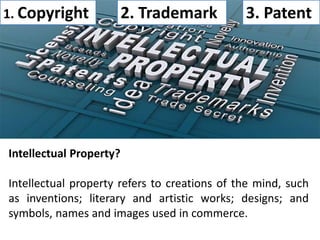
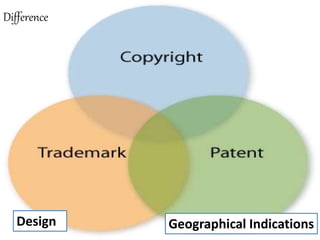
2. Trademark 3. Patent1. Copyright
Intellectual Property?
Intellectual property refers to creations of the mind, such
as inventions; literary and artistic works; designs; and
symbols, names and images used in commerce.
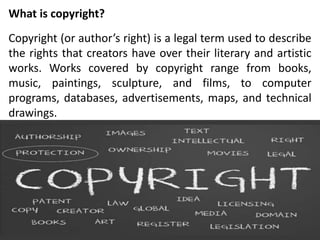
What is copyright?
Copyright (or author’s right) is a legal term used to describe
the rights that creators have over their literary and artistic
works. Works covered by copyright range from books,
music, paintings, sculpture, and films, to computer
programs, databases, advertisements, maps, and technical
drawings.
What is a trademark?
A trademark is a sign capable of distinguishing the goods
or services of one enterprise from those of other
enterprises. Trademarks are protected by intellectual
property rights.
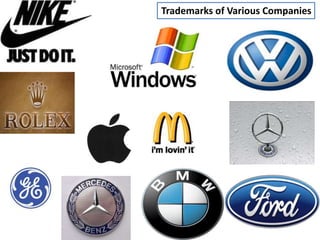
Trademarks of Various Companies
What is a patent?
A patent is an exclusive right granted for an invention, which is a
product or a process that provides, in general, a new way of doing
something, or offers a new technical solution to a problem. To get a
patent, technical information about the invention must be disclosed
to the public in a patent application.
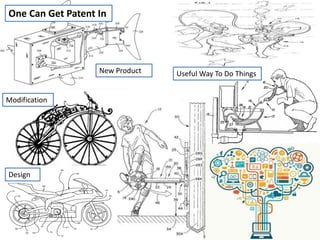
One Can Get Patent In
Modification
New Product
Design
Useful Way To Do Things
Difference
Design Geographical Indications
I P LEGISLATIONS IN INDIA
1. PATENTS ACT , 1970
2. TRADE MARKS ACT, 1999
3. COPY RIGHT ACT , 1957
4. DESIGNS ACT , 2000
5. SEMICONDUCTOR INTEGRATED CIRCUITS AND LAYOUT
DESIGNS ACT, 2000
6. GEOGRAPHICAL INDICATIONS OF GOODS (REGISTRATION
AND PROTECTION) ACT,1999
7. THE PROTECTON OF PLANT VARIETIES AND FARMERS
RIGHTS ACT,2001
Basmati Rice Patent Case
In 1997, when an American company RiceTec was granted a
patent by the US patent office to call the aromatic rice grown
outside India "Basmati“ (the queen of fragrance)
India filed case as the basmati rice is geographical indication.
But RiceTec claimed that the Starch index (SI) of their product is
different from Indian Basmati Rice.
Lose To India & Pakistan-
Economic loses.
Global trade losses (Indian Basmati lost market of US & Europe).
In 1996 India export 5 Lac Tonns of Basmati only to Europe
Both countries lose their global market share.
Total closedown on export of Pakistani Basmati Rice (i.e.
Basmati 22)
Benefits To RiceTec-
Brand Association
Reputation
Market share
Superior features/characteristics
Confusing the customers into buying their product
Monopoly on Basmati Rice In US & Europe
Continued….
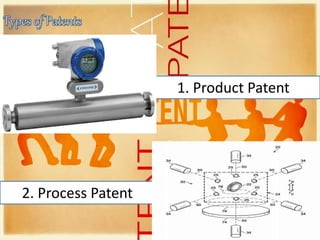
1. Product Patent
2. Process Patent
What Is Patentable?
Process, Method or Manner of manufacture
Machine, Apparatus or other Articles
Substances produced by Manufacturing
Software which has Technical application to Industry or is used
with Special Hardware
Product Patent for Food / Chemical / Medicines or Drugs
Improvements to any of the above
What Is Not Patentable?
Purely mental processes (Concept of Mind)
Mathematical algorithms or formulas
Arrangements of printed matter (This include under copyright)
Naturally occurring things (eg. gravity)
Scientific principles or older concepts or older practices
Inventions solely useful in making atomic weapons (Destructive
inventions)
Inventions harmful to natural occurrence of Human, Plant, Animal
Turmeric patent case
May, 1995 the US Patent Office granted to the University of
Mississippi Medical Center a patent [#5,401,504] for "Use of
Turmeric in Wound Healing.“
But in India use of Turmeric for Wound Healing is very old
practice
The patent was challenged by Dr. R A Mashelkar (Former Director
general of Council of Scientific and Industrial Research (CSIR)
(1995-2006), an Indian scientist who has done much to awaken
India to Intellectual Property Rights issues.
April, 1998 CSIR won the case and patent has been canceled
What Makes An Invention Patentable?
"Novel" means the invention was never described in a patent,
published patent application or other publication, and never in
public use or on sale, by others before you filed your application.
"Useful" generally means that the invention does something,
anything at all.
“Not obvious" means the invention must not be an obvious
development of what has gone before, in the judgment of an
ordinary person skilled in the applicable field.
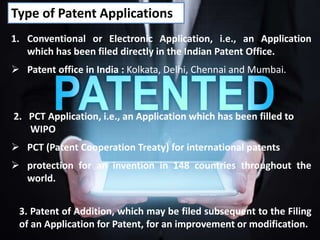
Type of Patent Applications
2. PCT Application, i.e., an Application which has been filled to
WIPO
 PCT (Patent Cooperation Treaty) for international patents
 protection for an invention in 148 countries throughout the
world.
1. Conventional or Electronic Application, i.e., an Application
which has been filed directly in the Indian Patent Office.
 Patent office in India : Kolkata, Delhi, Chennai and Mumbai.
3. Patent of Addition, which may be filed subsequent to the Filing
of an Application for Patent, for an improvement or modification.
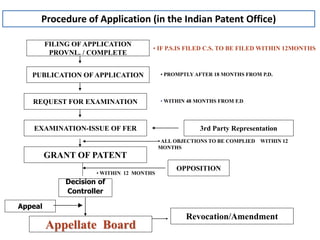
PUBLICATION OF APPLICATION
REQUEST FOR EXAMINATION
GRANT OF PATENT
3rd Party Representation
Revocation/Amendment
OPPOSITION
• PROMPTLY AFTER 18 MONTHS FROM P.D.
• WITHIN 48 MONTHS FROM F.D.
• ALL OBJECTIONS TO BE COMPLIED WITHIN 12
MONTHS
• IF P.S.IS FILED C.S. TO BE FILED WITHIN 12MONTHS
• WITHIN 12 MONTHS
FILING OF APPLICATION
PROVNL. / COMPLETE
Decision of
Controller
EXAMINATION-ISSUE OF FER
Appeal
Appellate Board
Procedure of Application (in the Indian Patent Office)
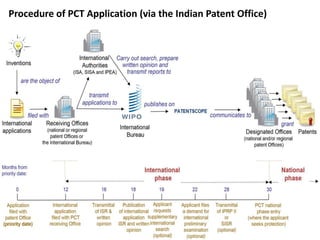
Procedure of PCT Application (via the Indian Patent Office)
Patent cost is about Rs. 45000 to Rs. 1,50,000
Patentee can take help of Patent Agent after signing Non
Disclosure Agreement.
Patentee must have to pay renewal fee from 3rd year to 20th year
(i.e. approximately Rs. 2000 to Rs. 44000 per year)
Patentee have right to use the patent for 20 year, but after 20
year anyone can use that innovation without concern of patentee
Time of the patent can be increased than 20 year on special
conditions with Supplementary Protection Certificate (SPC)
Other Information About Patents
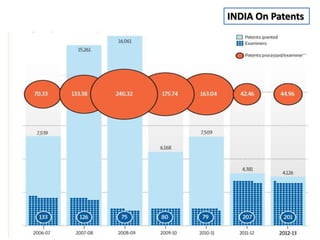
INDIA On Patents
Compulsory Licensing?
Patent owner has the right to decide who may – or may not –
use the patented invention for the period in which the invention
is protected
But government can use patent against interest of patentee
with special conditions.
Compulsory licensing:- is when a government allows someone
else to produce the patented product or process without the
consent of the patent owner.
Any one can apply for Compulsory licensing for any patent and
government can issue Compulsory license for public interest.
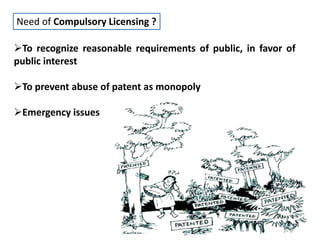
Need of Compulsory Licensing ?
To recognize reasonable requirements of public, in favor of
public interest
To prevent abuse of patent as monopoly
Emergency issues
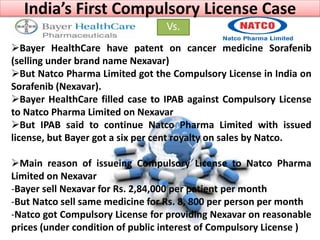
Vs.
India’s First Compulsory License Case
Bayer HealthCare have patent on cancer medicine Sorafenib
(selling under brand name Nexavar)
But Natco Pharma Limited got the Compulsory License in India on
Sorafenib (Nexavar).
Bayer HealthCare filled case to IPAB against Compulsory License
to Natco Pharma Limited on Nexavar
But IPAB said to continue Natco Pharma Limited with issued
license, but Bayer got a six per cent royalty on sales by Natco.
Main reason of issueing Compulsory License to Natco Pharma
Limited on Nexavar
-Bayer sell Nexavar for Rs. 2,84,000 per patient per month
-But Natco sell same medicine for Rs. 8, 800 per person per month
-Natco got Compulsory License for providing Nexavar on reasonable
prices (under condition of public interest of Compulsory License )
THANK YOU

Patents (With Popular Indian Case Studies)

  • 1.
    Submitted By- Jastinder PalSingh MBA (2015-17) 15421163 School of Management Studies, Punjabi University Patiala Submitted To- Dr. Apar Singh
  • 2.
    2. Trademark 3.Patent1. Copyright Intellectual Property? Intellectual property refers to creations of the mind, such as inventions; literary and artistic works; designs; and symbols, names and images used in commerce.
  • 3.
    What is copyright? Copyright(or author’s right) is a legal term used to describe the rights that creators have over their literary and artistic works. Works covered by copyright range from books, music, paintings, sculpture, and films, to computer programs, databases, advertisements, maps, and technical drawings.
  • 4.
    What is atrademark? A trademark is a sign capable of distinguishing the goods or services of one enterprise from those of other enterprises. Trademarks are protected by intellectual property rights.
  • 5.
  • 6.
    What is apatent? A patent is an exclusive right granted for an invention, which is a product or a process that provides, in general, a new way of doing something, or offers a new technical solution to a problem. To get a patent, technical information about the invention must be disclosed to the public in a patent application.
  • 7.
    One Can GetPatent In Modification New Product Design Useful Way To Do Things
  • 8.
  • 9.
    I P LEGISLATIONSIN INDIA 1. PATENTS ACT , 1970 2. TRADE MARKS ACT, 1999 3. COPY RIGHT ACT , 1957 4. DESIGNS ACT , 2000 5. SEMICONDUCTOR INTEGRATED CIRCUITS AND LAYOUT DESIGNS ACT, 2000 6. GEOGRAPHICAL INDICATIONS OF GOODS (REGISTRATION AND PROTECTION) ACT,1999 7. THE PROTECTON OF PLANT VARIETIES AND FARMERS RIGHTS ACT,2001
  • 10.
    Basmati Rice PatentCase In 1997, when an American company RiceTec was granted a patent by the US patent office to call the aromatic rice grown outside India "Basmati“ (the queen of fragrance) India filed case as the basmati rice is geographical indication. But RiceTec claimed that the Starch index (SI) of their product is different from Indian Basmati Rice.
  • 11.
    Lose To India& Pakistan- Economic loses. Global trade losses (Indian Basmati lost market of US & Europe). In 1996 India export 5 Lac Tonns of Basmati only to Europe Both countries lose their global market share. Total closedown on export of Pakistani Basmati Rice (i.e. Basmati 22) Benefits To RiceTec- Brand Association Reputation Market share Superior features/characteristics Confusing the customers into buying their product Monopoly on Basmati Rice In US & Europe Continued….
  • 12.
    1. Product Patent 2.Process Patent
  • 13.
    What Is Patentable? Process,Method or Manner of manufacture Machine, Apparatus or other Articles Substances produced by Manufacturing Software which has Technical application to Industry or is used with Special Hardware Product Patent for Food / Chemical / Medicines or Drugs Improvements to any of the above
  • 14.
    What Is NotPatentable? Purely mental processes (Concept of Mind) Mathematical algorithms or formulas Arrangements of printed matter (This include under copyright) Naturally occurring things (eg. gravity) Scientific principles or older concepts or older practices Inventions solely useful in making atomic weapons (Destructive inventions) Inventions harmful to natural occurrence of Human, Plant, Animal
  • 15.
    Turmeric patent case May,1995 the US Patent Office granted to the University of Mississippi Medical Center a patent [#5,401,504] for "Use of Turmeric in Wound Healing.“ But in India use of Turmeric for Wound Healing is very old practice The patent was challenged by Dr. R A Mashelkar (Former Director general of Council of Scientific and Industrial Research (CSIR) (1995-2006), an Indian scientist who has done much to awaken India to Intellectual Property Rights issues. April, 1998 CSIR won the case and patent has been canceled
  • 16.
    What Makes AnInvention Patentable? "Novel" means the invention was never described in a patent, published patent application or other publication, and never in public use or on sale, by others before you filed your application. "Useful" generally means that the invention does something, anything at all. “Not obvious" means the invention must not be an obvious development of what has gone before, in the judgment of an ordinary person skilled in the applicable field.
  • 17.
    Type of PatentApplications 2. PCT Application, i.e., an Application which has been filled to WIPO  PCT (Patent Cooperation Treaty) for international patents  protection for an invention in 148 countries throughout the world. 1. Conventional or Electronic Application, i.e., an Application which has been filed directly in the Indian Patent Office.  Patent office in India : Kolkata, Delhi, Chennai and Mumbai. 3. Patent of Addition, which may be filed subsequent to the Filing of an Application for Patent, for an improvement or modification.
  • 18.
    PUBLICATION OF APPLICATION REQUESTFOR EXAMINATION GRANT OF PATENT 3rd Party Representation Revocation/Amendment OPPOSITION • PROMPTLY AFTER 18 MONTHS FROM P.D. • WITHIN 48 MONTHS FROM F.D. • ALL OBJECTIONS TO BE COMPLIED WITHIN 12 MONTHS • IF P.S.IS FILED C.S. TO BE FILED WITHIN 12MONTHS • WITHIN 12 MONTHS FILING OF APPLICATION PROVNL. / COMPLETE Decision of Controller EXAMINATION-ISSUE OF FER Appeal Appellate Board Procedure of Application (in the Indian Patent Office)
  • 19.
    Procedure of PCTApplication (via the Indian Patent Office)
  • 20.
    Patent cost isabout Rs. 45000 to Rs. 1,50,000 Patentee can take help of Patent Agent after signing Non Disclosure Agreement. Patentee must have to pay renewal fee from 3rd year to 20th year (i.e. approximately Rs. 2000 to Rs. 44000 per year) Patentee have right to use the patent for 20 year, but after 20 year anyone can use that innovation without concern of patentee Time of the patent can be increased than 20 year on special conditions with Supplementary Protection Certificate (SPC) Other Information About Patents
  • 21.
  • 22.
    Compulsory Licensing? Patent ownerhas the right to decide who may – or may not – use the patented invention for the period in which the invention is protected But government can use patent against interest of patentee with special conditions. Compulsory licensing:- is when a government allows someone else to produce the patented product or process without the consent of the patent owner. Any one can apply for Compulsory licensing for any patent and government can issue Compulsory license for public interest.
  • 23.
    Need of CompulsoryLicensing ? To recognize reasonable requirements of public, in favor of public interest To prevent abuse of patent as monopoly Emergency issues
  • 24.
    Vs. India’s First CompulsoryLicense Case Bayer HealthCare have patent on cancer medicine Sorafenib (selling under brand name Nexavar) But Natco Pharma Limited got the Compulsory License in India on Sorafenib (Nexavar). Bayer HealthCare filled case to IPAB against Compulsory License to Natco Pharma Limited on Nexavar But IPAB said to continue Natco Pharma Limited with issued license, but Bayer got a six per cent royalty on sales by Natco. Main reason of issueing Compulsory License to Natco Pharma Limited on Nexavar -Bayer sell Nexavar for Rs. 2,84,000 per patient per month -But Natco sell same medicine for Rs. 8, 800 per person per month -Natco got Compulsory License for providing Nexavar on reasonable prices (under condition of public interest of Compulsory License )
  • 26.