AGD 509
INTELLECTUAL PROPERTY
RIGHTS
1(1+0)
Dr Tanvi Singh
INTELLECTUAL PROPERTY
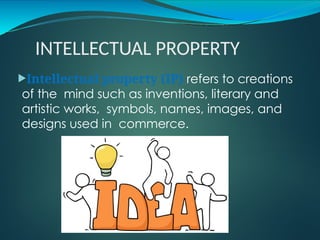
Intellectual property (IP) refers to creations
of the mind such as inventions, literary and
artistic works, symbols, names, images, and
designs used in commerce.
 Examples of intellectual property include
• an author's copyright on a book or article,
• a distinctive logo design representing a soft
drink company and its
products
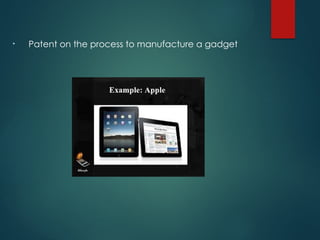
• Patent on the process to manufacture a gadget
 Intellectual property rights (IPR) can be
defined as the rights given to people over
the creation of their minds.
• They usually give the creator an exclusive
right over the use of his/her creations for a
certain period of time.
General Agreement on Tariffs
and Trade (GATT)
 A legal agreement between
many countries, whose
overall purpose was to
promote international trade
by reducing or eliminating
trade barriers such as tariffs
or quotas.
 Originated after World War II
(1939-45).
 It was signed by 23 nations
in Geneva on 30 October
1947, and took effect on 1
 The last round of negotiations, called the
Uruguay Round, began in 1986 and ended in
1994.
 Till 1994 (when it was replaced by WTO), GATT
had eight "rounds" of negotiation which
reduced tariffs and struggled to produce rules to
govern international trade.
 The Uruguay Round also provided for
establishment of the WTO which replaced the
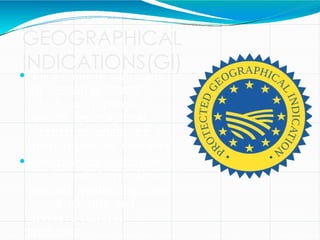
GATT.
 All of the 128 contracting states to the 1994
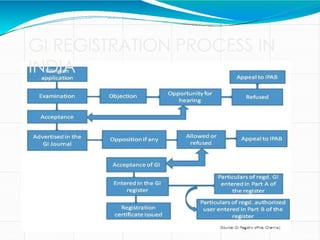
GATT Agreement, were eventually given
membership to the WTO.
World Trade
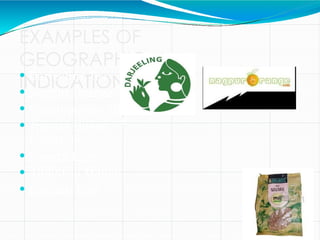
Organization (WTO)
• WTO is the only international
organization dealing with the global rules
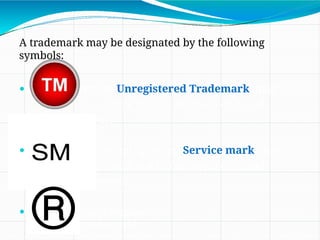
of trade between nations.
• It came into existence in 1995 by an
international treaty signed by the member
states of the General Agreement on Tariffs and
Trade (GATT).
• The stated objective of the WTO is to ensure
that trade flows as smoothly, productively and
freely as possible.
• The headquarters of WTO is at
Geneva, Switzerland.
Its main functions are :
•Administering WTO trade
agreements
•Acting as forum for trade
negotiations
•Handling trade disputes
•Monitoring national trade policies
•Technical assistance and training
for developing countries
•Co-operation with other
international organizations
World Intellectual Property Organization
(WIPO)
"The agreement to establish the World Intellectual Property
Organization" was signed at Stockholm in 1967 and came into
force in 1970.
There are three major functions of WIPO :
1.Registration activities
2.Promotion of inter-governmental cooperation
3. Promotion of substantive activities
Trade Related aspects of Intellectual
Property
Rights (TRIPS)
It is an international agreement administered by the
World Trade Organization (WTO) that sets down
minimum standards for many forms of Intellectual
Property (IP) regulations for all the members of WTO.
The TRIPS agreement introduced intellectual property
law into the international trading system for the first
time and remains the most comprehensive
international agreement on intellectual property to
date.
National Intellectual
Property Rights
Policy (12th MAY
2016)
The main focus of this policy is related to the slogan
‘Creative India, Innovative India’.
Based on this the government has been promoting
initiatives to encourage creativity, innovation
and entrepreneurship through missions like,
 ‘Make in India’,
 ‘Atal Innovation Mission’,
 ‘Start-Up India’, and
 ‘Stand-Up India’
Vision of this policy :
To create…
•An India where creativity and innovation are
stimulated by Intellectual Property for the benefit of
all;
•An India where intellectual property promotes
advancement in science and technology, arts and
culture, traditional knowledge and biodiversity
resources
•An India where knowledge is the main driver of
development, and knowledge owned is
transformed into knowledge shared’.
Following are the Intellectual Property Rights
that are covered under TRIPs
1) Patents;
2) New plant varieties;
3) Geographical indications;
4) Trademarks;
5) Copy right;
6) Industrial designs.
MAXIMUM PERIOD OF PROTECTION OF
VARIOUS IP RIGHTS
PATENT
PLANT
VARIETIES
: 20 years (renewed every year)
: 18 years, 15 years (renewed after
6th year/9th year)
GEORAPHICAL INDICATIONS : No limit(renewed every 10th year
TRADEMARK : No limit (renewed every 10th year)
COPYRIGHT :
INDUSTRIAL
DESIGNS
Life time of the author plus 60
years /60 years from the date
of publication)
: 10 +5 year(renewed after 10th
year)
1
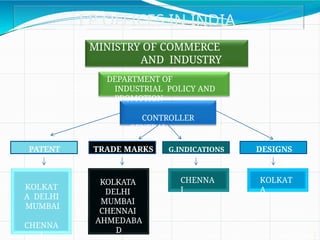
I P OFFICES IN INDIA
MINISTRY OF COMMERCE
AND INDUSTRY
DEPARTMENT OF
INDUSTRIAL POLICY AND
PROMOTION
CONTROLLER
GENERAL
(CGPDTM)
PATENT TRADE MARKS G.INDICATIONS DESIGNS
KOLKAT
A DELHI
MUMBAI
CHENNA
I
KOLKATA
DELHI
MUMBAI
CHENNAI
AHMEDABA
D
CHENNA
I
KOLKAT
A
PATENT
A ‘Patent’ gives an
inventor exclusive
rights to use their
invention for a limited
time. These rights will
prevent other parties
from copying or
selling
withou
t
the
invention the
permission
of the
inventor.
TYPES OF PATENTS
 Utility Patents
 Design Patents
 Plant Patents

Utility Patents: are issued for “. . . any new and
useful process, machine, manufacture, or composition of
matter, or any new and useful improvement thereof.”

Valid for twenty (20) years from the date of filing or the
earliest priority date.
Contd
…

Design Patents: are issued for novel,
non-obvious, ornamental design in an
article of manufacture, in other words, for
its appearance.
 The term of a design patent is
fourteen
(14) years from the date of grant.
Contd
…

Plant Patents: are issued for new
varieties of plants which have been
asexually reproduced.

The new variety must be novel, distinct
and non-obvious

Plants discovered in nature are
not patentable.

A plant patent has the same length of
term as a utility patent.
REQUIREMENTS FOR PATENTABILITY
Must be useful
Must be novel/new
Must be non obvious
BENEFITS OF PATENT
PROTECTION
1. Prevents theft of the
invention
2. Higher Profit Margins
3. Reduce Competition
4. Encourage Settlement
5. Expand Market Share
Are all inventions
Patentable? No.
The following inventions
are not Patentable:
1.An invention which is
frivolous
2. An invention which is contrary to well established
natural laws
3. The mere discovery of a scientific principle
or the formulation of an abstract theory.
4. An invention relating to Atomic Energy.
5. A method of Agriculture or Horticulture
6. An invention if already known to the public
or is in use
7. An invention if already patented anywhere
in the world
EXAMPLE FOR
PATENT
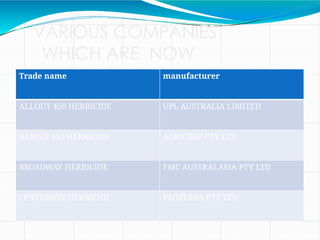
 Monsanto brought Glyphosate to the market in
1974 under the trade name Roundup, and
Monsanto's last commercially relevant United
States patent expired in 2000.
 Now Glyphosate has been marketed by
various companies
VARIOUS COMPANIES
WHICH ARE NOW
PRODUCING GLYPHOSATE
Trade name manufacturer
ALLOUT 450 HERBICIDE UPL AUSTRALIA LIMITED
BANISH 450 HERBICIDE AGRICROP PTY LTD
BROADWAY HERBICIDE FMC AUSTRALASIA PTY LTD
CENTURION HERBICIDE PROTERRA PTY LTD
TRADITIONAL
KNOWLEDGE (TK)
The knowledge continually developed, acquired, used,
practiced, transmitted and sustained by communities /
individuals through generations is called Traditional
Knowledge (TK).
In India traditional knowledge including existing oral
knowledge cannot be protected under the provisions of
the existing IPR laws / acts, as mentioned herein above.
BIO-PIRACY OF
TRADITIONAL
KNOWLEDGE
The commercial exploitation or monopolization of biological
or genetic
material, as medicinal plant extracts, usually without
compensating the
indigenous peoples or countries from which the material
or relevant knowledge is obtained.
BIO-PIRACY OF
TRADITIONAL
KNOWLEDGE
The commercial exploitation or monopolization of biologica
l material, as medicinal plant extracts, usually without
compensating the indigenous peoples or countries from
which the material or relevant knowledge is obtained
BASMATI CASE
STUDY
In late 1997, an American
company RiceTec Inc, was granted
a patent by the US patent office to
call the aromatic rice grown
outside India 'Basmati'.
RiceTec Inc, had been trying to
enter the international Basmati
market with brands like 'Kasmati'
and 'Texmati' described as
Basmati-type rice with minimal
success.
Contd
…
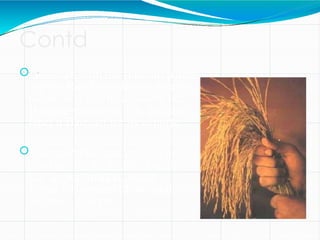
However, with the Basmati patent
rights, RiceTec will now be able
to not only call its aromatic rice
Basmati within the US, but also
label it Basmati for its exports.
India and Pakistan will not only
lose out on the 45,000 tonne
US import market, which
forms 10 percent of the total
Basmati exports.
Contd
…
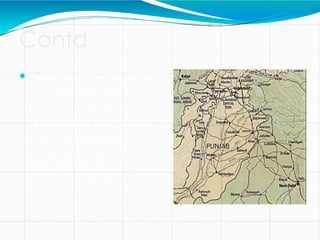
 In addition, the patent on
Basmati is believed to
be a violation of the
fundamental fact that the
long grain aromatic rice
grown only in Punjab,
Haryana, and Uttar
Pradesh is called
Basmati.."
Contd
…
According to Dr Vandana Shiva, director of a Delhi-based
research foundation which monitors issues involving
patents and biopiracy, claims the "theft involved in the
Basmati patent is, therefore, threefold:
-a theft of collective intellectual and biodiversity
heritage on Indian farmers,
-a theft from Indian traders and exporters whose
markets are being stolen by RiceTec Inc., and ,
-a deception of consumers since RiceTec is using a
stolen name Basmati for rice which is derived from Indian
rice but not grown in India, and hence not the same
quality."
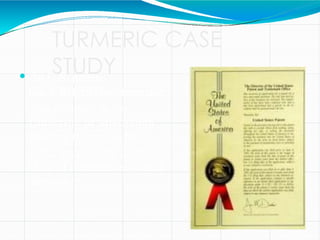
TURMERIC CASE
STUDY
 An U.S. patent
(no.5,401,504) on turmeric
was awarded to the
University of Mississippi
Medical Centre, in May
1995, specifically for the
“Use of turmeric in wound
healing.”
Awaken to Intellectual
property right
 The patent was promptly
challenged by Dr. R. A.
Mashelkar, as Indian scientist
who has done much to
awaken India to intellectual
property rights issues.
Director general of Council of Scientific
and Industrial Research (CSIR)
(1995-2006)
•In India where turmeric has been used medicinally for
thousands of years, concerns grew about the
economically and socially damaging impact of this legal
bio-piracy.
•CSIR argues that turmeric has been used for thousands
of years for healing wounds and rashes and thus its
medicinal use was not a novel invention.
•Their claim was supported by the documentary evidence
of traditional knowledge, including ancient Sanskrit text
and paper published in 1953 in the Journal of Indian
Medical Association.
TURMERIC CASE
STUDY
 US patent 5401504 granted : May 1995
 CSIR request for re-examination at USPTO : October
1996
 1st office action rejecting all patent claims : March 1997
 Response by patentee
 Second action report
 Patentee’s interview with examiner
 Re-examination certificate issued and
proceedings concluded in favor of CSIR : April 1998
NEEM CASE
STUDY
 For centuries the Western world ignored the neem tree and its
properties: the practices of Indian peasants and doctors were
not deemed worthy of attention by the majority of British,
French and Portuguese colonialists.
 In 1971, US timber importer Robert Larson observed the tree's
usefulness in India and began importing neem seed to his
company headquarters in Wisconsin.
 Over the next decade he conducted safety and performance tests
upon a pesticidal neem extract called Margosan-O and in 1985
received clearance for the product from the US Environmental
Protection Agency (EPA).
 Three years later he sold the patent for the product to the
multinational chemical corporation, W R Grace and Co.
Since 1985, over a dozen US patents have been
taken out by US and Japanese firms on formulae
for stable neem- based solutions and emulsions
and even for a neem- based toothpaste.
In 1992, W.R. Grace secured its rights to the formula
that used the emulsion from the Neem tree's seeds
to make a powerful pesticide.
It also began suing Indian companies for making
the emulsion.
THE NEEM
CAMPAIGN
 The Neem Campaign consisting of a group of
NGOs and individuals, was initiated in 1993 in
India.
 This was done to mobilize worldwide support to
protect indigenous knowledge systems and
resources of the Third World from piracy by the
West, particularly in light of emerging threats
from intellectual property rights regimes under
WTO and TRIPS.
 The Neem patent became the first case to
challenge European and US patents on grounds
of biopiracy.
NEEM CASE
JUDGEMENT
 On the 30th September 1997, the European Patent Office
(EPO) delivered a favourable interim judgement on the
challenge of a European patent on the fungicidal effects of
neem oil (Patent No. 436 257 B1) owned by W. R. Grace &
Co
 The European Patents Office accepted the arguments
offered by Indian scientists and rejected the order of the
US patents office to award the patent to W R Grace, a US-
based company, at the last hearing of the case.
 The Indian scientists argued that the people of India have
known the medicinal properties of neem for thousands of
years and hence no other company can patent its
properties. The EPO accepted the argument.
PLANT VARIETY PROTECTION OR
PLANT
BREEDERS’ RIGHTS
Rights granted to the breeder of a new variety of plant.
These laws typically grant the plant breeder control of the propagating
material (including seed, cuttings, divisions, tissue culture) and
harvested material (cut flowers, fruit, foliage) of a new variety for a
number of years.
International Rights
International Convention for the Protection of New Varieties of
Plants (UPOV Convention).
Purpose of the Convention was to ensure that the member states
party to the Convention acknowledge the achievements of breeders
of new plant varieties by making available to them an exclusive
property right, on the basis of a set of uniform and clearly defined
principles.
The main objectives of the PVP Act are
•To recognize and protect the rights of farmers for
their contribution made at any time in conserving,
improving and making available plant genetic resources for
the development of new plant varieties.
•To encourage the development of new
varieties of plants for accelerated
agricultural development.
•To accelerate the agricultural development in the country
and protect Plant Breeders Rights (PBR) and to stimulate
investment in research and development (R&D) both in
public and private sector, for breeding new plant varieties.
•To facilitate the growth of the seed industry, which will
ensure the availability of good quality seed and plant
material to the farmers.
Registration of all the plant varieties
It is Mandatory.
Time period. ( 15-18 years).
Type of varieties that can be registered
New Varieties
Farmers’
Varieties
Extant Varieties
Persons
eligible for
Registration of
plant varieties
Breeders,
Rights of Breeders
Production,Sale,Marketing,Distribution,Export &
Import
Farmers Rights
•To save, use, sow, re-sow, exchange, share or sell his
farm produce including seed in the same manner as
he was entitled earlier (Seeds for sale should not be
branded)
•To full disclosure of the expected performance of the
Seeds or planting material by the plant breeder.
Researchers Rights
Free and complete access to protected materials for
research use in developing new varieties of plants.
GEOGRAPHICAL
INDICATIONS(GI)
 It is a name or sign used
on certain products
which corresponds to a
specific geographical
location or origin (e.g. a
town, region, or country).
 Geographical Indications
are intended to designate
product quality, highlight
brand identity, and
preserve cultural
traditions
NECESSITY OF
GI
 Geographical indications allows producers to
obtain market recognition and often a
premium price.
 Geographical indications have become a key
source to have nice marketing.
 Geographical indications are also often
associated with non-monetary benefits such as
the protection of knowledge and community
rights.
GI IN
INDIA
 India, as a member of the World Trade
Organization (WTO), enacted the Geographical
Indications of Goods (Registration &
Protection)Act, 1999 has come into force with
effect from 15th September 2003.
 The Central Government of India has established
th e Geographical Indications Registry with all
India ju risdiction in Chennai.
 The GI Act is being administered by the
Controller General of Patents, Designs and Trade
Marks ‐ who is the Registrar of Geographical
CONDITIONS TO
GET GI
 It relates to a good although, in some
countries, services are also included.
 These goods/services must originate from a
defined area.
 The goods/services must have qualities,
reputations or other characteristics which are
clearly linked to the geographical origin of
goods.
GI REGISTRATION PROCESS IN
INDIA
EXAMPLES OF
GEOGRAPHICAL
INDICATIONS
Sare
e
 Darjeeling Tea
 Nagpur Orange
 Kanchipuram Silk
 Tripura Queen
Pineapple
 Navara Rice
 Alphanso Mango
 Basmati Rice
TRADEMAR
K
A trade mark (popularly known
as brand name) in layman’s
language is a visual symbol
which may be a word signature,
name, device, label, numerals or
combination of colours used by
one undertaking on goods or
services or other articles of
commerce
to
it
from
other
similar
distinguis
h goods
or
service
s from a
different
originating
undertakin
g.
ESSENTIAL
FEATURES
 It should be distinctive
 TM should preferably be an invented word. Eg: ZEN
 It should be easy to pronounce and remember if it is word mark.
 In case of a device mark -should be capable of being
described by a single word.
 It was be easy to spell correctly and write legibly.
 It should not be descriptive.
 It should be short.
 It should not belong to the class of marks prohibited
for registration.
 It should satisfy the requirements of registration.
A trademark may be designated by the following
symbols:
 (for an Unregistered Trademark, that
is, a mark used to promote or brand
goods)
 (for an unregistered Service mark, that
is, a mark used to promote or brand
services)
 (for a registered
trademark)
TRADEM
ARK
•According to Section 2 (zb) of the Trade Marks
Act, 1999, “trade mark means a mark capable of
being represented graphically and which is capable
of distinguishing the goods or services of one
person from those of others and may include shape
of goods, their packaging and combination of
colours.”
•A mark can include a device, brand, heading,
label, ticket, name, signature, word, letter, numeral,
shape of goods, packaging or combination of
colours or any such combinations.
TRADEMARK
REGISTRATION
WHAT ARE THE TYPES OF TRADEMARKS THAT CAN BE REGISTERED ?
Under the Indian trademark law the following are the types of trademarks
that can be registered:
 Product trademarks: are those that are affixed to identify goods.
 Service trademarks: are used to identify the services of an entity, such as
the trademark for a broadcasting service, retails outlet, etc. They are used
in advertising for services.
 Certification trademarks: are those that are capable of distinguishing
the goods or services in connection with which it is used in the course of
trade and which are certified by the proprietor with regard to their origin,
material, the method of manufacture, the quality or other specific features
 Collective trademarks: are registered in the name of groups,
associations or other organizations for the use of members of the group
in their commercial activities to indicate their membership of the group.
ADVANTAGES OF
TRADEMARK REGISTRATION
1. Protects your hard earned goodwill in the business
2. Protects your Name / Brand Name from being used in a same or
similar fashion, by any other business firm, thus discourages others
from cashing on your well built goodwill
3. Gives your products a status of Branded Goods.
4. Gives an impression to your customers that the company is selling
some standard Products or Services
5. The exclusive right to the use of the trade mark in relation to the
goods or services in respect of which the trade mark is registered.
6. To obtain relief in respect of infringement (misuse by others) of
the
trade mark.
7. Power to assign (transfer) the trade mark to others for
consideration.
TRADEMARK
INFRINGEMENT
EXAMPLE CASE
Amul won trademark case in Gujarat HC in 2007
It was conclueded that Utterly Butterly Delicious Amul's name cannot be
used by any other proprietor even if the company is selling goods other
than that sold by the proprietor, who has registered the trademark. In a
significant judgment, the Gujarat High Court has ruled that a registered
trademark user has the right to restrict others using their trademark for
different class or goods.
HC's judgment was in connection with a case where the Kaira District Co-
operative Milk Producers' Union popularly Amul Dairy and the Gujarat Co-
operative Milk Marketing Federation (GCMMF) had filed trademark
infringement cases against two local shop owners, Amul Chasmaghar and
Amul Cut Piece Stores in the district court. While Kaira Union owns brand
Amul, GCMMF manages the brand.
It was on April 25, in 2007 year that the district court had passed an order
that it was
a clear case of infringement and restrained the two from using Amul
trademark. Amul Chasmaghar however had challenged the district court's
interim injunction in the HC, where justice D N Patel upheld ruling of the
district court.
COPYRIG
HT
 HISTORY
 Copyright law entered India in 1847
through an enactment during the East
India Company's regime. According to the
1847 enactment, the term of copyright was
for the lifetime of the author plus seven
years post-mortem. But in no case could
the total term of copyright exceed a
period of forty- two years. The government
could grant a compulsory licence to
publish a book if the owner of copyright,
upon the death of the author, refused to
A copyright is an author’s
legal ownership of a
creative work.
Examples of such
creative works include a
writing, a pictorial
work, a three
dimensional sculptural
work, a musical
composition.
COPYRIG
HT
WHAT IS PROTECTED BY
COPYRIGHT?
"Original works of authorship fixed in any tangible medium of
expression, now known or later developed, from which they
can be perceived, reproduced, or otherwise communicated,
either directly or with the aid of a machine or device”.
CONDITIONS FOR
COPYRIGHT
 Must be original work: Authorship must
be original and cannot simply be copied or
reproduced from another author.
 Must be fixed in a tangible medium:
Cannot reside in the author's mind, but must
be transferred from the author’s mind onto
a fixed tangible medium, such as a writing,
a sculpture, a musical work, etc.
NOT PROTECTED BY
COPYRIGHT
Ideas are not protected:
 including concepts, methods of operation, business
systems, processes, procedures, discoveries and natural
laws.
 Facts and research results
 Work without original authorship
 Facts or discoveries
 Government works created by the government.
These are not proper for copyright protection, but rather
should be protected via the patent system.
PROTECTABLE
WORKS
 Blueprints
 Sound recordings
 Architectural works
 Fictitious characters
 Compilations
 Derivative works
RIGHTS UNDER COPYRIGHT
LAW
1) to reproduce or copy the work;
2) to prepare derivative works;
3) to distribute copies to the public;
4) to perform in public (such as for a play, a
musical composition);
5) the right to display the work in public
INDUSTRIAL
DESIGNS
 In a legal sense, an industrial
design constitutes the
ornamental or aesthetic
aspect of an article.
 An industrial design may
consist of three dimensional
features, such as the shape of
an article, or two
dimensional features, such as
patterns, lines or color.
WHAT IS A REGISTRABLE
INDUSTRIAL
DESIGN?
 To be registrable an industrial design must be new
at the date an application for its registration is filed.
A design is considered to be new only if it has not
been made available or disclosed to the public in
any way whatsoever in Malaysia or elsewhere
before the filing date of the application and it is
not on the record the Register of Industrial Designs.
WHAT SORT OF DESIGNS ARE
EXCLUDED FROM
REGISTRATION
The designs of certain types of article are specifically
excluded from design registration. An industrial
design is not registrable if: the aesthetic
appearance of an articles is not significant or the
design features differs only in immaterial details;
 it is a method or principle of construction;
 the designs are contrary to public order or morality;
 the designs of the articles concern exclusively with
how an article functions; and
 the designs of articles that are integral parts of
other articles and whose features are
dependent upon the appearance of other
article.
HOW TO FILE AN
APPLICATION FOR THE
REGISTRATION OF AN
INDUSTRIAL DESIGN?
Filing an application to register a design
requires:-
 A completed application form (ID Form 1) in
Malay or English;
 One copy of representation of the article to
which the design is applied (drawings or
photograph);
 A statement of novelty in respect of the
industrial designs to which the design is
applied. (However a statement of novelty is not
required when registering wallpaper, lace or
CONCLUSION
intellectual property rights presentation

intellectual property rights presentation

  • 1.
  • 2.
    INTELLECTUAL PROPERTY Intellectual property(IP) refers to creations of the mind such as inventions, literary and artistic works, symbols, names, images, and designs used in commerce.
  • 3.
     Examples ofintellectual property include • an author's copyright on a book or article, • a distinctive logo design representing a soft drink company and its products
  • 4.
    • Patent onthe process to manufacture a gadget
  • 5.
     Intellectual propertyrights (IPR) can be defined as the rights given to people over the creation of their minds. • They usually give the creator an exclusive right over the use of his/her creations for a certain period of time.
  • 6.
    General Agreement onTariffs and Trade (GATT)  A legal agreement between many countries, whose overall purpose was to promote international trade by reducing or eliminating trade barriers such as tariffs or quotas.  Originated after World War II (1939-45).  It was signed by 23 nations in Geneva on 30 October 1947, and took effect on 1
  • 7.
     The lastround of negotiations, called the Uruguay Round, began in 1986 and ended in 1994.  Till 1994 (when it was replaced by WTO), GATT had eight "rounds" of negotiation which reduced tariffs and struggled to produce rules to govern international trade.  The Uruguay Round also provided for establishment of the WTO which replaced the GATT.  All of the 128 contracting states to the 1994 GATT Agreement, were eventually given membership to the WTO.
  • 8.
    World Trade Organization (WTO) •WTO is the only international organization dealing with the global rules of trade between nations. • It came into existence in 1995 by an international treaty signed by the member states of the General Agreement on Tariffs and Trade (GATT). • The stated objective of the WTO is to ensure that trade flows as smoothly, productively and freely as possible. • The headquarters of WTO is at Geneva, Switzerland.
  • 9.
    Its main functionsare : •Administering WTO trade agreements •Acting as forum for trade negotiations •Handling trade disputes •Monitoring national trade policies •Technical assistance and training for developing countries •Co-operation with other international organizations
  • 10.
    World Intellectual PropertyOrganization (WIPO) "The agreement to establish the World Intellectual Property Organization" was signed at Stockholm in 1967 and came into force in 1970. There are three major functions of WIPO : 1.Registration activities 2.Promotion of inter-governmental cooperation 3. Promotion of substantive activities
  • 11.
    Trade Related aspectsof Intellectual Property Rights (TRIPS) It is an international agreement administered by the World Trade Organization (WTO) that sets down minimum standards for many forms of Intellectual Property (IP) regulations for all the members of WTO. The TRIPS agreement introduced intellectual property law into the international trading system for the first time and remains the most comprehensive international agreement on intellectual property to date.
  • 12.
    National Intellectual Property Rights Policy(12th MAY 2016) The main focus of this policy is related to the slogan ‘Creative India, Innovative India’. Based on this the government has been promoting initiatives to encourage creativity, innovation and entrepreneurship through missions like,  ‘Make in India’,  ‘Atal Innovation Mission’,  ‘Start-Up India’, and  ‘Stand-Up India’
  • 13.
    Vision of thispolicy : To create… •An India where creativity and innovation are stimulated by Intellectual Property for the benefit of all; •An India where intellectual property promotes advancement in science and technology, arts and culture, traditional knowledge and biodiversity resources •An India where knowledge is the main driver of development, and knowledge owned is transformed into knowledge shared’.
  • 14.
    Following are theIntellectual Property Rights that are covered under TRIPs 1) Patents; 2) New plant varieties; 3) Geographical indications; 4) Trademarks; 5) Copy right; 6) Industrial designs.
  • 15.
    MAXIMUM PERIOD OFPROTECTION OF VARIOUS IP RIGHTS PATENT PLANT VARIETIES : 20 years (renewed every year) : 18 years, 15 years (renewed after 6th year/9th year) GEORAPHICAL INDICATIONS : No limit(renewed every 10th year TRADEMARK : No limit (renewed every 10th year) COPYRIGHT : INDUSTRIAL DESIGNS Life time of the author plus 60 years /60 years from the date of publication) : 10 +5 year(renewed after 10th year)
  • 16.
    1 I P OFFICESIN INDIA MINISTRY OF COMMERCE AND INDUSTRY DEPARTMENT OF INDUSTRIAL POLICY AND PROMOTION CONTROLLER GENERAL (CGPDTM) PATENT TRADE MARKS G.INDICATIONS DESIGNS KOLKAT A DELHI MUMBAI CHENNA I KOLKATA DELHI MUMBAI CHENNAI AHMEDABA D CHENNA I KOLKAT A
  • 17.
    PATENT A ‘Patent’ givesan inventor exclusive rights to use their invention for a limited time. These rights will prevent other parties from copying or selling withou t the invention the permission of the inventor.
  • 18.
    TYPES OF PATENTS Utility Patents  Design Patents  Plant Patents  Utility Patents: are issued for “. . . any new and useful process, machine, manufacture, or composition of matter, or any new and useful improvement thereof.”  Valid for twenty (20) years from the date of filing or the earliest priority date.
  • 19.
    Contd …  Design Patents: areissued for novel, non-obvious, ornamental design in an article of manufacture, in other words, for its appearance.  The term of a design patent is fourteen (14) years from the date of grant.
  • 20.
    Contd …  Plant Patents: areissued for new varieties of plants which have been asexually reproduced.  The new variety must be novel, distinct and non-obvious  Plants discovered in nature are not patentable.  A plant patent has the same length of term as a utility patent.
  • 21.
    REQUIREMENTS FOR PATENTABILITY Mustbe useful Must be novel/new Must be non obvious
  • 22.
    BENEFITS OF PATENT PROTECTION 1.Prevents theft of the invention 2. Higher Profit Margins 3. Reduce Competition 4. Encourage Settlement 5. Expand Market Share
  • 23.
    Are all inventions Patentable?No. The following inventions are not Patentable: 1.An invention which is frivolous 2. An invention which is contrary to well established natural laws 3. The mere discovery of a scientific principle or the formulation of an abstract theory. 4. An invention relating to Atomic Energy. 5. A method of Agriculture or Horticulture 6. An invention if already known to the public or is in use 7. An invention if already patented anywhere in the world
  • 24.
    EXAMPLE FOR PATENT  Monsantobrought Glyphosate to the market in 1974 under the trade name Roundup, and Monsanto's last commercially relevant United States patent expired in 2000.  Now Glyphosate has been marketed by various companies
  • 25.
    VARIOUS COMPANIES WHICH ARENOW PRODUCING GLYPHOSATE Trade name manufacturer ALLOUT 450 HERBICIDE UPL AUSTRALIA LIMITED BANISH 450 HERBICIDE AGRICROP PTY LTD BROADWAY HERBICIDE FMC AUSTRALASIA PTY LTD CENTURION HERBICIDE PROTERRA PTY LTD
  • 26.
    TRADITIONAL KNOWLEDGE (TK) The knowledgecontinually developed, acquired, used, practiced, transmitted and sustained by communities / individuals through generations is called Traditional Knowledge (TK). In India traditional knowledge including existing oral knowledge cannot be protected under the provisions of the existing IPR laws / acts, as mentioned herein above.
  • 27.
    BIO-PIRACY OF TRADITIONAL KNOWLEDGE The commercialexploitation or monopolization of biological or genetic material, as medicinal plant extracts, usually without compensating the indigenous peoples or countries from which the material or relevant knowledge is obtained.
  • 28.
    BIO-PIRACY OF TRADITIONAL KNOWLEDGE The commercialexploitation or monopolization of biologica l material, as medicinal plant extracts, usually without compensating the indigenous peoples or countries from which the material or relevant knowledge is obtained
  • 29.
    BASMATI CASE STUDY In late1997, an American company RiceTec Inc, was granted a patent by the US patent office to call the aromatic rice grown outside India 'Basmati'. RiceTec Inc, had been trying to enter the international Basmati market with brands like 'Kasmati' and 'Texmati' described as Basmati-type rice with minimal success.
  • 30.
    Contd … However, with theBasmati patent rights, RiceTec will now be able to not only call its aromatic rice Basmati within the US, but also label it Basmati for its exports. India and Pakistan will not only lose out on the 45,000 tonne US import market, which forms 10 percent of the total Basmati exports.
  • 31.
    Contd …  In addition,the patent on Basmati is believed to be a violation of the fundamental fact that the long grain aromatic rice grown only in Punjab, Haryana, and Uttar Pradesh is called Basmati.."
  • 32.
    Contd … According to DrVandana Shiva, director of a Delhi-based research foundation which monitors issues involving patents and biopiracy, claims the "theft involved in the Basmati patent is, therefore, threefold: -a theft of collective intellectual and biodiversity heritage on Indian farmers, -a theft from Indian traders and exporters whose markets are being stolen by RiceTec Inc., and , -a deception of consumers since RiceTec is using a stolen name Basmati for rice which is derived from Indian rice but not grown in India, and hence not the same quality."
  • 33.
    TURMERIC CASE STUDY  AnU.S. patent (no.5,401,504) on turmeric was awarded to the University of Mississippi Medical Centre, in May 1995, specifically for the “Use of turmeric in wound healing.”
  • 34.
    Awaken to Intellectual propertyright  The patent was promptly challenged by Dr. R. A. Mashelkar, as Indian scientist who has done much to awaken India to intellectual property rights issues. Director general of Council of Scientific and Industrial Research (CSIR) (1995-2006)
  • 35.
    •In India whereturmeric has been used medicinally for thousands of years, concerns grew about the economically and socially damaging impact of this legal bio-piracy. •CSIR argues that turmeric has been used for thousands of years for healing wounds and rashes and thus its medicinal use was not a novel invention. •Their claim was supported by the documentary evidence of traditional knowledge, including ancient Sanskrit text and paper published in 1953 in the Journal of Indian Medical Association.
  • 36.
    TURMERIC CASE STUDY  USpatent 5401504 granted : May 1995  CSIR request for re-examination at USPTO : October 1996  1st office action rejecting all patent claims : March 1997  Response by patentee  Second action report  Patentee’s interview with examiner  Re-examination certificate issued and proceedings concluded in favor of CSIR : April 1998
  • 37.
    NEEM CASE STUDY  Forcenturies the Western world ignored the neem tree and its properties: the practices of Indian peasants and doctors were not deemed worthy of attention by the majority of British, French and Portuguese colonialists.  In 1971, US timber importer Robert Larson observed the tree's usefulness in India and began importing neem seed to his company headquarters in Wisconsin.  Over the next decade he conducted safety and performance tests upon a pesticidal neem extract called Margosan-O and in 1985 received clearance for the product from the US Environmental Protection Agency (EPA).  Three years later he sold the patent for the product to the multinational chemical corporation, W R Grace and Co.
  • 38.
    Since 1985, overa dozen US patents have been taken out by US and Japanese firms on formulae for stable neem- based solutions and emulsions and even for a neem- based toothpaste. In 1992, W.R. Grace secured its rights to the formula that used the emulsion from the Neem tree's seeds to make a powerful pesticide. It also began suing Indian companies for making the emulsion.
  • 39.
    THE NEEM CAMPAIGN  TheNeem Campaign consisting of a group of NGOs and individuals, was initiated in 1993 in India.  This was done to mobilize worldwide support to protect indigenous knowledge systems and resources of the Third World from piracy by the West, particularly in light of emerging threats from intellectual property rights regimes under WTO and TRIPS.  The Neem patent became the first case to challenge European and US patents on grounds of biopiracy.
  • 40.
    NEEM CASE JUDGEMENT  Onthe 30th September 1997, the European Patent Office (EPO) delivered a favourable interim judgement on the challenge of a European patent on the fungicidal effects of neem oil (Patent No. 436 257 B1) owned by W. R. Grace & Co  The European Patents Office accepted the arguments offered by Indian scientists and rejected the order of the US patents office to award the patent to W R Grace, a US- based company, at the last hearing of the case.  The Indian scientists argued that the people of India have known the medicinal properties of neem for thousands of years and hence no other company can patent its properties. The EPO accepted the argument.
  • 41.
    PLANT VARIETY PROTECTIONOR PLANT BREEDERS’ RIGHTS Rights granted to the breeder of a new variety of plant. These laws typically grant the plant breeder control of the propagating material (including seed, cuttings, divisions, tissue culture) and harvested material (cut flowers, fruit, foliage) of a new variety for a number of years. International Rights International Convention for the Protection of New Varieties of Plants (UPOV Convention). Purpose of the Convention was to ensure that the member states party to the Convention acknowledge the achievements of breeders of new plant varieties by making available to them an exclusive property right, on the basis of a set of uniform and clearly defined principles.
  • 42.
    The main objectivesof the PVP Act are •To recognize and protect the rights of farmers for their contribution made at any time in conserving, improving and making available plant genetic resources for the development of new plant varieties. •To encourage the development of new varieties of plants for accelerated agricultural development. •To accelerate the agricultural development in the country and protect Plant Breeders Rights (PBR) and to stimulate investment in research and development (R&D) both in public and private sector, for breeding new plant varieties. •To facilitate the growth of the seed industry, which will ensure the availability of good quality seed and plant material to the farmers.
  • 43.
    Registration of allthe plant varieties It is Mandatory. Time period. ( 15-18 years). Type of varieties that can be registered New Varieties Farmers’ Varieties Extant Varieties Persons eligible for Registration of plant varieties Breeders,
  • 44.
    Rights of Breeders Production,Sale,Marketing,Distribution,Export& Import Farmers Rights •To save, use, sow, re-sow, exchange, share or sell his farm produce including seed in the same manner as he was entitled earlier (Seeds for sale should not be branded) •To full disclosure of the expected performance of the Seeds or planting material by the plant breeder. Researchers Rights Free and complete access to protected materials for research use in developing new varieties of plants.
  • 45.
    GEOGRAPHICAL INDICATIONS(GI)  It isa name or sign used on certain products which corresponds to a specific geographical location or origin (e.g. a town, region, or country).  Geographical Indications are intended to designate product quality, highlight brand identity, and preserve cultural traditions
  • 46.
    NECESSITY OF GI  Geographicalindications allows producers to obtain market recognition and often a premium price.  Geographical indications have become a key source to have nice marketing.  Geographical indications are also often associated with non-monetary benefits such as the protection of knowledge and community rights.
  • 47.
    GI IN INDIA  India,as a member of the World Trade Organization (WTO), enacted the Geographical Indications of Goods (Registration & Protection)Act, 1999 has come into force with effect from 15th September 2003.  The Central Government of India has established th e Geographical Indications Registry with all India ju risdiction in Chennai.  The GI Act is being administered by the Controller General of Patents, Designs and Trade Marks ‐ who is the Registrar of Geographical
  • 48.
    CONDITIONS TO GET GI It relates to a good although, in some countries, services are also included.  These goods/services must originate from a defined area.  The goods/services must have qualities, reputations or other characteristics which are clearly linked to the geographical origin of goods.
  • 49.
  • 50.
    EXAMPLES OF GEOGRAPHICAL INDICATIONS Sare e  DarjeelingTea  Nagpur Orange  Kanchipuram Silk  Tripura Queen Pineapple  Navara Rice  Alphanso Mango  Basmati Rice
  • 51.
    TRADEMAR K A trade mark(popularly known as brand name) in layman’s language is a visual symbol which may be a word signature, name, device, label, numerals or combination of colours used by one undertaking on goods or services or other articles of commerce to it from other similar distinguis h goods or service s from a different originating undertakin g.
  • 52.
    ESSENTIAL FEATURES  It shouldbe distinctive  TM should preferably be an invented word. Eg: ZEN  It should be easy to pronounce and remember if it is word mark.  In case of a device mark -should be capable of being described by a single word.  It was be easy to spell correctly and write legibly.  It should not be descriptive.  It should be short.  It should not belong to the class of marks prohibited for registration.  It should satisfy the requirements of registration.
  • 53.
    A trademark maybe designated by the following symbols:  (for an Unregistered Trademark, that is, a mark used to promote or brand goods)  (for an unregistered Service mark, that is, a mark used to promote or brand services)  (for a registered trademark)
  • 54.
    TRADEM ARK •According to Section2 (zb) of the Trade Marks Act, 1999, “trade mark means a mark capable of being represented graphically and which is capable of distinguishing the goods or services of one person from those of others and may include shape of goods, their packaging and combination of colours.” •A mark can include a device, brand, heading, label, ticket, name, signature, word, letter, numeral, shape of goods, packaging or combination of colours or any such combinations.
  • 55.
    TRADEMARK REGISTRATION WHAT ARE THETYPES OF TRADEMARKS THAT CAN BE REGISTERED ? Under the Indian trademark law the following are the types of trademarks that can be registered:  Product trademarks: are those that are affixed to identify goods.  Service trademarks: are used to identify the services of an entity, such as the trademark for a broadcasting service, retails outlet, etc. They are used in advertising for services.  Certification trademarks: are those that are capable of distinguishing the goods or services in connection with which it is used in the course of trade and which are certified by the proprietor with regard to their origin, material, the method of manufacture, the quality or other specific features  Collective trademarks: are registered in the name of groups, associations or other organizations for the use of members of the group in their commercial activities to indicate their membership of the group.
  • 56.
    ADVANTAGES OF TRADEMARK REGISTRATION 1.Protects your hard earned goodwill in the business 2. Protects your Name / Brand Name from being used in a same or similar fashion, by any other business firm, thus discourages others from cashing on your well built goodwill 3. Gives your products a status of Branded Goods. 4. Gives an impression to your customers that the company is selling some standard Products or Services 5. The exclusive right to the use of the trade mark in relation to the goods or services in respect of which the trade mark is registered. 6. To obtain relief in respect of infringement (misuse by others) of the trade mark. 7. Power to assign (transfer) the trade mark to others for consideration.
  • 57.
    TRADEMARK INFRINGEMENT EXAMPLE CASE Amul wontrademark case in Gujarat HC in 2007 It was conclueded that Utterly Butterly Delicious Amul's name cannot be used by any other proprietor even if the company is selling goods other than that sold by the proprietor, who has registered the trademark. In a significant judgment, the Gujarat High Court has ruled that a registered trademark user has the right to restrict others using their trademark for different class or goods. HC's judgment was in connection with a case where the Kaira District Co- operative Milk Producers' Union popularly Amul Dairy and the Gujarat Co- operative Milk Marketing Federation (GCMMF) had filed trademark infringement cases against two local shop owners, Amul Chasmaghar and Amul Cut Piece Stores in the district court. While Kaira Union owns brand Amul, GCMMF manages the brand. It was on April 25, in 2007 year that the district court had passed an order that it was a clear case of infringement and restrained the two from using Amul trademark. Amul Chasmaghar however had challenged the district court's interim injunction in the HC, where justice D N Patel upheld ruling of the district court.
  • 58.
    COPYRIG HT  HISTORY  Copyrightlaw entered India in 1847 through an enactment during the East India Company's regime. According to the 1847 enactment, the term of copyright was for the lifetime of the author plus seven years post-mortem. But in no case could the total term of copyright exceed a period of forty- two years. The government could grant a compulsory licence to publish a book if the owner of copyright, upon the death of the author, refused to
  • 59.
    A copyright isan author’s legal ownership of a creative work. Examples of such creative works include a writing, a pictorial work, a three dimensional sculptural work, a musical composition. COPYRIG HT
  • 60.
    WHAT IS PROTECTEDBY COPYRIGHT? "Original works of authorship fixed in any tangible medium of expression, now known or later developed, from which they can be perceived, reproduced, or otherwise communicated, either directly or with the aid of a machine or device”.
  • 61.
    CONDITIONS FOR COPYRIGHT  Mustbe original work: Authorship must be original and cannot simply be copied or reproduced from another author.  Must be fixed in a tangible medium: Cannot reside in the author's mind, but must be transferred from the author’s mind onto a fixed tangible medium, such as a writing, a sculpture, a musical work, etc.
  • 62.
    NOT PROTECTED BY COPYRIGHT Ideasare not protected:  including concepts, methods of operation, business systems, processes, procedures, discoveries and natural laws.  Facts and research results  Work without original authorship  Facts or discoveries  Government works created by the government. These are not proper for copyright protection, but rather should be protected via the patent system.
  • 63.
    PROTECTABLE WORKS  Blueprints  Soundrecordings  Architectural works  Fictitious characters  Compilations  Derivative works
  • 64.
    RIGHTS UNDER COPYRIGHT LAW 1)to reproduce or copy the work; 2) to prepare derivative works; 3) to distribute copies to the public; 4) to perform in public (such as for a play, a musical composition); 5) the right to display the work in public
  • 65.
    INDUSTRIAL DESIGNS  In alegal sense, an industrial design constitutes the ornamental or aesthetic aspect of an article.  An industrial design may consist of three dimensional features, such as the shape of an article, or two dimensional features, such as patterns, lines or color.
  • 66.
    WHAT IS AREGISTRABLE INDUSTRIAL DESIGN?  To be registrable an industrial design must be new at the date an application for its registration is filed. A design is considered to be new only if it has not been made available or disclosed to the public in any way whatsoever in Malaysia or elsewhere before the filing date of the application and it is not on the record the Register of Industrial Designs.
  • 67.
    WHAT SORT OFDESIGNS ARE EXCLUDED FROM REGISTRATION The designs of certain types of article are specifically excluded from design registration. An industrial design is not registrable if: the aesthetic appearance of an articles is not significant or the design features differs only in immaterial details;  it is a method or principle of construction;  the designs are contrary to public order or morality;  the designs of the articles concern exclusively with how an article functions; and  the designs of articles that are integral parts of other articles and whose features are dependent upon the appearance of other article.
  • 68.
    HOW TO FILEAN APPLICATION FOR THE REGISTRATION OF AN INDUSTRIAL DESIGN? Filing an application to register a design requires:-  A completed application form (ID Form 1) in Malay or English;  One copy of representation of the article to which the design is applied (drawings or photograph);  A statement of novelty in respect of the industrial designs to which the design is applied. (However a statement of novelty is not required when registering wallpaper, lace or
  • 69.