BASMATI CASE STUDY


 Compiled by
 Deepika


                     1
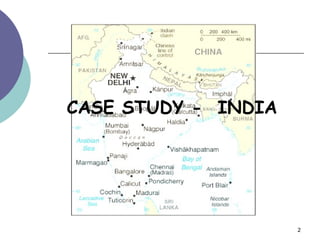
CASE STUDY - INDIA


                     2
BASMATI CASE STUDY
                    In late 1997, an American
                     company RiceTec Inc, was
                     granted a patent by the US
                     patent office to call the
                     aromatic rice grown outside
                     India 'Basmati'.
                     RiceTec Inc, had been
                     trying to enter the
                     international Basmati
                     market with brands like
                     'Kasmati' and 'Texmati'
                     described as Basmati-type
                     rice with minimal success.

                                             3
BASMATI CASE STUDY
   However, with the
    Basmati patent rights,
    RiceTec will now be able
    to not only call its
    aromatic rice Basmati
    within the US, but also
    label it Basmati for its
    exports.)

   India and Pakistan will
    not only lose out on the
    45,000 tonne US import
    market, which forms 10
    percent of the total
    Basmati exports.


                               4
BASMATI CASE STUDY
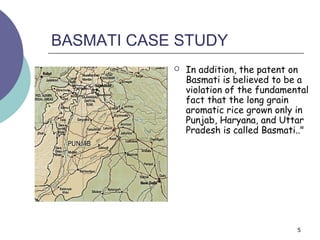
               In addition, the patent on
                Basmati is believed to be a
                violation of the fundamental
                fact that the long grain
                aromatic rice grown only in
                Punjab, Haryana, and Uttar
                Pradesh is called Basmati.."


                                         5
BASMATI CASE STUDY
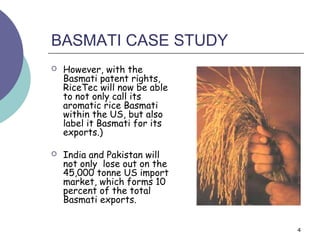
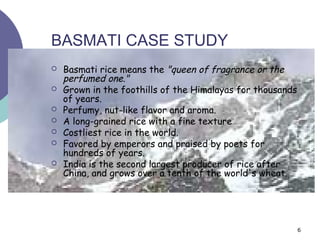
   Basmati rice means the "queen of fragrance or the
    perfumed one."
   Grown in the foothills of the Himalayas for thousands
    of years.
   Perfumy, nut-like flavor and aroma.
   A long-grained rice with a fine texture
   Costliest rice in the world.
   Favored by emperors and praised by poets for
    hundreds of years.
   India is the second largest producer of rice after
    China, and grows over a tenth of the world's wheat.


                                                            6
BASMATI CASE STUDY
   In the abstract, "the invention relates to novel rice
    lines and to plants and grains of these lines . . . . .
    Specifically, one aspect of the invention relates to
    novel rice lines whose plants are semi-dwarf in
    stature, substantially photoperiod insensitive and high
    yielding, and produce rice grains having
    characteristics similar or superior to those of good
    quality Basmati rice. Another aspect of the invention
    relates to novel rice lines produced from novel rice
    lines . . . . "


                                                          7
BASMATI CASE STUDY
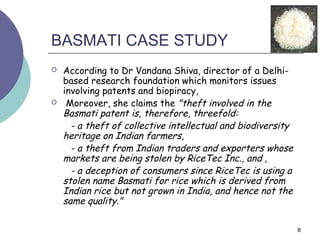
   According to Dr Vandana Shiva, director of a Delhi-
    based research foundation which monitors issues
    involving patents and biopiracy,
    Moreover, she claims the "theft involved in the
    Basmati patent is, therefore, threefold:
      - a theft of collective intellectual and biodiversity
    heritage on Indian farmers,
      - a theft from Indian traders and exporters whose
    markets are being stolen by RiceTec Inc., and ,
      - a deception of consumers since RiceTec is using a
    stolen name Basmati for rice which is derived from
    Indian rice but not grown in India, and hence not the
    same quality."

                                                              8

Basmati rice case study

  • 1.
    BASMATI CASE STUDY Compiled by Deepika 1
  • 2.
    CASE STUDY -INDIA 2
  • 3.
    BASMATI CASE STUDY  In late 1997, an American company RiceTec Inc, was granted a patent by the US patent office to call the aromatic rice grown outside India 'Basmati'.  RiceTec Inc, had been trying to enter the international Basmati market with brands like 'Kasmati' and 'Texmati' described as Basmati-type rice with minimal success. 3
  • 4.
    BASMATI CASE STUDY  However, with the Basmati patent rights, RiceTec will now be able to not only call its aromatic rice Basmati within the US, but also label it Basmati for its exports.)  India and Pakistan will not only lose out on the 45,000 tonne US import market, which forms 10 percent of the total Basmati exports. 4
  • 5.
    BASMATI CASE STUDY  In addition, the patent on Basmati is believed to be a violation of the fundamental fact that the long grain aromatic rice grown only in Punjab, Haryana, and Uttar Pradesh is called Basmati.." 5
  • 6.
    BASMATI CASE STUDY  Basmati rice means the "queen of fragrance or the perfumed one."  Grown in the foothills of the Himalayas for thousands of years.  Perfumy, nut-like flavor and aroma.  A long-grained rice with a fine texture  Costliest rice in the world.  Favored by emperors and praised by poets for hundreds of years.  India is the second largest producer of rice after China, and grows over a tenth of the world's wheat. 6
  • 7.
    BASMATI CASE STUDY  In the abstract, "the invention relates to novel rice lines and to plants and grains of these lines . . . . . Specifically, one aspect of the invention relates to novel rice lines whose plants are semi-dwarf in stature, substantially photoperiod insensitive and high yielding, and produce rice grains having characteristics similar or superior to those of good quality Basmati rice. Another aspect of the invention relates to novel rice lines produced from novel rice lines . . . . " 7
  • 8.
    BASMATI CASE STUDY  According to Dr Vandana Shiva, director of a Delhi- based research foundation which monitors issues involving patents and biopiracy,  Moreover, she claims the "theft involved in the Basmati patent is, therefore, threefold: - a theft of collective intellectual and biodiversity heritage on Indian farmers, - a theft from Indian traders and exporters whose markets are being stolen by RiceTec Inc., and , - a deception of consumers since RiceTec is using a stolen name Basmati for rice which is derived from Indian rice but not grown in India, and hence not the same quality." 8