
Food Crisis, Development and
         Intellectual Property


D.ssa Francesca Re Manning
CAS-IP
A presentation to the Cambridge International Development Society
5 December 2009
Food Crisis

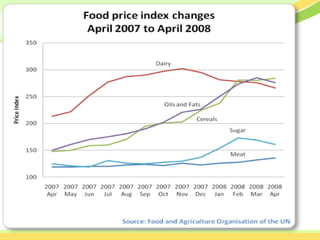
 World Bank “food prices rose 83% over last 3
 years”

 FAO “45% increase in food price index in last 9
 months
Food Crisis


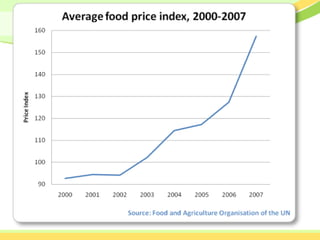
 But the crisis was not sudden. Prices have been
 rising for some time now, so perhaps earlier
 warning signs were missed or ignored?
Food prices or overpopulation?


 IFDP “food produced steadily at over 20% a
 year while rate of population growth dropped at
 1.14% a year
Some causes

 “Unnecessary” or excessively produced
 products – tobacco, cocoa, tea, sugar...

 Droughts in wheat producing areas

 Biofuels diversion of crops – 10%
Deeper and long-term causes

 No voice in food security policy of developing
 countries

  WTO removal of trade barriers

  GMOs and proprietary of technology
Agriculture and Development

  75% poor people depend on agriculture to
 survive
  In agriculture-based countries, it generates on
 average 29% of the GDP and employs 65% of
 the labour force

  Investigation in Agriculture is essential
The Consultative Group on
International Agricultural Research
CGIAR
  Created in 1971
  Alliance of countries, international and regional
  organizations, and private foundations

   • supporting 15 international agricultural research
     Centres
   • that work with national agricultural research systems,
     civil society organizations, and the private sector.
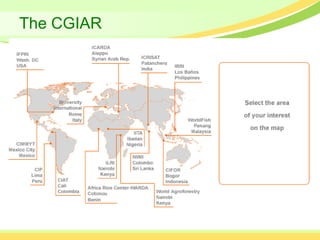
The CGIAR
CGIAR 5 focuses

 Sustainable production
 Enhancement of National Agricultural Research
 Systems (NARS)
 Germplasm Improvement
 Germplasm Collection
 Policy
Some achievements of the CGIAR

 Comite’s de Investigacion Agricola Local
 New Rices for Africa (NERICA)
 Quality Protein Maize
 Potatoes Virus detection kit
 Improved, drought resistant maize
 Improved aquaculture techniques and new
 varieties of tilapia fish
Borlaug’s reaction to critics to Green
Revolution

  "some of the environmental lobbyists of the Western
  nations are the salt of the earth, but many of them are
  elitists. They've never experienced the physical
  sensation of hunger. They do their lobbying from
  comfortable office suites in Washington or Brussels. If
  they lived just one month amid the misery of the
  developing world, as I have for fifty years, they'd be
  crying out for tractors and fertilizer and irrigation canals
  and be outraged that fashionable elitists back home
  were trying to deny them these things".
Primal aim of the CGIAR

  Knowledge AS International Public Goods
  •   Available, Accessible, Applicable
  •   Non-rivalrous
  •   Non- excludable
  •   Transboundaries
Knowledge as International Public
Good

 CGIAR Centres must managed the knowledge
 produced properly to ensure
  • access
  • sharing
  • impact
Central Advisory Service


  Assist the Centres to manage their knowledge
 to ensure access and use of their intellectual
 assets as public goods for the benefit of the
 poor
Intellectual Assets as Property


  Intellectual Property
  “all those things that emanate from the exercise of the
    human mind”
The law....

   The law does not protect the right to own
  intellectual property unless the author has taken
  steps to claim ownership over the results of
  his/her creative product
Intellectual Property Rights

IPRs are the rights granted to inventors, artists,
  plant breeders, in recognition of their work
  There is usually a need to meet certain
  standards of creativity before it is granted
  The rights granted are limited – by time, and by
  country
  Often exploited by licensing
  When others wish to use IPRs they must get
  consent, and perhaps pay a royalty
Main IPRs in Agriculture


  Patents
  Plant Variety Rights
  Copyright
  Geographical Indications
Patents

  Exclusive right to make, use and sell
  Monopoly granted by the State to the inventor to
 disclose the invention and recoup investment
  A grant of a patent requires an invention to pass tests
 of novelty, inventive step (unobviousness), and
 industrial applicability
  Rights are national, i.e. by country
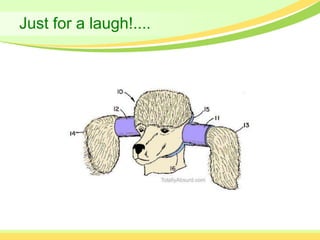
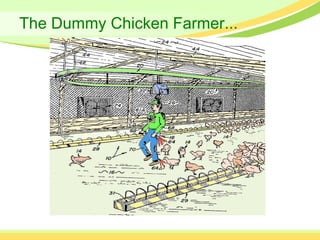
Just for a laugh!....
The Dummy Chicken Farmer...
Patents and Public Goods

  Enola bean case
  • patent over new variety of yellow bean
  • restrictions on imports (sale)
  • limitation on farmers’ right to re-use, exchange or sell
    patented seed + breeders’ right of to use that seed
    for further research and breeding purposes
  Turmeric & Basmati cases
  • Used for years in India – millions of money to defend
International Solution

  Countries’ recognition of genetic material
  subject to patent protection and no return
  Convention on Biological Diversity (“CBD”)
   • Conservation
   • Sustainable use
   • Fair & Equitable sharing of profits
Free exchange of genetic material

  CBD requires bilateral agreements
  • Time and money consuming


 International Treaty on Plant Genetic for Food
 and Agriculture (“IT”)
  • Multilateral system for exchange of list of crops
  • Farmers’ rights: traditional knowledge & decision-
    making
  • Restrictions on IPRs over original material
  • Compulsory benefit sharing if commercialised
Copyright

 Right over expression of idea involving some
 creative element – literary, musical, theatrical...
 Automatic right once fixated – but US system
  • so not on ideas
  Exclusive right to control copying or issuing
 copies, adapt, translate, modify
Copyright and Public Goods

  Open Access
  • Make results of research as widely and accessible
    as possible
  • Free from technological and economic restraints
  Wheat scientist in Kazakhstan
  NGO Extension in Ethiopia
  • Negotiations with Publishers
Copyright and Public Goods

  Creative Commons
  • some rights reserved
  • clear understanding of permitted uses


  Open Access Journals
Geographical Indications

  Name or sign used on a product corresponding
 to the country or place of origin
  • Protected Denomination of Origin (“PDO”) and
    Protected Geographical Indication (“PGI”)
    – Natural and Human factor
    – Quality, reputation, or other characteristic
 Protection against incorrect and misleading,
 damaging or exploiting reputation
  • Darjeeling (and Darjeeling Nouveau)
  • Budweiser (Budejovice or Budweis)
Geographical Indications and
Development

  Collective group of producers
  Protection and development
  • Economy
  • Traditional knowledge
  • Rural community
  • Agro-Biodiversity
  Ethiopian Coffee: Harar, Sidamo, and Yirgacheffe
Thank you!
f.remanning@cgiar.org

Food Crisis, Development and Intellectual Property

  • 1.
    Food Crisis, Developmentand Intellectual Property D.ssa Francesca Re Manning CAS-IP A presentation to the Cambridge International Development Society 5 December 2009
  • 2.
    Food Crisis WorldBank “food prices rose 83% over last 3 years” FAO “45% increase in food price index in last 9 months
  • 4.
    Food Crisis Butthe crisis was not sudden. Prices have been rising for some time now, so perhaps earlier warning signs were missed or ignored?
  • 6.
    Food prices oroverpopulation? IFDP “food produced steadily at over 20% a year while rate of population growth dropped at 1.14% a year
  • 7.
    Some causes “Unnecessary”or excessively produced products – tobacco, cocoa, tea, sugar... Droughts in wheat producing areas Biofuels diversion of crops – 10%
  • 8.
    Deeper and long-termcauses No voice in food security policy of developing countries WTO removal of trade barriers GMOs and proprietary of technology
  • 9.
    Agriculture and Development 75% poor people depend on agriculture to survive In agriculture-based countries, it generates on average 29% of the GDP and employs 65% of the labour force Investigation in Agriculture is essential
  • 10.
    The Consultative Groupon International Agricultural Research CGIAR Created in 1971 Alliance of countries, international and regional organizations, and private foundations • supporting 15 international agricultural research Centres • that work with national agricultural research systems, civil society organizations, and the private sector.
  • 11.
  • 12.
    CGIAR 5 focuses Sustainable production Enhancement of National Agricultural Research Systems (NARS) Germplasm Improvement Germplasm Collection Policy
  • 13.
    Some achievements ofthe CGIAR Comite’s de Investigacion Agricola Local New Rices for Africa (NERICA) Quality Protein Maize Potatoes Virus detection kit Improved, drought resistant maize Improved aquaculture techniques and new varieties of tilapia fish
  • 14.
    Borlaug’s reaction tocritics to Green Revolution "some of the environmental lobbyists of the Western nations are the salt of the earth, but many of them are elitists. They've never experienced the physical sensation of hunger. They do their lobbying from comfortable office suites in Washington or Brussels. If they lived just one month amid the misery of the developing world, as I have for fifty years, they'd be crying out for tractors and fertilizer and irrigation canals and be outraged that fashionable elitists back home were trying to deny them these things".
  • 15.
    Primal aim ofthe CGIAR Knowledge AS International Public Goods • Available, Accessible, Applicable • Non-rivalrous • Non- excludable • Transboundaries
  • 16.
    Knowledge as InternationalPublic Good CGIAR Centres must managed the knowledge produced properly to ensure • access • sharing • impact
  • 17.
    Central Advisory Service Assist the Centres to manage their knowledge to ensure access and use of their intellectual assets as public goods for the benefit of the poor
  • 18.
    Intellectual Assets asProperty Intellectual Property “all those things that emanate from the exercise of the human mind”
  • 19.
    The law.... The law does not protect the right to own intellectual property unless the author has taken steps to claim ownership over the results of his/her creative product
  • 20.
    Intellectual Property Rights IPRsare the rights granted to inventors, artists, plant breeders, in recognition of their work There is usually a need to meet certain standards of creativity before it is granted The rights granted are limited – by time, and by country Often exploited by licensing When others wish to use IPRs they must get consent, and perhaps pay a royalty
  • 21.
    Main IPRs inAgriculture Patents Plant Variety Rights Copyright Geographical Indications
  • 22.
    Patents Exclusiveright to make, use and sell Monopoly granted by the State to the inventor to disclose the invention and recoup investment A grant of a patent requires an invention to pass tests of novelty, inventive step (unobviousness), and industrial applicability Rights are national, i.e. by country
  • 23.
    Just for alaugh!....
  • 24.
  • 25.
    Patents and PublicGoods Enola bean case • patent over new variety of yellow bean • restrictions on imports (sale) • limitation on farmers’ right to re-use, exchange or sell patented seed + breeders’ right of to use that seed for further research and breeding purposes Turmeric & Basmati cases • Used for years in India – millions of money to defend
  • 26.
    International Solution Countries’ recognition of genetic material subject to patent protection and no return Convention on Biological Diversity (“CBD”) • Conservation • Sustainable use • Fair & Equitable sharing of profits
  • 27.
    Free exchange ofgenetic material CBD requires bilateral agreements • Time and money consuming International Treaty on Plant Genetic for Food and Agriculture (“IT”) • Multilateral system for exchange of list of crops • Farmers’ rights: traditional knowledge & decision- making • Restrictions on IPRs over original material • Compulsory benefit sharing if commercialised
  • 28.
    Copyright Right overexpression of idea involving some creative element – literary, musical, theatrical... Automatic right once fixated – but US system • so not on ideas Exclusive right to control copying or issuing copies, adapt, translate, modify
  • 29.
    Copyright and PublicGoods Open Access • Make results of research as widely and accessible as possible • Free from technological and economic restraints Wheat scientist in Kazakhstan NGO Extension in Ethiopia • Negotiations with Publishers
  • 30.
    Copyright and PublicGoods Creative Commons • some rights reserved • clear understanding of permitted uses Open Access Journals
  • 31.
    Geographical Indications Name or sign used on a product corresponding to the country or place of origin • Protected Denomination of Origin (“PDO”) and Protected Geographical Indication (“PGI”) – Natural and Human factor – Quality, reputation, or other characteristic Protection against incorrect and misleading, damaging or exploiting reputation • Darjeeling (and Darjeeling Nouveau) • Budweiser (Budejovice or Budweis)
  • 33.
    Geographical Indications and Development Collective group of producers Protection and development • Economy • Traditional knowledge • Rural community • Agro-Biodiversity Ethiopian Coffee: Harar, Sidamo, and Yirgacheffe
  • 34.