Precision Agriculture Muhammad Aleem Siddiqui
What is Precision Agriculture ?
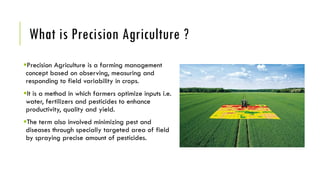
Precision Agriculture is a farming management
concept based on observing, measuring and
responding to field variability in crops.
It is a method in which farmers optimize inputs i.e.
water, fertilizers and pesticides to enhance
productivity, quality and yield.
The term also involved minimizing pest and
diseases through specially targeted area of field
by spraying precise amount of pesticides.
Tools used for Precision Agriculture
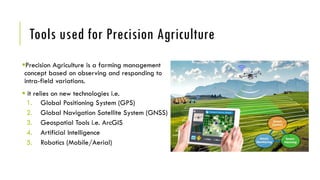
Precision Agriculture is a farming management
concept based on observing and responding to
intra-field variations.
 it relies on new technologies i.e.
1. Global Positioning System (GPS)
2. Global Navigation Satellite System (GNSS)
3. Geospatial Tools i.e. ArcGIS
4. Artificial Intelligence
5. Robotics (Mobile/Aerial)
Using Sensor in Precision Agriculture
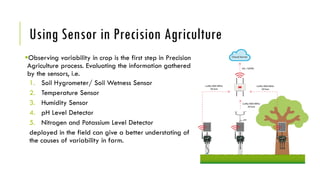
Observing variability in crop is the first step in Precision
Agriculture process. Evaluating the information gathered
by the sensors, i.e.
1. Soil Hygrometer/ Soil Wetness Sensor
2. Temperature Sensor
3. Humidity Sensor
4. pH Level Detector
5. Nitrogen and Potassium Level Detector
deployed in the field can give a better understating of
the causes of variability in farm.
Using Satellites and Drones in Precision
Agriculture
Geospatial technologies i.e.
1. Global Positioning System (GPS)
2. Global Navigation Satellite System (GNSS)
3. Remote Sensing
plays an important role in Precise Location of
problems, for optimizing resources and
maximizing yields.
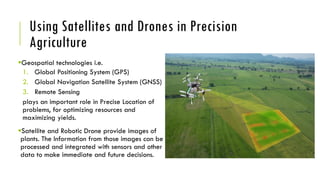
Satellite and Robotic Drone provide images of
plants. The Information from those images can be
processed and integrated with sensors and other
data to make immediate and future decisions.
Using Machine Learning in Precision Agriculture
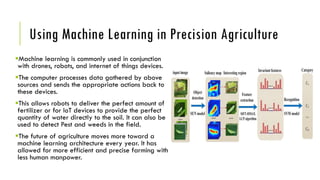
Machine learning is commonly used in conjunction
with drones, robots, and internet of things devices.
The computer processes data gathered by above
sources and sends the appropriate actions back to
these devices.
This allows robots to deliver the perfect amount of
fertilizer or for IoT devices to provide the perfect
quantity of water directly to the soil. It can also be
used to detect Pest and weeds in the field.
The future of agriculture moves more toward a
machine learning architecture every year. It has
allowed for more efficient and precise farming with
less human manpower.
Uses of Precision Agriculture
Using Precision Agriculture you can able to deal with
parts of your field in appropriate way, because these
parts of the field may be different on the basis of Soil
or Slope.
It can save your crops from being infected by pests.
It can able to detect weeds, and save a large amount
of fertilizers being absorbed by weeds.
It can give you an idea, if you need to apply particular
mineral or fertilizer in one area of your land, rather then
using it in entire farm, thus saving your money, resource
and time.
CONCLUSION
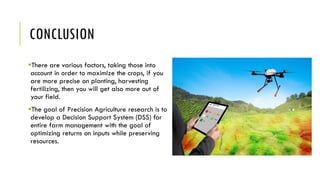
There are various factors, taking those into
account in order to maximize the crops, if you
are more precise on planting, harvesting
fertilizing, then you will get also more out of
your field.
The goal of Precision Agriculture research is to
develop a Decision Support System (DSS) for
entire farm management with the goal of
optimizing returns on inputs while preserving
resources.
Precision Agriculture

Precision Agriculture

  • 1.
  • 2.
    What is PrecisionAgriculture ? Precision Agriculture is a farming management concept based on observing, measuring and responding to field variability in crops. It is a method in which farmers optimize inputs i.e. water, fertilizers and pesticides to enhance productivity, quality and yield. The term also involved minimizing pest and diseases through specially targeted area of field by spraying precise amount of pesticides.
  • 3.
    Tools used forPrecision Agriculture Precision Agriculture is a farming management concept based on observing and responding to intra-field variations.  it relies on new technologies i.e. 1. Global Positioning System (GPS) 2. Global Navigation Satellite System (GNSS) 3. Geospatial Tools i.e. ArcGIS 4. Artificial Intelligence 5. Robotics (Mobile/Aerial)
  • 4.
    Using Sensor inPrecision Agriculture Observing variability in crop is the first step in Precision Agriculture process. Evaluating the information gathered by the sensors, i.e. 1. Soil Hygrometer/ Soil Wetness Sensor 2. Temperature Sensor 3. Humidity Sensor 4. pH Level Detector 5. Nitrogen and Potassium Level Detector deployed in the field can give a better understating of the causes of variability in farm.
  • 5.
    Using Satellites andDrones in Precision Agriculture Geospatial technologies i.e. 1. Global Positioning System (GPS) 2. Global Navigation Satellite System (GNSS) 3. Remote Sensing plays an important role in Precise Location of problems, for optimizing resources and maximizing yields. Satellite and Robotic Drone provide images of plants. The Information from those images can be processed and integrated with sensors and other data to make immediate and future decisions.
  • 6.
    Using Machine Learningin Precision Agriculture Machine learning is commonly used in conjunction with drones, robots, and internet of things devices. The computer processes data gathered by above sources and sends the appropriate actions back to these devices. This allows robots to deliver the perfect amount of fertilizer or for IoT devices to provide the perfect quantity of water directly to the soil. It can also be used to detect Pest and weeds in the field. The future of agriculture moves more toward a machine learning architecture every year. It has allowed for more efficient and precise farming with less human manpower.
  • 7.
    Uses of PrecisionAgriculture Using Precision Agriculture you can able to deal with parts of your field in appropriate way, because these parts of the field may be different on the basis of Soil or Slope. It can save your crops from being infected by pests. It can able to detect weeds, and save a large amount of fertilizers being absorbed by weeds. It can give you an idea, if you need to apply particular mineral or fertilizer in one area of your land, rather then using it in entire farm, thus saving your money, resource and time.
  • 8.
    CONCLUSION There are variousfactors, taking those into account in order to maximize the crops, if you are more precise on planting, harvesting fertilizing, then you will get also more out of your field. The goal of Precision Agriculture research is to develop a Decision Support System (DSS) for entire farm management with the goal of optimizing returns on inputs while preserving resources.