Bioprospecting
Presented by
R. Bharathi Rathinam
What is Bioprospecting?
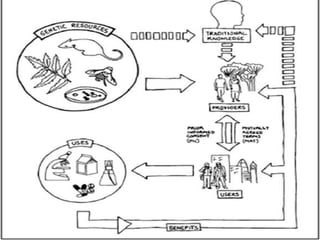
• Bioprospecting, also known as biodiversity
prospecting, is the exploration of biological
material for commercially valuable genetic and
biochemical properties.
• In simple terms this means the investigation of
living things to see how they can be
commercially useful to humans.
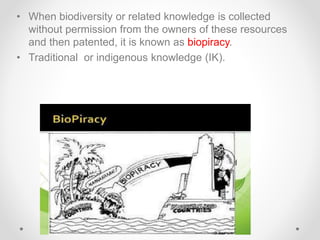
• When biodiversity or related knowledge is collected
without permission from the owners of these resources
and then patented, it is known as biopiracy.
• Traditional or indigenous knowledge (IK).
Concept of Bioprospecting
• Extreme environments, provide habitats for
“extremophiles”, organisms with unique characteristics
developed for survival.
• The biological processes and materials which enable
these extremophiles to survive in extreme temperatures,
pressures, salinity etc, and other unique conditions are
sources of great potential for scientific advancement and
commercial application.
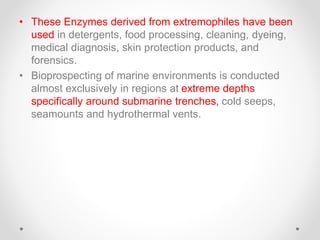
• These Enzymes derived from extremophiles have been
used in detergents, food processing, cleaning, dyeing,
medical diagnosis, skin protection products, and
forensics.
• Bioprospecting of marine environments is conducted
almost exclusively in regions at extreme depths
specifically around submarine trenches, cold seeps,
seamounts and hydrothermal vents.
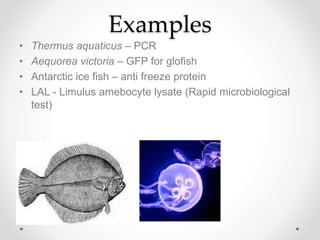
Examples
• Thermus aquaticus – PCR
• Aequorea victoria – GFP for glofish
• Antarctic ice fish – anti freeze protein
• LAL - Limulus amebocyte lysate (Rapid microbiological
test)
Why is it needed?
• The underlying aim of bio prospecting is to find new
resources and products from nature that can be
used by humans.
• Improving human health, through both medicine and
better nutrition are key focal areas.
• It plays a dominant role in discovering leads for drug
development, since existing/known compounds for
developing drugs for human use are limited.
• A study showed that between 1983 and 2003, almost
two thirds of anti-cancer agents being investigated as
drug candidates were derived from natural products..
• Other related sectors, such as crop plant biotechnology,
screen natural resources for useful traits, such as
disease resistance.
Where?
• Although bioprospecting can happen wherever there is
biodiversity, it tends to be focused where biodiversity is
at its richest, as this raises the chances of finding
something useful.
• Statistically, the chance of a successful “hit” is one in
10,000 for synthetic compounds and one in 30,000 or
40,000 for natural products.
• Extreme environments and unique ecological niches are
also good sources for diversity, such as Antarctica. Yet,
only a tiny fraction of the world’s biodiversity has actually
been explored and the richest areas of biodiversity tend
to be in developing countries.
Process of Bioprospecting
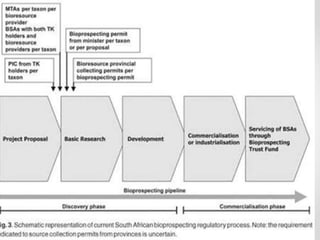
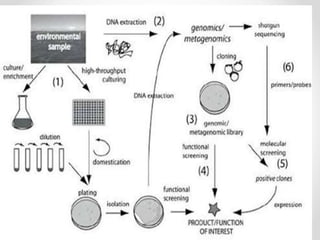
• As a process, it generally consists of four phases:
• Phase 1: on-site collection of samples;
• Phase 2: isolation, charactisation and culture of specific
compounds;
• Phase 3: screening for potential uses, such as
pharmaceutical or other uses; and,
• Phase 4: product development and commercialisation,
including patenting, trials, sales and marketing.
Who does bioprospecting?
• Pharmaceutical, agribusiness (biotechnology,
seed, crop protection and horticulture), cosmetic
and personal care, fragrance, botanicals, and
the food and beverage industries.
• The pharmaceutical and agri-business sectors
are more involved.
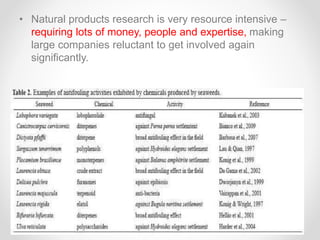
• Natural products research is very resource intensive –
requiring lots of money, people and expertise, making
large companies reluctant to get involved again
significantly.
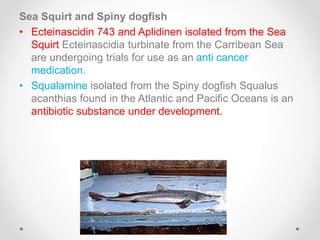
Sea Squirt and Spiny dogfish
• Ecteinascidin 743 and Aplidinen isolated from the Sea
Squirt Ecteinascidia turbinate from the Carribean Sea
are undergoing trials for use as an anti cancer
medication.
• Squalamine isolated from the Spiny dogfish Squalus
acanthias found in the Atlantic and Pacific Oceans is an
antibiotic substance under development.
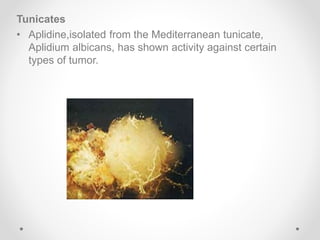
Tunicates
• Aplidine,isolated from the Mediterranean tunicate,
Aplidium albicans, has shown activity against certain
types of tumor.
Added potential
environmental impacts of
Bioprospecting
• In situ experiments in and around the Deep Seabed can
introduce light and noise or change water temperature,
which, in-turn, can affect procreation and the survival of
organisms in these areas.
• Bioprospecting activities can also produce pollution in
the form of debris or discharge from vessels and
equipment.
• Additionally, inadvertant movement of organisms through
disrupting currents or discarding of scientific samples
can lead to biological contamination.
• Finally, there is the usual possibility of over-exploitation
in harvesting organisms in these regions and the flow on
environmental impacts.
Key issues & challenges
• Conservation versus exploitation:
Conservation is not always the top priority of
nations, and some seek to make a quick profit from their
natural resources rather than preserving them. As a result,
the biodiversity they wish to exploit is disappearing.
• Lack of legal clarity:
There is a need for clearer, more specific rules
on how origins of samples and IK are recorded and their
benefits shared, both nationally and abroad.
The commercial benefit should be accrue to
those who discovered the active ingredient or the biotech
company able to identify/ improve on this key ingredient
• Greater sector involvement:
Many sectors actively involved in bioprospecting
remain ignorant of the regulations, and are committing
biopiracy. Education and participation in relevant
international and national discussions is needed to ensure
regulation across all sectors.
A comprehensive
bioprospecting policy
• Legislation and regulation:
Appropriate legislation and regulations are the basis for
implementation of the policy, and are needed in order to make it
enforceable. Probably the most crucial issue to be addressed is
regulation of access to biological resources, and to the
associated knowledge.
Legislation and regulations should (i) ensure that clear
conditions and procedures govern access to genetic
resources, (ii) make access subject to written agreement
based on prior informed consent and (iii) require fair and
equitable sharing of the benefits. Enforcement is needed to
ensure that the handling of genetic resources, both by nationals
and foreigners, is consistent with the national policies and laws.
•
• Benefit sharing mechanisms: a mechanism for benefit
sharing should be developed. Benefits should be
distributed fairly and equitably among all parties
concerned, including local communities, indigenous
groups, universities, etc.
• Capacity building: building technological capacity,
including the capacity to innovate, is important in order to
increase the possibilities to add value to genetic resources,
thus generating greater social and economic benefits.
Similarly, education and training are needed to
encourage the protection of biodiversity. Institutional
development should also be included in capacity building
efforts.
• Financing: obviously, sources of funding will have to
be identified for the development and
implementation of the policy. Often, the process of
formulating a policy is as important as its contents, since
it can generate commitment and thereby facilitate
implementation.
• • Assessment or situation analysis: a sound
assessment of relevant aspects, notably the
opportunities, needs, resources and capacities of a
country to make sustainable use of its biological and
genetic resources should be the basis for developing
an appropriate policy and for devising sound strategies
on bio prospecting and access. National capacity should
also be assessed in order to make optimal use of
existing opportunities.
• •
• • Monitoring and evaluation: procedures for monitoring
and evaluation should be put in place, so that progress -
or the lack thereof- can be assessed. Moreover, this
will allow for adjustment of policy goals and strategies as
and when needed.
Bioprospecting

Bioprospecting

  • 1.
  • 2.
    What is Bioprospecting? •Bioprospecting, also known as biodiversity prospecting, is the exploration of biological material for commercially valuable genetic and biochemical properties. • In simple terms this means the investigation of living things to see how they can be commercially useful to humans.
  • 3.
    • When biodiversityor related knowledge is collected without permission from the owners of these resources and then patented, it is known as biopiracy. • Traditional or indigenous knowledge (IK).
  • 4.
    Concept of Bioprospecting •Extreme environments, provide habitats for “extremophiles”, organisms with unique characteristics developed for survival. • The biological processes and materials which enable these extremophiles to survive in extreme temperatures, pressures, salinity etc, and other unique conditions are sources of great potential for scientific advancement and commercial application.
  • 5.
    • These Enzymesderived from extremophiles have been used in detergents, food processing, cleaning, dyeing, medical diagnosis, skin protection products, and forensics. • Bioprospecting of marine environments is conducted almost exclusively in regions at extreme depths specifically around submarine trenches, cold seeps, seamounts and hydrothermal vents.
  • 6.
    Examples • Thermus aquaticus– PCR • Aequorea victoria – GFP for glofish • Antarctic ice fish – anti freeze protein • LAL - Limulus amebocyte lysate (Rapid microbiological test)
  • 8.
    Why is itneeded? • The underlying aim of bio prospecting is to find new resources and products from nature that can be used by humans. • Improving human health, through both medicine and better nutrition are key focal areas. • It plays a dominant role in discovering leads for drug development, since existing/known compounds for developing drugs for human use are limited.
  • 9.
    • A studyshowed that between 1983 and 2003, almost two thirds of anti-cancer agents being investigated as drug candidates were derived from natural products.. • Other related sectors, such as crop plant biotechnology, screen natural resources for useful traits, such as disease resistance.
  • 10.
    Where? • Although bioprospectingcan happen wherever there is biodiversity, it tends to be focused where biodiversity is at its richest, as this raises the chances of finding something useful. • Statistically, the chance of a successful “hit” is one in 10,000 for synthetic compounds and one in 30,000 or 40,000 for natural products. • Extreme environments and unique ecological niches are also good sources for diversity, such as Antarctica. Yet, only a tiny fraction of the world’s biodiversity has actually been explored and the richest areas of biodiversity tend to be in developing countries.
  • 11.
    Process of Bioprospecting •As a process, it generally consists of four phases: • Phase 1: on-site collection of samples; • Phase 2: isolation, charactisation and culture of specific compounds; • Phase 3: screening for potential uses, such as pharmaceutical or other uses; and, • Phase 4: product development and commercialisation, including patenting, trials, sales and marketing.
  • 15.
    Who does bioprospecting? •Pharmaceutical, agribusiness (biotechnology, seed, crop protection and horticulture), cosmetic and personal care, fragrance, botanicals, and the food and beverage industries. • The pharmaceutical and agri-business sectors are more involved.
  • 16.
    • Natural productsresearch is very resource intensive – requiring lots of money, people and expertise, making large companies reluctant to get involved again significantly.
  • 17.
    Sea Squirt andSpiny dogfish • Ecteinascidin 743 and Aplidinen isolated from the Sea Squirt Ecteinascidia turbinate from the Carribean Sea are undergoing trials for use as an anti cancer medication. • Squalamine isolated from the Spiny dogfish Squalus acanthias found in the Atlantic and Pacific Oceans is an antibiotic substance under development.
  • 18.
    Tunicates • Aplidine,isolated fromthe Mediterranean tunicate, Aplidium albicans, has shown activity against certain types of tumor.
  • 19.
    Added potential environmental impactsof Bioprospecting • In situ experiments in and around the Deep Seabed can introduce light and noise or change water temperature, which, in-turn, can affect procreation and the survival of organisms in these areas. • Bioprospecting activities can also produce pollution in the form of debris or discharge from vessels and equipment.
  • 20.
    • Additionally, inadvertantmovement of organisms through disrupting currents or discarding of scientific samples can lead to biological contamination. • Finally, there is the usual possibility of over-exploitation in harvesting organisms in these regions and the flow on environmental impacts.
  • 21.
    Key issues &challenges • Conservation versus exploitation: Conservation is not always the top priority of nations, and some seek to make a quick profit from their natural resources rather than preserving them. As a result, the biodiversity they wish to exploit is disappearing.
  • 22.
    • Lack oflegal clarity: There is a need for clearer, more specific rules on how origins of samples and IK are recorded and their benefits shared, both nationally and abroad. The commercial benefit should be accrue to those who discovered the active ingredient or the biotech company able to identify/ improve on this key ingredient
  • 23.
    • Greater sectorinvolvement: Many sectors actively involved in bioprospecting remain ignorant of the regulations, and are committing biopiracy. Education and participation in relevant international and national discussions is needed to ensure regulation across all sectors.
  • 24.
    A comprehensive bioprospecting policy •Legislation and regulation: Appropriate legislation and regulations are the basis for implementation of the policy, and are needed in order to make it enforceable. Probably the most crucial issue to be addressed is regulation of access to biological resources, and to the associated knowledge. Legislation and regulations should (i) ensure that clear conditions and procedures govern access to genetic resources, (ii) make access subject to written agreement based on prior informed consent and (iii) require fair and equitable sharing of the benefits. Enforcement is needed to ensure that the handling of genetic resources, both by nationals and foreigners, is consistent with the national policies and laws. •
  • 25.
    • Benefit sharingmechanisms: a mechanism for benefit sharing should be developed. Benefits should be distributed fairly and equitably among all parties concerned, including local communities, indigenous groups, universities, etc. • Capacity building: building technological capacity, including the capacity to innovate, is important in order to increase the possibilities to add value to genetic resources, thus generating greater social and economic benefits. Similarly, education and training are needed to encourage the protection of biodiversity. Institutional development should also be included in capacity building efforts.
  • 26.
    • Financing: obviously,sources of funding will have to be identified for the development and implementation of the policy. Often, the process of formulating a policy is as important as its contents, since it can generate commitment and thereby facilitate implementation. • • Assessment or situation analysis: a sound assessment of relevant aspects, notably the opportunities, needs, resources and capacities of a country to make sustainable use of its biological and genetic resources should be the basis for developing an appropriate policy and for devising sound strategies on bio prospecting and access. National capacity should also be assessed in order to make optimal use of existing opportunities. • •
  • 27.
    • • Monitoringand evaluation: procedures for monitoring and evaluation should be put in place, so that progress - or the lack thereof- can be assessed. Moreover, this will allow for adjustment of policy goals and strategies as and when needed.