Basis of Bacterial Classification
Anil Shrestha
Msc medical microbiology
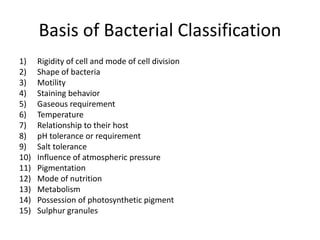
Basis of Bacterial Classification
1) Rigidity of cell and mode of cell division
2) Shape of bacteria
3) Motility
4) Staining behavior
5) Gaseous requirement
6) Temperature
7) Relationship to their host
8) pH tolerance or requirement
9) Salt tolerance
10) Influence of atmospheric pressure
11) Pigmentation
12) Mode of nutrition
13) Metabolism
14) Possession of photosynthetic pigment
15) Sulphur granules
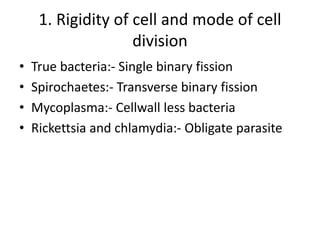
1. Rigidity of cell and mode of cell
division
• True bacteria:- Single binary fission
• Spirochaetes:- Transverse binary fission
• Mycoplasma:- Cellwall less bacteria
• Rickettsia and chlamydia:- Obligate parasite
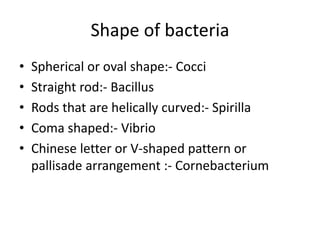
Shape of bacteria
• Spherical or oval shape:- Cocci
• Straight rod:- Bacillus
• Rods that are helically curved:- Spirilla
• Coma shaped:- Vibrio
• Chinese letter or V-shaped pattern or
pallisade arrangement :- Cornebacterium
Shape of bacteria…
Cocci in
• Pairs:- Diplococci
• Chain:- Streptococci
• Group of four:- Tetrad
• Grapes like cluster:- Staphylococci
• Group of eight:- Sarcina
Shape of bacteria…
Bacillus in
• Pairs:- Diplobacilli
• Coccobacilli:- length of individual organisms
approximately its width. Eg, Brucella spp.
• Streptobacillus:- arranged in chain. Eg,
Streptobacillus moniliformis .
• Branched aggregation type rod:- Mycobacterium
tuberculosis
• Long chain of rod:- Lactobacillus spp.
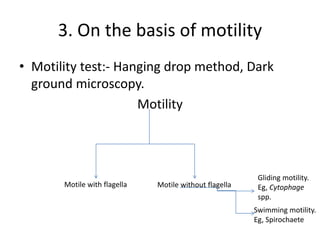
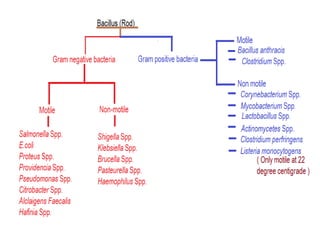
3. On the basis of motility
• Motility test:- Hanging drop method, Dark
ground microscopy.
Motility
Motile with flagella Motile without flagella
Gliding motility.
Eg, Cytophage
spp.
Swimming motility.
Eg, Spirochaete
3. On the basis of motility
On the basis of flagellar arrangement, bacteria can
be divided into
• Monotrichous:- Single polar flagella. Eg,
Psedomonas aeruginosa, Vibrio cholerae.
• Lophotrichus:- Cluster of polar flagella. Eg,
Pseudomonas fluorescens.
• Amphitrichous:- flagella either single or clusters
at both poles. Eg, Aquaspirillum serpens.
• Peritrichous:- Surrounded by lateral flagella. Eg,
Salmonella typhi, Proteus spp, E. coli etc.
4. On the basis of staining behaviour
• Gram staining
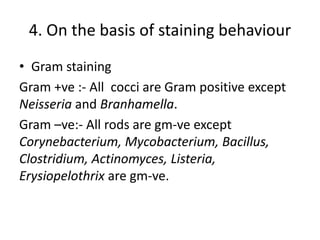
Gram +ve :- All cocci are Gram positive except
Neisseria and Branhamella.
Gram –ve:- All rods are gm-ve except
Corynebacterium, Mycobacterium, Bacillus,
Clostridium, Actinomyces, Listeria,
Erysiopelothrix are gm-ve.
• Acid fast staining:- Ziehl Neelson staining
method.
• Acid fast bacteria:- Mycobacterium tuberculosis,
Mycobaterium leprae, Nocardia Spp.
• Capsulated bacteria:- Streptococcus
pneumoniae, Bacillus anthracis, Klebsiella
pneumoniae, Streptococcus mutans,
Haemophilus influenza, Clostridium perfringes.
• Spore former:- Bacillus Spp., Clostridium Spp.,
Thermoactinomyces vulgaris, Coxiella burnetti,
Desulfotomaculum Spp., Sporolactobacillus,
Sporomusa Spp.
• Albert staining:- Corynebacterium Spp
• Bipolar staining :- Yersinia pestis, Burkholderia
pseudomallei, Pasturella multocida,
Francisella tularensis, Klebsiella granulomatis
5. On the basis of GASEOUS
REQUIREMENTS
• Aerobic:- Bacillus Spp., Pseudomonas Spp
• Anaerobic:- Clostridium Spp., Bacteroides Spp.,
Fusobacterium Spp., Peptostreptococcus.,
Peptococcus., Ruminococcus
• Facultative anaerobes:- members of family of
enterobcateriaceae.
• Microaerophilic:- Mycobacterium tuberculosis.,
Camplylobacter Spp., Helicobacter pylori
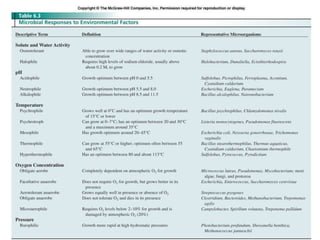
On the basis of temperature
• Psychrophiles:- grow well at 0⁰C or below 7 ⁰C and
have optimum temperature of 15-25 ⁰C.
Eg:- Pseudomonas, Alcaligens, Lactobacillus,
Achromobacter, Flavobacterium, Psychromobacter
• Mesophiles:- grow at 20-45⁰C and optimum
temperature at 37 ⁰C. eg:- all member of
enterobacteriaceae etc.
• Thermophiles:- Grow well above 45 ⁰C and optimum at
55-60 ⁰C. Eg:- Bacillus stereothermophilus, Clostridium
Spp.
• Hyperthermophilus:- grow well at 70 ⁰C and optimum
at 80-90 ⁰C. eg:- Thermus aquaticus, Thermococcus
Spp., Pyrococcus Spp., Pyrodictium Spp.
On the basis of relationship with their
host
• Saprophytism :- Those bacteria that are free
living but depend on dead and decayed
organic matter for their growth.
• Parasites:- Those bacteria that can establish
themselves and multiply in host tissue
deriving nourishment from the host.
On the basis of pH requirement
• Acidophiles:- These bacteria which require low pH and
unable to grow at high pH i.e, pH˃ 5. eg. Thiobacillus
ferroxidans can tolerate up to pH 1. Flavobacterium
acidurans, Sulfolobus Spp., Thermoplasma Spp.
Some acid tolerant bacteria are lactobacillus,
Acetobacter.
• Neutrophiles:- growth on neutral pH 6.8. Most of
bacteria are neutrophils. Eg:- Alcaligens, Pseudomonas,
E. coli
• Alkalophiles:- Grow well above pH 8. i.e, basic pH
Eg:- Bacillus alcalophiles, Bacillus circulans,
Natranococcus Spp., Natranobacterium Spp.,
Ectothhiorhodo Spirillum Spp.
On the basis of salt requirement
• Non halophiles:- Unable to grow in high salt
concentration. Eg: E. coli
• Halotolerant:- tolerate low level of salt
concentration i.e 8% salt
• Halophiles:- grow in high salt concentration ie salt
loving
– Slightly:- Require 0.5to 3% Nacl
»Pseudomonas spp
»Vibrio
»Moraxella
»Acinetobater
• Moderately:- Require 3% to 15% Nacl
»Bacillus spp.
»Micrococcus spp.
• Extremely:- Require 15% to 30% salt
 Halobacterium spp
 Halococcus spp
 Natranobacterium spp
 Natranococcus spp
 Haloterax spp
On the basis of influence of
atmospheric pressure
• Bacteria that can tolerate high pressure and
isolated from deep sea are called Barotolerant.
– 300 M depth Barotolerant
– 4000-6000 M depth Barophilic
– 10,000 M depth extremely
Barophilic
Eg:
Shewenella, Photobacterium, Moritella japonica,
Methanococcus .
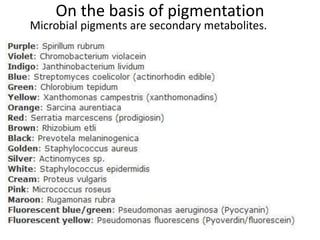
On the basis of pigmentation
Microbial pigments are secondary metabolites.
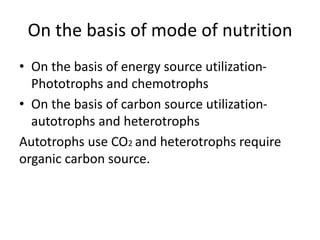
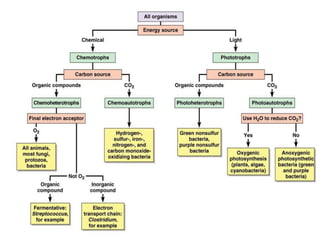
On the basis of mode of nutrition
• On the basis of energy source utilization-
Phototrophs and chemotrophs
• On the basis of carbon source utilization-
autotrophs and heterotrophs
Autotrophs use CO2 and heterotrophs require
organic carbon source.
On the basis of metabolism
• Heterotrophic bacteria are classified into two
types;
– Respiratory
– Fermentative
Respiratory mechanism may be aerobic or anerobic.
In aerobic respiration, oxygen serves as the terminal
electron acceptor whereas in anaerobic respiration
NO3 ¯, SO4¯, C03¯ etc
Partial oxidation of organic compound in case of
fermentation.
On the basis of possession of
photosynthetic pigments
• 95%of bacteria do not contain the
photosynthetic pigment. Only 5% of bacteria
which are autotrophs contain bacterio-
chlorophyll (eg, Nitrobacter, Nitrosomonas)
On the basis of possession of sulfur
granules
• Thiobacillus spp are categorised on the basis
of sulfur granules
– Thiobacillus thiooxidans - Iron eater
– Thiocbacillus concreteadians - Concrete cement
eater

Basis of bacterial classification by Anil Shrestha

  • 1.
    Basis of BacterialClassification Anil Shrestha Msc medical microbiology
  • 2.
    Basis of BacterialClassification 1) Rigidity of cell and mode of cell division 2) Shape of bacteria 3) Motility 4) Staining behavior 5) Gaseous requirement 6) Temperature 7) Relationship to their host 8) pH tolerance or requirement 9) Salt tolerance 10) Influence of atmospheric pressure 11) Pigmentation 12) Mode of nutrition 13) Metabolism 14) Possession of photosynthetic pigment 15) Sulphur granules
  • 3.
    1. Rigidity ofcell and mode of cell division • True bacteria:- Single binary fission • Spirochaetes:- Transverse binary fission • Mycoplasma:- Cellwall less bacteria • Rickettsia and chlamydia:- Obligate parasite
  • 4.
    Shape of bacteria •Spherical or oval shape:- Cocci • Straight rod:- Bacillus • Rods that are helically curved:- Spirilla • Coma shaped:- Vibrio • Chinese letter or V-shaped pattern or pallisade arrangement :- Cornebacterium
  • 5.
    Shape of bacteria… Cocciin • Pairs:- Diplococci • Chain:- Streptococci • Group of four:- Tetrad • Grapes like cluster:- Staphylococci • Group of eight:- Sarcina
  • 6.
    Shape of bacteria… Bacillusin • Pairs:- Diplobacilli • Coccobacilli:- length of individual organisms approximately its width. Eg, Brucella spp. • Streptobacillus:- arranged in chain. Eg, Streptobacillus moniliformis . • Branched aggregation type rod:- Mycobacterium tuberculosis • Long chain of rod:- Lactobacillus spp.
  • 7.
    3. On thebasis of motility • Motility test:- Hanging drop method, Dark ground microscopy. Motility Motile with flagella Motile without flagella Gliding motility. Eg, Cytophage spp. Swimming motility. Eg, Spirochaete
  • 8.
    3. On thebasis of motility On the basis of flagellar arrangement, bacteria can be divided into • Monotrichous:- Single polar flagella. Eg, Psedomonas aeruginosa, Vibrio cholerae. • Lophotrichus:- Cluster of polar flagella. Eg, Pseudomonas fluorescens. • Amphitrichous:- flagella either single or clusters at both poles. Eg, Aquaspirillum serpens. • Peritrichous:- Surrounded by lateral flagella. Eg, Salmonella typhi, Proteus spp, E. coli etc.
  • 10.
    4. On thebasis of staining behaviour • Gram staining Gram +ve :- All cocci are Gram positive except Neisseria and Branhamella. Gram –ve:- All rods are gm-ve except Corynebacterium, Mycobacterium, Bacillus, Clostridium, Actinomyces, Listeria, Erysiopelothrix are gm-ve.
  • 11.
    • Acid faststaining:- Ziehl Neelson staining method. • Acid fast bacteria:- Mycobacterium tuberculosis, Mycobaterium leprae, Nocardia Spp.
  • 12.
    • Capsulated bacteria:-Streptococcus pneumoniae, Bacillus anthracis, Klebsiella pneumoniae, Streptococcus mutans, Haemophilus influenza, Clostridium perfringes. • Spore former:- Bacillus Spp., Clostridium Spp., Thermoactinomyces vulgaris, Coxiella burnetti, Desulfotomaculum Spp., Sporolactobacillus, Sporomusa Spp.
  • 13.
    • Albert staining:-Corynebacterium Spp • Bipolar staining :- Yersinia pestis, Burkholderia pseudomallei, Pasturella multocida, Francisella tularensis, Klebsiella granulomatis
  • 14.
    5. On thebasis of GASEOUS REQUIREMENTS • Aerobic:- Bacillus Spp., Pseudomonas Spp • Anaerobic:- Clostridium Spp., Bacteroides Spp., Fusobacterium Spp., Peptostreptococcus., Peptococcus., Ruminococcus • Facultative anaerobes:- members of family of enterobcateriaceae. • Microaerophilic:- Mycobacterium tuberculosis., Camplylobacter Spp., Helicobacter pylori
  • 15.
    On the basisof temperature • Psychrophiles:- grow well at 0⁰C or below 7 ⁰C and have optimum temperature of 15-25 ⁰C. Eg:- Pseudomonas, Alcaligens, Lactobacillus, Achromobacter, Flavobacterium, Psychromobacter • Mesophiles:- grow at 20-45⁰C and optimum temperature at 37 ⁰C. eg:- all member of enterobacteriaceae etc. • Thermophiles:- Grow well above 45 ⁰C and optimum at 55-60 ⁰C. Eg:- Bacillus stereothermophilus, Clostridium Spp. • Hyperthermophilus:- grow well at 70 ⁰C and optimum at 80-90 ⁰C. eg:- Thermus aquaticus, Thermococcus Spp., Pyrococcus Spp., Pyrodictium Spp.
  • 16.
    On the basisof relationship with their host • Saprophytism :- Those bacteria that are free living but depend on dead and decayed organic matter for their growth. • Parasites:- Those bacteria that can establish themselves and multiply in host tissue deriving nourishment from the host.
  • 17.
    On the basisof pH requirement • Acidophiles:- These bacteria which require low pH and unable to grow at high pH i.e, pH˃ 5. eg. Thiobacillus ferroxidans can tolerate up to pH 1. Flavobacterium acidurans, Sulfolobus Spp., Thermoplasma Spp. Some acid tolerant bacteria are lactobacillus, Acetobacter. • Neutrophiles:- growth on neutral pH 6.8. Most of bacteria are neutrophils. Eg:- Alcaligens, Pseudomonas, E. coli • Alkalophiles:- Grow well above pH 8. i.e, basic pH Eg:- Bacillus alcalophiles, Bacillus circulans, Natranococcus Spp., Natranobacterium Spp., Ectothhiorhodo Spirillum Spp.
  • 18.
    On the basisof salt requirement • Non halophiles:- Unable to grow in high salt concentration. Eg: E. coli • Halotolerant:- tolerate low level of salt concentration i.e 8% salt • Halophiles:- grow in high salt concentration ie salt loving – Slightly:- Require 0.5to 3% Nacl »Pseudomonas spp »Vibrio »Moraxella »Acinetobater
  • 19.
    • Moderately:- Require3% to 15% Nacl »Bacillus spp. »Micrococcus spp. • Extremely:- Require 15% to 30% salt  Halobacterium spp  Halococcus spp  Natranobacterium spp  Natranococcus spp  Haloterax spp
  • 20.
    On the basisof influence of atmospheric pressure • Bacteria that can tolerate high pressure and isolated from deep sea are called Barotolerant. – 300 M depth Barotolerant – 4000-6000 M depth Barophilic – 10,000 M depth extremely Barophilic Eg: Shewenella, Photobacterium, Moritella japonica, Methanococcus .
  • 21.
    On the basisof pigmentation Microbial pigments are secondary metabolites.
  • 23.
    On the basisof mode of nutrition • On the basis of energy source utilization- Phototrophs and chemotrophs • On the basis of carbon source utilization- autotrophs and heterotrophs Autotrophs use CO2 and heterotrophs require organic carbon source.
  • 25.
    On the basisof metabolism • Heterotrophic bacteria are classified into two types; – Respiratory – Fermentative Respiratory mechanism may be aerobic or anerobic. In aerobic respiration, oxygen serves as the terminal electron acceptor whereas in anaerobic respiration NO3 ¯, SO4¯, C03¯ etc Partial oxidation of organic compound in case of fermentation.
  • 26.
    On the basisof possession of photosynthetic pigments • 95%of bacteria do not contain the photosynthetic pigment. Only 5% of bacteria which are autotrophs contain bacterio- chlorophyll (eg, Nitrobacter, Nitrosomonas)
  • 27.
    On the basisof possession of sulfur granules • Thiobacillus spp are categorised on the basis of sulfur granules – Thiobacillus thiooxidans - Iron eater – Thiocbacillus concreteadians - Concrete cement eater