CLASSIFICATION OF BACTERIA
BY
Dr. Jitendra Patel
Assistant Professor
GSP, Hyderabad Campus, India.
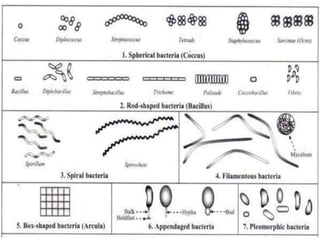
Classification of bacteria on the basis of shape
• In the year 1872 scientist Cohn classified
bacteria to 4 major types depending on their
shapes are as follows:
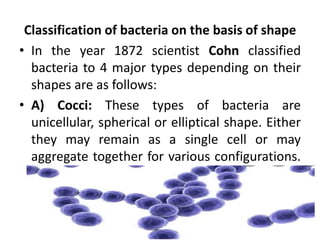
• A) Cocci: These types of bacteria are
unicellular, spherical or elliptical shape. Either
they may remain as a single cell or may
aggregate together for various configurations.
They are as follows:
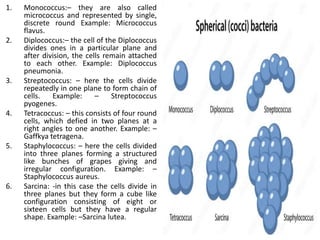
1. Monococcus:– they are also called
micrococcus and represented by single,
discrete round Example: Micrococcus
flavus.
2. Diplococcus:– the cell of the Diplococcus
divides ones in a particular plane and
after division, the cells remain attached
to each other. Example: Diplococcus
pneumonia.
3. Streptococcus: – here the cells divide
repeatedly in one plane to form chain of
cells. Example: – Streptococcus
pyogenes.
4. Tetracoccus: – this consists of four round
cells, which defied in two planes at a
right angles to one another. Example: –
Gaffkya tetragena.
5. Staphylococcus: – here the cells divided
into three planes forming a structured
like bunches of grapes giving and
irregular configuration. Example: –
Staphylococcus aureus.
6. Sarcina: -in this case the cells divide in
three planes but they form a cube like
configuration consisting of eight or
sixteen cells but they have a regular
shape. Example: –Sarcina lutea.
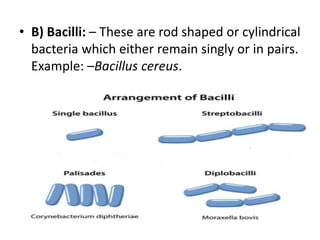
• B) Bacilli: – These are rod shaped or cylindrical
bacteria which either remain singly or in pairs.
Example: –Bacillus cereus.
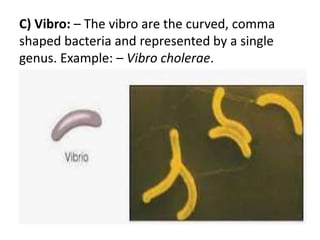
C) Vibro: – The vibro are the curved, comma
shaped bacteria and represented by a single
genus. Example: – Vibro cholerae.
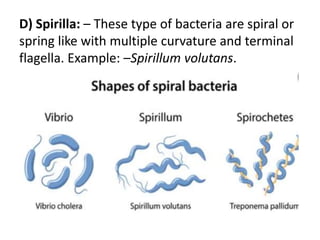
D) Spirilla: – These type of bacteria are spiral or
spring like with multiple curvature and terminal
flagella. Example: –Spirillum volutans.
• Others:-
• Actinomycetes are branching filamentous
bacteria,
• Mycoplasmas are bacteria that are cell wall
deficient and hence do not possess a stable
morphology.
Classification on the basis of Mode of Nutrition
• 1.Phototrophs:
• Those bacteria which gain energy from
light.
• Phototrops are further divided into two
groups on the basis of source of electron.
• Photolithotrophs: these bacteria gain
energy from light and uses reduced
inorganic compounds such as H2S as
electron source. Eg. Chromatium okenii.
• Photoorganotrophs: these bacteria gain
energy from light and uses organic
compounds such as succinate as electron
source.
• 2. Chemotrophs:
• Those bacteria gain energy from chemical compounds.
• They cannot carry out photosynthesis.
• Chemotrops are further divided into two groups on the basis of
source of electron.
• Chemolithotrophs: they gain energy from oxidation of chemical
compound and reduces inorganic compounds such as NH3 as
electron source. Eg. Nitrosomonas.
• Chemoorganotrophs: they gain energy from chemical
compounds and uses organic compound such as glucose and
amino acids as source of electron. eg. Pseudomonas
pseudoflava.
• 3. Autotrophs:
• Those bacteria which uses carbon di oxide as sole
source of carbon to prepare its own food.
• Autotrophs are divided into two types on the
basis of energy utilized to assimilate
carbondioxide. ie. Photoautotrophs and
chemoautotrophs.
• Photoautotrophs: they utilized light to assimilate
CO2. They are further divided into two group
on the basis of electron sources.
Ie. Photolithotropic autotrophs and
Photoorganotropic autotrophs
Chemoautotrophs: They utilize
chemical energy for assimilation of CO2.
• 4. Heterotrophs:
• Those bacteria which uses organic compound as carbon source.
• They lack the ability to fix CO2.
• Most of the human pathogenic bacteria are heterotropic in nature.
• Some heterotrops are simple, because they have simple nutritional
requirement. However there are some bacteria that require special
nutrients for their growth; known as fastidious heterotrophs.
Classification of bacteria on the basis of
temperature Requirement
• Bacteria can be classified into the following major types on the
basis of their temperatures response as indicated below:
• 1.Psychrophiles:
• Bacteria that can grow at 0°C or below but the optimum
temperature of growth is 15 °C or below and maximum
temperature is 20°C are called psychrophiles
Psychrophiles have
polyunsaturated fatty acids in their
cell membrane which gives fluid
nature to the cell membrane even
at lower temperature.
Examples: Vibrio psychroerythrus,
vibrio marinus, Polaromonas
vaculata, Psychroflexus.
• 2. Psychrotrops (facultative psychrophiles):
• Those bacteria that can grow even at 0°C but
optimum temperature for growth is (20-30)°C
• 3. Mesophiles:
• Those bacteria that can grow best between
(25-40)oC but optimum temperature for
growth is 37C
• Most of the human pathogens are mesophilic
in nature.
• Examples: E. coli, Salmonella, Klebsiella,
Staphylococci.
• 4. Thermophiles:
• Those bacteria that can best grow above 45C.
• Thermophiles capable of growing in mesophilic
range are called facultative thermophiles.
• True thermophiles are called as
Stenothermophiles, they are obligate
thermophiles,
Thermophils contains saturated
fattyacids in their cell membrane so
their cell membrane does not become
too fluid even at higher temperature.
Examples: Streptococcus
thermophiles, Bacillus
stearothermophilus, Thermus
aquaticus.
5. Hypethermophiles:
• Those bacteria that have optimum
temperature of growth above 80C.
Mostly Archeobacteria are
hyperthermophiles.
Monolayer cell membrane of
Archeobacteria is more
resistant to heat and they
adopt to grow in higher
remperature.
Examples:
Thermodesulfobacterium,
Aquifex, Pyrolobus fumari,
Thermotoga.
Classification of bacteria on the basis of
Oxygen Requirement
• Obligate Aerobes:
• Require oxygen to live.
• Example: Pseudomonas, common nosocomial pathogen.
• Facultative Anaerobes:
• Can use oxygen, but can grow in its absence.
• They have complex set of enzymes.
• Examples: E. coli, Staphylococcus, yeasts, and many
intestinal bacteria.
• Obligate Anaerobes:
• Cannot use oxygen and are harmed by the presence of
toxic forms of oxygen.
• Examples: Clostridium bacteria that cause tetanus and
botulism.
• Aerotolerant Anaerobes:
• Cannot use oxygen, but tolerate its presence.
• Can break down toxic forms of oxygen.
• Example: Lactobacillus carries out
fermentation regardless of oxygen presence.
• Microaerophiles:
• Require oxygen, but at low concentrations.
• Sensitive to toxic forms of oxygen.
• Example: Campylobacter.
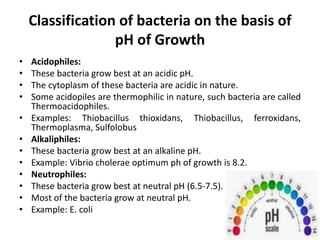
Classification of bacteria on the basis of
pH of Growth
• Acidophiles:
• These bacteria grow best at an acidic pH.
• The cytoplasm of these bacteria are acidic in nature.
• Some acidopiles are thermophilic in nature, such bacteria are called
Thermoacidophiles.
• Examples: Thiobacillus thioxidans, Thiobacillus, ferroxidans,
Thermoplasma, Sulfolobus
• Alkaliphiles:
• These bacteria grow best at an alkaline pH.
• Example: Vibrio cholerae optimum ph of growth is 8.2.
• Neutrophiles:
• These bacteria grow best at neutral pH (6.5-7.5).
• Most of the bacteria grow at neutral pH.
• Example: E. coli
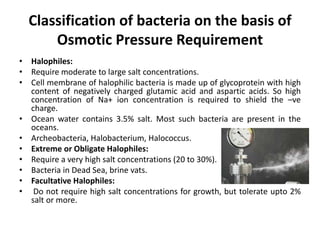
Classification of bacteria on the basis of
Osmotic Pressure Requirement
• Halophiles:
• Require moderate to large salt concentrations.
• Cell membrane of halophilic bacteria is made up of glycoprotein with high
content of negatively charged glutamic acid and aspartic acids. So high
concentration of Na+ ion concentration is required to shield the –ve
charge.
• Ocean water contains 3.5% salt. Most such bacteria are present in the
oceans.
• Archeobacteria, Halobacterium, Halococcus.
• Extreme or Obligate Halophiles:
• Require a very high salt concentrations (20 to 30%).
• Bacteria in Dead Sea, brine vats.
• Facultative Halophiles:
• Do not require high salt concentrations for growth, but tolerate upto 2%
salt or more.
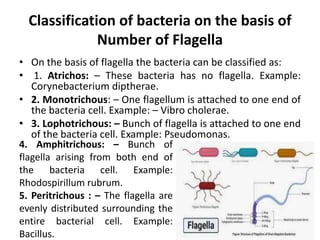
Classification of bacteria on the basis of
Number of Flagella
• On the basis of flagella the bacteria can be classified as:
• 1. Atrichos: – These bacteria has no flagella. Example:
Corynebacterium diptherae.
• 2. Monotrichous: – One flagellum is attached to one end of
the bacteria cell. Example: – Vibro cholerae.
• 3. Lophotrichous: – Bunch of flagella is attached to one end
of the bacteria cell. Example: Pseudomonas.
4. Amphitrichous: – Bunch of
flagella arising from both end of
the bacteria cell. Example:
Rhodospirillum rubrum.
5. Peritrichous : – The flagella are
evenly distributed surrounding the
entire bacterial cell. Example:
Bacillus.
Classification of bacteria on the basis of
Spore formation
• 1. Spore forming bacteria:
• Those bacteria that produce spore during
unfavorable condition.
• These are further divided into two groups:
• i) Endospore forming bacteria: Spore is produced
within the bacterial cell. Examples. Bacillus,
Clostridium, Sporosarcina etc
• ii) Exospore forming bacteria: Spore is produced
outside the cell. Example. Methylosinus 2. Non
sporing bacteria:
• Those bacteria which do not produce spores. Eg.
E. coli, Salmonella.
References
• Ananthanarayan and Paniker’s, Textbook of
microbiology, 7th edition.
• Ashutosh Kar, Pharmaceutical Microbiology,
New age International (P) Limited, Publishers.
• Hugo and Russell’s. Pharmaceutical
Microbiology, 8th edition, Wiley black well.
Sources to obtained matters:
• Slide share :
• https://www.slideshare.net/DrJITENDRAPATEL
1/edit_my_uploads?page=2
• YouTube channel link :
• https://youtube.com/playlist?list=PLlCSanxO4
a9FAn0akowMDInYs9uQApVQ1
Thank You

5. Classification of bacteria.pptx

  • 1.
    CLASSIFICATION OF BACTERIA BY Dr.Jitendra Patel Assistant Professor GSP, Hyderabad Campus, India.
  • 2.
    Classification of bacteriaon the basis of shape • In the year 1872 scientist Cohn classified bacteria to 4 major types depending on their shapes are as follows: • A) Cocci: These types of bacteria are unicellular, spherical or elliptical shape. Either they may remain as a single cell or may aggregate together for various configurations. They are as follows:
  • 3.
    1. Monococcus:– theyare also called micrococcus and represented by single, discrete round Example: Micrococcus flavus. 2. Diplococcus:– the cell of the Diplococcus divides ones in a particular plane and after division, the cells remain attached to each other. Example: Diplococcus pneumonia. 3. Streptococcus: – here the cells divide repeatedly in one plane to form chain of cells. Example: – Streptococcus pyogenes. 4. Tetracoccus: – this consists of four round cells, which defied in two planes at a right angles to one another. Example: – Gaffkya tetragena. 5. Staphylococcus: – here the cells divided into three planes forming a structured like bunches of grapes giving and irregular configuration. Example: – Staphylococcus aureus. 6. Sarcina: -in this case the cells divide in three planes but they form a cube like configuration consisting of eight or sixteen cells but they have a regular shape. Example: –Sarcina lutea.
  • 4.
    • B) Bacilli:– These are rod shaped or cylindrical bacteria which either remain singly or in pairs. Example: –Bacillus cereus.
  • 5.
    C) Vibro: –The vibro are the curved, comma shaped bacteria and represented by a single genus. Example: – Vibro cholerae.
  • 6.
    D) Spirilla: –These type of bacteria are spiral or spring like with multiple curvature and terminal flagella. Example: –Spirillum volutans.
  • 7.
    • Others:- • Actinomycetesare branching filamentous bacteria, • Mycoplasmas are bacteria that are cell wall deficient and hence do not possess a stable morphology.
  • 9.
    Classification on thebasis of Mode of Nutrition • 1.Phototrophs: • Those bacteria which gain energy from light. • Phototrops are further divided into two groups on the basis of source of electron. • Photolithotrophs: these bacteria gain energy from light and uses reduced inorganic compounds such as H2S as electron source. Eg. Chromatium okenii. • Photoorganotrophs: these bacteria gain energy from light and uses organic compounds such as succinate as electron source.
  • 10.
    • 2. Chemotrophs: •Those bacteria gain energy from chemical compounds. • They cannot carry out photosynthesis. • Chemotrops are further divided into two groups on the basis of source of electron. • Chemolithotrophs: they gain energy from oxidation of chemical compound and reduces inorganic compounds such as NH3 as electron source. Eg. Nitrosomonas. • Chemoorganotrophs: they gain energy from chemical compounds and uses organic compound such as glucose and amino acids as source of electron. eg. Pseudomonas pseudoflava.
  • 11.
    • 3. Autotrophs: •Those bacteria which uses carbon di oxide as sole source of carbon to prepare its own food. • Autotrophs are divided into two types on the basis of energy utilized to assimilate carbondioxide. ie. Photoautotrophs and chemoautotrophs. • Photoautotrophs: they utilized light to assimilate CO2. They are further divided into two group on the basis of electron sources. Ie. Photolithotropic autotrophs and Photoorganotropic autotrophs Chemoautotrophs: They utilize chemical energy for assimilation of CO2.
  • 12.
    • 4. Heterotrophs: •Those bacteria which uses organic compound as carbon source. • They lack the ability to fix CO2. • Most of the human pathogenic bacteria are heterotropic in nature. • Some heterotrops are simple, because they have simple nutritional requirement. However there are some bacteria that require special nutrients for their growth; known as fastidious heterotrophs.
  • 13.
    Classification of bacteriaon the basis of temperature Requirement • Bacteria can be classified into the following major types on the basis of their temperatures response as indicated below: • 1.Psychrophiles: • Bacteria that can grow at 0°C or below but the optimum temperature of growth is 15 °C or below and maximum temperature is 20°C are called psychrophiles Psychrophiles have polyunsaturated fatty acids in their cell membrane which gives fluid nature to the cell membrane even at lower temperature. Examples: Vibrio psychroerythrus, vibrio marinus, Polaromonas vaculata, Psychroflexus.
  • 14.
    • 2. Psychrotrops(facultative psychrophiles): • Those bacteria that can grow even at 0°C but optimum temperature for growth is (20-30)°C • 3. Mesophiles: • Those bacteria that can grow best between (25-40)oC but optimum temperature for growth is 37C • Most of the human pathogens are mesophilic in nature. • Examples: E. coli, Salmonella, Klebsiella, Staphylococci.
  • 15.
    • 4. Thermophiles: •Those bacteria that can best grow above 45C. • Thermophiles capable of growing in mesophilic range are called facultative thermophiles. • True thermophiles are called as Stenothermophiles, they are obligate thermophiles, Thermophils contains saturated fattyacids in their cell membrane so their cell membrane does not become too fluid even at higher temperature. Examples: Streptococcus thermophiles, Bacillus stearothermophilus, Thermus aquaticus.
  • 16.
    5. Hypethermophiles: • Thosebacteria that have optimum temperature of growth above 80C. Mostly Archeobacteria are hyperthermophiles. Monolayer cell membrane of Archeobacteria is more resistant to heat and they adopt to grow in higher remperature. Examples: Thermodesulfobacterium, Aquifex, Pyrolobus fumari, Thermotoga.
  • 17.
    Classification of bacteriaon the basis of Oxygen Requirement • Obligate Aerobes: • Require oxygen to live. • Example: Pseudomonas, common nosocomial pathogen. • Facultative Anaerobes: • Can use oxygen, but can grow in its absence. • They have complex set of enzymes. • Examples: E. coli, Staphylococcus, yeasts, and many intestinal bacteria. • Obligate Anaerobes: • Cannot use oxygen and are harmed by the presence of toxic forms of oxygen. • Examples: Clostridium bacteria that cause tetanus and botulism.
  • 18.
    • Aerotolerant Anaerobes: •Cannot use oxygen, but tolerate its presence. • Can break down toxic forms of oxygen. • Example: Lactobacillus carries out fermentation regardless of oxygen presence. • Microaerophiles: • Require oxygen, but at low concentrations. • Sensitive to toxic forms of oxygen. • Example: Campylobacter.
  • 19.
    Classification of bacteriaon the basis of pH of Growth • Acidophiles: • These bacteria grow best at an acidic pH. • The cytoplasm of these bacteria are acidic in nature. • Some acidopiles are thermophilic in nature, such bacteria are called Thermoacidophiles. • Examples: Thiobacillus thioxidans, Thiobacillus, ferroxidans, Thermoplasma, Sulfolobus • Alkaliphiles: • These bacteria grow best at an alkaline pH. • Example: Vibrio cholerae optimum ph of growth is 8.2. • Neutrophiles: • These bacteria grow best at neutral pH (6.5-7.5). • Most of the bacteria grow at neutral pH. • Example: E. coli
  • 20.
    Classification of bacteriaon the basis of Osmotic Pressure Requirement • Halophiles: • Require moderate to large salt concentrations. • Cell membrane of halophilic bacteria is made up of glycoprotein with high content of negatively charged glutamic acid and aspartic acids. So high concentration of Na+ ion concentration is required to shield the –ve charge. • Ocean water contains 3.5% salt. Most such bacteria are present in the oceans. • Archeobacteria, Halobacterium, Halococcus. • Extreme or Obligate Halophiles: • Require a very high salt concentrations (20 to 30%). • Bacteria in Dead Sea, brine vats. • Facultative Halophiles: • Do not require high salt concentrations for growth, but tolerate upto 2% salt or more.
  • 21.
    Classification of bacteriaon the basis of Number of Flagella • On the basis of flagella the bacteria can be classified as: • 1. Atrichos: – These bacteria has no flagella. Example: Corynebacterium diptherae. • 2. Monotrichous: – One flagellum is attached to one end of the bacteria cell. Example: – Vibro cholerae. • 3. Lophotrichous: – Bunch of flagella is attached to one end of the bacteria cell. Example: Pseudomonas. 4. Amphitrichous: – Bunch of flagella arising from both end of the bacteria cell. Example: Rhodospirillum rubrum. 5. Peritrichous : – The flagella are evenly distributed surrounding the entire bacterial cell. Example: Bacillus.
  • 22.
    Classification of bacteriaon the basis of Spore formation • 1. Spore forming bacteria: • Those bacteria that produce spore during unfavorable condition. • These are further divided into two groups: • i) Endospore forming bacteria: Spore is produced within the bacterial cell. Examples. Bacillus, Clostridium, Sporosarcina etc • ii) Exospore forming bacteria: Spore is produced outside the cell. Example. Methylosinus 2. Non sporing bacteria: • Those bacteria which do not produce spores. Eg. E. coli, Salmonella.
  • 23.
    References • Ananthanarayan andPaniker’s, Textbook of microbiology, 7th edition. • Ashutosh Kar, Pharmaceutical Microbiology, New age International (P) Limited, Publishers. • Hugo and Russell’s. Pharmaceutical Microbiology, 8th edition, Wiley black well.
  • 24.
    Sources to obtainedmatters: • Slide share : • https://www.slideshare.net/DrJITENDRAPATEL 1/edit_my_uploads?page=2 • YouTube channel link : • https://youtube.com/playlist?list=PLlCSanxO4 a9FAn0akowMDInYs9uQApVQ1
  • 25.