SEDATIVES
&
HYPNOTICS
-By Dr. Jayesh Vaghela
Overview
 Sleep cycle
 Introduction about Drug groups
 Classification : - BZDs
- Barbiturates
- Non-BZD hypnotics
- Atypical Anxiolytics
 Recent advances
07-Jul-14 2
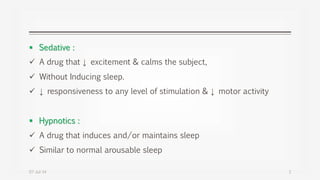
 Sedative :
 A drug that ↓ excitement & calms the subject,
 Without Inducing sleep.
 ↓ responsiveness to any level of stimulation & ↓ motor activity
 Hypnotics :
 A drug that induces and/or maintains sleep
 Similar to normal arousable sleep
07-Jul-14 3
History
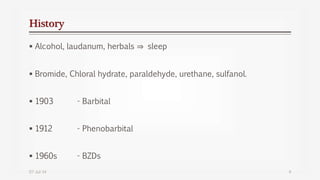
 Alcohol, laudanum, herbals ⇒ sleep
 Bromide, Chloral hydrate, paraldehyde, urethane, sulfanol.
 1903 - Barbital
 1912 - Phenobarbital
 1960s - BZDs
07-Jul-14 4
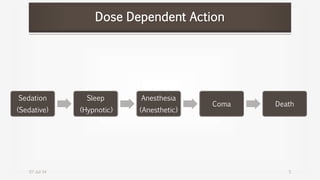
Dose Dependent Action
Sedation
(Sedative)
Sleep
(Hypnotic)
Anesthesia
(Anesthetic)
Coma Death
07-Jul-14 5
Sleep Cycle
07-Jul-14 6
07-Jul-14 7
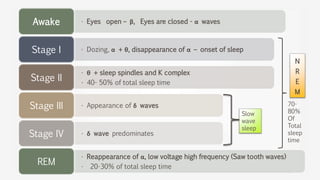
• Eyes open – β, Eyes are closed - α wavesAwake
• Dozing, α + θ, disappearance of α – onset of sleepStage I
• θ + sleep spindles and K complex
• 40- 50% of total sleep time
Stage II
• Appearance of δ wavesStage III
• δ wave predominatesStage IV
• Reappearance of α, low voltage high frequency (Saw tooth waves)
• 20-30% of total sleep time
REM
N
R
E
M
70-
80%
Of
Total
sleep
time
Slow
wave
sleep
BENZODIAZEPINES ( BZDs )
07-Jul-14 8
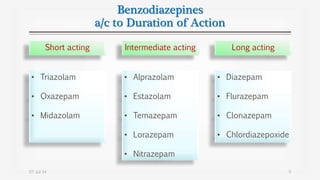
Benzodiazepines
a/c to Duration of Action
07-Jul-14 9
Short acting
• Triazolam
• Oxazepam
• Midazolam
Intermediate acting Long acting
• Alprazolam
• Estazolam
• Temazepam
• Lorazepam
• Nitrazepam
• Diazepam
• Flurazepam
• Clonazepam
• Chlordiazepoxide
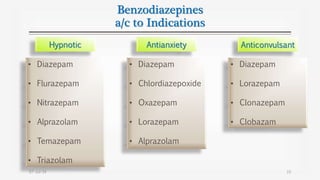
Benzodiazepines
a/c to Indications
07-Jul-14 10
Hypnotic Antianxiety Anticonvulsant
• Diazepam
• Flurazepam
• Nitrazepam
• Alprazolam
• Temazepam
• Triazolam
• Diazepam
• Chlordiazepoxide
• Oxazepam
• Lorazepam
• Alprazolam
• Diazepam
• Lorazepam
• Clonazepam
• Clobazam
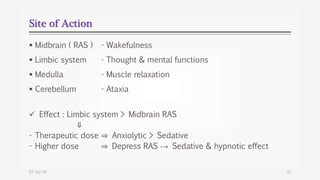
Site of Action
 Midbrain ( RAS ) - Wakefulness
 Limbic system - Thought & mental functions
 Medulla - Muscle relaxation
 Cerebellum - Ataxia
 Effect : Limbic system > Midbrain RAS
⇓
- Therapeutic dose ⇒ Anxiolytic > Sedative
- Higher dose ⇒ Depress RAS → Sedative & hypnotic effect
07-Jul-14 11
07-Jul-14 12
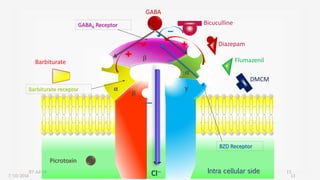
Mechanism of Action
α γ
α
β
GABA
Bicuculline
Diazepam
Intra cellular side
Flumazenil
DMCM
Barbiturate
GABAA Receptor
Barbiturate receptor
BZD Receptor
Cl--
Picrotoxin
7/10/2014 13
β
07-Jul-14 13
07-Jul-14 14
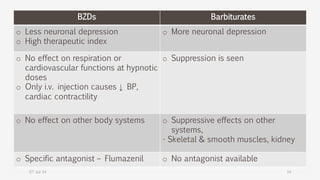
BZDs Barbiturates
o Less neuronal depression
o High therapeutic index
o More neuronal depression
o No effect on respiration or
cardiovascular functions at hypnotic
doses
o Only i.v. injection causes ↓ BP,
cardiac contractility
o Suppression is seen
o No effect on other body systems o Suppressive effects on other
systems,
- Skeletal & smooth muscles, kidney
o Specific antagonist – Flumazenil o No antagonist available
07-Jul-14 15
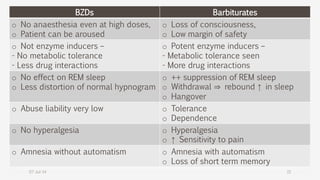
BZDs Barbiturates
o No anaesthesia even at high doses,
o Patient can be aroused
o Loss of consciousness,
o Low margin of safety
o Not enzyme inducers –
- No metabolic tolerance
- Less drug interactions
o Potent enzyme inducers –
- Metabolic tolerance seen
- More drug interactions
o No effect on REM sleep
o Less distortion of normal hypnogram
o ++ suppression of REM sleep
o Withdrawal ⇒ rebound ↑ in sleep
o Hangover
o Abuse liability very low o Tolerance
o Dependence
o No hyperalgesia o Hyperalgesia
o ↑ Sensitivity to pain
o Amnesia without automatism o Amnesia with automatism
o Loss of short term memory
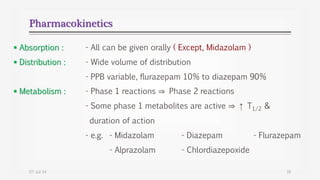
Pharmacokinetics
 Absorption : - All can be given orally ( Except, Midazolam )
 Distribution : - Wide volume of distribution
- PPB variable, flurazepam 10% to diazepam 90%
 Metabolism : - Phase 1 reactions ⇒ Phase 2 reactions
- Some phase 1 metabolites are active ⇒ ↑ T1/2 &
duration of action
- e.g. - Midazolam - Diazepam - Flurazepam
- Alprazolam - Chlordiazepoxide
07-Jul-14 16
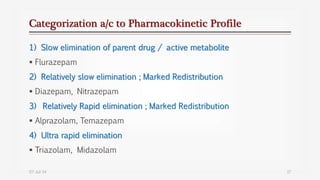
Categorization a/c to Pharmacokinetic Profile
1) Slow elimination of parent drug / active metabolite
 Flurazepam
2) Relatively slow elimination ; Marked Redistribution
 Diazepam, Nitrazepam
3) Relatively Rapid elimination ; Marked Redistribution
 Alprazolam, Temazepam
4) Ultra rapid elimination
 Triazolam, Midazolam
07-Jul-14 17
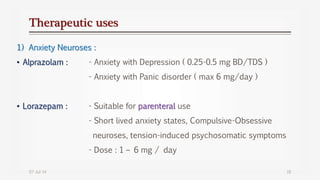
Therapeutic uses
1) Anxiety Neuroses :
• Alprazolam : - Anxiety with Depression ( 0.25-0.5 mg BD/TDS )
- Anxiety with Panic disorder ( max 6 mg/day )
• Lorazepam : - Suitable for parenteral use
- Short lived anxiety states, Compulsive-Obsessive
neuroses, tension-induced psychosomatic symptoms
- Dose : 1 – 6 mg / day
07-Jul-14 18
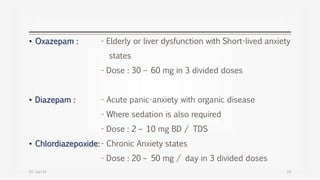
• Oxazepam : - Elderly or liver dysfunction with Short-lived anxiety
states
- Dose : 30 – 60 mg in 3 divided doses
• Diazepam : - Acute panic-anxiety with organic disease
- Where sedation is also required
- Dose : 2 – 10 mg BD / TDS
• Chlordiazepoxide:- Chronic Anxiety states
- Dose : 20 – 50 mg / day in 3 divided doses
07-Jul-14 19
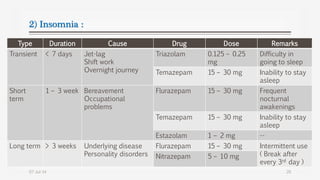
2) Insomnia :
Type Duration Cause Drug Dose Remarks
Transient < 7 days Jet-lag
Shift work
Overnight journey
Triazolam 0.125 – 0.25
mg
Difficulty in
going to sleep
Temazepam 15 – 30 mg Inability to stay
asleep
Short
term
1 – 3 week Bereavement
Occupational
problems
Flurazepam 15 – 30 mg Frequent
nocturnal
awakenings
Temazepam 15 – 30 mg Inability to stay
asleep
Estazolam 1 – 2 mg --
Long term > 3 weeks Underlying disease
Personality disorders
Flurazepam 15 – 30 mg Intermittent use
( Break after
every 3rd day )
Nitrazepam 5 – 10 mg
07-Jul-14 20
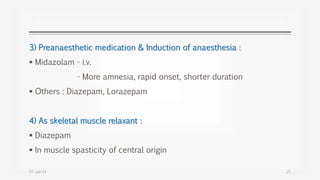
3) Preanaesthetic medication & Induction of anaesthesia :
 Midazolam - i.v.
- More amnesia, rapid onset, shorter duration
 Others : Diazepam, Lorazepam
4) As skeletal muscle relaxant :
 Diazepam
 In muscle spasticity of central origin
07-Jul-14 21
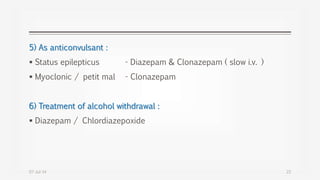
5) As anticonvulsant :
 Status epilepticus - Diazepam & Clonazepam ( slow i.v. )
 Myoclonic / petit mal - Clonazepam
6) Treatment of alcohol withdrawal :
 Diazepam / Chlordiazepoxide
07-Jul-14 22
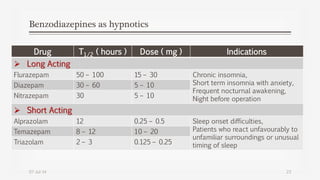
Benzodiazepines as hypnotics
07-Jul-14 23
Drug T1/2 ( hours ) Dose ( mg ) Indications
 Long Acting
Flurazepam 50 – 100 15 – 30 Chronic insomnia,
Short term insomnia with anxiety,
Frequent nocturnal awakening,
Night before operation
Diazepam 30 – 60 5 – 10
Nitrazepam 30 5 – 10
 Short Acting
Alprazolam 12 0.25 – 0.5 Sleep onset difficulties,
Patients who react unfavourably to
unfamiliar surroundings or unusual
timing of sleep
Temazepam 8 – 12 10 – 20
Triazolam 2 – 3 0.125 – 0.25
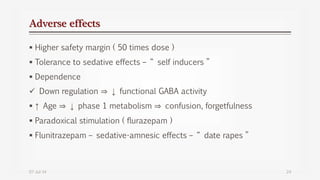
Adverse effects
 Higher safety margin ( 50 times dose )
 Tolerance to sedative effects – “ self inducers ”
 Dependence
 Down regulation ⇒ ↓ functional GABA activity
 ↑ Age ⇒ ↓ phase 1 metabolism ⇒ confusion, forgetfulness
 Paradoxical stimulation ( flurazepam )
 Flunitrazepam – sedative-amnesic effects – “ date rapes ”
07-Jul-14 24
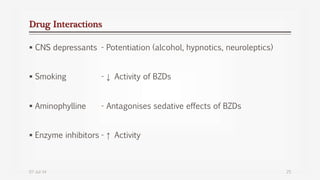
Drug Interactions
 CNS depressants - Potentiation (alcohol, hypnotics, neuroleptics)
 Smoking - ↓ Activity of BZDs
 Aminophylline - Antagonises sedative effects of BZDs
 Enzyme inhibitors - ↑ Activity
07-Jul-14 25
NON – BZD HYPNOTICS
( THE “ Z ” COMPOUNDS )
07-Jul-14 26
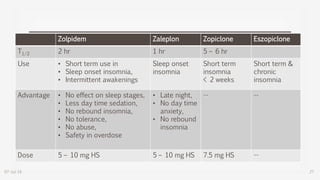
Zolpidem Zaleplon Zopiclone Eszopiclone
T1/2 2 hr 1 hr 5 – 6 hr
Use • Short term use in
• Sleep onset insomnia,
• Intermittent awakenings
Sleep onset
insomnia
Short term
insomnia
< 2 weeks
Short term &
chronic
insomnia
Advantage • No effect on sleep stages,
• Less day time sedation,
• No rebound insomnia,
• No tolerance,
• No abuse,
• Safety in overdose
• Late night,
• No day time
anxiety,
• No rebound
insomnia
-- --
Dose 5 – 10 mg HS 5 – 10 mg HS 7.5 mg HS --
07-Jul-14 27
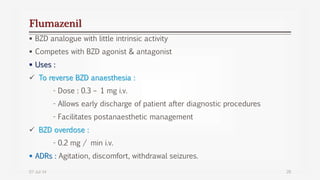
Flumazenil
 BZD analogue with little intrinsic activity
 Competes with BZD agonist & antagonist
 Uses :
 To reverse BZD anaesthesia :
- Dose : 0.3 – 1 mg i.v.
- Allows early discharge of patient after diagnostic procedures
- Facilitates postanaesthetic management
 BZD overdose :
- 0.2 mg / min i.v.
 ADRs : Agitation, discomfort, withdrawal seizures.
07-Jul-14 28
BARBITURATES
07-Jul-14 29
Barbiturates
07-Jul-14 30
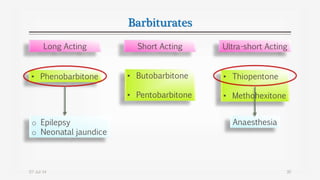
Long Acting Short Acting Ultra-short Acting
• Phenobarbitone • Butobarbitone
• Pentobarbitone
• Thiopentone
• Methohexitone
o Epilepsy
o Neonatal jaundice
Anaesthesia
Barbiturates
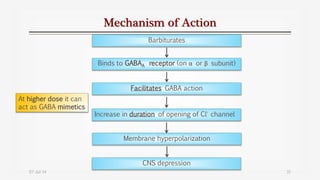
Binds to GABAA receptor (on α or β subunit)
Facilitates GABA action
Increase in duration of opening of Cl-
channel
Membrane hyperpolarization
CNS depression
At higher dose it can
act as GABA mimetics
Mechanism of Action
07-Jul-14 31
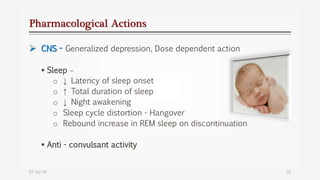
Pharmacological Actions
 CNS - Generalized depression, Dose dependent action
 Sleep –
o ↓ Latency of sleep onset
o ↑ Total duration of sleep
o ↓ Night awakening
o Sleep cycle distortion - Hangover
o Rebound increase in REM sleep on discontinuation
 Anti - convulsant activity
07-Jul-14 32
 RS :
 Depression of respiratory center
 CVS :
 Depression of VMC
 ↓ Myocardial contractility
 ↓ BP, HR
 Smooth muscles :
 ↓ tone & motility of bowel
 Kidney :
 ↓ Urine flow
07-Jul-14 33
Adverse effects
 Hangover
 Hypersensitivity
 Tolerance & Dependence ( Abuse potential )
 Poisoning ⇒ No Antidote, Only Symptomatic Treatment
07-Jul-14 34
Interactions
 Enzyme inducers - ↑ Metabolism, ↓ Effectiveness
- Steroids, Warfarin
 CNS depressants - Additive action
 Sod. Valproate - ↑ Concentration of phenobarbitone
 Phenytoin - Induction & Inhibition by phenobarbitone
07-Jul-14 35
Atypical Anxiolytics
07-Jul-14 36
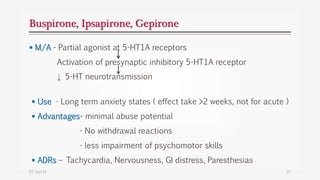
Buspirone, Ipsapirone, Gepirone
 M/A - Partial agonist at 5-HT1A receptors
Activation of presynaptic inhibitory 5-HT1A receptor
↓ 5-HT neurotransmission
07-Jul-14 37
 Use - Long term anxiety states ( effect take >2 weeks, not for acute )
 Advantages- minimal abuse potential
- No withdrawal reactions
- less impairment of psychomotor skills
 ADRs – Tachycardia, Nervousness, GI distress, Paresthesias
Beta Adrenoceptor Antagonist
 Worrying situations & Apprehensions ( job interview, exam, etc. )
Palpitation, tremors, GI upset.
Reinforce anxiety
 Propranolol 20 mg TDS breaks the vicious cycle
 CVS effects ⇒ Unlikely to be used as anxiolytic
07-Jul-14 38
Melatonin
 Pineal gland hormone
 Affects sleep – wake cycle
 Darkness ⇒ Melatonin ⇒ MT1 MT2 receptors in SCN ⇒ Circadian
rhythm
 Use - Jet-lag insomnia
 Dose: 3 mg 2 hour before bed time
07-Jul-14 39
Ramelteon
 MT1 & MT2 receptor agonist
 Use - Sleep onset insomnia
- Speeds sleep onset
- Longer duration of sleep
 Adv. - No dependence
- No rebound insomnia
 Dose- 8 mg ½ hour before going to sleep
07-Jul-14 40
Tasimelteon
 MT 1 & MT 2 receptor agonist
 Recently approved by USFDA in Jan – 2014
 Use - Non 24-hour sleep wake disorder in totally blind
 ADR - Headache, Nightmares.
07-Jul-14 41
References
 Catterall AW and Mackie K. Sedatives & Hypnotics. In : Bruton LL,
editor. Goodman & Gilman’s – The Pharmacological basis of
therapeutics. 12th edition. New York : Mc Graw Hill Publication; 2011.
p. 566-82.
 Schulman JM and Strichartz GR. Neurotransmission in central nervous
system. In: Golan DE, editor. Principles of Pharmacology – The
pathophysiological basis of drug therapy. 3rd edition. New Delhi:
Walters Kluwer Publication; 2012. p. 147-62.
07-Jul-14 42
 Tripathi KD. Essentials of Medical Pharmacology. 6th ed. New Delhi :
Jaypee brothers medical publishers; 2009. p. 360-71.
 Sharma HL & Sharma KK. Principles of Pharmacology. 2nd ed. New
Delhi: Paras publication; 2012. p. 212-22.
 Shrivastava SK. A complete textbook of medical pharmacology. 1st
ed. New Delhi: Avichal publication; 2012. p. 552-67.
07-Jul-14 43
07-Jul-14 44

Sedatives & hypnotics Dr Jayesh Vaghela

  • 1.
  • 2.
    Overview  Sleep cycle Introduction about Drug groups  Classification : - BZDs - Barbiturates - Non-BZD hypnotics - Atypical Anxiolytics  Recent advances 07-Jul-14 2
  • 3.
     Sedative : A drug that ↓ excitement & calms the subject,  Without Inducing sleep.  ↓ responsiveness to any level of stimulation & ↓ motor activity  Hypnotics :  A drug that induces and/or maintains sleep  Similar to normal arousable sleep 07-Jul-14 3
  • 4.
    History  Alcohol, laudanum,herbals ⇒ sleep  Bromide, Chloral hydrate, paraldehyde, urethane, sulfanol.  1903 - Barbital  1912 - Phenobarbital  1960s - BZDs 07-Jul-14 4
  • 5.
  • 6.
  • 7.
    07-Jul-14 7 • Eyesopen – β, Eyes are closed - α wavesAwake • Dozing, α + θ, disappearance of α – onset of sleepStage I • θ + sleep spindles and K complex • 40- 50% of total sleep time Stage II • Appearance of δ wavesStage III • δ wave predominatesStage IV • Reappearance of α, low voltage high frequency (Saw tooth waves) • 20-30% of total sleep time REM N R E M 70- 80% Of Total sleep time Slow wave sleep
  • 8.
  • 9.
    Benzodiazepines a/c to Durationof Action 07-Jul-14 9 Short acting • Triazolam • Oxazepam • Midazolam Intermediate acting Long acting • Alprazolam • Estazolam • Temazepam • Lorazepam • Nitrazepam • Diazepam • Flurazepam • Clonazepam • Chlordiazepoxide
  • 10.
    Benzodiazepines a/c to Indications 07-Jul-1410 Hypnotic Antianxiety Anticonvulsant • Diazepam • Flurazepam • Nitrazepam • Alprazolam • Temazepam • Triazolam • Diazepam • Chlordiazepoxide • Oxazepam • Lorazepam • Alprazolam • Diazepam • Lorazepam • Clonazepam • Clobazam
  • 11.
    Site of Action Midbrain ( RAS ) - Wakefulness  Limbic system - Thought & mental functions  Medulla - Muscle relaxation  Cerebellum - Ataxia  Effect : Limbic system > Midbrain RAS ⇓ - Therapeutic dose ⇒ Anxiolytic > Sedative - Higher dose ⇒ Depress RAS → Sedative & hypnotic effect 07-Jul-14 11
  • 12.
  • 13.
    α γ α β GABA Bicuculline Diazepam Intra cellularside Flumazenil DMCM Barbiturate GABAA Receptor Barbiturate receptor BZD Receptor Cl-- Picrotoxin 7/10/2014 13 β 07-Jul-14 13
  • 14.
    07-Jul-14 14 BZDs Barbiturates oLess neuronal depression o High therapeutic index o More neuronal depression o No effect on respiration or cardiovascular functions at hypnotic doses o Only i.v. injection causes ↓ BP, cardiac contractility o Suppression is seen o No effect on other body systems o Suppressive effects on other systems, - Skeletal & smooth muscles, kidney o Specific antagonist – Flumazenil o No antagonist available
  • 15.
    07-Jul-14 15 BZDs Barbiturates oNo anaesthesia even at high doses, o Patient can be aroused o Loss of consciousness, o Low margin of safety o Not enzyme inducers – - No metabolic tolerance - Less drug interactions o Potent enzyme inducers – - Metabolic tolerance seen - More drug interactions o No effect on REM sleep o Less distortion of normal hypnogram o ++ suppression of REM sleep o Withdrawal ⇒ rebound ↑ in sleep o Hangover o Abuse liability very low o Tolerance o Dependence o No hyperalgesia o Hyperalgesia o ↑ Sensitivity to pain o Amnesia without automatism o Amnesia with automatism o Loss of short term memory
  • 16.
    Pharmacokinetics  Absorption :- All can be given orally ( Except, Midazolam )  Distribution : - Wide volume of distribution - PPB variable, flurazepam 10% to diazepam 90%  Metabolism : - Phase 1 reactions ⇒ Phase 2 reactions - Some phase 1 metabolites are active ⇒ ↑ T1/2 & duration of action - e.g. - Midazolam - Diazepam - Flurazepam - Alprazolam - Chlordiazepoxide 07-Jul-14 16
  • 17.
    Categorization a/c toPharmacokinetic Profile 1) Slow elimination of parent drug / active metabolite  Flurazepam 2) Relatively slow elimination ; Marked Redistribution  Diazepam, Nitrazepam 3) Relatively Rapid elimination ; Marked Redistribution  Alprazolam, Temazepam 4) Ultra rapid elimination  Triazolam, Midazolam 07-Jul-14 17
  • 18.
    Therapeutic uses 1) AnxietyNeuroses : • Alprazolam : - Anxiety with Depression ( 0.25-0.5 mg BD/TDS ) - Anxiety with Panic disorder ( max 6 mg/day ) • Lorazepam : - Suitable for parenteral use - Short lived anxiety states, Compulsive-Obsessive neuroses, tension-induced psychosomatic symptoms - Dose : 1 – 6 mg / day 07-Jul-14 18
  • 19.
    • Oxazepam :- Elderly or liver dysfunction with Short-lived anxiety states - Dose : 30 – 60 mg in 3 divided doses • Diazepam : - Acute panic-anxiety with organic disease - Where sedation is also required - Dose : 2 – 10 mg BD / TDS • Chlordiazepoxide:- Chronic Anxiety states - Dose : 20 – 50 mg / day in 3 divided doses 07-Jul-14 19
  • 20.
    2) Insomnia : TypeDuration Cause Drug Dose Remarks Transient < 7 days Jet-lag Shift work Overnight journey Triazolam 0.125 – 0.25 mg Difficulty in going to sleep Temazepam 15 – 30 mg Inability to stay asleep Short term 1 – 3 week Bereavement Occupational problems Flurazepam 15 – 30 mg Frequent nocturnal awakenings Temazepam 15 – 30 mg Inability to stay asleep Estazolam 1 – 2 mg -- Long term > 3 weeks Underlying disease Personality disorders Flurazepam 15 – 30 mg Intermittent use ( Break after every 3rd day ) Nitrazepam 5 – 10 mg 07-Jul-14 20
  • 21.
    3) Preanaesthetic medication& Induction of anaesthesia :  Midazolam - i.v. - More amnesia, rapid onset, shorter duration  Others : Diazepam, Lorazepam 4) As skeletal muscle relaxant :  Diazepam  In muscle spasticity of central origin 07-Jul-14 21
  • 22.
    5) As anticonvulsant:  Status epilepticus - Diazepam & Clonazepam ( slow i.v. )  Myoclonic / petit mal - Clonazepam 6) Treatment of alcohol withdrawal :  Diazepam / Chlordiazepoxide 07-Jul-14 22
  • 23.
    Benzodiazepines as hypnotics 07-Jul-1423 Drug T1/2 ( hours ) Dose ( mg ) Indications  Long Acting Flurazepam 50 – 100 15 – 30 Chronic insomnia, Short term insomnia with anxiety, Frequent nocturnal awakening, Night before operation Diazepam 30 – 60 5 – 10 Nitrazepam 30 5 – 10  Short Acting Alprazolam 12 0.25 – 0.5 Sleep onset difficulties, Patients who react unfavourably to unfamiliar surroundings or unusual timing of sleep Temazepam 8 – 12 10 – 20 Triazolam 2 – 3 0.125 – 0.25
  • 24.
    Adverse effects  Highersafety margin ( 50 times dose )  Tolerance to sedative effects – “ self inducers ”  Dependence  Down regulation ⇒ ↓ functional GABA activity  ↑ Age ⇒ ↓ phase 1 metabolism ⇒ confusion, forgetfulness  Paradoxical stimulation ( flurazepam )  Flunitrazepam – sedative-amnesic effects – “ date rapes ” 07-Jul-14 24
  • 25.
    Drug Interactions  CNSdepressants - Potentiation (alcohol, hypnotics, neuroleptics)  Smoking - ↓ Activity of BZDs  Aminophylline - Antagonises sedative effects of BZDs  Enzyme inhibitors - ↑ Activity 07-Jul-14 25
  • 26.
    NON – BZDHYPNOTICS ( THE “ Z ” COMPOUNDS ) 07-Jul-14 26
  • 27.
    Zolpidem Zaleplon ZopicloneEszopiclone T1/2 2 hr 1 hr 5 – 6 hr Use • Short term use in • Sleep onset insomnia, • Intermittent awakenings Sleep onset insomnia Short term insomnia < 2 weeks Short term & chronic insomnia Advantage • No effect on sleep stages, • Less day time sedation, • No rebound insomnia, • No tolerance, • No abuse, • Safety in overdose • Late night, • No day time anxiety, • No rebound insomnia -- -- Dose 5 – 10 mg HS 5 – 10 mg HS 7.5 mg HS -- 07-Jul-14 27
  • 28.
    Flumazenil  BZD analoguewith little intrinsic activity  Competes with BZD agonist & antagonist  Uses :  To reverse BZD anaesthesia : - Dose : 0.3 – 1 mg i.v. - Allows early discharge of patient after diagnostic procedures - Facilitates postanaesthetic management  BZD overdose : - 0.2 mg / min i.v.  ADRs : Agitation, discomfort, withdrawal seizures. 07-Jul-14 28
  • 29.
  • 30.
    Barbiturates 07-Jul-14 30 Long ActingShort Acting Ultra-short Acting • Phenobarbitone • Butobarbitone • Pentobarbitone • Thiopentone • Methohexitone o Epilepsy o Neonatal jaundice Anaesthesia
  • 31.
    Barbiturates Binds to GABAAreceptor (on α or β subunit) Facilitates GABA action Increase in duration of opening of Cl- channel Membrane hyperpolarization CNS depression At higher dose it can act as GABA mimetics Mechanism of Action 07-Jul-14 31
  • 32.
    Pharmacological Actions  CNS- Generalized depression, Dose dependent action  Sleep – o ↓ Latency of sleep onset o ↑ Total duration of sleep o ↓ Night awakening o Sleep cycle distortion - Hangover o Rebound increase in REM sleep on discontinuation  Anti - convulsant activity 07-Jul-14 32
  • 33.
     RS : Depression of respiratory center  CVS :  Depression of VMC  ↓ Myocardial contractility  ↓ BP, HR  Smooth muscles :  ↓ tone & motility of bowel  Kidney :  ↓ Urine flow 07-Jul-14 33
  • 34.
    Adverse effects  Hangover Hypersensitivity  Tolerance & Dependence ( Abuse potential )  Poisoning ⇒ No Antidote, Only Symptomatic Treatment 07-Jul-14 34
  • 35.
    Interactions  Enzyme inducers- ↑ Metabolism, ↓ Effectiveness - Steroids, Warfarin  CNS depressants - Additive action  Sod. Valproate - ↑ Concentration of phenobarbitone  Phenytoin - Induction & Inhibition by phenobarbitone 07-Jul-14 35
  • 36.
  • 37.
    Buspirone, Ipsapirone, Gepirone M/A - Partial agonist at 5-HT1A receptors Activation of presynaptic inhibitory 5-HT1A receptor ↓ 5-HT neurotransmission 07-Jul-14 37  Use - Long term anxiety states ( effect take >2 weeks, not for acute )  Advantages- minimal abuse potential - No withdrawal reactions - less impairment of psychomotor skills  ADRs – Tachycardia, Nervousness, GI distress, Paresthesias
  • 38.
    Beta Adrenoceptor Antagonist Worrying situations & Apprehensions ( job interview, exam, etc. ) Palpitation, tremors, GI upset. Reinforce anxiety  Propranolol 20 mg TDS breaks the vicious cycle  CVS effects ⇒ Unlikely to be used as anxiolytic 07-Jul-14 38
  • 39.
    Melatonin  Pineal glandhormone  Affects sleep – wake cycle  Darkness ⇒ Melatonin ⇒ MT1 MT2 receptors in SCN ⇒ Circadian rhythm  Use - Jet-lag insomnia  Dose: 3 mg 2 hour before bed time 07-Jul-14 39
  • 40.
    Ramelteon  MT1 &MT2 receptor agonist  Use - Sleep onset insomnia - Speeds sleep onset - Longer duration of sleep  Adv. - No dependence - No rebound insomnia  Dose- 8 mg ½ hour before going to sleep 07-Jul-14 40
  • 41.
    Tasimelteon  MT 1& MT 2 receptor agonist  Recently approved by USFDA in Jan – 2014  Use - Non 24-hour sleep wake disorder in totally blind  ADR - Headache, Nightmares. 07-Jul-14 41
  • 42.
    References  Catterall AWand Mackie K. Sedatives & Hypnotics. In : Bruton LL, editor. Goodman & Gilman’s – The Pharmacological basis of therapeutics. 12th edition. New York : Mc Graw Hill Publication; 2011. p. 566-82.  Schulman JM and Strichartz GR. Neurotransmission in central nervous system. In: Golan DE, editor. Principles of Pharmacology – The pathophysiological basis of drug therapy. 3rd edition. New Delhi: Walters Kluwer Publication; 2012. p. 147-62. 07-Jul-14 42
  • 43.
     Tripathi KD.Essentials of Medical Pharmacology. 6th ed. New Delhi : Jaypee brothers medical publishers; 2009. p. 360-71.  Sharma HL & Sharma KK. Principles of Pharmacology. 2nd ed. New Delhi: Paras publication; 2012. p. 212-22.  Shrivastava SK. A complete textbook of medical pharmacology. 1st ed. New Delhi: Avichal publication; 2012. p. 552-67. 07-Jul-14 43
  • 44.

Editor's Notes

  • #6 There is no clear cut demarcation for sedatives and hypnotics
  • #28 Disadvantage of zopiclone – bitter taste, dry mouth, psychological disturbances, impaired judgement