BASIC RESEARCH WRITING
FOR TEACHERS & STUDENTS
Verse of the Day
The Institutional Research Format of LOA
• The Lyceum of Alabang follows the format set by the
American Psychological Association (APA).
• However, there were some modifications
incorporated to establish the identification of the
institution, but in general, the APA format still
applies.
General Guidelines
• Use standard-sized paper (8.5 x 11).
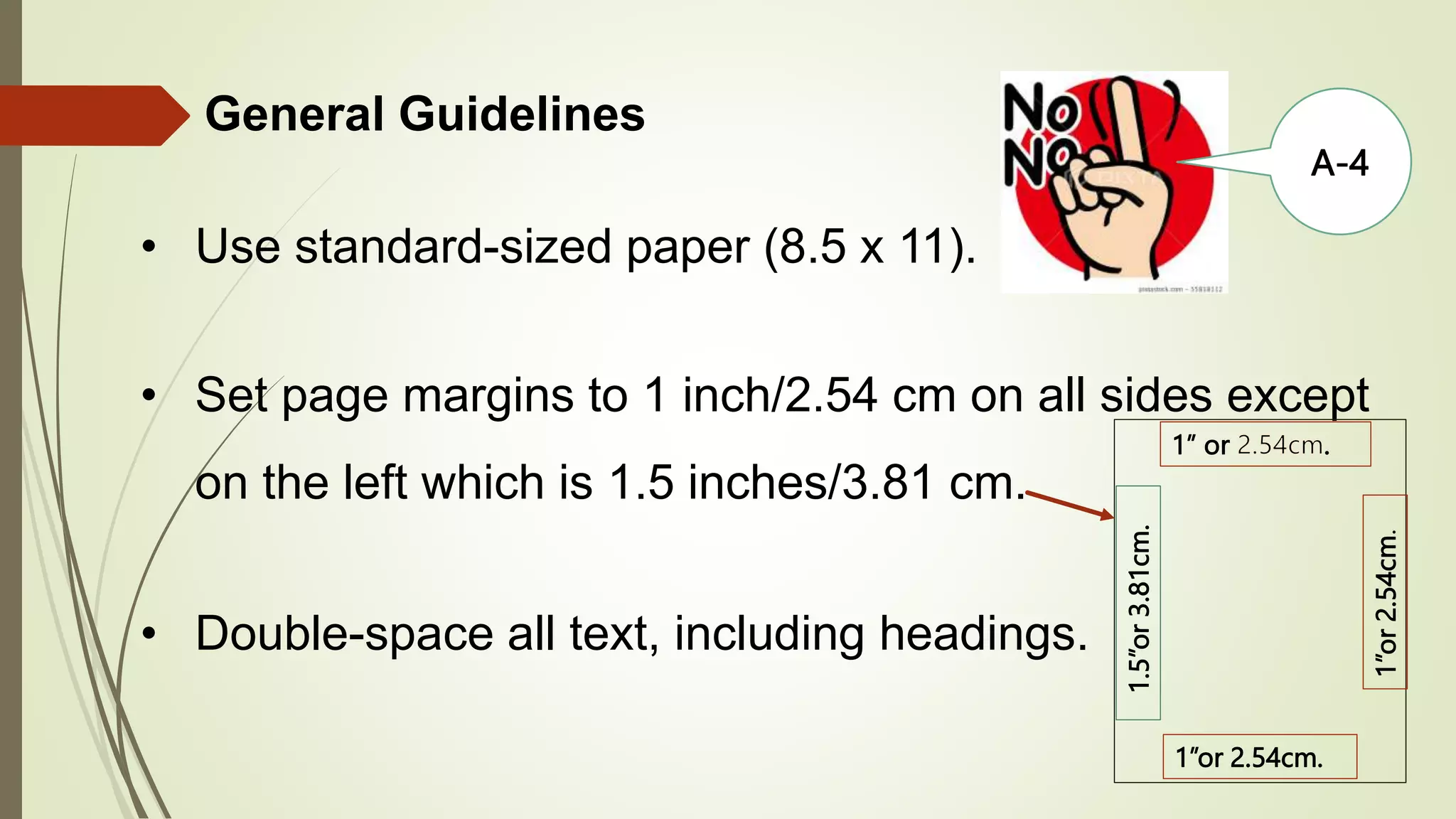
• Set page margins to 1 inch/2.54 cm on all sides except
on the left which is 1.5 inches/3.81 cm.
• Double-space all text, including headings.
A-4
1” or .
1”or 2.54cm.
1”or
2.54cm.
1.5”or
3.81cm.
• Indent the first line of every paragraph 0.5 inches.
A. General Guidelines
• APA recommends the researcher to use: sans serif
fonts such as 11-point Calibri, 11-point Arial, or 10-
point Lucida Sans Unicode, or serif fonts such as 12-
point Times New Roman, 11-point Georgia, or normal
(10-point) Computer Modern (the default font for
LaTeX).
For uniformity, LOA applies the 12-point Arial all
throughout the paper.
• Researchers should avoid the use of color except
when it is necessary for understanding the material.
A. General Guidelines
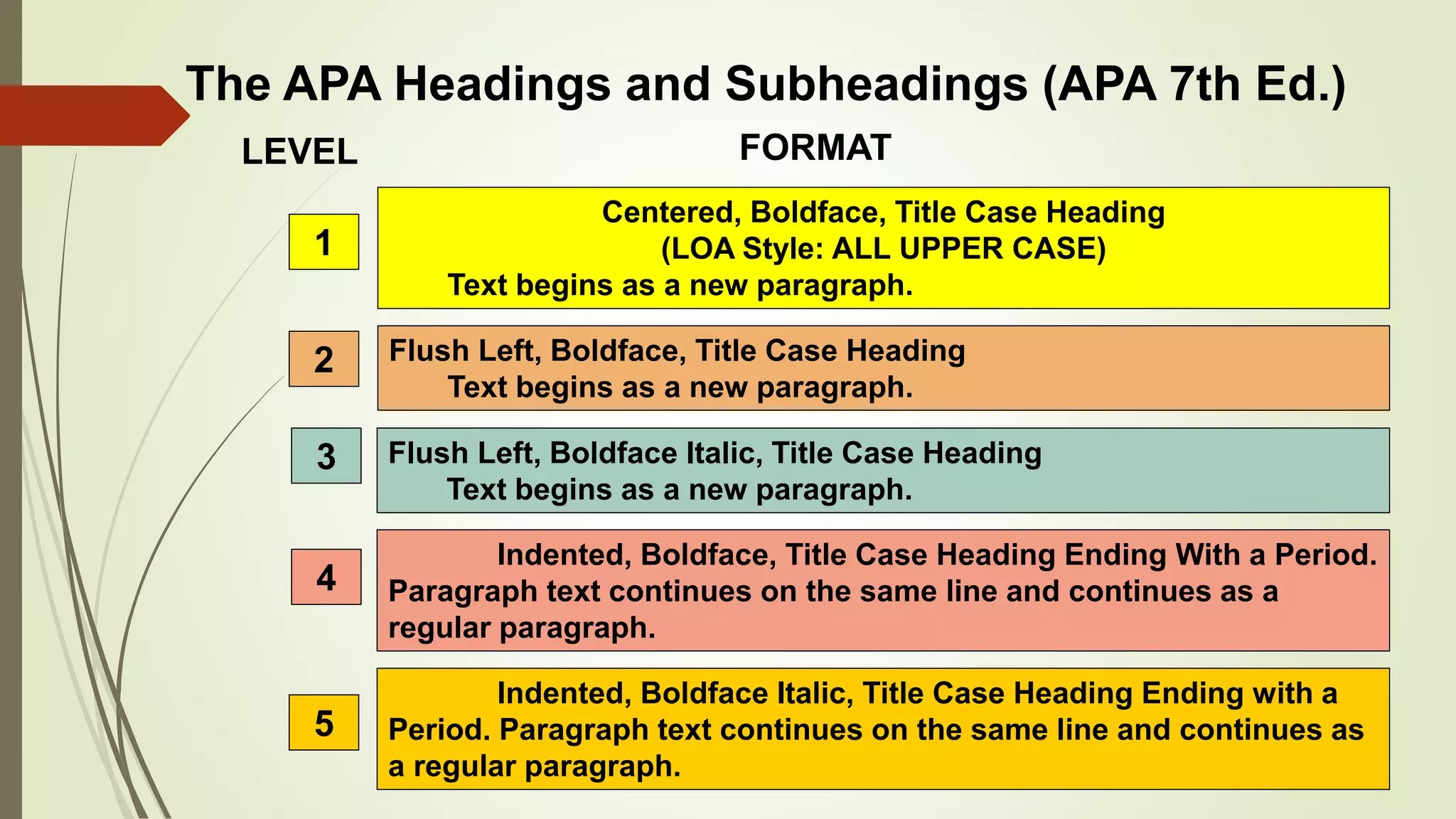
The APA Headings and Subheadings (APA 7th Ed.)
1
LEVEL FORMAT
Centered, Boldface, Title Case Heading
(LOA Style: ALL UPPER CASE)
Text begins as a new paragraph.
Flush Left, Boldface, Title Case Heading
Text begins as a new paragraph.
Flush Left, Boldface Italic, Title Case Heading
Text begins as a new paragraph.
Indented, Boldface, Title Case Heading Ending With a Period.
Paragraph text continues on the same line and continues as a
regular paragraph.
Indented, Boldface Italic, Title Case Heading Ending with a
Period. Paragraph text continues on the same line and continues as
a regular paragraph.
2
3
4
5
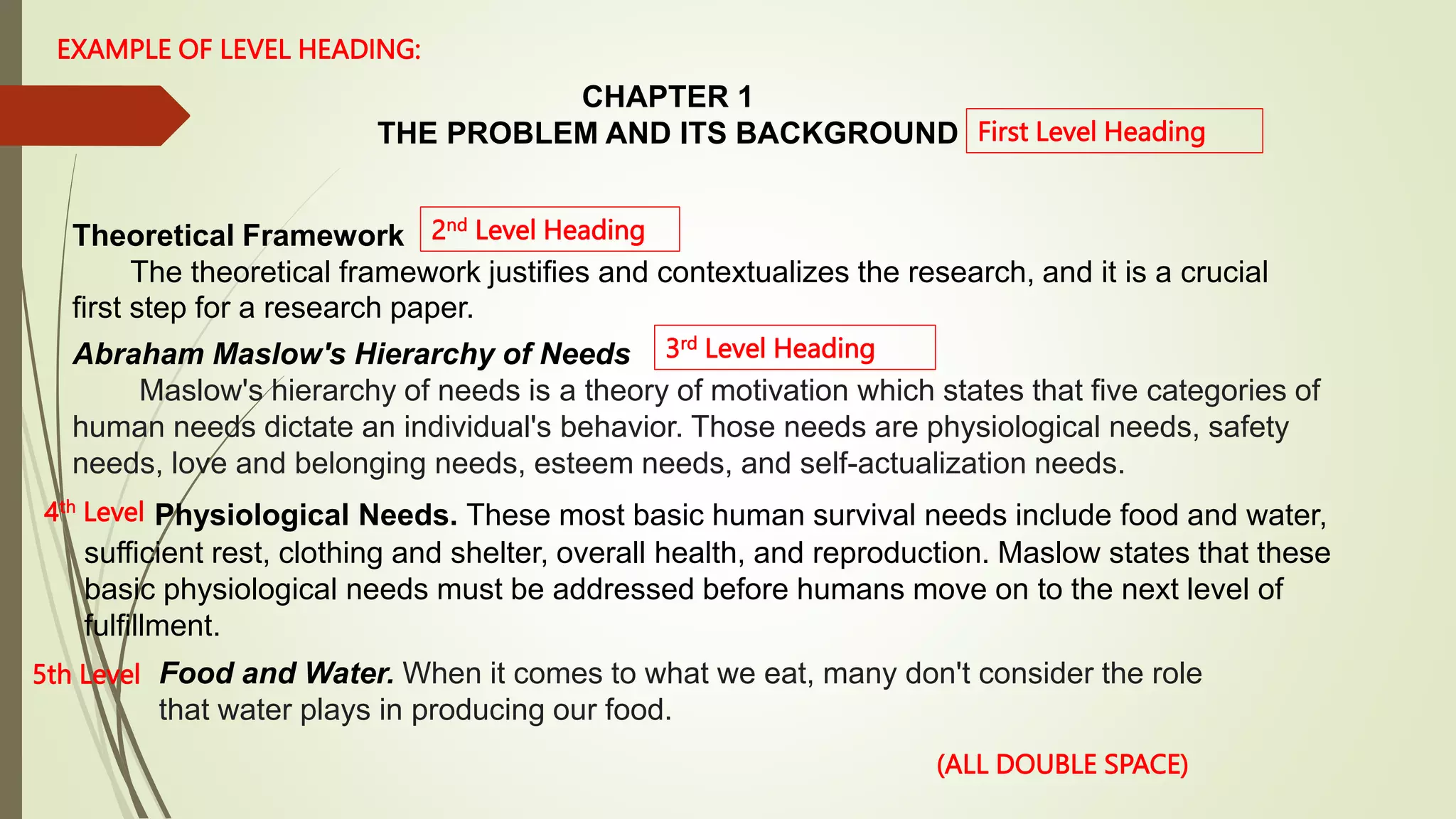
CHAPTER 1
THE PROBLEM AND ITS BACKGROUND
Theoretical Framework
The theoretical framework justifies and contextualizes the research, and it is a crucial
first step for a research paper.
Abraham Maslow's Hierarchy of Needs
Maslow's hierarchy of needs is a theory of motivation which states that five categories of
human needs dictate an individual's behavior. Those needs are physiological needs, safety
needs, love and belonging needs, esteem needs, and self-actualization needs.
Physiological Needs. These most basic human survival needs include food and water,
sufficient rest, clothing and shelter, overall health, and reproduction. Maslow states that these
basic physiological needs must be addressed before humans move on to the next level of
fulfillment.
First Level Heading
2nd Level Heading
3rd Level Heading
EXAMPLE OF LEVEL HEADING:
4th Level
5th Level Food and Water. When it comes to what we eat, many don't consider the role
that water plays in producing our food.
(ALL DOUBLE SPACE)
In-Text Citation
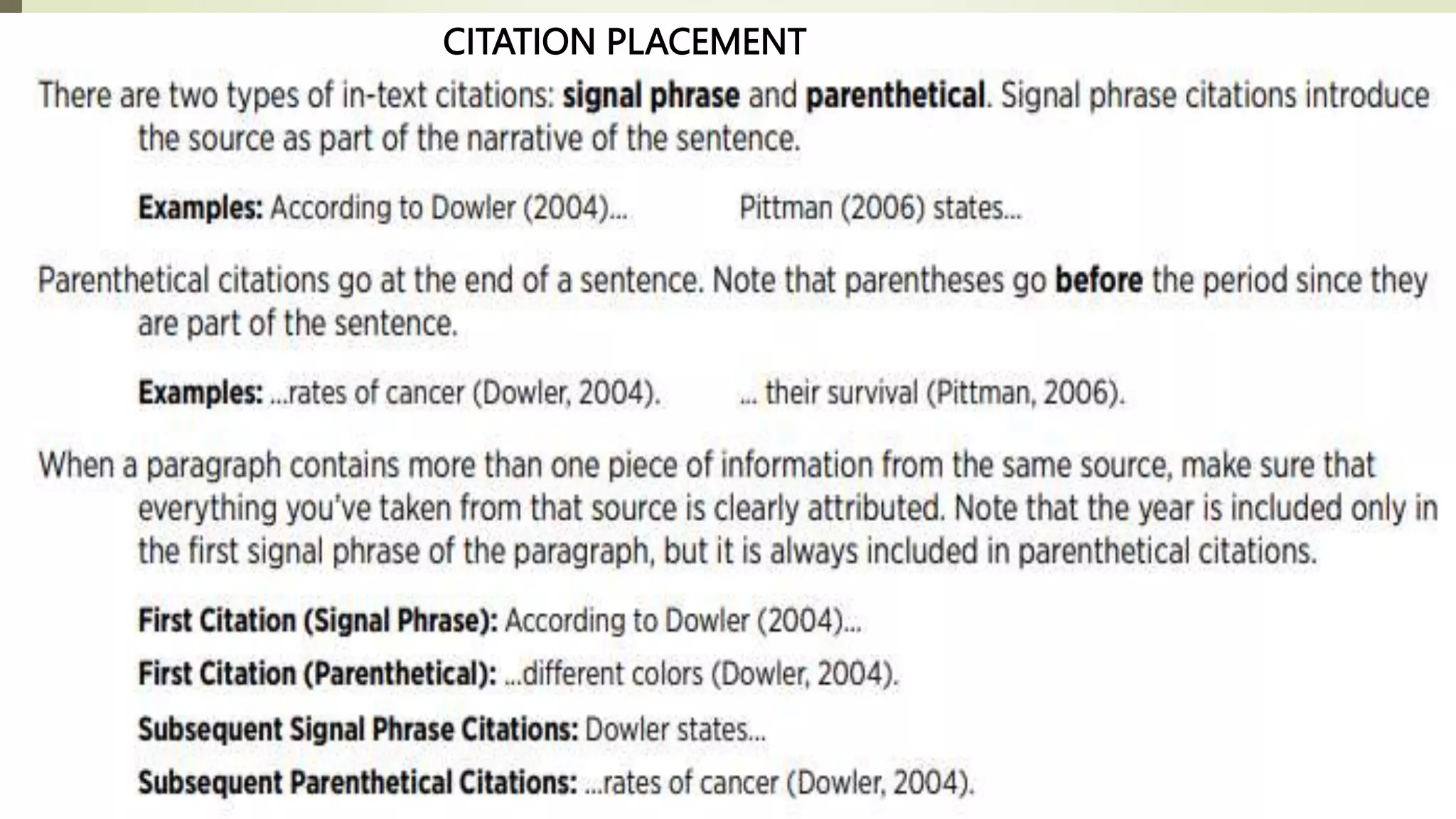
When you are writing a paper in APA style, you cite other
works (articles, books, etc.) using the author-date citation
method. By naming the author and the date of the work you are
citing in your in-text citation, you're helping the reader find the
work in your reference list at the end of your paper.
A primary source reports original content; a secondary source
refers to content first reported in another source. Cite secondary
sources sparingly (8.6 APA 7th Ed).
CITATION PLACEMENT
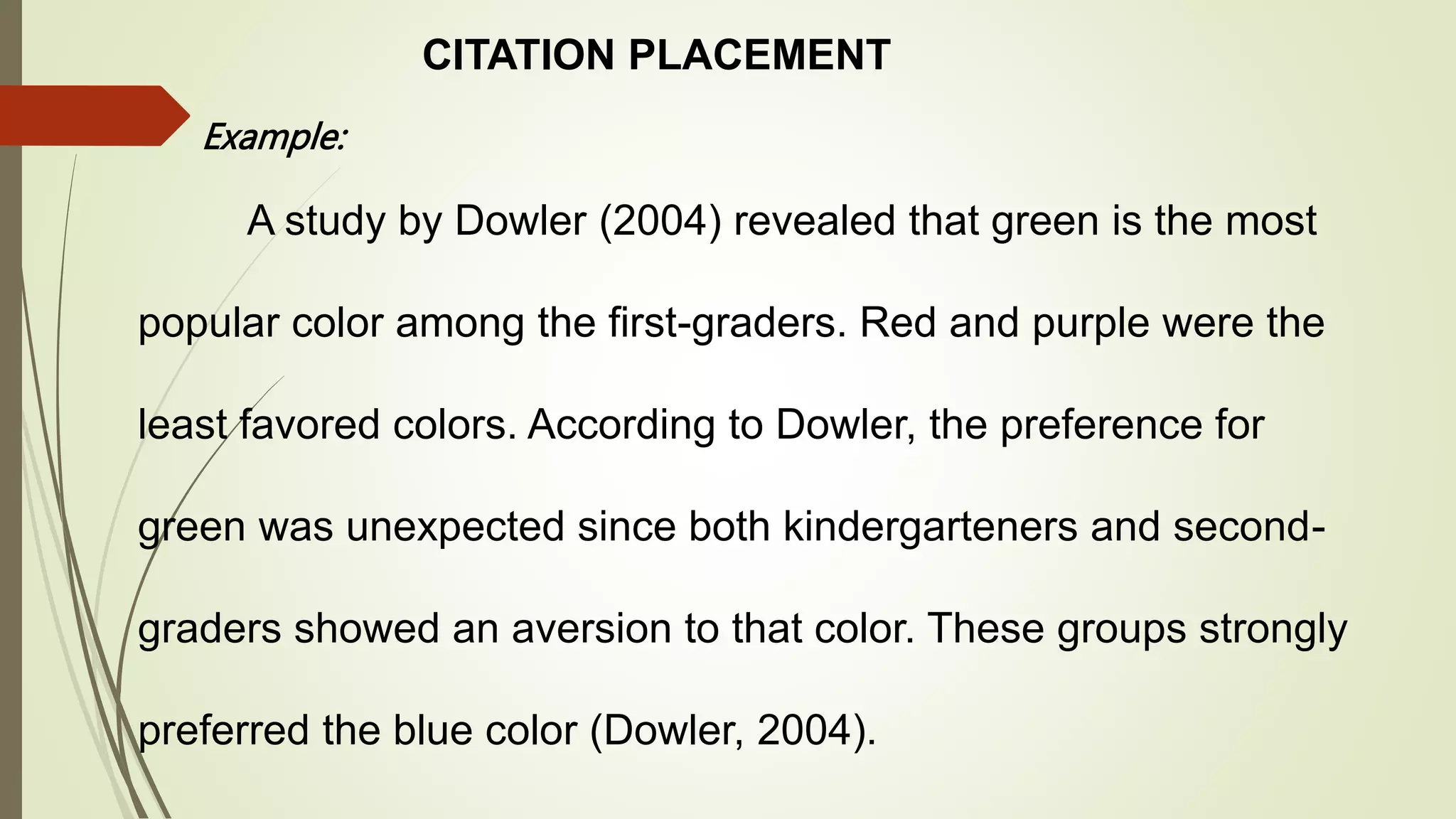
CITATION PLACEMENT
Example:
A study by Dowler (2004) revealed that green is the most
popular color among the first-graders. Red and purple were the
least favored colors. According to Dowler, the preference for
green was unexpected since both kindergarteners and second-
graders showed an aversion to that color. These groups strongly
preferred the blue color (Dowler, 2004).
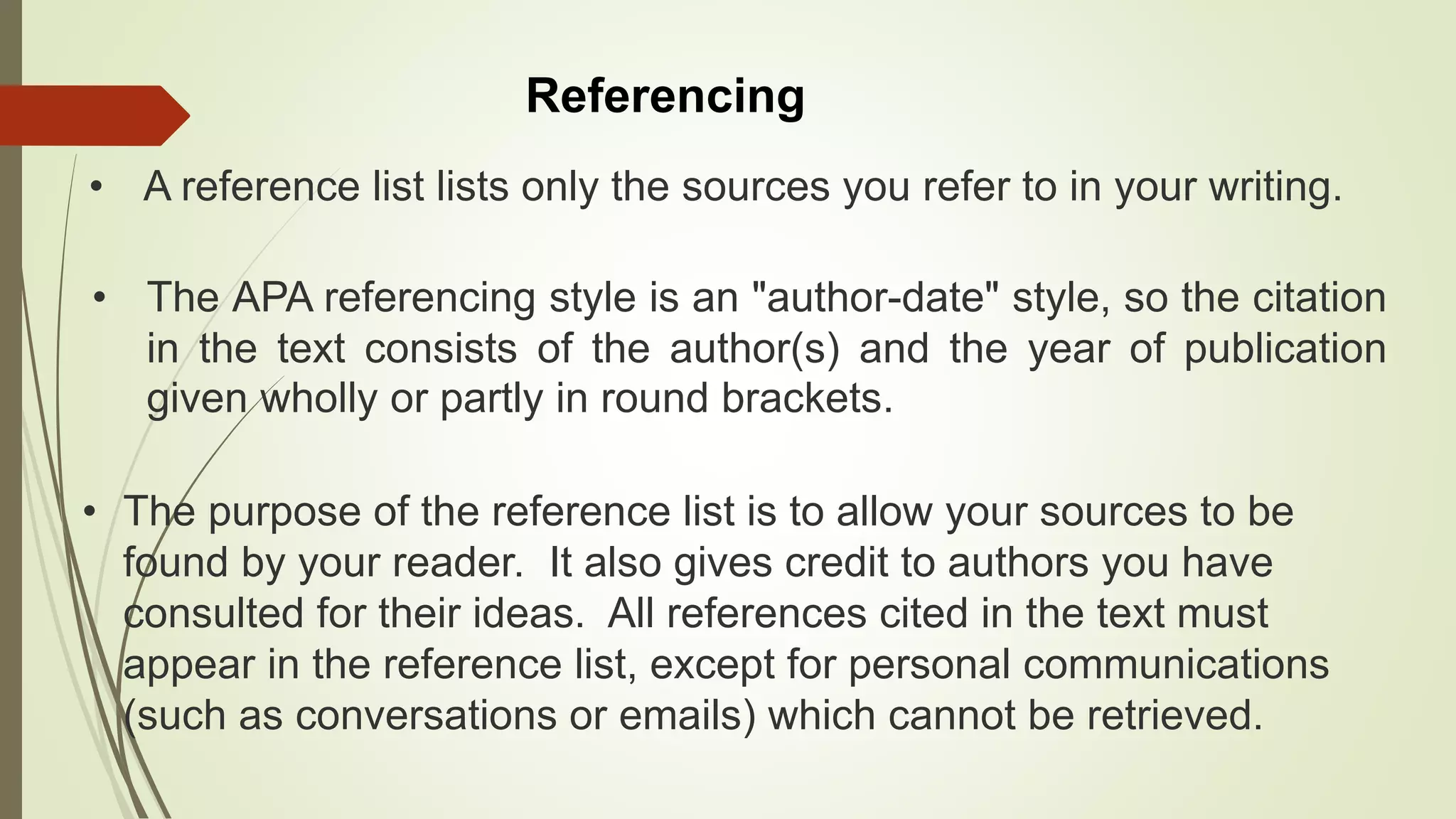
Referencing
• The APA referencing style is an "author-date" style, so the citation
in the text consists of the author(s) and the year of publication
given wholly or partly in round brackets.
• The purpose of the reference list is to allow your sources to be
found by your reader. It also gives credit to authors you have
consulted for their ideas. All references cited in the text must
appear in the reference list, except for personal communications
(such as conversations or emails) which cannot be retrieved.
• A reference list lists only the sources you refer to in your writing.
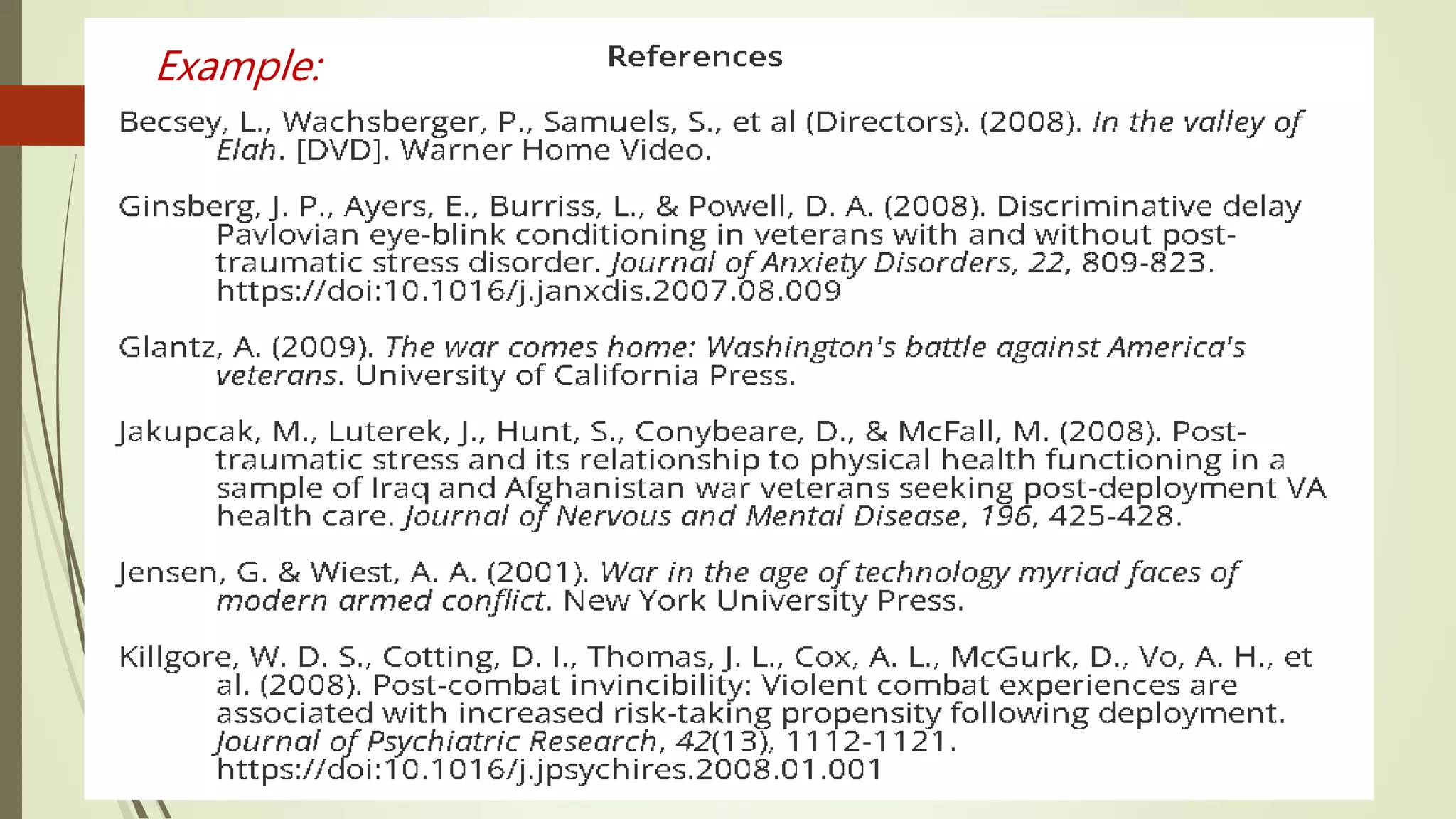
Example:
• It should include the introduction, the
purpose/objectives, methods or methodology,
results, and conclusions (RDE Operations Manual,
p. 45).
Abstract
• An Abstract should be a summary of the study
consisting of 200 to 250 words written in one
paragraph.
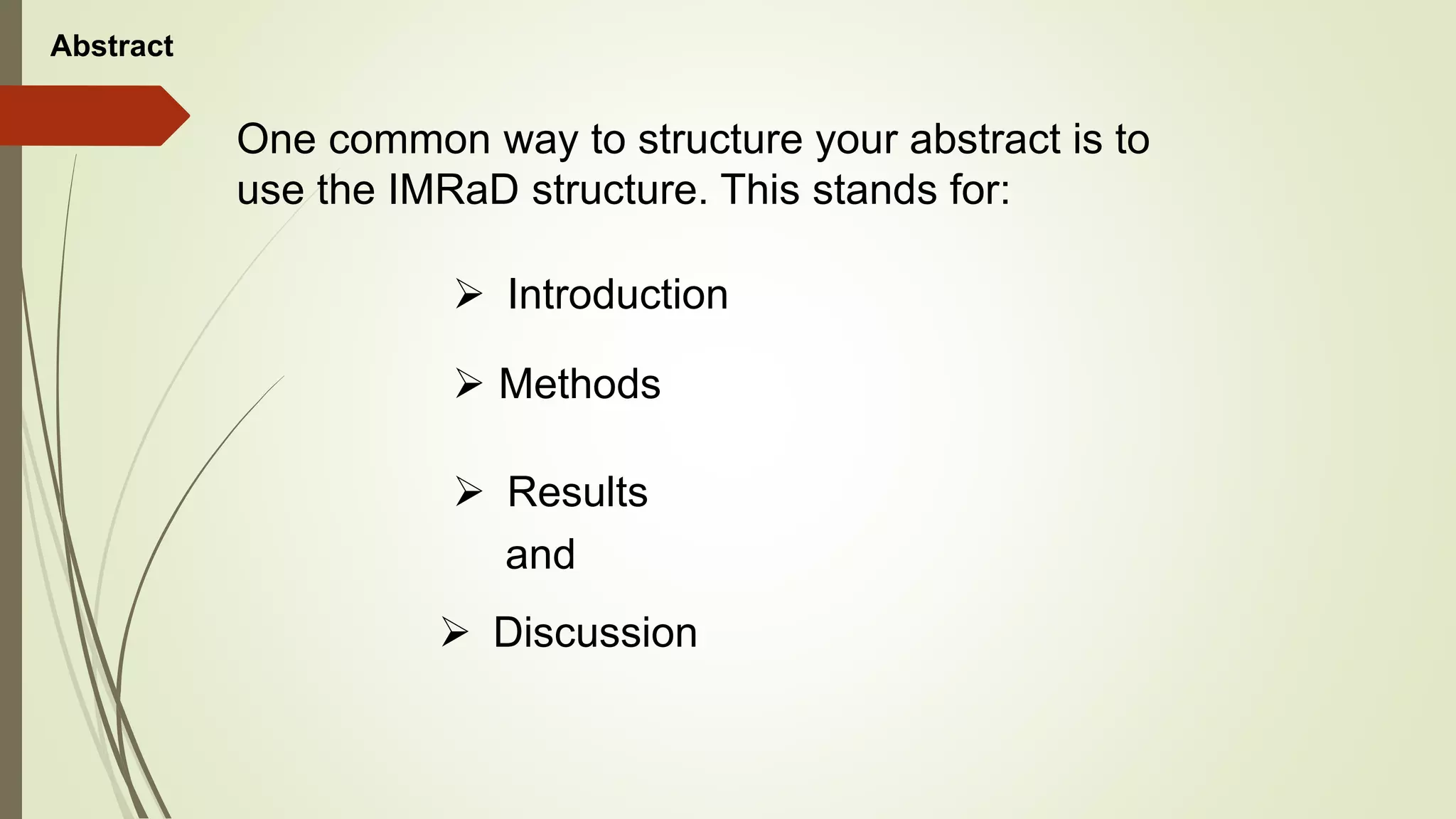
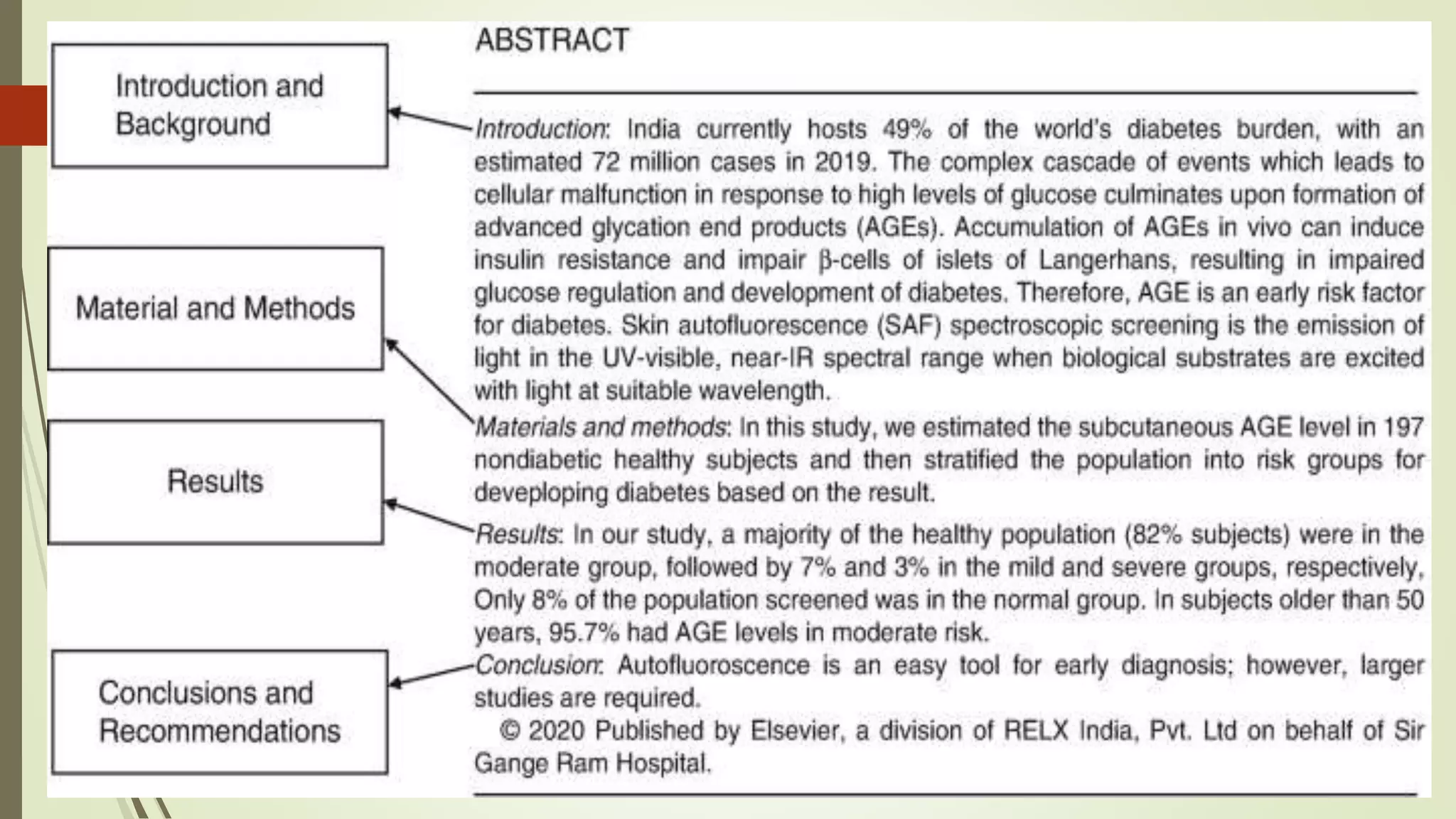
Abstract
One common way to structure your abstract is to
use the IMRaD structure. This stands for:
 Introduction
 Methods
 Results
 Discussion
and
Keywords
• Keywords are words phrases or acronyms that describe the
most important aspects of your paper. Keywords are not
required for student papers unless requested by the
instructor or the institution (2.9).
• Keywords should be written after the abstract and should
include the discipline of the study, variables used, methods,
and locale (RDE Operations Manual, p. 45).
THE PROBLEM AND ITS BACKGROUND
The introduction follows the inductive-deductive method, i.e.,
from the general to the specific, and the last paragraph or the
concluding statement is the primary purpose of the study. In other
words, the first few paragraphs/statements will be the general
information/ broad explanation or narration of the study, and as the
introduction progresses, the information and the statements become
more and more specific (Maximum of 2 pages).
Introduction
CHAPTER 1
CHAPTER 1
THE PROBLEM AND ITS BACKGROUND
Background of the Study
The background of the study contains all specific information
gathered for the study. The researchers can cite/mention other studies
related to their study to prove that the study/research is not plagiarized
or copied from another source, study, or thesis and other materials.
Theoretical Framework
CHAPTER 1
THE PROBLEM AND ITS BACKGROUND
A theoretical framework is a foundational review of existing
theories that serve as a roadmap for developing the arguments the
researcher will use in his/her own work.
Theories are developed by researchers to explain
phenomena, draw connections, and make predictions. In a
theoretical framework, the researcher explains the existing
theories that support his/her research, showing that the work is
grounded on established ideas.
CHAPTER 1
THE PROBLEM AND ITS BACKGROUND
Conceptual Paradigm/ Research Paradigm
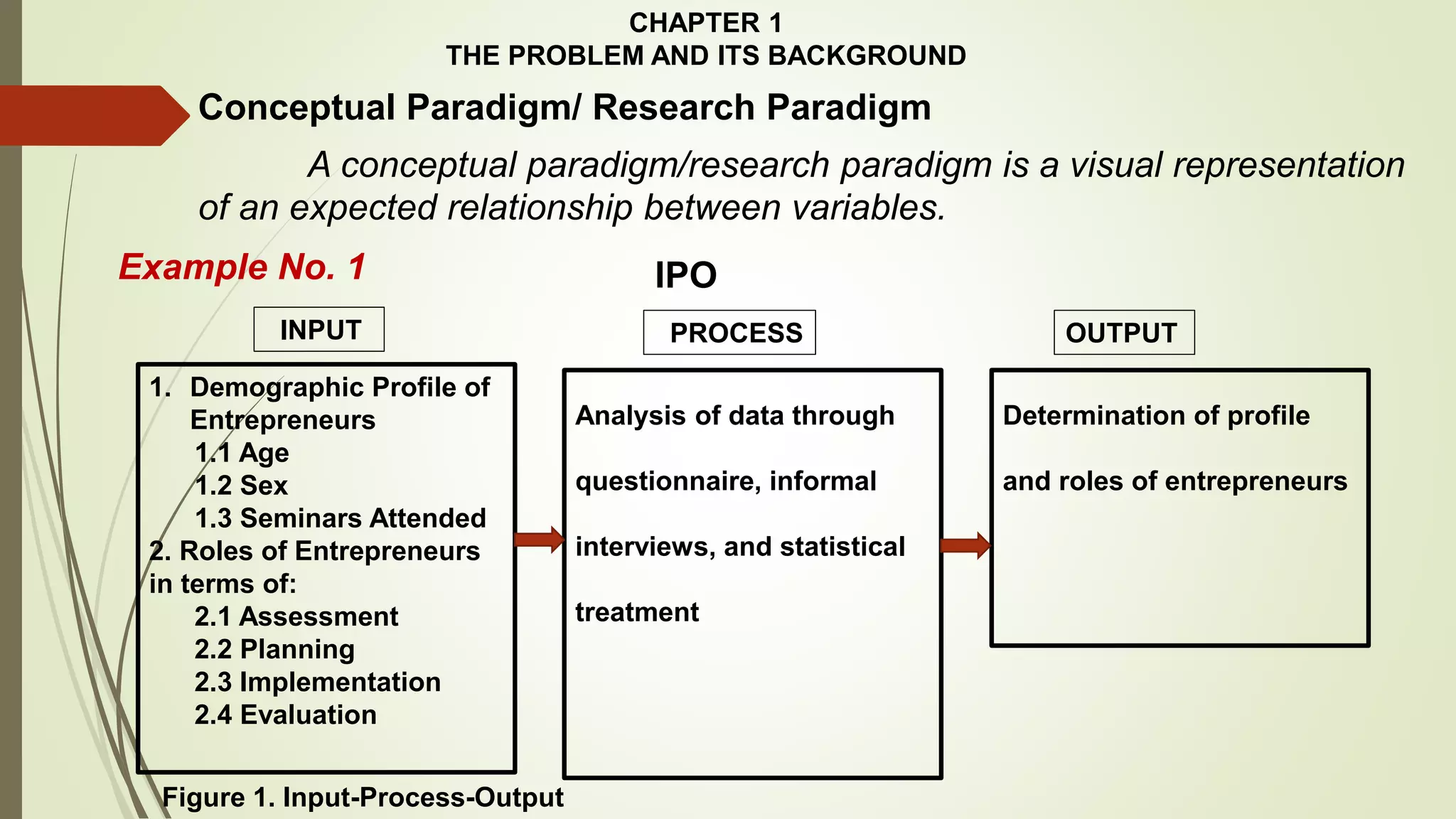
A conceptual paradigm/research paradigm is a visual representation
of an expected relationship between variables.
Example No. 1 IPO
1. Demographic Profile of
Entrepreneurs
1.1 Age
1.2 Sex
1.3 Seminars Attended
2. Roles of Entrepreneurs
in terms of:
2.1 Assessment
2.2 Planning
2.3 Implementation
2.4 Evaluation
Analysis of data through
questionnaire, informal
interviews, and statistical
treatment
Determination of profile
and roles of entrepreneurs
INPUT PROCESS OUTPUT
Figure 1. Input-Process-Output
CHAPTER 1
THE PROBLEM AND ITS BACKGROUND
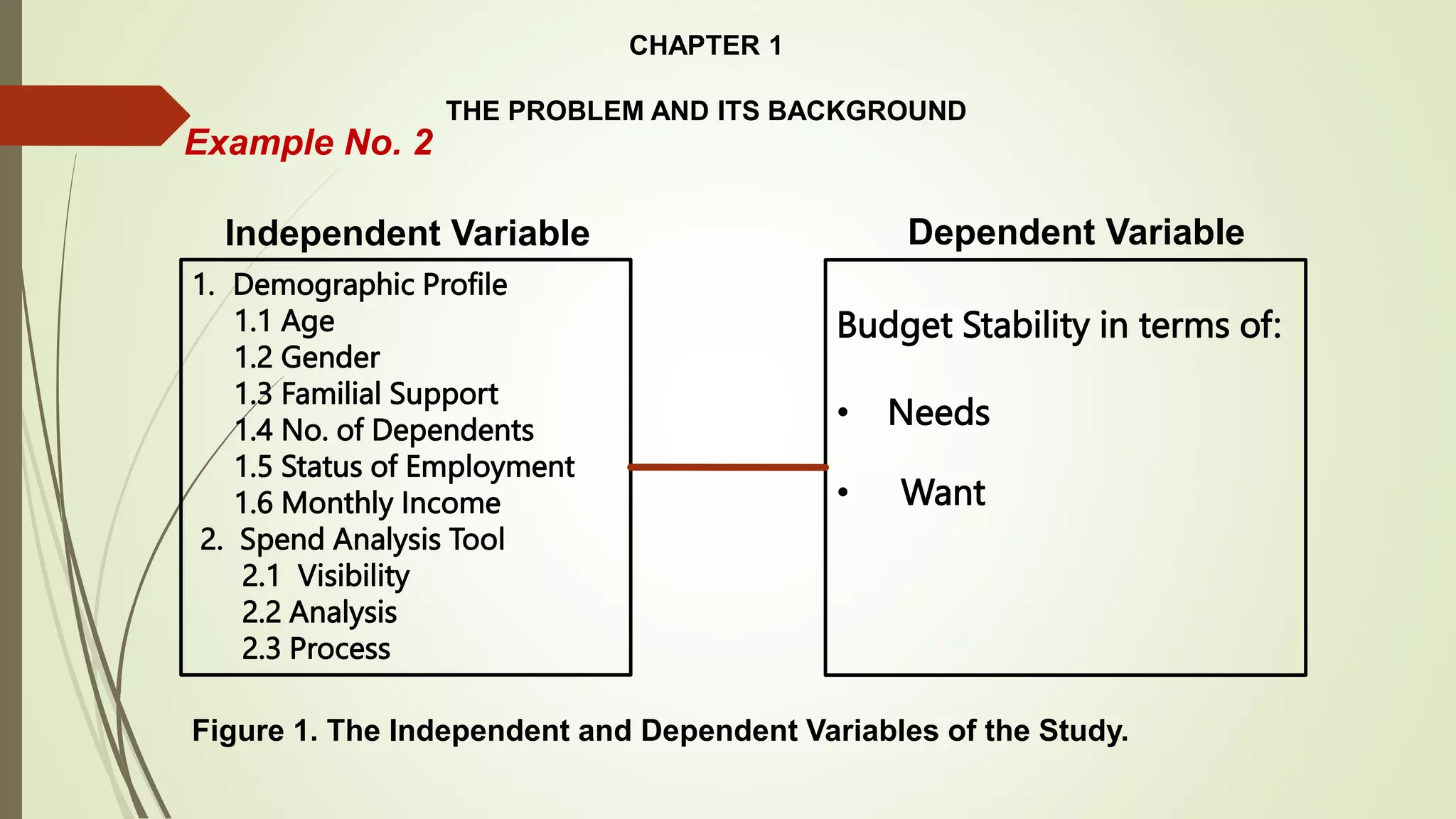
Example No. 2
1. Demographic Profile
1.1 Age
1.2 Gender
1.3 Familial Support
1.4 No. of Dependents
1.5 Status of Employment
1.6 Monthly Income
2. Spend Analysis Tool
2.1 Visibility
2.2 Analysis
2.3 Process
Budget Stability in terms of:
• Needs
• Want
Independent Variable Dependent Variable
Figure 1. The Independent and Dependent Variables of the Study.
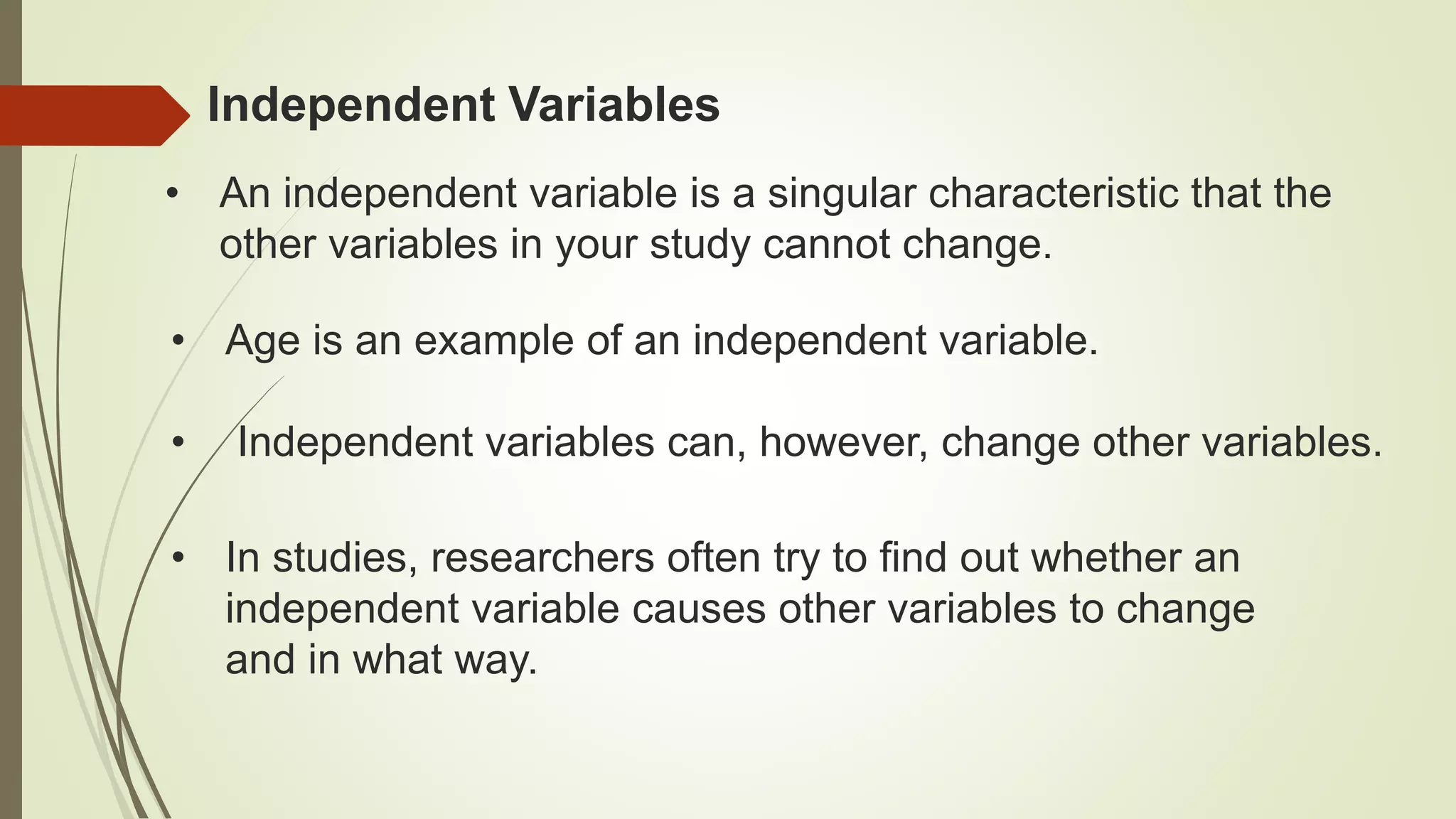
• An independent variable is a singular characteristic that the
other variables in your study cannot change.
Independent Variables
• Age is an example of an independent variable.
• Independent variables can, however, change other variables.
• In studies, researchers often try to find out whether an
independent variable causes other variables to change
and in what way.
Dependent Variables
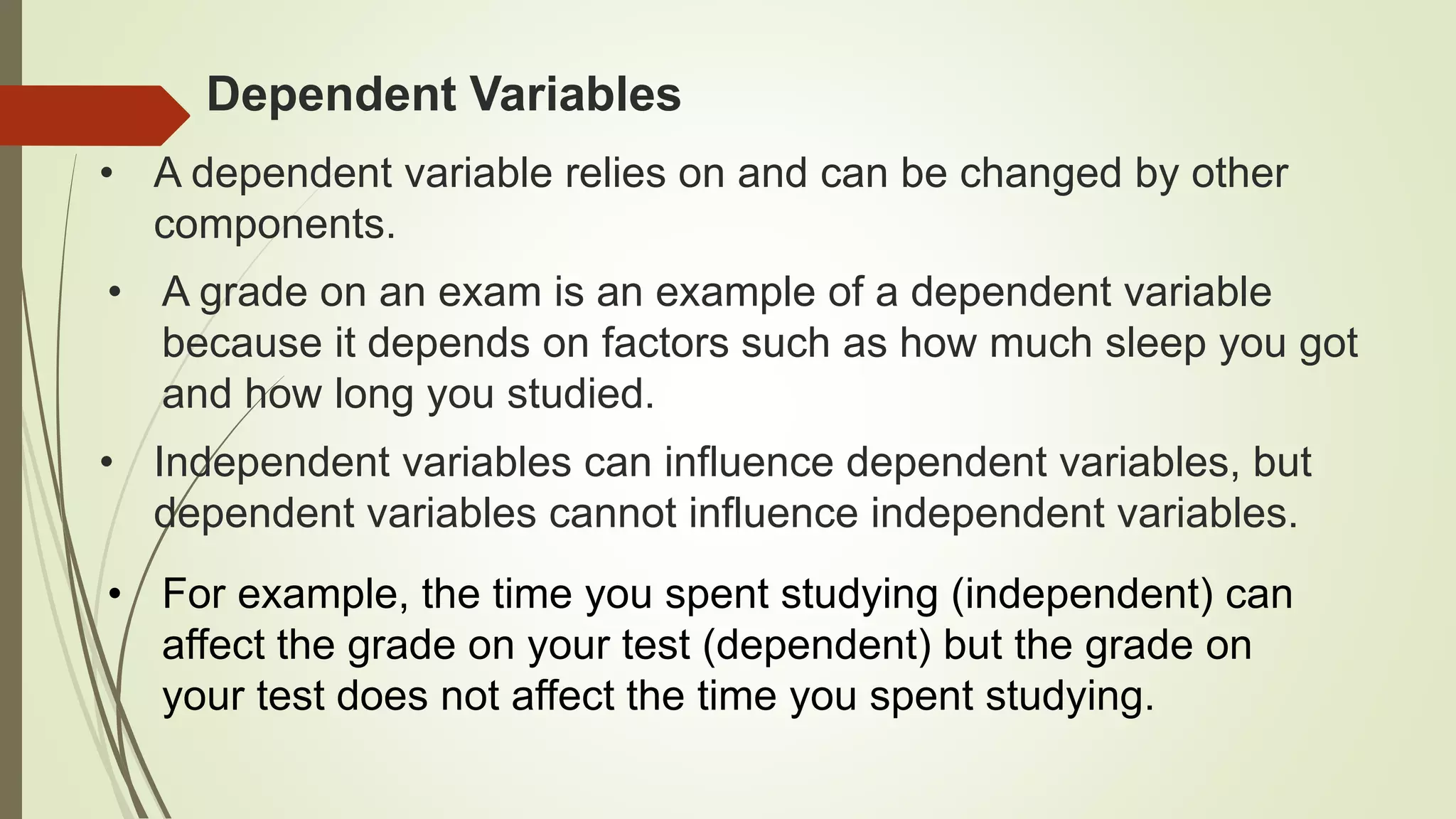
• A dependent variable relies on and can be changed by other
components.
• For example, the time you spent studying (independent) can
affect the grade on your test (dependent) but the grade on
your test does not affect the time you spent studying.
• A grade on an exam is an example of a dependent variable
because it depends on factors such as how much sleep you got
and how long you studied.
• Independent variables can influence dependent variables, but
dependent variables cannot influence independent variables.
CHAPTER 1
THE PROBLEM AND ITS BACKGROUND
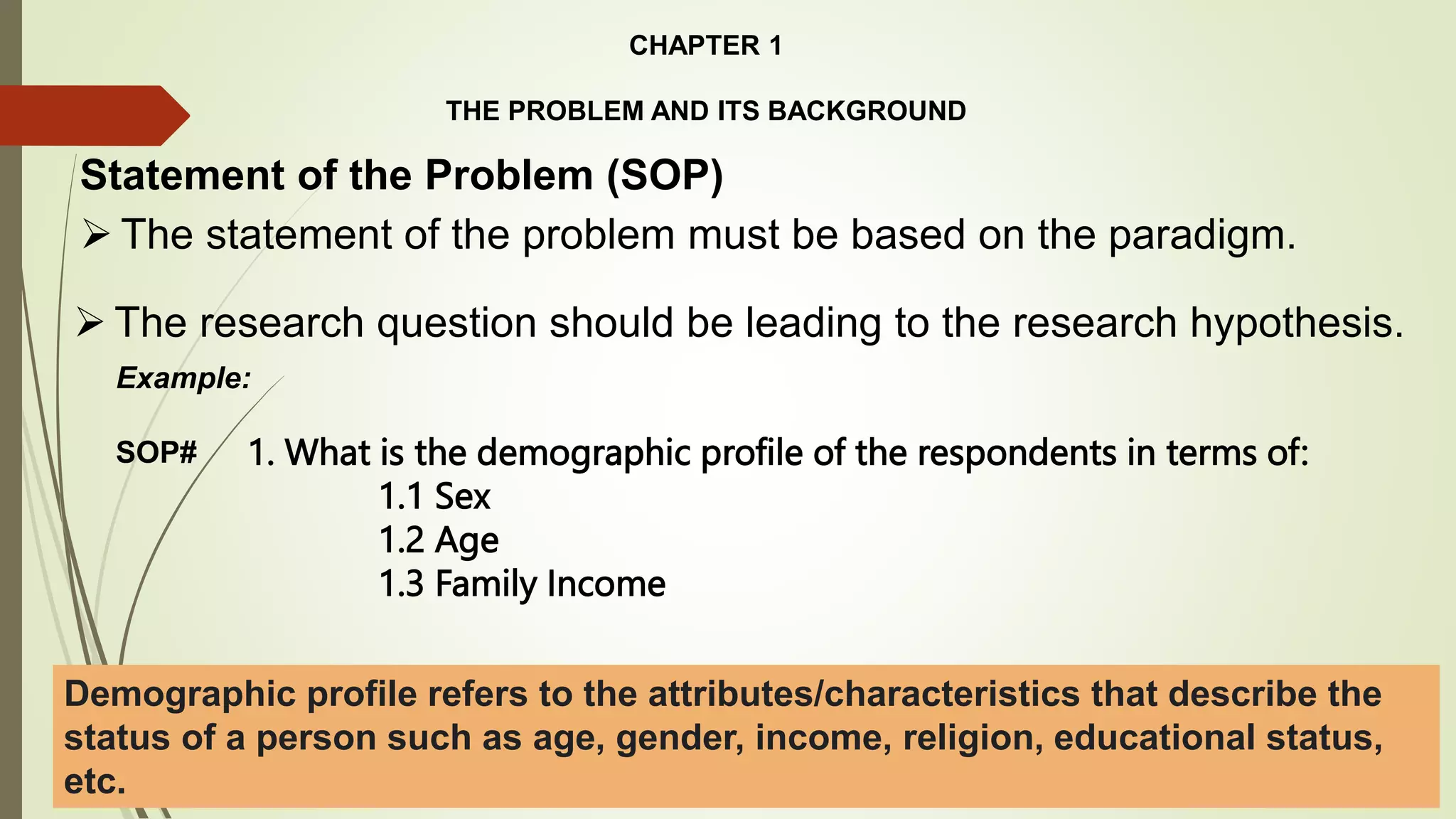
Statement of the Problem (SOP)
 The statement of the problem must be based on the paradigm.
Demographic profile refers to the attributes/characteristics that describe the
status of a person such as age, gender, income, religion, educational status,
etc.
Example:
1. What is the demographic profile of the respondents in terms of:
1.1 Sex
1.2 Age
1.3 Family Income
 The research question should be leading to the research hypothesis.
SOP#
CHAPTER 1
THE PROBLEM AND ITS BACKGROUND
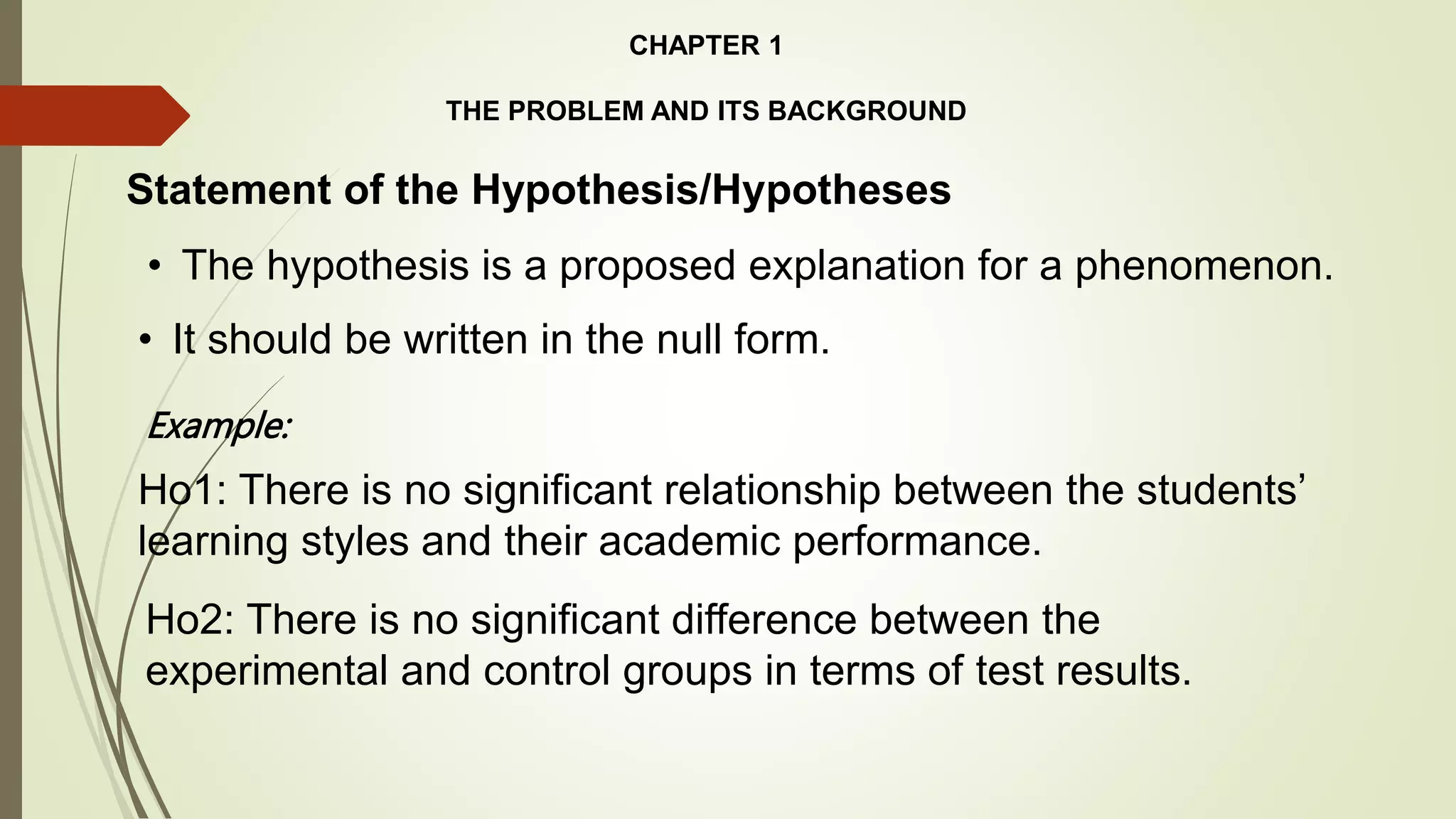
Statement of the Hypothesis/Hypotheses
• The hypothesis is a proposed explanation for a phenomenon.
Example:
Ho1: There is no significant relationship between the students’
learning styles and their academic performance.
• It should be written in the null form.
Ho2: There is no significant difference between the
experimental and control groups in terms of test results.
CHAPTER 1
THE PROBLEM AND ITS BACKGROUND
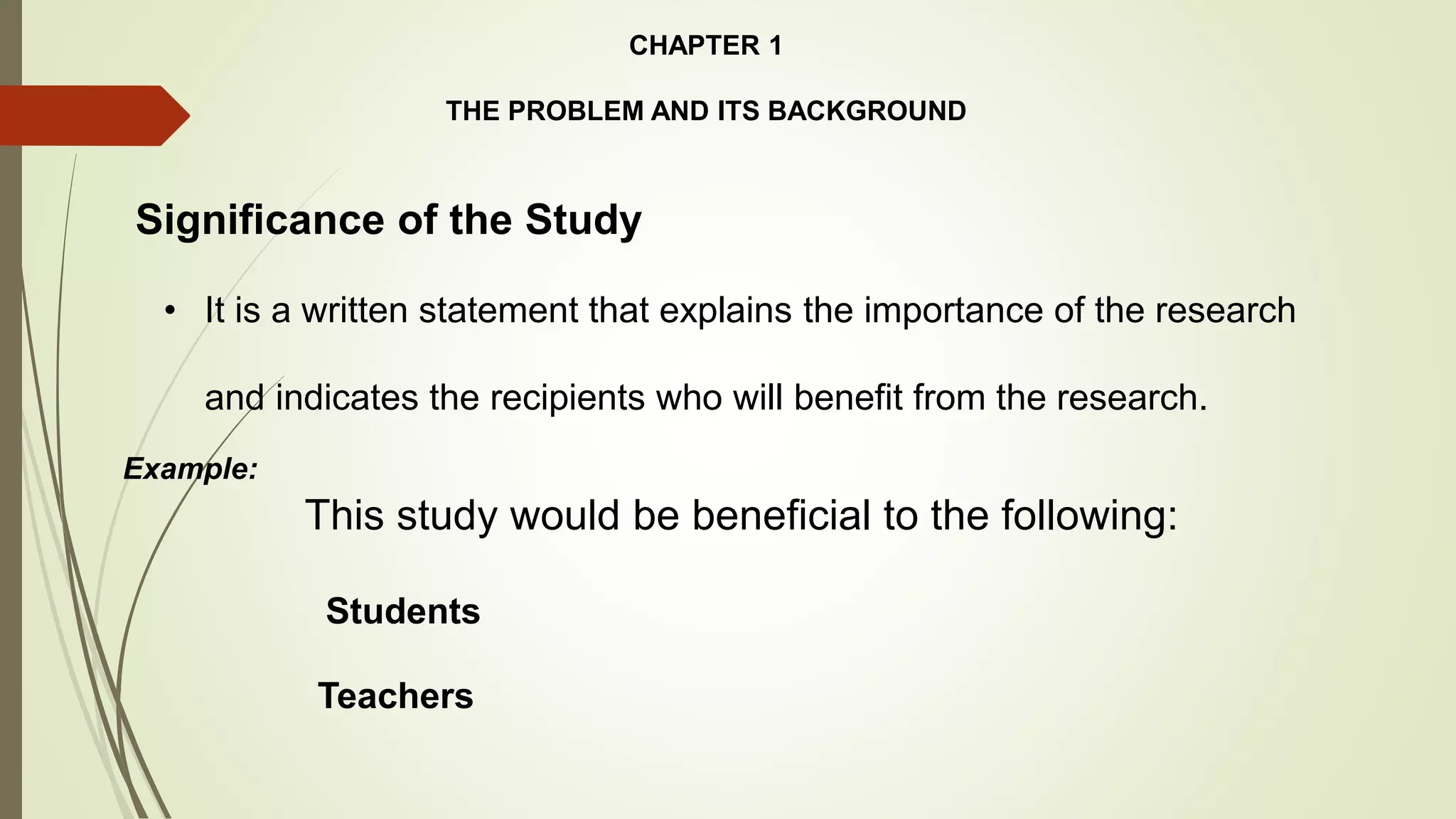
Significance of the Study
• It is a written statement that explains the importance of the research
and indicates the recipients who will benefit from the research.
Example:
This study would be beneficial to the following:
Students
Teachers
CHAPTER 1
THE PROBLEM AND ITS BACKGROUND
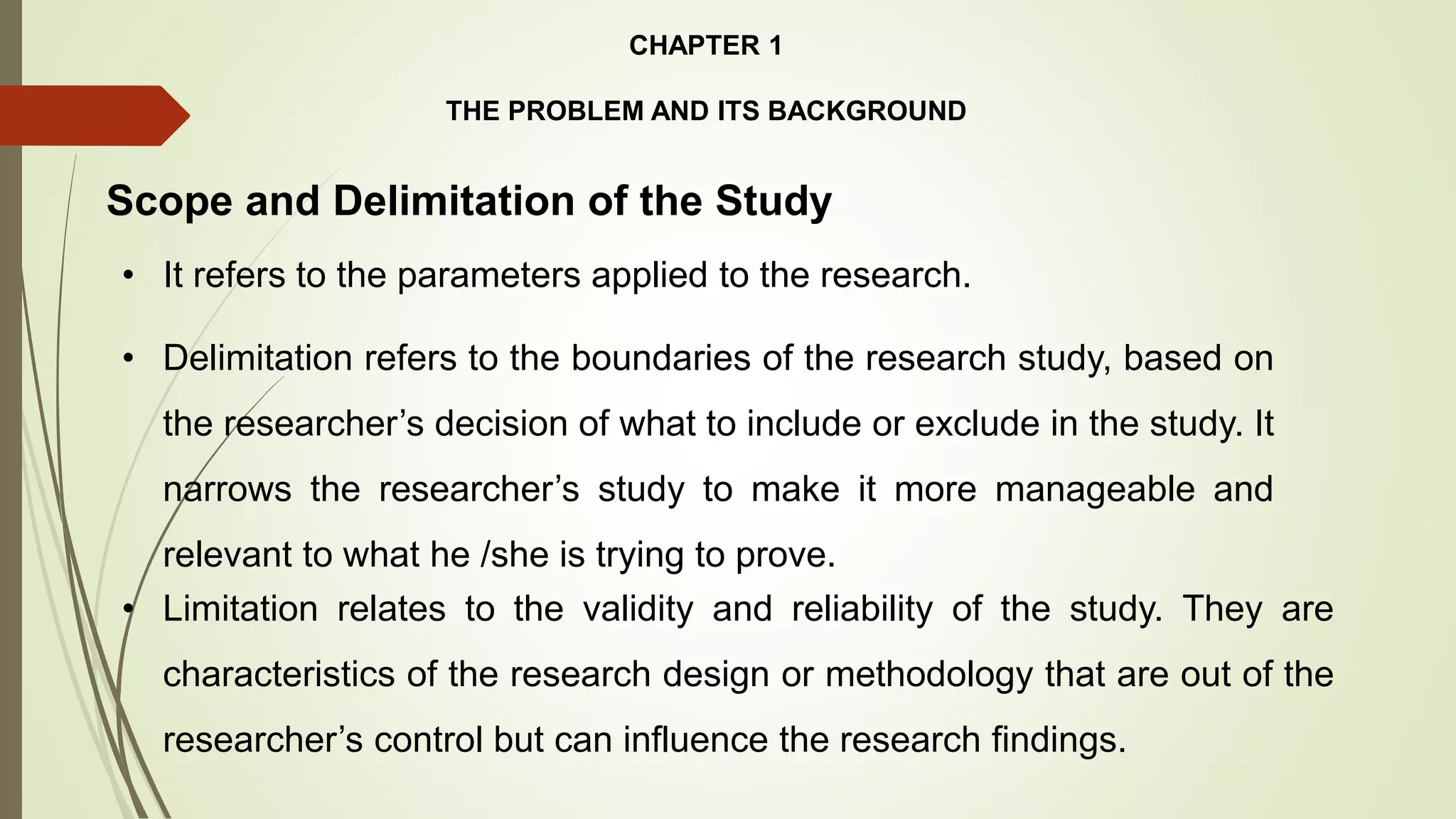
Scope and Delimitation of the Study
• It refers to the parameters applied to the research.
• Limitation relates to the validity and reliability of the study. They are
characteristics of the research design or methodology that are out of the
researcher’s control but can influence the research findings.
• Delimitation refers to the boundaries of the research study, based on
the researcher’s decision of what to include or exclude in the study. It
narrows the researcher’s study to make it more manageable and
relevant to what he /she is trying to prove.
CHAPTER 1
THE PROBLEM AND ITS BACKGROUND
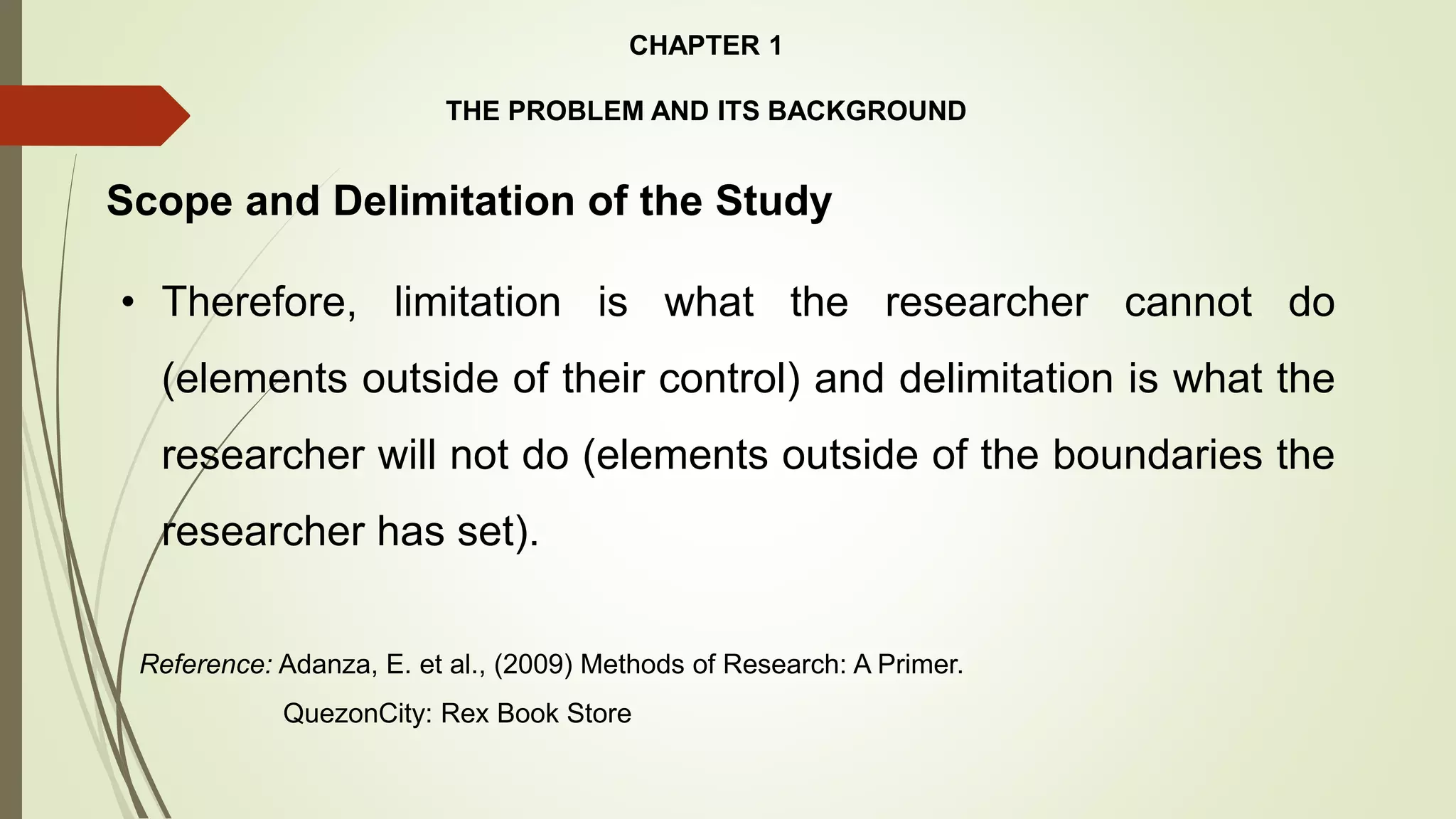
• Therefore, limitation is what the researcher cannot do
(elements outside of their control) and delimitation is what the
researcher will not do (elements outside of the boundaries the
researcher has set).
Scope and Delimitation of the Study
Reference: Adanza, E. et al., (2009) Methods of Research: A Primer.
QuezonCity: Rex Book Store
CHAPTER 1
THE PROBLEM AND ITS BACKGROUND
Definition of Terms
• A conceptual definition tells you what the concept means, while an
operational definition only tells you how to measure it.
• The definition of terms ensures that the readers will
understand the components of your study.
• The terms used should be defined conceptually and
operationally and should be arranged alphabetically.
CHAPTER 1
THE PROBLEM AND ITS BACKGROUND
How to Select the Terms to Define
Definition of Terms
• The rule of thumb is to include and define terms that are
important to your study or are used frequently throughout the
research but are not common knowledge.
• Also, include terms that have a unique meaning within the
scope of your study.
CHAPTER 2
REVIEW OF RELATED LITERATURE AND STUDIES
(All the variables in the paradigm should be included using all
available materials related to the study – e.g. books, magazines,
published and unpublished theses/dissertations, journals,
newspapers, and electronic sources.)
*Arrange the RRL according to the variables in the paradigm by
topic (thematic format).
CHAPTER 2
REVIEW OF RELATED LITERATURE AND STUDIES
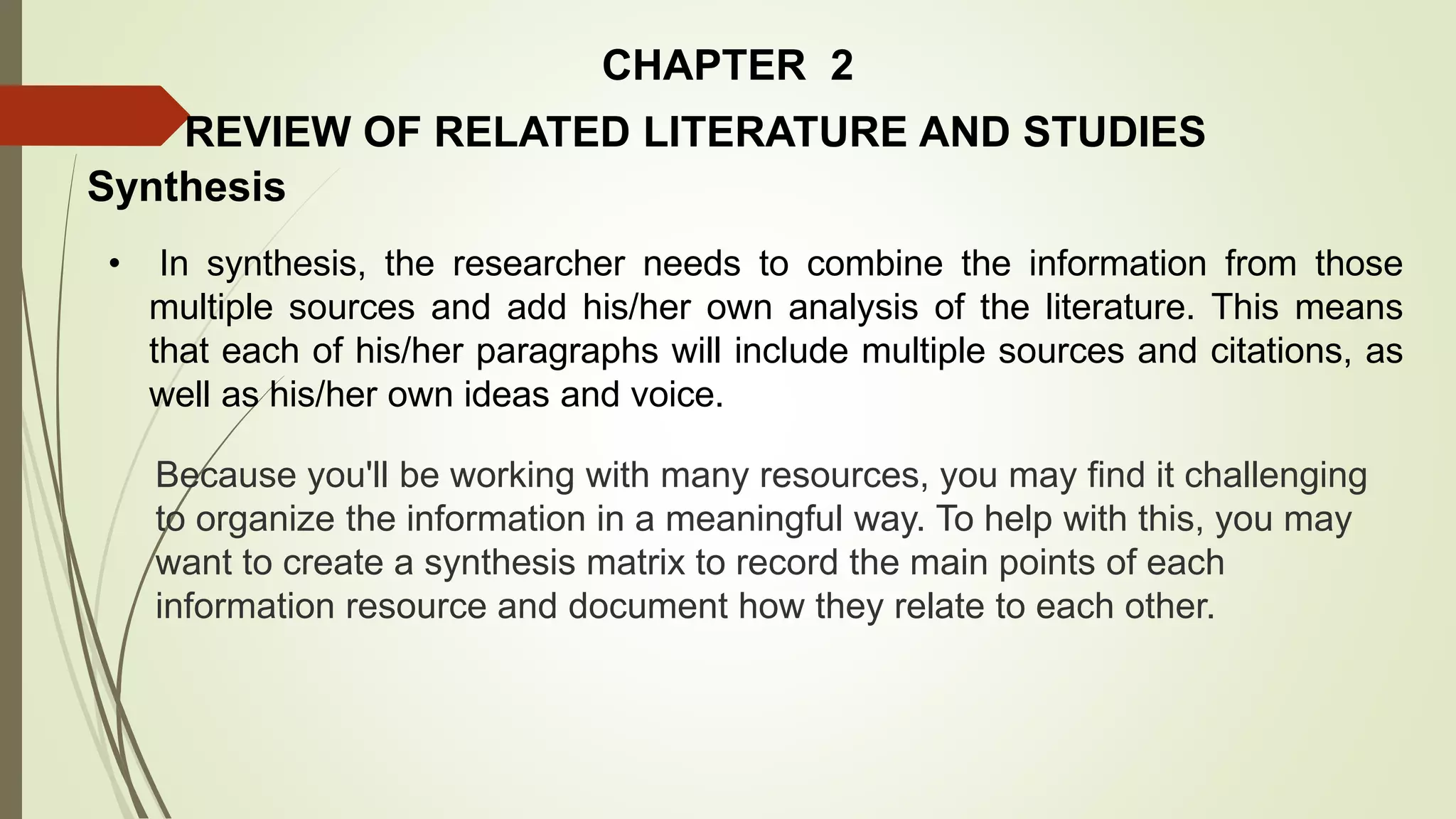
Synthesis
• It refers to combining multiple sources and ideas. The researcher
uses information from several sources to create new ideas based
on his/her analysis of what he/she has read.
• When asked to synthesize sources and research, many
researchers start to summarize individual sources. However, this
is not the same as synthesis. In a summary, the researcher
shares the key points from an individual source and then moves
on and summarizes another source.
CHAPTER 2
REVIEW OF RELATED LITERATURE AND STUDIES
Synthesis
• In synthesis, the researcher needs to combine the information from those
multiple sources and add his/her own analysis of the literature. This means
that each of his/her paragraphs will include multiple sources and citations, as
well as his/her own ideas and voice.
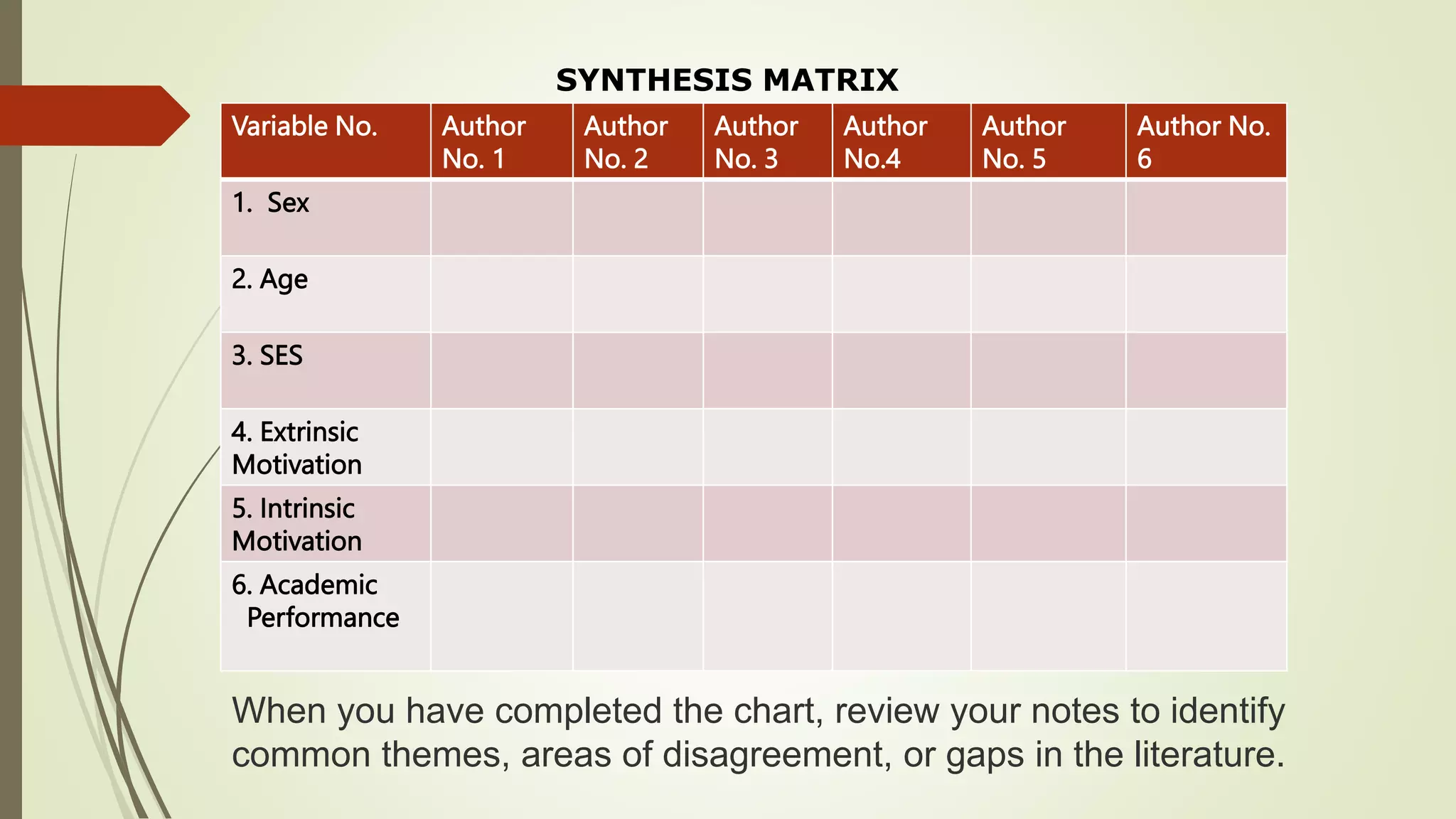
Because you'll be working with many resources, you may find it challenging
to organize the information in a meaningful way. To help with this, you may
want to create a synthesis matrix to record the main points of each
information resource and document how they relate to each other.
Variable No. Author
No. 1
Author
No. 2
Author
No. 3
Author
No.4
Author
No. 5
Author No.
6
1. Sex
2. Age
3. SES
4. Extrinsic
Motivation
5. Intrinsic
Motivation
6. Academic
Performance
When you have completed the chart, review your notes to identify
common themes, areas of disagreement, or gaps in the literature.
SYNTHESIS MATRIX
CHAPTER 3
RESEARCH METHODOLOGY
This chapter presents the discussion of the research
methodology of the study, the subjects, the research
instrument, data gathering procedure, and statistical
treatment for accurate data analysis and interpretation.
c/o Dr. A. Espinas
CHAPTER 3
RESEARCH METHODOLOGY
• Research Design
• Subject/Respondents/Participants of the Study
• Sampling Technique
• Research Instrument
• Validation of the Research Instrument
• Data Gathering Procedure
• Statistical Analysis of Data
CHAPTER 3
RESEARCH METHODOLOGY
This chapter presents the discussion of the research methodology of
the study, the subjects, research instrument, data gathering procedure, and
statistical treatment
for accurate data analysis and interpretation.
Research Design
The research design refers to the overall strategy researchers choose to
integrate the different components of the study in a coherent and logical way
to effectively address the research problem. It is the blueprint for the
collection, measurement, and analysis of data. It is the researcher’s way of
answering the research question or testing the research hypothesis.
Subjects/Respondents/Participants of the Study
A distinction should be made between the subjects and respondents
of the study. Subjects are persons investigated in the study. For
example, in the thesis “An Assessment of the Academic Performance of
the Junior College Students in an Online Learning Modality,” the
students were the subjects while the teachers who were asked to fill out
the questionnaire were the respondents of the study. Respondents are
the providers of information needed in the study. Participants refers to
those who are involved in the qualitative type of research.
Sampling Technique
The researcher should indicate the sampling technique to be used ----
random, purposive, convenience, stratified, etc. and why the researcher chose
it. What procedure will be followed to carry out the technique?
Research Instrument
This refers to the questionnaire, tests, interviews, observations to gather
information
The researcher must explain / describe / Illustrate in paragraph form all
the details of how he/she prepared the research instrument.
Validation of the Research Instrument
An instrument is content valid when the items adequately reflect the
process and content dimensions of the objectives of the instrument (Benson
& Clark, 1982).
Content validity is most often measured by relying on the knowledge of
people who are familiar with the construct being measured. These subject-
matter experts are usually provided with access to the measurement tool and
are asked to provide feedback on how well each question measures the
construct in question. The researcher must
 Explain / Describe / Illustrate in paragraph form the process of validation.
 Ensure validators are experts in the field of research.
Note: The RDE-designated statistician will be the last to check the
research instrument. Signatures of the validators are required on the
proposed instrument before the RDE-designated statistician checks it for
final validation.
Data Gathering Procedure
The researcher must identify the sources of data. If a questionnaire
will be used, explain what kind and how it will be constructed if it is
original, how it is pre-tested, distributed, retrieved, collated, presented,
and interpreted.
The researcher must explain/describe in narrative form every detail
of the data gathering procedure.
Statistical Treatment of Data
The researcher should specify the statistical treatment/s to be used to
interpret the data and why they are necessary. Also, include the Likert scale or
the verbal interpretation for statistical processing of the data. The researcher
must”
 Explain / Discuss why he/she chose a specific statistical tool/treatment
 Show the formula if manual computation is used.
 Show the formula and the scale to be used in each question in the statement
of the problem (SOP) that ask for the frequency, percentage, mean and
standard deviation (SD).
 For the research question that will go through the SPSS, it is not necessary to
illustrate the formula; instead, discuss the use of SPSS.
CHAPTER 4
PRESENTATION, ANALYSIS, AND INTERPRETATION OF DATA
Write a short introduction for Chapter 4
This chapter answers the research questions, research problems, and
hypothesis. The researcher must use tables or graphic presentations for
the data. and arrange the data according to the questions in the SOP. The
researcher should:
 Write the question before the table (See illustration below)
 Choose only presentation (Graphical or Tabular)
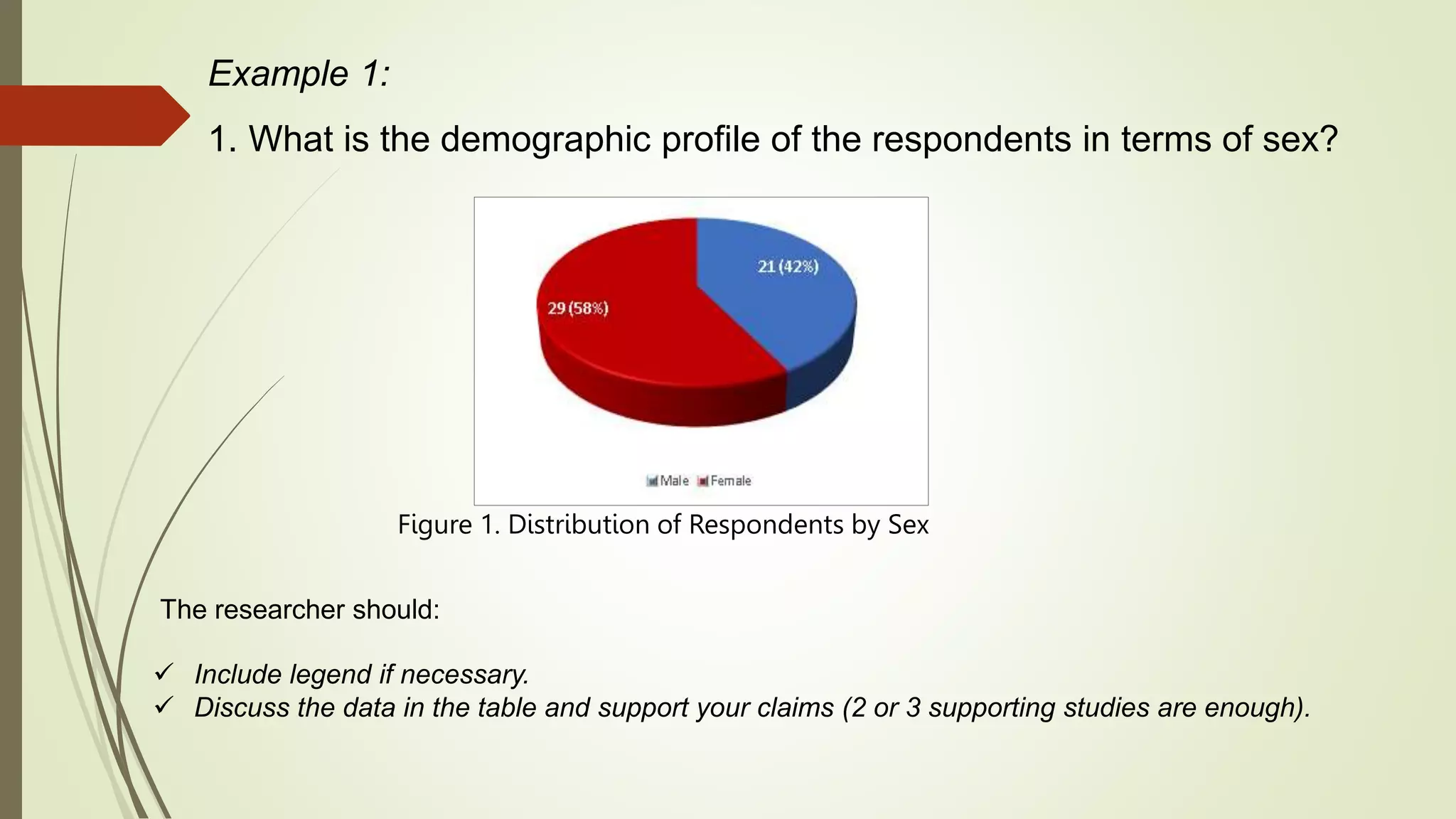
Example 1:
1. What is the demographic profile of the respondents in terms of sex?
Figure 1. Distribution of Respondents by Sex
The researcher should:
 Include legend if necessary.
 Discuss the data in the table and support your claims (2 or 3 supporting studies are enough).
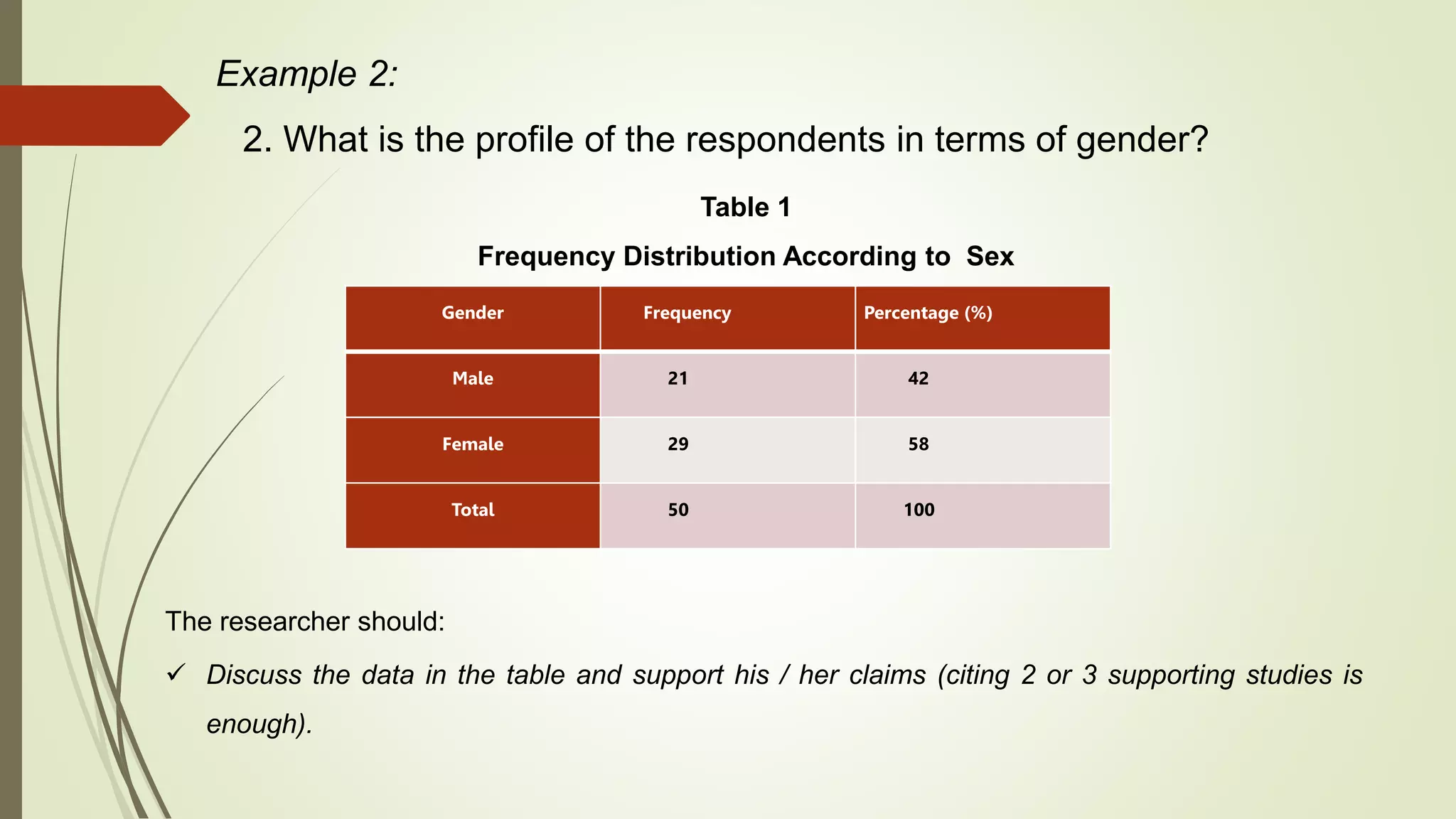
Example 2:
2. What is the profile of the respondents in terms of gender?
Table 1
Frequency Distribution According to Sex
Gender Frequency Percentage (%)
Male 21 42
Female 29 58
Total 50 100
The researcher should:
 Discuss the data in the table and support his / her claims (citing 2 or 3 supporting studies is
enough).
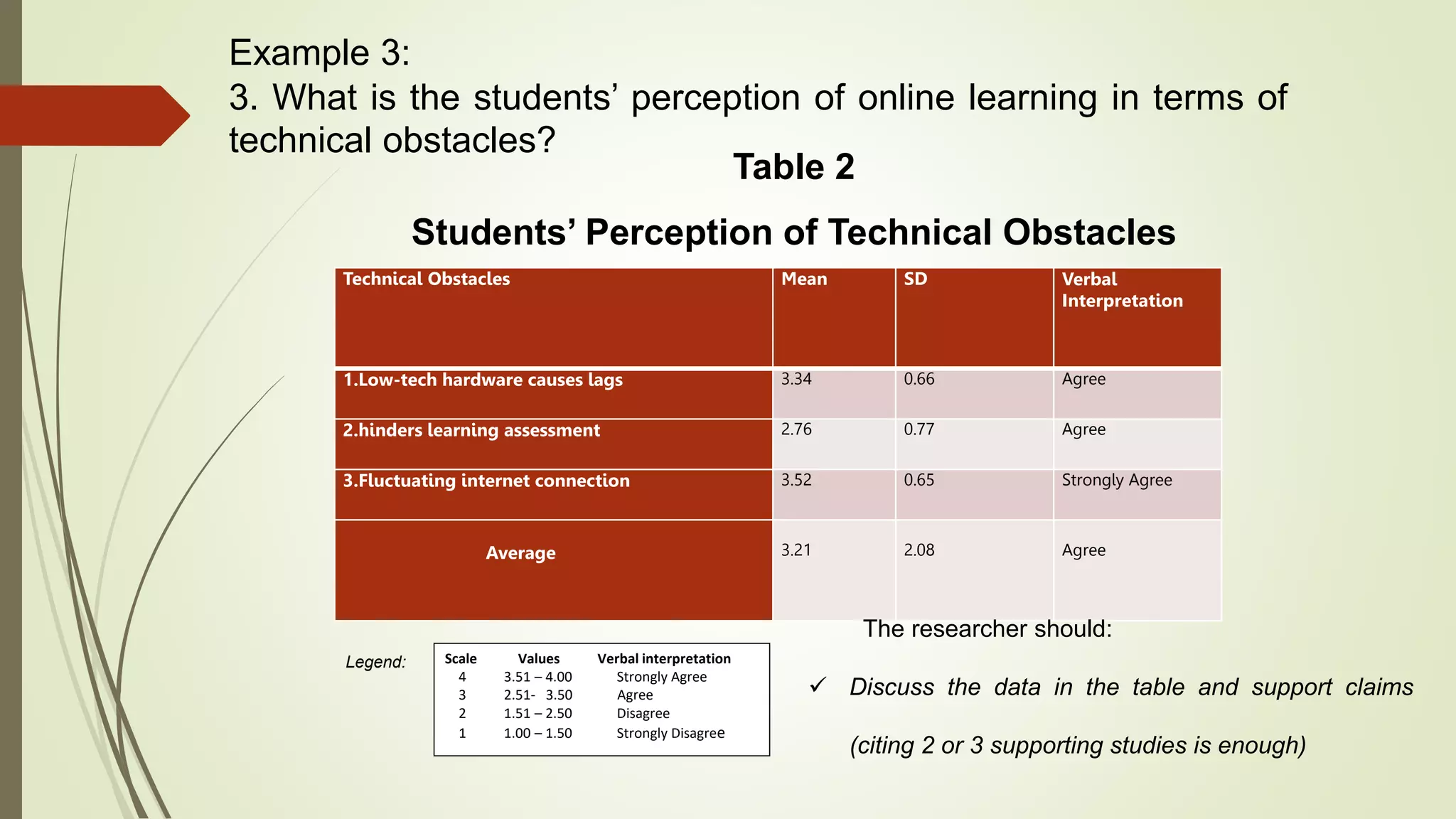
Example 3:
3. What is the students’ perception of online learning in terms of
technical obstacles?
Technical Obstacles Mean SD Verbal
Interpretation
1.Low-tech hardware causes lags 3.34 0.66 Agree
2.hinders learning assessment 2.76 0.77 Agree
3.Fluctuating internet connection 3.52 0.65 Strongly Agree
Average 3.21 2.08 Agree
Table 2
Students’ Perception of Technical Obstacles
Scale Values Verbal interpretation
4 3.51 – 4.00 Strongly Agree
3 2.51- 3.50 Agree
2 1.51 – 2.50 Disagree
1 1.00 – 1.50 Strongly Disagree
Legend:
The researcher should:
 Discuss the data in the table and support claims
(citing 2 or 3 supporting studies is enough)
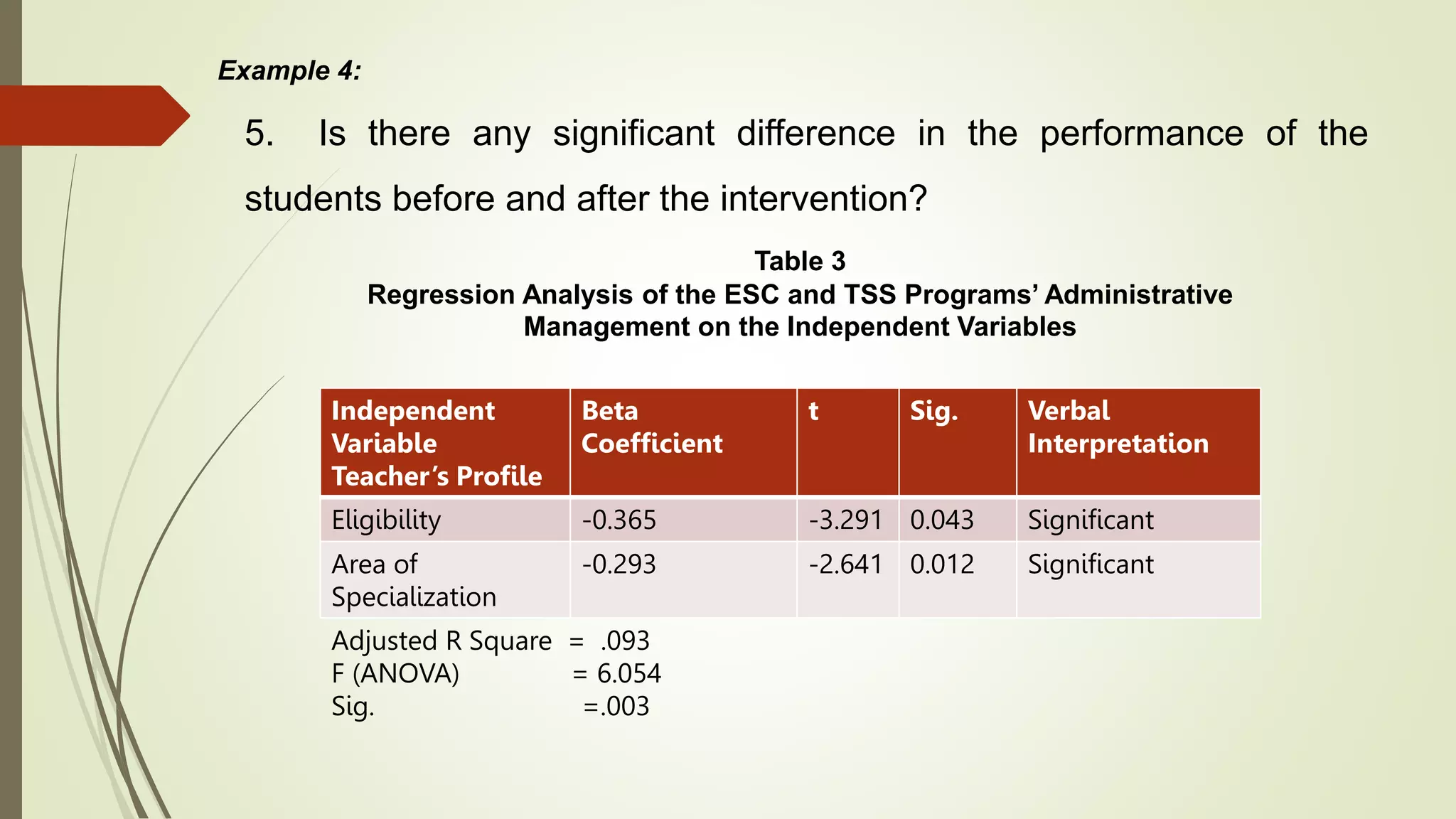
Example 4:
5. Is there any significant difference in the performance of the
students before and after the intervention?
Table 3
Regression Analysis of the ESC and TSS Programs’ Administrative
Management on the Independent Variables
Independent
Variable
Teacher’s Profile
Beta
Coefficient
t Sig. Verbal
Interpretation
Eligibility -0.365 -3.291 0.043 Significant
Area of
Specialization
-0.293 -2.641 0.012 Significant
Adjusted R Square = .093
F (ANOVA) = 6.054
Sig. =.003
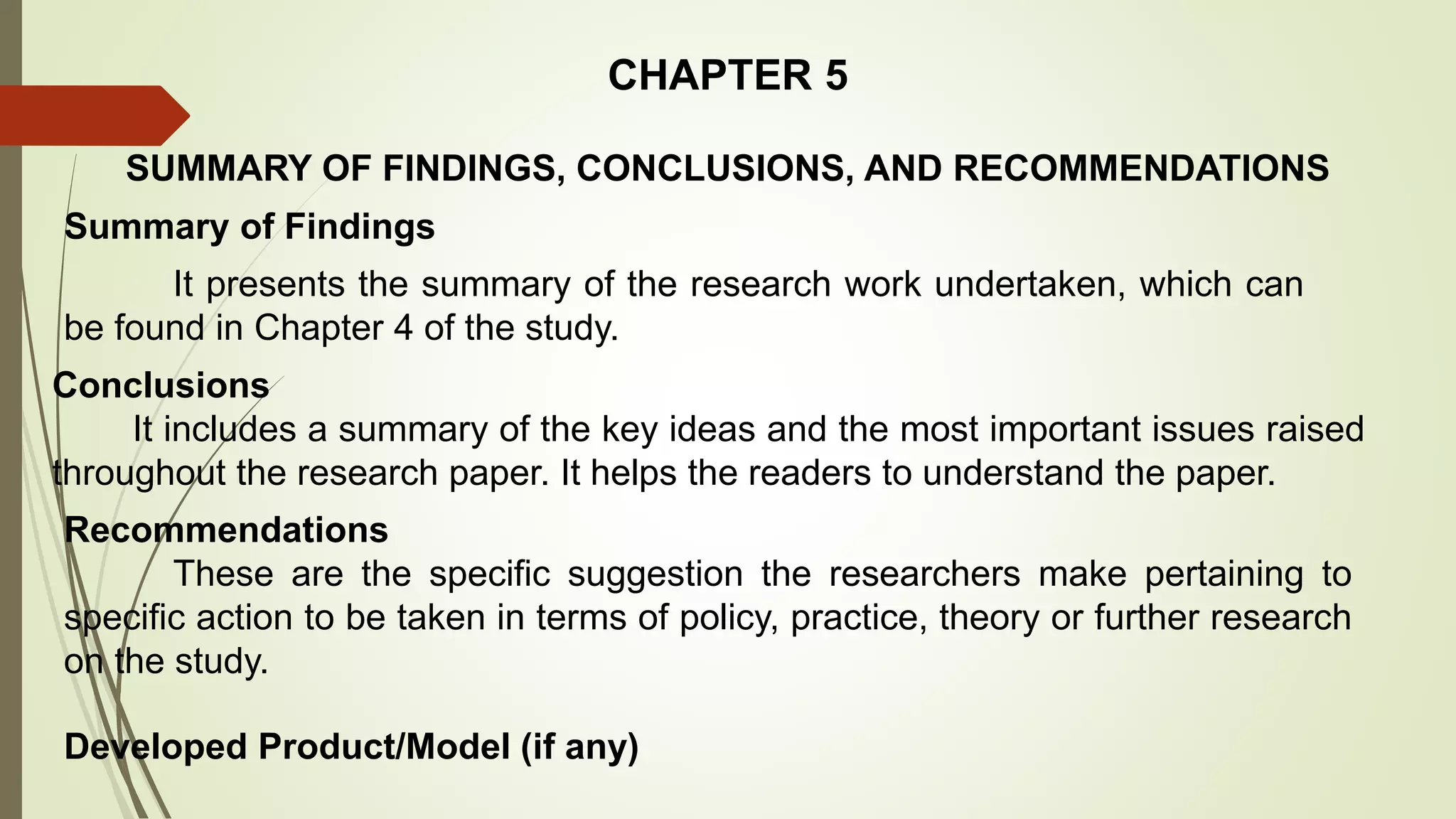
CHAPTER 5
SUMMARY OF FINDINGS, CONCLUSIONS, AND RECOMMENDATIONS
Recommendations
These are the specific suggestion the researchers make pertaining to
specific action to be taken in terms of policy, practice, theory or further research
on the study.
Summary of Findings
It presents the summary of the research work undertaken, which can
be found in Chapter 4 of the study.
Conclusions
It includes a summary of the key ideas and the most important issues raised
throughout the research paper. It helps the readers to understand the paper.
Developed Product/Model (if any)
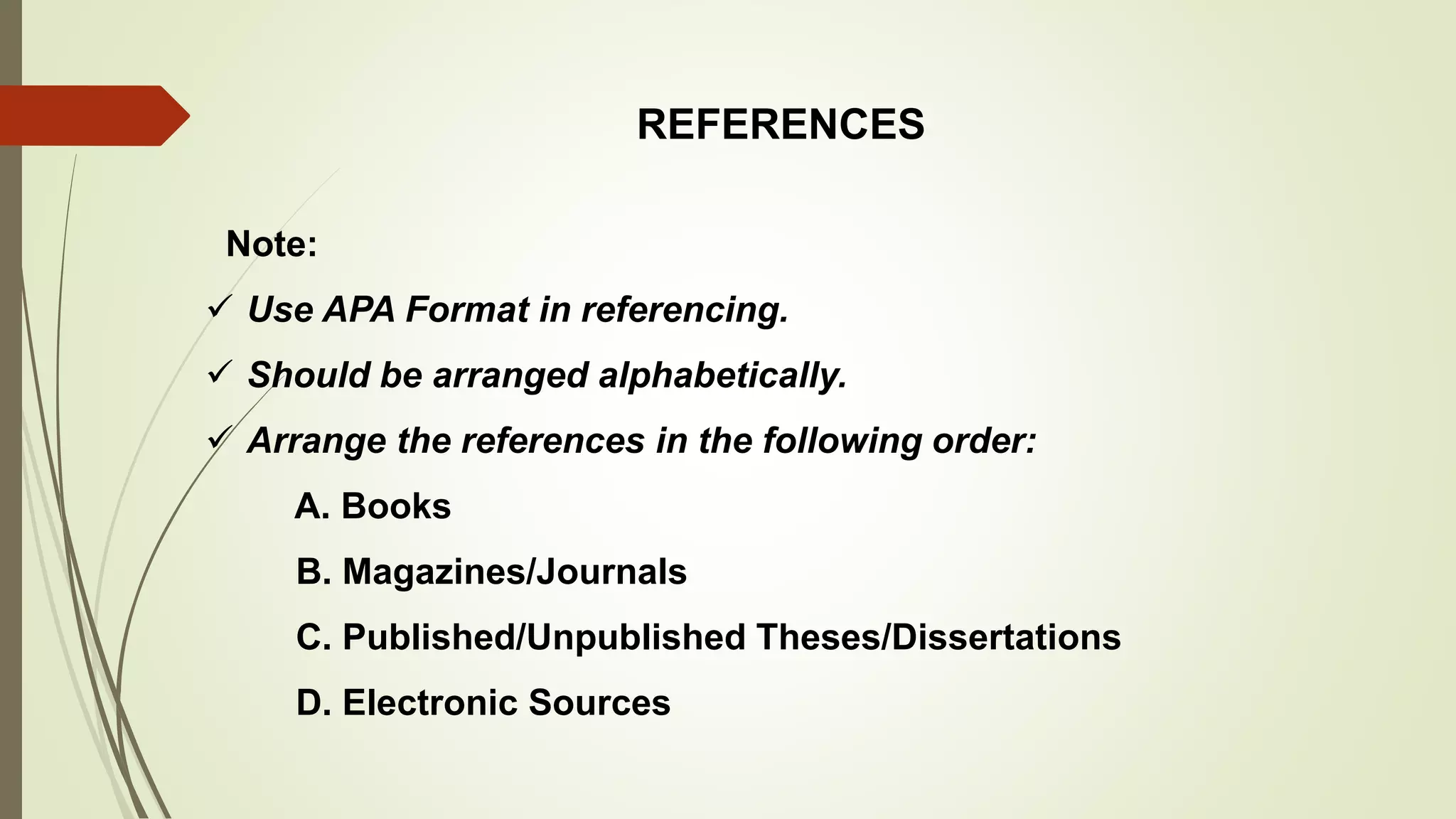
REFERENCES
Note:
 Use APA Format in referencing.
 Should be arranged alphabetically.
 Arrange the references in the following order:
A. Books
B. Magazines/Journals
C. Published/Unpublished Theses/Dissertations
D. Electronic Sources
APPENDIX / APPENDICES
• It contains supplementary material/s that is / are not (an)
essential part of the text but may be helpful in providing a
more comprehensive understanding of the research
problem.
• It also may be any information that is too awkward to be
included in the body of the paper.
Example:
Appendix A. Letter of Request
Appendix B. Research Instrument
Appendix C. Curriculum Vitae
Basic-Research-Guidelines (1).pptx

Basic-Research-Guidelines (1).pptx

  • 1.
    BASIC RESEARCH WRITING FORTEACHERS & STUDENTS
  • 3.
  • 4.
    The Institutional ResearchFormat of LOA • The Lyceum of Alabang follows the format set by the American Psychological Association (APA). • However, there were some modifications incorporated to establish the identification of the institution, but in general, the APA format still applies.
  • 5.
    General Guidelines • Usestandard-sized paper (8.5 x 11). • Set page margins to 1 inch/2.54 cm on all sides except on the left which is 1.5 inches/3.81 cm. • Double-space all text, including headings. A-4 1” or . 1”or 2.54cm. 1”or 2.54cm. 1.5”or 3.81cm.
  • 6.
    • Indent thefirst line of every paragraph 0.5 inches. A. General Guidelines • APA recommends the researcher to use: sans serif fonts such as 11-point Calibri, 11-point Arial, or 10- point Lucida Sans Unicode, or serif fonts such as 12- point Times New Roman, 11-point Georgia, or normal (10-point) Computer Modern (the default font for LaTeX).
  • 7.
    For uniformity, LOAapplies the 12-point Arial all throughout the paper. • Researchers should avoid the use of color except when it is necessary for understanding the material. A. General Guidelines
  • 8.
    The APA Headingsand Subheadings (APA 7th Ed.) 1 LEVEL FORMAT Centered, Boldface, Title Case Heading (LOA Style: ALL UPPER CASE) Text begins as a new paragraph. Flush Left, Boldface, Title Case Heading Text begins as a new paragraph. Flush Left, Boldface Italic, Title Case Heading Text begins as a new paragraph. Indented, Boldface, Title Case Heading Ending With a Period. Paragraph text continues on the same line and continues as a regular paragraph. Indented, Boldface Italic, Title Case Heading Ending with a Period. Paragraph text continues on the same line and continues as a regular paragraph. 2 3 4 5
  • 9.
    CHAPTER 1 THE PROBLEMAND ITS BACKGROUND Theoretical Framework The theoretical framework justifies and contextualizes the research, and it is a crucial first step for a research paper. Abraham Maslow's Hierarchy of Needs Maslow's hierarchy of needs is a theory of motivation which states that five categories of human needs dictate an individual's behavior. Those needs are physiological needs, safety needs, love and belonging needs, esteem needs, and self-actualization needs. Physiological Needs. These most basic human survival needs include food and water, sufficient rest, clothing and shelter, overall health, and reproduction. Maslow states that these basic physiological needs must be addressed before humans move on to the next level of fulfillment. First Level Heading 2nd Level Heading 3rd Level Heading EXAMPLE OF LEVEL HEADING: 4th Level 5th Level Food and Water. When it comes to what we eat, many don't consider the role that water plays in producing our food. (ALL DOUBLE SPACE)
  • 10.
    In-Text Citation When youare writing a paper in APA style, you cite other works (articles, books, etc.) using the author-date citation method. By naming the author and the date of the work you are citing in your in-text citation, you're helping the reader find the work in your reference list at the end of your paper. A primary source reports original content; a secondary source refers to content first reported in another source. Cite secondary sources sparingly (8.6 APA 7th Ed).
  • 11.
  • 12.
    CITATION PLACEMENT Example: A studyby Dowler (2004) revealed that green is the most popular color among the first-graders. Red and purple were the least favored colors. According to Dowler, the preference for green was unexpected since both kindergarteners and second- graders showed an aversion to that color. These groups strongly preferred the blue color (Dowler, 2004).
  • 13.
    Referencing • The APAreferencing style is an "author-date" style, so the citation in the text consists of the author(s) and the year of publication given wholly or partly in round brackets. • The purpose of the reference list is to allow your sources to be found by your reader. It also gives credit to authors you have consulted for their ideas. All references cited in the text must appear in the reference list, except for personal communications (such as conversations or emails) which cannot be retrieved. • A reference list lists only the sources you refer to in your writing.
  • 14.
  • 15.
    • It shouldinclude the introduction, the purpose/objectives, methods or methodology, results, and conclusions (RDE Operations Manual, p. 45). Abstract • An Abstract should be a summary of the study consisting of 200 to 250 words written in one paragraph.
  • 16.
    Abstract One common wayto structure your abstract is to use the IMRaD structure. This stands for:  Introduction  Methods  Results  Discussion and
  • 18.
    Keywords • Keywords arewords phrases or acronyms that describe the most important aspects of your paper. Keywords are not required for student papers unless requested by the instructor or the institution (2.9). • Keywords should be written after the abstract and should include the discipline of the study, variables used, methods, and locale (RDE Operations Manual, p. 45).
  • 19.
    THE PROBLEM ANDITS BACKGROUND The introduction follows the inductive-deductive method, i.e., from the general to the specific, and the last paragraph or the concluding statement is the primary purpose of the study. In other words, the first few paragraphs/statements will be the general information/ broad explanation or narration of the study, and as the introduction progresses, the information and the statements become more and more specific (Maximum of 2 pages). Introduction CHAPTER 1
  • 20.
    CHAPTER 1 THE PROBLEMAND ITS BACKGROUND Background of the Study The background of the study contains all specific information gathered for the study. The researchers can cite/mention other studies related to their study to prove that the study/research is not plagiarized or copied from another source, study, or thesis and other materials.
  • 21.
    Theoretical Framework CHAPTER 1 THEPROBLEM AND ITS BACKGROUND A theoretical framework is a foundational review of existing theories that serve as a roadmap for developing the arguments the researcher will use in his/her own work. Theories are developed by researchers to explain phenomena, draw connections, and make predictions. In a theoretical framework, the researcher explains the existing theories that support his/her research, showing that the work is grounded on established ideas.
  • 22.
    CHAPTER 1 THE PROBLEMAND ITS BACKGROUND Conceptual Paradigm/ Research Paradigm A conceptual paradigm/research paradigm is a visual representation of an expected relationship between variables. Example No. 1 IPO 1. Demographic Profile of Entrepreneurs 1.1 Age 1.2 Sex 1.3 Seminars Attended 2. Roles of Entrepreneurs in terms of: 2.1 Assessment 2.2 Planning 2.3 Implementation 2.4 Evaluation Analysis of data through questionnaire, informal interviews, and statistical treatment Determination of profile and roles of entrepreneurs INPUT PROCESS OUTPUT Figure 1. Input-Process-Output
  • 23.
    CHAPTER 1 THE PROBLEMAND ITS BACKGROUND Example No. 2 1. Demographic Profile 1.1 Age 1.2 Gender 1.3 Familial Support 1.4 No. of Dependents 1.5 Status of Employment 1.6 Monthly Income 2. Spend Analysis Tool 2.1 Visibility 2.2 Analysis 2.3 Process Budget Stability in terms of: • Needs • Want Independent Variable Dependent Variable Figure 1. The Independent and Dependent Variables of the Study.
  • 24.
    • An independentvariable is a singular characteristic that the other variables in your study cannot change. Independent Variables • Age is an example of an independent variable. • Independent variables can, however, change other variables. • In studies, researchers often try to find out whether an independent variable causes other variables to change and in what way.
  • 25.
    Dependent Variables • Adependent variable relies on and can be changed by other components. • For example, the time you spent studying (independent) can affect the grade on your test (dependent) but the grade on your test does not affect the time you spent studying. • A grade on an exam is an example of a dependent variable because it depends on factors such as how much sleep you got and how long you studied. • Independent variables can influence dependent variables, but dependent variables cannot influence independent variables.
  • 26.
    CHAPTER 1 THE PROBLEMAND ITS BACKGROUND Statement of the Problem (SOP)  The statement of the problem must be based on the paradigm. Demographic profile refers to the attributes/characteristics that describe the status of a person such as age, gender, income, religion, educational status, etc. Example: 1. What is the demographic profile of the respondents in terms of: 1.1 Sex 1.2 Age 1.3 Family Income  The research question should be leading to the research hypothesis. SOP#
  • 27.
    CHAPTER 1 THE PROBLEMAND ITS BACKGROUND Statement of the Hypothesis/Hypotheses • The hypothesis is a proposed explanation for a phenomenon. Example: Ho1: There is no significant relationship between the students’ learning styles and their academic performance. • It should be written in the null form. Ho2: There is no significant difference between the experimental and control groups in terms of test results.
  • 28.
    CHAPTER 1 THE PROBLEMAND ITS BACKGROUND Significance of the Study • It is a written statement that explains the importance of the research and indicates the recipients who will benefit from the research. Example: This study would be beneficial to the following: Students Teachers
  • 29.
    CHAPTER 1 THE PROBLEMAND ITS BACKGROUND Scope and Delimitation of the Study • It refers to the parameters applied to the research. • Limitation relates to the validity and reliability of the study. They are characteristics of the research design or methodology that are out of the researcher’s control but can influence the research findings. • Delimitation refers to the boundaries of the research study, based on the researcher’s decision of what to include or exclude in the study. It narrows the researcher’s study to make it more manageable and relevant to what he /she is trying to prove.
  • 30.
    CHAPTER 1 THE PROBLEMAND ITS BACKGROUND • Therefore, limitation is what the researcher cannot do (elements outside of their control) and delimitation is what the researcher will not do (elements outside of the boundaries the researcher has set). Scope and Delimitation of the Study Reference: Adanza, E. et al., (2009) Methods of Research: A Primer. QuezonCity: Rex Book Store
  • 31.
    CHAPTER 1 THE PROBLEMAND ITS BACKGROUND Definition of Terms • A conceptual definition tells you what the concept means, while an operational definition only tells you how to measure it. • The definition of terms ensures that the readers will understand the components of your study. • The terms used should be defined conceptually and operationally and should be arranged alphabetically.
  • 32.
    CHAPTER 1 THE PROBLEMAND ITS BACKGROUND How to Select the Terms to Define Definition of Terms • The rule of thumb is to include and define terms that are important to your study or are used frequently throughout the research but are not common knowledge. • Also, include terms that have a unique meaning within the scope of your study.
  • 33.
    CHAPTER 2 REVIEW OFRELATED LITERATURE AND STUDIES (All the variables in the paradigm should be included using all available materials related to the study – e.g. books, magazines, published and unpublished theses/dissertations, journals, newspapers, and electronic sources.) *Arrange the RRL according to the variables in the paradigm by topic (thematic format).
  • 34.
    CHAPTER 2 REVIEW OFRELATED LITERATURE AND STUDIES Synthesis • It refers to combining multiple sources and ideas. The researcher uses information from several sources to create new ideas based on his/her analysis of what he/she has read. • When asked to synthesize sources and research, many researchers start to summarize individual sources. However, this is not the same as synthesis. In a summary, the researcher shares the key points from an individual source and then moves on and summarizes another source.
  • 35.
    CHAPTER 2 REVIEW OFRELATED LITERATURE AND STUDIES Synthesis • In synthesis, the researcher needs to combine the information from those multiple sources and add his/her own analysis of the literature. This means that each of his/her paragraphs will include multiple sources and citations, as well as his/her own ideas and voice. Because you'll be working with many resources, you may find it challenging to organize the information in a meaningful way. To help with this, you may want to create a synthesis matrix to record the main points of each information resource and document how they relate to each other.
  • 36.
    Variable No. Author No.1 Author No. 2 Author No. 3 Author No.4 Author No. 5 Author No. 6 1. Sex 2. Age 3. SES 4. Extrinsic Motivation 5. Intrinsic Motivation 6. Academic Performance When you have completed the chart, review your notes to identify common themes, areas of disagreement, or gaps in the literature. SYNTHESIS MATRIX
  • 37.
    CHAPTER 3 RESEARCH METHODOLOGY Thischapter presents the discussion of the research methodology of the study, the subjects, the research instrument, data gathering procedure, and statistical treatment for accurate data analysis and interpretation. c/o Dr. A. Espinas
  • 38.
    CHAPTER 3 RESEARCH METHODOLOGY •Research Design • Subject/Respondents/Participants of the Study • Sampling Technique • Research Instrument • Validation of the Research Instrument • Data Gathering Procedure • Statistical Analysis of Data
  • 39.
    CHAPTER 3 RESEARCH METHODOLOGY Thischapter presents the discussion of the research methodology of the study, the subjects, research instrument, data gathering procedure, and statistical treatment for accurate data analysis and interpretation. Research Design The research design refers to the overall strategy researchers choose to integrate the different components of the study in a coherent and logical way to effectively address the research problem. It is the blueprint for the collection, measurement, and analysis of data. It is the researcher’s way of answering the research question or testing the research hypothesis.
  • 40.
    Subjects/Respondents/Participants of theStudy A distinction should be made between the subjects and respondents of the study. Subjects are persons investigated in the study. For example, in the thesis “An Assessment of the Academic Performance of the Junior College Students in an Online Learning Modality,” the students were the subjects while the teachers who were asked to fill out the questionnaire were the respondents of the study. Respondents are the providers of information needed in the study. Participants refers to those who are involved in the qualitative type of research.
  • 41.
    Sampling Technique The researchershould indicate the sampling technique to be used ---- random, purposive, convenience, stratified, etc. and why the researcher chose it. What procedure will be followed to carry out the technique? Research Instrument This refers to the questionnaire, tests, interviews, observations to gather information The researcher must explain / describe / Illustrate in paragraph form all the details of how he/she prepared the research instrument.
  • 42.
    Validation of theResearch Instrument An instrument is content valid when the items adequately reflect the process and content dimensions of the objectives of the instrument (Benson & Clark, 1982). Content validity is most often measured by relying on the knowledge of people who are familiar with the construct being measured. These subject- matter experts are usually provided with access to the measurement tool and are asked to provide feedback on how well each question measures the construct in question. The researcher must  Explain / Describe / Illustrate in paragraph form the process of validation.  Ensure validators are experts in the field of research. Note: The RDE-designated statistician will be the last to check the research instrument. Signatures of the validators are required on the proposed instrument before the RDE-designated statistician checks it for final validation.
  • 43.
    Data Gathering Procedure Theresearcher must identify the sources of data. If a questionnaire will be used, explain what kind and how it will be constructed if it is original, how it is pre-tested, distributed, retrieved, collated, presented, and interpreted. The researcher must explain/describe in narrative form every detail of the data gathering procedure.
  • 44.
    Statistical Treatment ofData The researcher should specify the statistical treatment/s to be used to interpret the data and why they are necessary. Also, include the Likert scale or the verbal interpretation for statistical processing of the data. The researcher must”  Explain / Discuss why he/she chose a specific statistical tool/treatment  Show the formula if manual computation is used.  Show the formula and the scale to be used in each question in the statement of the problem (SOP) that ask for the frequency, percentage, mean and standard deviation (SD).  For the research question that will go through the SPSS, it is not necessary to illustrate the formula; instead, discuss the use of SPSS.
  • 45.
    CHAPTER 4 PRESENTATION, ANALYSIS,AND INTERPRETATION OF DATA Write a short introduction for Chapter 4 This chapter answers the research questions, research problems, and hypothesis. The researcher must use tables or graphic presentations for the data. and arrange the data according to the questions in the SOP. The researcher should:  Write the question before the table (See illustration below)  Choose only presentation (Graphical or Tabular)
  • 46.
    Example 1: 1. Whatis the demographic profile of the respondents in terms of sex? Figure 1. Distribution of Respondents by Sex The researcher should:  Include legend if necessary.  Discuss the data in the table and support your claims (2 or 3 supporting studies are enough).
  • 47.
    Example 2: 2. Whatis the profile of the respondents in terms of gender? Table 1 Frequency Distribution According to Sex Gender Frequency Percentage (%) Male 21 42 Female 29 58 Total 50 100 The researcher should:  Discuss the data in the table and support his / her claims (citing 2 or 3 supporting studies is enough).
  • 48.
    Example 3: 3. Whatis the students’ perception of online learning in terms of technical obstacles? Technical Obstacles Mean SD Verbal Interpretation 1.Low-tech hardware causes lags 3.34 0.66 Agree 2.hinders learning assessment 2.76 0.77 Agree 3.Fluctuating internet connection 3.52 0.65 Strongly Agree Average 3.21 2.08 Agree Table 2 Students’ Perception of Technical Obstacles Scale Values Verbal interpretation 4 3.51 – 4.00 Strongly Agree 3 2.51- 3.50 Agree 2 1.51 – 2.50 Disagree 1 1.00 – 1.50 Strongly Disagree Legend: The researcher should:  Discuss the data in the table and support claims (citing 2 or 3 supporting studies is enough)
  • 49.
    Example 4: 5. Isthere any significant difference in the performance of the students before and after the intervention? Table 3 Regression Analysis of the ESC and TSS Programs’ Administrative Management on the Independent Variables Independent Variable Teacher’s Profile Beta Coefficient t Sig. Verbal Interpretation Eligibility -0.365 -3.291 0.043 Significant Area of Specialization -0.293 -2.641 0.012 Significant Adjusted R Square = .093 F (ANOVA) = 6.054 Sig. =.003
  • 50.
    CHAPTER 5 SUMMARY OFFINDINGS, CONCLUSIONS, AND RECOMMENDATIONS Recommendations These are the specific suggestion the researchers make pertaining to specific action to be taken in terms of policy, practice, theory or further research on the study. Summary of Findings It presents the summary of the research work undertaken, which can be found in Chapter 4 of the study. Conclusions It includes a summary of the key ideas and the most important issues raised throughout the research paper. It helps the readers to understand the paper. Developed Product/Model (if any)
  • 51.
    REFERENCES Note:  Use APAFormat in referencing.  Should be arranged alphabetically.  Arrange the references in the following order: A. Books B. Magazines/Journals C. Published/Unpublished Theses/Dissertations D. Electronic Sources
  • 52.
    APPENDIX / APPENDICES •It contains supplementary material/s that is / are not (an) essential part of the text but may be helpful in providing a more comprehensive understanding of the research problem. • It also may be any information that is too awkward to be included in the body of the paper. Example: Appendix A. Letter of Request Appendix B. Research Instrument Appendix C. Curriculum Vitae