Research Writing
Manish Godse, Ph.D.
2
Disclaimer
 This presentation is purely for academic purpose and does not carry any
commercial value.
 All images used in this presentation are property of respective image holders.
Images are used only for indicative purpose and does not carry any other
meaning.
Research
3
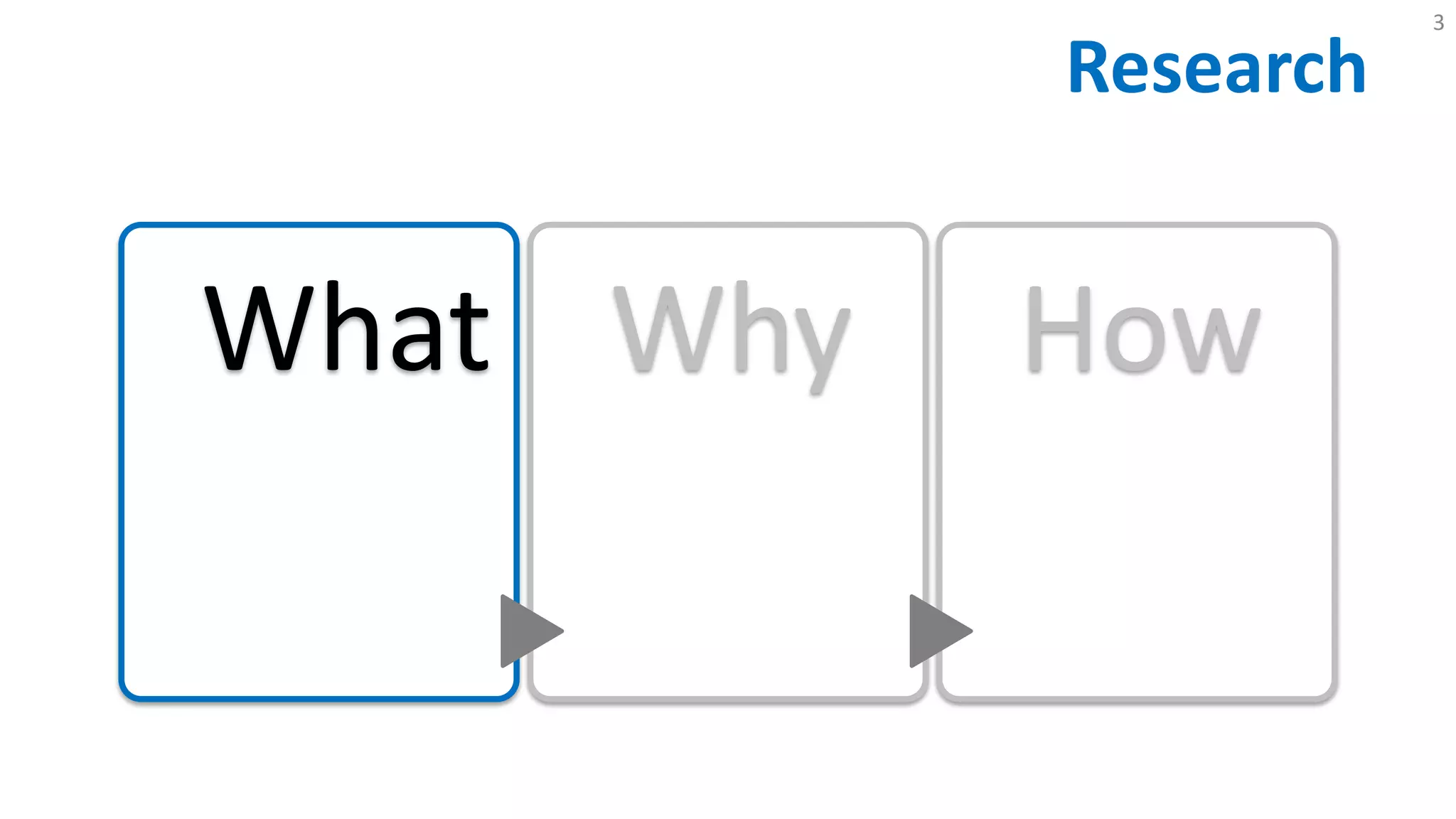
What Why How
What is Engineering ?
4
 Engineers identify a problem, and come up with a solution – often creating
something completely new in the process.
 Traditionally, engineering is about infrastructure. Engineers were known to create
bridges and vehicles that got us from A to B faster more efficiently. Now engineering is
acknowledged as a discipline that opens up opportunities and creates technology
and products that help make our lives easier.
 Engineers are shaping the future by applying their skills to almost everything you can
think of, from medicine to renewable energy, food technologies to sustainable mining.
There really is no limit to what engineers can do.
Reference: http://www.engineering.unsw.edu.au/what-is-engineering
What is Research ?
5
Solve a Problem.
Do Engineering.
We do research everyday.
But our eyes are closed hence we could not notice it.
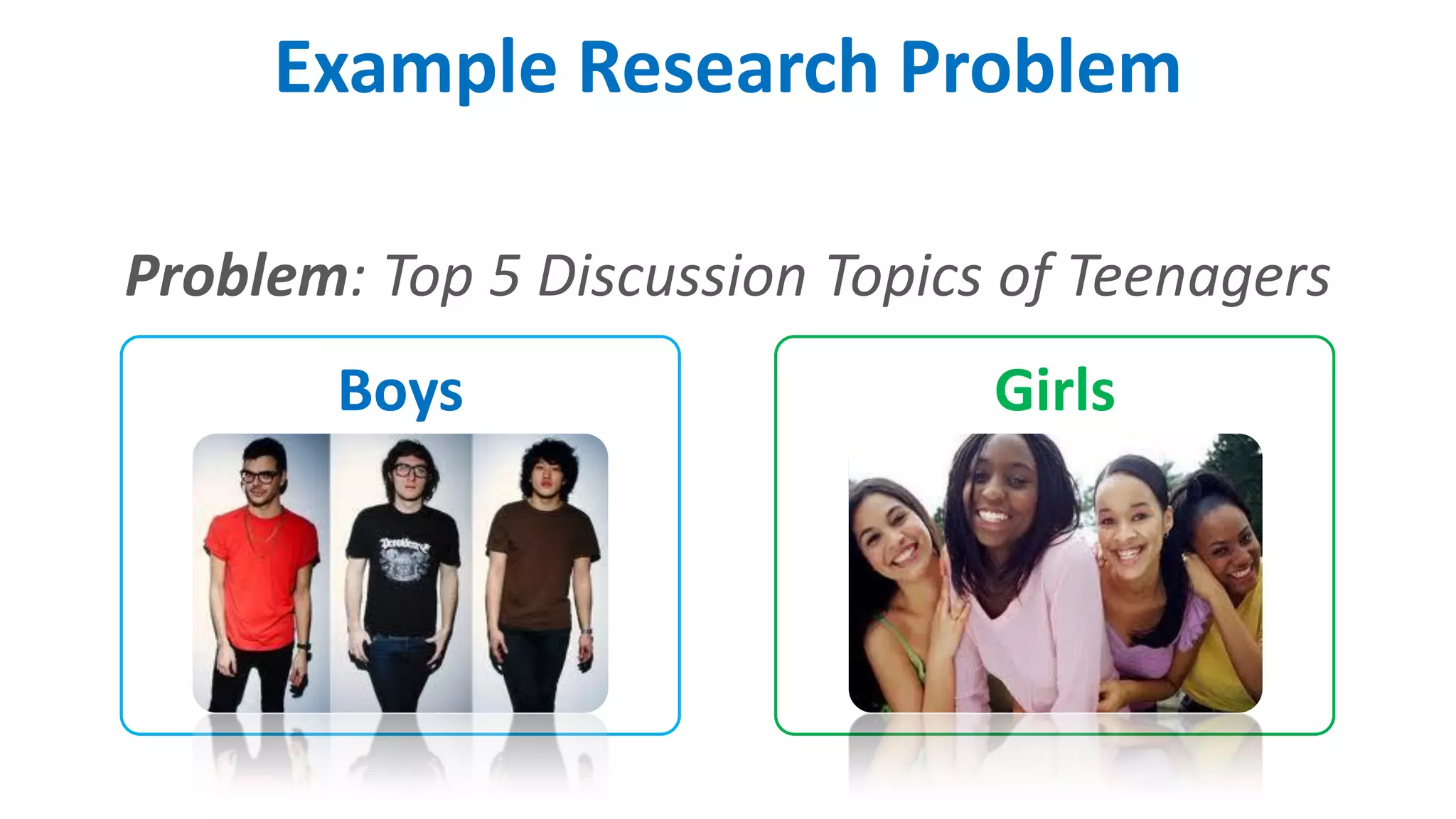
GirlsBoys
Example Research Problem
Problem: Top 5 Discussion Topics of Teenagers
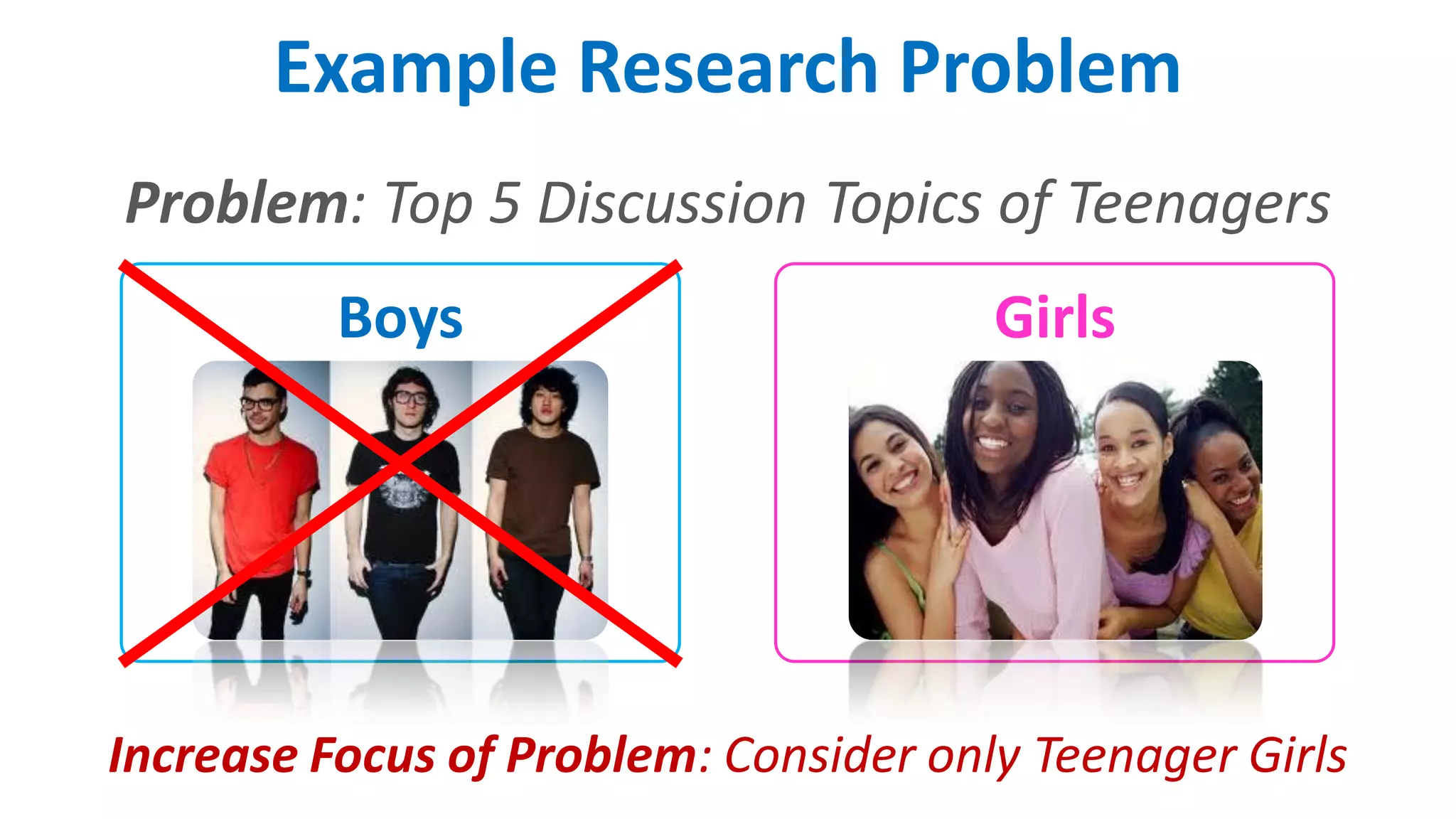
GirlsBoys
Example Research Problem
Problem: Top 5 Discussion Topics of Teenagers
Increase Focus of Problem: Consider only Teenager Girls
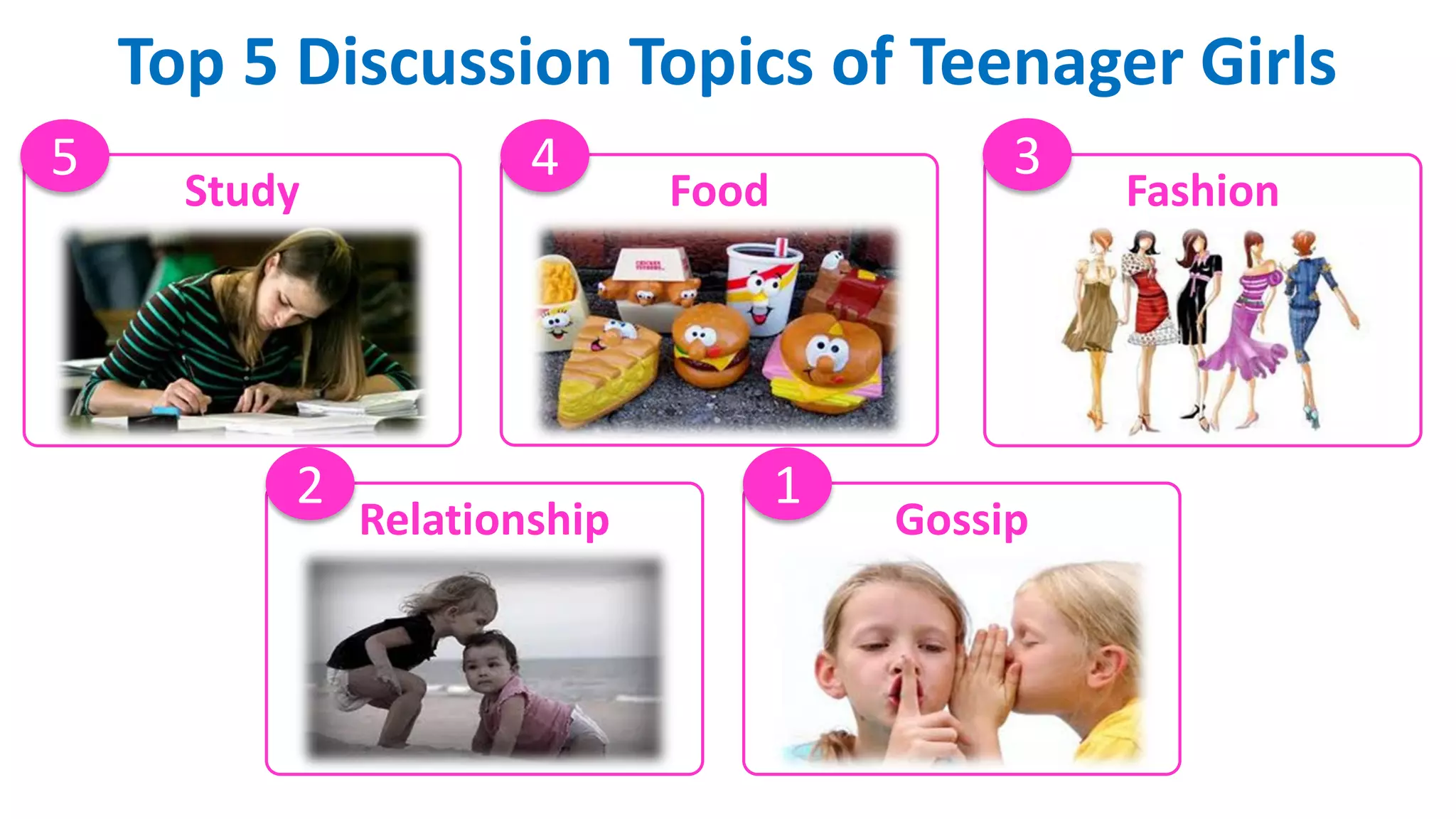
Top 5 Discussion Topics of Teenager Girls
1 2 3
4 5
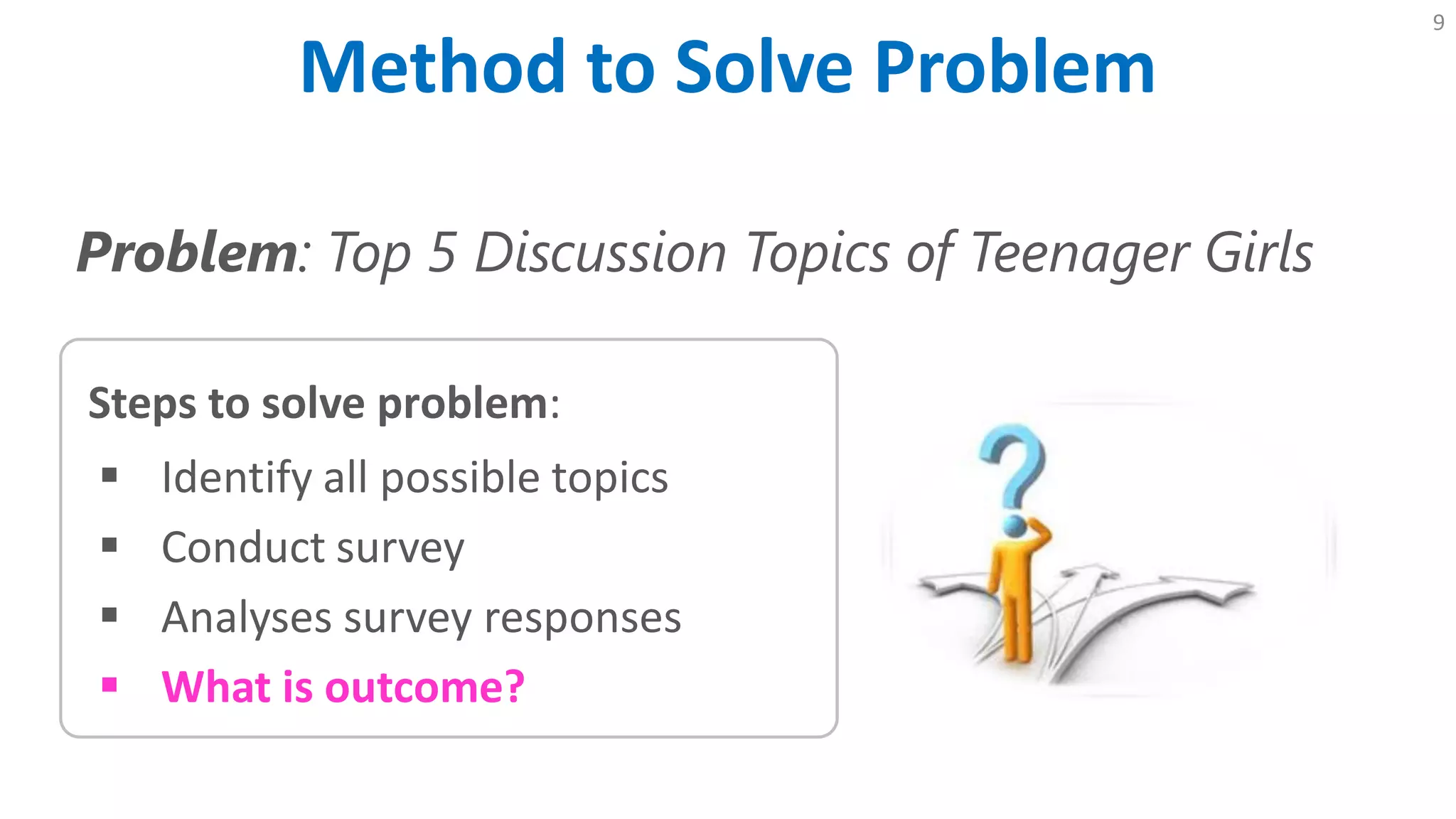
Method to Solve Problem
9
Problem: Top 5 Discussion Topics of Teenager Girls
Steps to solve problem:
 Identify all possible topics
 Conduct survey
 Analyses survey responses
 What is outcome?
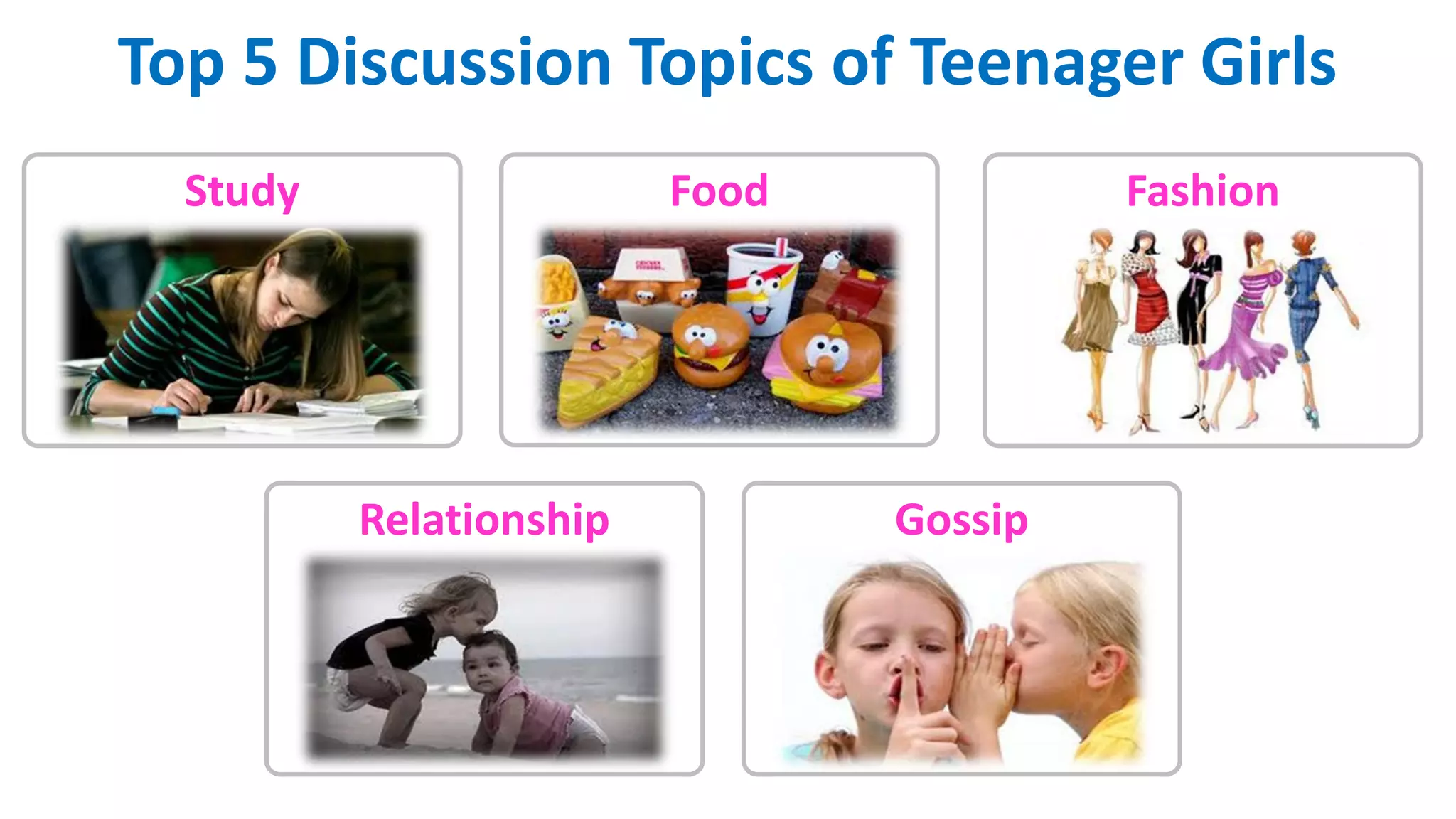
Top 5 Discussion Topics of Teenager Girls
Study Food Fashion
Relationship Gossip
Top 5 Discussion Topics of Teenager Girls
Study Food Fashion
Relationship Gossip
12
345
Research
12
What Why How
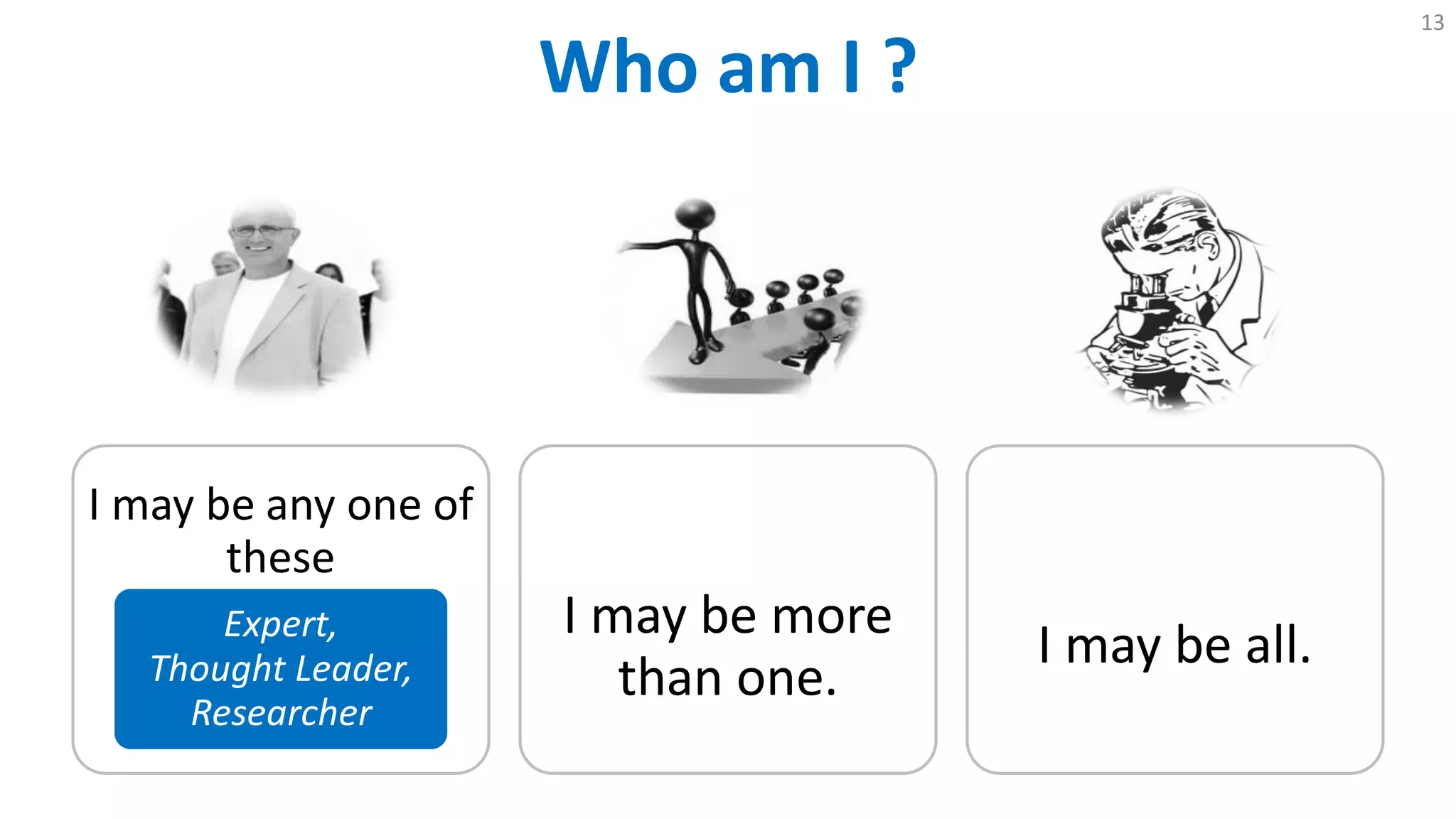
Who am I ?
13
I may be any one of
these
Expert,
Thought Leader,
Researcher
I may be more
than one.
I may be all.
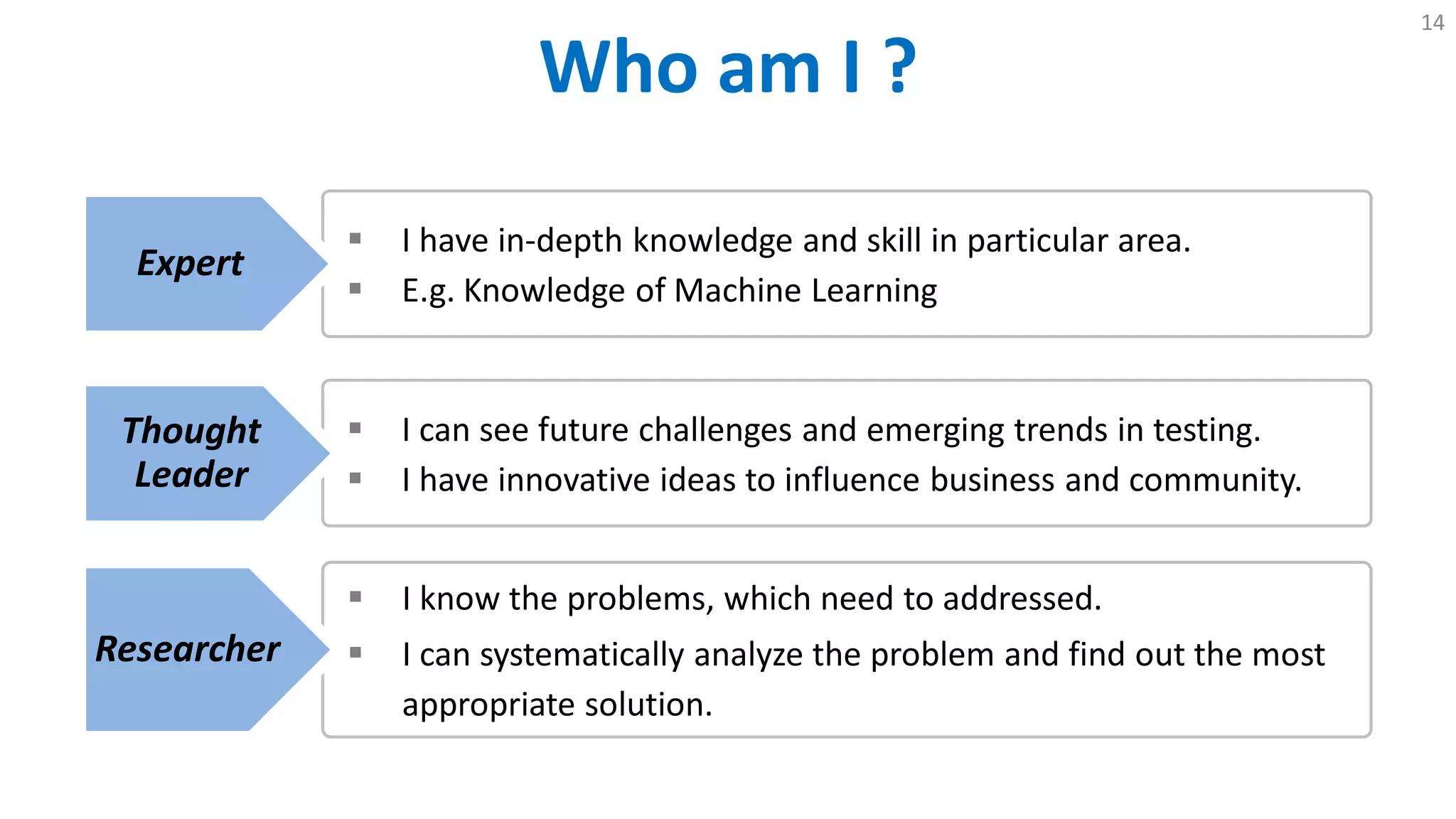
 I can see future challenges and emerging trends in testing.
 I have innovative ideas to influence business and community.
 I have in-depth knowledge and skill in particular area.
 E.g. Knowledge of Machine Learning
Who am I ?
14
 I know the problems, which need to addressed.
 I can systematically analyze the problem and find out the most
appropriate solution.
Expert
Thought
Leader
Researcher
Knowledge and IT Industry
15
 IT industry is knowledge based business.
 IT project/product development is a team work.
 One has to collaborate within team/organization/outside-
organization to complete task/solve problems/write cases etc.
 In this process knowledge is generated.
Knowledge: Share & publish
16
Knowledge should be shared.
PublishHow to share?
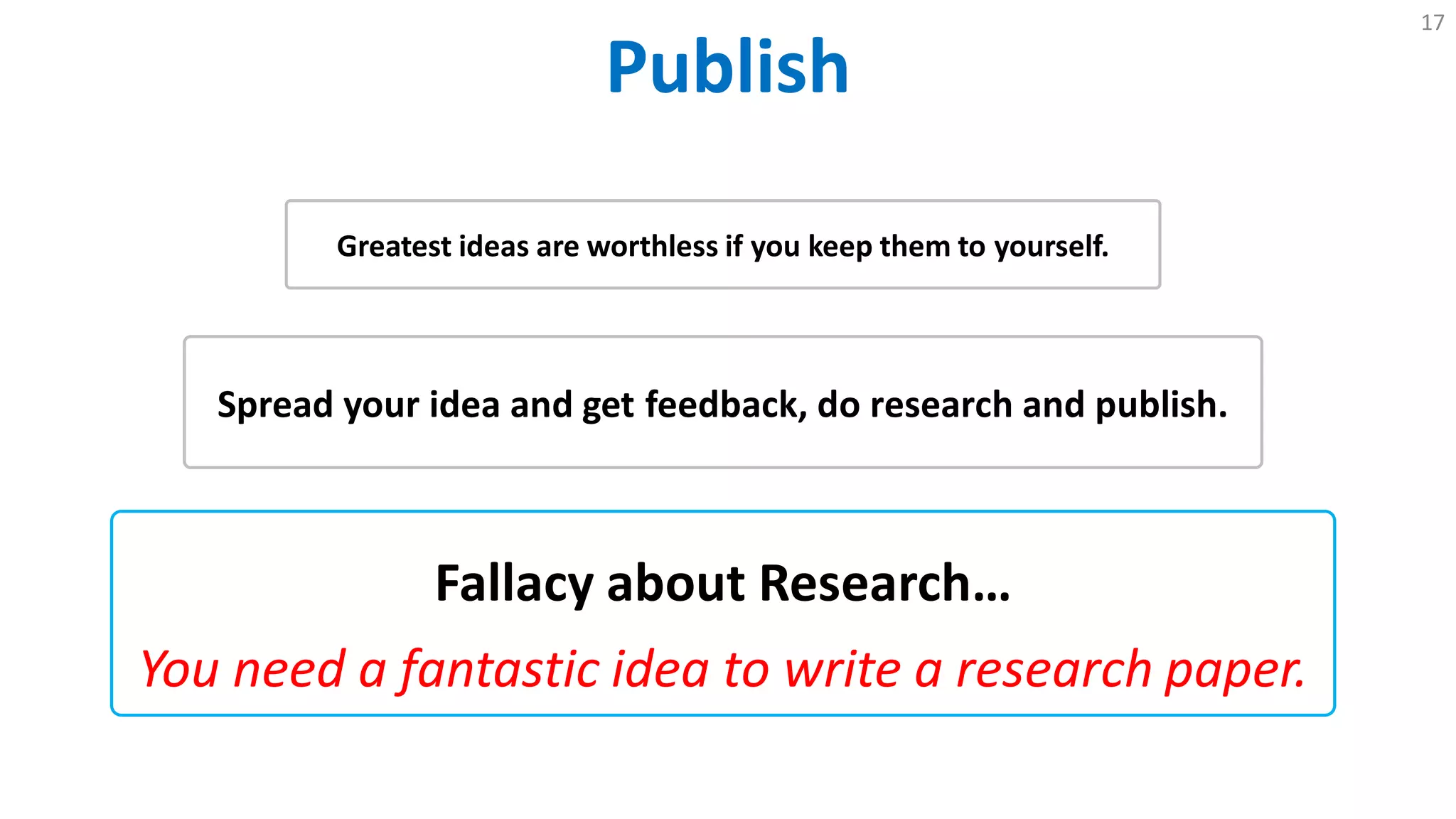
Publish
17
Fallacy about Research…
You need a fantastic idea to write a research paper.
Greatest ideas are worthless if you keep them to yourself.
Spread your idea and get feedback, do research and publish.
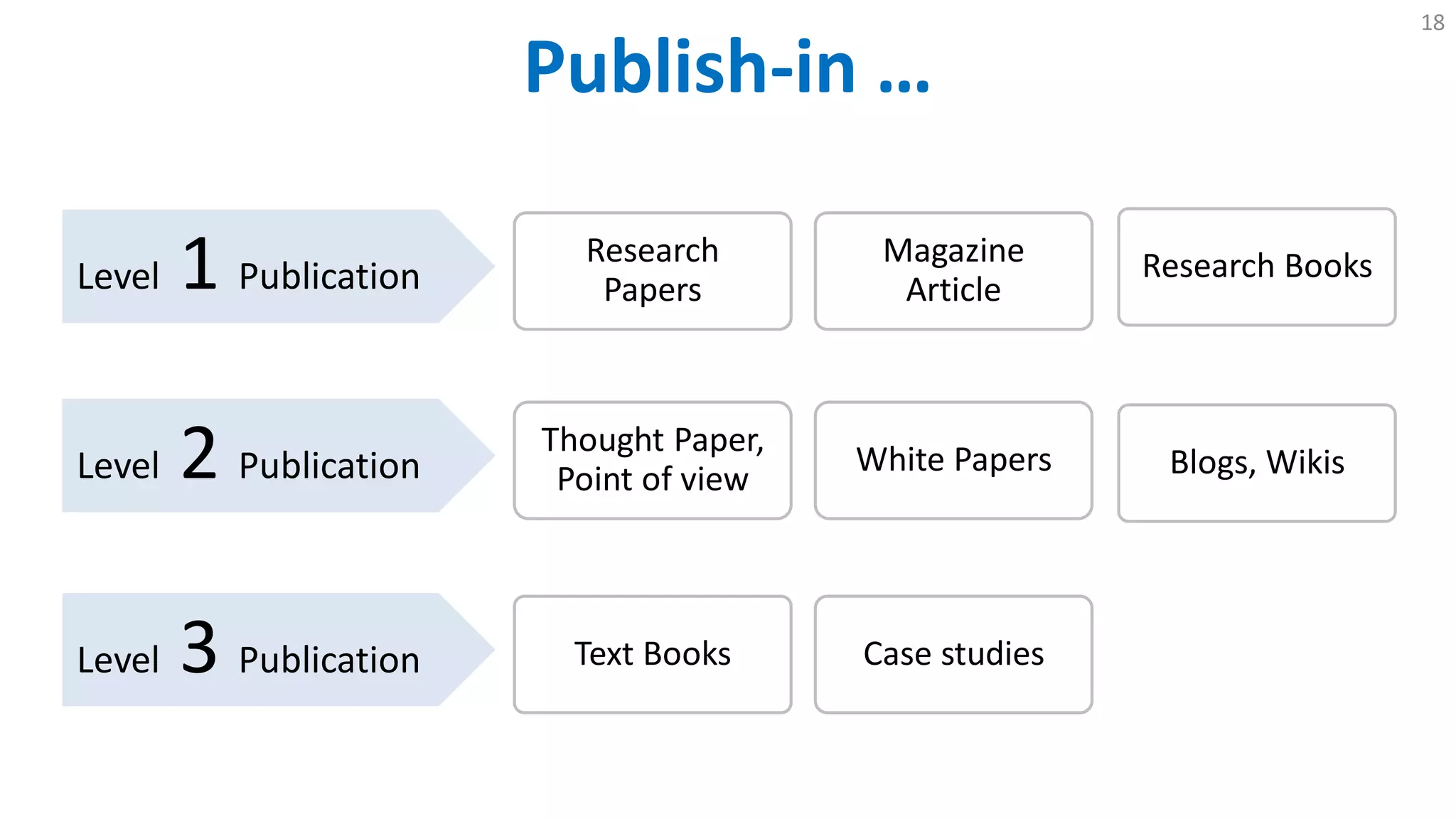
Publish-in …
18
Research
Papers
Research BooksMagazine
Article
Case studies
Thought Paper,
Point of view
White Papers Blogs, Wikis
Text Books
Level 1 Publication
Level 2 Publication
Level 3 Publication
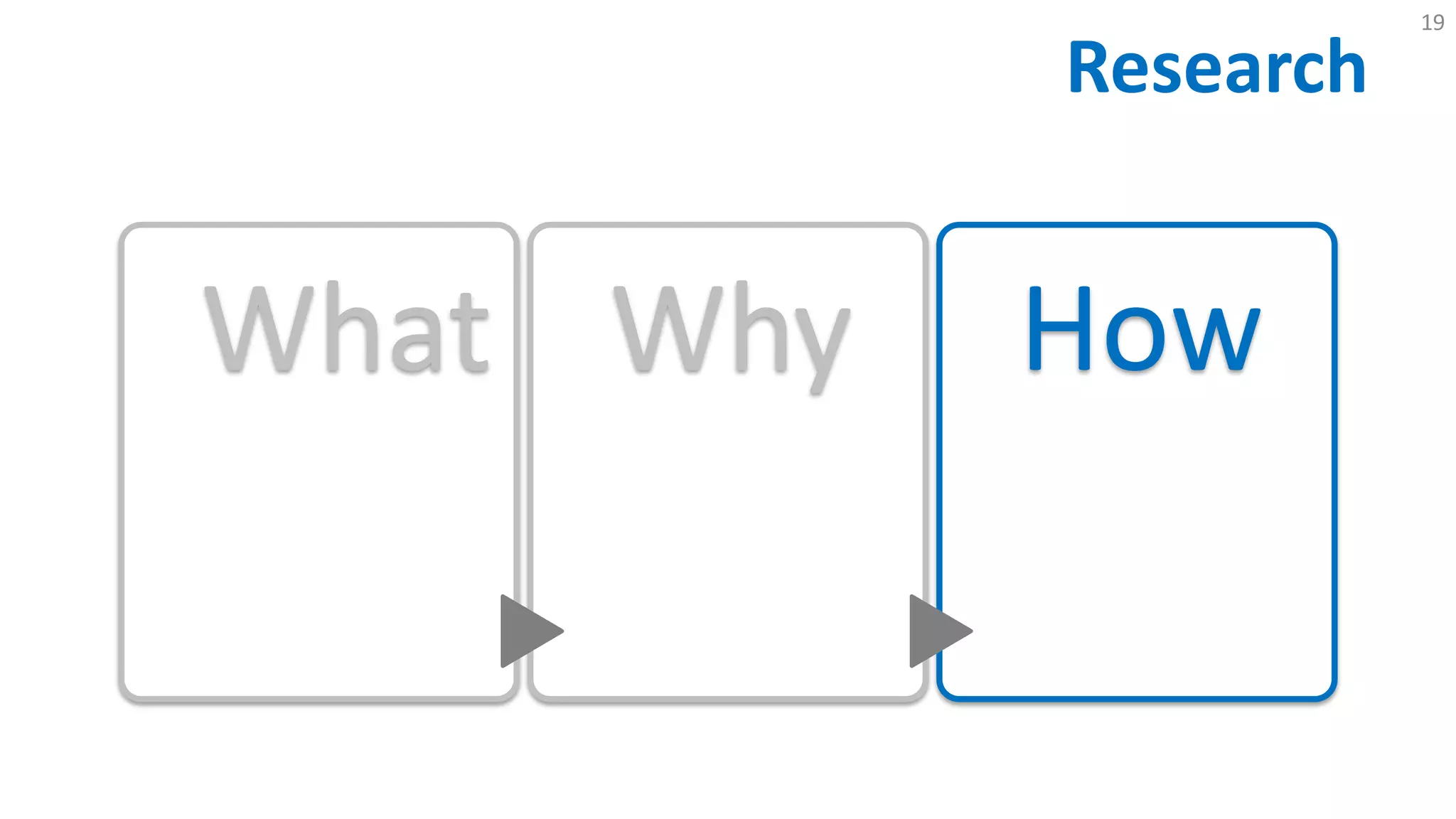
Research
19
What Why How
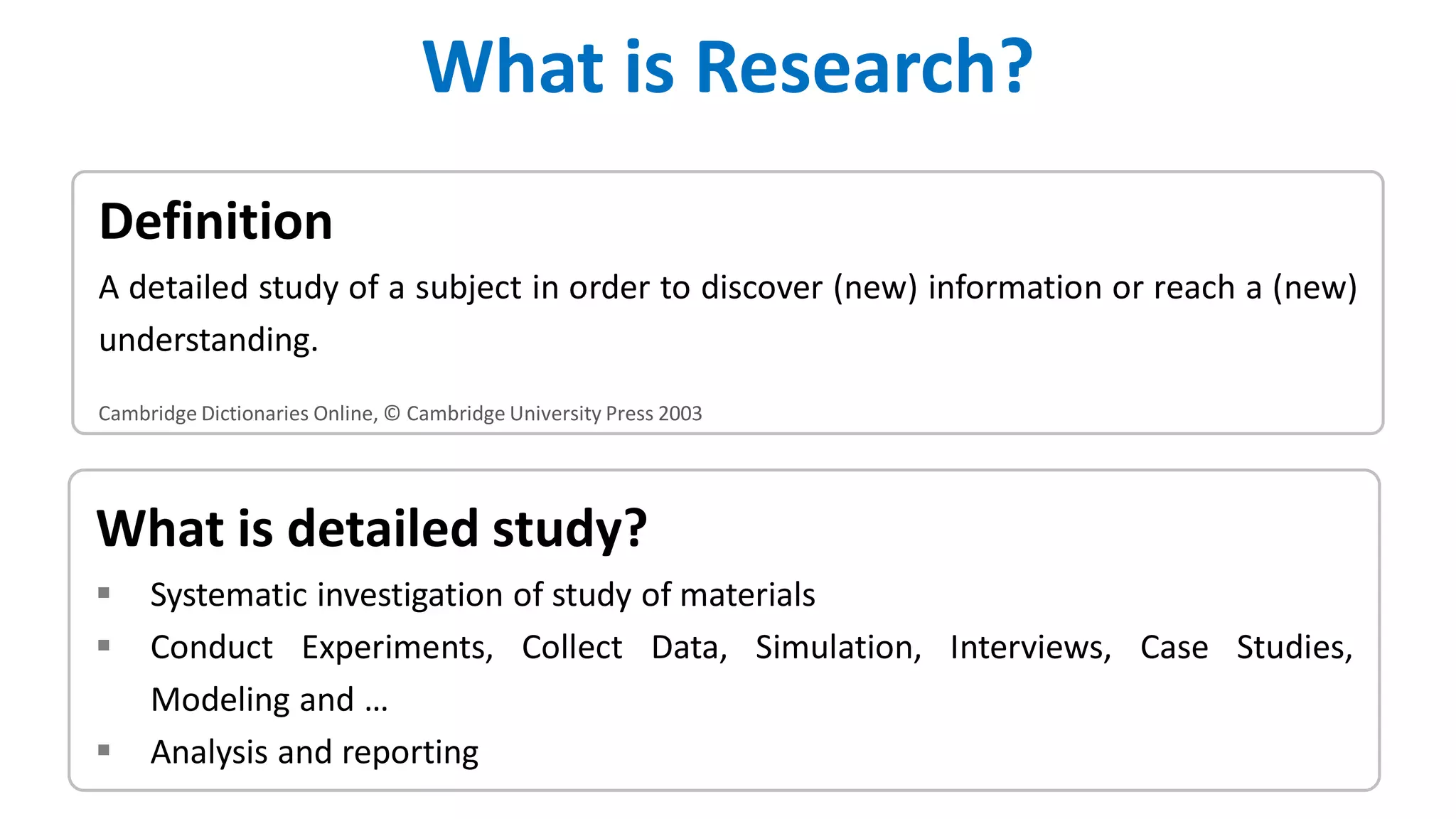
What is detailed study?
 Systematic investigation of study of materials
 Conduct Experiments, Collect Data, Simulation, Interviews, Case Studies,
Modeling and …
 Analysis and reporting
Definition
A detailed study of a subject in order to discover (new) information or reach a (new)
understanding.
Cambridge Dictionaries Online, © Cambridge University Press 2003
What is Research?
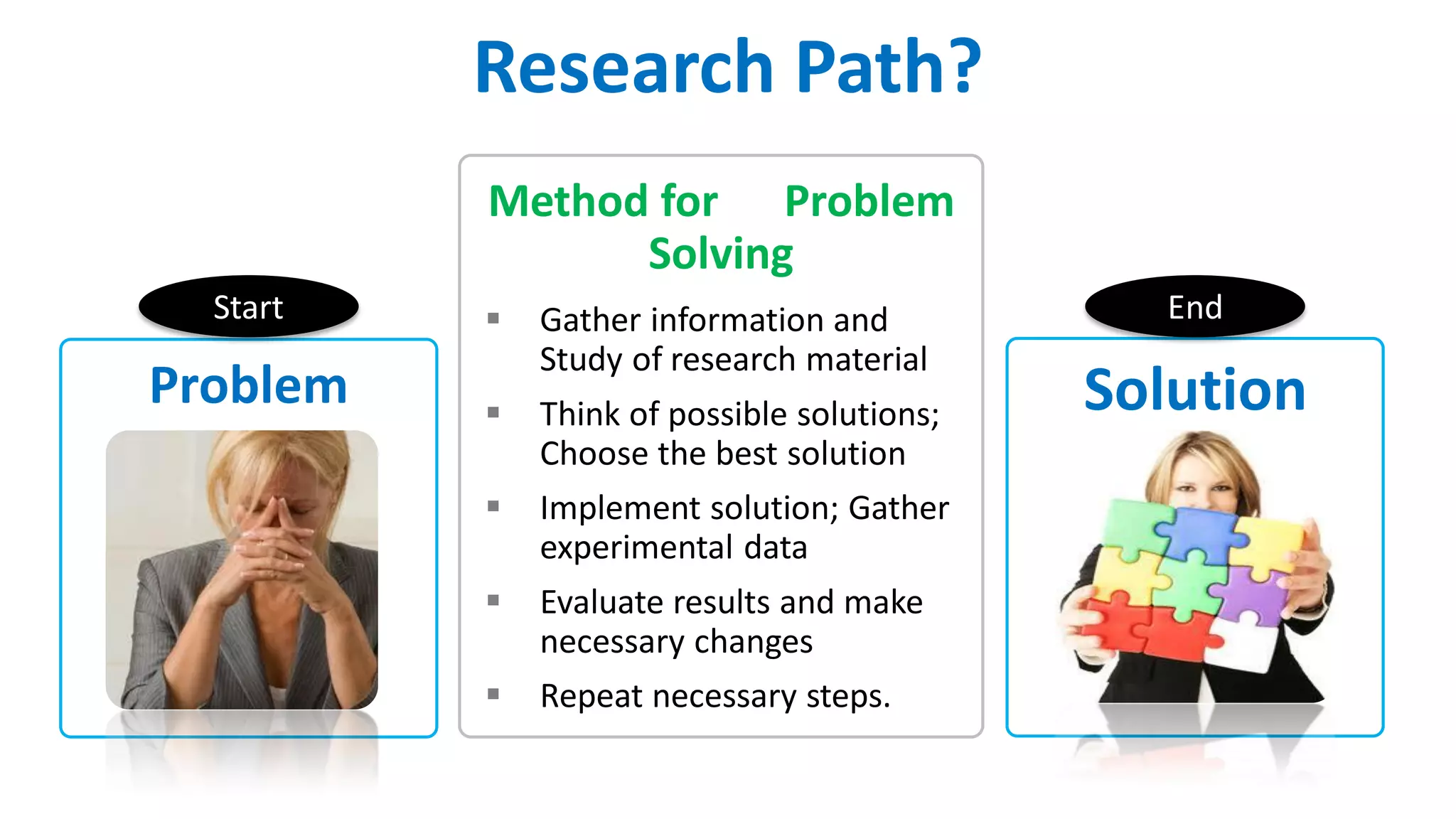
Method for Problem
Solving
 Gather information and
Study of research material
 Think of possible solutions;
Choose the best solution
 Implement solution; Gather
experimental data
 Evaluate results and make
necessary changes
 Repeat necessary steps.
SolutionProblem
Research Path?
Start End
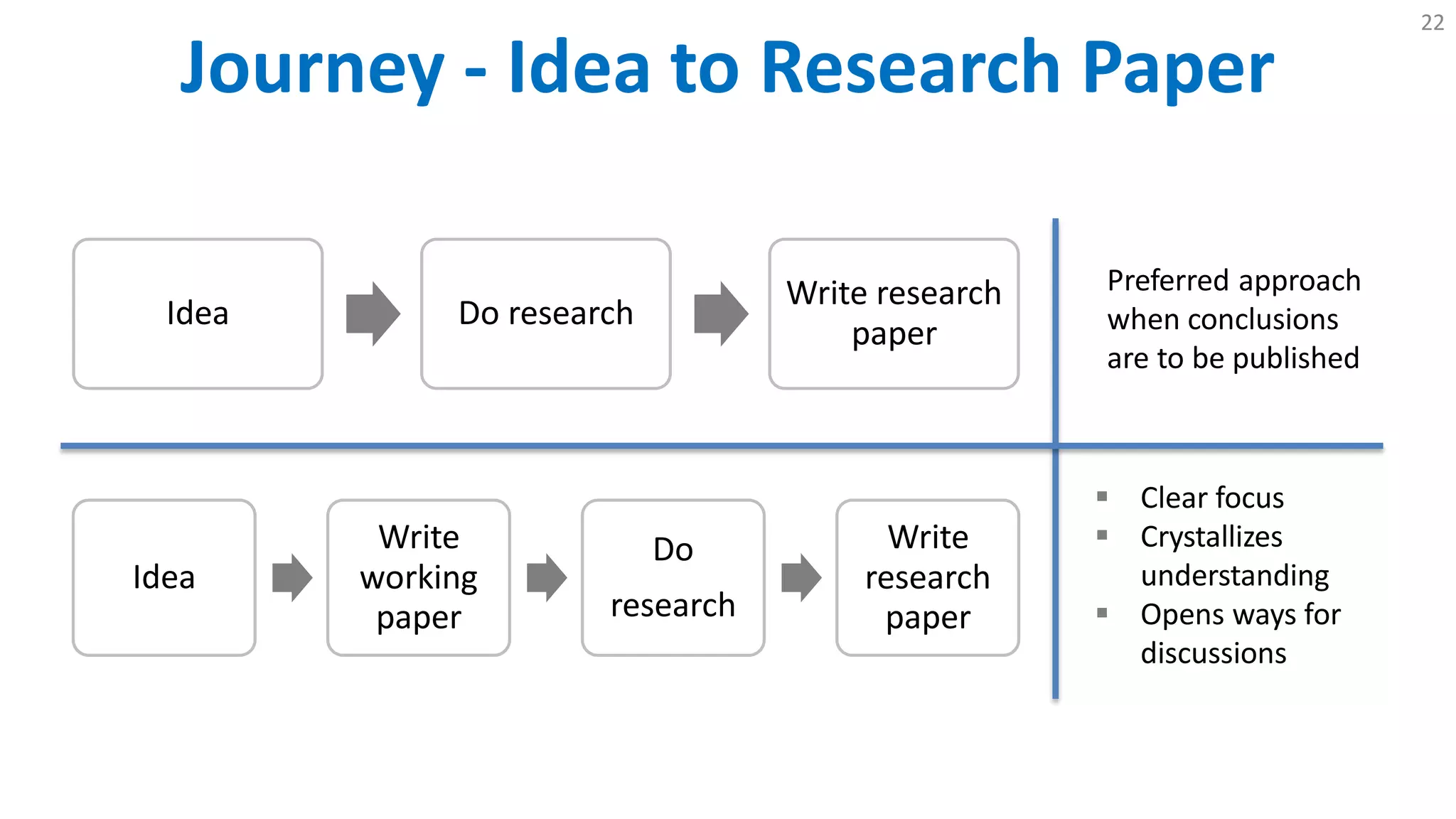
Journey - Idea to Research Paper
22
Idea Do research
Write research
paper
Idea
Write
working
paper
Do
research
Write
research
paper
 Clear focus
 Crystallizes
understanding
 Opens ways for
discussions
Preferred approach
when conclusions
are to be published
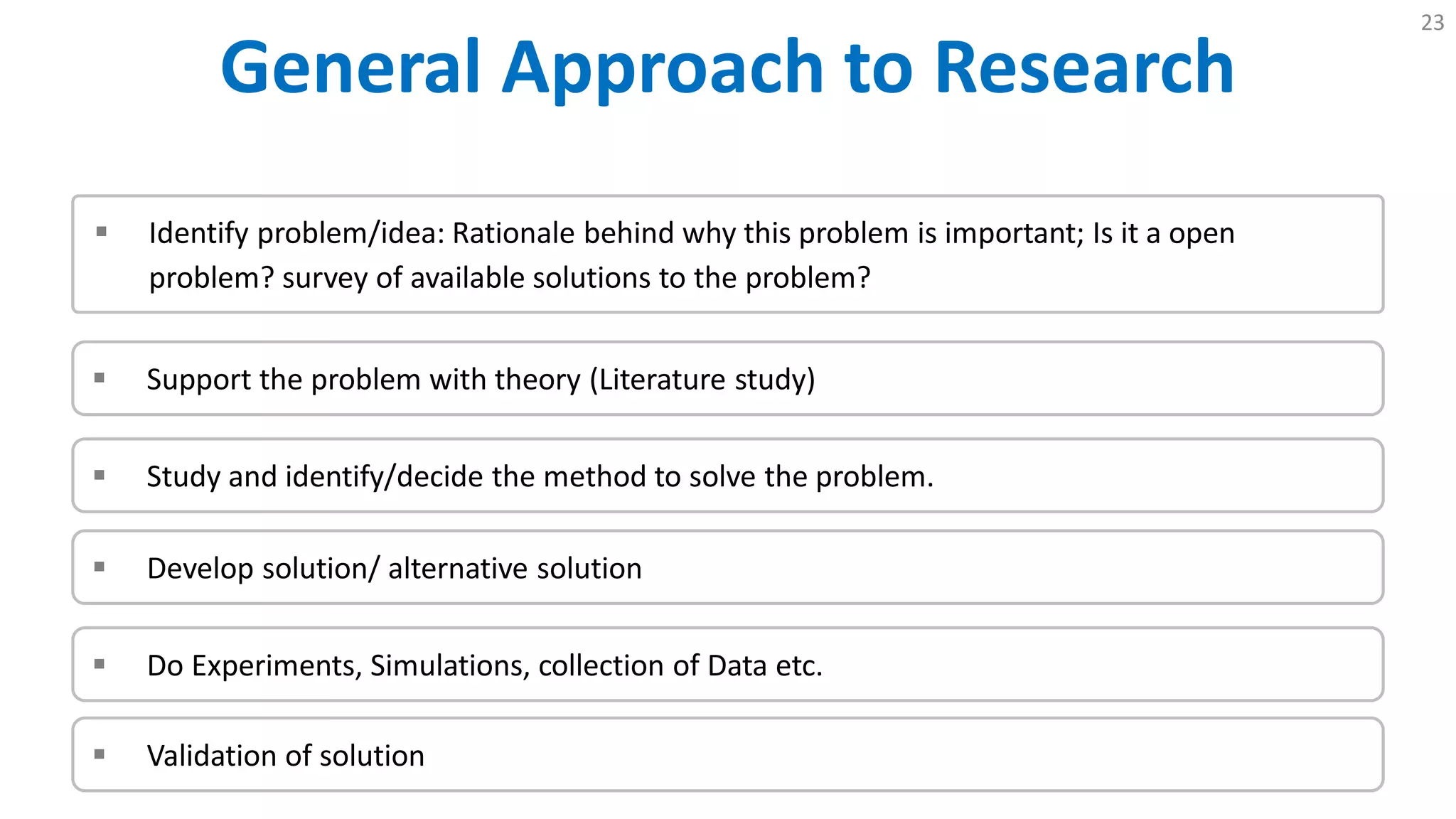
General Approach to Research
23
 Identify problem/idea: Rationale behind why this problem is important; Is it a open
problem? survey of available solutions to the problem?
 Support the problem with theory (Literature study)
 Study and identify/decide the method to solve the problem.
 Develop solution/ alternative solution
 Do Experiments, Simulations, collection of Data etc.
 Validation of solution
24
Research Methods
& Results
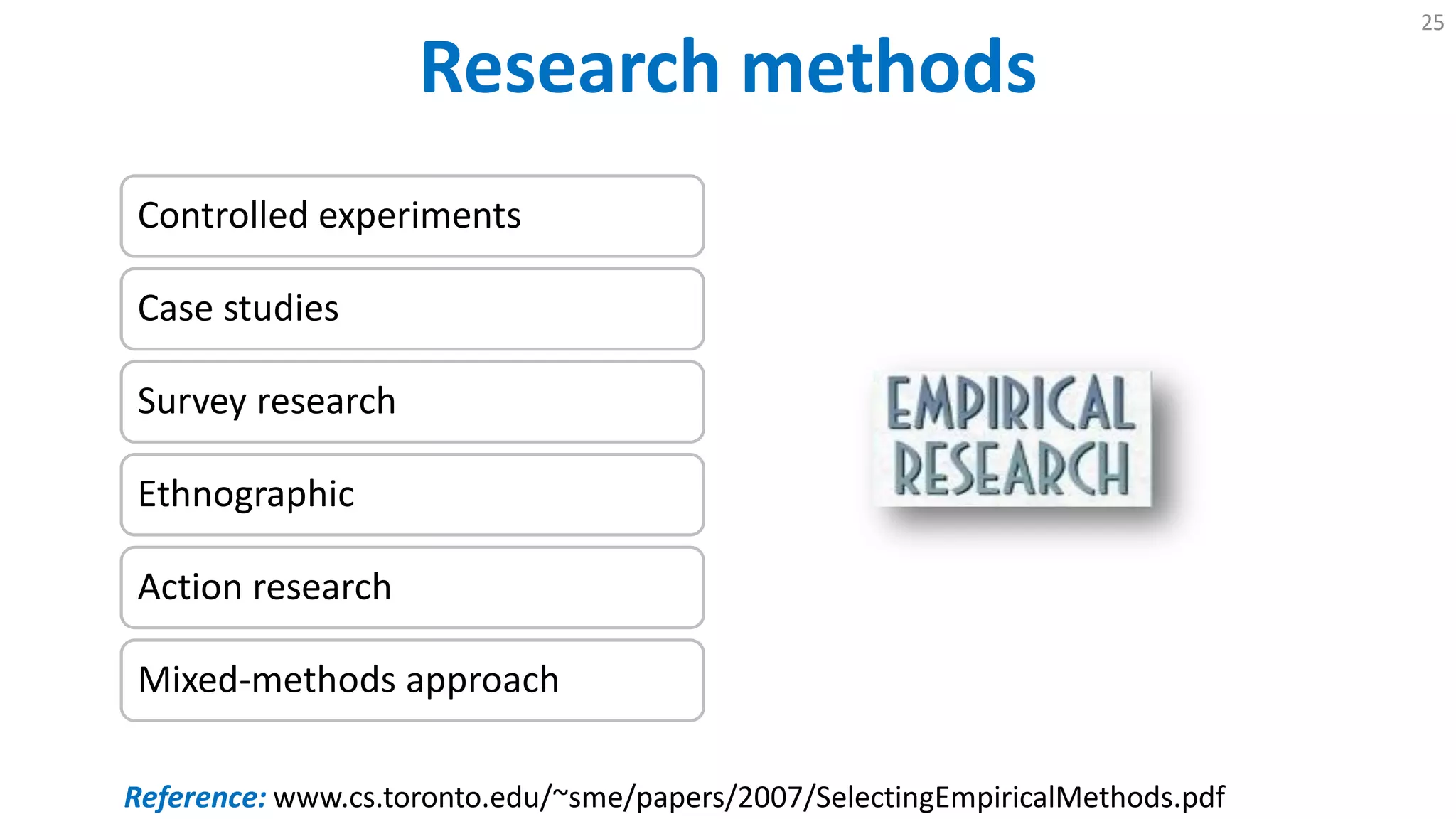
Research Methods
25
Controlled experiments
Case studies
Survey research
Ethnographic
Action research
Mixed-methods approach
Reference: www.cs.toronto.edu/~sme/papers/2007/SelectingEmpiricalMethods.pdf
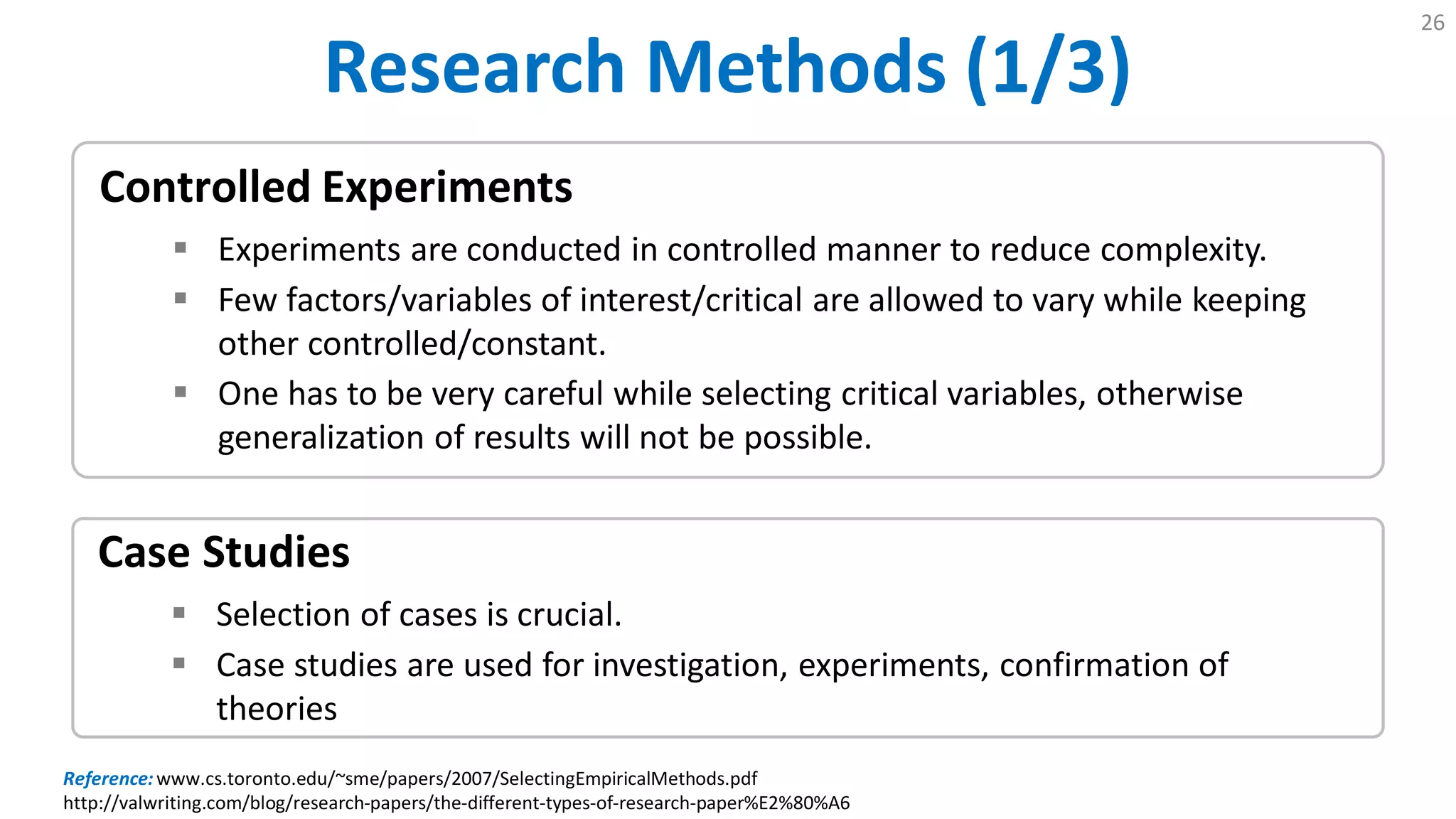
Research Methods (1/3)
26
Case Studies
 Selection of cases is crucial.
 Case studies are used for investigation, experiments, confirmation of
theories
Controlled Experiments
 Experiments are conducted in controlled manner to reduce complexity.
 Few factors/variables of interest/critical are allowed to vary while keeping
other controlled/constant.
 One has to be very careful while selecting critical variables, otherwise
generalization of results will not be possible.
Reference:www.cs.toronto.edu/~sme/papers/2007/SelectingEmpiricalMethods.pdf
http://valwriting.com/blog/research-papers/the-different-types-of-research-paper%E2%80%A6
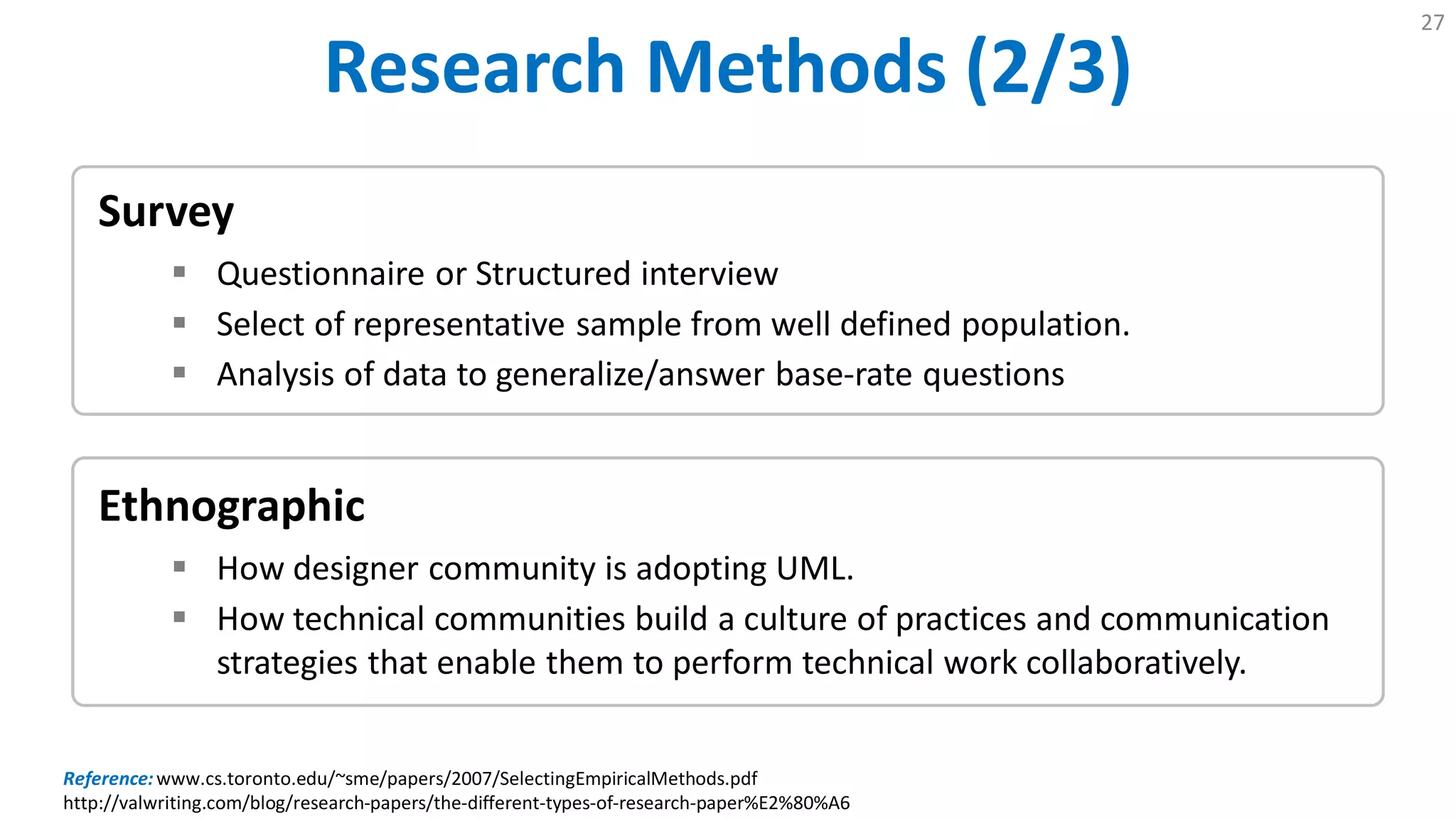
Research Methods (2/3)
27
Ethnographic
 How designer community is adopting UML.
 How technical communities build a culture of practices and communication
strategies that enable them to perform technical work collaboratively.
Survey
 Questionnaire or Structured interview
 Select of representative sample from well defined population.
 Analysis of data to generalize/answer base-rate questions
Reference:www.cs.toronto.edu/~sme/papers/2007/SelectingEmpiricalMethods.pdf
http://valwriting.com/blog/research-papers/the-different-types-of-research-paper%E2%80%A6
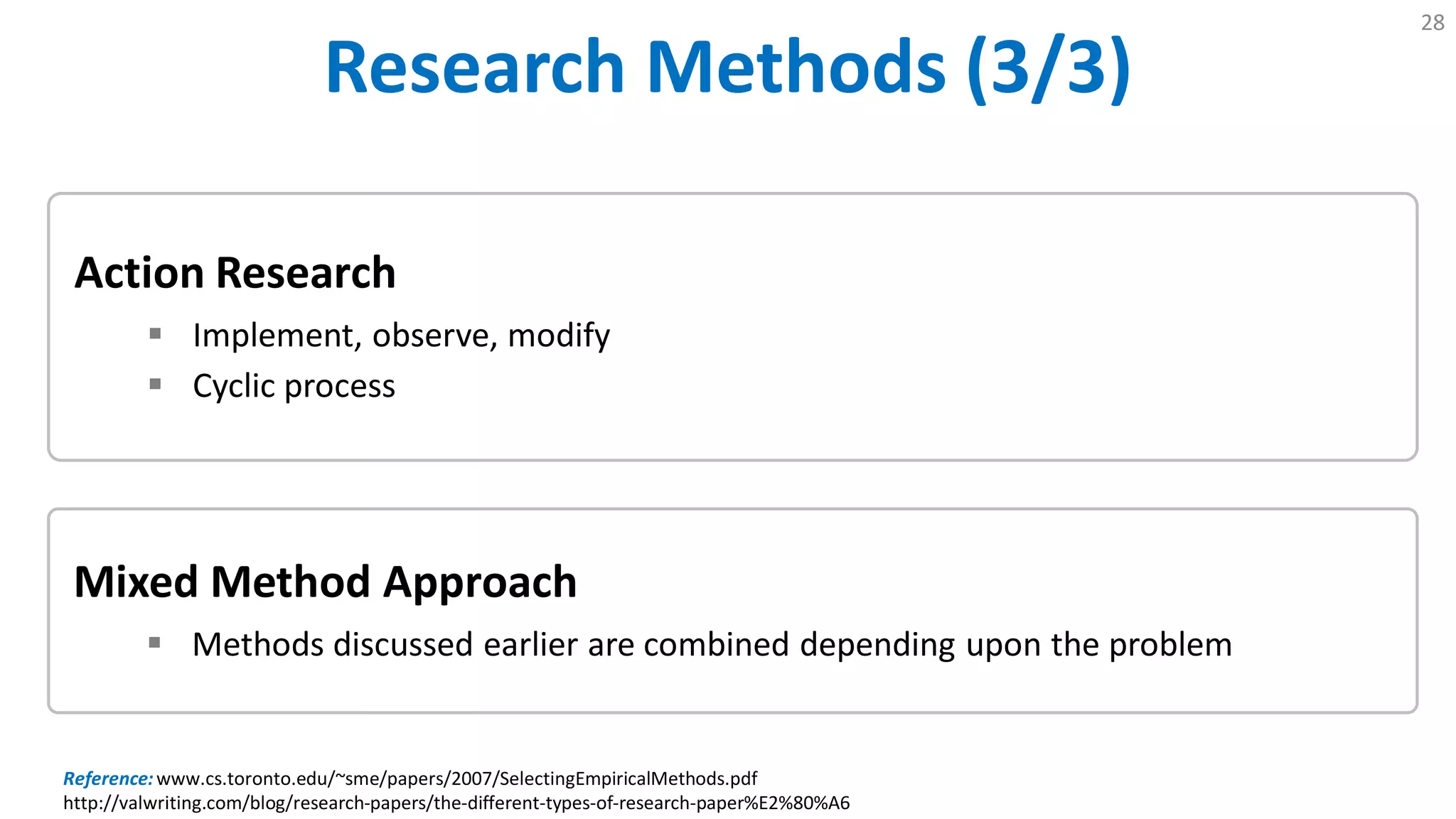
Research Methods (3/3)
28
Mixed Method Approach
 Methods discussed earlier are combined depending upon the problem
Action Research
 Implement, observe, modify
 Cyclic process
Reference:www.cs.toronto.edu/~sme/papers/2007/SelectingEmpiricalMethods.pdf
http://valwriting.com/blog/research-papers/the-different-types-of-research-paper%E2%80%A6
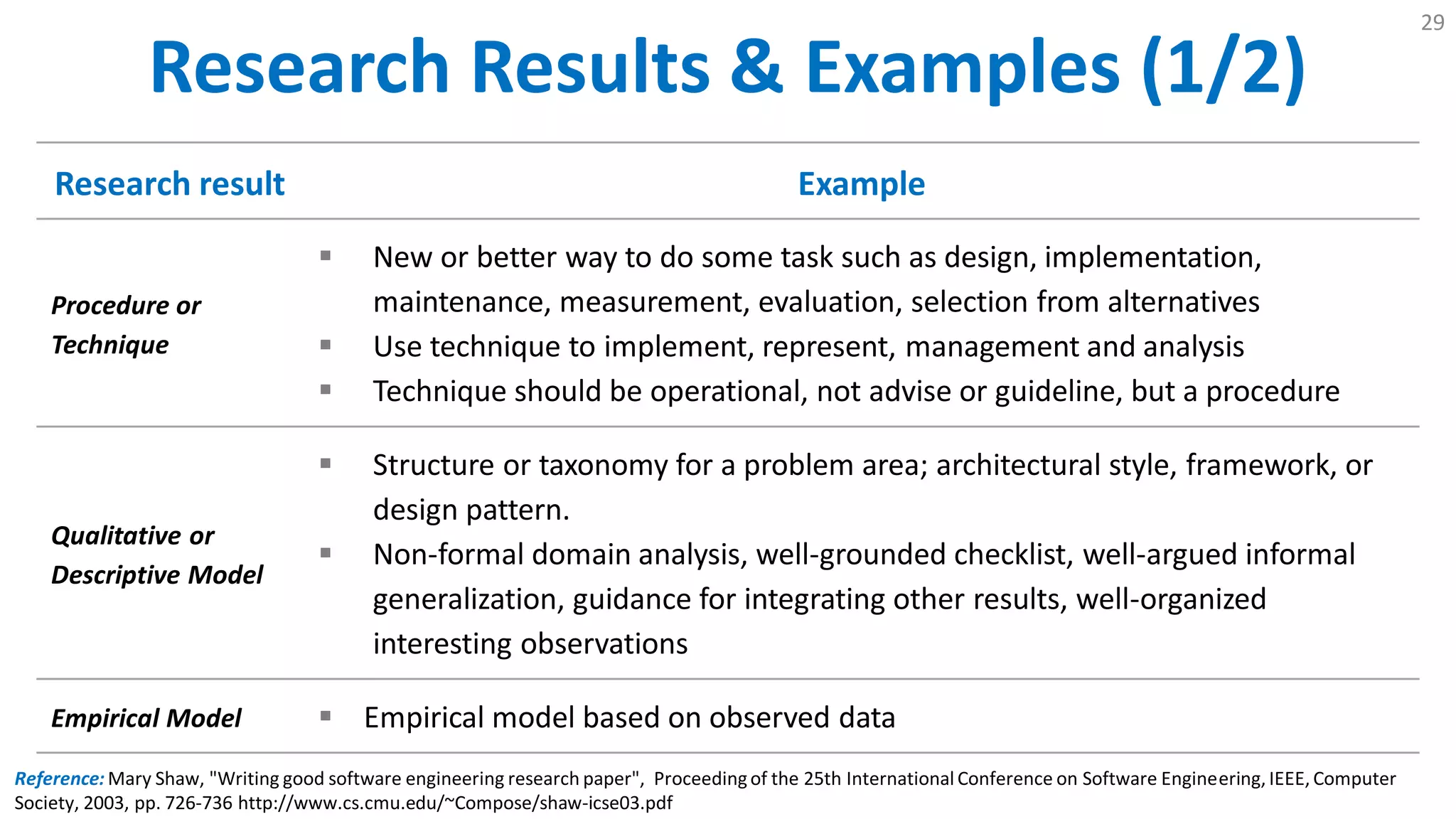
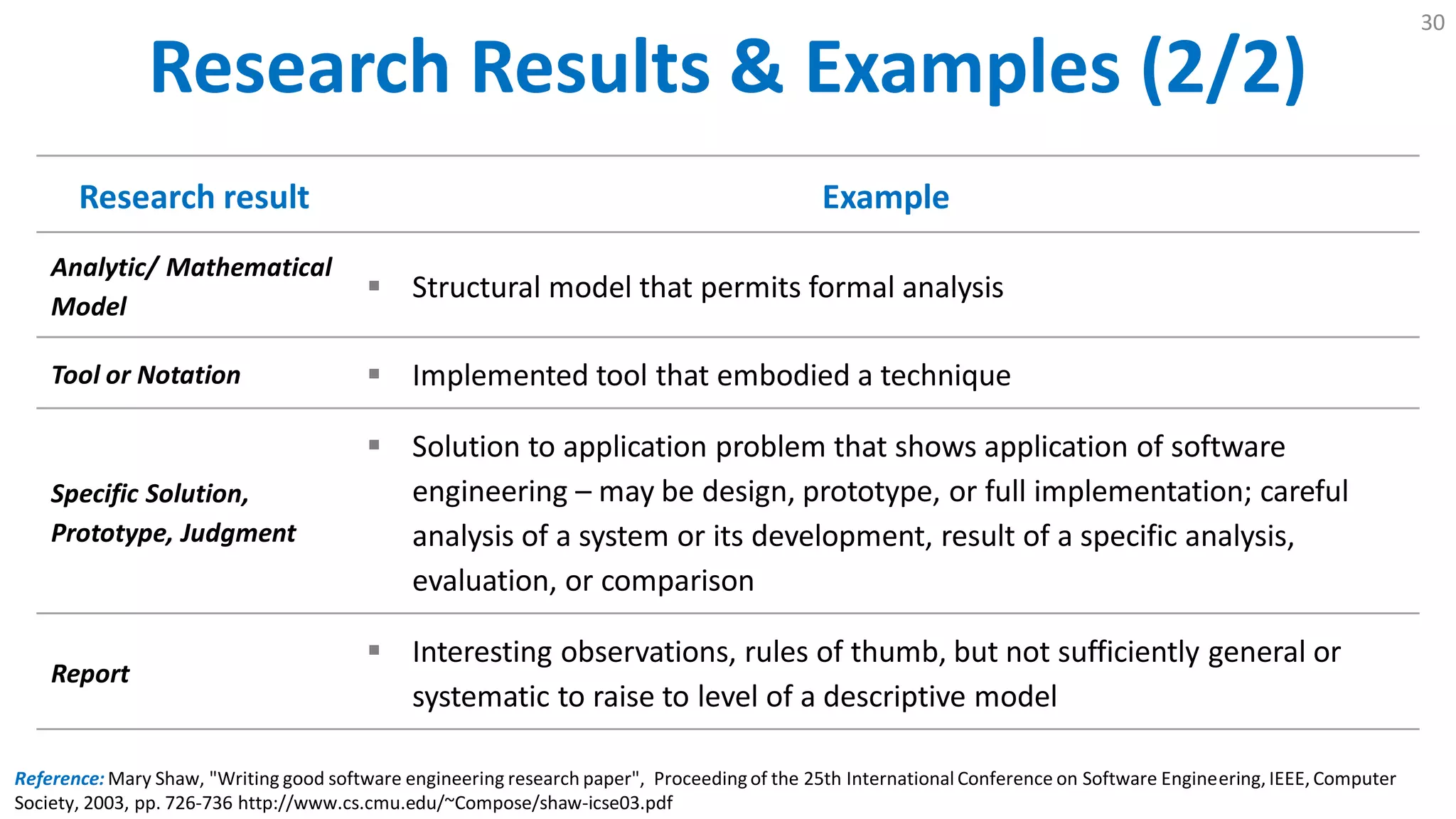
Research Results & Examples (1/2)
29
Research result Example
Procedure or
Technique
 New or better way to do some task such as design, implementation,
maintenance, measurement, evaluation, selection from alternatives
 Use technique to implement, represent, management and analysis
 Technique should be operational, not advise or guideline, but a procedure
Qualitative or
Descriptive Model
 Structure or taxonomy for a problem area; architectural style, framework, or
design pattern.
 Non-formal domain analysis, well-grounded checklist, well-argued informal
generalization, guidance for integrating other results, well-organized
interesting observations
Empirical Model  Empirical model based on observed data
Reference: Mary Shaw, "Writing good software engineering research paper", Proceedingof the 25th International Conference on Software Engineering, IEEE, Computer
Society, 2003, pp. 726-736 http://www.cs.cmu.edu/~Compose/shaw-icse03.pdf
Research Results & Examples (2/2)
30
Research result Example
Analytic/ Mathematical
Model
 Structural model that permits formal analysis
Tool or Notation  Implemented tool that embodied a technique
Specific Solution,
Prototype, Judgment
 Solution to application problem that shows application of software
engineering – may be design, prototype, or full implementation; careful
analysis of a system or its development, result of a specific analysis,
evaluation, or comparison
Report
 Interesting observations, rules of thumb, but not sufficiently general or
systematic to raise to level of a descriptive model
Reference: Mary Shaw, "Writing good software engineering research paper", Proceedingof the 25th International Conference on Software Engineering, IEEE, Computer
Society, 2003, pp. 726-736 http://www.cs.cmu.edu/~Compose/shaw-icse03.pdf
31
Research Writing
What is Research Writing ?
32
Is it synonymous to
End-to-end
Story Writing ?
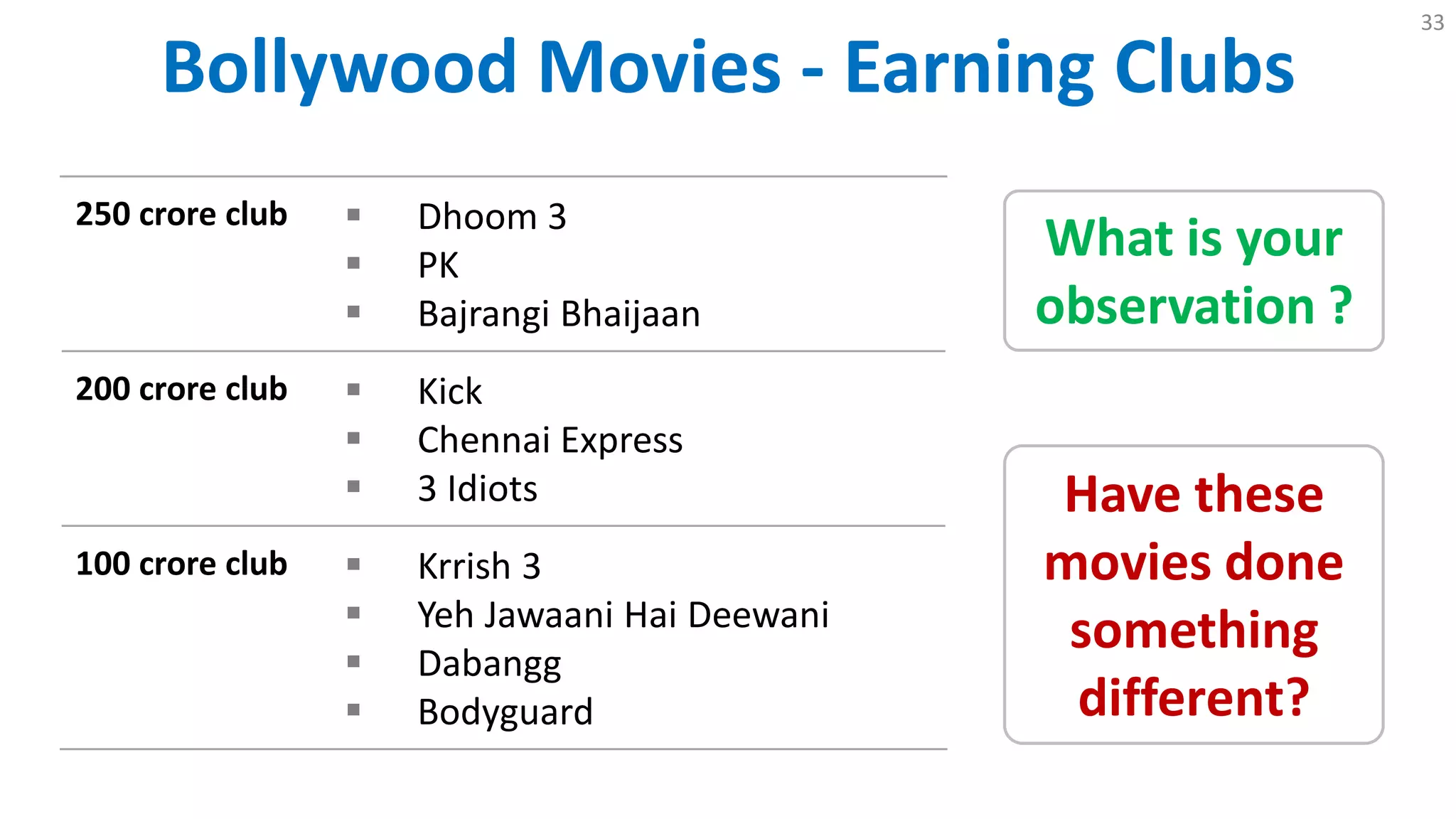
Bollywood Movies - Earning Clubs
33
250 crore club  Dhoom 3
 PK
 Bajrangi Bhaijaan
200 crore club  Kick
 Chennai Express
 3 Idiots
100 crore club  Krrish 3
 Yeh Jawaani Hai Deewani
 Dabangg
 Bodyguard
What is your
observation ?
Have these
movies done
something
different?
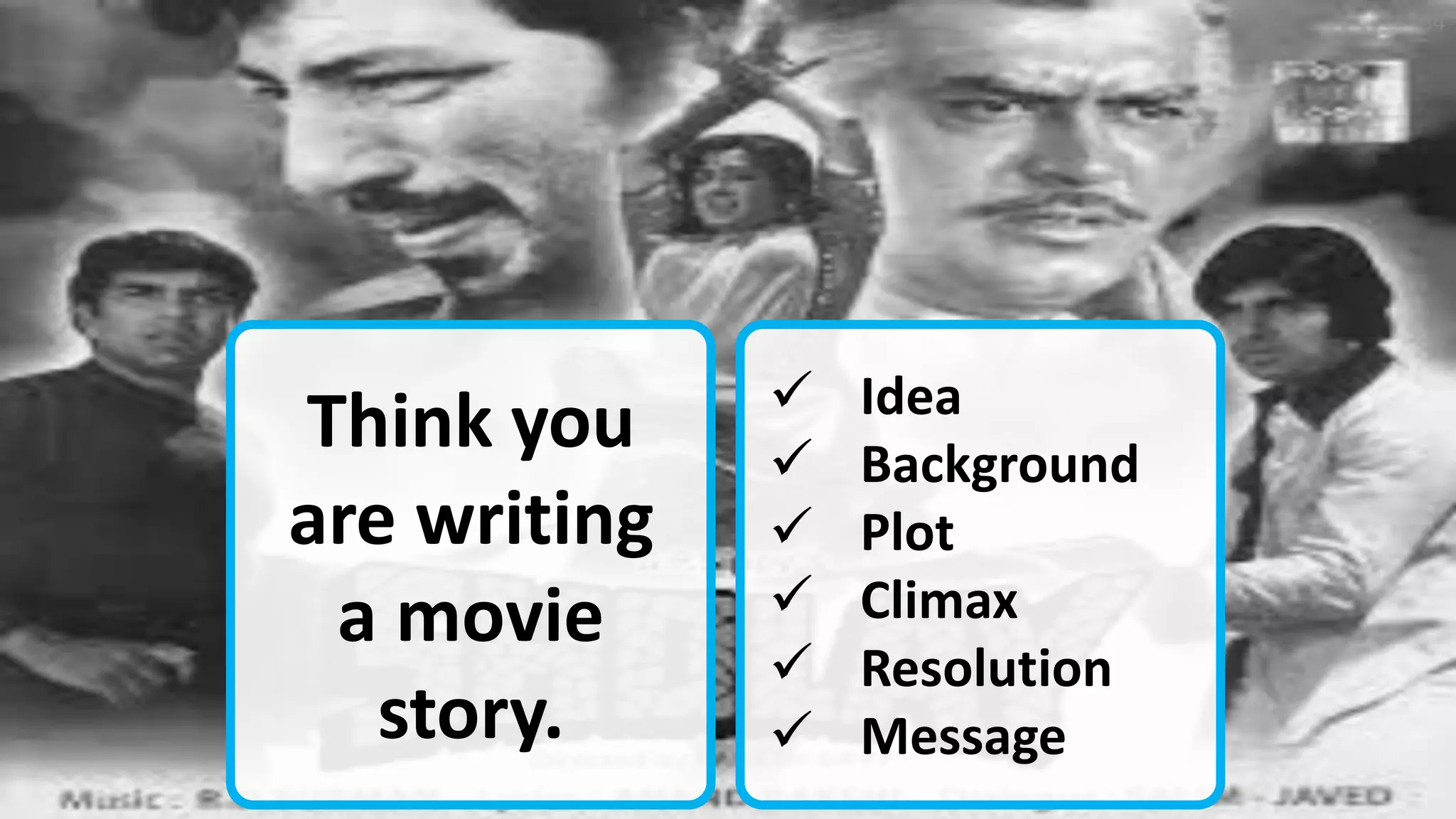
How ? Movie Story Writing
34
 Idea
 Background
 Plot
 Climax
 Resolution
 Message
Think you
are writing
a movie
story.
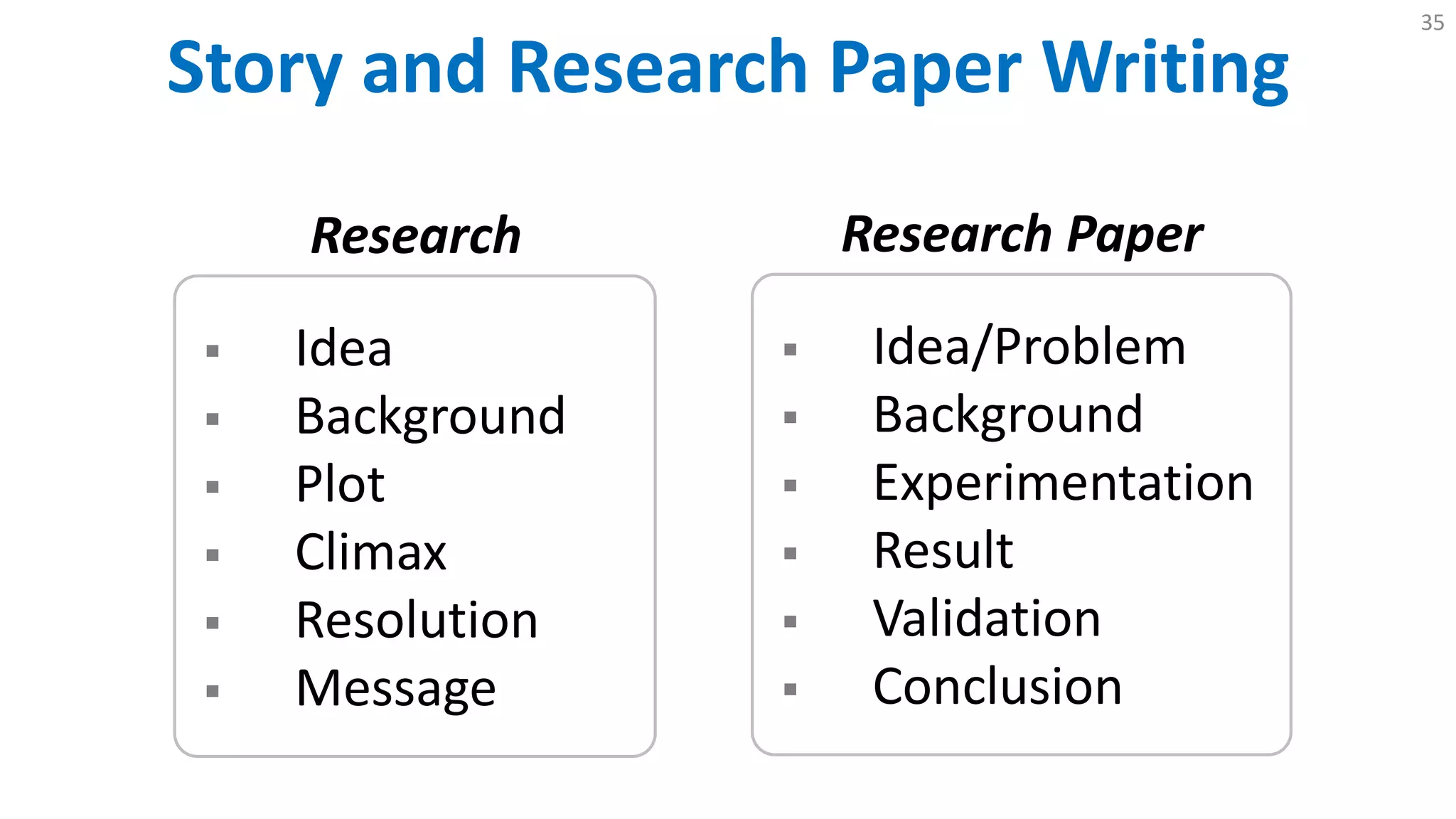
Story and Research Paper Writing
35
Research
 Idea
 Background
 Plot
 Climax
 Resolution
 Message
Research Paper
 Idea/Problem
 Background
 Experimentation
 Result
 Validation
 Conclusion
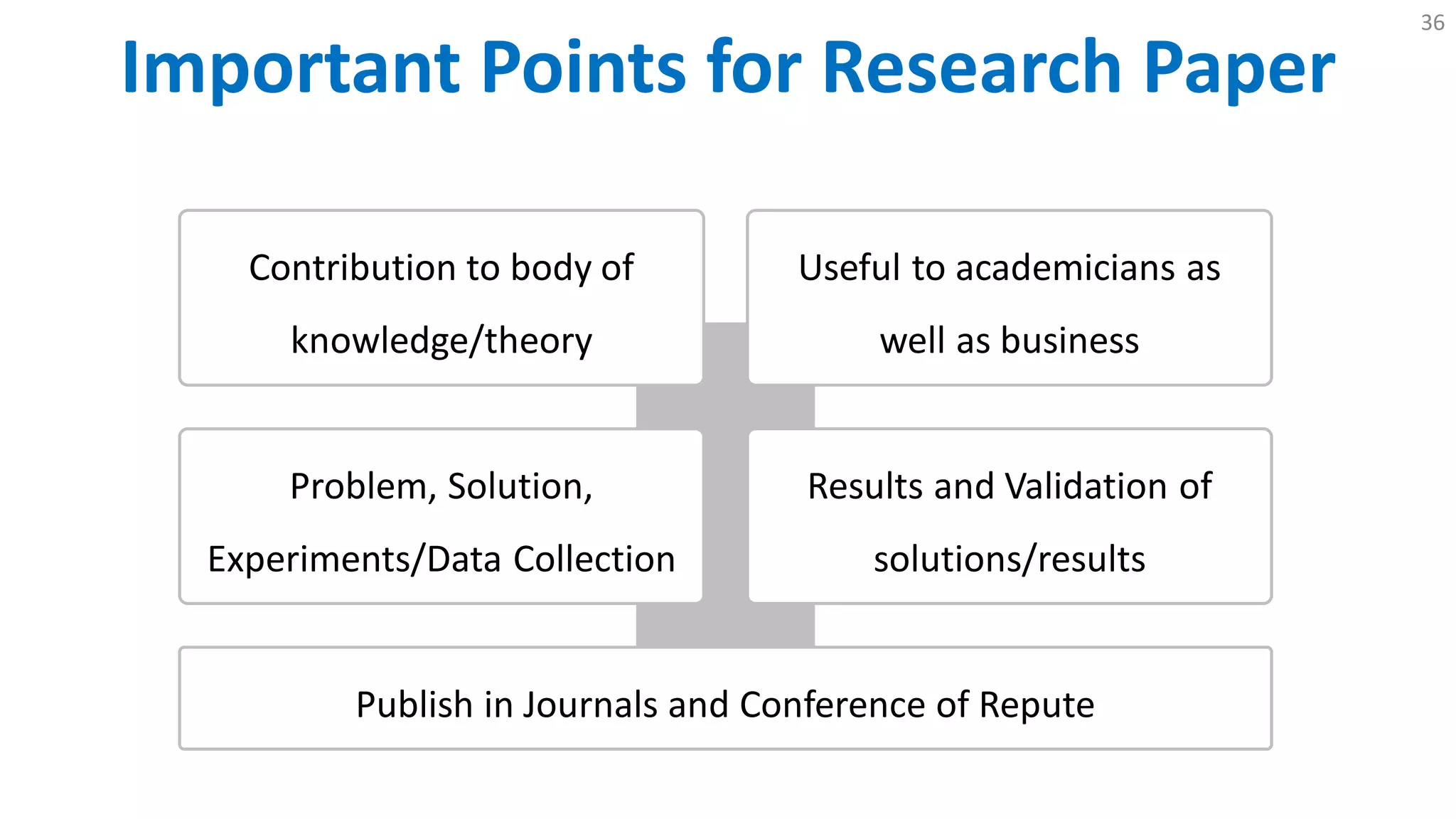
Contribution to body of
knowledge/theory
Important Points for Research Paper
36
Results and Validation of
solutions/results
Problem, Solution,
Experiments/Data Collection
Useful to academicians as
well as business
Publish in Journals and Conference of Repute
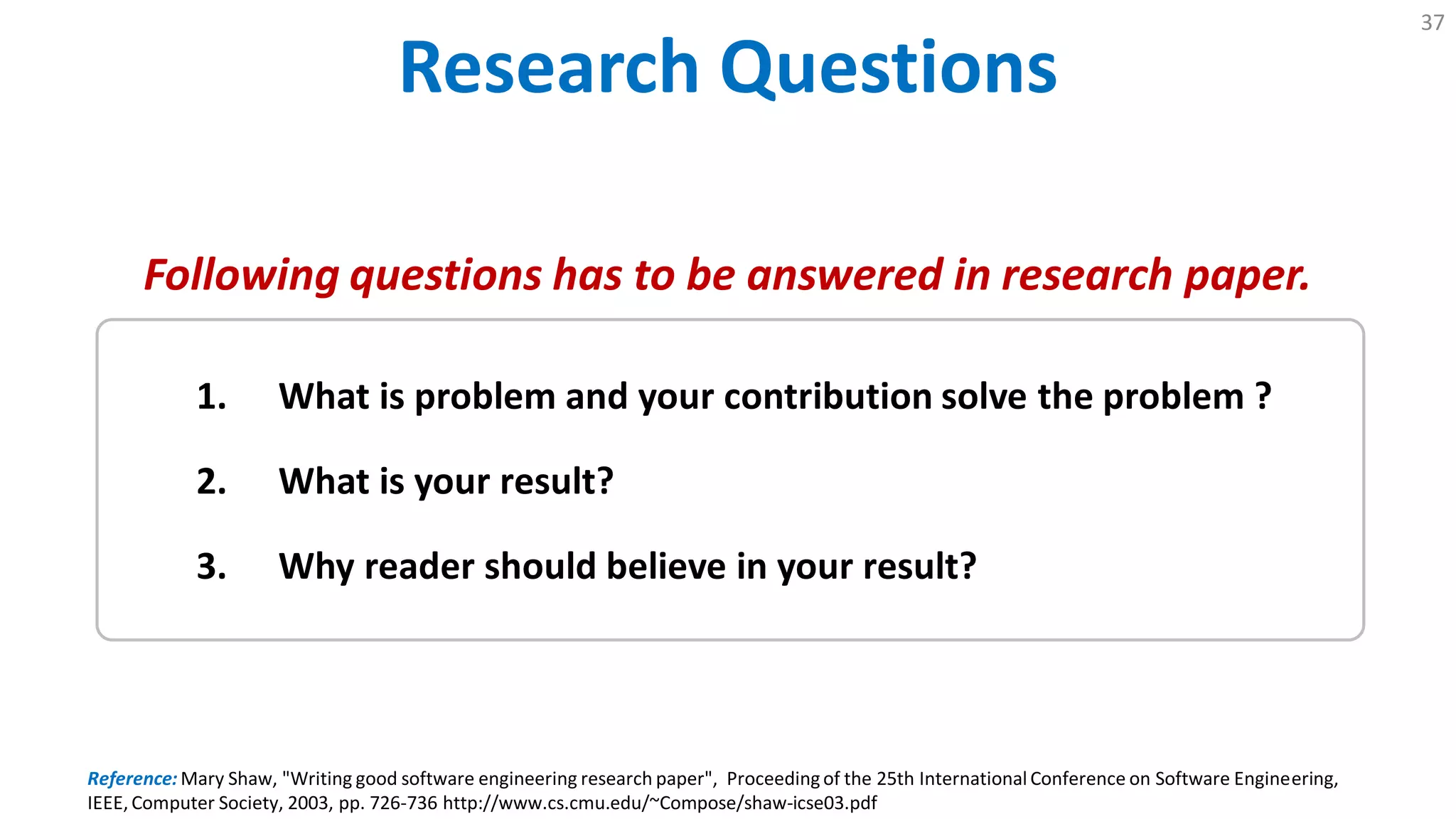
Research Questions
37
Reference: Mary Shaw, "Writing good software engineering research paper", Proceedingof the 25th International Conference on Software Engineering,
IEEE, Computer Society, 2003, pp. 726-736 http://www.cs.cmu.edu/~Compose/shaw-icse03.pdf
1. What is problem and your contribution solve the problem ?
2. What is your result?
3. Why reader should believe in your result?
Following questions has to be answered in research paper.
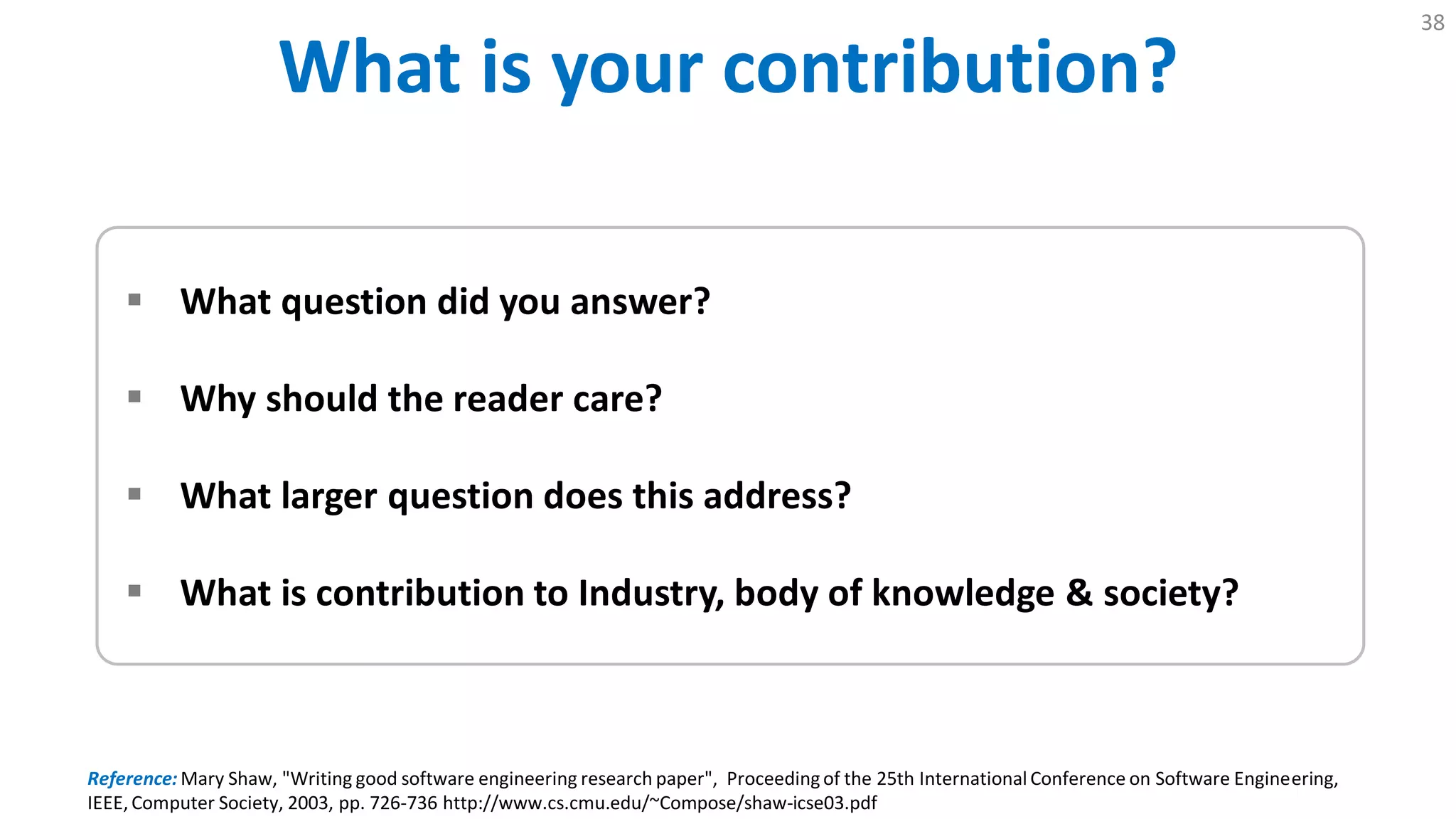
What is Your Contribution?
38
 What question did you answer?
 Why should the reader care?
 What larger question does this address?
 What is contribution to Industry, body of knowledge & society?
Reference: Mary Shaw, "Writing good software engineering research paper", Proceedingof the 25th International Conference on Software Engineering,
IEEE, Computer Society, 2003, pp. 726-736 http://www.cs.cmu.edu/~Compose/shaw-icse03.pdf
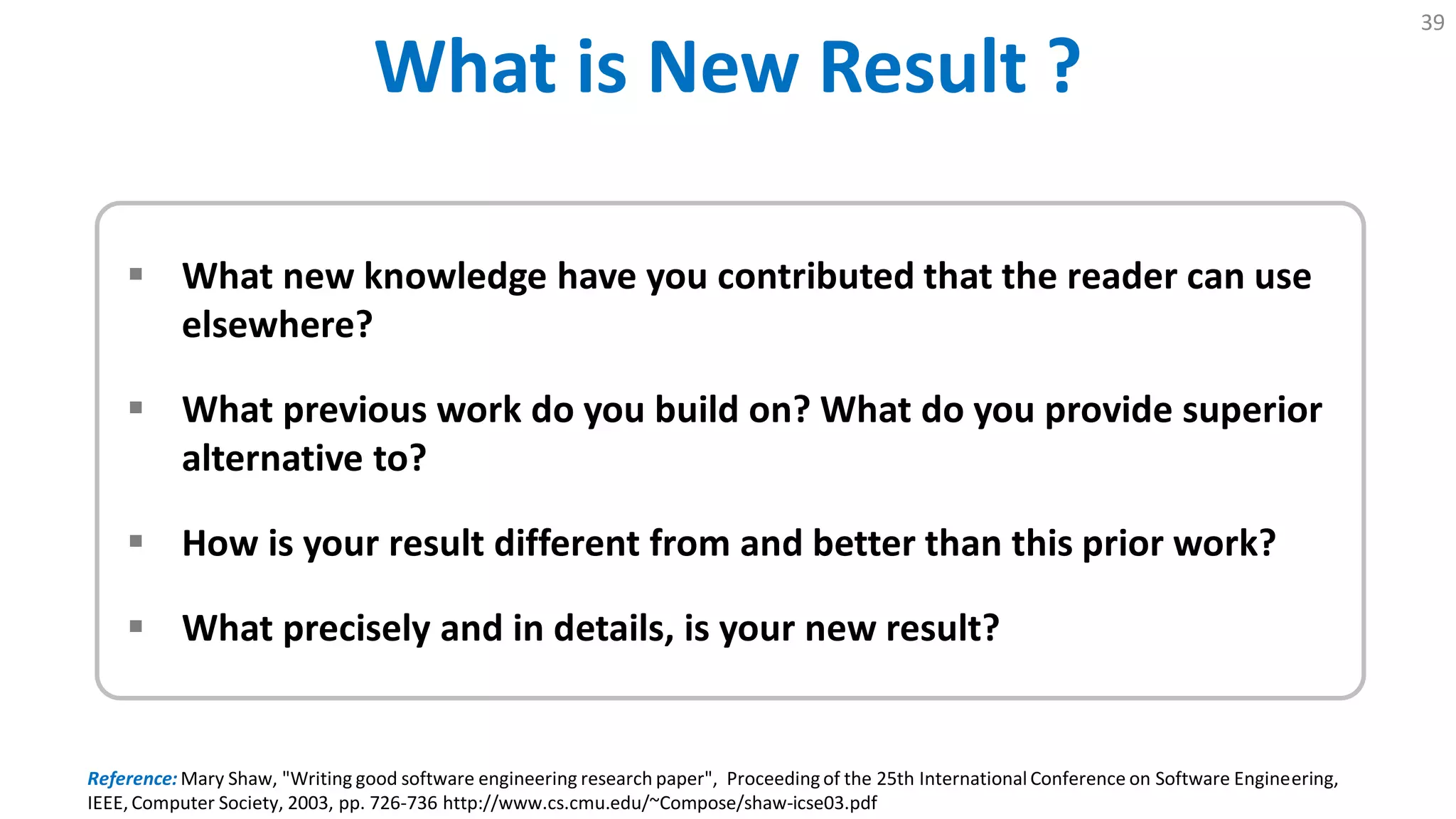
What is New Result ?
39
 What new knowledge have you contributed that the reader can use
elsewhere?
 What previous work do you build on? What do you provide superior
alternative to?
 How is your result different from and better than this prior work?
 What precisely and in details, is your new result?
Reference: Mary Shaw, "Writing good software engineering research paper", Proceedingof the 25th International Conference on Software Engineering,
IEEE, Computer Society, 2003, pp. 726-736 http://www.cs.cmu.edu/~Compose/shaw-icse03.pdf
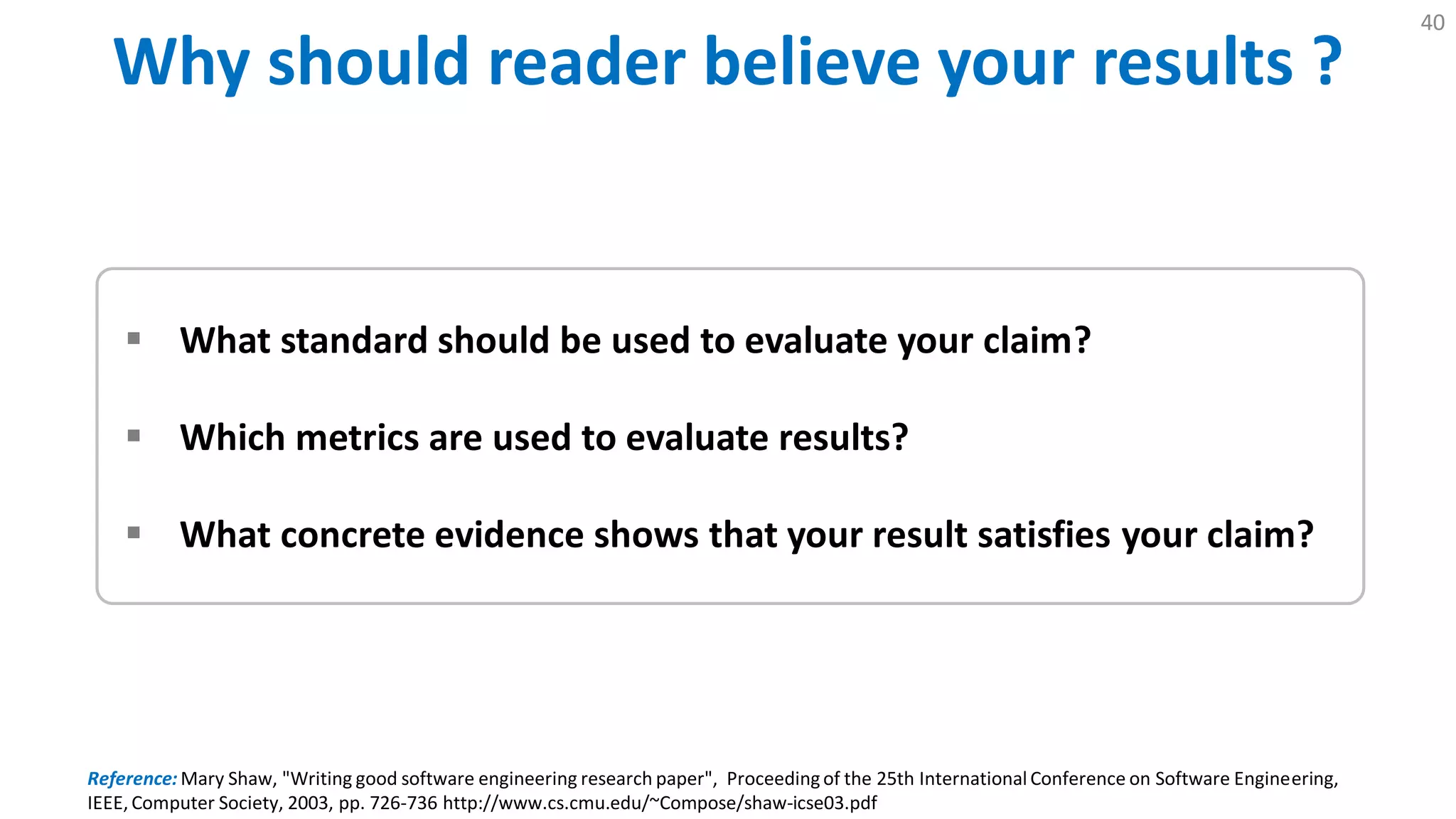
Why Should Reader Believe Your Results ?
40
 What standard should be used to evaluate your claim?
 Which metrics are used to evaluate results?
 What concrete evidence shows that your result satisfies your claim?
Reference: Mary Shaw, "Writing good software engineering research paper", Proceedingof the 25th International Conference on Software Engineering,
IEEE, Computer Society, 2003, pp. 726-736 http://www.cs.cmu.edu/~Compose/shaw-icse03.pdf
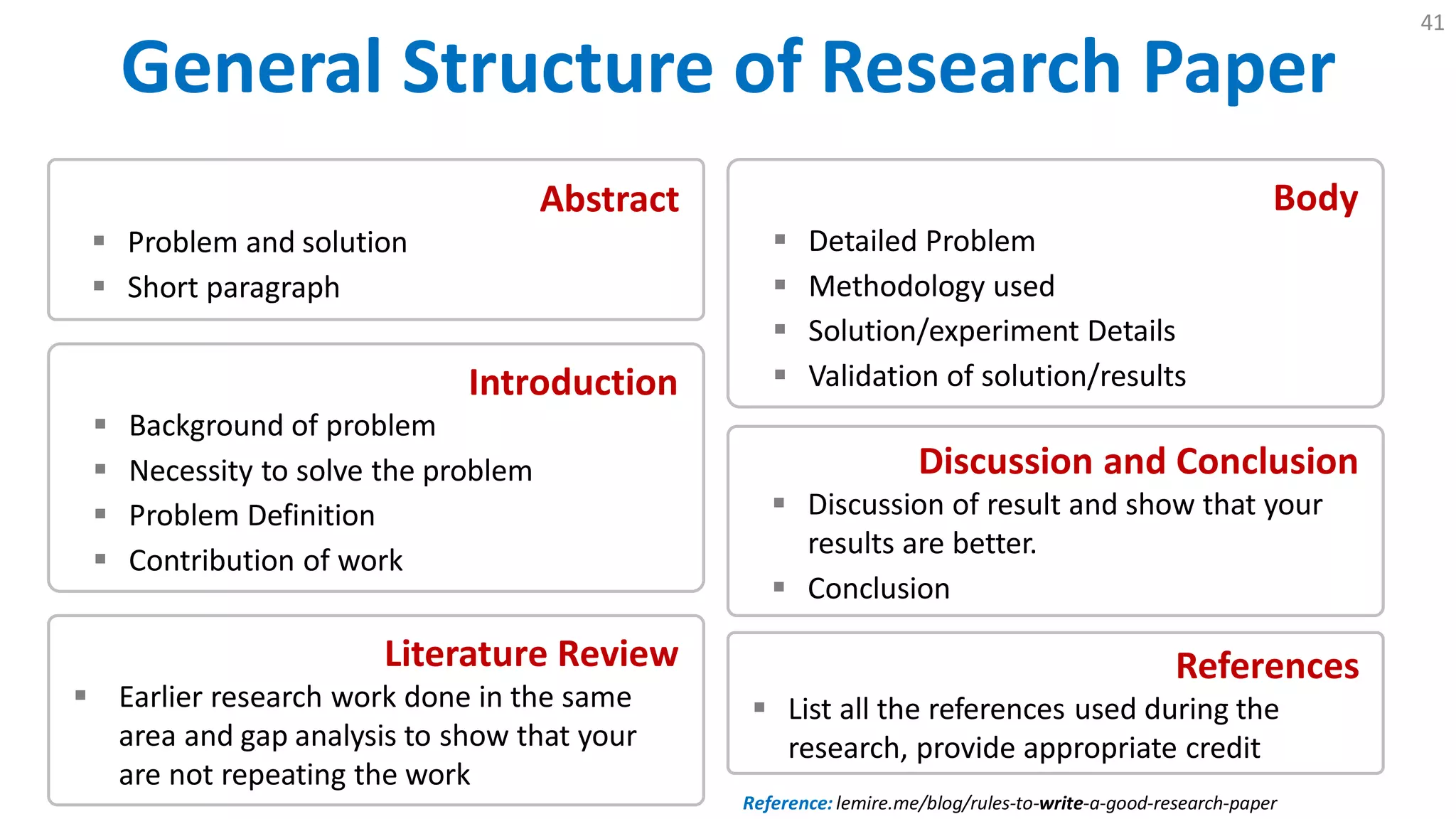
General Structure of Research Paper
41
Abstract
 Problem and solution
 Short paragraph
Introduction
 Background of problem
 Necessity to solve the problem
 Problem Definition
 Contribution of work
Literature Review
 Earlier research work done in the same
area and gap analysis to show that your
are not repeating the work
Body
 Detailed Problem
 Methodology used
 Solution/experiment Details
 Validation of solution/results
Discussion and Conclusion
 Discussion of result and show that your
results are better.
 Conclusion
References
 List all the references used during the
research, provide appropriate credit
Reference: lemire.me/blog/rules-to-write-a-good-research-paper
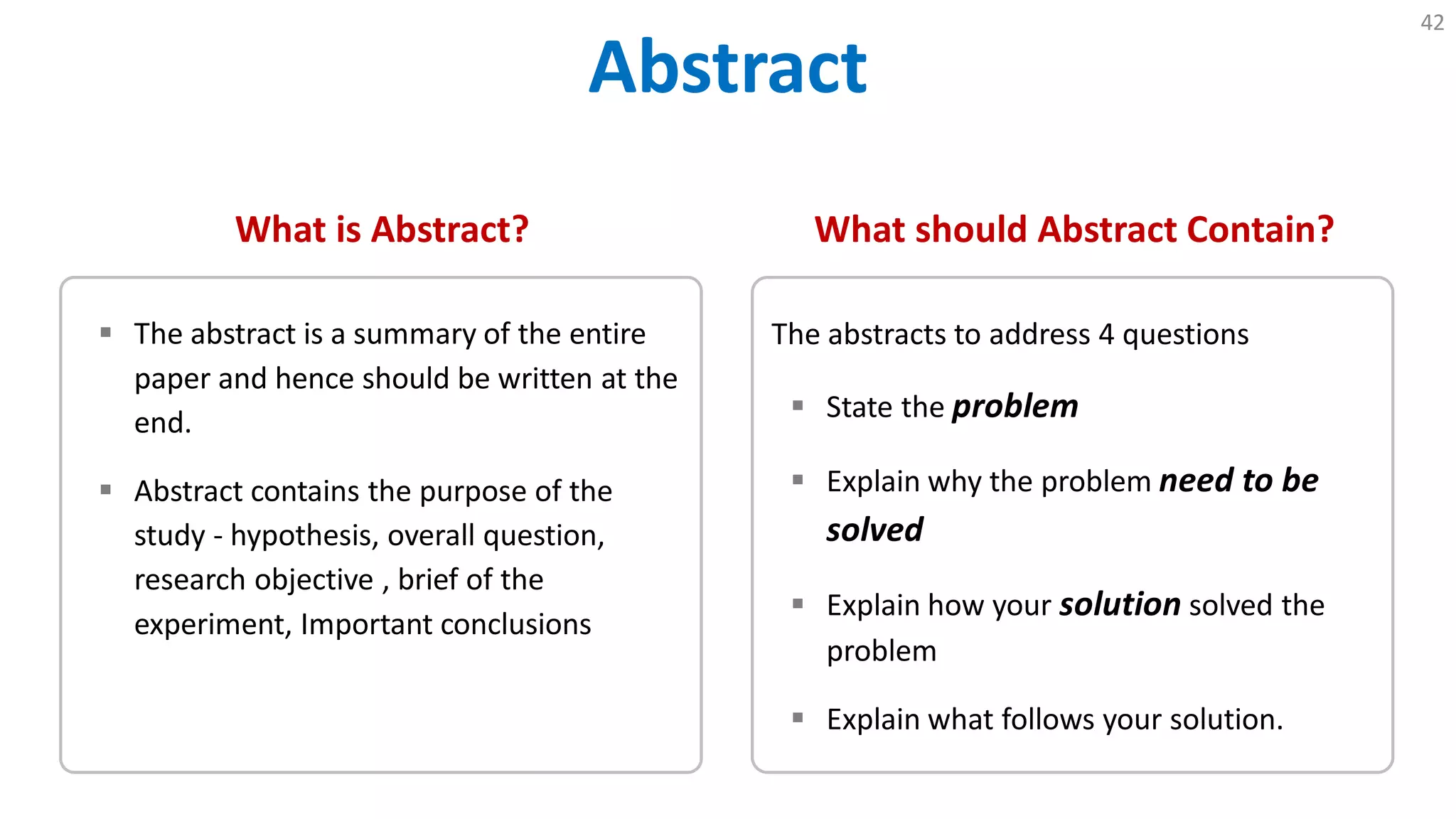
Abstract
42
What is Abstract?
 The abstract is a summary of the entire
paper and hence should be written at the
end.
 Abstract contains the purpose of the
study - hypothesis, overall question,
research objective , brief of the
experiment, Important conclusions
What should Abstract Contain?
The abstracts to address 4 questions
 State the problem
 Explain why the problem need to be
solved
 Explain how your solution solved the
problem
 Explain what follows your solution.
Introduction
43
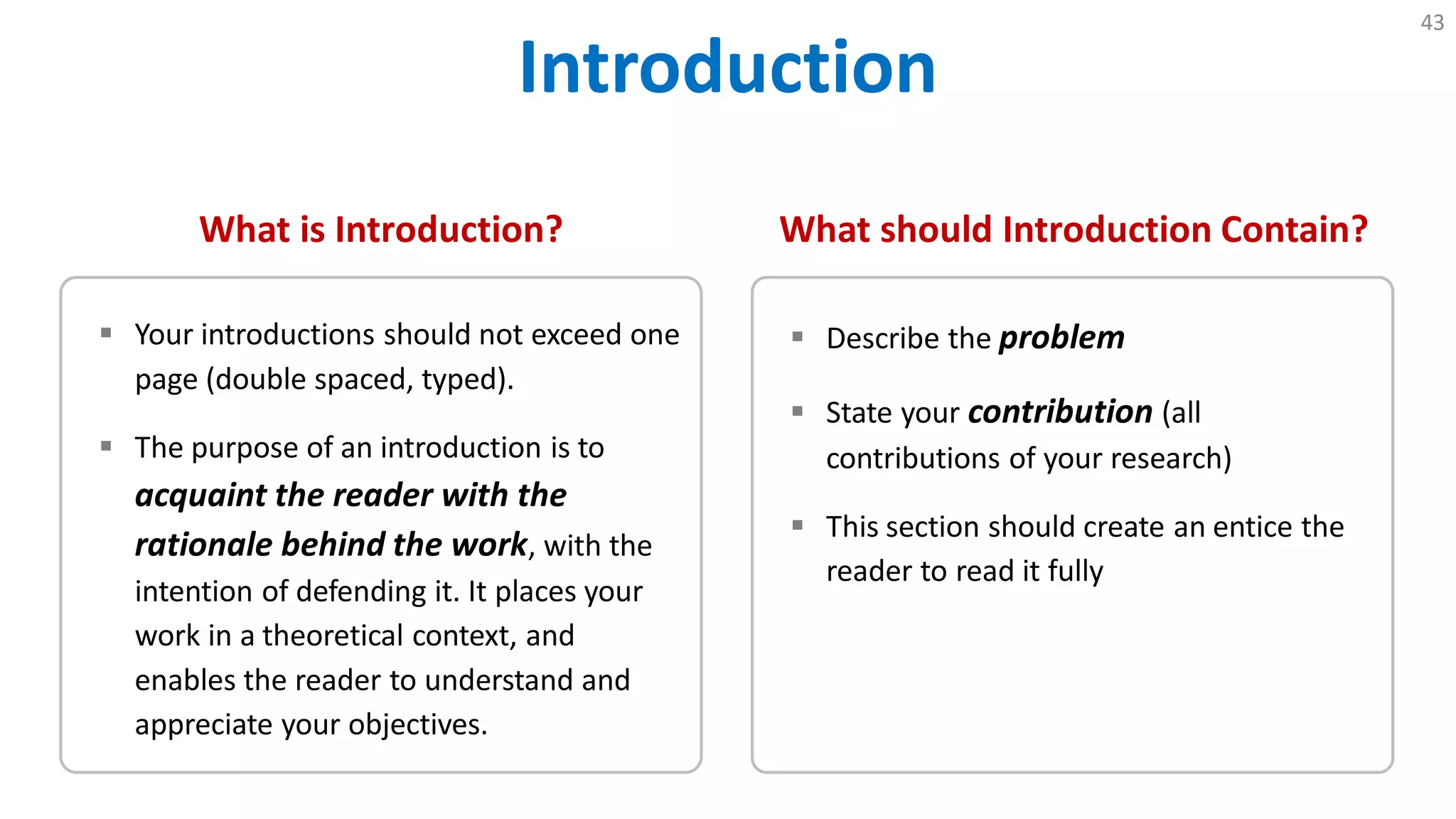
What is Introduction?
 Your introductions should not exceed one
page (double spaced, typed).
 The purpose of an introduction is to
acquaint the reader with the
rationale behind the work, with the
intention of defending it. It places your
work in a theoretical context, and
enables the reader to understand and
appreciate your objectives.
What should Introduction Contain?
 Describe the problem
 State your contribution (all
contributions of your research)
 This section should create an entice the
reader to read it fully
Literature Review
44
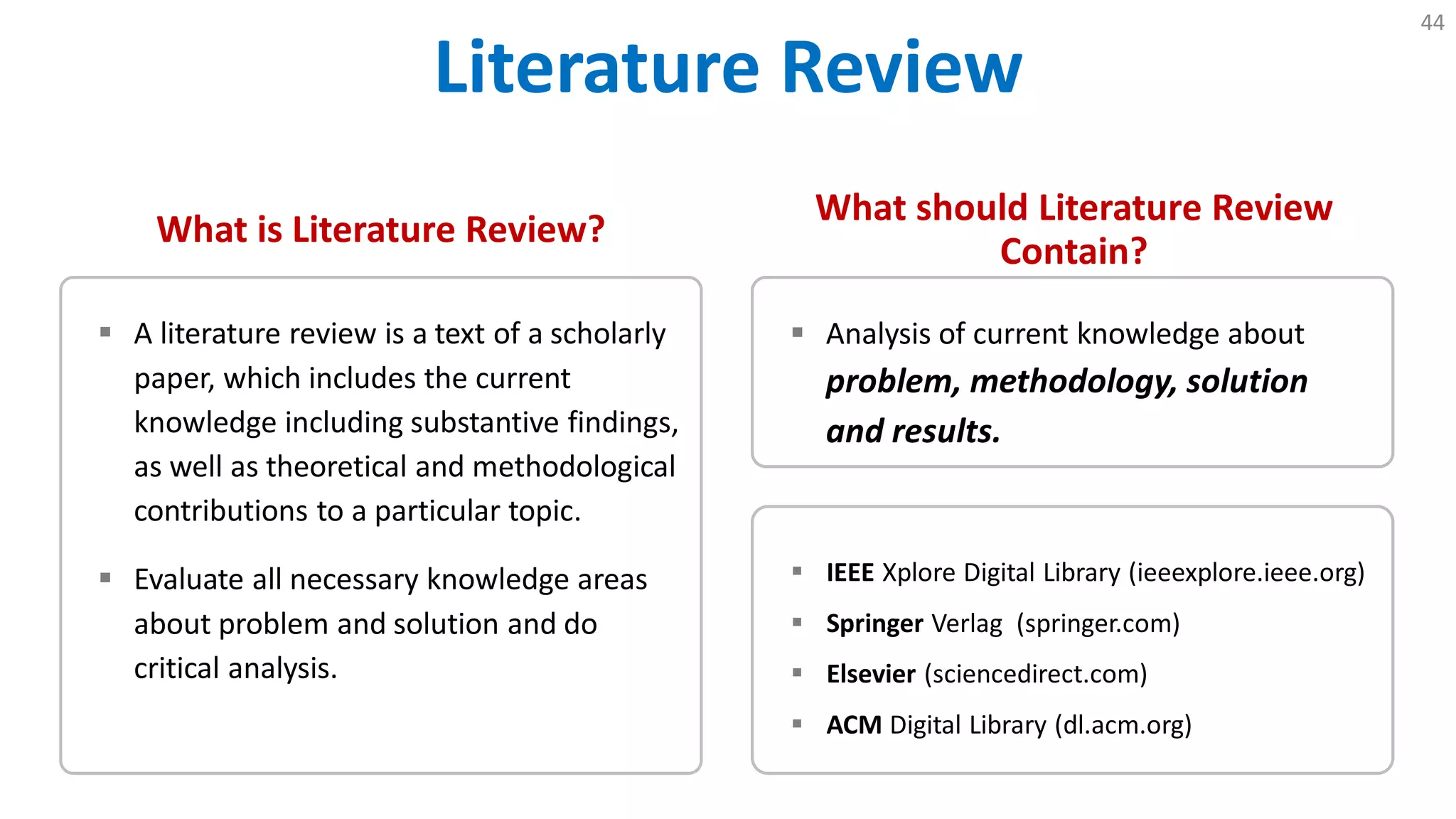
What is Literature Review?
 A literature review is a text of a scholarly
paper, which includes the current
knowledge including substantive findings,
as well as theoretical and methodological
contributions to a particular topic.
 Evaluate all necessary knowledge areas
about problem and solution and do
critical analysis.
What should Literature Review
Contain?
 Analysis of current knowledge about
problem, methodology, solution
and results.
 IEEE Xplore Digital Library (ieeexplore.ieee.org)
 Springer Verlag (springer.com)
 Elsevier (sciencedirect.com)
 ACM Digital Library (dl.acm.org)
Body
45
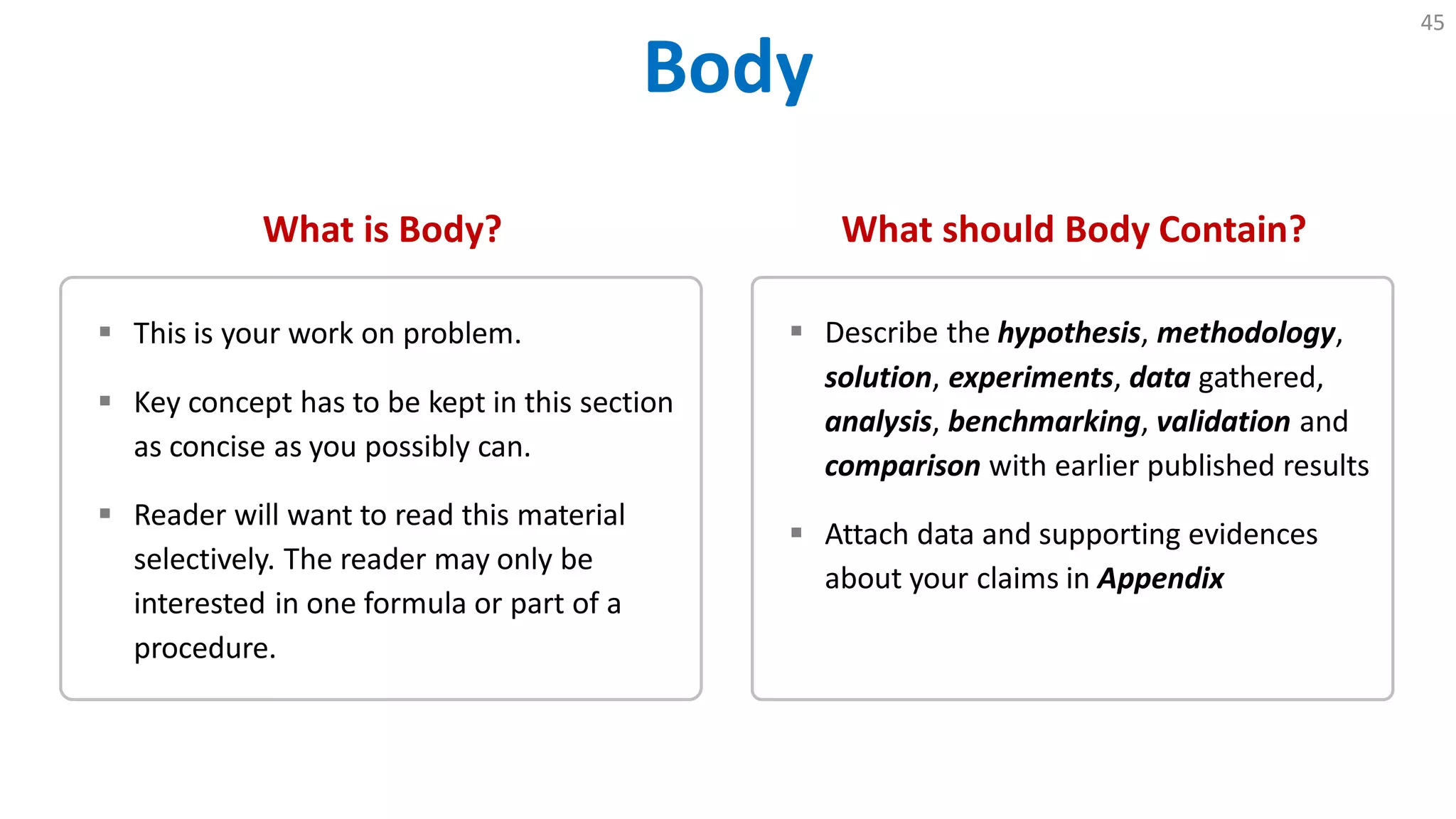
What is Body?
 This is your work on problem.
 Key concept has to be kept in this section
as concise as you possibly can.
 Reader will want to read this material
selectively. The reader may only be
interested in one formula or part of a
procedure.
What should Body Contain?
 Describe the hypothesis, methodology,
solution, experiments, data gathered,
analysis, benchmarking, validation and
comparison with earlier published results
 Attach data and supporting evidences
about your claims in Appendix
Conclusion
46
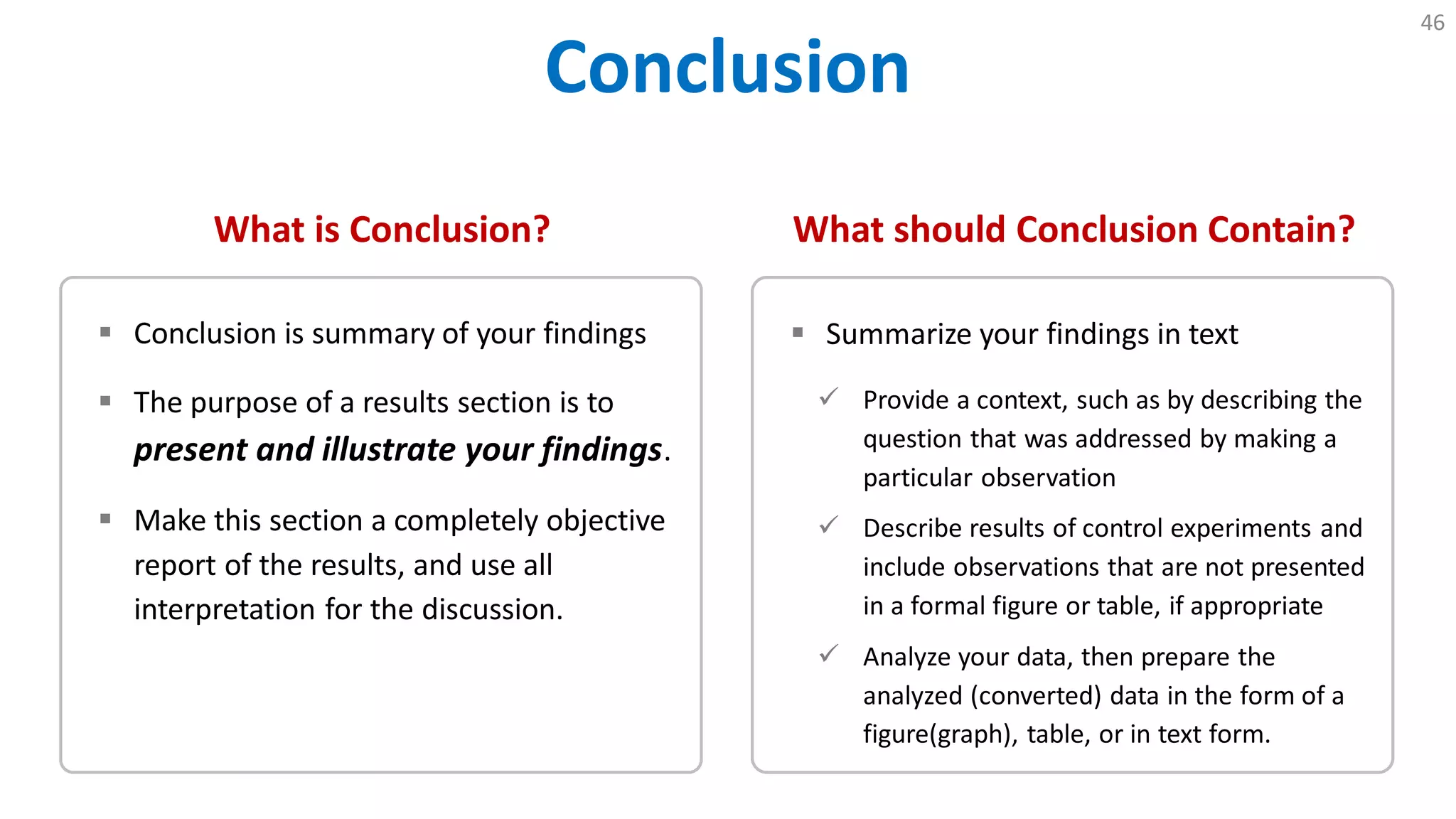
What is Conclusion?
 Conclusion is summary of your findings
 The purpose of a results section is to
present and illustrate your findings.
 Make this section a completely objective
report of the results, and use all
interpretation for the discussion.
What should Conclusion Contain?
 Summarize your findings in text
 Provide a context, such as by describing the
question that was addressed by making a
particular observation
 Describe results of control experiments and
include observations that are not presented
in a formal figure or table, if appropriate
 Analyze your data, then prepare the
analyzed (converted) data in the form of a
figure(graph), table, or in text form.
References
47
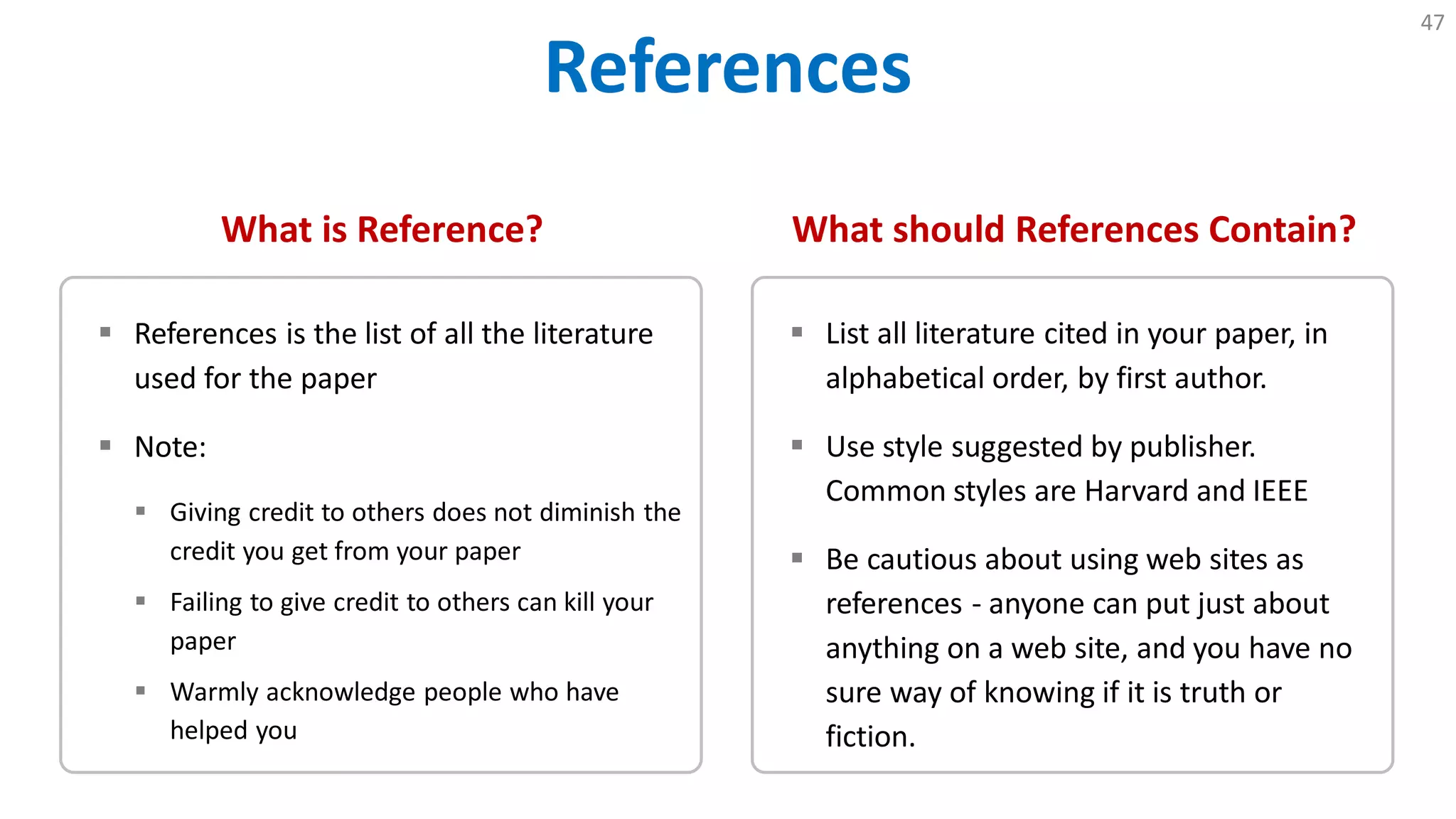
What is Reference?
 References is the list of all the literature
used for the paper
 Note:
 Giving credit to others does not diminish the
credit you get from your paper
 Failing to give credit to others can kill your
paper
 Warmly acknowledge people who have
helped you
What should References Contain?
 List all literature cited in your paper, in
alphabetical order, by first author.
 Use style suggested by publisher.
Common styles are Harvard and IEEE
 Be cautious about using web sites as
references - anyone can put just about
anything on a web site, and you have no
sure way of knowing if it is truth or
fiction.
48
Different Types
of Papers
Different Types of Papers (1/2)
49
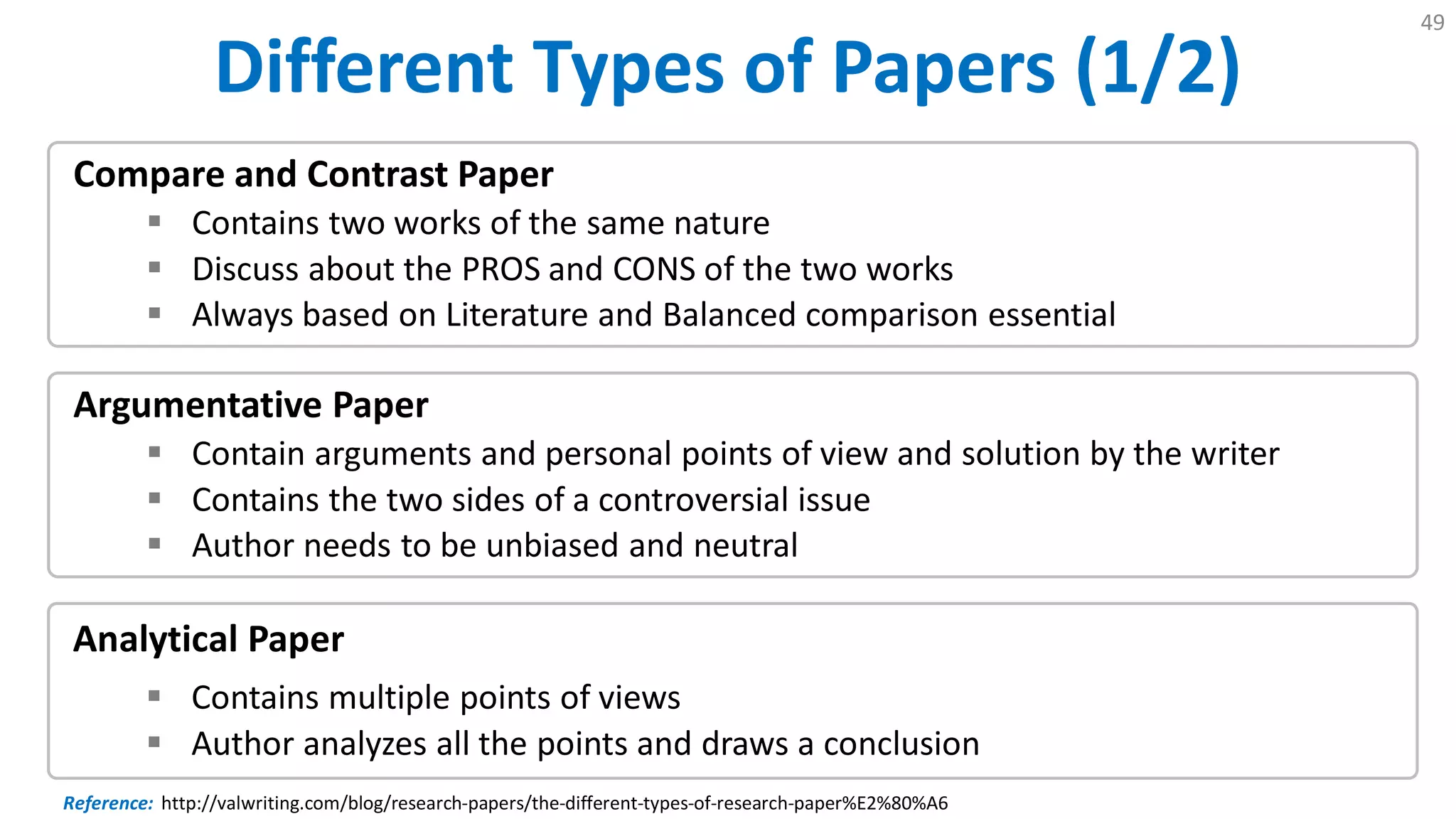
Analytical Paper
 Contains multiple points of views
 Author analyzes all the points and draws a conclusion
Argumentative Paper
 Contain arguments and personal points of view and solution by the writer
 Contains the two sides of a controversial issue
 Author needs to be unbiased and neutral
Compare and Contrast Paper
 Contains two works of the same nature
 Discuss about the PROS and CONS of the two works
 Always based on Literature and Balanced comparison essential
Reference: http://valwriting.com/blog/research-papers/the-different-types-of-research-paper%E2%80%A6
Different Types of Papers (2/2)
50
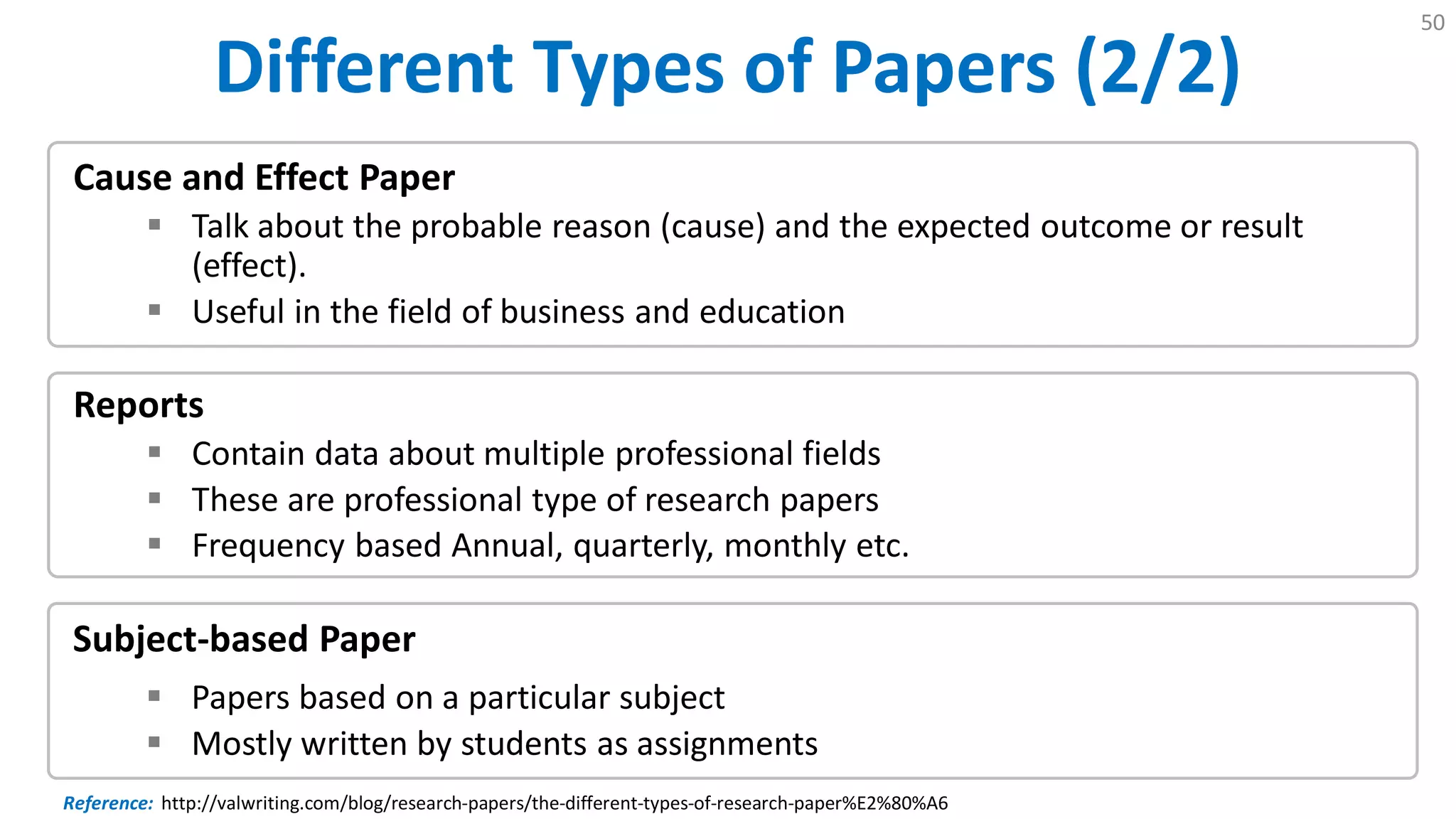
Subject-based Paper
 Papers based on a particular subject
 Mostly written by students as assignments
Reports
 Contain data about multiple professional fields
 These are professional type of research papers
 Frequency based Annual, quarterly, monthly etc.
Cause and Effect Paper
 Talk about the probable reason (cause) and the expected outcome or result
(effect).
 Useful in the field of business and education
Reference: http://valwriting.com/blog/research-papers/the-different-types-of-research-paper%E2%80%A6
51
Things to Avoid
52
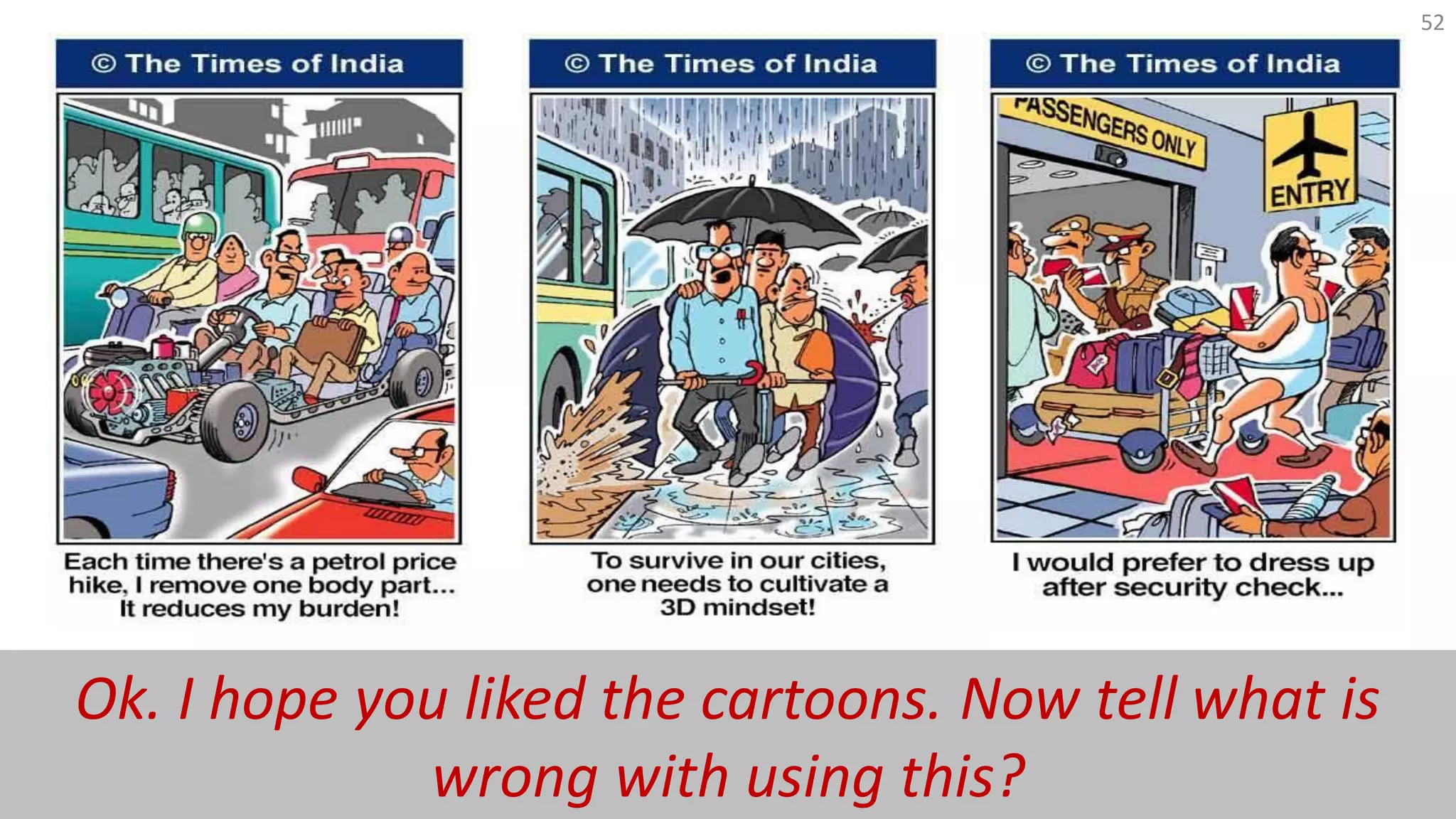
Ok. I hope you liked the cartoons. Now tell what is wrong with using this? These images
are property of Times of India, and its unlawful use may lead to copyright violation.
Things to avoid
53
Things to Avoid
54
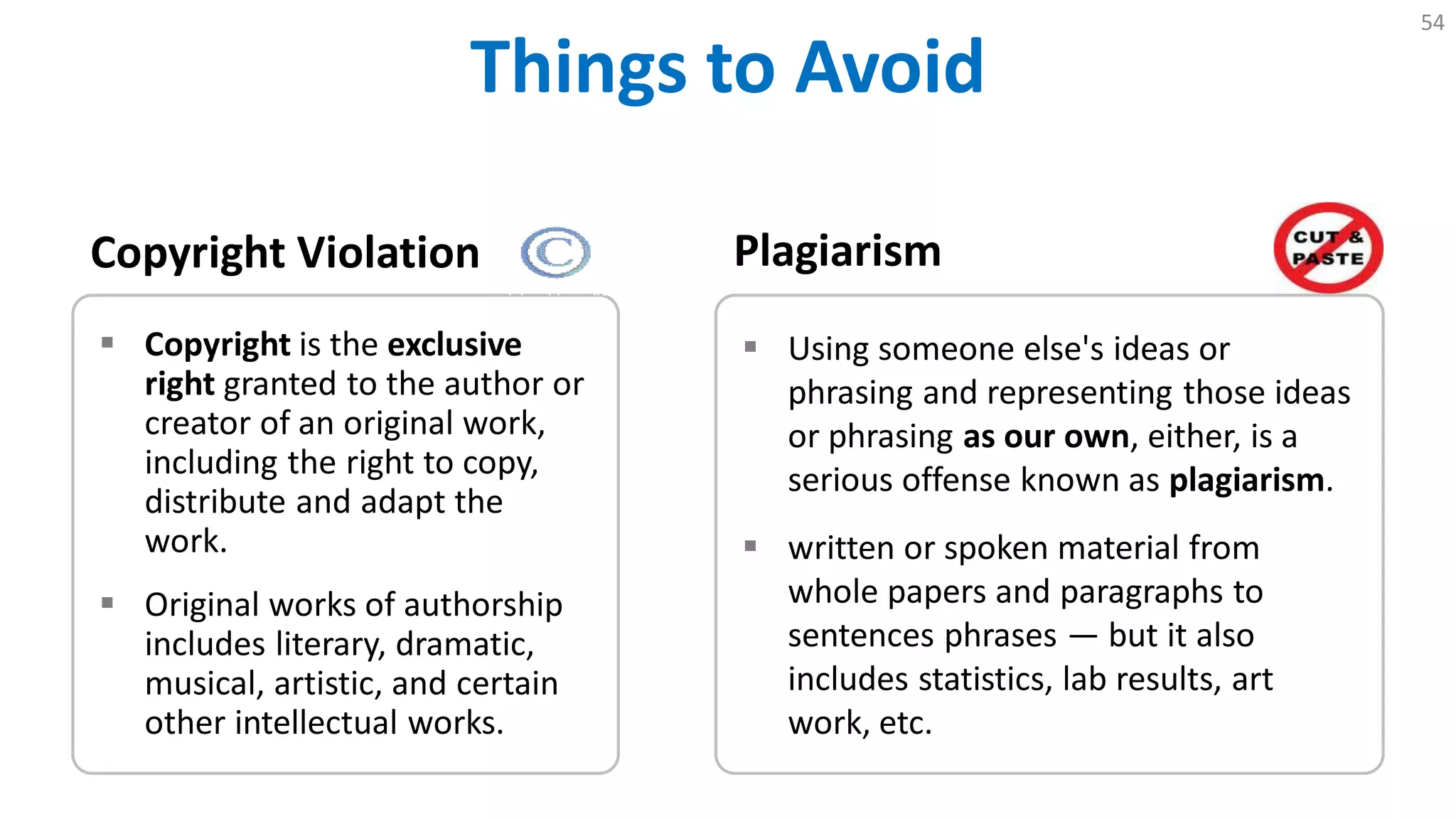
Copyright Violation
 Copyright is the exclusive
right granted to the author or
creator of an original work,
including the right to copy,
distribute and adapt the
work.
 Original works of authorship
includes literary, dramatic,
musical, artistic, and certain
other intellectual works.
Plagiarism
 Using someone else's ideas or
phrasing and representing those ideas
or phrasing as our own, either, is a
serious offense known as plagiarism.
 written or spoken material from
whole papers and paragraphs to
sentences phrases — but it also
includes statistics, lab results, art
work, etc.
55
Publication
Process
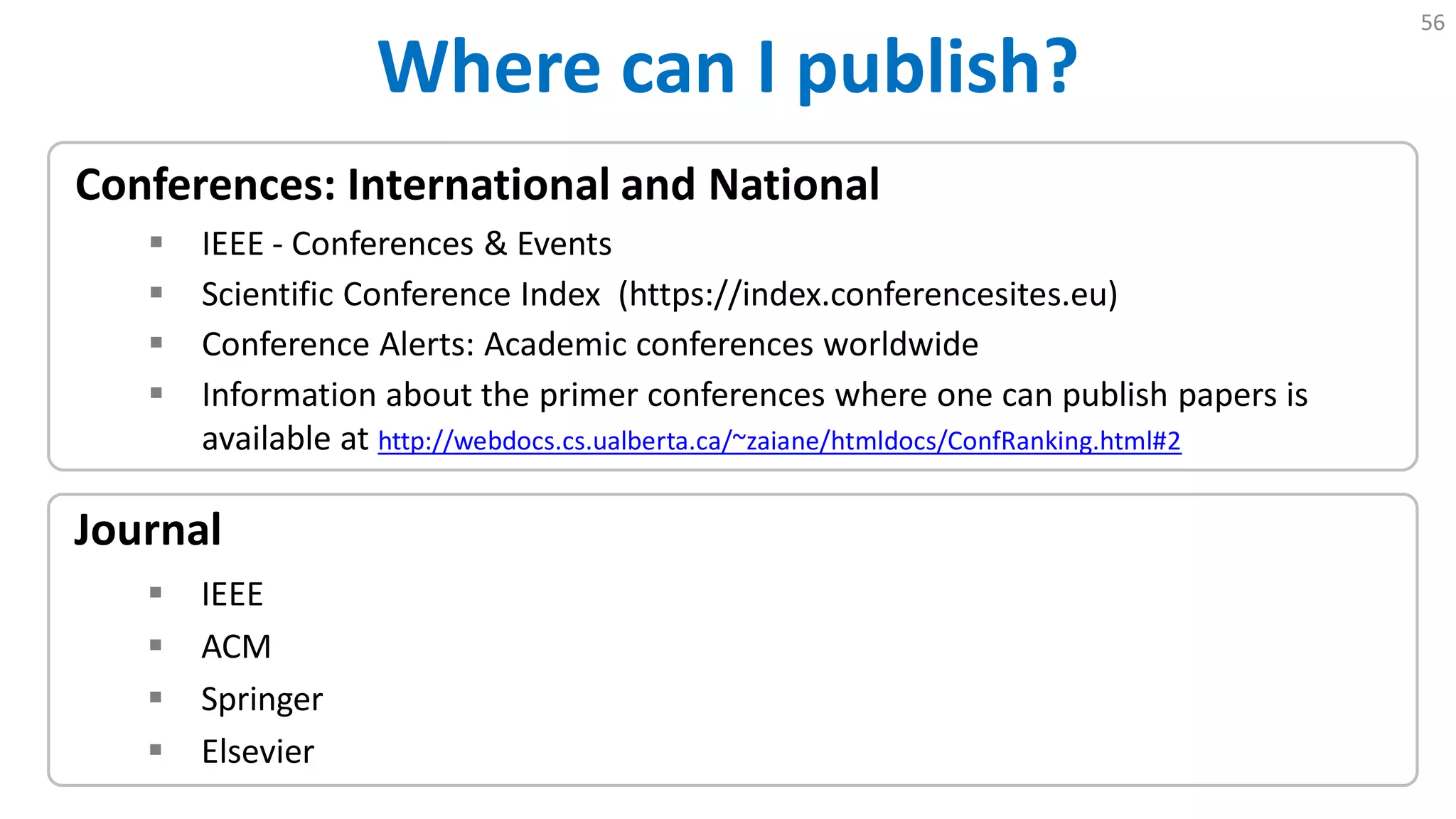
Where can I publish?
56
Journal
 IEEE
 ACM
 Springer
 Elsevier
Conferences: International and National
 IEEE - Conferences & Events
 Scientific Conference Index (https://index.conferencesites.eu)
 Conference Alerts: Academic conferences worldwide
 Information about the primer conferences where one can publish papers is
available at http://webdocs.cs.ualberta.ca/~zaiane/htmldocs/ConfRanking.html#2
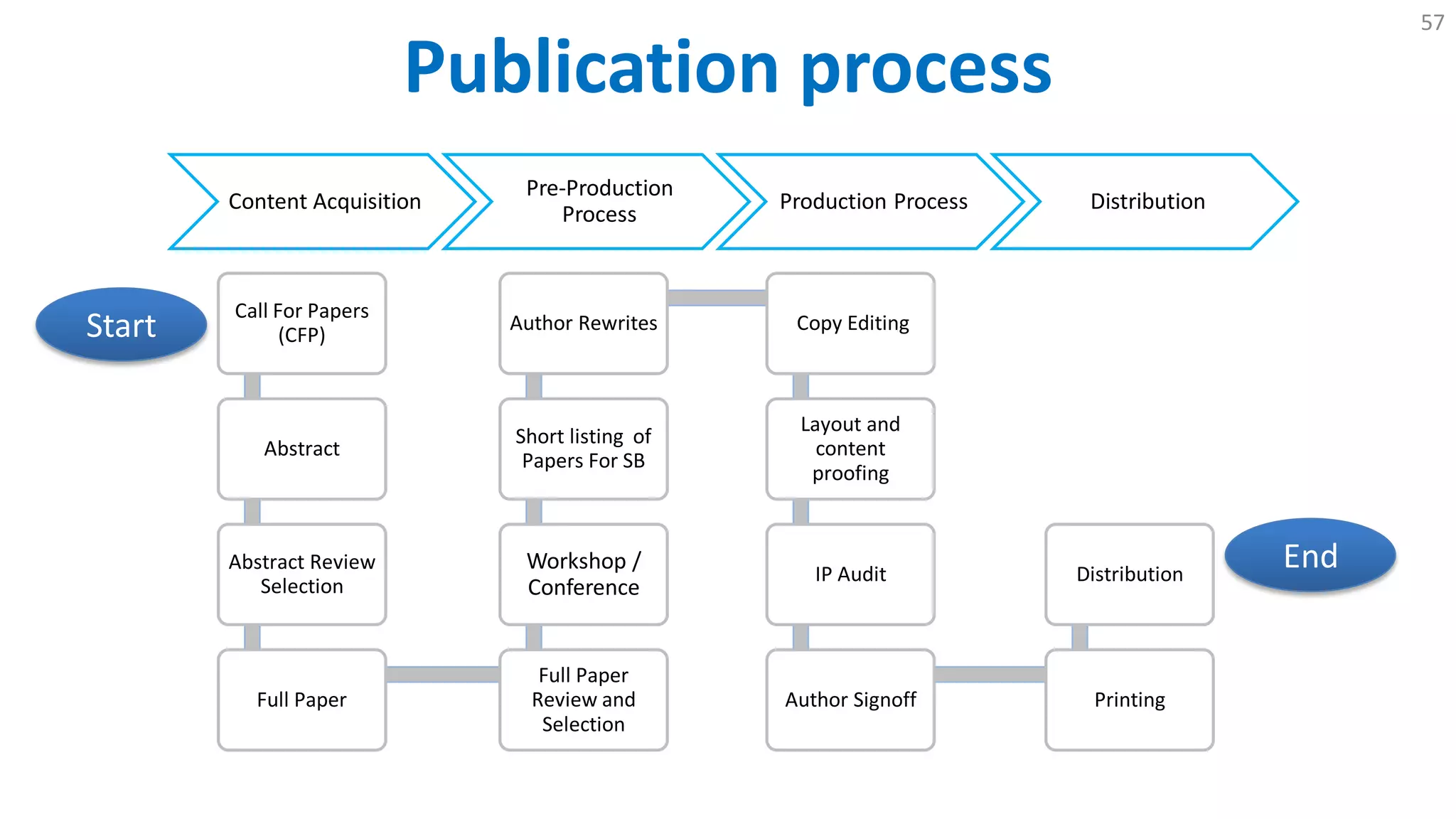
Publication process
57
Content Acquisition
Pre-Production
Process
Production Process Distribution
Call For Papers
(CFP)
Abstract
Abstract Review
Selection
Full Paper
Full Paper
Review and
Selection
Workshop /
Conference
Short listing of
Papers For SB
Author Rewrites Copy Editing
Layout and
content
proofing
IP Audit
Author Signoff Printing
Distribution
Start
End
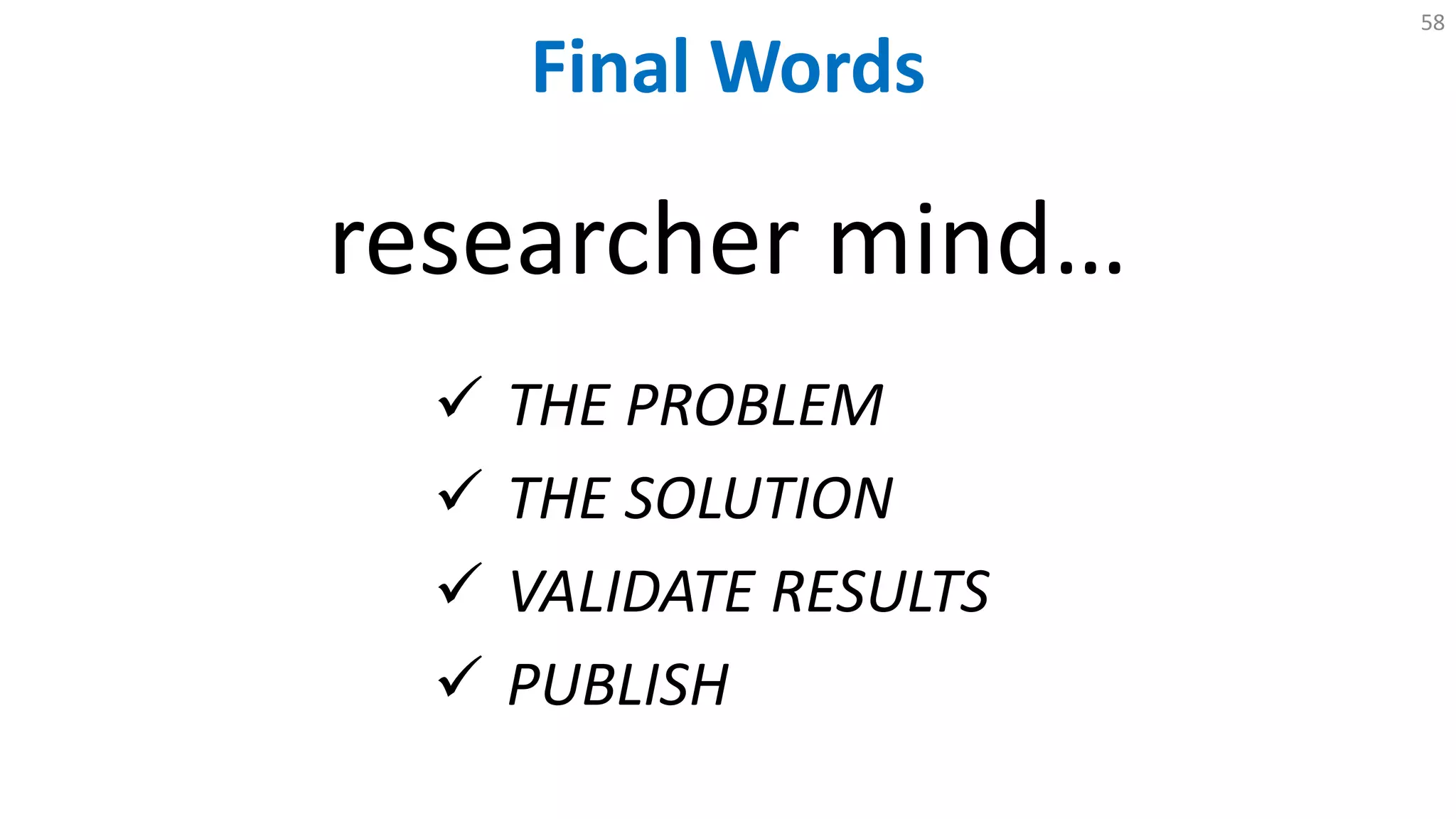
Final Words
58
researcher mind…
 THE PROBLEM
 THE SOLUTION
 VALIDATE RESULTS
 PUBLISH
Disclaimer
 This presentation is purely for academic purpose and does not carry any commercial value.
 All images used in this presentation are property of respective image holders. Images are used
only for indicative purpose and does not carry any other meaning.

How to write research paper

  • 1.
  • 2.
    2 Disclaimer  This presentationis purely for academic purpose and does not carry any commercial value.  All images used in this presentation are property of respective image holders. Images are used only for indicative purpose and does not carry any other meaning.
  • 3.
  • 4.
    What is Engineering? 4  Engineers identify a problem, and come up with a solution – often creating something completely new in the process.  Traditionally, engineering is about infrastructure. Engineers were known to create bridges and vehicles that got us from A to B faster more efficiently. Now engineering is acknowledged as a discipline that opens up opportunities and creates technology and products that help make our lives easier.  Engineers are shaping the future by applying their skills to almost everything you can think of, from medicine to renewable energy, food technologies to sustainable mining. There really is no limit to what engineers can do. Reference: http://www.engineering.unsw.edu.au/what-is-engineering
  • 5.
    What is Research? 5 Solve a Problem. Do Engineering. We do research everyday. But our eyes are closed hence we could not notice it.
  • 6.
    GirlsBoys Example Research Problem Problem:Top 5 Discussion Topics of Teenagers
  • 7.
    GirlsBoys Example Research Problem Problem:Top 5 Discussion Topics of Teenagers Increase Focus of Problem: Consider only Teenager Girls
  • 8.
    Top 5 DiscussionTopics of Teenager Girls 1 2 3 4 5
  • 9.
    Method to SolveProblem 9 Problem: Top 5 Discussion Topics of Teenager Girls Steps to solve problem:  Identify all possible topics  Conduct survey  Analyses survey responses  What is outcome?
  • 10.
    Top 5 DiscussionTopics of Teenager Girls Study Food Fashion Relationship Gossip
  • 11.
    Top 5 DiscussionTopics of Teenager Girls Study Food Fashion Relationship Gossip 12 345
  • 12.
  • 13.
    Who am I? 13 I may be any one of these Expert, Thought Leader, Researcher I may be more than one. I may be all.
  • 14.
     I cansee future challenges and emerging trends in testing.  I have innovative ideas to influence business and community.  I have in-depth knowledge and skill in particular area.  E.g. Knowledge of Machine Learning Who am I ? 14  I know the problems, which need to addressed.  I can systematically analyze the problem and find out the most appropriate solution. Expert Thought Leader Researcher
  • 15.
    Knowledge and ITIndustry 15  IT industry is knowledge based business.  IT project/product development is a team work.  One has to collaborate within team/organization/outside- organization to complete task/solve problems/write cases etc.  In this process knowledge is generated.
  • 16.
    Knowledge: Share &publish 16 Knowledge should be shared. PublishHow to share?
  • 17.
    Publish 17 Fallacy about Research… Youneed a fantastic idea to write a research paper. Greatest ideas are worthless if you keep them to yourself. Spread your idea and get feedback, do research and publish.
  • 18.
    Publish-in … 18 Research Papers Research BooksMagazine Article Casestudies Thought Paper, Point of view White Papers Blogs, Wikis Text Books Level 1 Publication Level 2 Publication Level 3 Publication
  • 19.
  • 20.
    What is detailedstudy?  Systematic investigation of study of materials  Conduct Experiments, Collect Data, Simulation, Interviews, Case Studies, Modeling and …  Analysis and reporting Definition A detailed study of a subject in order to discover (new) information or reach a (new) understanding. Cambridge Dictionaries Online, © Cambridge University Press 2003 What is Research?
  • 21.
    Method for Problem Solving Gather information and Study of research material  Think of possible solutions; Choose the best solution  Implement solution; Gather experimental data  Evaluate results and make necessary changes  Repeat necessary steps. SolutionProblem Research Path? Start End
  • 22.
    Journey - Ideato Research Paper 22 Idea Do research Write research paper Idea Write working paper Do research Write research paper  Clear focus  Crystallizes understanding  Opens ways for discussions Preferred approach when conclusions are to be published
  • 23.
    General Approach toResearch 23  Identify problem/idea: Rationale behind why this problem is important; Is it a open problem? survey of available solutions to the problem?  Support the problem with theory (Literature study)  Study and identify/decide the method to solve the problem.  Develop solution/ alternative solution  Do Experiments, Simulations, collection of Data etc.  Validation of solution
  • 24.
  • 25.
    Research Methods 25 Controlled experiments Casestudies Survey research Ethnographic Action research Mixed-methods approach Reference: www.cs.toronto.edu/~sme/papers/2007/SelectingEmpiricalMethods.pdf
  • 26.
    Research Methods (1/3) 26 CaseStudies  Selection of cases is crucial.  Case studies are used for investigation, experiments, confirmation of theories Controlled Experiments  Experiments are conducted in controlled manner to reduce complexity.  Few factors/variables of interest/critical are allowed to vary while keeping other controlled/constant.  One has to be very careful while selecting critical variables, otherwise generalization of results will not be possible. Reference:www.cs.toronto.edu/~sme/papers/2007/SelectingEmpiricalMethods.pdf http://valwriting.com/blog/research-papers/the-different-types-of-research-paper%E2%80%A6
  • 27.
    Research Methods (2/3) 27 Ethnographic How designer community is adopting UML.  How technical communities build a culture of practices and communication strategies that enable them to perform technical work collaboratively. Survey  Questionnaire or Structured interview  Select of representative sample from well defined population.  Analysis of data to generalize/answer base-rate questions Reference:www.cs.toronto.edu/~sme/papers/2007/SelectingEmpiricalMethods.pdf http://valwriting.com/blog/research-papers/the-different-types-of-research-paper%E2%80%A6
  • 28.
    Research Methods (3/3) 28 MixedMethod Approach  Methods discussed earlier are combined depending upon the problem Action Research  Implement, observe, modify  Cyclic process Reference:www.cs.toronto.edu/~sme/papers/2007/SelectingEmpiricalMethods.pdf http://valwriting.com/blog/research-papers/the-different-types-of-research-paper%E2%80%A6
  • 29.
    Research Results &Examples (1/2) 29 Research result Example Procedure or Technique  New or better way to do some task such as design, implementation, maintenance, measurement, evaluation, selection from alternatives  Use technique to implement, represent, management and analysis  Technique should be operational, not advise or guideline, but a procedure Qualitative or Descriptive Model  Structure or taxonomy for a problem area; architectural style, framework, or design pattern.  Non-formal domain analysis, well-grounded checklist, well-argued informal generalization, guidance for integrating other results, well-organized interesting observations Empirical Model  Empirical model based on observed data Reference: Mary Shaw, "Writing good software engineering research paper", Proceedingof the 25th International Conference on Software Engineering, IEEE, Computer Society, 2003, pp. 726-736 http://www.cs.cmu.edu/~Compose/shaw-icse03.pdf
  • 30.
    Research Results &Examples (2/2) 30 Research result Example Analytic/ Mathematical Model  Structural model that permits formal analysis Tool or Notation  Implemented tool that embodied a technique Specific Solution, Prototype, Judgment  Solution to application problem that shows application of software engineering – may be design, prototype, or full implementation; careful analysis of a system or its development, result of a specific analysis, evaluation, or comparison Report  Interesting observations, rules of thumb, but not sufficiently general or systematic to raise to level of a descriptive model Reference: Mary Shaw, "Writing good software engineering research paper", Proceedingof the 25th International Conference on Software Engineering, IEEE, Computer Society, 2003, pp. 726-736 http://www.cs.cmu.edu/~Compose/shaw-icse03.pdf
  • 31.
  • 32.
    What is ResearchWriting ? 32 Is it synonymous to End-to-end Story Writing ?
  • 33.
    Bollywood Movies -Earning Clubs 33 250 crore club  Dhoom 3  PK  Bajrangi Bhaijaan 200 crore club  Kick  Chennai Express  3 Idiots 100 crore club  Krrish 3  Yeh Jawaani Hai Deewani  Dabangg  Bodyguard What is your observation ? Have these movies done something different?
  • 34.
    How ? MovieStory Writing 34  Idea  Background  Plot  Climax  Resolution  Message Think you are writing a movie story.
  • 35.
    Story and ResearchPaper Writing 35 Research  Idea  Background  Plot  Climax  Resolution  Message Research Paper  Idea/Problem  Background  Experimentation  Result  Validation  Conclusion
  • 36.
    Contribution to bodyof knowledge/theory Important Points for Research Paper 36 Results and Validation of solutions/results Problem, Solution, Experiments/Data Collection Useful to academicians as well as business Publish in Journals and Conference of Repute
  • 37.
    Research Questions 37 Reference: MaryShaw, "Writing good software engineering research paper", Proceedingof the 25th International Conference on Software Engineering, IEEE, Computer Society, 2003, pp. 726-736 http://www.cs.cmu.edu/~Compose/shaw-icse03.pdf 1. What is problem and your contribution solve the problem ? 2. What is your result? 3. Why reader should believe in your result? Following questions has to be answered in research paper.
  • 38.
    What is YourContribution? 38  What question did you answer?  Why should the reader care?  What larger question does this address?  What is contribution to Industry, body of knowledge & society? Reference: Mary Shaw, "Writing good software engineering research paper", Proceedingof the 25th International Conference on Software Engineering, IEEE, Computer Society, 2003, pp. 726-736 http://www.cs.cmu.edu/~Compose/shaw-icse03.pdf
  • 39.
    What is NewResult ? 39  What new knowledge have you contributed that the reader can use elsewhere?  What previous work do you build on? What do you provide superior alternative to?  How is your result different from and better than this prior work?  What precisely and in details, is your new result? Reference: Mary Shaw, "Writing good software engineering research paper", Proceedingof the 25th International Conference on Software Engineering, IEEE, Computer Society, 2003, pp. 726-736 http://www.cs.cmu.edu/~Compose/shaw-icse03.pdf
  • 40.
    Why Should ReaderBelieve Your Results ? 40  What standard should be used to evaluate your claim?  Which metrics are used to evaluate results?  What concrete evidence shows that your result satisfies your claim? Reference: Mary Shaw, "Writing good software engineering research paper", Proceedingof the 25th International Conference on Software Engineering, IEEE, Computer Society, 2003, pp. 726-736 http://www.cs.cmu.edu/~Compose/shaw-icse03.pdf
  • 41.
    General Structure ofResearch Paper 41 Abstract  Problem and solution  Short paragraph Introduction  Background of problem  Necessity to solve the problem  Problem Definition  Contribution of work Literature Review  Earlier research work done in the same area and gap analysis to show that your are not repeating the work Body  Detailed Problem  Methodology used  Solution/experiment Details  Validation of solution/results Discussion and Conclusion  Discussion of result and show that your results are better.  Conclusion References  List all the references used during the research, provide appropriate credit Reference: lemire.me/blog/rules-to-write-a-good-research-paper
  • 42.
    Abstract 42 What is Abstract? The abstract is a summary of the entire paper and hence should be written at the end.  Abstract contains the purpose of the study - hypothesis, overall question, research objective , brief of the experiment, Important conclusions What should Abstract Contain? The abstracts to address 4 questions  State the problem  Explain why the problem need to be solved  Explain how your solution solved the problem  Explain what follows your solution.
  • 43.
    Introduction 43 What is Introduction? Your introductions should not exceed one page (double spaced, typed).  The purpose of an introduction is to acquaint the reader with the rationale behind the work, with the intention of defending it. It places your work in a theoretical context, and enables the reader to understand and appreciate your objectives. What should Introduction Contain?  Describe the problem  State your contribution (all contributions of your research)  This section should create an entice the reader to read it fully
  • 44.
    Literature Review 44 What isLiterature Review?  A literature review is a text of a scholarly paper, which includes the current knowledge including substantive findings, as well as theoretical and methodological contributions to a particular topic.  Evaluate all necessary knowledge areas about problem and solution and do critical analysis. What should Literature Review Contain?  Analysis of current knowledge about problem, methodology, solution and results.  IEEE Xplore Digital Library (ieeexplore.ieee.org)  Springer Verlag (springer.com)  Elsevier (sciencedirect.com)  ACM Digital Library (dl.acm.org)
  • 45.
    Body 45 What is Body? This is your work on problem.  Key concept has to be kept in this section as concise as you possibly can.  Reader will want to read this material selectively. The reader may only be interested in one formula or part of a procedure. What should Body Contain?  Describe the hypothesis, methodology, solution, experiments, data gathered, analysis, benchmarking, validation and comparison with earlier published results  Attach data and supporting evidences about your claims in Appendix
  • 46.
    Conclusion 46 What is Conclusion? Conclusion is summary of your findings  The purpose of a results section is to present and illustrate your findings.  Make this section a completely objective report of the results, and use all interpretation for the discussion. What should Conclusion Contain?  Summarize your findings in text  Provide a context, such as by describing the question that was addressed by making a particular observation  Describe results of control experiments and include observations that are not presented in a formal figure or table, if appropriate  Analyze your data, then prepare the analyzed (converted) data in the form of a figure(graph), table, or in text form.
  • 47.
    References 47 What is Reference? References is the list of all the literature used for the paper  Note:  Giving credit to others does not diminish the credit you get from your paper  Failing to give credit to others can kill your paper  Warmly acknowledge people who have helped you What should References Contain?  List all literature cited in your paper, in alphabetical order, by first author.  Use style suggested by publisher. Common styles are Harvard and IEEE  Be cautious about using web sites as references - anyone can put just about anything on a web site, and you have no sure way of knowing if it is truth or fiction.
  • 48.
  • 49.
    Different Types ofPapers (1/2) 49 Analytical Paper  Contains multiple points of views  Author analyzes all the points and draws a conclusion Argumentative Paper  Contain arguments and personal points of view and solution by the writer  Contains the two sides of a controversial issue  Author needs to be unbiased and neutral Compare and Contrast Paper  Contains two works of the same nature  Discuss about the PROS and CONS of the two works  Always based on Literature and Balanced comparison essential Reference: http://valwriting.com/blog/research-papers/the-different-types-of-research-paper%E2%80%A6
  • 50.
    Different Types ofPapers (2/2) 50 Subject-based Paper  Papers based on a particular subject  Mostly written by students as assignments Reports  Contain data about multiple professional fields  These are professional type of research papers  Frequency based Annual, quarterly, monthly etc. Cause and Effect Paper  Talk about the probable reason (cause) and the expected outcome or result (effect).  Useful in the field of business and education Reference: http://valwriting.com/blog/research-papers/the-different-types-of-research-paper%E2%80%A6
  • 51.
  • 52.
    52 Ok. I hopeyou liked the cartoons. Now tell what is wrong with using this? These images are property of Times of India, and its unlawful use may lead to copyright violation.
  • 53.
  • 54.
    Things to Avoid 54 CopyrightViolation  Copyright is the exclusive right granted to the author or creator of an original work, including the right to copy, distribute and adapt the work.  Original works of authorship includes literary, dramatic, musical, artistic, and certain other intellectual works. Plagiarism  Using someone else's ideas or phrasing and representing those ideas or phrasing as our own, either, is a serious offense known as plagiarism.  written or spoken material from whole papers and paragraphs to sentences phrases — but it also includes statistics, lab results, art work, etc.
  • 55.
  • 56.
    Where can Ipublish? 56 Journal  IEEE  ACM  Springer  Elsevier Conferences: International and National  IEEE - Conferences & Events  Scientific Conference Index (https://index.conferencesites.eu)  Conference Alerts: Academic conferences worldwide  Information about the primer conferences where one can publish papers is available at http://webdocs.cs.ualberta.ca/~zaiane/htmldocs/ConfRanking.html#2
  • 57.
    Publication process 57 Content Acquisition Pre-Production Process ProductionProcess Distribution Call For Papers (CFP) Abstract Abstract Review Selection Full Paper Full Paper Review and Selection Workshop / Conference Short listing of Papers For SB Author Rewrites Copy Editing Layout and content proofing IP Audit Author Signoff Printing Distribution Start End
  • 58.
    Final Words 58 researcher mind… THE PROBLEM  THE SOLUTION  VALIDATE RESULTS  PUBLISH
  • 59.
    Disclaimer  This presentationis purely for academic purpose and does not carry any commercial value.  All images used in this presentation are property of respective image holders. Images are used only for indicative purpose and does not carry any other meaning.