How to Write a Research
Proposal and Report
By
Prof R.J.Odora
What is a research proposal?
•The research proposal is, arguably, the most
important document guiding your research
project.
•It is the road-map or plan of action that
ensures that your final research project is of
the required quality to obtain your
postgraduate degree.
What is a research proposal?
• It outlines why you are doing it. what you
are going to do and how you are going to do
it
• It is a steering wheel that guides you to
successfully complete your research
project.
Why is research proposal so important?
• Gives you chance to explain the
significance of your research project
• It demonstrates the quality and
importance of your project as well as your
ability to conduct the proposed research.
Why is research proposal so important?
• It gives you the opportunity to think
through your research project, to refine
your focus, and to predict any challenges
that may arise.
• It is a launching pad for writing your
research report.
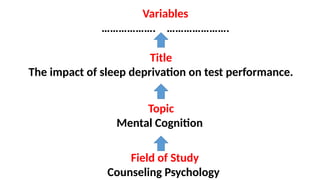
Research Topic, Title , Variables
• Choosing a Research Topic, Title, and
Variables from a Specific Area of Study
can be a challenging task.
• Start from a wider research area.
• Narrow down to the research topic
• Identify the key variables.
• Frame your research title
Field of Study
Counseling Psychology
Topic
Mental Cognition
Title
The impact of sleep deprivation on test performance.
Variables
………………. ………………….
Research Topic
• A well-defined research topic is the starting
point of every successful research project.
• Choosing a topic is an ongoing process by
which researchers explore, define, and
refine their ideas.
Research Topic
A research topic is a subject or issue that a
researcher is interested in when
conducting research.
Examples
- Gender-based violence
- Alcoholism
- Drug abuse
- Delinquency
Research Title (cont.)
Research title is without doubt the part of a
research project that is read the most, and it
is usually read first.
Example
“The impact of sleep deprivation on test
performance”
Research Title (cont.)
A good and attractive title should :
• include the primary variables
• be specific and limited. Titles with 7 to 12 words
are more appropriate.
• be clear, unambiguous, and attractive.
Research Variables
Variables in research are things that can be
changed or altered, such as a characteristic or
value.
• Dependent and Independent Variables
• Intervening Variables
• Extraneous Variables
• Controlled Variables
• Confounding Variables
Independent and Dependent Variables
Dependent and Independent Variables
Example: The impact of sleep deprivation on test
performance.
The independent variable is the variable that is
manipulated by the experimenter.
Example: sleep deprivation
The dependent variable is the variable that is
measured by the experimenter.
Example: test performance.
Intervening Variables
Factors that play a role in the
relationship between two other
variables.
Example
Stress might be an intervening variable that
plays a role in how much sleep people get,
which may then influence how well they
perform on exams.
Extraneous Variables
Any variable not being investigated that has the
potential to affect the outcome of a research study.
Example
Physical performance (independent variable), the effect
of a specific athletic shoe (dependent variable) may be
tested. Extraneous variables in this example might
include:
• Demographics such as age and gender
• Testing environment
• Time of day of testing
Controlled Variables
• A control variable is anything that is held constant
or limited in a research study.
• It’s a variable that is not of interest to the study’s
objectives, but is controlled because it could
influence the outcomes.
Example
- Room temperature
- Amount of light
- Noise in the environment
Confounding Variables
Confounding variables are a type of extraneous
variable that are related to a study’s independent
and dependent variables. A variable must meet
two conditions to be a confounder.
It must be
(a) Correlated with the independent variable.
(b) Causally related to the dependent variable
Research Report Outline
1. Background
2. Conceptual/Theoretical framework
3. Literature Review
4. Methodology
5. Results
6. Discussion
7. Conclusion and Recommendations
8. References
Appendix
1. Background to the study
• Provide detailed information about the topic
• Clearly define the existing research problem in a
broad context
• Discuss what has been done or is being done to
address the problem
• Discuss the research gap – based on existing
literature.
• Formulate research objectives. These are the
ideas that you will be “testing” in your research.
1.1. Problem statement
A research problem may be defined as an area of
concern, a gap in the existing knowledge or a
deviation in the norms or standard that points to
the need for further understanding and
investigation (Bwisa,2018).
Sources of Research Problem
• School library
• Own experience (observation)
• Classroom lecture
• Classroom group discussion
• Seminars/workshops/paper presentation
• Internet
• Daily problems
Sources of Research Problem (cont.)
• Technological changes
• Unexplored areas
• Discussion with other people
1.2. Statement of the Problem
• A statement of the problem is used in research
work as a claim that outline/point to the problem
addressed by the study.
• The statement of the problem briefly addresses the
question: What is the problem the researcher will
address?
• The statement of the problem need not be long and
elaborate. One page is more that enough for a good
statement of problem.
Statement of the Problem format
A persuasive statement of the problem is usually
written in three parts.
Part A (The Ideal) Statement 1
• It describe the desired or ideal situation
• It explain how things should be
Part B (The Reality) Statement 2
• It explains the conditions that prevents the goal,
state, or value in Part A from being achieved or
realized at this time
Statement of the Problem format
Part B (The Reality) Statement 2
• It explains how the current situation falls short of
the goal or ideal.
Part C (The Consequences) Statement 3
• It identifies the way you proposed to improve the
current situation and move it closer to the goal or
ideal.
Example of Statement of the Problem
STATEMENT 1
• Ministry of Education and Sports is dedicated
in allocating funds to Primary and Secondary
education in Uganda. These funds are made
available in order to increase enrolment and
improve quality of education.
• (Provide relevant statistics and quote)
Example of Statement of the Problem
STATEMENT 2
• One of the focus of the ministry is consistency.
Unfortunately, consistency in allocating funds to
different sectors of education requires prior
knowledge of previous allocation and established
practices. The current continuous disbursement
method does no allow for adequate analysis of
previous disbursement before the current
disbursement is done.
Example of Statement of the Problem
STATEMENT 3
• Continuing with this current disbursement method
prevents consistency and causes decision to
become grossly political, which in turn inhibits the
achievement of the goals of funds. Developing a
more informed disbursement system could help
better implement the consistency focus of the
ministry and at the same time help the ministry
better monitor and evaluate its funds.
Example of Statement of the Problem
STATEMENT 3 (cont.)
• This proposed aims to explore options for a new
funds disbursement system that would focus on
consistency. To do this, the researcher will carry out
a full stakeholder analysis and use it to propose
appropriate interventions.
Research questions
Research questions are designed to refine
the parameters and provide direction for
the research (Khoo, 2005).
“To find the right question requires that you
understand what you are asking about, and
know to keep the question simple enough to
be answerable, but challenging enough to
be interesting.”
Research questions (cont.)
Characteristics of a good research question
• The question is important and relevant.
• It is interesting to the researchers and others
• It is simple
• It is feasible, i.e. answerable within a set
timeframe
• It is clear and succinct
• It is original, set out to discover something new
1.2 Research Objectives
• Objective – statement of intend
• To adequately address the research problem,
objectives should be specific, well thought and
reflect the research question being asked. They
should also be aligned to the chosen
methodology (Ming, 2005).
• Different research questions and objectives will
require different methodology.
Research Hypothesis
• Hypothesis is a tentative prediction or
explanation of a relationship between two
variables. It implies that there is a
systematic relationship between an
independent and dependent variable.
• Theoretical framework or conceptual
framework are the most important sources
of hypothesis.
Importance of Hypothesis
• Hypothesis enable the researcher to
objectively investigate new areas of discovery,
thus help in theory building
• Hypothesis provides directions to conduct
research.
• It serves a bridge between theory and reality
Types of Hypothesis
NULL HYPOTHESIS (Ho)
• It is also known as STATISTICAL HYPOTHESIS.
It is used for statistical testing and
interpretation of statistical outcomes.
• It states the existence of NO relationship
between independent and dependent
variables.
Example
“There is no relationship between sleep
deprivation and test performance”
Types of Hypothesis (cont.)
DIRECTIONAL HYPOTHESIS (Ha)
• Reflects the relationship between two or
more variables but does not specify the
anticipated direction and nature of
relationship such as positive or negative.
Example
“There is a positive relationship between years
of teaching experience and job satisfaction
among teachers”
Types of Hypothesis (cont.)
NON-DIRECTIONAL HYPOTHESIS (Ha)
• It indicate the existence of a relationship
between independent and dependent
variable.
Example
“There is a relationship between years of
teaching experience and job satisfaction among
teachers”
Conceptual framework
• It is used to show relationships among
dependent and independent variable(s) and
how they relate to the research study.
• It defines the relevant objectives for
your research process and maps out how they
come together to draw coherent conclusion.
• Mainly used in qualitative research
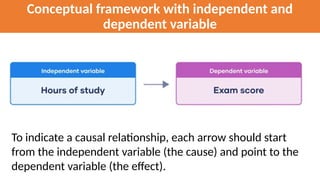
Conceptual framework with independent and
dependent variable
To indicate a causal relationship, each arrow should start
from the independent variable (the cause) and point to the
dependent variable (the effect).
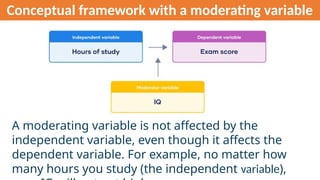
Conceptual framework with a moderating variable
A moderating variable is not affected by the
independent variable, even though it affects the
dependent variable. For example, no matter how
many hours you study (the independent variable),
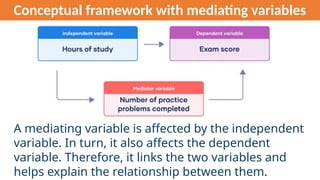
Conceptual framework with mediating variables
A mediating variable is affected by the independent
variable. In turn, it also affects the dependent
variable. Therefore, it links the two variables and
helps explain the relationship between them.
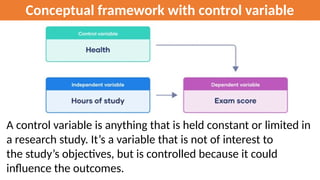
Conceptual framework with control variable
A control variable is anything that is held constant or limited in
a research study. It’s a variable that is not of interest to
the study’s objectives, but is controlled because it could
influence the outcomes.
Theoretical framework
• A theoretical framework is a single formal
theory.
• When a study is designed around a theoretical
framework, the theory is the primary means in
which the research problem is understood and
investigated.
• Theoretical frameworks may be used in
quantitative and qualitative research.
Example of Theoretical framework
• Technology Acceptance Model (TAM) by Davis
(1985) was used as theoretical framework. The
model travels the use and ease of technology to
motivate people to use it for specific purposes.
• TAM postulates that users' adoption of information
technology is determined by two concepts, the
Perceived Usefulness (PU) and the Perceived Ease
of Use (PEOU) (Davis, 1989).
Literature review
• A literature review discusses published
information in a particular topic within a certain
time period. It is a comprehensive summary of
major writings and other sources on a selected
research topic.
• A literature review is carried out in order to
critically evaluate the current literature and
justify why further study and research is
required.
Literature review (cont.)
• As a project in itself, a literature review
provides a comprehensive survey of the works
published in a particular discipline or area of
research over a specified period of time.
• The sources of such published information
may include academic journals, books,
newspapers, government and international
agencies reports, etc.
Research Methods
• Research methods – quantitative, qualitative
or mixed method
• Research design –depending on research
method
• Participants – population and sample
• Instrument - tools used to collect data
• Data analysis – quantitative or qualitative
data analysis
Results
• A results section is where you report the main
findings of the data collection and analysis you
conducted for your Research project.
• Report all relevant results concisely and objectively,
in a logical order.
• Don’t include subjective interpretations of why you
found these results or what they mean—any
evaluation should be saved for the discussion
section.
How to structure Results
1. Begin with an introduction to connect the results with
the research question(s). This brings the readers’ focus
back to the purpose of the study after reading the
literature review and methods sections of your paper.
2. Present your findings in a structured way (such as
thematically or chronologically), bringing the readers’
attention to any important, interesting, or significant
findings. Be sure to include a combination of text and
visuals.
How to structure Results (cont.)
3. The results section should include a closing paragraph
that clearly summarizes the key findings of the study.
This paves the way for the discussion section of the
research paper, wherein the results are interpreted
and put in conversation with existing literature.
Quantitative Results
1. Report your statistics and data analysis – What kind
of analysis was conducted: regression, structural
equation, linear models etc.
2. Report on the outcome of these analyses – Include
values of tests conducted: degrees of freedom,
probability, effect size or confidence intervals –
Data can be presented in text, table, or chart form.
Example of Quantitative Results
[Introductory Context] At the end of the data collection, 131 stakeholders
participated in the survey. The respondents were distributed by districts as
follows: 29 from the Gulu district, (22.1% of the total), 38 from Nwoya (29.0%),
28 from Agago (21.4%) and 36 from Omoro (27.5%). [See RQ1 Table 1]
[Important Finding] The results show that, for most stakeholders, the most
important category of WES is regulating services (w = 0.3202), followed by
provisioning services (w = 0.3064) and supporting services (w = 0.2209).
Cultural services, on the other hand, are of low importance compared to the
other three categories (w = 0.1524) (Table 1). [...] [Interesting Finding] It is also
interesting to note that stakeholders from Omoro and Gulu district placed a
higher value on cultural services than those from Nwoya and Agago. For all
groups of stakeholders, the consistency ratio (CR) is less than 0.05 (5%).
Qualitative Results
• Use extracts from your interviews, focus groups or
exemplary pictures which you have analysed to
justify your analysis
• You do not have to use all of them – focus on the
most expressive
• Longer extracts have to be highlighted in the text
e.g., indent, numbered and explained
Qualitative Results (cont.)
• Shorter extracts can be put into the main text and
become part of your sentence structure
• Use coded identifier to guarantee data protection for
your participants, but enables you to know where the
extract initially originates from.
Opening of Discussion Section
• Open the Discussion section with a clear statement of
the support or non-support of your original hypotheses
respectively the main findings of your research
Example “This research sought to explore how the male-
only stereotype affects the self-perception and discourse
of politically motivated hackers. Four discourses arising
from the discursive object gender… ”
• Approximately one paragraph for the summary of your
findings.
Main body of Discussion Section
• Thereafter similarities and differences between your
results and the work of others should be discussed
• Confirm, contextualize and clarify your conclusions
• Do not repeat and reformulate points already made
• Each new statement should contribute to your
interpretation and the reader‘s understanding of the
problem.
Conclusion and Recommendations
End the Discussion section with a reasoned and
justifiable commentary on the importance of your
findings.

Consider:
- What is the theoretical and practical significance of the findings?
- If the findings are valid and replicable
- what real-life phenomena might be explained by the results?
- What problems remain unresolved or arise anew because of the
findings?
Conclusion and Recommendations
• The Concluding section / paragraph may be brief
and should be tightly reasoned, self-contained and
not overstated.
• The recommendation section should clearly state
the gaps in your study and how it should be
addressed in similar studies.
List of references
• The preferred style for referencing used in
most research projects is based on APA style.
Please ensure that it is consistent throughout
the notes, text citation.
• The references must be written alphabetically.
Thank you for listening

How to Write a Research Proposal (1).pptx

  • 1.
    How to Writea Research Proposal and Report By Prof R.J.Odora
  • 2.
    What is aresearch proposal? •The research proposal is, arguably, the most important document guiding your research project. •It is the road-map or plan of action that ensures that your final research project is of the required quality to obtain your postgraduate degree.
  • 3.
    What is aresearch proposal? • It outlines why you are doing it. what you are going to do and how you are going to do it • It is a steering wheel that guides you to successfully complete your research project.
  • 4.
    Why is researchproposal so important? • Gives you chance to explain the significance of your research project • It demonstrates the quality and importance of your project as well as your ability to conduct the proposed research.
  • 5.
    Why is researchproposal so important? • It gives you the opportunity to think through your research project, to refine your focus, and to predict any challenges that may arise. • It is a launching pad for writing your research report.
  • 6.
    Research Topic, Title, Variables • Choosing a Research Topic, Title, and Variables from a Specific Area of Study can be a challenging task. • Start from a wider research area. • Narrow down to the research topic • Identify the key variables. • Frame your research title
  • 7.
    Field of Study CounselingPsychology Topic Mental Cognition Title The impact of sleep deprivation on test performance. Variables ………………. ………………….
  • 8.
    Research Topic • Awell-defined research topic is the starting point of every successful research project. • Choosing a topic is an ongoing process by which researchers explore, define, and refine their ideas.
  • 9.
    Research Topic A researchtopic is a subject or issue that a researcher is interested in when conducting research. Examples - Gender-based violence - Alcoholism - Drug abuse - Delinquency
  • 10.
    Research Title (cont.) Researchtitle is without doubt the part of a research project that is read the most, and it is usually read first. Example “The impact of sleep deprivation on test performance”
  • 11.
    Research Title (cont.) Agood and attractive title should : • include the primary variables • be specific and limited. Titles with 7 to 12 words are more appropriate. • be clear, unambiguous, and attractive.
  • 12.
    Research Variables Variables inresearch are things that can be changed or altered, such as a characteristic or value. • Dependent and Independent Variables • Intervening Variables • Extraneous Variables • Controlled Variables • Confounding Variables
  • 13.
    Independent and DependentVariables Dependent and Independent Variables Example: The impact of sleep deprivation on test performance. The independent variable is the variable that is manipulated by the experimenter. Example: sleep deprivation The dependent variable is the variable that is measured by the experimenter. Example: test performance.
  • 14.
    Intervening Variables Factors thatplay a role in the relationship between two other variables. Example Stress might be an intervening variable that plays a role in how much sleep people get, which may then influence how well they perform on exams.
  • 15.
    Extraneous Variables Any variablenot being investigated that has the potential to affect the outcome of a research study. Example Physical performance (independent variable), the effect of a specific athletic shoe (dependent variable) may be tested. Extraneous variables in this example might include: • Demographics such as age and gender • Testing environment • Time of day of testing
  • 16.
    Controlled Variables • Acontrol variable is anything that is held constant or limited in a research study. • It’s a variable that is not of interest to the study’s objectives, but is controlled because it could influence the outcomes. Example - Room temperature - Amount of light - Noise in the environment
  • 17.
    Confounding Variables Confounding variablesare a type of extraneous variable that are related to a study’s independent and dependent variables. A variable must meet two conditions to be a confounder. It must be (a) Correlated with the independent variable. (b) Causally related to the dependent variable
  • 18.
    Research Report Outline 1.Background 2. Conceptual/Theoretical framework 3. Literature Review 4. Methodology 5. Results 6. Discussion 7. Conclusion and Recommendations 8. References Appendix
  • 19.
    1. Background tothe study • Provide detailed information about the topic • Clearly define the existing research problem in a broad context • Discuss what has been done or is being done to address the problem • Discuss the research gap – based on existing literature. • Formulate research objectives. These are the ideas that you will be “testing” in your research.
  • 20.
    1.1. Problem statement Aresearch problem may be defined as an area of concern, a gap in the existing knowledge or a deviation in the norms or standard that points to the need for further understanding and investigation (Bwisa,2018).
  • 21.
    Sources of ResearchProblem • School library • Own experience (observation) • Classroom lecture • Classroom group discussion • Seminars/workshops/paper presentation • Internet • Daily problems
  • 22.
    Sources of ResearchProblem (cont.) • Technological changes • Unexplored areas • Discussion with other people
  • 23.
    1.2. Statement ofthe Problem • A statement of the problem is used in research work as a claim that outline/point to the problem addressed by the study. • The statement of the problem briefly addresses the question: What is the problem the researcher will address? • The statement of the problem need not be long and elaborate. One page is more that enough for a good statement of problem.
  • 24.
    Statement of theProblem format A persuasive statement of the problem is usually written in three parts. Part A (The Ideal) Statement 1 • It describe the desired or ideal situation • It explain how things should be Part B (The Reality) Statement 2 • It explains the conditions that prevents the goal, state, or value in Part A from being achieved or realized at this time
  • 25.
    Statement of theProblem format Part B (The Reality) Statement 2 • It explains how the current situation falls short of the goal or ideal. Part C (The Consequences) Statement 3 • It identifies the way you proposed to improve the current situation and move it closer to the goal or ideal.
  • 26.
    Example of Statementof the Problem STATEMENT 1 • Ministry of Education and Sports is dedicated in allocating funds to Primary and Secondary education in Uganda. These funds are made available in order to increase enrolment and improve quality of education. • (Provide relevant statistics and quote)
  • 27.
    Example of Statementof the Problem STATEMENT 2 • One of the focus of the ministry is consistency. Unfortunately, consistency in allocating funds to different sectors of education requires prior knowledge of previous allocation and established practices. The current continuous disbursement method does no allow for adequate analysis of previous disbursement before the current disbursement is done.
  • 28.
    Example of Statementof the Problem STATEMENT 3 • Continuing with this current disbursement method prevents consistency and causes decision to become grossly political, which in turn inhibits the achievement of the goals of funds. Developing a more informed disbursement system could help better implement the consistency focus of the ministry and at the same time help the ministry better monitor and evaluate its funds.
  • 29.
    Example of Statementof the Problem STATEMENT 3 (cont.) • This proposed aims to explore options for a new funds disbursement system that would focus on consistency. To do this, the researcher will carry out a full stakeholder analysis and use it to propose appropriate interventions.
  • 30.
    Research questions Research questionsare designed to refine the parameters and provide direction for the research (Khoo, 2005). “To find the right question requires that you understand what you are asking about, and know to keep the question simple enough to be answerable, but challenging enough to be interesting.”
  • 31.
    Research questions (cont.) Characteristicsof a good research question • The question is important and relevant. • It is interesting to the researchers and others • It is simple • It is feasible, i.e. answerable within a set timeframe • It is clear and succinct • It is original, set out to discover something new
  • 32.
    1.2 Research Objectives •Objective – statement of intend • To adequately address the research problem, objectives should be specific, well thought and reflect the research question being asked. They should also be aligned to the chosen methodology (Ming, 2005). • Different research questions and objectives will require different methodology.
  • 33.
    Research Hypothesis • Hypothesisis a tentative prediction or explanation of a relationship between two variables. It implies that there is a systematic relationship between an independent and dependent variable. • Theoretical framework or conceptual framework are the most important sources of hypothesis.
  • 34.
    Importance of Hypothesis •Hypothesis enable the researcher to objectively investigate new areas of discovery, thus help in theory building • Hypothesis provides directions to conduct research. • It serves a bridge between theory and reality
  • 35.
    Types of Hypothesis NULLHYPOTHESIS (Ho) • It is also known as STATISTICAL HYPOTHESIS. It is used for statistical testing and interpretation of statistical outcomes. • It states the existence of NO relationship between independent and dependent variables. Example “There is no relationship between sleep deprivation and test performance”
  • 36.
    Types of Hypothesis(cont.) DIRECTIONAL HYPOTHESIS (Ha) • Reflects the relationship between two or more variables but does not specify the anticipated direction and nature of relationship such as positive or negative. Example “There is a positive relationship between years of teaching experience and job satisfaction among teachers”
  • 37.
    Types of Hypothesis(cont.) NON-DIRECTIONAL HYPOTHESIS (Ha) • It indicate the existence of a relationship between independent and dependent variable. Example “There is a relationship between years of teaching experience and job satisfaction among teachers”
  • 38.
    Conceptual framework • Itis used to show relationships among dependent and independent variable(s) and how they relate to the research study. • It defines the relevant objectives for your research process and maps out how they come together to draw coherent conclusion. • Mainly used in qualitative research
  • 39.
    Conceptual framework withindependent and dependent variable To indicate a causal relationship, each arrow should start from the independent variable (the cause) and point to the dependent variable (the effect).
  • 40.
    Conceptual framework witha moderating variable A moderating variable is not affected by the independent variable, even though it affects the dependent variable. For example, no matter how many hours you study (the independent variable),
  • 41.
    Conceptual framework withmediating variables A mediating variable is affected by the independent variable. In turn, it also affects the dependent variable. Therefore, it links the two variables and helps explain the relationship between them.
  • 42.
    Conceptual framework withcontrol variable A control variable is anything that is held constant or limited in a research study. It’s a variable that is not of interest to the study’s objectives, but is controlled because it could influence the outcomes.
  • 43.
    Theoretical framework • Atheoretical framework is a single formal theory. • When a study is designed around a theoretical framework, the theory is the primary means in which the research problem is understood and investigated. • Theoretical frameworks may be used in quantitative and qualitative research.
  • 44.
    Example of Theoreticalframework • Technology Acceptance Model (TAM) by Davis (1985) was used as theoretical framework. The model travels the use and ease of technology to motivate people to use it for specific purposes. • TAM postulates that users' adoption of information technology is determined by two concepts, the Perceived Usefulness (PU) and the Perceived Ease of Use (PEOU) (Davis, 1989).
  • 45.
    Literature review • Aliterature review discusses published information in a particular topic within a certain time period. It is a comprehensive summary of major writings and other sources on a selected research topic. • A literature review is carried out in order to critically evaluate the current literature and justify why further study and research is required.
  • 46.
    Literature review (cont.) •As a project in itself, a literature review provides a comprehensive survey of the works published in a particular discipline or area of research over a specified period of time. • The sources of such published information may include academic journals, books, newspapers, government and international agencies reports, etc.
  • 47.
    Research Methods • Researchmethods – quantitative, qualitative or mixed method • Research design –depending on research method • Participants – population and sample • Instrument - tools used to collect data • Data analysis – quantitative or qualitative data analysis
  • 48.
    Results • A resultssection is where you report the main findings of the data collection and analysis you conducted for your Research project. • Report all relevant results concisely and objectively, in a logical order. • Don’t include subjective interpretations of why you found these results or what they mean—any evaluation should be saved for the discussion section.
  • 49.
    How to structureResults 1. Begin with an introduction to connect the results with the research question(s). This brings the readers’ focus back to the purpose of the study after reading the literature review and methods sections of your paper. 2. Present your findings in a structured way (such as thematically or chronologically), bringing the readers’ attention to any important, interesting, or significant findings. Be sure to include a combination of text and visuals.
  • 50.
    How to structureResults (cont.) 3. The results section should include a closing paragraph that clearly summarizes the key findings of the study. This paves the way for the discussion section of the research paper, wherein the results are interpreted and put in conversation with existing literature.
  • 51.
    Quantitative Results 1. Reportyour statistics and data analysis – What kind of analysis was conducted: regression, structural equation, linear models etc. 2. Report on the outcome of these analyses – Include values of tests conducted: degrees of freedom, probability, effect size or confidence intervals – Data can be presented in text, table, or chart form.
  • 52.
    Example of QuantitativeResults [Introductory Context] At the end of the data collection, 131 stakeholders participated in the survey. The respondents were distributed by districts as follows: 29 from the Gulu district, (22.1% of the total), 38 from Nwoya (29.0%), 28 from Agago (21.4%) and 36 from Omoro (27.5%). [See RQ1 Table 1] [Important Finding] The results show that, for most stakeholders, the most important category of WES is regulating services (w = 0.3202), followed by provisioning services (w = 0.3064) and supporting services (w = 0.2209). Cultural services, on the other hand, are of low importance compared to the other three categories (w = 0.1524) (Table 1). [...] [Interesting Finding] It is also interesting to note that stakeholders from Omoro and Gulu district placed a higher value on cultural services than those from Nwoya and Agago. For all groups of stakeholders, the consistency ratio (CR) is less than 0.05 (5%).
  • 53.
    Qualitative Results • Useextracts from your interviews, focus groups or exemplary pictures which you have analysed to justify your analysis • You do not have to use all of them – focus on the most expressive • Longer extracts have to be highlighted in the text e.g., indent, numbered and explained
  • 54.
    Qualitative Results (cont.) •Shorter extracts can be put into the main text and become part of your sentence structure • Use coded identifier to guarantee data protection for your participants, but enables you to know where the extract initially originates from.
  • 55.
    Opening of DiscussionSection • Open the Discussion section with a clear statement of the support or non-support of your original hypotheses respectively the main findings of your research Example “This research sought to explore how the male- only stereotype affects the self-perception and discourse of politically motivated hackers. Four discourses arising from the discursive object gender… ” • Approximately one paragraph for the summary of your findings.
  • 56.
    Main body ofDiscussion Section • Thereafter similarities and differences between your results and the work of others should be discussed • Confirm, contextualize and clarify your conclusions • Do not repeat and reformulate points already made • Each new statement should contribute to your interpretation and the reader‘s understanding of the problem.
  • 57.
    Conclusion and Recommendations Endthe Discussion section with a reasoned and justifiable commentary on the importance of your findings. Consider: - What is the theoretical and practical significance of the findings? - If the findings are valid and replicable - what real-life phenomena might be explained by the results? - What problems remain unresolved or arise anew because of the findings?
  • 58.
    Conclusion and Recommendations •The Concluding section / paragraph may be brief and should be tightly reasoned, self-contained and not overstated. • The recommendation section should clearly state the gaps in your study and how it should be addressed in similar studies.
  • 59.
    List of references •The preferred style for referencing used in most research projects is based on APA style. Please ensure that it is consistent throughout the notes, text citation. • The references must be written alphabetically.
  • 60.
    Thank you forlistening