Stanton University
APA
APA Formatting and Style Guide
Created by Jessica Medina
What is APA style?
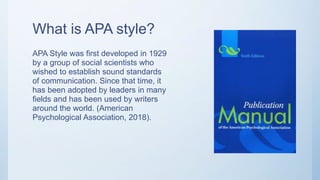
APA Style was first developed in 1929
by a group of social scientists who
wished to establish sound standards
of communication. Since that time, it
has been adopted by leaders in many
fields and has been used by writers
around the world. (American
Psychological Association, 2018).
APA Style (cont.)
• These rules are designed to ensure clear and consistent presentation
of written material. Editorial style concerns uniform use of such
elements as
• punctuation and abbreviations,
• construction of tables,
• selection of headings,
• citation of references, and
• presentation of statistics.
(American Psychological Association, 2018).
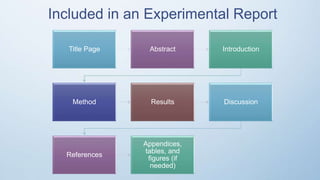
Included in an Experimental Report
Title Page Abstract Introduction
Method Results Discussion
References
Appendices,
tables, and
figures (if
needed)
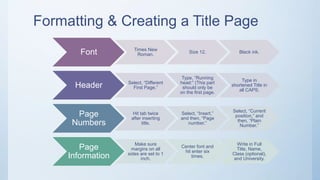
Formatting & Creating a Title Page
Font Times New
Roman.
Size 12. Black ink.
Header Select, “Different
First Page.”
Type, “Running
head:” (This part
should only be
on the first page.
Type in
shortened Title in
all CAPS.
Page
Numbers
Hit tab twice
after inserting
title.
Select, “Insert,”
and then, “Page
number.”
Select, “Current
position,” and
then, “Plain
Number.”
Page
Information
Make sure
margins on all
sides are set to 1
inch.
Center font and
hit enter six
times.
Write in Full
Title, Name,
Class (optional),
and University.
Title Page
Example
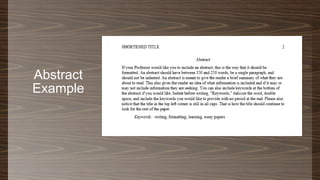
Abstract
Example
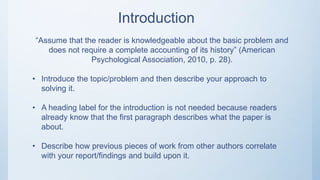
Introduction
“Assume that the reader is knowledgeable about the basic problem and
does not require a complete accounting of its history” (American
Psychological Association, 2010, p. 28).
• Introduce the topic/problem and then describe your approach to
solving it.
• A heading label for the introduction is not needed because readers
already know that the first paragraph describes what the paper is
about.
• Describe how previous pieces of work from other authors correlate
with your report/findings and build upon it.
Introduction (Experimental) Example
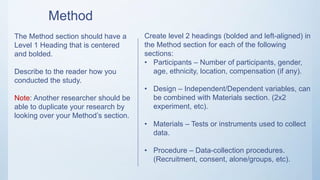
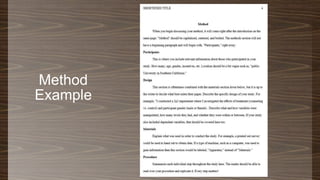
Method
The Method section should have a
Level 1 Heading that is centered
and bolded.
Describe to the reader how you
conducted the study.
Note: Another researcher should be
able to duplicate your research by
looking over your Method’s section.
Create level 2 headings (bolded and left-aligned) in
the Method section for each of the following
sections:
• Participants – Number of participants, gender,
age, ethnicity, location, compensation (if any).
• Design – Independent/Dependent variables, can
be combined with Materials section. (2x2
experiment, etc).
• Materials – Tests or instruments used to collect
data.
• Procedure – Data-collection procedures.
(Recruitment, consent, alone/groups, etc).
Method
Example
Results
• Start with a statement describing your dependent measure and the
analysis conducted on your data.
• Present your data that clearly answers questions involving your
hypothesis.
• Report the outcome of the analysis (e.g., means, standard deviations, t
values, F values, etc.
• Depending on your study, decide which type of table or figure would
best represent your results.
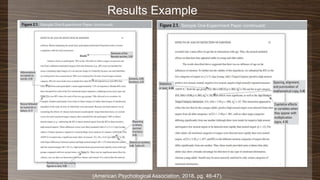
Results Example
(American Psychological Association, 2018, pg. 46-47).
Discussion
Open the discussion section
with a clear statement of the
support or nonsupport for
your original hypothesis.
Your interpretation of the results should
take in account (a) sources of potential
bias and other threats to internal
validity, (b) the imprecision of
measures, (c) the overall number of
tests or overlap among tests, (d) the
effect sizes observes, and (e) other
limitations or weaknesses of the study.
(American Psychological Association, 2010, pg. 35).
Discussion Example
References
Why should I include a reference page?
• It gives scholars recognition that they deserve.
• It provides a reliable way to locate previous studies.
• It permits readers the ability to fact check information and
statistics to ensure that the information given is accurate.
A reference page should begin on a new page. If you only use
one reference, the heading should be singular. (Reference vs.
References).
Cite in APA format!
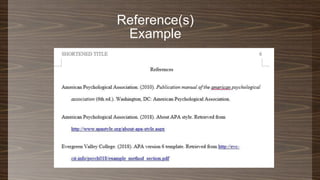
Reference(s)
Example
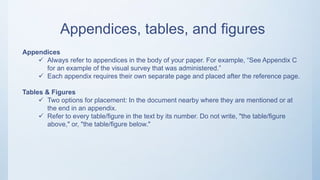
Appendices, tables, and figures
Appendices
 Always refer to appendices in the body of your paper. For example, “See Appendix C
for an example of the visual survey that was administered.”
 Each appendix requires their own separate page and placed after the reference page.
Tables & Figures
 Two options for placement: In the document nearby where they are mentioned or at
the end in an appendix.
 Refer to every table/figure in the text by its number. Do not write, "the table/figure
above," or, "the table/figure below."
Example of Table and Figure
(Conestoga, 2018).
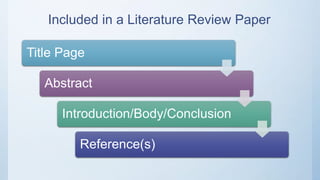
Included in a Literature Review Paper
Title Page
Abstract
Introduction/Body/Conclusion
Reference(s)
Formatting & Creating a Title Page
Font Times New
Roman.
Size 12. Black ink.
Header Select, “Different
First Page.”
Type, “Running
head:” (This part
should only be
on the first page.
Type in
shortened Title in
all CAPS.
Page
Numbers
Hit tab twice
after inserting
title.
Select, “Insert,”
and then, “Page
number.”
Select, “Current
position,” and
then, “Plain
Number.”
Page
Information
Make sure
margins on all
sides are set to 1
inch.
Center font and
hit enter six
times.
Write in Full
Title, Name,
Class (optional),
and University.
Title Page
Example
Abstract
Example
Introduction (Literature) Example
Headings:
Levels 1 & 2
(Idaho State University
Writing Center, 2016).
In-text
citations
Basic Citation Styles
(Table 6.1) from American
Psychological Association.
(2010). Publication
Manual of the American
Psychological
Association (p. 177).
In-text citations examples
One author:
Holloway (2018) found significant results in her case.
Library science is a real science (Halloway, 2018).
Two authors:
Carl and Mark (2016) continued their research.
Chocolate is better than vanilla (Carl & Mark, 2016).
Direct Quotes & Citing Specific Parts of
a Source
Fewer than 40 words – mid sentence:
Summarizing these results, Holloway et al. (2015) concluded that “brownies are significantly better than
cake” (p. 18), resulting in happier people.
Fewer than 40 words – end of sentence:
Even though some people may disagree, “brownies are better than boring cake” (Holloway, 2015, p. 18).
More than 40 words: Get rid of the double quotes surrounding the text
and separate it from the rest of the text in a freestanding block.
It is scientific fact that brownies are better than cake. Brownies have much better texture, taste,
and appearance than cake. Cake has been the super star in our world for far too long. You can find
cake everywhere and is overrated. It would be nicer to show up to a wedding or birthday party that
serves brownies instead. (Holloway, 2015, pp. 18-19)
Direct Quotes & Citing Specific Parts of a
Source (continued)
More than 40 words: Get rid
of the double quotes
surrounding the text and
separate it from the rest of
the text in a freestanding
block.
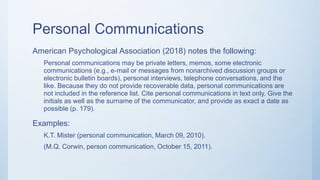
Personal Communications
American Psychological Association (2018) notes the following:
Personal communications may be private letters, memos, some electronic
communications (e.g., e-mail or messages from nonarchived discussion groups or
electronic bulletin boards), personal interviews, telephone conversations, and the
like. Because they do not provide recoverable data, personal communications are
not included in the reference list. Cite personal communications in text only. Give the
initials as well as the surname of the communicator, and provide as exact a date as
possible (p. 179).
Examples:
K.T. Mister (personal communication, March 09, 2010).
(M.Q. Corwin, person communication, October 15, 2011).
Grammar and Usage
Verbs: “Use the active rather than the passive voice…” (p. 77).
Pronouns: “Use who for human beings; use that or which for nonhuman
animals and things” (p. 79).
Adverbs: (p. 82)
 More important, blah More importantly
 An interesting… Interestingly, blah blah
 First, we hypothesized Firstly, we hypothesized
 I hope that… Hopefully, blah blah
(American Psychological Association, 2018, pp. 77-82).
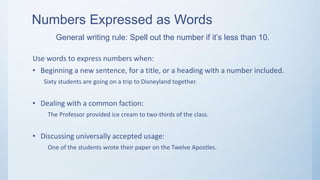
Numbers Expressed as Words
General writing rule: Spell out the number if it’s less than 10.
Use words to express numbers when:
• Beginning a new sentence, for a title, or a heading with a number included.
Sixty students are going on a trip to Disneyland together.
• Dealing with a common faction:
The Professor provided ice cream to two-thirds of the class.
• Discussing universally accepted usage:
One of the students wrote their paper on the Twelve Apostles.
Numbers Expressed as Numerals
Use numerals to express numbers when:
• Numbers appear within the abstract of an essay.
• Numbers precede units of measurement.
Carl was prescribed to take a 30-mg dose of Adderall for his ADHD each day.
• Numbers that represent a part of a mathematical expression.
The top 10% of the student body where invited to a special party at the end of the school year.
• Numbers that represent an exact sum of money, time, dates, ages, or scores/points.
Sable was dodging my calls because he owed me $50.
We have an important meeting at 3:30 p.m.
I am hopeful for the 2020 United States election.
The beginner’s baking class was for 6-year-olds only.
The bowling team scored a perfect 300.
References
Why should I include a reference page?
• It gives scholars recognition that they deserve.
• It provides a reliable way to locate previous studies.
• It permits readers the ability to fact check information and
statistics to ensure that the information given is accurate.
A reference page should begin on a new page. If you only use
one reference, the heading should be singular. (Reference vs.
References).
Citation Guides
(EasyBib, 2015.)
Citation Guides (cont)
(EasyBib, 2015.)
APA Generator
After browsing a significant amount of “free” APA generator’s online; I
believe you are better off paying a bit of money for one that will do it
correctly.
Below is a link to a website that charges $9.99/month. It is easy to use,
formats correctly, and is provided by a trusted company.
EasyBib Pro
Reference(s)
Example Page
References
American Psychological Association. (2010). Publication manual of the american psychological
association (6th ed.). Washington, DC: American Psychological Association.
American Psychological Association. (2018). About APA style. Retrieved from
http://www.apastyle.org/about-apa-style.aspx
Conestoga. (2018). Visuals & appendices: Tables, figures, appendices. Retrieved from
https://apa.conestogac.on.ca/Sections/Visuals#tables
EasyBib. (2015). APA citation basics (6th ed.) Imagine Easy Solutions, Inc. Retrieved from
http://info.easybib.com/hs-fs/hub/222136/file-1616255036-pdf/APA_Citation_E-
book_Merged.pdf?t=1525826088813
Evergreen Valley College. (2018). APA version 6 template. Retrieved from http://evc-
cit.info/psych018/example_method_section.pdf
Idaho State University Writing Center. (2016). Formatting headings in APA. Retrieved from
http://www2.isu.edu/success/writing/handouts/apa_headings.pdf

Apa Formatting

  • 1.
    Stanton University APA APA Formattingand Style Guide Created by Jessica Medina
  • 2.
    What is APAstyle? APA Style was first developed in 1929 by a group of social scientists who wished to establish sound standards of communication. Since that time, it has been adopted by leaders in many fields and has been used by writers around the world. (American Psychological Association, 2018).
  • 3.
    APA Style (cont.) •These rules are designed to ensure clear and consistent presentation of written material. Editorial style concerns uniform use of such elements as • punctuation and abbreviations, • construction of tables, • selection of headings, • citation of references, and • presentation of statistics. (American Psychological Association, 2018).
  • 5.
    Included in anExperimental Report Title Page Abstract Introduction Method Results Discussion References Appendices, tables, and figures (if needed)
  • 6.
    Formatting & Creatinga Title Page Font Times New Roman. Size 12. Black ink. Header Select, “Different First Page.” Type, “Running head:” (This part should only be on the first page. Type in shortened Title in all CAPS. Page Numbers Hit tab twice after inserting title. Select, “Insert,” and then, “Page number.” Select, “Current position,” and then, “Plain Number.” Page Information Make sure margins on all sides are set to 1 inch. Center font and hit enter six times. Write in Full Title, Name, Class (optional), and University.
  • 7.
  • 8.
  • 9.
    Introduction “Assume that thereader is knowledgeable about the basic problem and does not require a complete accounting of its history” (American Psychological Association, 2010, p. 28). • Introduce the topic/problem and then describe your approach to solving it. • A heading label for the introduction is not needed because readers already know that the first paragraph describes what the paper is about. • Describe how previous pieces of work from other authors correlate with your report/findings and build upon it.
  • 10.
  • 11.
    Method The Method sectionshould have a Level 1 Heading that is centered and bolded. Describe to the reader how you conducted the study. Note: Another researcher should be able to duplicate your research by looking over your Method’s section. Create level 2 headings (bolded and left-aligned) in the Method section for each of the following sections: • Participants – Number of participants, gender, age, ethnicity, location, compensation (if any). • Design – Independent/Dependent variables, can be combined with Materials section. (2x2 experiment, etc). • Materials – Tests or instruments used to collect data. • Procedure – Data-collection procedures. (Recruitment, consent, alone/groups, etc).
  • 12.
  • 13.
    Results • Start witha statement describing your dependent measure and the analysis conducted on your data. • Present your data that clearly answers questions involving your hypothesis. • Report the outcome of the analysis (e.g., means, standard deviations, t values, F values, etc. • Depending on your study, decide which type of table or figure would best represent your results.
  • 14.
    Results Example (American PsychologicalAssociation, 2018, pg. 46-47).
  • 15.
    Discussion Open the discussionsection with a clear statement of the support or nonsupport for your original hypothesis. Your interpretation of the results should take in account (a) sources of potential bias and other threats to internal validity, (b) the imprecision of measures, (c) the overall number of tests or overlap among tests, (d) the effect sizes observes, and (e) other limitations or weaknesses of the study. (American Psychological Association, 2010, pg. 35).
  • 16.
  • 17.
    References Why should Iinclude a reference page? • It gives scholars recognition that they deserve. • It provides a reliable way to locate previous studies. • It permits readers the ability to fact check information and statistics to ensure that the information given is accurate. A reference page should begin on a new page. If you only use one reference, the heading should be singular. (Reference vs. References). Cite in APA format!
  • 18.
  • 19.
    Appendices, tables, andfigures Appendices  Always refer to appendices in the body of your paper. For example, “See Appendix C for an example of the visual survey that was administered.”  Each appendix requires their own separate page and placed after the reference page. Tables & Figures  Two options for placement: In the document nearby where they are mentioned or at the end in an appendix.  Refer to every table/figure in the text by its number. Do not write, "the table/figure above," or, "the table/figure below."
  • 20.
    Example of Tableand Figure (Conestoga, 2018).
  • 22.
    Included in aLiterature Review Paper Title Page Abstract Introduction/Body/Conclusion Reference(s)
  • 23.
    Formatting & Creatinga Title Page Font Times New Roman. Size 12. Black ink. Header Select, “Different First Page.” Type, “Running head:” (This part should only be on the first page. Type in shortened Title in all CAPS. Page Numbers Hit tab twice after inserting title. Select, “Insert,” and then, “Page number.” Select, “Current position,” and then, “Plain Number.” Page Information Make sure margins on all sides are set to 1 inch. Center font and hit enter six times. Write in Full Title, Name, Class (optional), and University.
  • 24.
  • 25.
  • 26.
  • 27.
    Headings: Levels 1 &2 (Idaho State University Writing Center, 2016).
  • 28.
    In-text citations Basic Citation Styles (Table6.1) from American Psychological Association. (2010). Publication Manual of the American Psychological Association (p. 177).
  • 29.
    In-text citations examples Oneauthor: Holloway (2018) found significant results in her case. Library science is a real science (Halloway, 2018). Two authors: Carl and Mark (2016) continued their research. Chocolate is better than vanilla (Carl & Mark, 2016).
  • 30.
    Direct Quotes &Citing Specific Parts of a Source Fewer than 40 words – mid sentence: Summarizing these results, Holloway et al. (2015) concluded that “brownies are significantly better than cake” (p. 18), resulting in happier people. Fewer than 40 words – end of sentence: Even though some people may disagree, “brownies are better than boring cake” (Holloway, 2015, p. 18). More than 40 words: Get rid of the double quotes surrounding the text and separate it from the rest of the text in a freestanding block. It is scientific fact that brownies are better than cake. Brownies have much better texture, taste, and appearance than cake. Cake has been the super star in our world for far too long. You can find cake everywhere and is overrated. It would be nicer to show up to a wedding or birthday party that serves brownies instead. (Holloway, 2015, pp. 18-19)
  • 31.
    Direct Quotes &Citing Specific Parts of a Source (continued) More than 40 words: Get rid of the double quotes surrounding the text and separate it from the rest of the text in a freestanding block.
  • 32.
    Personal Communications American PsychologicalAssociation (2018) notes the following: Personal communications may be private letters, memos, some electronic communications (e.g., e-mail or messages from nonarchived discussion groups or electronic bulletin boards), personal interviews, telephone conversations, and the like. Because they do not provide recoverable data, personal communications are not included in the reference list. Cite personal communications in text only. Give the initials as well as the surname of the communicator, and provide as exact a date as possible (p. 179). Examples: K.T. Mister (personal communication, March 09, 2010). (M.Q. Corwin, person communication, October 15, 2011).
  • 33.
    Grammar and Usage Verbs:“Use the active rather than the passive voice…” (p. 77). Pronouns: “Use who for human beings; use that or which for nonhuman animals and things” (p. 79). Adverbs: (p. 82)  More important, blah More importantly  An interesting… Interestingly, blah blah  First, we hypothesized Firstly, we hypothesized  I hope that… Hopefully, blah blah (American Psychological Association, 2018, pp. 77-82).
  • 34.
    Numbers Expressed asWords General writing rule: Spell out the number if it’s less than 10. Use words to express numbers when: • Beginning a new sentence, for a title, or a heading with a number included. Sixty students are going on a trip to Disneyland together. • Dealing with a common faction: The Professor provided ice cream to two-thirds of the class. • Discussing universally accepted usage: One of the students wrote their paper on the Twelve Apostles.
  • 35.
    Numbers Expressed asNumerals Use numerals to express numbers when: • Numbers appear within the abstract of an essay. • Numbers precede units of measurement. Carl was prescribed to take a 30-mg dose of Adderall for his ADHD each day. • Numbers that represent a part of a mathematical expression. The top 10% of the student body where invited to a special party at the end of the school year. • Numbers that represent an exact sum of money, time, dates, ages, or scores/points. Sable was dodging my calls because he owed me $50. We have an important meeting at 3:30 p.m. I am hopeful for the 2020 United States election. The beginner’s baking class was for 6-year-olds only. The bowling team scored a perfect 300.
  • 36.
    References Why should Iinclude a reference page? • It gives scholars recognition that they deserve. • It provides a reliable way to locate previous studies. • It permits readers the ability to fact check information and statistics to ensure that the information given is accurate. A reference page should begin on a new page. If you only use one reference, the heading should be singular. (Reference vs. References).
  • 37.
  • 38.
  • 39.
    APA Generator After browsinga significant amount of “free” APA generator’s online; I believe you are better off paying a bit of money for one that will do it correctly. Below is a link to a website that charges $9.99/month. It is easy to use, formats correctly, and is provided by a trusted company. EasyBib Pro
  • 40.
  • 41.
    References American Psychological Association.(2010). Publication manual of the american psychological association (6th ed.). Washington, DC: American Psychological Association. American Psychological Association. (2018). About APA style. Retrieved from http://www.apastyle.org/about-apa-style.aspx Conestoga. (2018). Visuals & appendices: Tables, figures, appendices. Retrieved from https://apa.conestogac.on.ca/Sections/Visuals#tables EasyBib. (2015). APA citation basics (6th ed.) Imagine Easy Solutions, Inc. Retrieved from http://info.easybib.com/hs-fs/hub/222136/file-1616255036-pdf/APA_Citation_E- book_Merged.pdf?t=1525826088813 Evergreen Valley College. (2018). APA version 6 template. Retrieved from http://evc- cit.info/psych018/example_method_section.pdf Idaho State University Writing Center. (2016). Formatting headings in APA. Retrieved from http://www2.isu.edu/success/writing/handouts/apa_headings.pdf