Syntax
(Basic Sentence Types)
(Introduction to Linguistics)
Level-3
Definition
A sentence can be defined as ‘a sequence or group
of words which gives a complete thought’.
First word of a sentence starts with a capital letter
and last word is followed by an end punctuation
mark (period/full stop, question mark or
exclamation mark)'
Subject
 All sentences are about something or someone.
 The something or someone that the sentence is about
is called the subject of the sentence.
Predicate
 The predicate contains information about the someone
or something that is the subject.
Subject/Predicate
Examples
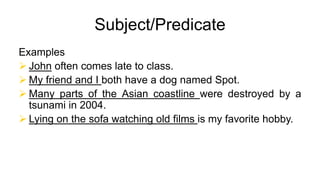
 John often comes late to class.
 My friend and I both have a dog named Spot.
 Many parts of the Asian coastline were destroyed by a
tsunami in 2004.
 Lying on the sofa watching old films is my favorite hobby.
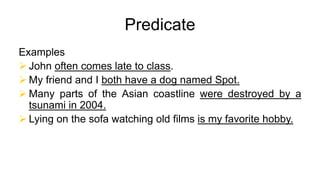
Predicate
Examples
 John often comes late to class.
 My friend and I both have a dog named Spot.
 Many parts of the Asian coastline were destroyed by a
tsunami in 2004.
 Lying on the sofa watching old films is my favorite hobby.
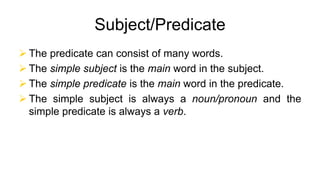
Subject/Predicate
 The predicate can consist of many words.
 The simple subject is the main word in the subject.
 The simple predicate is the main word in the predicate.
 The simple subject is always a noun/pronoun and the
simple predicate is always a verb.
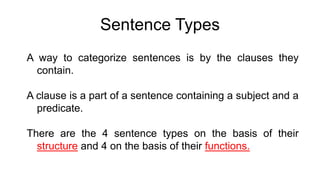
Sentence Types
A way to categorize sentences is by the clauses they
contain.
A clause is a part of a sentence containing a subject and a
predicate.
There are the 4 sentence types on the basis of their
structure and 4 on the basis of their functions.
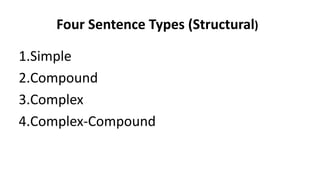
Four Sentence Types (Structural)
1.Simple
2.Compound
3.Complex
4.Complex-Compound
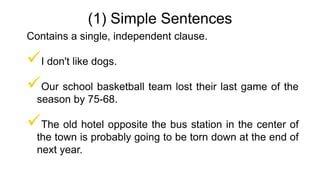
(1) Simple Sentences
Contains a single, independent clause.
I don't like dogs.
Our school basketball team lost their last game of the
season by 75-68.
The old hotel opposite the bus station in the center of
the town is probably going to be torn down at the end of
next year.
(2) Compound Sentences
Contain two independent clauses that are joined by a
coordinating conjunction. The most common
coordinating conjunctions are: and, or, but, so.)
I don't like dogs, and my brother doesn't like cats.
You can write on paper, or you can use a computer.
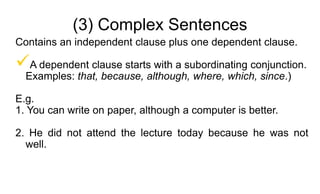
(3) Complex Sentences
Contains an independent clause plus one dependent clause.
A dependent clause starts with a subordinating conjunction.
Examples: that, because, although, where, which, since.)
E.g.
1. You can write on paper, although a computer is better.
2. He did not attend the lecture today because he was not
well.
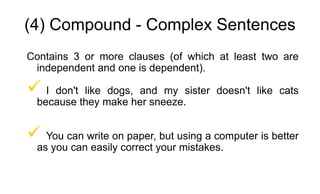
(4) Compound - Complex Sentences
Contains 3 or more clauses (of which at least two are
independent and one is dependent).
 I don't like dogs, and my sister doesn't like cats
because they make her sneeze.
 You can write on paper, but using a computer is better
as you can easily correct your mistakes.
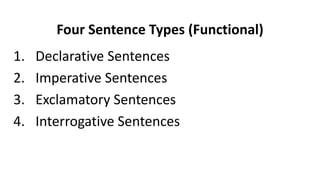
Four Sentence Types (Functional)
1. Declarative Sentences
2. Imperative Sentences
3. Exclamatory Sentences
4. Interrogative Sentences
(1) Declarative Sentences
Declarative sentences make a statement to relay information or ideas.
They are punctuated with a simple period. Formal essays or reports
are composed almost entirely of declarative sentences.
Examples
 The concert begins in two hours.
 July 4th is Independence Day.
 Green is my favorite color.
(2) Imperative Sentences
Imperative sentences issue commands or requests or they can
express a desire or wish. They are punctuated with a simple period or
they can be exclamations requiring an exclamation mark. Exclamatory
sentences can consist of a single verb or they can be more lengthy
and complex.
Examples;
 Please lower your voice. (Request)
 Meet me at the town square. (Order)
(3) Exclamatory Sentences
Exclamatory sentences express strong emotion. It doesn’t really matter
what the emotion is, an exclamatory sentence is the type of sentence
needed to express it. Exclamatory sentences always end in an
exclamation mark, so it’s easy to spot them.
Examples of Exclamatory Sentences:
 I can’t wait for the party! (Excitement)
 I don’t know what I’ll do if I don’t pass this test! (Nervousness)
 Oh, my goodness, I won! (Happiness)
 Suddenly, a bear appeared in my path! (Scared/Shocked)
 This is the best day of my life! (Happiness)
 Please don’t go! (Sadness)
(4) Interrogative Sentences
Interrogative sentences are also easy to spot. That’s because
they always ask a question and end in a question mark.
Examples of Interrogative Sentences:
 Is it snowing?
 Have you had breakfast?
 Do you want Coke or Pepsi?

Basic sentence structure

  • 1.
  • 2.
    Definition A sentence canbe defined as ‘a sequence or group of words which gives a complete thought’. First word of a sentence starts with a capital letter and last word is followed by an end punctuation mark (period/full stop, question mark or exclamation mark)'
  • 3.
    Subject  All sentencesare about something or someone.  The something or someone that the sentence is about is called the subject of the sentence. Predicate  The predicate contains information about the someone or something that is the subject.
  • 4.
    Subject/Predicate Examples  John oftencomes late to class.  My friend and I both have a dog named Spot.  Many parts of the Asian coastline were destroyed by a tsunami in 2004.  Lying on the sofa watching old films is my favorite hobby.
  • 5.
    Predicate Examples  John oftencomes late to class.  My friend and I both have a dog named Spot.  Many parts of the Asian coastline were destroyed by a tsunami in 2004.  Lying on the sofa watching old films is my favorite hobby.
  • 6.
    Subject/Predicate  The predicatecan consist of many words.  The simple subject is the main word in the subject.  The simple predicate is the main word in the predicate.  The simple subject is always a noun/pronoun and the simple predicate is always a verb.
  • 7.
    Sentence Types A wayto categorize sentences is by the clauses they contain. A clause is a part of a sentence containing a subject and a predicate. There are the 4 sentence types on the basis of their structure and 4 on the basis of their functions.
  • 8.
    Four Sentence Types(Structural) 1.Simple 2.Compound 3.Complex 4.Complex-Compound
  • 9.
    (1) Simple Sentences Containsa single, independent clause. I don't like dogs. Our school basketball team lost their last game of the season by 75-68. The old hotel opposite the bus station in the center of the town is probably going to be torn down at the end of next year.
  • 10.
    (2) Compound Sentences Containtwo independent clauses that are joined by a coordinating conjunction. The most common coordinating conjunctions are: and, or, but, so.) I don't like dogs, and my brother doesn't like cats. You can write on paper, or you can use a computer.
  • 11.
    (3) Complex Sentences Containsan independent clause plus one dependent clause. A dependent clause starts with a subordinating conjunction. Examples: that, because, although, where, which, since.) E.g. 1. You can write on paper, although a computer is better. 2. He did not attend the lecture today because he was not well.
  • 12.
    (4) Compound -Complex Sentences Contains 3 or more clauses (of which at least two are independent and one is dependent).  I don't like dogs, and my sister doesn't like cats because they make her sneeze.  You can write on paper, but using a computer is better as you can easily correct your mistakes.
  • 13.
    Four Sentence Types(Functional) 1. Declarative Sentences 2. Imperative Sentences 3. Exclamatory Sentences 4. Interrogative Sentences
  • 14.
    (1) Declarative Sentences Declarativesentences make a statement to relay information or ideas. They are punctuated with a simple period. Formal essays or reports are composed almost entirely of declarative sentences. Examples  The concert begins in two hours.  July 4th is Independence Day.  Green is my favorite color.
  • 15.
    (2) Imperative Sentences Imperativesentences issue commands or requests or they can express a desire or wish. They are punctuated with a simple period or they can be exclamations requiring an exclamation mark. Exclamatory sentences can consist of a single verb or they can be more lengthy and complex. Examples;  Please lower your voice. (Request)  Meet me at the town square. (Order)
  • 16.
    (3) Exclamatory Sentences Exclamatorysentences express strong emotion. It doesn’t really matter what the emotion is, an exclamatory sentence is the type of sentence needed to express it. Exclamatory sentences always end in an exclamation mark, so it’s easy to spot them. Examples of Exclamatory Sentences:  I can’t wait for the party! (Excitement)  I don’t know what I’ll do if I don’t pass this test! (Nervousness)  Oh, my goodness, I won! (Happiness)  Suddenly, a bear appeared in my path! (Scared/Shocked)  This is the best day of my life! (Happiness)  Please don’t go! (Sadness)
  • 17.
    (4) Interrogative Sentences Interrogativesentences are also easy to spot. That’s because they always ask a question and end in a question mark. Examples of Interrogative Sentences:  Is it snowing?  Have you had breakfast?  Do you want Coke or Pepsi?