1. bloom the flowers.
2. postcard he friend sent his a.
3. painted the house they.
4. cat the dog the chased.
SYNTAX
•is the study of the structure of
language, particularly the way in
which words can be put together to
create meaningful phrases, clauses,
or sentences.
Importance of Syntax in Language
Syntax is crucial in language
because it defines the rules that govern
how words are combined to form
phrases, clauses, and sentences. These
rules dictate the structure of language,
ensuring that communication is
coherent and meaningful.
FIVE BASIC RULES OF
SYNTAX IN ENGLISH
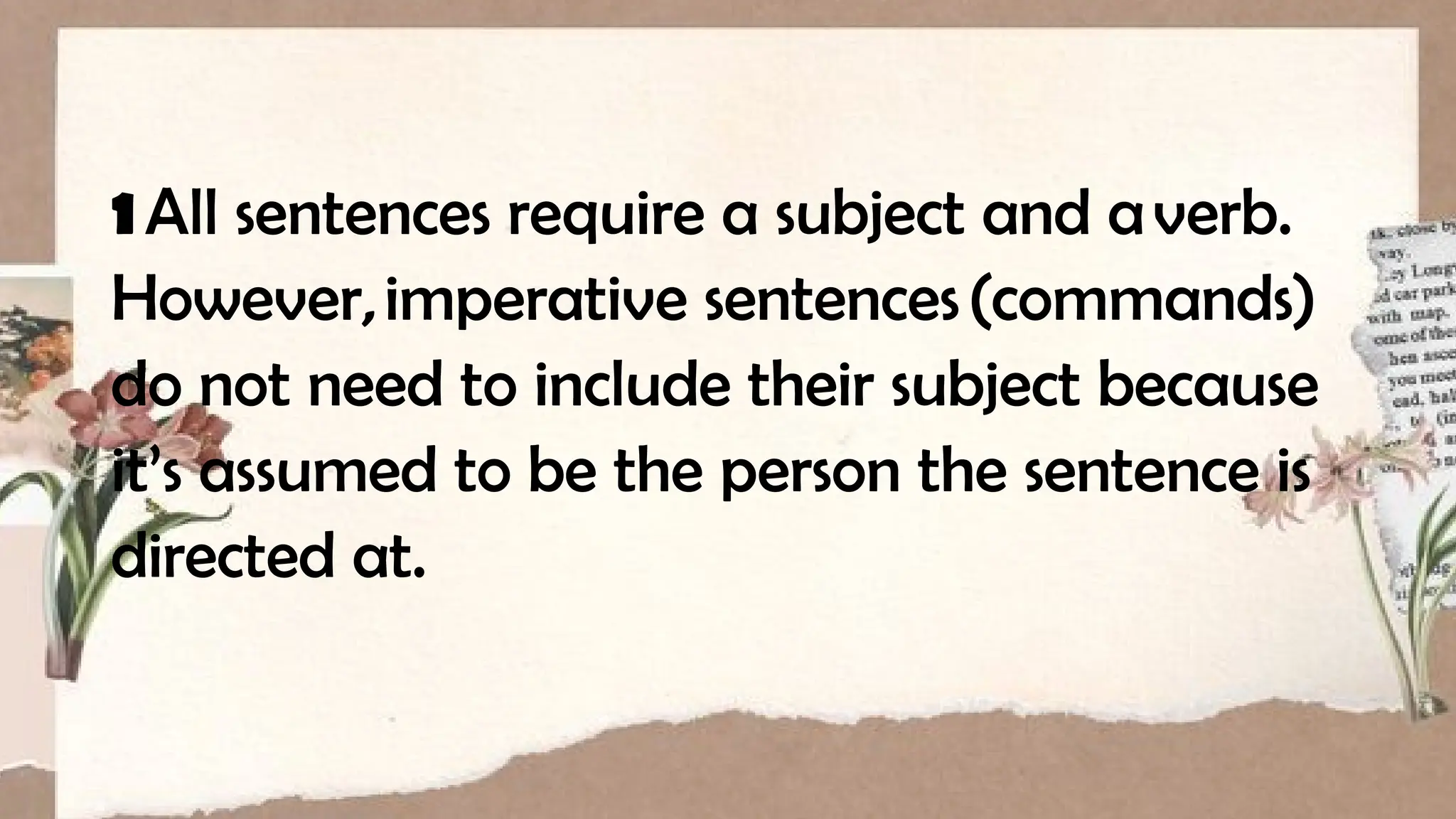
1All sentences require a subject and averb.
However,imperative sentences(commands)
do not need to include their subject because
it’s assumed to be the person the sentence is
directed at.
2A single sentence should include one
main idea. If a sentence includes two
or more ideas, it’s best to break it up
into multiple sentences.
3The subject comes first, and the verb
comes second. If the sentence has
objects, they come third, after the
verb.
4Subordinate clauses(dependent clauses)
also require a subject and verb.
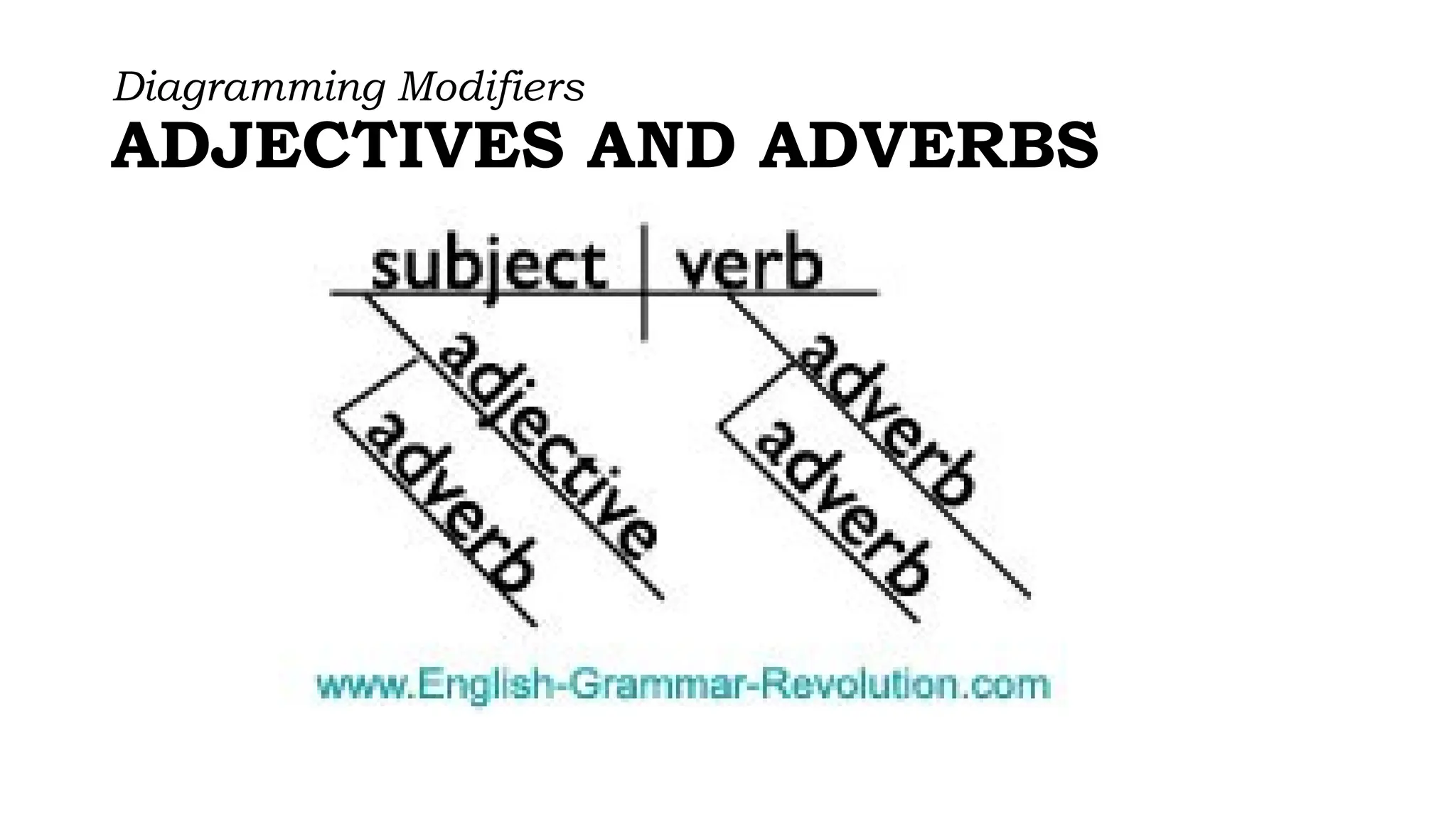
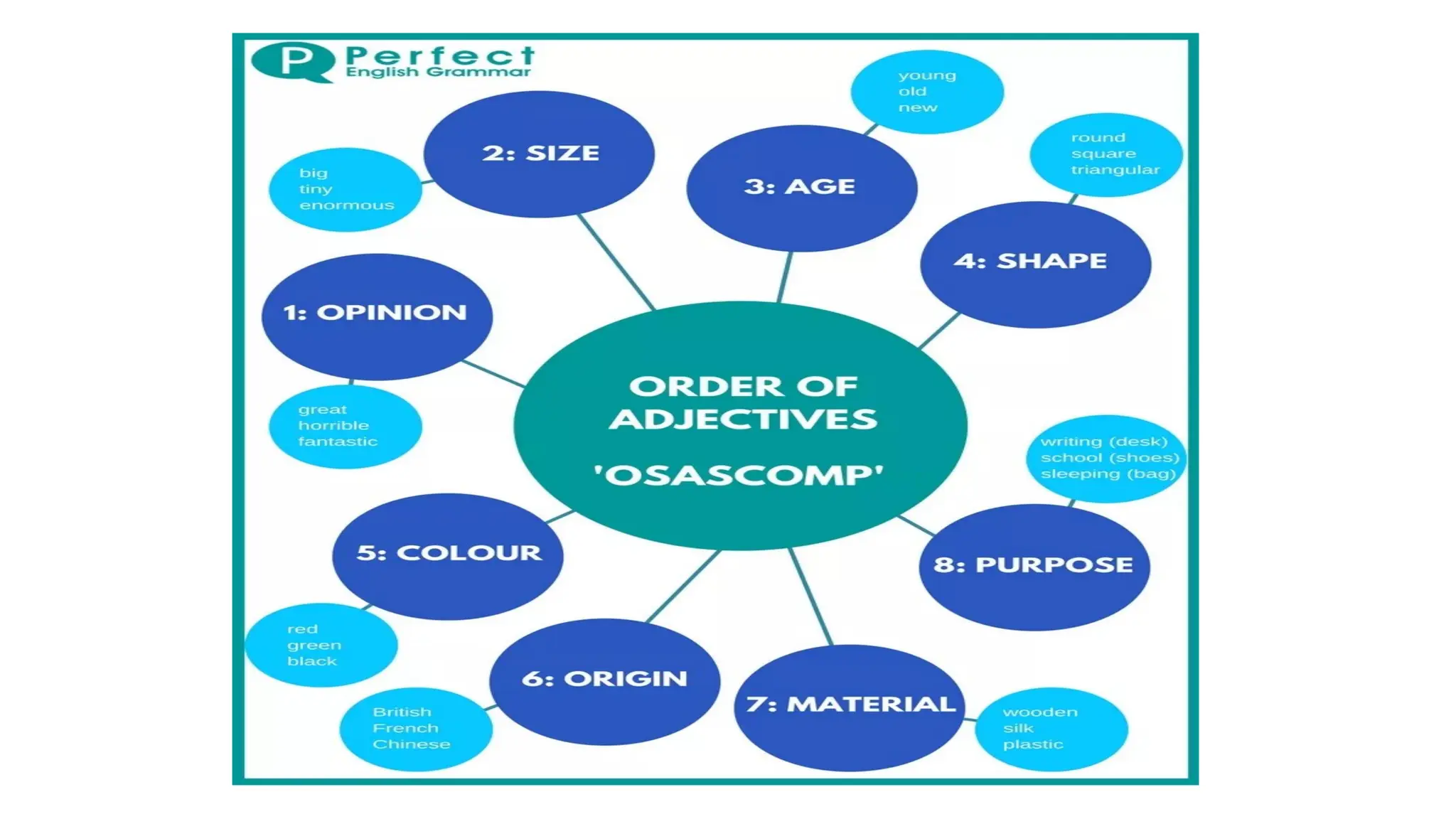
5Adjectives and adverbs go in front of
the words they describe. If there are
multiple adjectives describing the same
noun, use the properadjective order.
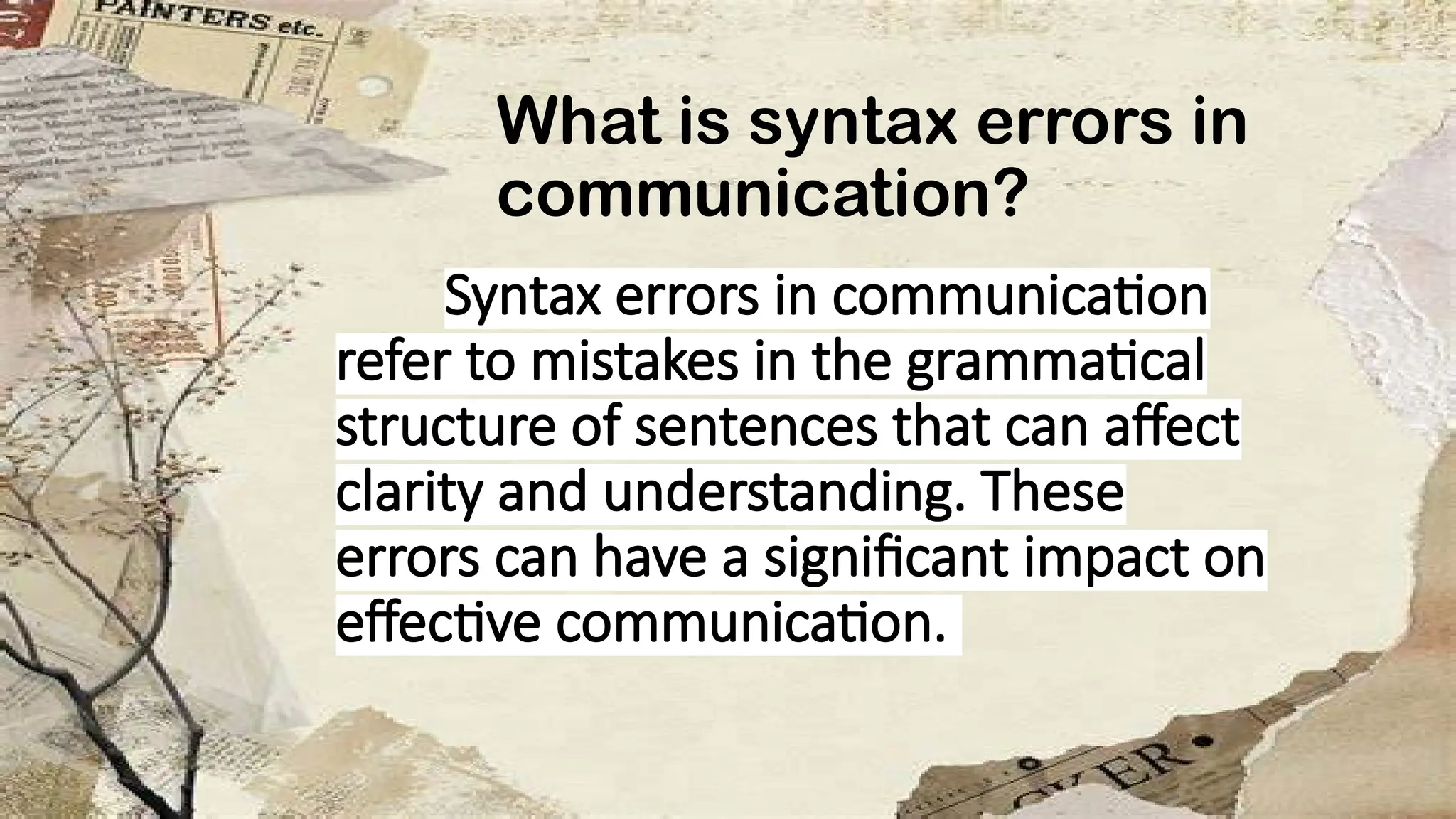
What is syntax errors in
communication?
Syntax errors in communication
refer to mistakes in the grammatical
structure of sentences that can affect
clarity and understanding. These
errors can have a significant impact on
effective communication.
SENTENCE
A sentence is a group of words
that communicate a complete idea.
There are two basic and necessary
parts for a sentence to be complete:
the subject and the predicate.
SUBJECT
-identifies the topic of the sentence.
PREDICATE
-provides information about the topic of the
sentence
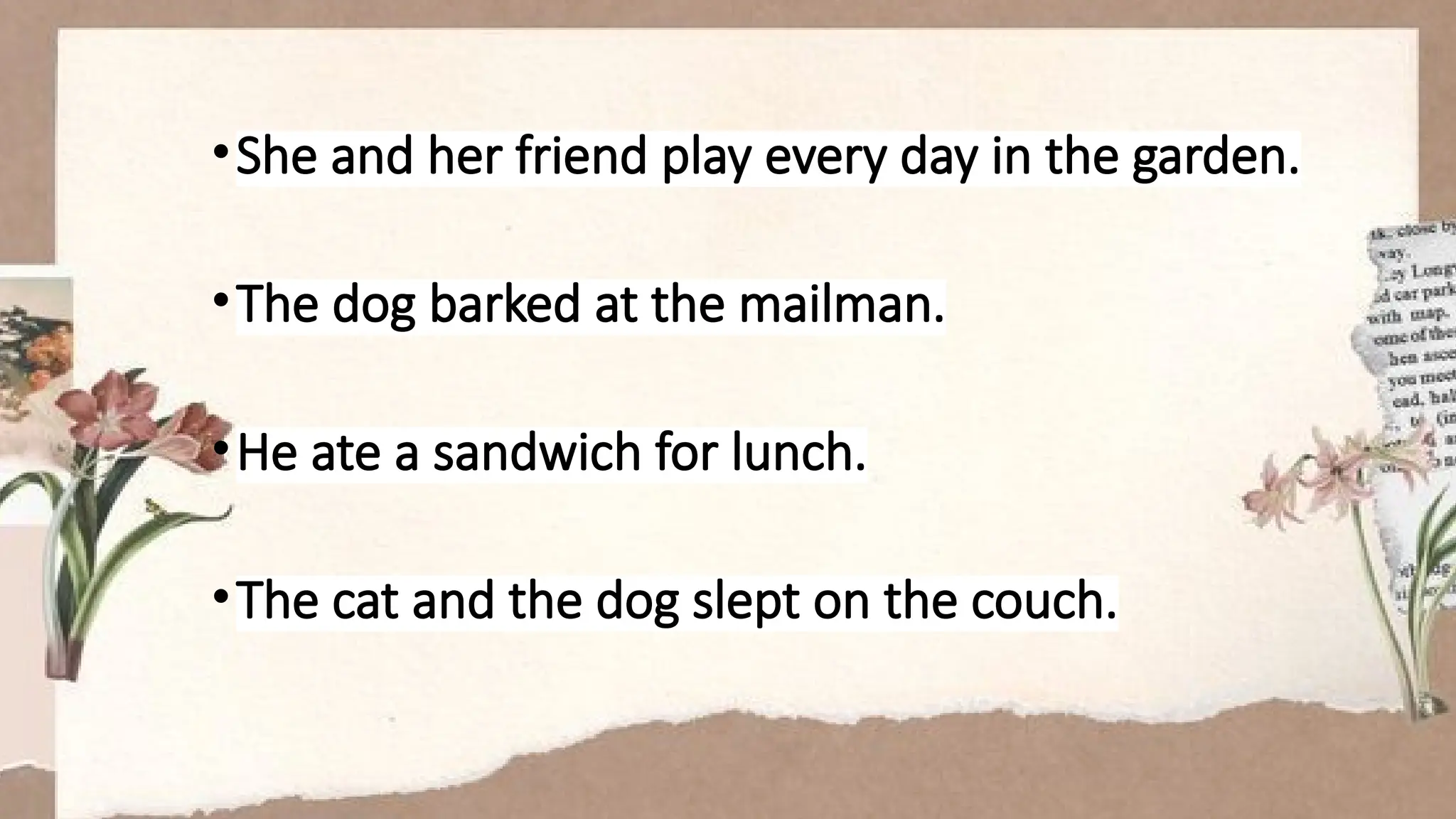
•She and her friend play every day in the garden.
•The dog barked at the mailman.
•He ate a sandwich for lunch.
•The cat and the dog slept on the couch.
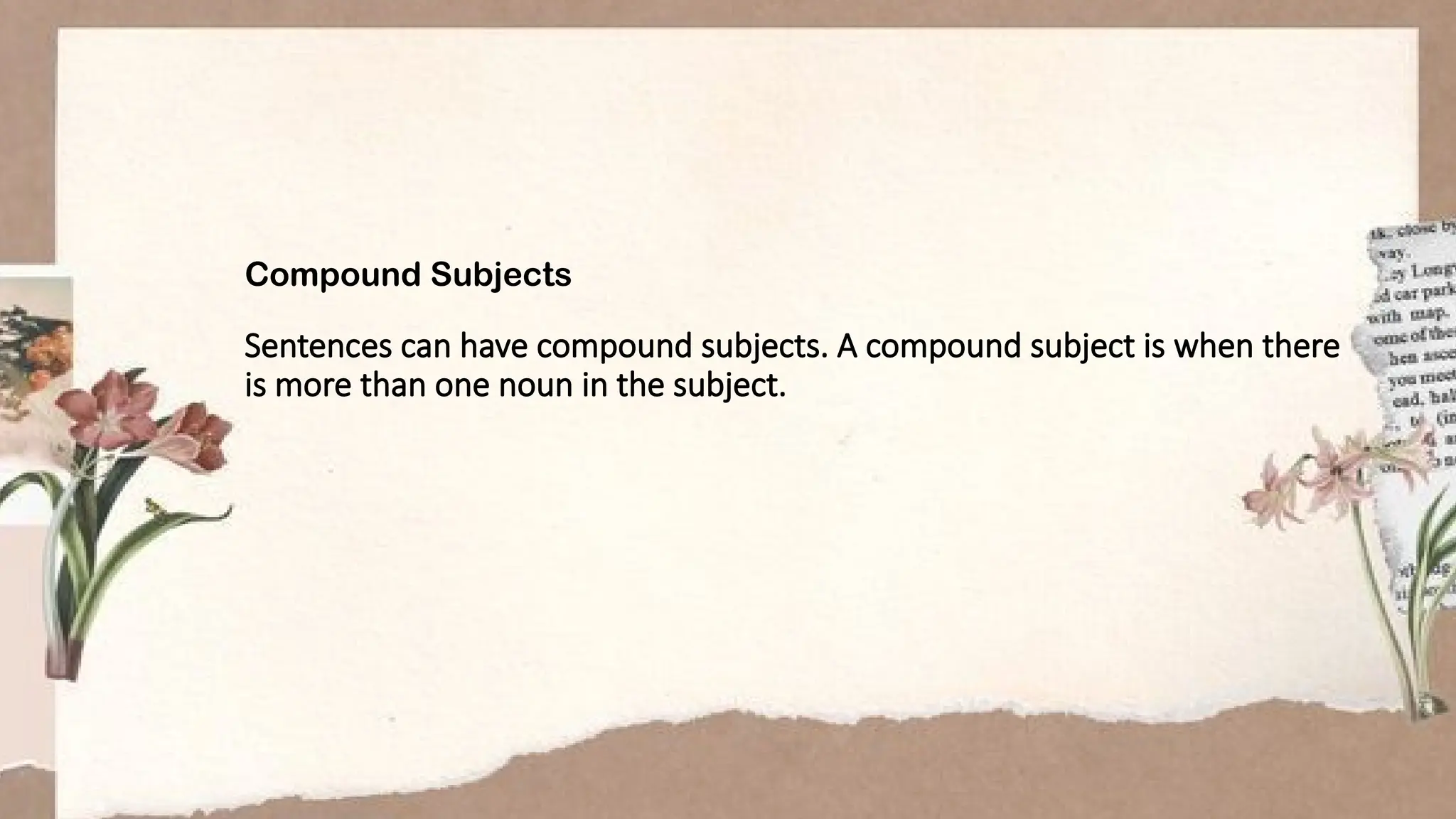
Compound Subjects
Sentences can have compound subjects. A compound subject is when there
is more than one noun in the subject.
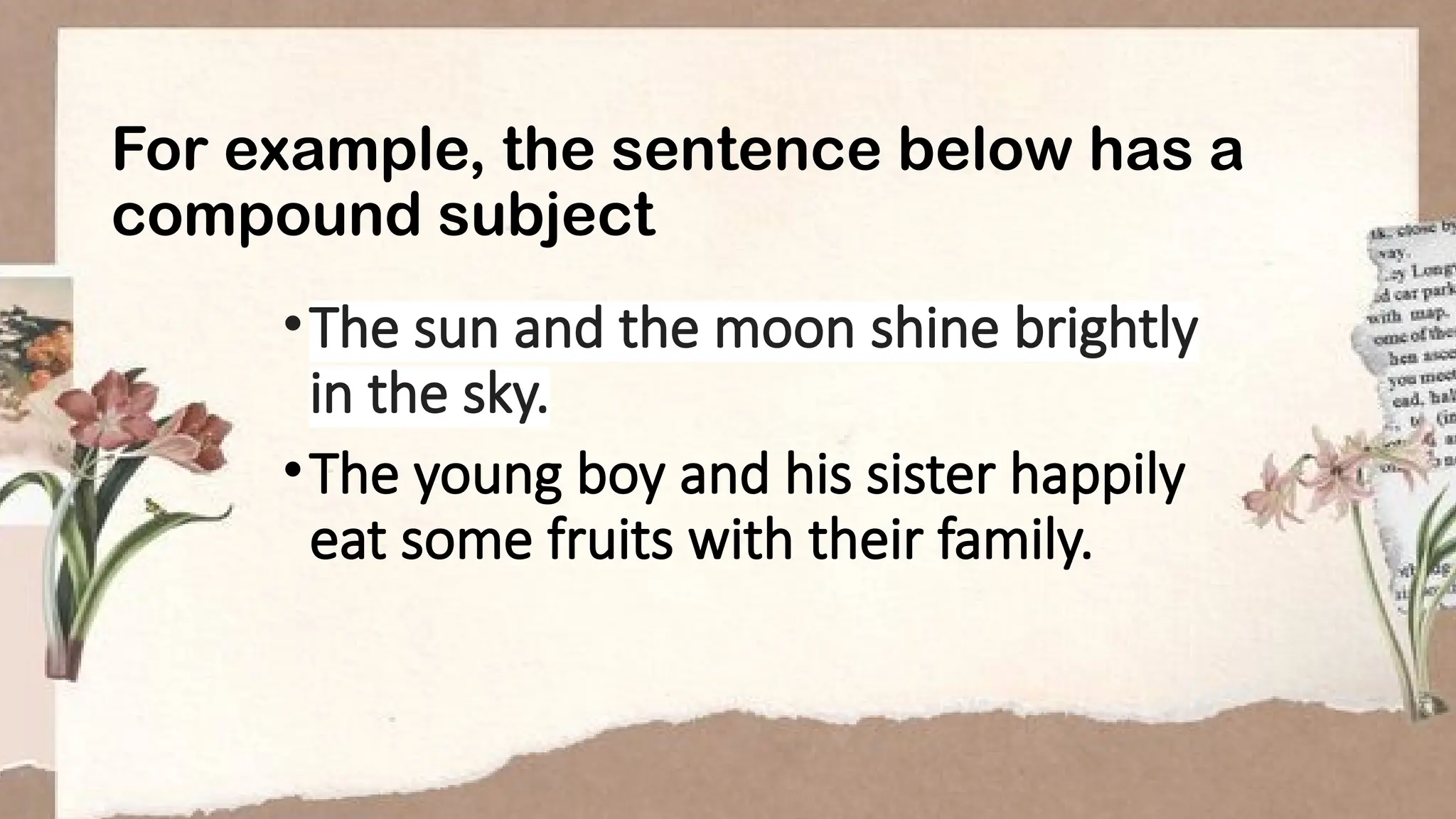
For example, the sentence below has a
compound subject
•The sun and the moon shine brightly
in the sky.
•The young boy and his sister happily
eat some fruits with their family.
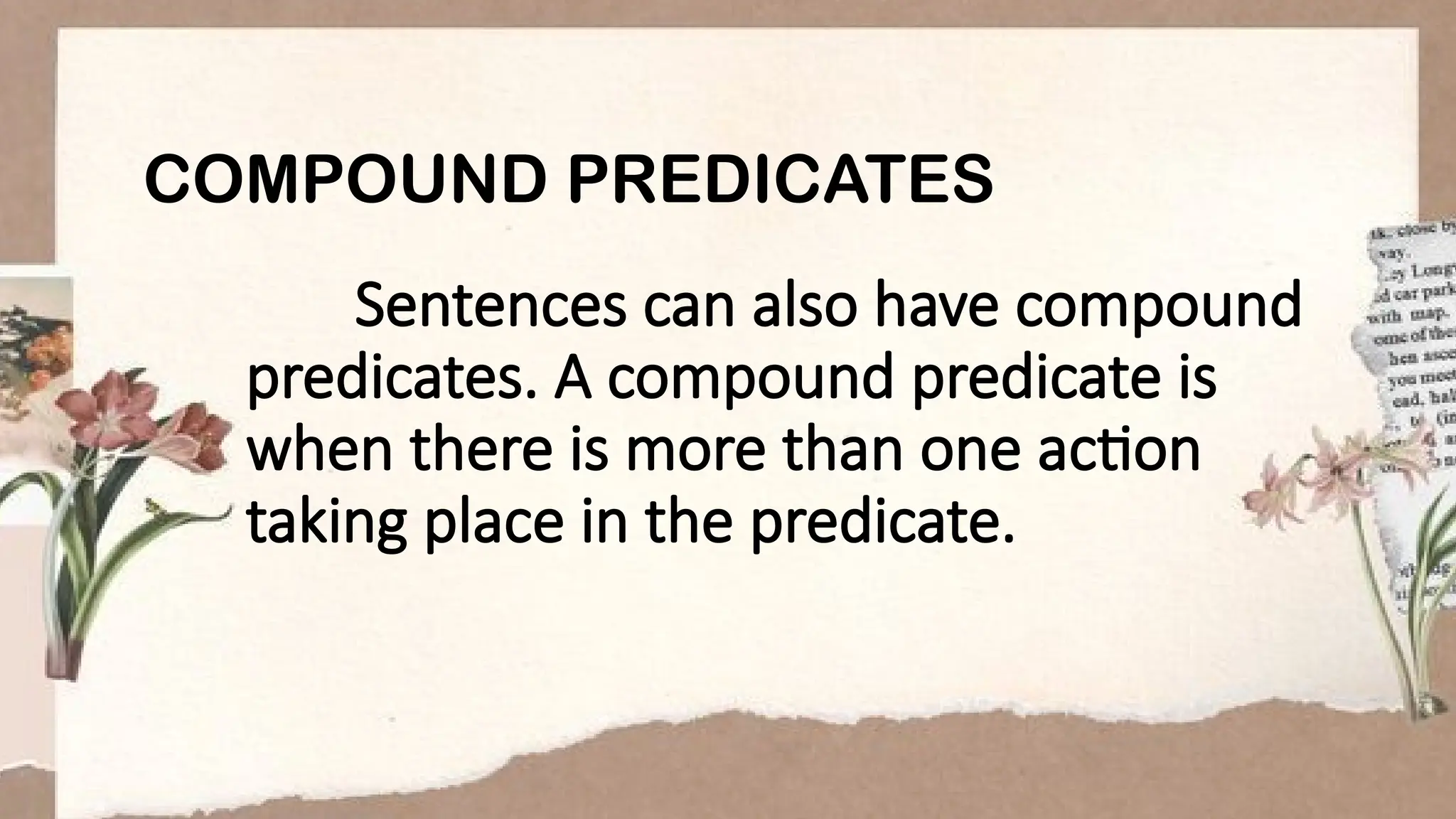
COMPOUND PREDICATES
Sentences can also have compound
predicates. A compound predicate is
when there is more than one action
taking place in the predicate.
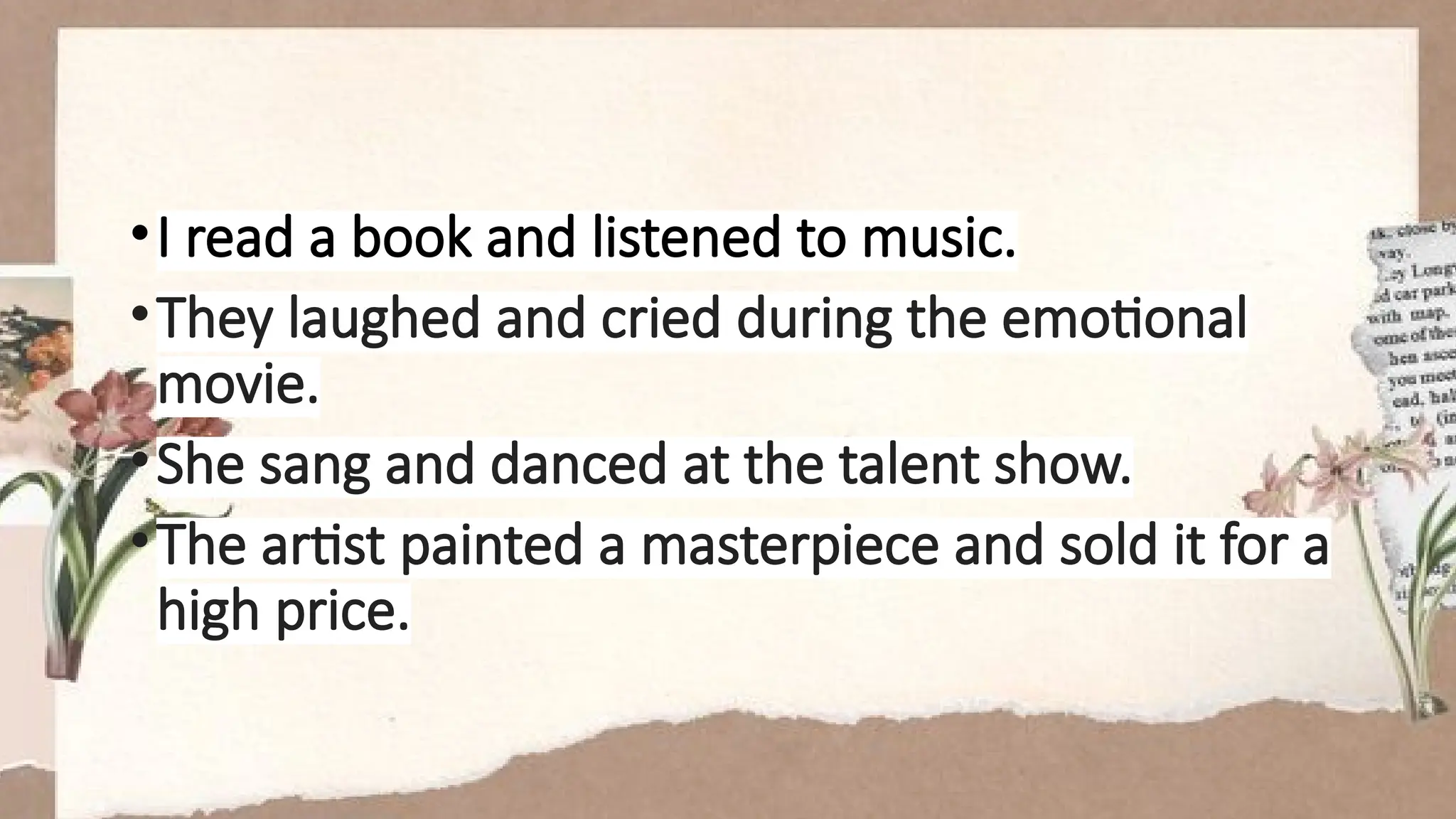
•I read a book and listened to music.
•They laughed and cried during the emotional
movie.
•She sang and danced at the talent show.
•The artist painted a masterpiece and sold it for a
high price.
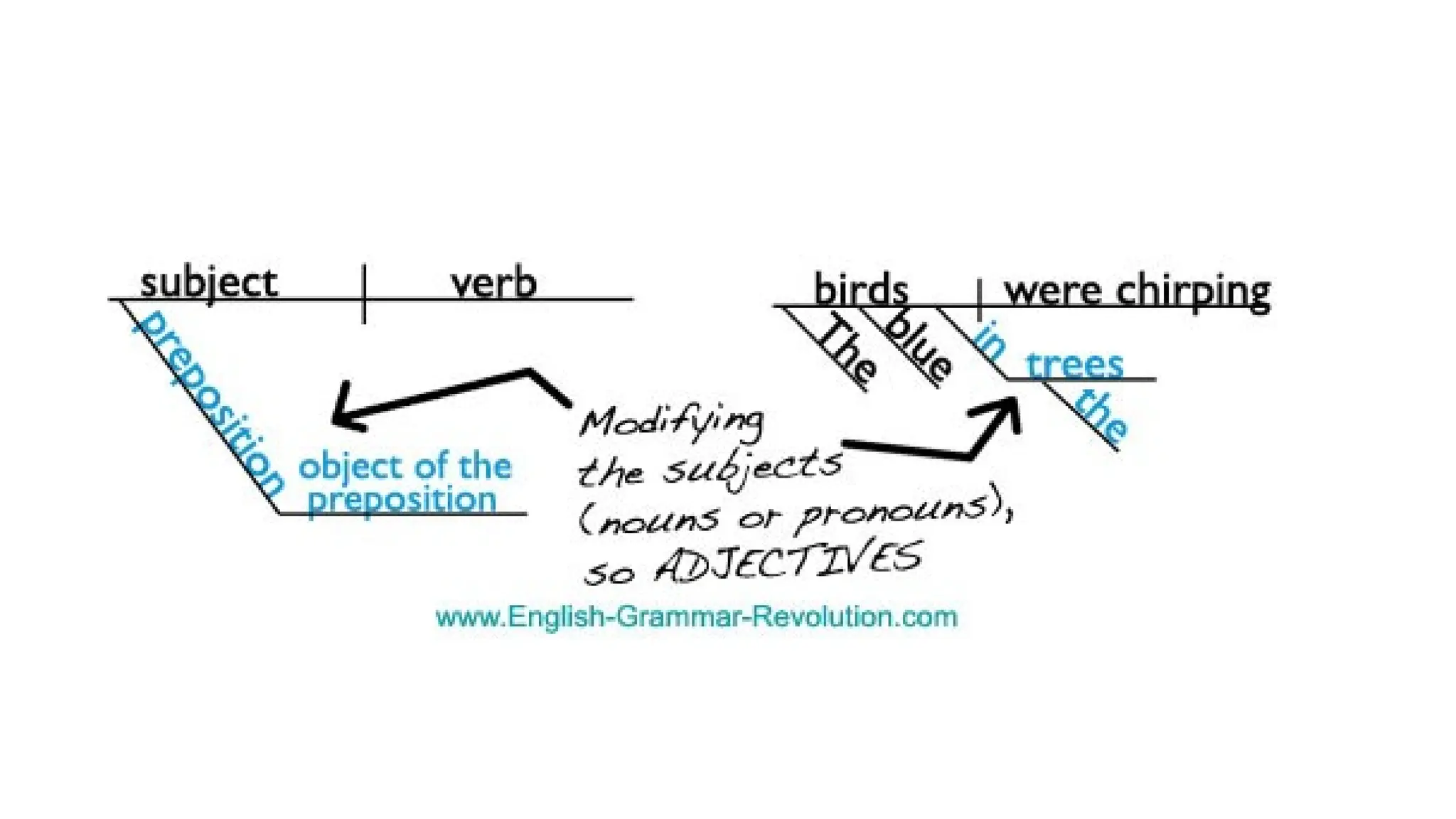
SENTENCE DIAGRAMMING
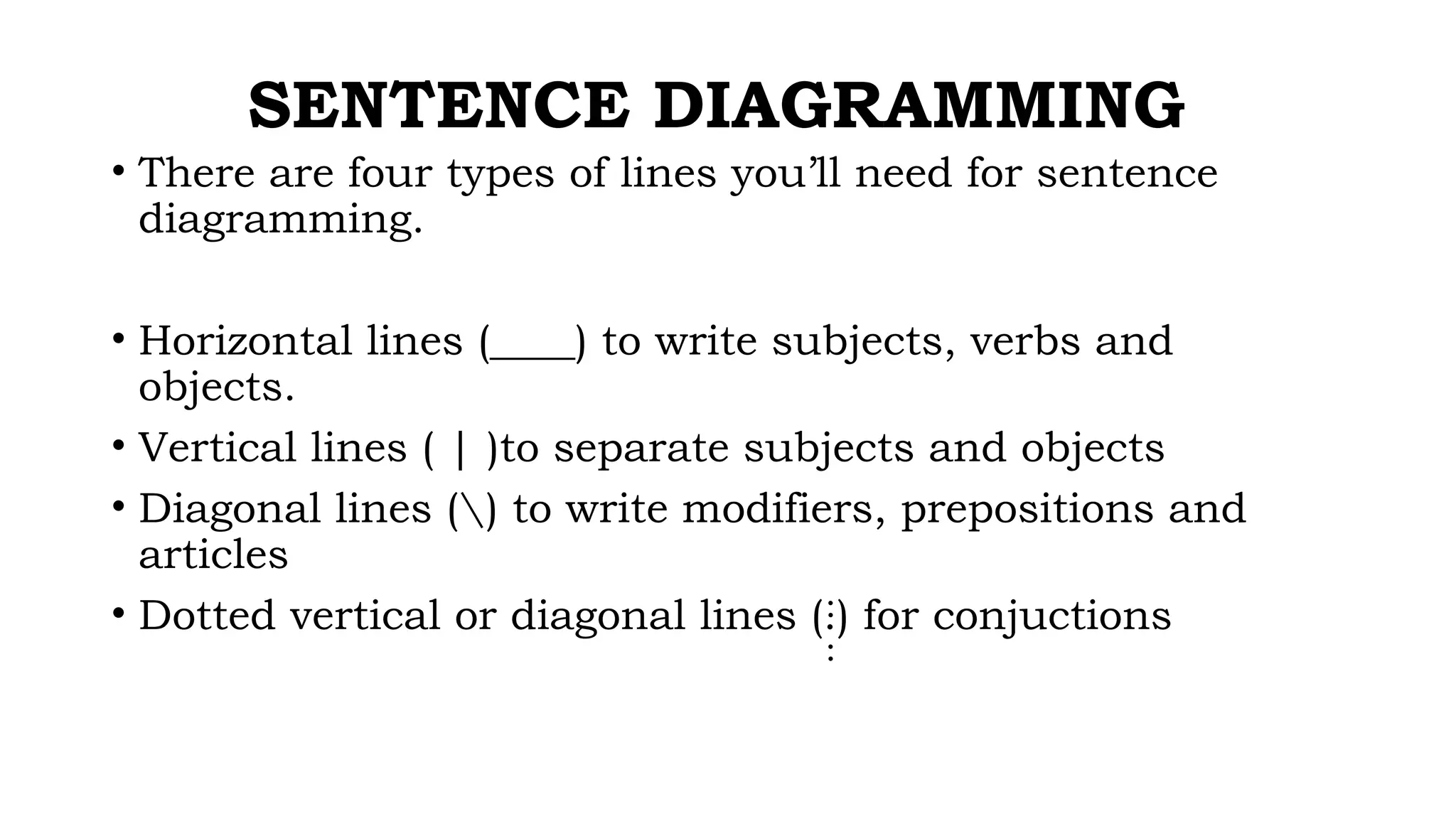
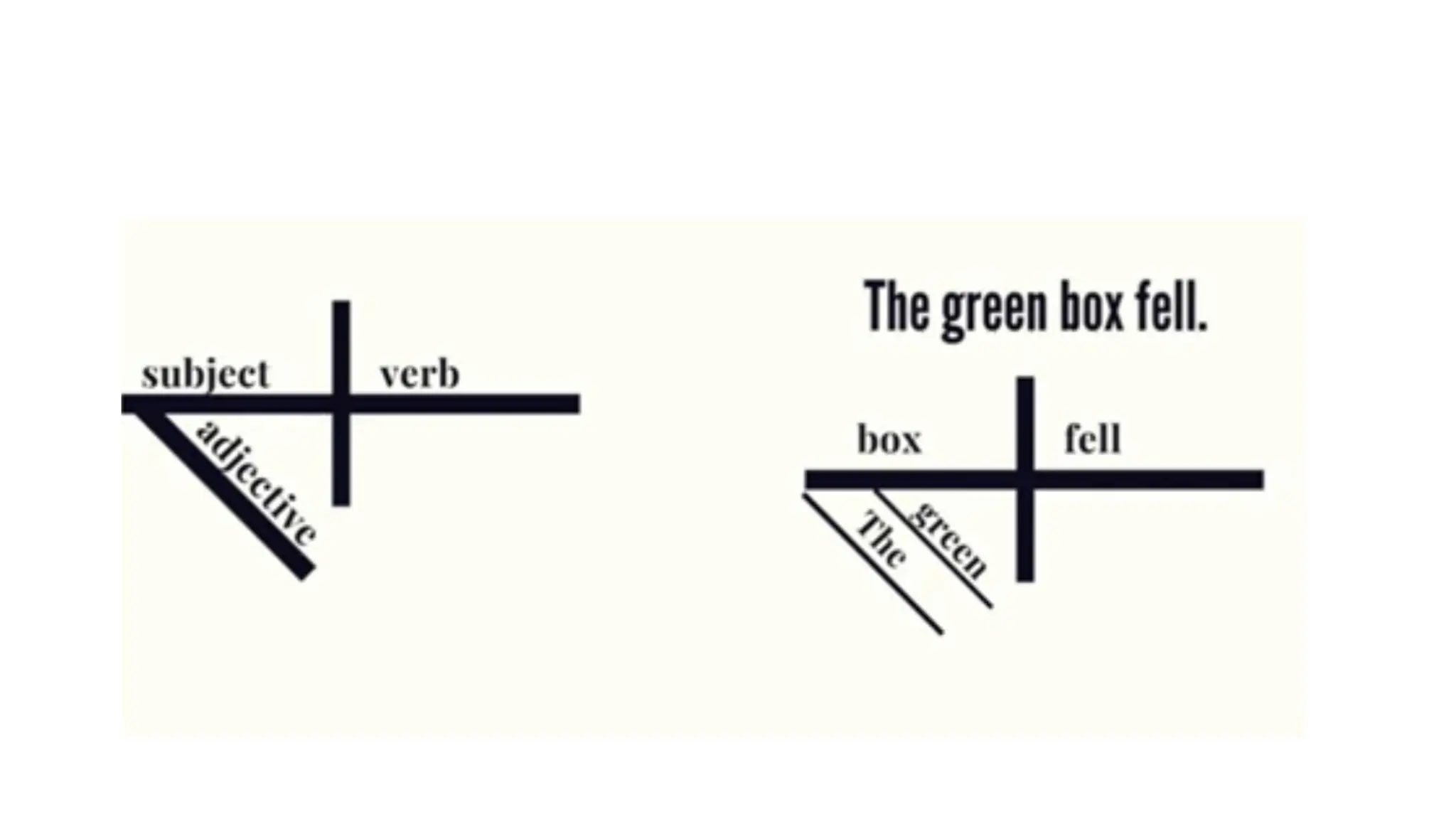
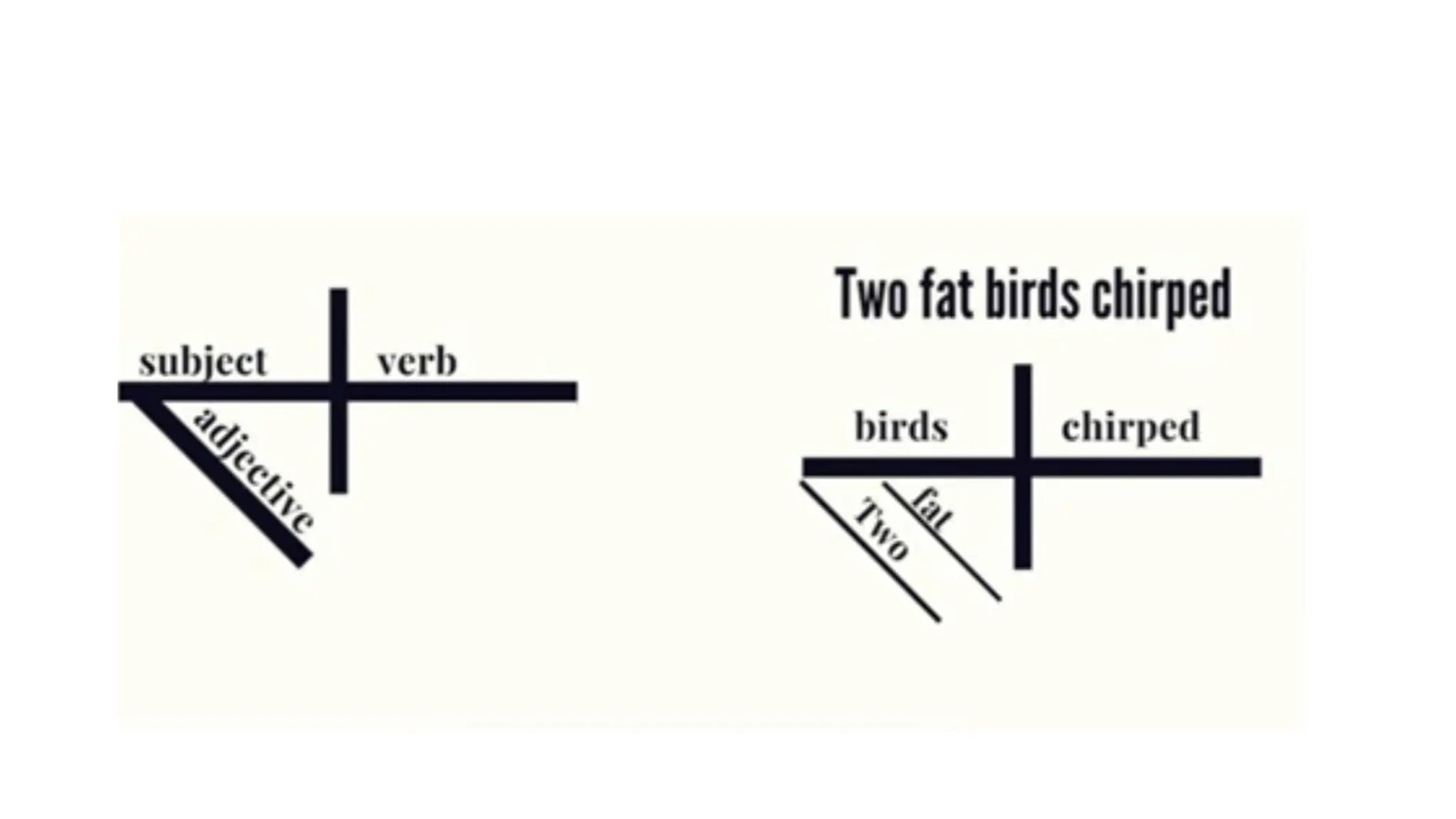
• There are four types of lines you’ll need for sentence
diagramming.
• Horizontal lines (____) to write subjects, verbs and
objects.
• Vertical lines ( | )to separate subjects and objects
• Diagonal lines ( ) to write modifiers, prepositions and
articles
• Dotted vertical or diagonal lines (.) for conjuctions
:
:
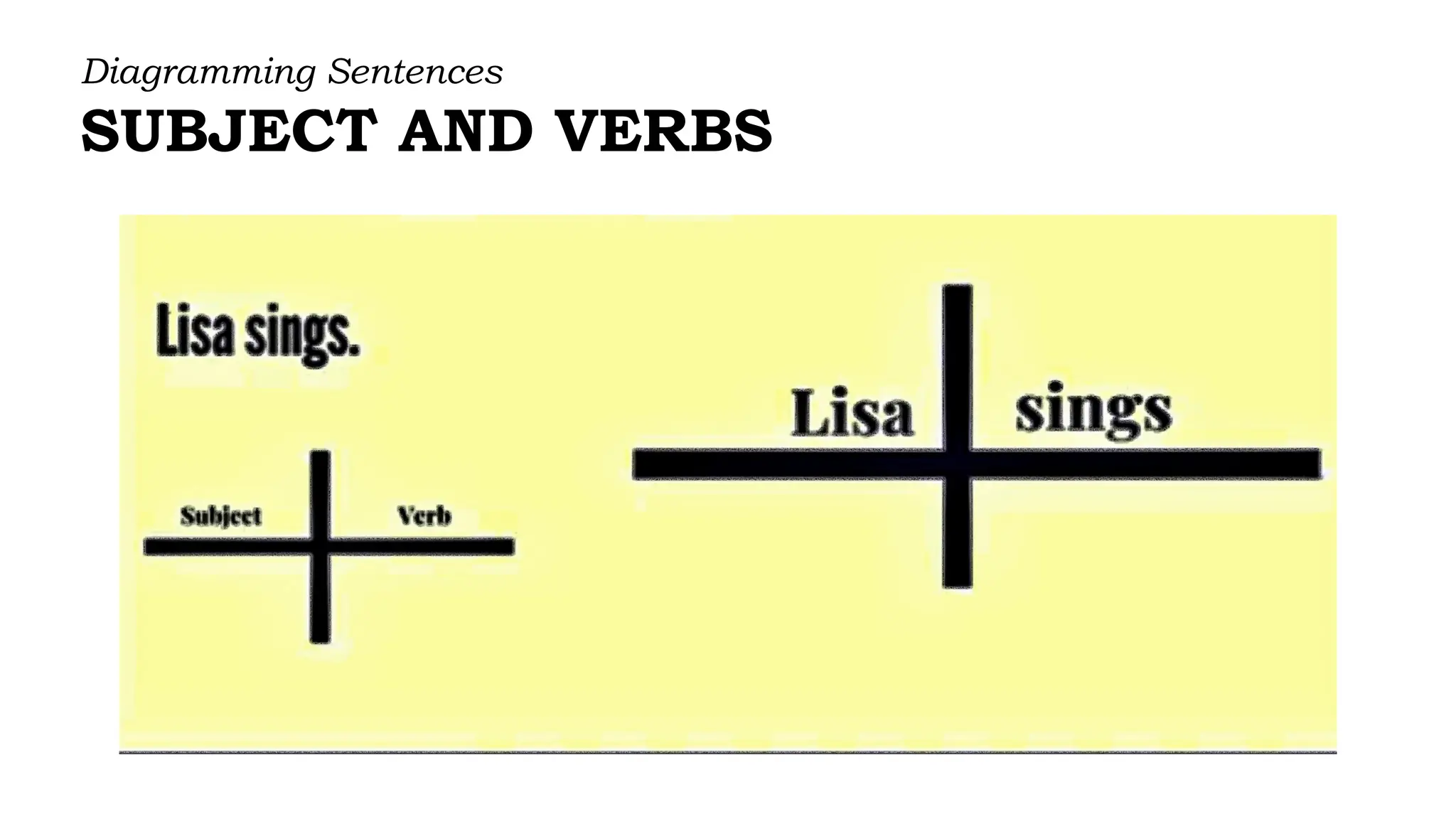
Diagramming Sentences
SUBJECT AND VERBS
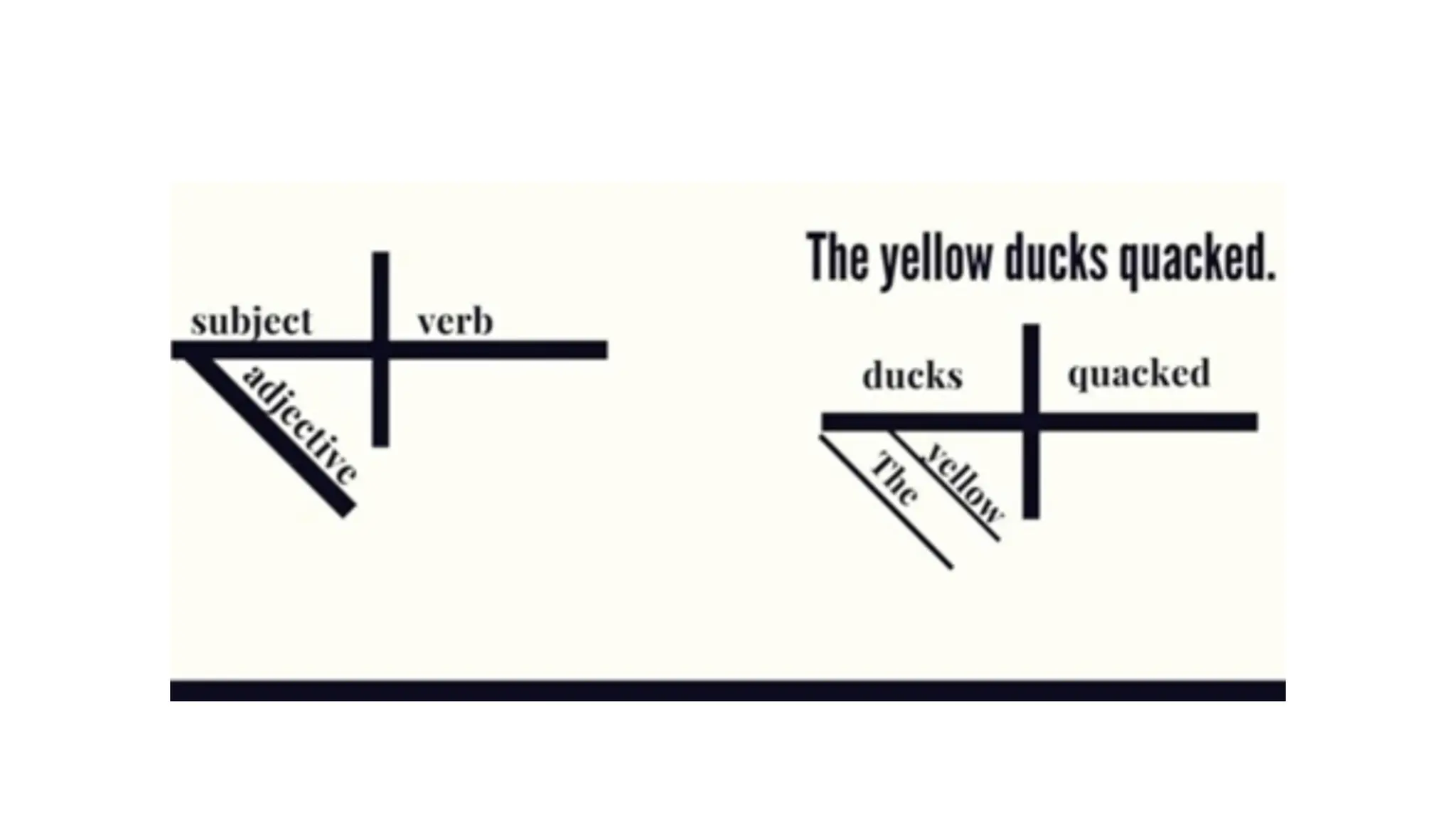
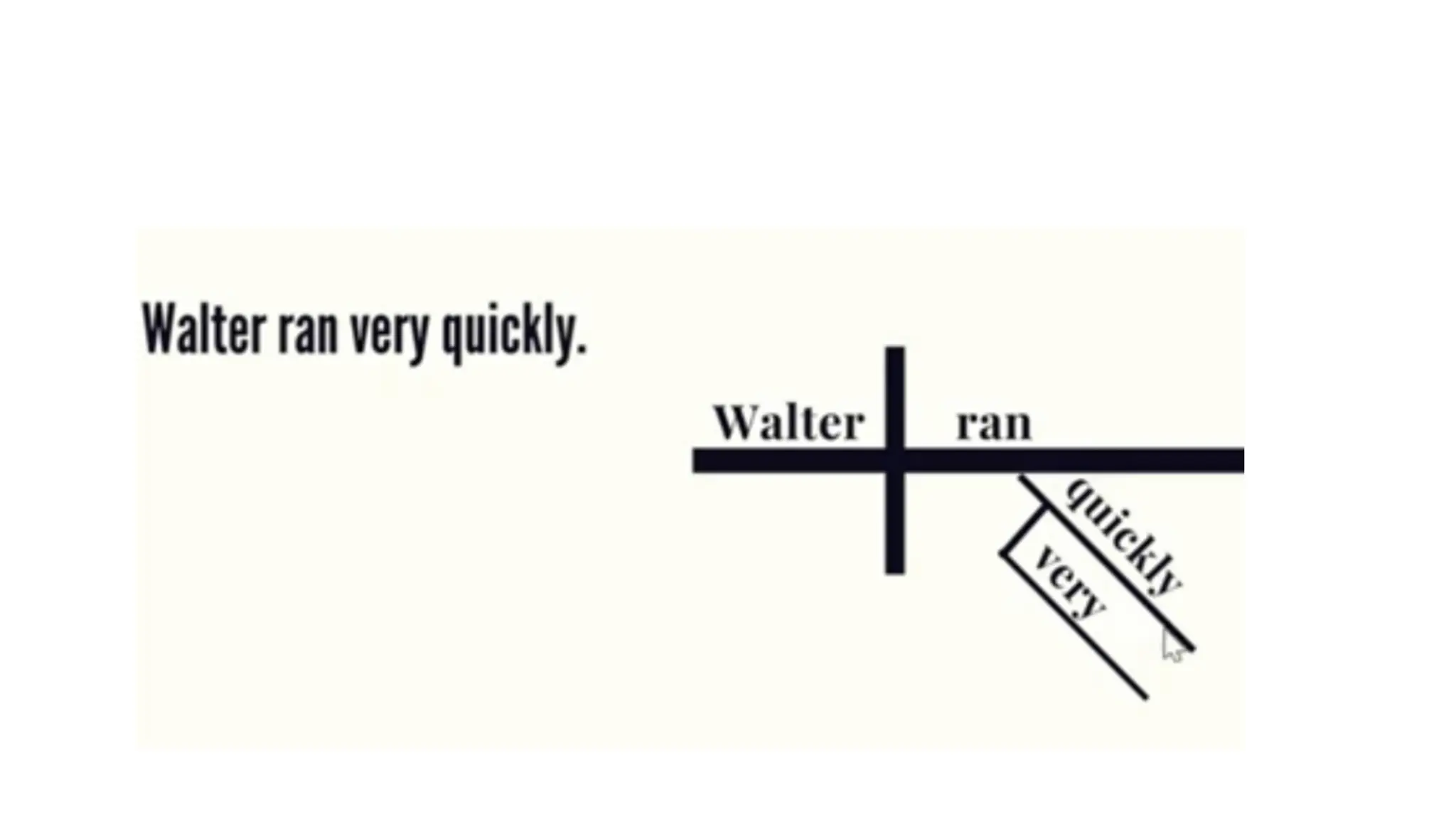
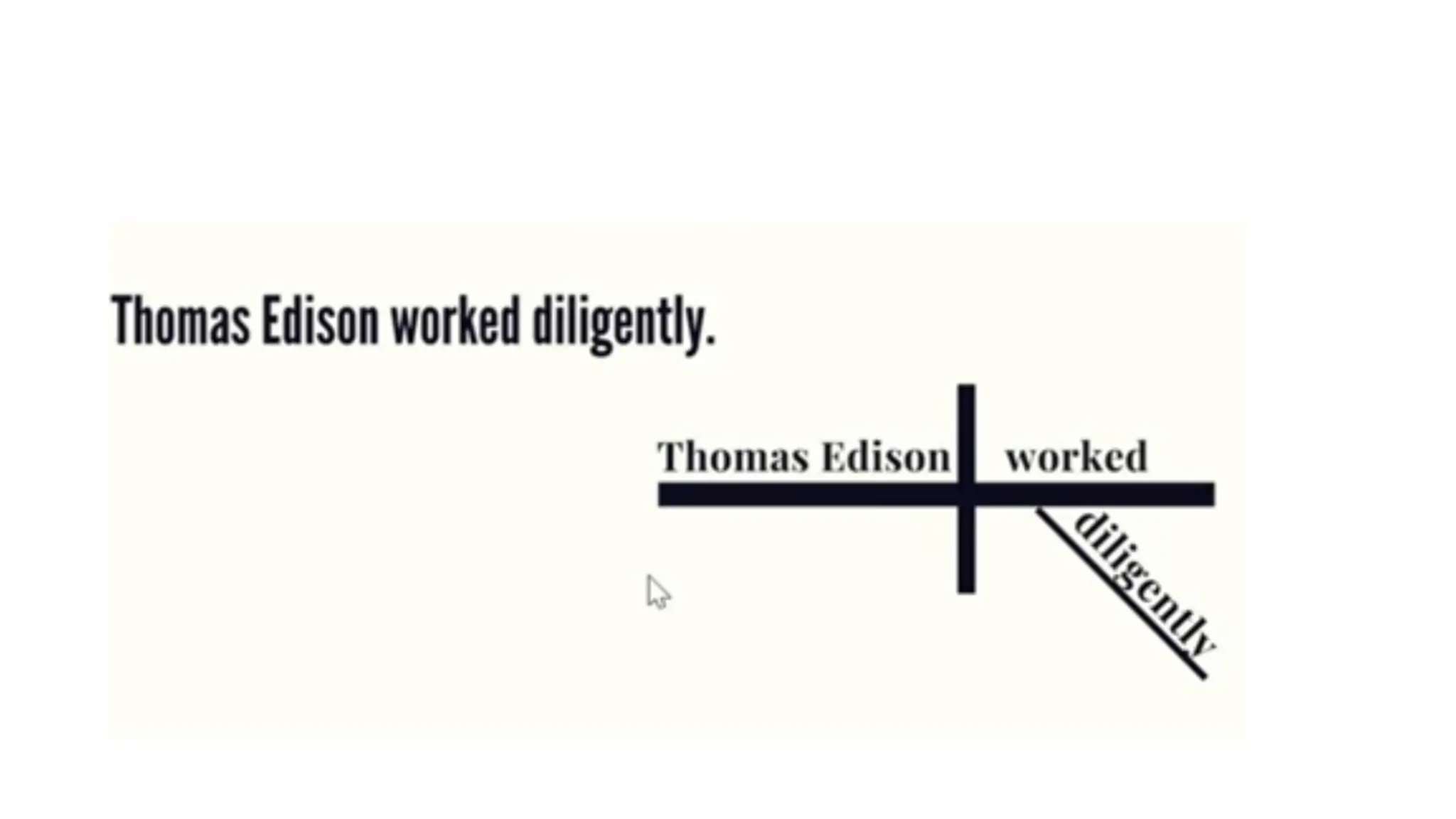
Diagramming Modifiers
ADJECTIVES AND ADVERBS
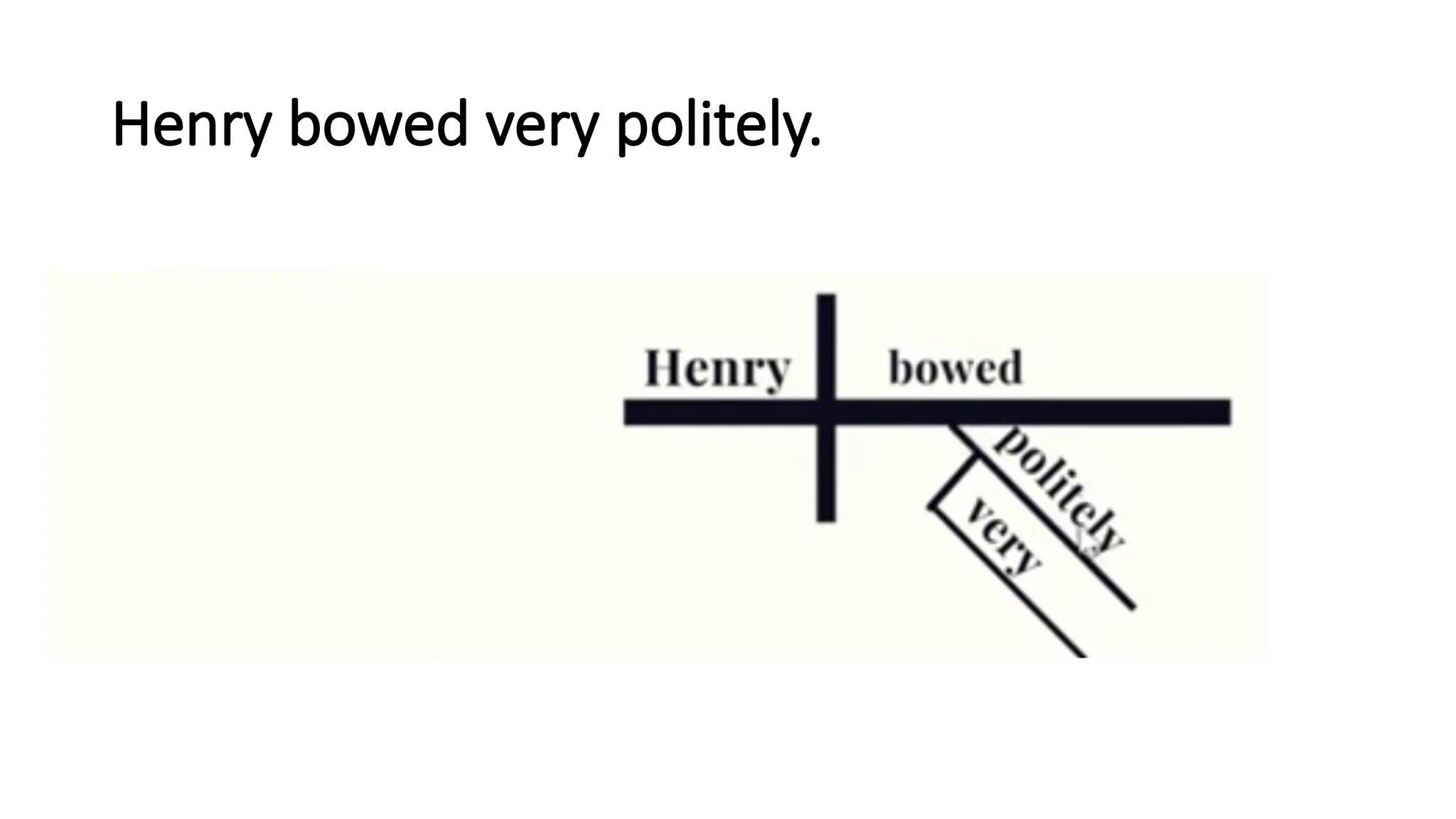
Henry bowed very politely.
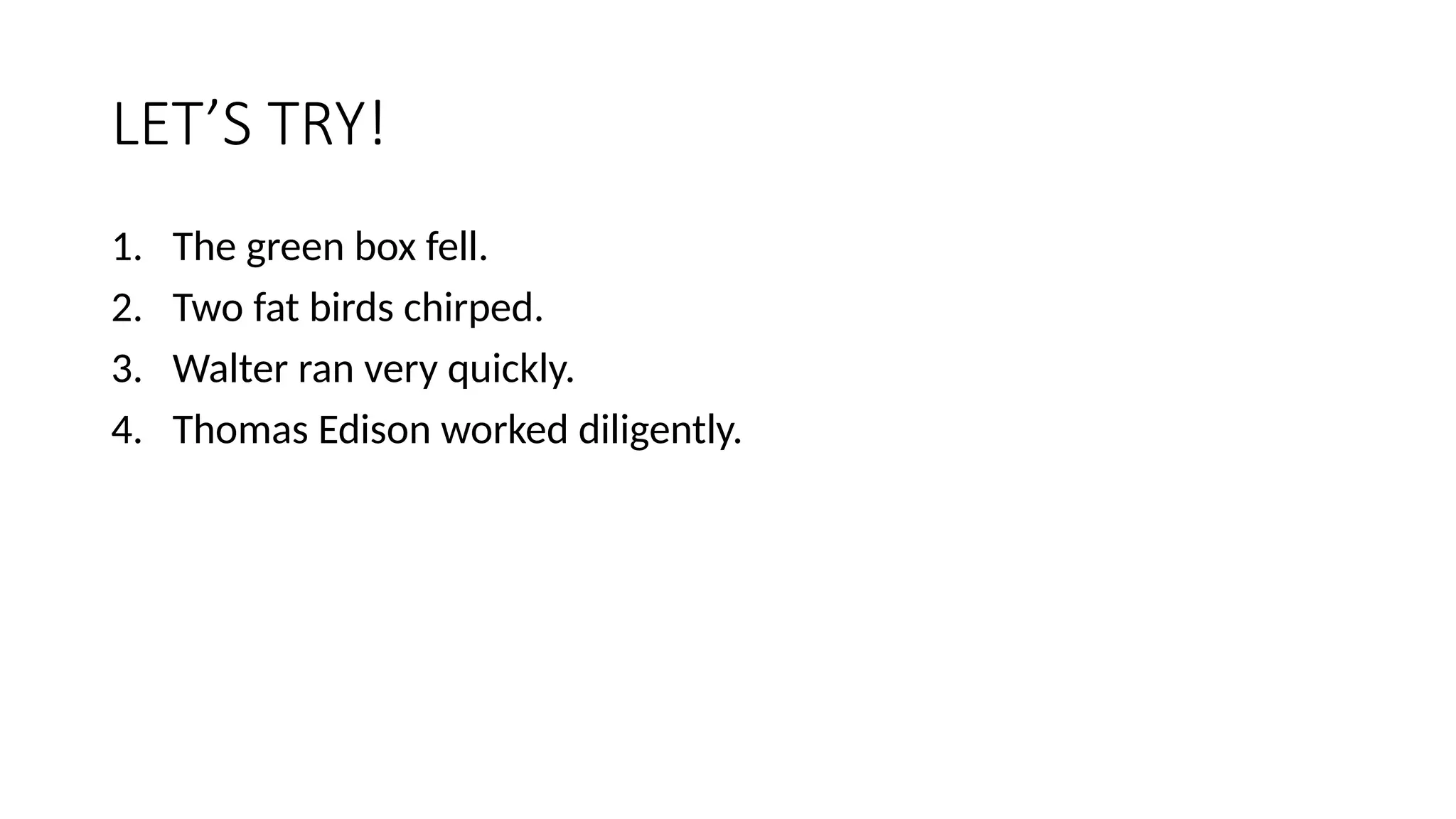
LET’S TRY!
1. The green box fell.
2. Two fat birds chirped.
3. Walter ran very quickly.
4. Thomas Edison worked diligently.
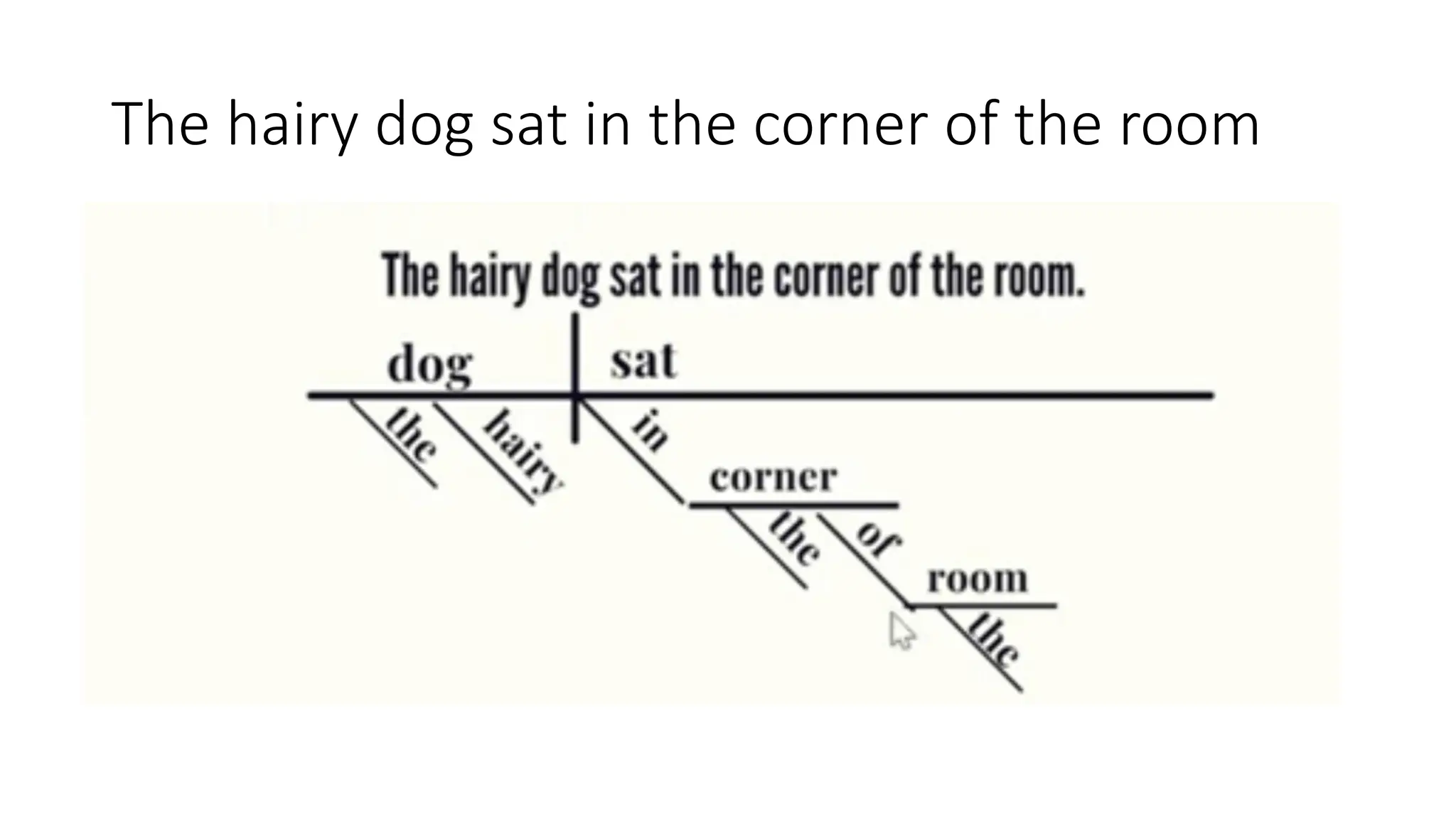
The hairy dog sat in the corner of the room
Word order refers to how the words are
organized and sequenced in a sentence.
Basic word order of English is Subject +
Verb + Object (S+V+O). The object is the
item which receives the action from the
verb.
WORD ORDER OF A SENTENCE
1. ORDER OF ADJECTIVES
In a sentence we may have more than one
adjective at a time. At this time they should follow
the following order.
•She is wearing a (silk red new) dress.
She is wearing a new red silk dress.
•I carried a (black small) suitcase
I carried a small black suitcase
•He found a (tiny Chinese white triangular historic
fascinating porcelain) teacup.
He found a fascinating tiny historic triangular white
Chinese porcelain teacup.
•They purchased a (little unique new silver Japanese
cylindrical metal) pen.
They purchased a unique little new cylindrical
silver Japanese metal pen.
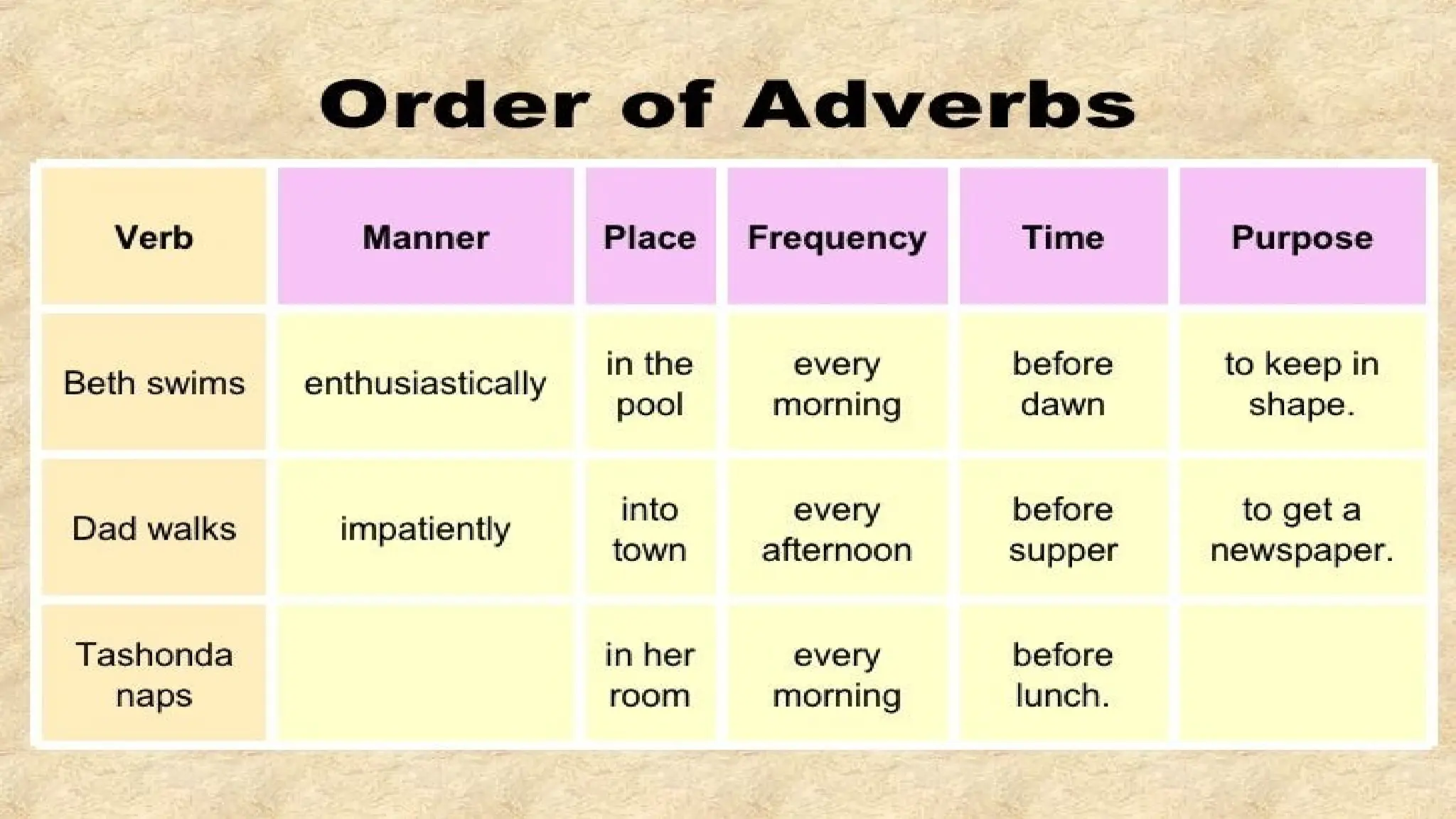
2. ORDER OF ADVERBS
In a descriptive sentence, there may be more
than one adverb, although we rarely see
sentences with more than two adverbs modifying
a verb. At this time they should follow the
following order; Adverb of manner, place,
frequency, time, purpose
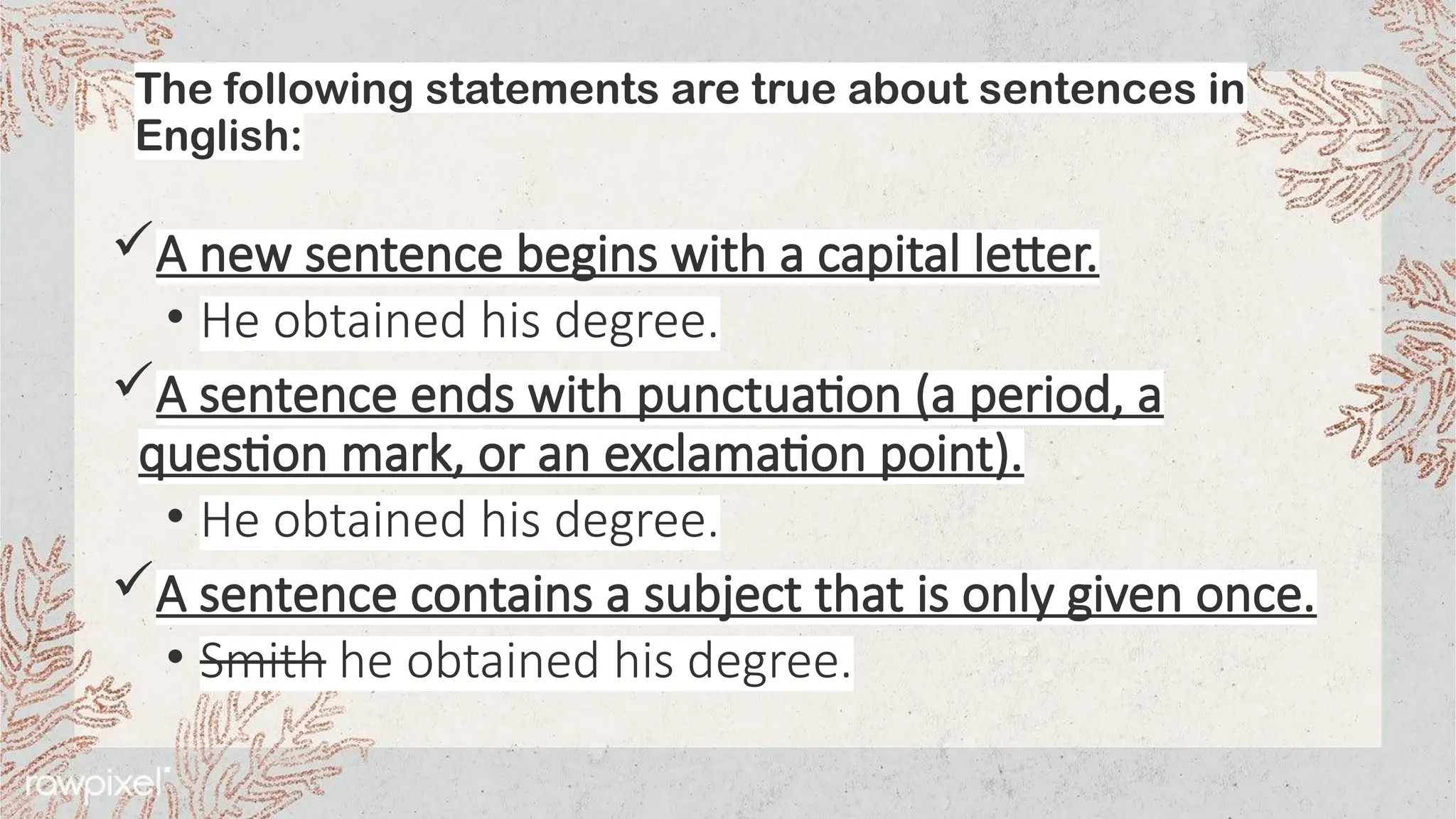
The following statements are true about sentences in
English:
A new sentence begins with a capital letter.
• He obtained his degree.
A sentence ends with punctuation (a period, a
question mark, or an exclamation point).
• He obtained his degree.
A sentence contains a subject that is only given once.
• Smith he obtained his degree.
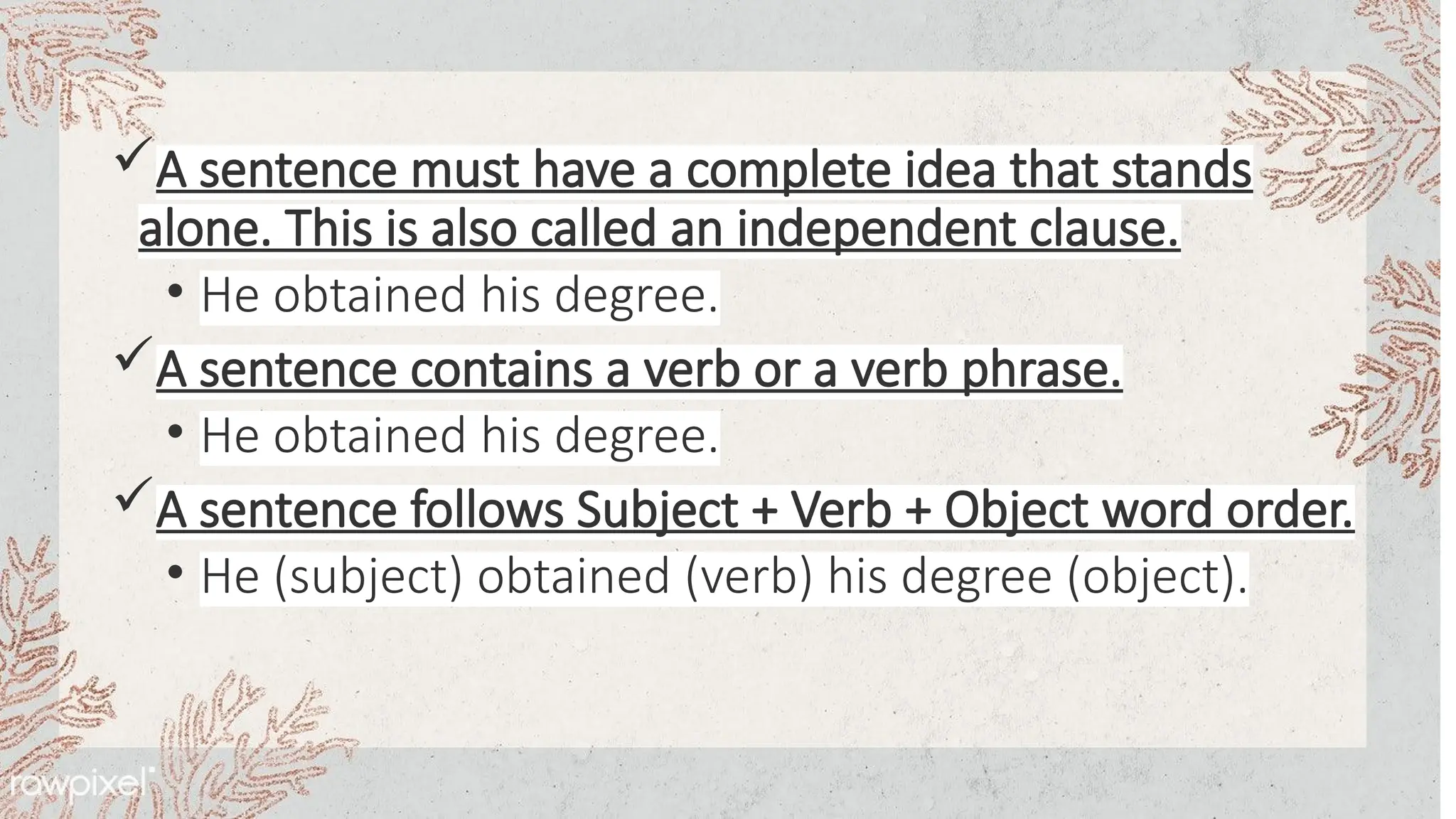
A sentence must have a complete idea that stands
alone. This is also called an independent clause.
• He obtained his degree.
A sentence contains a verb or a verb phrase.
• He obtained his degree.
A sentence follows Subject + Verb + Object word order.
• He (subject) obtained (verb) his degree (object).
The 5 Basic Sentence Patterns
in English
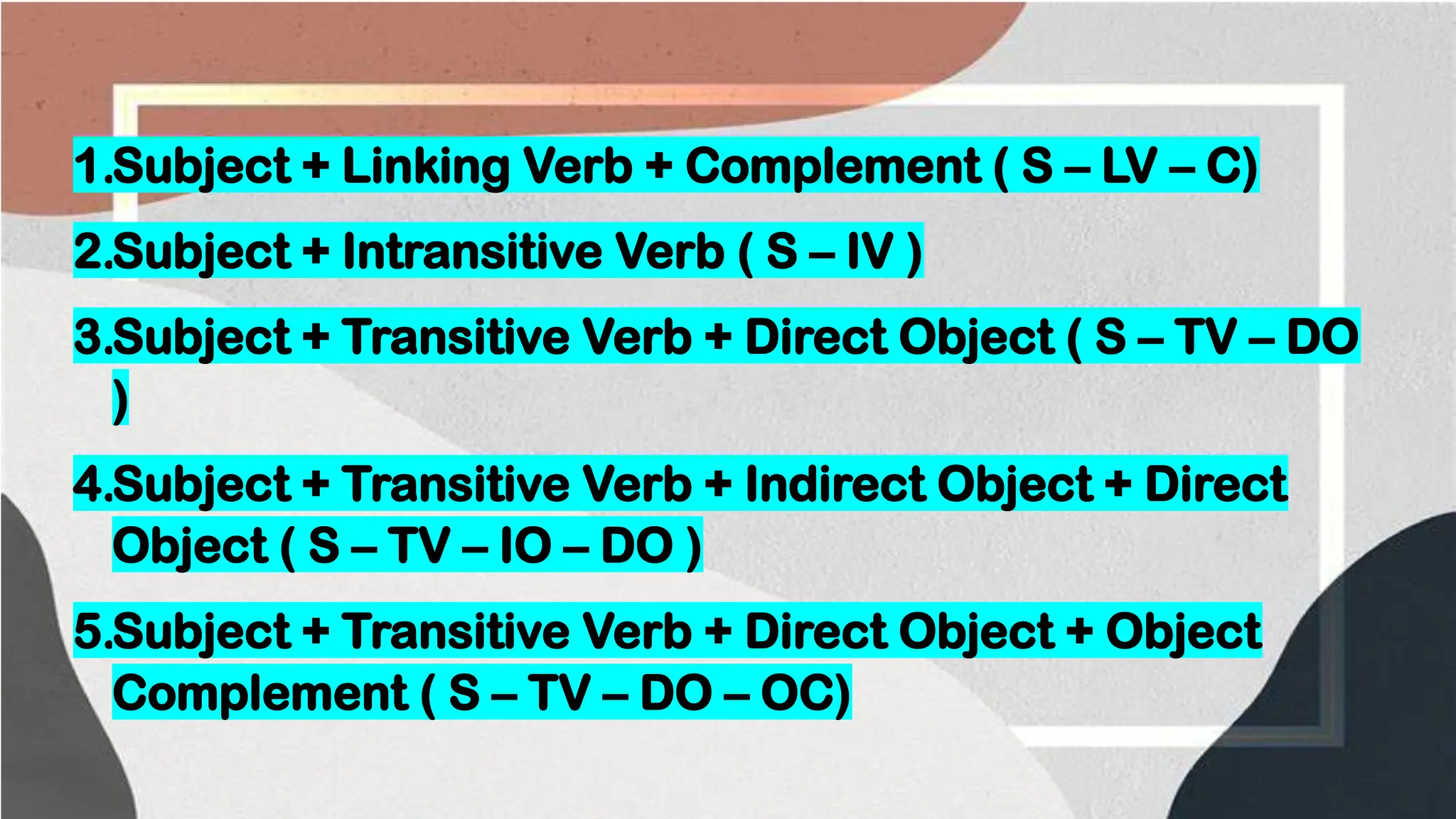
1.Subject + Linking Verb + Complement ( S – LV – C)
2.Subject + Intransitive Verb ( S – IV )
3.Subject + Transitive Verb + Direct Object ( S – TV – DO
)
4.Subject + Transitive Verb + Indirect Object + Direct
Object ( S – TV – IO – DO )
5.Subject + Transitive Verb + Direct Object + Object
Complement ( S – TV – DO – OC)
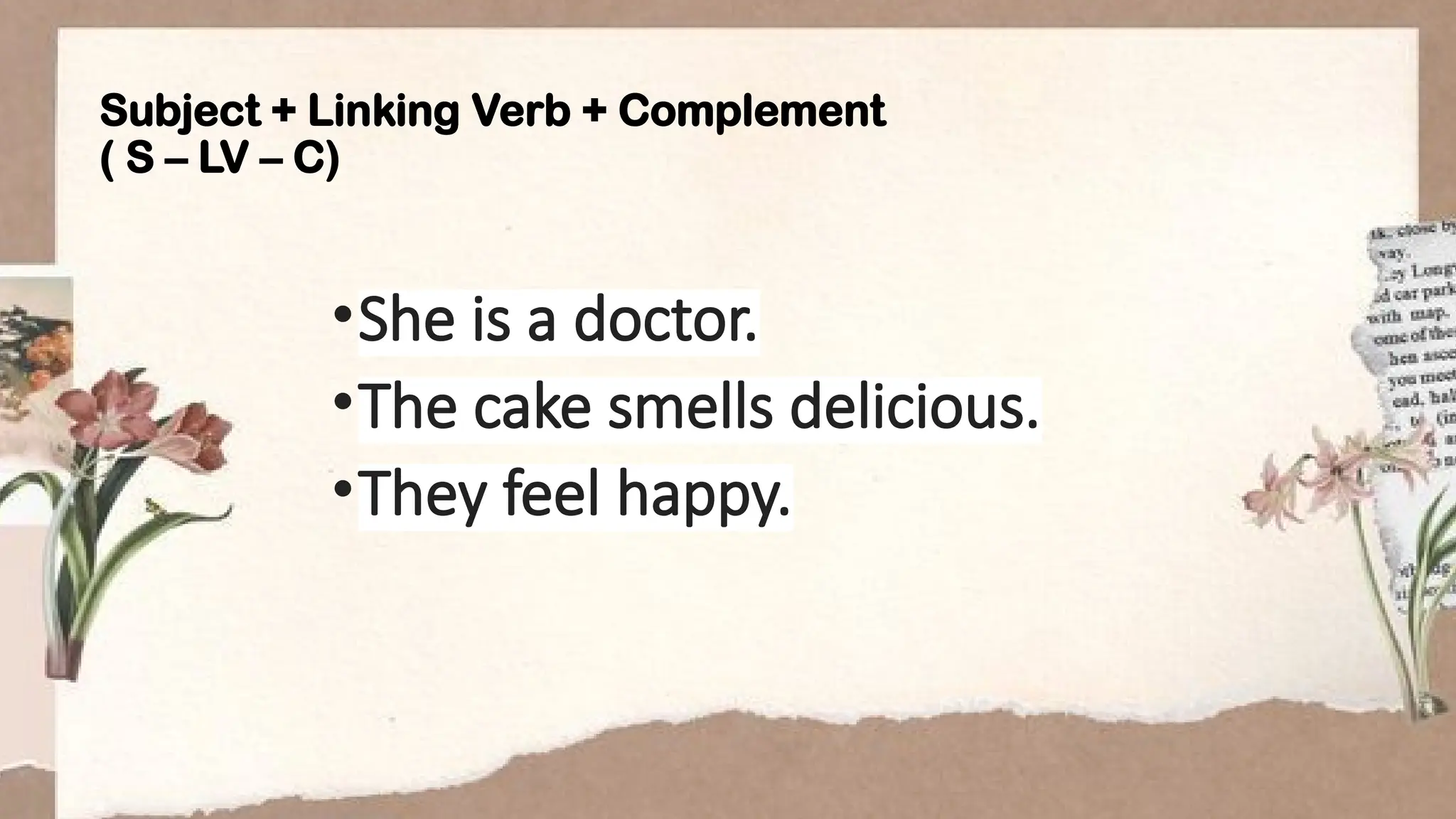
Subject + Linking Verb + Complement
( S – LV – C)
•She is a doctor.
•The cake smells delicious.
•They feel happy.
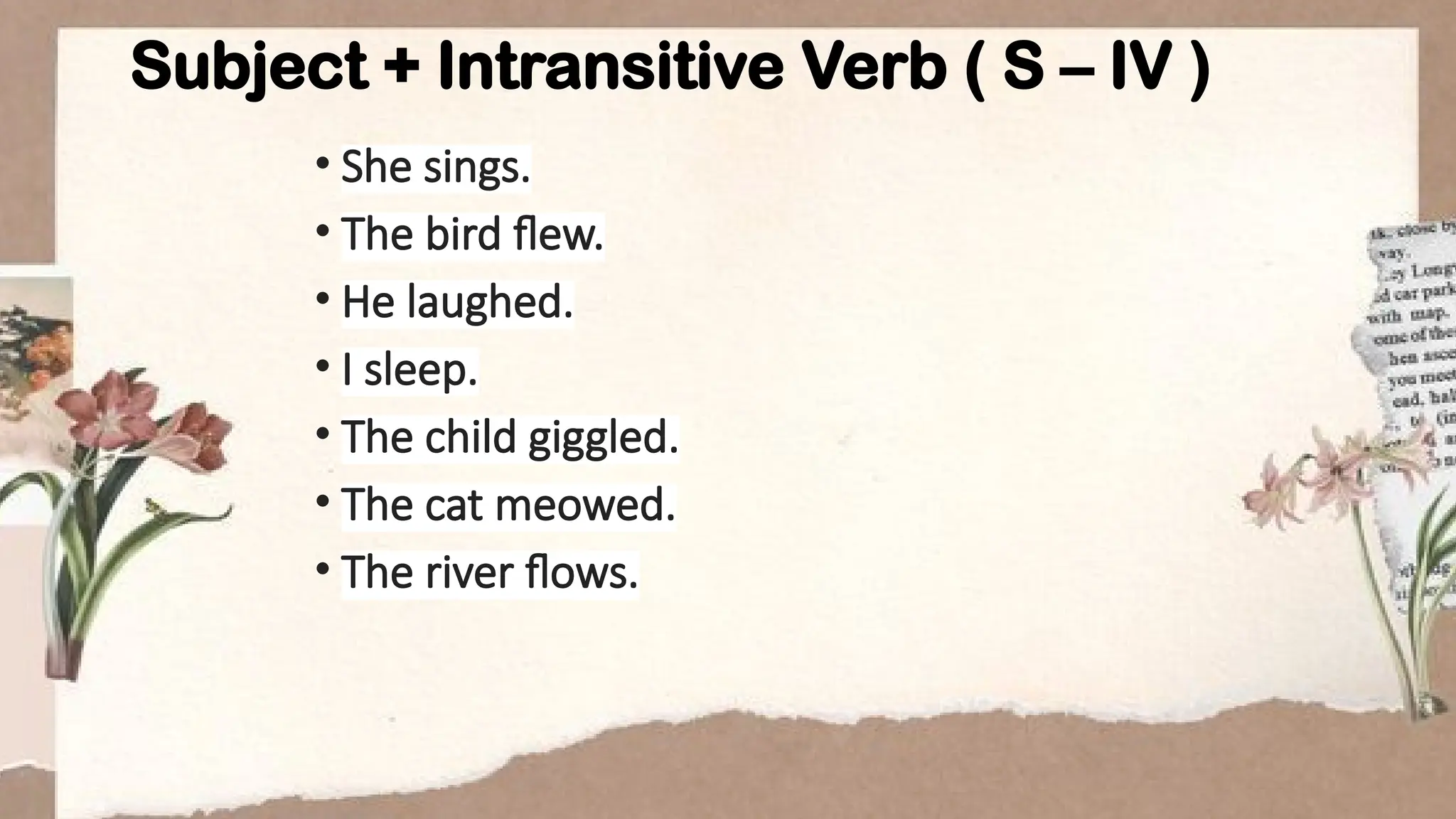
Subject + Intransitive Verb ( S – IV )
• She sings.
• The bird flew.
• He laughed.
• I sleep.
• The child giggled.
• The cat meowed.
• The river flows.
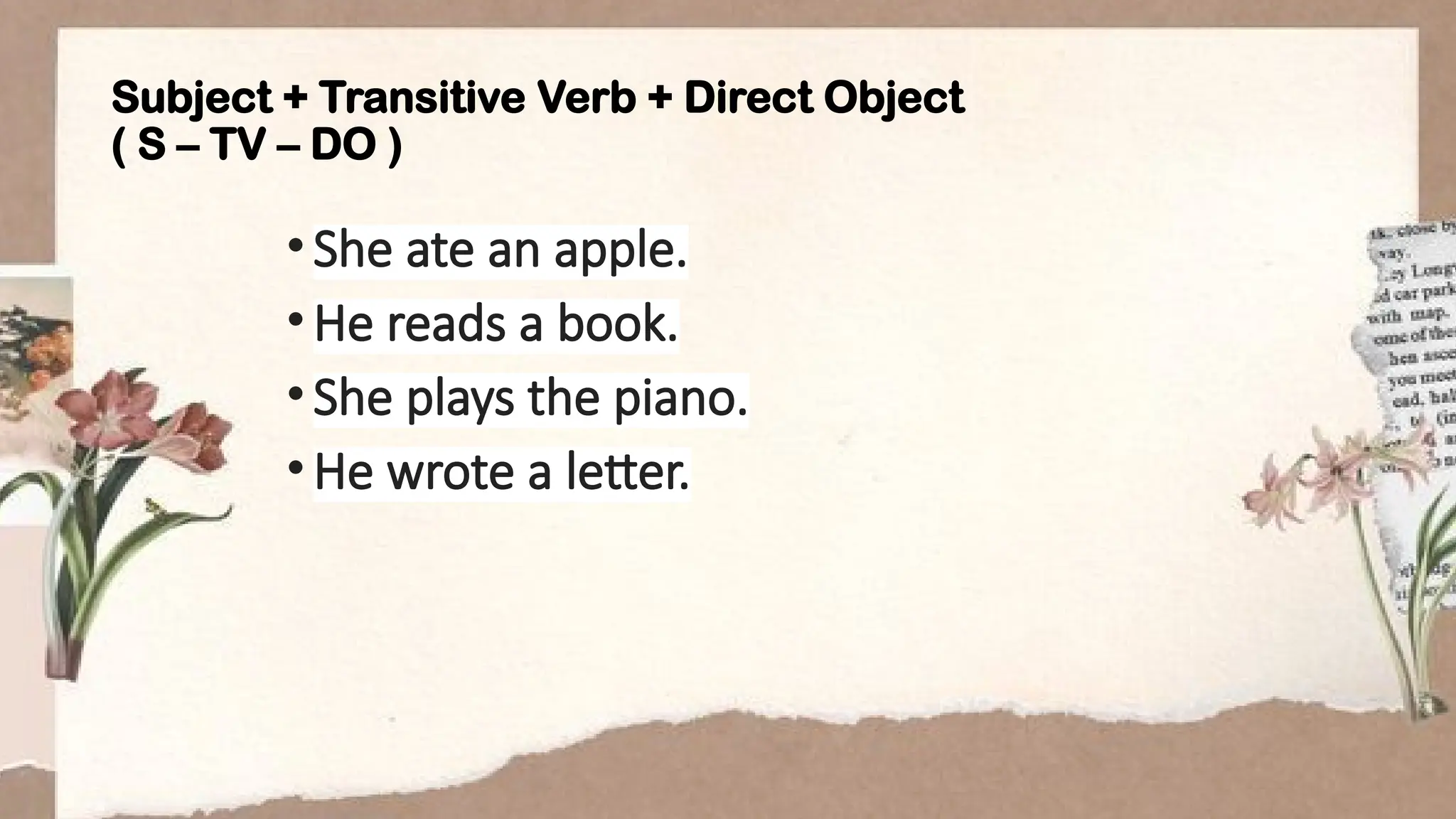
Subject + Transitive Verb + Direct Object
( S – TV – DO )
•She ate an apple.
•He reads a book.
•She plays the piano.
•He wrote a letter.
Subject + Transitive Verb + Indirect Object + Direct
Object ( S – TV – IO – DO )
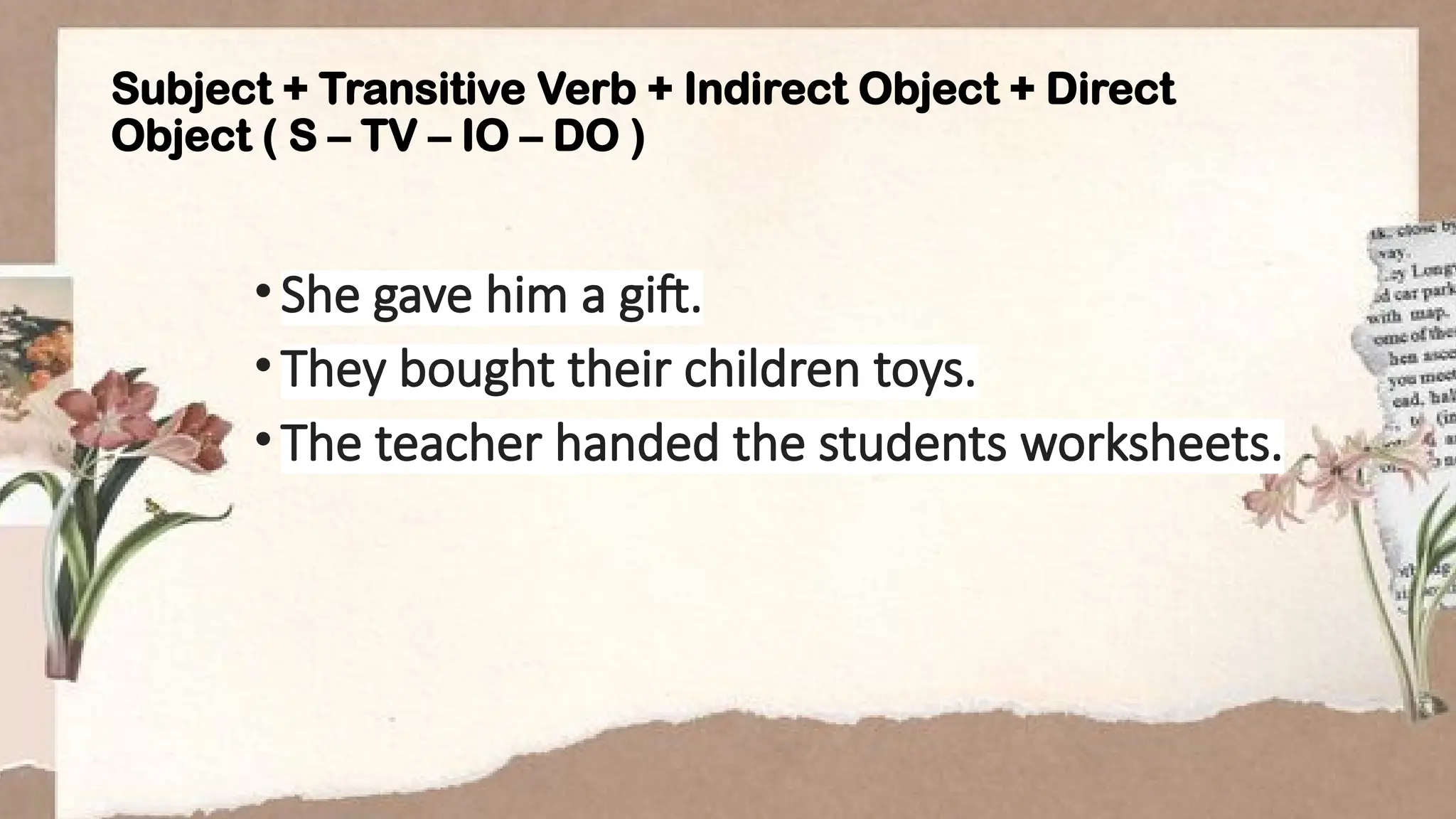
•She gave him a gift.
•They bought their children toys.
•The teacher handed the students worksheets.
Subject + Transitive Verb + Direct Object + Object
Complement ( S – TV – DO – OC)
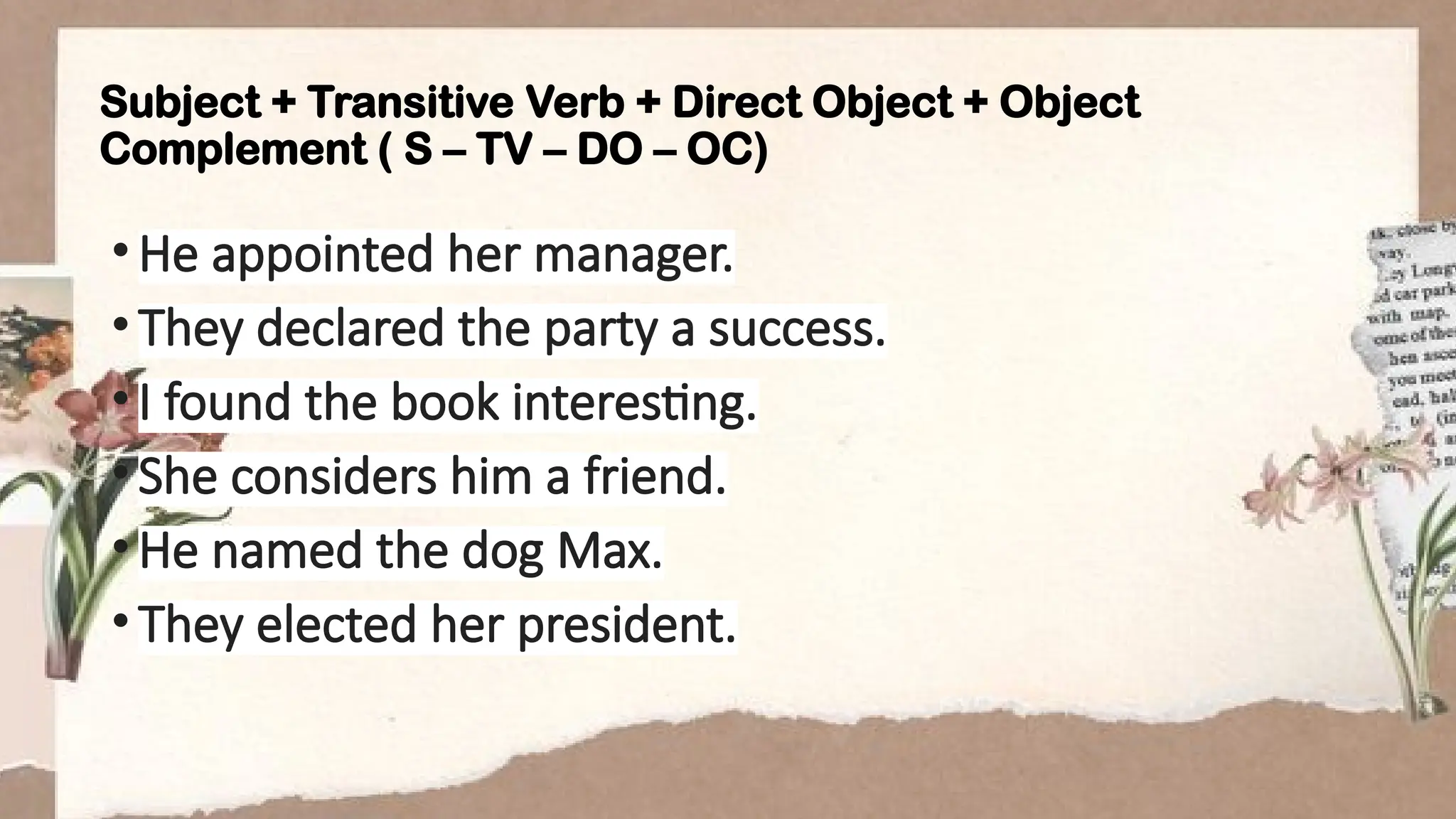
•He appointed her manager.
•They declared the party a success.
•I found the book interesting.
•She considers him a friend.
•He named the dog Max.
•They elected her president.
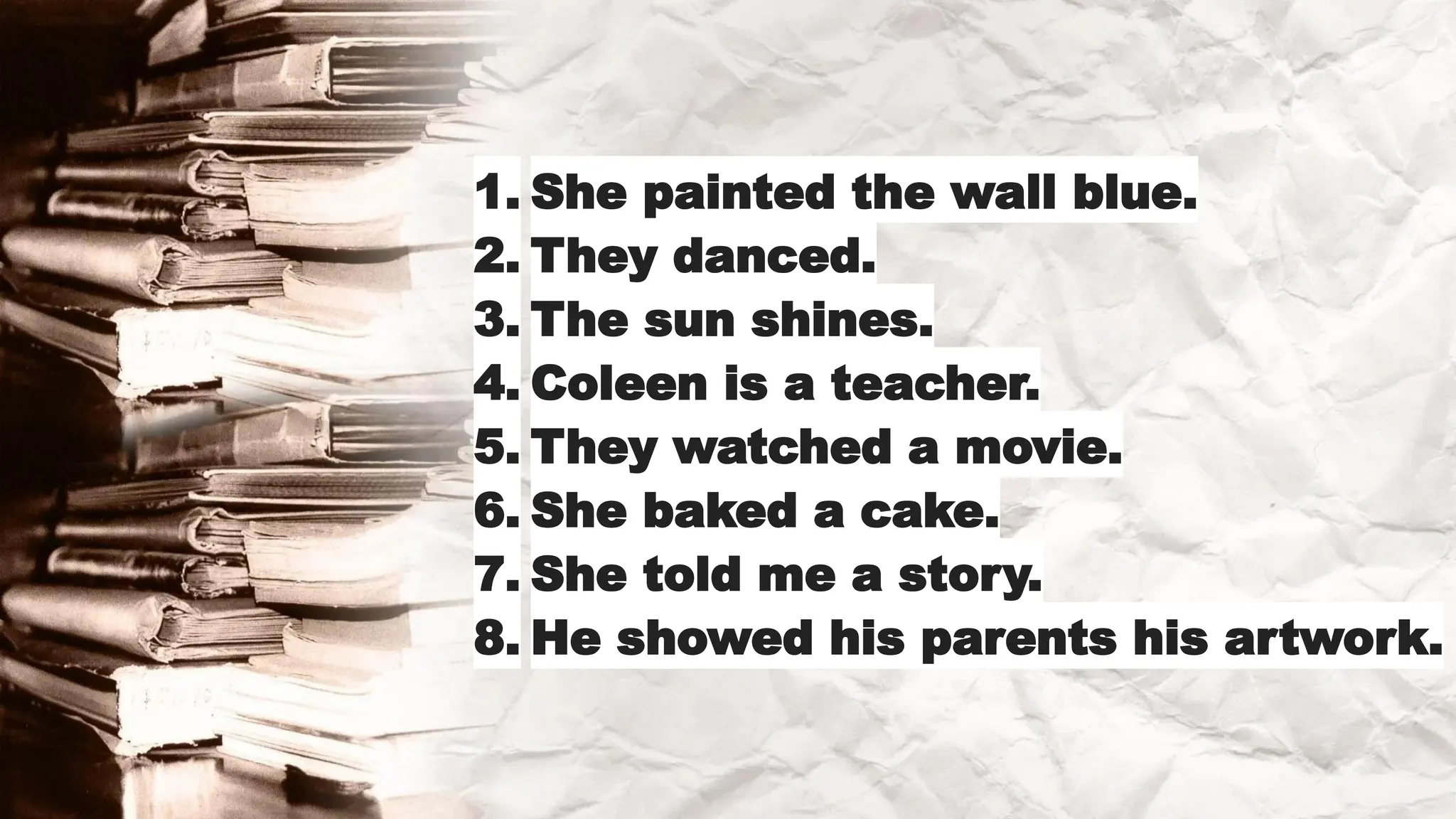
1. She painted the wall blue.
2. They danced.
3. The sun shines.
4. Coleen is a teacher.
5. They watched a movie.
6. She baked a cake.
7. She told me a story.
8. He showed his parents his artwork.
SENTENCES ACCORDING TO STRUCTURE
 SIMPLE SENTENCE
 COMPOUND SENTENCE
 COMPLEX SENTENCE
 COMPOUND-COMPLEX SENTENCE
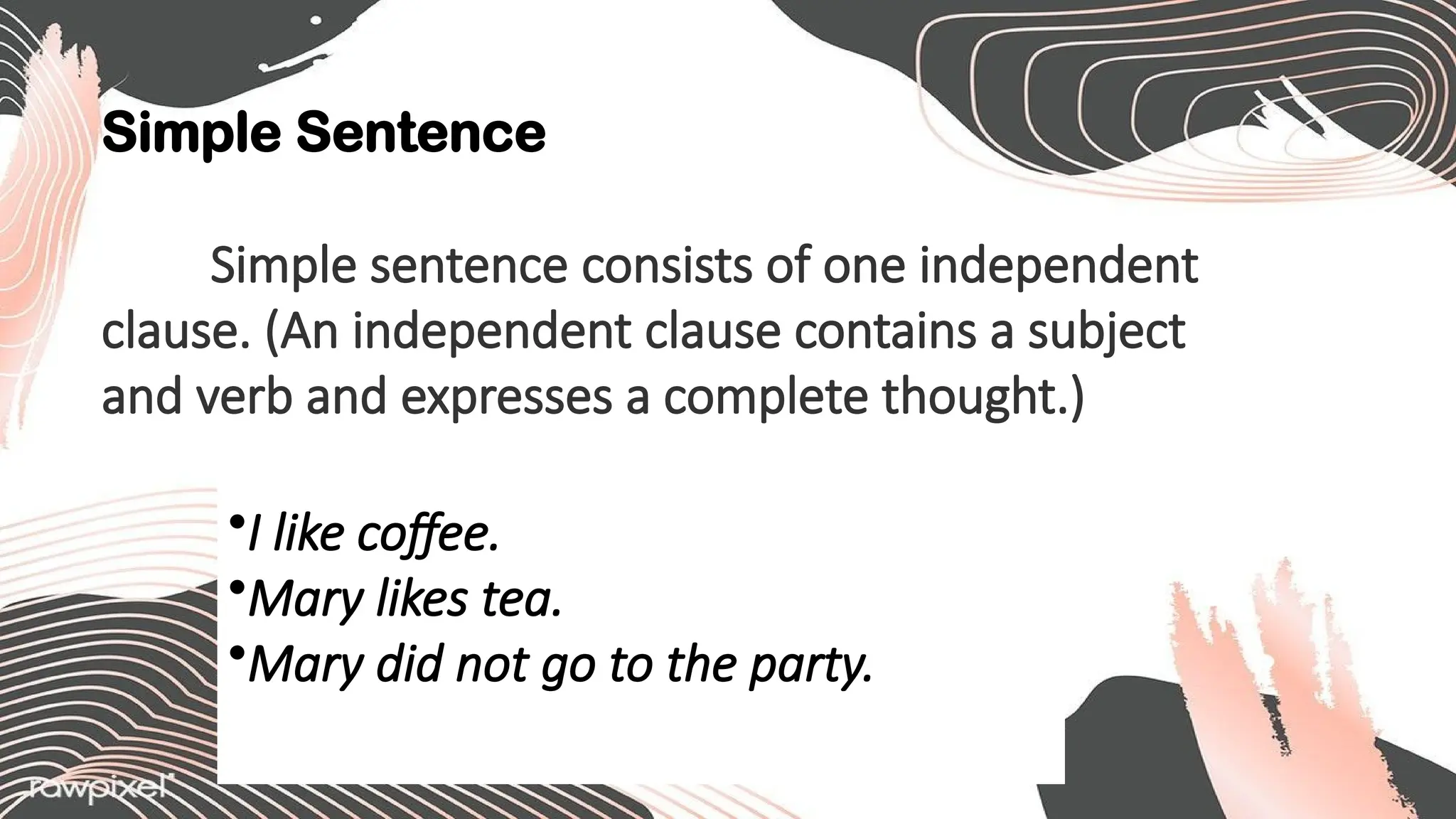
Simple Sentence
Simple sentence consists of one independent
clause. (An independent clause contains a subject
and verb and expresses a complete thought.)
•I like coffee.
•Mary likes tea.
•Mary did not go to the party.
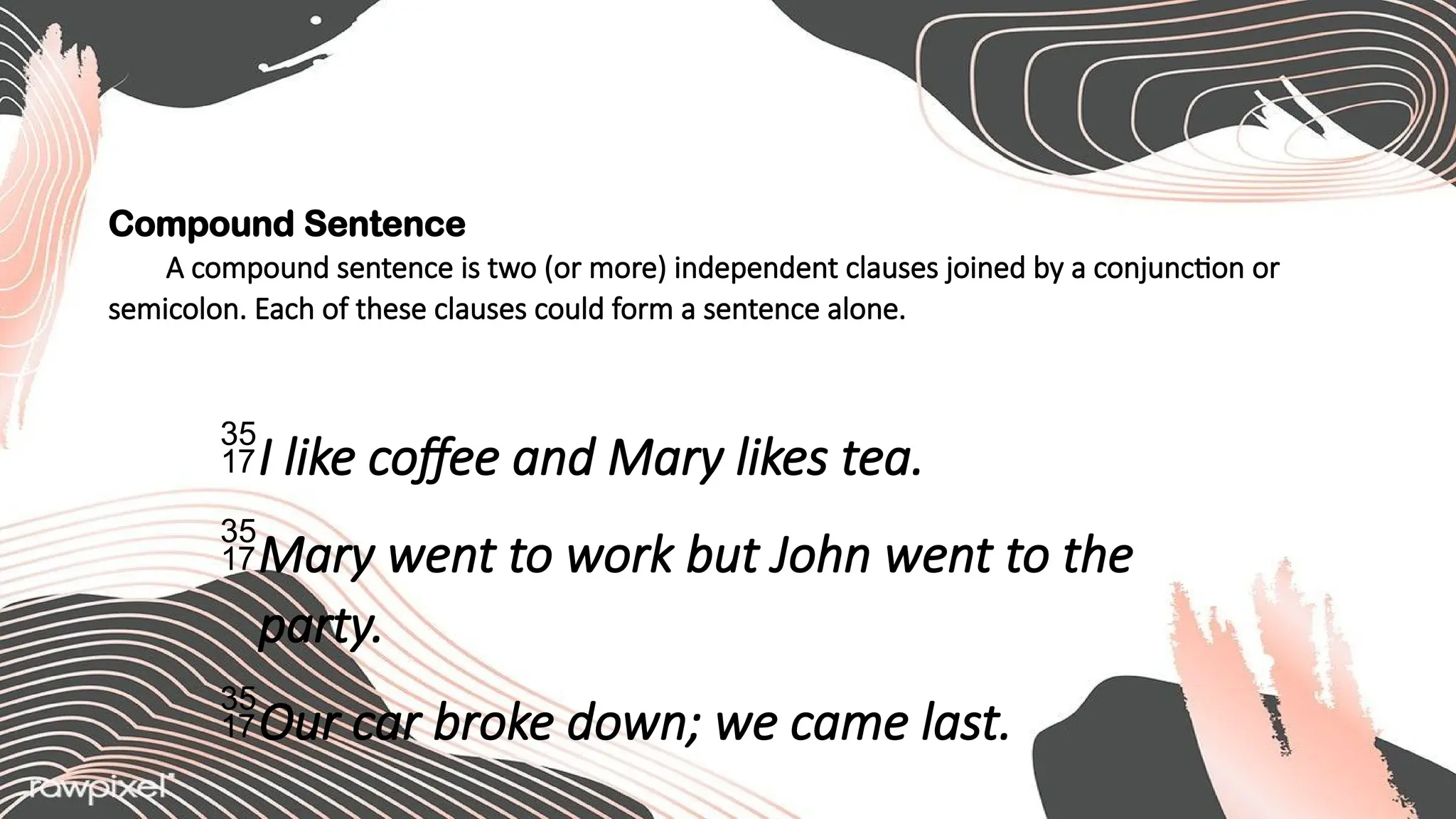
Compound Sentence
A compound sentence is two (or more) independent clauses joined by a conjunction or
semicolon. Each of these clauses could form a sentence alone.
I like coffee and Mary likes tea.
Mary went to work but John went to the
party.
Our car broke down; we came last.
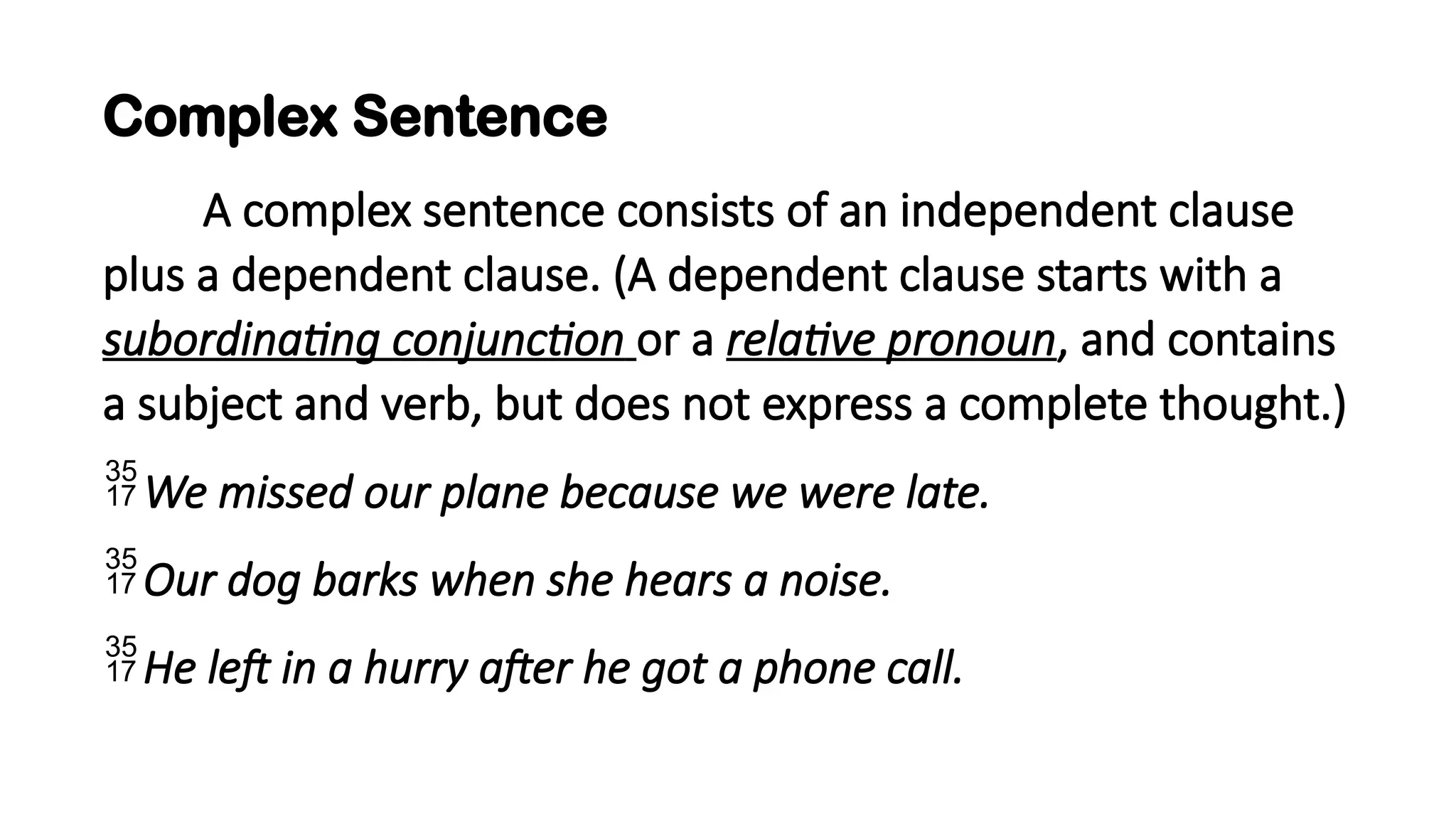
Complex Sentence
A complex sentence consists of an independent clause
plus a dependent clause. (A dependent clause starts with a
subordinating conjunction or a relative pronoun, and contains
a subject and verb, but does not express a complete thought.)
We missed our plane because we were late.
Our dog barks when she hears a noise.
He left in a hurry after he got a phone call.
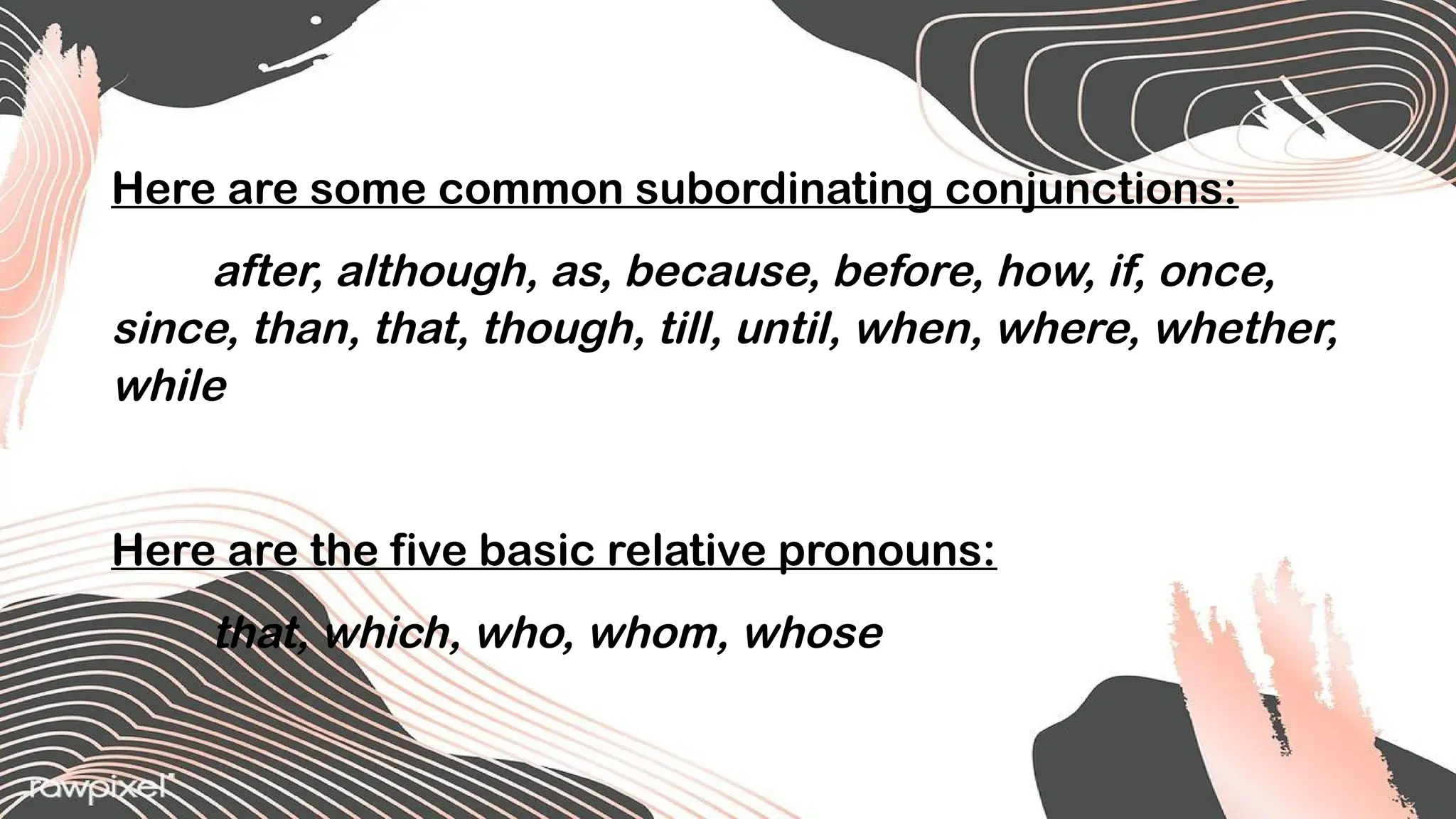
Here are some common subordinating conjunctions:
after, although, as, because, before, how, if, once,
since, than, that, though, till, until, when, where, whether,
while
Here are the five basic relative pronouns:
that, which, who, whom, whose
Compound-Complex Sentence
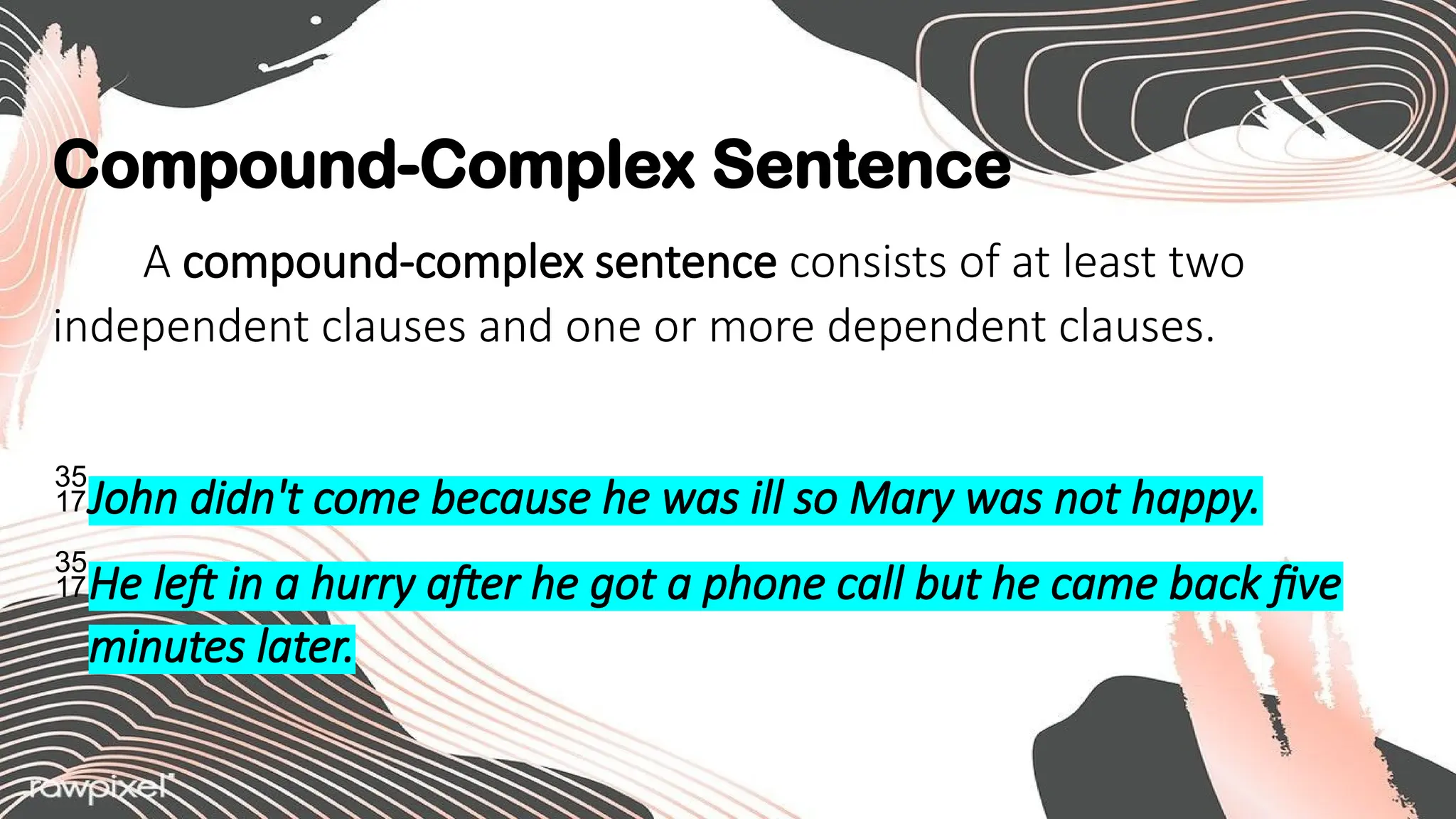
A compound-complex sentence consists of at least two
independent clauses and one or more dependent clauses.
John didn't come because he was ill so Mary was not happy.
He left in a hurry after he got a phone call but he came back five
minutes later.
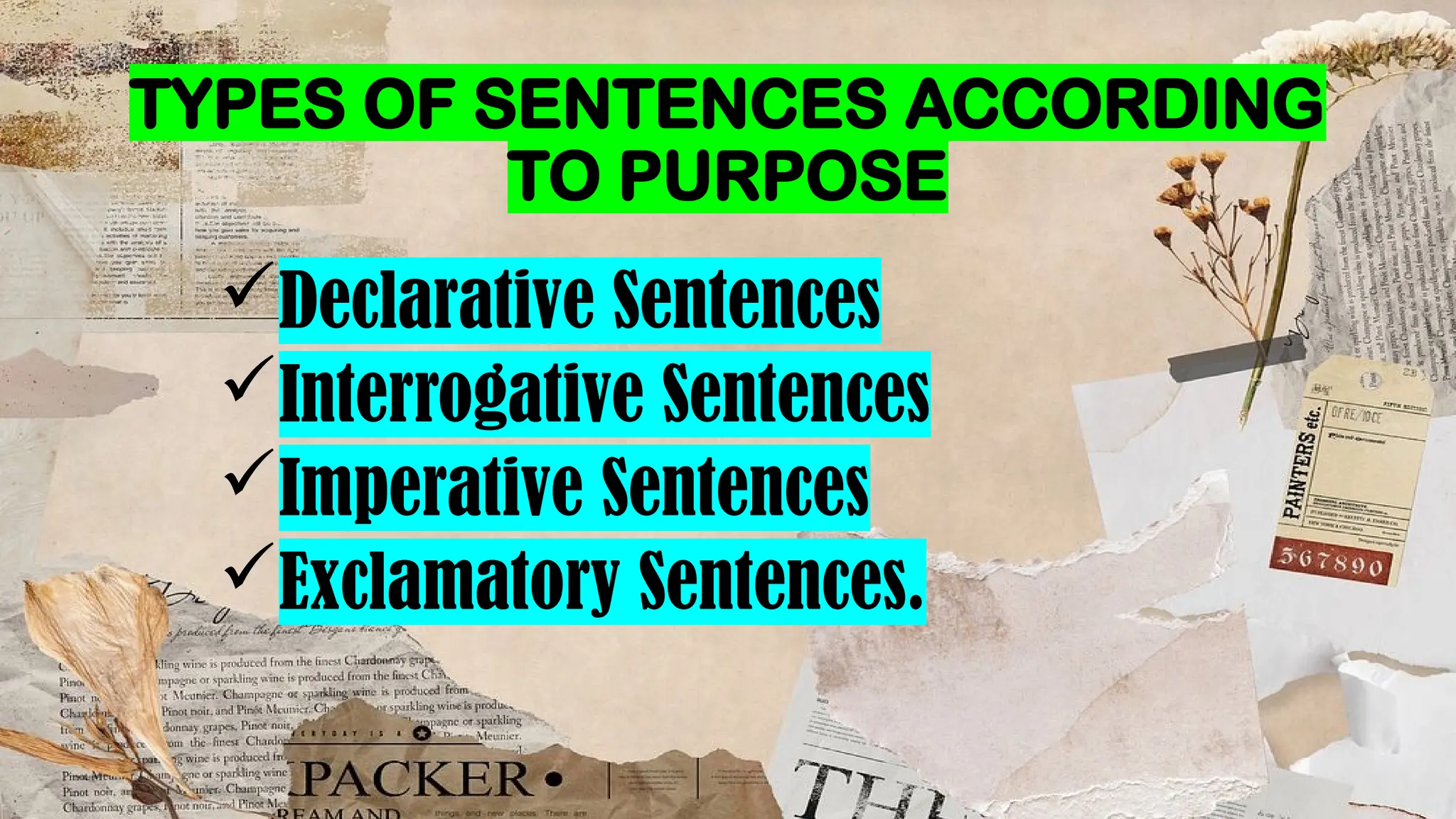
TYPES OF SENTENCES ACCORDING
TO PURPOSE
Declarative Sentences
Interrogative Sentences
Imperative Sentences
Exclamatory Sentences.

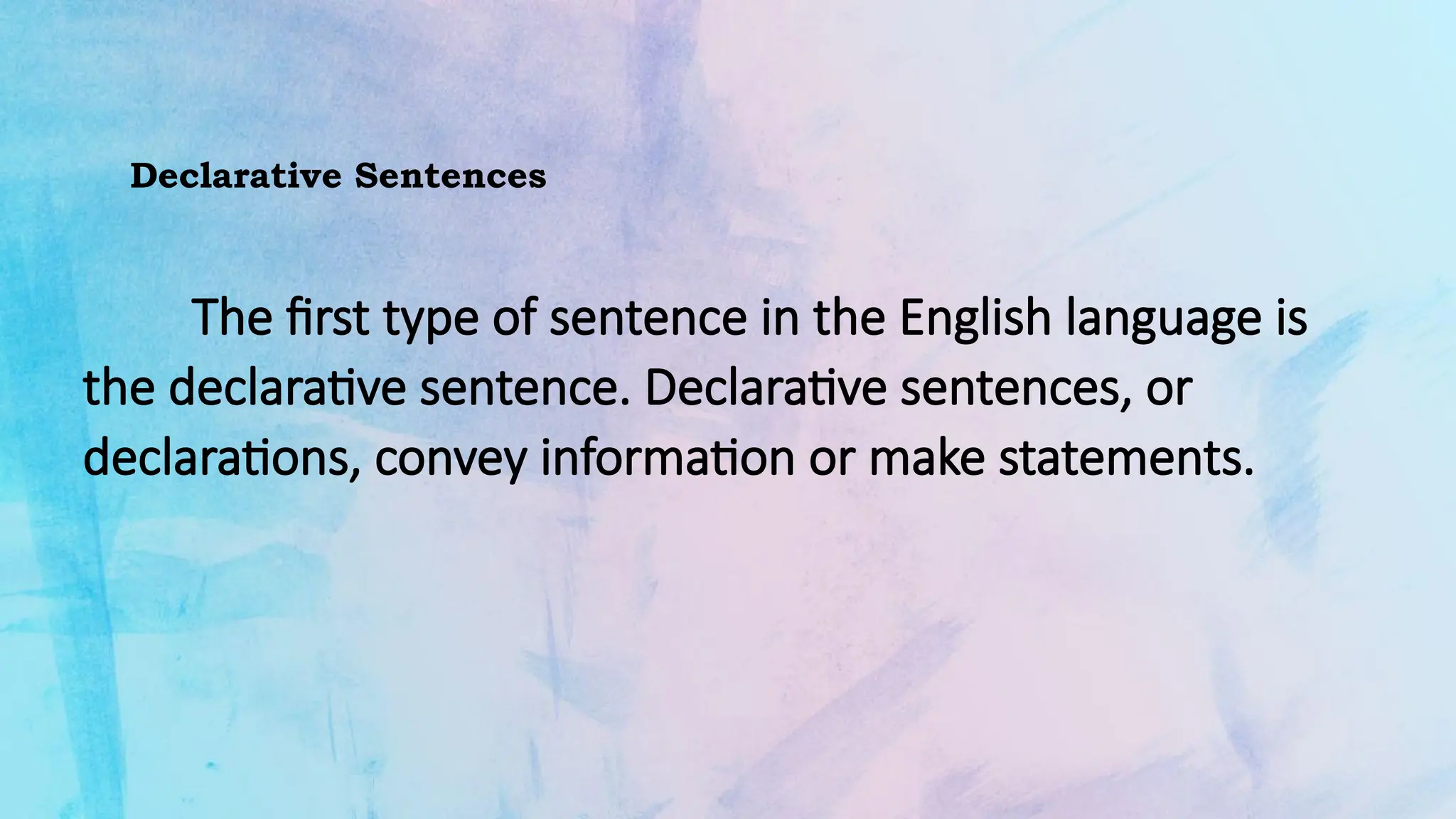
Declarative Sentences
The first type of sentence in the English language is
the declarative sentence. Declarative sentences, or
declarations, convey information or make statements.
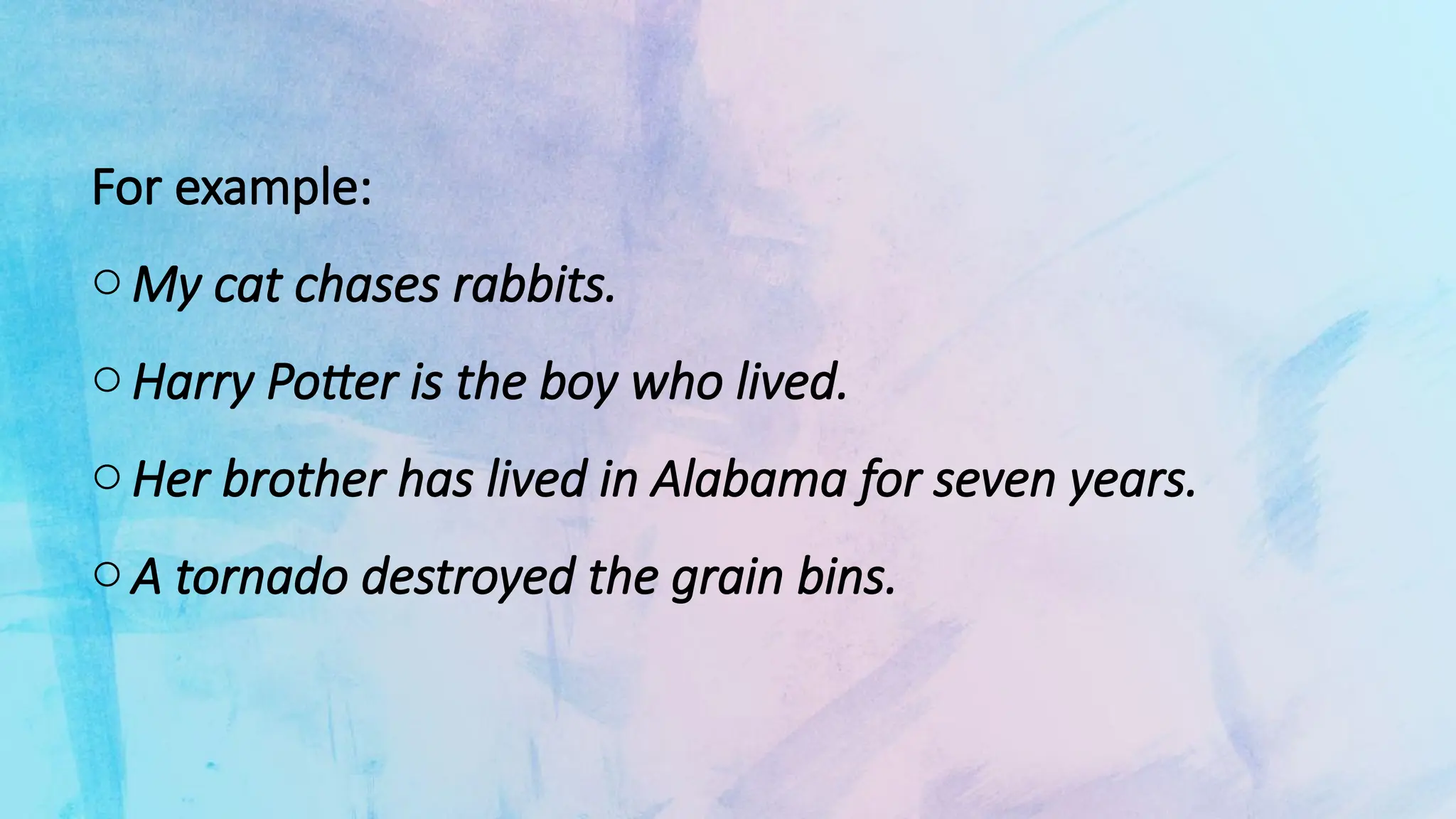
For example:
o My cat chases rabbits.
o Harry Potter is the boy who lived.
o Her brother has lived in Alabama for seven years.
o A tornado destroyed the grain bins.
Interrogative Sentences
The second type of sentence in the English
language is the interrogative sentence.
Interrogative sentences, or questions, request
information or ask questions.
For example:
o When does the train leave?
o Do your dogs like peanut butter?
o How old is your daughter?
o Is your husband a firefighter?
Imperative Sentences
The third type of sentence in the English
language is the imperative sentence.
Imperative sentences, or imperatives, make
commands or requests.
For example:
o Buy some bread and milk on your way home.
o Shut the door please.
o Turn right at the park.
o Stop talking so loudly!
o Open the windows to let the smoke out!
Exclamatory Sentences
The fourth type of sentence in the English
language is the exclamatory sentence. Exclamatory
sentences, or exclamations, show emphasis.
Unlike the other three sentences purposes,
exclamatory sentences are not a distinct sentence
type. Instead, declarative, interrogative, and
imperative sentences become exclamatory through
added emphasis.
For example:
o The train left an hour ago! (declarative)
o How did you break your leg?! (interrogative)
o What the heck was that?! (interrogative)
o Stop chewing with your mouth open! (imperative)
o Do not open the presents until the morning!
(imperative)
THANK YOU, chers! Mabuhay!
REFERENCES
• Muin, Fatchul. (2019). Chapter 7 SYNTAX.
• 5 Basic sentence patterns in English: rules and structures you must know. (2021, April 21).
QQEnglish | English Language School.https://qqeng.net/Learning/basic-sentence-
patterns-in-english/
• What is syntax? Learn the meaning and rules, with examples. (2022, April 29). What Is
Syntax? Definition, Rules, and Examples |
Grammarly.https://www.grammarly.com/blog/syntax/?
msockid=1bd45d93344b6517146b4903357b6469

Study of SYNTAX and sentence structure.pptx

  • 1.
    1. bloom theflowers. 2. postcard he friend sent his a. 3. painted the house they. 4. cat the dog the chased.
  • 3.
    SYNTAX •is the studyof the structure of language, particularly the way in which words can be put together to create meaningful phrases, clauses, or sentences.
  • 4.
    Importance of Syntaxin Language Syntax is crucial in language because it defines the rules that govern how words are combined to form phrases, clauses, and sentences. These rules dictate the structure of language, ensuring that communication is coherent and meaningful.
  • 5.
    FIVE BASIC RULESOF SYNTAX IN ENGLISH
  • 6.
    1All sentences requirea subject and averb. However,imperative sentences(commands) do not need to include their subject because it’s assumed to be the person the sentence is directed at.
  • 7.
    2A single sentenceshould include one main idea. If a sentence includes two or more ideas, it’s best to break it up into multiple sentences.
  • 8.
    3The subject comesfirst, and the verb comes second. If the sentence has objects, they come third, after the verb.
  • 9.
  • 10.
    5Adjectives and adverbsgo in front of the words they describe. If there are multiple adjectives describing the same noun, use the properadjective order.
  • 11.
    What is syntaxerrors in communication? Syntax errors in communication refer to mistakes in the grammatical structure of sentences that can affect clarity and understanding. These errors can have a significant impact on effective communication.
  • 12.
    SENTENCE A sentence isa group of words that communicate a complete idea. There are two basic and necessary parts for a sentence to be complete: the subject and the predicate.
  • 13.
  • 14.
    PREDICATE -provides information aboutthe topic of the sentence
  • 15.
    •She and herfriend play every day in the garden. •The dog barked at the mailman. •He ate a sandwich for lunch. •The cat and the dog slept on the couch.
  • 16.
    Compound Subjects Sentences canhave compound subjects. A compound subject is when there is more than one noun in the subject.
  • 17.
    For example, thesentence below has a compound subject •The sun and the moon shine brightly in the sky. •The young boy and his sister happily eat some fruits with their family.
  • 18.
    COMPOUND PREDICATES Sentences canalso have compound predicates. A compound predicate is when there is more than one action taking place in the predicate.
  • 19.
    •I read abook and listened to music. •They laughed and cried during the emotional movie. •She sang and danced at the talent show. •The artist painted a masterpiece and sold it for a high price.
  • 20.
  • 21.
    SENTENCE DIAGRAMMING • Thereare four types of lines you’ll need for sentence diagramming. • Horizontal lines (____) to write subjects, verbs and objects. • Vertical lines ( | )to separate subjects and objects • Diagonal lines ( ) to write modifiers, prepositions and articles • Dotted vertical or diagonal lines (.) for conjuctions : :
  • 22.
  • 23.
  • 24.
  • 26.
    LET’S TRY! 1. Thegreen box fell. 2. Two fat birds chirped. 3. Walter ran very quickly. 4. Thomas Edison worked diligently.
  • 32.
    The hairy dogsat in the corner of the room
  • 33.
    Word order refersto how the words are organized and sequenced in a sentence. Basic word order of English is Subject + Verb + Object (S+V+O). The object is the item which receives the action from the verb. WORD ORDER OF A SENTENCE
  • 34.
    1. ORDER OFADJECTIVES In a sentence we may have more than one adjective at a time. At this time they should follow the following order.
  • 36.
    •She is wearinga (silk red new) dress. She is wearing a new red silk dress. •I carried a (black small) suitcase I carried a small black suitcase
  • 37.
    •He found a(tiny Chinese white triangular historic fascinating porcelain) teacup. He found a fascinating tiny historic triangular white Chinese porcelain teacup. •They purchased a (little unique new silver Japanese cylindrical metal) pen. They purchased a unique little new cylindrical silver Japanese metal pen.
  • 38.
    2. ORDER OFADVERBS In a descriptive sentence, there may be more than one adverb, although we rarely see sentences with more than two adverbs modifying a verb. At this time they should follow the following order; Adverb of manner, place, frequency, time, purpose
  • 40.
    The following statementsare true about sentences in English: A new sentence begins with a capital letter. • He obtained his degree. A sentence ends with punctuation (a period, a question mark, or an exclamation point). • He obtained his degree. A sentence contains a subject that is only given once. • Smith he obtained his degree.
  • 41.
    A sentence musthave a complete idea that stands alone. This is also called an independent clause. • He obtained his degree. A sentence contains a verb or a verb phrase. • He obtained his degree. A sentence follows Subject + Verb + Object word order. • He (subject) obtained (verb) his degree (object).
  • 42.
    The 5 BasicSentence Patterns in English
  • 43.
    1.Subject + LinkingVerb + Complement ( S – LV – C) 2.Subject + Intransitive Verb ( S – IV ) 3.Subject + Transitive Verb + Direct Object ( S – TV – DO ) 4.Subject + Transitive Verb + Indirect Object + Direct Object ( S – TV – IO – DO ) 5.Subject + Transitive Verb + Direct Object + Object Complement ( S – TV – DO – OC)
  • 44.
    Subject + LinkingVerb + Complement ( S – LV – C) •She is a doctor. •The cake smells delicious. •They feel happy.
  • 45.
    Subject + IntransitiveVerb ( S – IV ) • She sings. • The bird flew. • He laughed. • I sleep. • The child giggled. • The cat meowed. • The river flows.
  • 46.
    Subject + TransitiveVerb + Direct Object ( S – TV – DO ) •She ate an apple. •He reads a book. •She plays the piano. •He wrote a letter.
  • 47.
    Subject + TransitiveVerb + Indirect Object + Direct Object ( S – TV – IO – DO ) •She gave him a gift. •They bought their children toys. •The teacher handed the students worksheets.
  • 48.
    Subject + TransitiveVerb + Direct Object + Object Complement ( S – TV – DO – OC) •He appointed her manager. •They declared the party a success. •I found the book interesting. •She considers him a friend. •He named the dog Max. •They elected her president.
  • 49.
    1. She paintedthe wall blue. 2. They danced. 3. The sun shines. 4. Coleen is a teacher. 5. They watched a movie. 6. She baked a cake. 7. She told me a story. 8. He showed his parents his artwork.
  • 50.
    SENTENCES ACCORDING TOSTRUCTURE  SIMPLE SENTENCE  COMPOUND SENTENCE  COMPLEX SENTENCE  COMPOUND-COMPLEX SENTENCE
  • 51.
    Simple Sentence Simple sentenceconsists of one independent clause. (An independent clause contains a subject and verb and expresses a complete thought.) •I like coffee. •Mary likes tea. •Mary did not go to the party.
  • 52.
    Compound Sentence A compoundsentence is two (or more) independent clauses joined by a conjunction or semicolon. Each of these clauses could form a sentence alone. I like coffee and Mary likes tea. Mary went to work but John went to the party. Our car broke down; we came last.
  • 53.
    Complex Sentence A complexsentence consists of an independent clause plus a dependent clause. (A dependent clause starts with a subordinating conjunction or a relative pronoun, and contains a subject and verb, but does not express a complete thought.) We missed our plane because we were late. Our dog barks when she hears a noise. He left in a hurry after he got a phone call.
  • 54.
    Here are somecommon subordinating conjunctions: after, although, as, because, before, how, if, once, since, than, that, though, till, until, when, where, whether, while Here are the five basic relative pronouns: that, which, who, whom, whose
  • 55.
    Compound-Complex Sentence A compound-complexsentence consists of at least two independent clauses and one or more dependent clauses. John didn't come because he was ill so Mary was not happy. He left in a hurry after he got a phone call but he came back five minutes later.
  • 56.
    TYPES OF SENTENCESACCORDING TO PURPOSE Declarative Sentences Interrogative Sentences Imperative Sentences Exclamatory Sentences.
  • 57.
    Declarative Sentences The firsttype of sentence in the English language is the declarative sentence. Declarative sentences, or declarations, convey information or make statements.
  • 58.
    For example: o Mycat chases rabbits. o Harry Potter is the boy who lived. o Her brother has lived in Alabama for seven years. o A tornado destroyed the grain bins.
  • 59.
    Interrogative Sentences The secondtype of sentence in the English language is the interrogative sentence. Interrogative sentences, or questions, request information or ask questions.
  • 60.
    For example: o Whendoes the train leave? o Do your dogs like peanut butter? o How old is your daughter? o Is your husband a firefighter?
  • 61.
    Imperative Sentences The thirdtype of sentence in the English language is the imperative sentence. Imperative sentences, or imperatives, make commands or requests.
  • 62.
    For example: o Buysome bread and milk on your way home. o Shut the door please. o Turn right at the park. o Stop talking so loudly! o Open the windows to let the smoke out!
  • 63.
    Exclamatory Sentences The fourthtype of sentence in the English language is the exclamatory sentence. Exclamatory sentences, or exclamations, show emphasis. Unlike the other three sentences purposes, exclamatory sentences are not a distinct sentence type. Instead, declarative, interrogative, and imperative sentences become exclamatory through added emphasis.
  • 64.
    For example: o Thetrain left an hour ago! (declarative) o How did you break your leg?! (interrogative) o What the heck was that?! (interrogative) o Stop chewing with your mouth open! (imperative) o Do not open the presents until the morning! (imperative)
  • 65.
  • 66.
    REFERENCES • Muin, Fatchul.(2019). Chapter 7 SYNTAX. • 5 Basic sentence patterns in English: rules and structures you must know. (2021, April 21). QQEnglish | English Language School.https://qqeng.net/Learning/basic-sentence- patterns-in-english/ • What is syntax? Learn the meaning and rules, with examples. (2022, April 29). What Is Syntax? Definition, Rules, and Examples | Grammarly.https://www.grammarly.com/blog/syntax/? msockid=1bd45d93344b6517146b4903357b6469