Punctuation and
Capitalization
By
Brayan Gómez Anaya
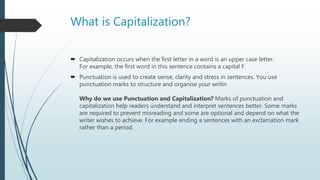
What is Capitalization?
 Capitalization occurs when the first letter in a word is an upper case letter.
For example, the first word in this sentence contains a capital F.
 Punctuation is used to create sense, clarity and stress in sentences. You use
punctuation marks to structure and organise your writin
Why do we use Punctuation and Capitalization? Marks of punctuation and
capitalization help readers understand and interpret sentences better. Some marks
are required to prevent misreading and some are optional and depend on what the
writer wishes to achieve. For example ending a sentences with an exclamation mark
rather than a period.
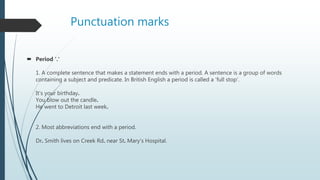
Punctuation marks
 Period '.'
1. A complete sentence that makes a statement ends with a period. A sentence is a group of words
containing a subject and predicate. In British English a period is called a 'full stop'.
It's your birthday.
You blow out the candle.
He went to Detroit last week.
2. Most abbreviations end with a period.
Dr. Smith lives on Creek Rd. near St. Mary's Hospital.
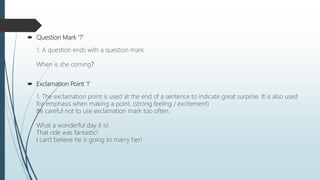
 Question Mark '?'
1. A question ends with a question mark.
When is she coming?
 Exclamation Point '!'
1. The exclamation point is used at the end of a sentence to indicate great surprise. It is also used
for emphasis when making a point. (strong feeling / excitement)
Be careful not to use exclamation mark too often.
What a wonderful day it is!
That ride was fantastic!
I can't believe he is going to marry her!
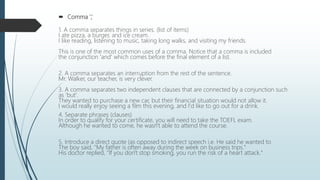
 Comma ',‘
1. A comma separates things in series. (list of items)
I ate pizza, a burger, and ice cream.
I like reading, listening to music, taking long walks, and visiting my friends.
This is one of the most common uses of a comma. Notice that a comma is included
the conjunction 'and' which comes before the final element of a list.
2. A comma separates an interruption from the rest of the sentence.
Mr. Walker, our teacher, is very clever.
3. A comma separates two independent clauses that are connected by a conjunction such
as 'but'.
They wanted to purchase a new car, but their financial situation would not allow it.
I would really enjoy seeing a film this evening, and I'd like to go out for a drink.
4. Separate phrases (clauses)
In order to qualify for your certificate, you will need to take the TOEFL exam.
Although he wanted to come, he wasn't able to attend the course.
5. Introduce a direct quote (as opposed to indirect speech i.e. He said he wanted to
The boy said, "My father is often away during the week on business trips."
His doctor replied, "If you don't stop smoking, you run the risk of a heart attack."
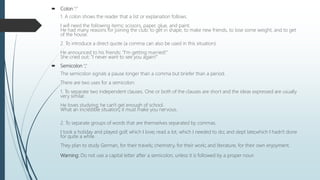
 Colon ':'
1. A colon shows the reader that a list or explanation follows.
I will need the following items: scissors, paper, glue, and paint.
He had many reasons for joining the club: to get in shape, to make new friends, to lose some weight, and to get
of the house.
2. To introduce a direct quote (a comma can also be used in this situation)
He announced to his friends: "I'm getting married!"
She cried out: "I never want to see you again!“
 Semicolon ';'
The semicolon signals a pause longer than a comma but briefer than a period.
There are two uses for a semicolon:
1. To separate two independent clauses. One or both of the clauses are short and the ideas expressed are usually
very similar.
He loves studying; he can't get enough of school.
What an incredible situation; it must make you nervous.
2. To separate groups of words that are themselves separated by commas.
I took a holiday and played golf, which I love; read a lot, which I needed to do; and slept late;which I hadn't done
for quite a while.
They plan to study German, for their travels; chemistry, for their work; and literature, for their own enjoyment.
Warning: Do not use a capital letter after a semicolon, unless it is followed by a proper noun
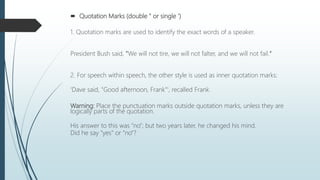
 Quotation Marks (double " or single ')
1. Quotation marks are used to identify the exact words of a speaker.
President Bush said, "We will not tire, we will not falter, and we will not fail."
2. For speech within speech, the other style is used as inner quotation marks:
'Dave said, "Good afternoon, Frank"', recalled Frank.
Warning: Place the punctuation marks outside quotation marks, unless they are
logically parts of the quotation.
His answer to this was "no"; but two years later, he changed his mind.
Did he say "yes" or "no"?
References
 http://www.grammarbank.com/punctuation-and-capitalization.html
 http://www.ef.com/english-resources/english-grammar/punctuation/

Punctuation and capitalization

  • 1.
  • 2.
    What is Capitalization? Capitalization occurs when the first letter in a word is an upper case letter. For example, the first word in this sentence contains a capital F.  Punctuation is used to create sense, clarity and stress in sentences. You use punctuation marks to structure and organise your writin Why do we use Punctuation and Capitalization? Marks of punctuation and capitalization help readers understand and interpret sentences better. Some marks are required to prevent misreading and some are optional and depend on what the writer wishes to achieve. For example ending a sentences with an exclamation mark rather than a period.
  • 3.
    Punctuation marks  Period'.' 1. A complete sentence that makes a statement ends with a period. A sentence is a group of words containing a subject and predicate. In British English a period is called a 'full stop'. It's your birthday. You blow out the candle. He went to Detroit last week. 2. Most abbreviations end with a period. Dr. Smith lives on Creek Rd. near St. Mary's Hospital.
  • 4.
     Question Mark'?' 1. A question ends with a question mark. When is she coming?  Exclamation Point '!' 1. The exclamation point is used at the end of a sentence to indicate great surprise. It is also used for emphasis when making a point. (strong feeling / excitement) Be careful not to use exclamation mark too often. What a wonderful day it is! That ride was fantastic! I can't believe he is going to marry her!
  • 5.
     Comma ',‘ 1.A comma separates things in series. (list of items) I ate pizza, a burger, and ice cream. I like reading, listening to music, taking long walks, and visiting my friends. This is one of the most common uses of a comma. Notice that a comma is included the conjunction 'and' which comes before the final element of a list. 2. A comma separates an interruption from the rest of the sentence. Mr. Walker, our teacher, is very clever. 3. A comma separates two independent clauses that are connected by a conjunction such as 'but'. They wanted to purchase a new car, but their financial situation would not allow it. I would really enjoy seeing a film this evening, and I'd like to go out for a drink. 4. Separate phrases (clauses) In order to qualify for your certificate, you will need to take the TOEFL exam. Although he wanted to come, he wasn't able to attend the course. 5. Introduce a direct quote (as opposed to indirect speech i.e. He said he wanted to The boy said, "My father is often away during the week on business trips." His doctor replied, "If you don't stop smoking, you run the risk of a heart attack."
  • 6.
     Colon ':' 1.A colon shows the reader that a list or explanation follows. I will need the following items: scissors, paper, glue, and paint. He had many reasons for joining the club: to get in shape, to make new friends, to lose some weight, and to get of the house. 2. To introduce a direct quote (a comma can also be used in this situation) He announced to his friends: "I'm getting married!" She cried out: "I never want to see you again!“  Semicolon ';' The semicolon signals a pause longer than a comma but briefer than a period. There are two uses for a semicolon: 1. To separate two independent clauses. One or both of the clauses are short and the ideas expressed are usually very similar. He loves studying; he can't get enough of school. What an incredible situation; it must make you nervous. 2. To separate groups of words that are themselves separated by commas. I took a holiday and played golf, which I love; read a lot, which I needed to do; and slept late;which I hadn't done for quite a while. They plan to study German, for their travels; chemistry, for their work; and literature, for their own enjoyment. Warning: Do not use a capital letter after a semicolon, unless it is followed by a proper noun
  • 7.
     Quotation Marks(double " or single ') 1. Quotation marks are used to identify the exact words of a speaker. President Bush said, "We will not tire, we will not falter, and we will not fail." 2. For speech within speech, the other style is used as inner quotation marks: 'Dave said, "Good afternoon, Frank"', recalled Frank. Warning: Place the punctuation marks outside quotation marks, unless they are logically parts of the quotation. His answer to this was "no"; but two years later, he changed his mind. Did he say "yes" or "no"?
  • 8.