THE COMPLETE SENTENCE Writing a complete sentence seems easy enough, but you may not realize that you don’t have one when you edit your writing if you don’t know what you are looking for.
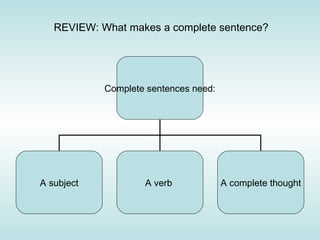
REVIEW: What makes a complete sentence? Complete sentences need: A subject A verb  A complete thought
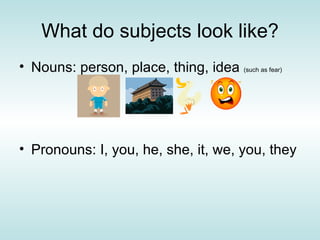
What do subjects look like? Nouns: person, place, thing, idea  (such as fear) Pronouns: I, you, he, she, it, we, you, they
Remember . . .  A noun or string of nouns does not make a complete sentence Ex: The boy, the girl, the dog, the cat  *Note that length doesn’t determine a complete sentence  The noun must have a verb working with it to make a complete sentence
So if the subject needs a verb . . . What do verbs look like? Action words: hit, run, bike, jog In different tenses: ran, biked, has jogged However some verbs do not show action: State of being: She  feels  sad.  Notice that she is not “feeling” something sad as an action but rather internally experiencing it (sad refers back to subject) To be: am, is, are, was, were, be, being, been These words can be coupled with action verbs as helping verbs or stand by themselves Ex of a helping verb: She  is  walking to the store (present progressive tense) Ex of a to be verb: I  am  happy.  She  is  the captain of the team.
Expletive & Imperatives There  are  a couple of exceptions to the subjects before verbs to make a complete sentence rule. Notice the sentence you just read.  What is the verb? (are).  Sometimes it is helpful when identifying complete sentences to find you verb and then look for your subject before it.  Subjects are most often in front of the verb they go with. BUT—What is the subject???? Is it “There”?  What “are” in the sentence? The true subject in a sentence that begins with the word “there” comes after the verb. This construction is called an expletive.
Wait a minute – one more exception to the standard complete sentence! An imperative sentence or a command will NOT look like your typical complete sentence. Run!  Take out the trash! Notice what these sentences start with—VERBS!  Where is the subject? Better yet—Who is being spoken to? Your subject is YOU!  Whomever the command is being given to is the subject of the sentence.  If that person is not identified by name, then the subject would be an understood you.
ARE YOU READY? Go to the links provided to test your noun and verb knowledge before going on to the next part of your study.

Complete Sentence

  • 1.
    THE COMPLETE SENTENCEWriting a complete sentence seems easy enough, but you may not realize that you don’t have one when you edit your writing if you don’t know what you are looking for.
  • 2.
    REVIEW: What makesa complete sentence? Complete sentences need: A subject A verb A complete thought
  • 3.
    What do subjectslook like? Nouns: person, place, thing, idea (such as fear) Pronouns: I, you, he, she, it, we, you, they
  • 4.
    Remember . .. A noun or string of nouns does not make a complete sentence Ex: The boy, the girl, the dog, the cat *Note that length doesn’t determine a complete sentence The noun must have a verb working with it to make a complete sentence
  • 5.
    So if thesubject needs a verb . . . What do verbs look like? Action words: hit, run, bike, jog In different tenses: ran, biked, has jogged However some verbs do not show action: State of being: She feels sad. Notice that she is not “feeling” something sad as an action but rather internally experiencing it (sad refers back to subject) To be: am, is, are, was, were, be, being, been These words can be coupled with action verbs as helping verbs or stand by themselves Ex of a helping verb: She is walking to the store (present progressive tense) Ex of a to be verb: I am happy. She is the captain of the team.
  • 6.
    Expletive & ImperativesThere are a couple of exceptions to the subjects before verbs to make a complete sentence rule. Notice the sentence you just read. What is the verb? (are). Sometimes it is helpful when identifying complete sentences to find you verb and then look for your subject before it. Subjects are most often in front of the verb they go with. BUT—What is the subject???? Is it “There”? What “are” in the sentence? The true subject in a sentence that begins with the word “there” comes after the verb. This construction is called an expletive.
  • 7.
    Wait a minute– one more exception to the standard complete sentence! An imperative sentence or a command will NOT look like your typical complete sentence. Run! Take out the trash! Notice what these sentences start with—VERBS! Where is the subject? Better yet—Who is being spoken to? Your subject is YOU! Whomever the command is being given to is the subject of the sentence. If that person is not identified by name, then the subject would be an understood you.
  • 8.
    ARE YOU READY?Go to the links provided to test your noun and verb knowledge before going on to the next part of your study.