Beginning English
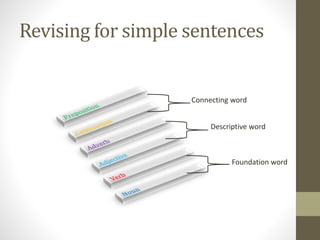
Revising for simple sentences
Foundation word
Descriptive word
Connecting word
Foundation Words: Nouns
A noun is a word that identifies a person, place, or thing. There are three types
of nouns (concrete, proper, and abstract) and a noun substitute (pronoun).
Concrete nouns identify physical objects that can be seen or touched, such as
desk, pencil, laptop, shirt, dress, shoe, and so on. Simply look around you: Any
object that you can see or touch has a name for it, and
that name is a concrete noun.
Abstract nouns do not identify physical objects. Instead, they identify feelings
or sensations (love, fear, sadness, hunger, and so on), ideas (fun, trouble,
intelligence, success, and so on), or activities (shouting, thinking, jogging, lying,
and so on). Remember: Because you can’t touch any of these things, they are
considered abstract.
Nouns
Proper nouns are the names given to specific people, places, or things, such as
Michael Jackson, Philadelphia, or Toyota. Proper nouns always begin with a
capital letter.
Pronouns are convenient substitutes for the other types of nouns. The most
common pronouns are personal pronouns: I, you, he, she, it, they, and we. As an
example, she could be a convenient substitute for the woman. Remember:
Pronouns can be the subject or actor in a sentence.
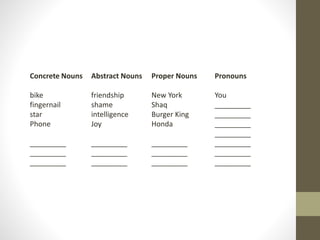
Concrete Nouns
bike
fingernail
star
Phone
_________
_________
_________
Abstract Nouns
friendship
shame
intelligence
Joy
_________
_________
_________
Proper Nouns
New York
Shaq
Burger King
Honda
_________
_________
_________
Pronouns
You
_________
_________
_________
_________
_________
_________
_________
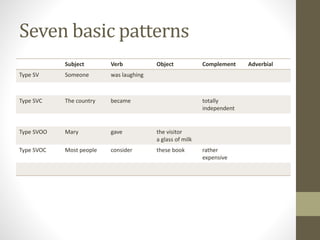
Subject Verb Object Complement Adverbial
Type SV Someone was laughing
Type SVC The country became totally
independent
Type SVOO Mary gave the visitor
a glass of milk
Type SVOC Most people consider these book rather
expensive
Seven basic patterns
A typical SVO pattern
• In most cases a verb must be followed by another noun to
make sense and express a complete thought.
• The verb bellow is an example of action verbs
Noun Verb Noun
Teachers Give _______________ [What?]
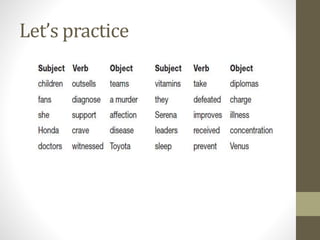
Let’s practice
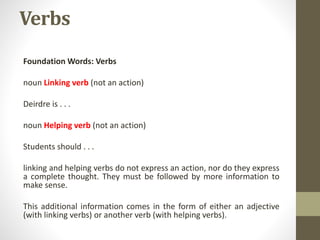
Verbs
Foundation Words: Verbs
noun Linking verb (not an action)
Deirdre is . . .
noun Helping verb (not an action)
Students should . . .
linking and helping verbs do not express an action, nor do they express
a complete thought. They must be followed by more information to
make sense.
This additional information comes in the form of either an adjective
(with linking verbs) or another verb (with helping verbs).
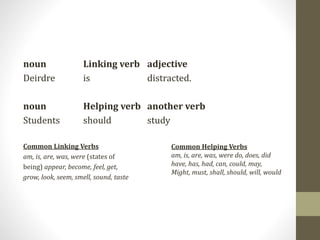
noun Linking verb adjective
Deirdre is distracted.
noun Helping verb another verb
Students should study
Common Linking Verbs
am, is, are, was, were (states of
being) appear, become, feel, get,
grow, look, seem, smell, sound, taste
Common Helping Verbs
am, is, are, was, were do, does, did
have, has, had, can, could, may,
Might, must, shall, should, will, would
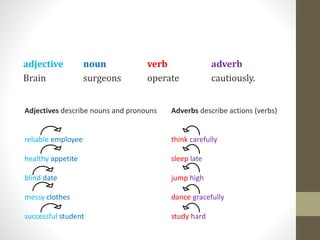
adjective noun verb adverb
Brain surgeons operate cautiously.
Adjectives describe nouns and pronouns
reliable employee
healthy appetite
blind date
messy clothes
successful student
Adverbs describe actions (verbs)
think carefully
sleep late
jump high
dance gracefully
study hard
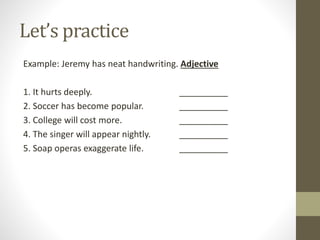
Let’s practice
Example: Jeremy has neat handwriting. Adjective
1. It hurts deeply. __________
2. Soccer has become popular. __________
3. College will cost more. __________
4. The singer will appear nightly. __________
5. Soap operas exaggerate life. __________
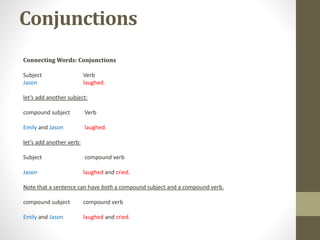
Conjunctions
Connecting Words: Conjunctions
Subject Verb
Jason laughed.
let’s add another subject:
compound subject Verb
Emily and Jason laughed.
let’s add another verb:
Subject compound verb
Jason laughed and cried.
Note that a sentence can have both a compound subject and a compound verb.
compound subject compound verb
Emily and Jason laughed and cried.
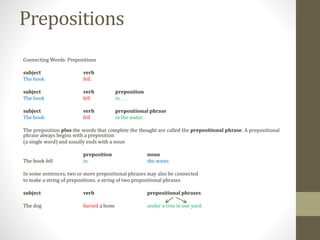
Prepositions
Connecting Words: Prepositions
subject verb
The book fell.
subject verb preposition
The book fell in . . .
subject verb prepositional phrase
The book fell in the water.
The preposition plus the words that complete the thought are called the prepositional phrase. A prepositional
phrase always begins with a preposition
(a single word) and usually ends with a noun
preposition noun
The book fell in the water.
In some sentences, two or more prepositional phrases may also be connected
to make a string of prepositions. a string of two prepositional phrases
subject verb prepositional phrases
The dog buried a bone under a tree in our yard.
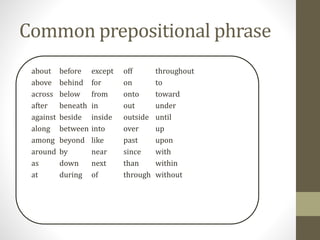
Common prepositional phrase
about before except off throughout
above behind for on to
across below from onto toward
after beneath in out under
against beside inside outside until
along between into over up
among beyond like past upon
around by near since with
as down next than within
at during of through without
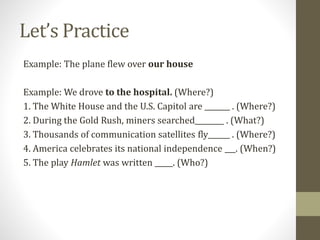
Let’s Practice
Example: The plane flew over our house
Example: We drove to the hospital. (Where?)
1. The White House and the U.S. Capitol are _______ . (Where?)
2. During the Gold Rush, miners searched________ . (What?)
3. Thousands of communication satellites fly______ . (Where?)
4. America celebrates its national independence ___. (When?)
5. The play Hamlet was written _____. (Who?)
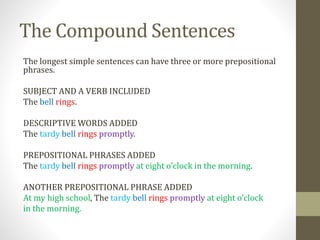
The Compound Sentences
The longest simple sentences can have three or more prepositional
phrases.
SUBJECT AND A VERB INCLUDED
The bell rings.
DESCRIPTIVE WORDS ADDED
The tardy bell rings promptly.
PREPOSITIONAL PHRASES ADDED
The tardy bell rings promptly at eight o’clock in the morning.
ANOTHER PREPOSITIONAL PHRASE ADDED
At my high school, The tardy bell rings promptly at eight o’clock
in the morning.
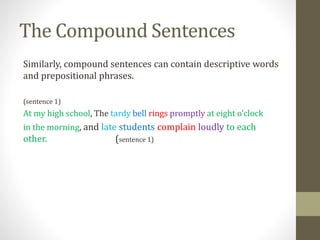
The Compound Sentences
Similarly, compound sentences can contain descriptive words
and prepositional phrases.
(sentence 1)
At my high school, The tardy bell rings promptly at eight o’clock
in the morning, and late students complain loudly to each
other. (sentence 1)
Let’s Practice
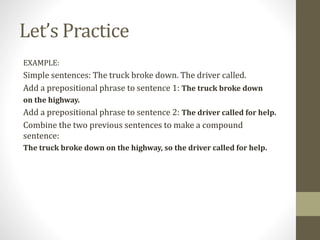
EXAMPLE:
Simple sentences: The truck broke down. The driver called.
Add a prepositional phrase to sentence 1: The truck broke down
on the highway.
Add a prepositional phrase to sentence 2: The driver called for help.
Combine the two previous sentences to make a compound
sentence:
The truck broke down on the highway, so the driver called for help.
Let’s Practice
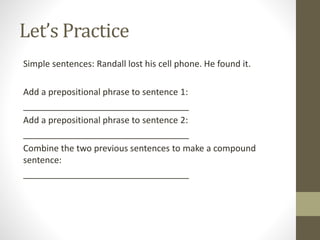
Simple sentences: Randall lost his cell phone. He found it.
Add a prepositional phrase to sentence 1:
__________________________________
Add a prepositional phrase to sentence 2:
__________________________________
Combine the two previous sentences to make a compound
sentence:
__________________________________
To be continued…

5182016

  • 1.
  • 2.
    Revising for simplesentences Foundation word Descriptive word Connecting word
  • 3.
    Foundation Words: Nouns Anoun is a word that identifies a person, place, or thing. There are three types of nouns (concrete, proper, and abstract) and a noun substitute (pronoun). Concrete nouns identify physical objects that can be seen or touched, such as desk, pencil, laptop, shirt, dress, shoe, and so on. Simply look around you: Any object that you can see or touch has a name for it, and that name is a concrete noun. Abstract nouns do not identify physical objects. Instead, they identify feelings or sensations (love, fear, sadness, hunger, and so on), ideas (fun, trouble, intelligence, success, and so on), or activities (shouting, thinking, jogging, lying, and so on). Remember: Because you can’t touch any of these things, they are considered abstract. Nouns
  • 4.
    Proper nouns arethe names given to specific people, places, or things, such as Michael Jackson, Philadelphia, or Toyota. Proper nouns always begin with a capital letter. Pronouns are convenient substitutes for the other types of nouns. The most common pronouns are personal pronouns: I, you, he, she, it, they, and we. As an example, she could be a convenient substitute for the woman. Remember: Pronouns can be the subject or actor in a sentence.
  • 5.
    Concrete Nouns bike fingernail star Phone _________ _________ _________ Abstract Nouns friendship shame intelligence Joy _________ _________ _________ ProperNouns New York Shaq Burger King Honda _________ _________ _________ Pronouns You _________ _________ _________ _________ _________ _________ _________
  • 6.
    Subject Verb ObjectComplement Adverbial Type SV Someone was laughing Type SVC The country became totally independent Type SVOO Mary gave the visitor a glass of milk Type SVOC Most people consider these book rather expensive Seven basic patterns
  • 7.
    A typical SVOpattern • In most cases a verb must be followed by another noun to make sense and express a complete thought. • The verb bellow is an example of action verbs Noun Verb Noun Teachers Give _______________ [What?]
  • 8.
  • 9.
    Verbs Foundation Words: Verbs nounLinking verb (not an action) Deirdre is . . . noun Helping verb (not an action) Students should . . . linking and helping verbs do not express an action, nor do they express a complete thought. They must be followed by more information to make sense. This additional information comes in the form of either an adjective (with linking verbs) or another verb (with helping verbs).
  • 10.
    noun Linking verbadjective Deirdre is distracted. noun Helping verb another verb Students should study Common Linking Verbs am, is, are, was, were (states of being) appear, become, feel, get, grow, look, seem, smell, sound, taste Common Helping Verbs am, is, are, was, were do, does, did have, has, had, can, could, may, Might, must, shall, should, will, would
  • 11.
    adjective noun verbadverb Brain surgeons operate cautiously. Adjectives describe nouns and pronouns reliable employee healthy appetite blind date messy clothes successful student Adverbs describe actions (verbs) think carefully sleep late jump high dance gracefully study hard
  • 12.
    Let’s practice Example: Jeremyhas neat handwriting. Adjective 1. It hurts deeply. __________ 2. Soccer has become popular. __________ 3. College will cost more. __________ 4. The singer will appear nightly. __________ 5. Soap operas exaggerate life. __________
  • 13.
    Conjunctions Connecting Words: Conjunctions SubjectVerb Jason laughed. let’s add another subject: compound subject Verb Emily and Jason laughed. let’s add another verb: Subject compound verb Jason laughed and cried. Note that a sentence can have both a compound subject and a compound verb. compound subject compound verb Emily and Jason laughed and cried.
  • 14.
    Prepositions Connecting Words: Prepositions subjectverb The book fell. subject verb preposition The book fell in . . . subject verb prepositional phrase The book fell in the water. The preposition plus the words that complete the thought are called the prepositional phrase. A prepositional phrase always begins with a preposition (a single word) and usually ends with a noun preposition noun The book fell in the water. In some sentences, two or more prepositional phrases may also be connected to make a string of prepositions. a string of two prepositional phrases subject verb prepositional phrases The dog buried a bone under a tree in our yard.
  • 15.
    Common prepositional phrase aboutbefore except off throughout above behind for on to across below from onto toward after beneath in out under against beside inside outside until along between into over up among beyond like past upon around by near since with as down next than within at during of through without
  • 16.
    Let’s Practice Example: Theplane flew over our house Example: We drove to the hospital. (Where?) 1. The White House and the U.S. Capitol are _______ . (Where?) 2. During the Gold Rush, miners searched________ . (What?) 3. Thousands of communication satellites fly______ . (Where?) 4. America celebrates its national independence ___. (When?) 5. The play Hamlet was written _____. (Who?)
  • 17.
    The Compound Sentences Thelongest simple sentences can have three or more prepositional phrases. SUBJECT AND A VERB INCLUDED The bell rings. DESCRIPTIVE WORDS ADDED The tardy bell rings promptly. PREPOSITIONAL PHRASES ADDED The tardy bell rings promptly at eight o’clock in the morning. ANOTHER PREPOSITIONAL PHRASE ADDED At my high school, The tardy bell rings promptly at eight o’clock in the morning.
  • 18.
    The Compound Sentences Similarly,compound sentences can contain descriptive words and prepositional phrases. (sentence 1) At my high school, The tardy bell rings promptly at eight o’clock in the morning, and late students complain loudly to each other. (sentence 1)
  • 19.
    Let’s Practice EXAMPLE: Simple sentences:The truck broke down. The driver called. Add a prepositional phrase to sentence 1: The truck broke down on the highway. Add a prepositional phrase to sentence 2: The driver called for help. Combine the two previous sentences to make a compound sentence: The truck broke down on the highway, so the driver called for help.
  • 20.
    Let’s Practice Simple sentences:Randall lost his cell phone. He found it. Add a prepositional phrase to sentence 1: __________________________________ Add a prepositional phrase to sentence 2: __________________________________ Combine the two previous sentences to make a compound sentence: __________________________________
  • 21.