

Types of Articles
SUBMITTED BY:
NISHA YADAV
B.A.LL.B 1ST SEMESTER
Submitted to:
Pradhuman Yadav
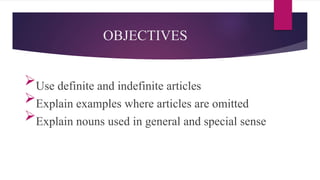
OBJECTIVES
Use definite and indefinite articles
Explain examples where articles are omitted
Explain nouns used in general and special sense
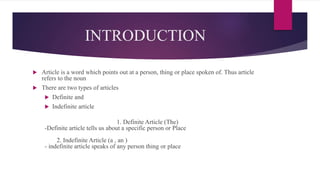
INTRODUCTION
 Article is a word which points out at a person, thing or place spoken of. Thus article
refers to the noun
 There are two types of articles
 Definite and
 Indefinite article
1. Definite Article (The)
-Definite article tells us about a specific person or Place
2. Indefinite Article (a , an )
- indefinite article speaks of any person thing or place
TYPES OF ARTICLES
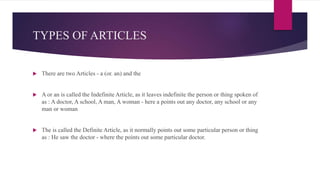
 There are two Articles - a (or. an) and the
 A or an is called the Indefinite Article, as it leaves indefinite the person or thing spoken of
as : A doctor, A school, A man, A woman - here a points out any doctor, any school or any
man or woman
 The is called the Definite Article, as it normally points out some particular person or thing
as : He saw the doctor - where the points out some particular doctor.
 The indefinite article is used before singular countable nouns e.g. A book, An orange, A girl The definite
article is used before singular countable nouns, plural countable and uncountable nouns, for eg. The book,
the books, the milk.
A or An
The choice between a and an is determined by sound before a word beginning with a vowel sound an is used :
For eg., an egg, an orange an honest man, an hour. A and An are used with the singular number only.
Use Of The Definite Article
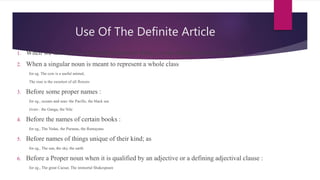
1. When we talk about a particular person or thing, or one already referred to earlier,
2. When a singular noun is meant to represent a whole class
for eg. The cow is a useful animal,
The rose is the sweetest of all flowers
3. Before some proper names :
for eg., oceans and seas: the Pacific, the black sea
rivers : the Ganga, the Nile
4. Before the names of certain books :
for eg., The Vedas, the Puranas, the Ramayana
5. Before names of things unique of their kind; as
for eg., The sun, the sky, the earth
6. Before a Proper noun when it is qualified by an adjective or a defining adjectival clause :
for eg., The great Caesar, The immortal Shakespeare
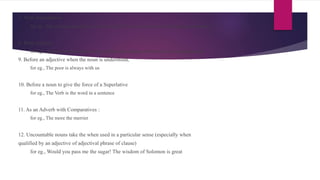
7. With Superlatives
for eg., The darkest cloud has a silver lining, This is the best book of elementary chemistry
8. With ordinals :
for eg., He was the first man to arrive, The ninth chapter of the book is very interesting
9. Before an adjective when the noun is understood,
for eg., The poor is always with us
10. Before a noun to give the force of a Superlative
for eg., The Verb is the word in a sentence
11. As an Adverb with Comparatives :
for eg., The more the merrier
12. Uncountable nouns take the when used in a particular sense (especially when
qualified by an adjective of adjectival phrase of clause)
for eg., Would you pass me the sugar! The wisdom of Solomon is great
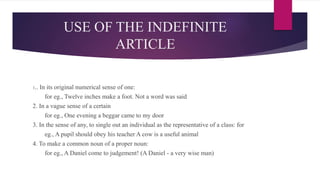
USE OF THE INDEFINITE
ARTICLE
1.. In its original numerical sense of one:
for eg., Twelve inches make a foot. Not a word was said
2. In a vague sense of a certain
for eg., One evening a beggar came to my door
3. In the sense of any, to single out an individual as the representative of a class: for
eg., A pupil should obey his teacher A cow is a useful animal
4. To make a common noun of a proper noun:
for eg., A Daniel come to judgement! (A Daniel - a very wise man)
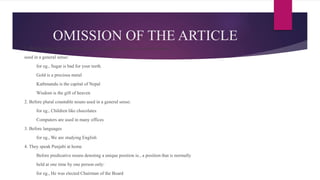
OMISSION OF THE ARTICLE
1. Before names of substances, proper and abstract nouns (uncountable nouns)
used in a general sense:
for eg., Sugar is bad for your teeth.
Gold is a precious metal
Kathmandu is the capital of Nepal
Wisdom is the gift of heaven
2. Before plural countable nouns used in a general sense:
for eg., Children like chocolates
Computers are used in many offices
3. Before languages
for eg., We are studying English
4. They speak Punjabi at home
Before predicative nouns denoting a unique position ie., a position that is normally
held at one time by one person only:
for eg., He was elected Chairman of the Board
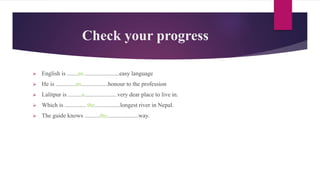
Check your progress
 English is .......an........................easy language
 He is .............an..................honour to the profession
 Lalitpur is .........a......................very dear place to live in.
 Which is .............. the.................longest river in Nepal.
 The guide knows ..........the.....................way.
THANK YOU

Articles ppt

  • 1.
    Types of Articles SUBMITTEDBY: NISHA YADAV B.A.LL.B 1ST SEMESTER Submitted to: Pradhuman Yadav
  • 2.
    OBJECTIVES Use definite andindefinite articles Explain examples where articles are omitted Explain nouns used in general and special sense
  • 3.
    INTRODUCTION  Article isa word which points out at a person, thing or place spoken of. Thus article refers to the noun  There are two types of articles  Definite and  Indefinite article 1. Definite Article (The) -Definite article tells us about a specific person or Place 2. Indefinite Article (a , an ) - indefinite article speaks of any person thing or place
  • 4.
    TYPES OF ARTICLES There are two Articles - a (or. an) and the  A or an is called the Indefinite Article, as it leaves indefinite the person or thing spoken of as : A doctor, A school, A man, A woman - here a points out any doctor, any school or any man or woman  The is called the Definite Article, as it normally points out some particular person or thing as : He saw the doctor - where the points out some particular doctor.
  • 5.
     The indefinitearticle is used before singular countable nouns e.g. A book, An orange, A girl The definite article is used before singular countable nouns, plural countable and uncountable nouns, for eg. The book, the books, the milk. A or An The choice between a and an is determined by sound before a word beginning with a vowel sound an is used : For eg., an egg, an orange an honest man, an hour. A and An are used with the singular number only.
  • 6.
    Use Of TheDefinite Article 1. When we talk about a particular person or thing, or one already referred to earlier, 2. When a singular noun is meant to represent a whole class for eg. The cow is a useful animal, The rose is the sweetest of all flowers 3. Before some proper names : for eg., oceans and seas: the Pacific, the black sea rivers : the Ganga, the Nile 4. Before the names of certain books : for eg., The Vedas, the Puranas, the Ramayana 5. Before names of things unique of their kind; as for eg., The sun, the sky, the earth 6. Before a Proper noun when it is qualified by an adjective or a defining adjectival clause : for eg., The great Caesar, The immortal Shakespeare
  • 7.
    7. With Superlatives foreg., The darkest cloud has a silver lining, This is the best book of elementary chemistry 8. With ordinals : for eg., He was the first man to arrive, The ninth chapter of the book is very interesting 9. Before an adjective when the noun is understood, for eg., The poor is always with us 10. Before a noun to give the force of a Superlative for eg., The Verb is the word in a sentence 11. As an Adverb with Comparatives : for eg., The more the merrier 12. Uncountable nouns take the when used in a particular sense (especially when qualified by an adjective of adjectival phrase of clause) for eg., Would you pass me the sugar! The wisdom of Solomon is great
  • 8.
    USE OF THEINDEFINITE ARTICLE 1.. In its original numerical sense of one: for eg., Twelve inches make a foot. Not a word was said 2. In a vague sense of a certain for eg., One evening a beggar came to my door 3. In the sense of any, to single out an individual as the representative of a class: for eg., A pupil should obey his teacher A cow is a useful animal 4. To make a common noun of a proper noun: for eg., A Daniel come to judgement! (A Daniel - a very wise man)
  • 9.
    OMISSION OF THEARTICLE 1. Before names of substances, proper and abstract nouns (uncountable nouns) used in a general sense: for eg., Sugar is bad for your teeth. Gold is a precious metal Kathmandu is the capital of Nepal Wisdom is the gift of heaven 2. Before plural countable nouns used in a general sense: for eg., Children like chocolates Computers are used in many offices 3. Before languages for eg., We are studying English 4. They speak Punjabi at home Before predicative nouns denoting a unique position ie., a position that is normally held at one time by one person only: for eg., He was elected Chairman of the Board
  • 10.
    Check your progress English is .......an........................easy language  He is .............an..................honour to the profession  Lalitpur is .........a......................very dear place to live in.  Which is .............. the.................longest river in Nepal.  The guide knows ..........the.....................way.
  • 11.