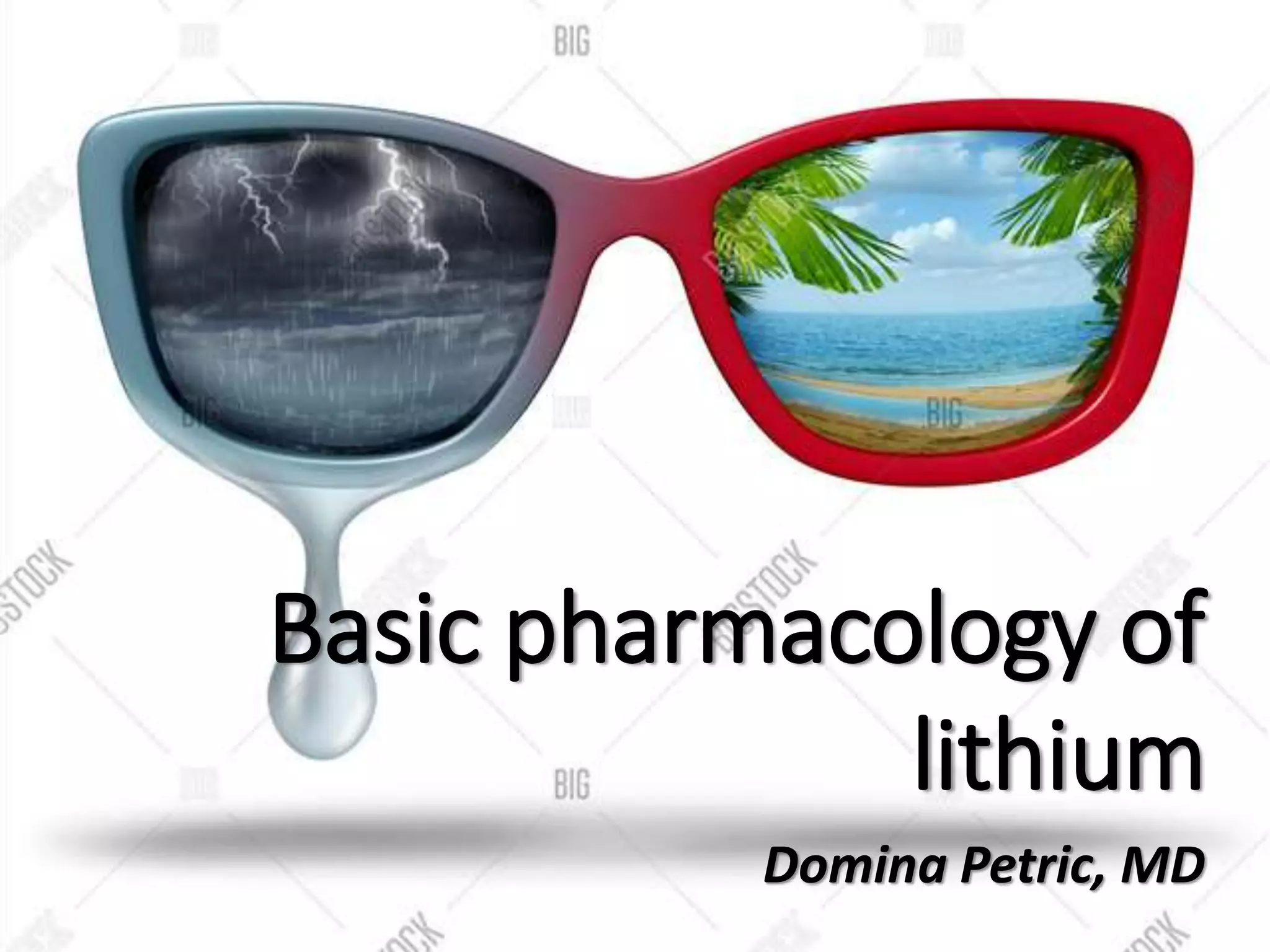
Basic pharmacology of
lithium
Domina Petric, MD
Pharmacokinetics
I.
Katzung, Masters, Trevor.
Basic and clinical
Pharmacokinetics
• Lithium is a small monovalent cation.
• Absorption virtually completes within 6-8
hours.
• Peak plasma levels are reached in 30
minutes to 2 hours.
• Distribution: in total body water, slow
entry into intracellular compartment.
• Initial volume of distribution is 0,5 L7kg,
rising to 0,7-0,9 L/kg.
Katzung, Masters, Trevor.
Basic and clinical
Pharmacokinetics
• Lithium shows some sequestration in
bone.
• It is not bind to proteins.
• There is no metabolism.
• Excretion is virtually entierly in urine.
• Lithium clearance is about 20% of
creatinine.
• Plasma half-life is about 20 hours.
Katzung, Masters, Trevor.
Basic and clinical
Pharmacokinetics
Target plasma concentration
is 0,6-1,4 mEq/L.
Dosage is 0,5 mEq/kg/day in
divided doses.
Katzung, Masters, Trevor.
Basic and clinical
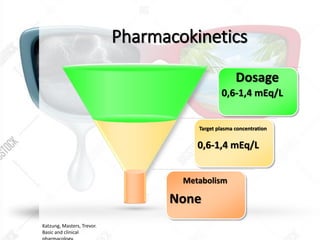
Pharmacokinetics
Target plasma concentration
0,6-1,4 mEq/L
Dosage
0,6-1,4 mEq/L
Metabolism
None
Katzung, Masters, Trevor.
Basic and clinical
Pharmacodynamics
II.
Katzung, Masters, Trevor.
Basic and clinical
Pharmacodynamics
• Lithium directly inhibits two signal
transduction pathways.
• It suppresses inositol signaling through
depletion of intracellular inositol.
• It inhibits glycogen synthase kinase-3
(GSK-3).
• GSK-3 is a multifunctional protein kinase
and it is a component of diverse
intracellular signaling pathways.
Katzung, Masters, Trevor.
Basic and clinical
Pharmacodynamics
GSK-3 is a component of diverse intracellular
signaling pathways:
• insulin/insulin-like growth factor
• brain-derived neurotrophic factor (BDNF)
• Wnt pathway
GSK-3 phosphorylates β-catenin, resulting in
interaction with transcription factors.
Modulation of energy metabolism,
neuroprotection and increase of
neuroplasticity.
Katzung, Masters, Trevor.
Basic and clinical
Effects on electrolytes and ion
transport
• Lithium is closely related to sodium in its
properties.
• It can substitute for sodium in generating
action potentials and in Na+-Na+ exchange
across the membrane.
• Li+-Na+ exchange is gradually slowed after
lithium is introduced into the body.
• At therapeutic concentrations (1 mmol/L)
lithium does not significantly affect the Na+-
Ca2+ exchanger nor the Na+/K+-ATPase pump.
Katzung, Masters, Trevor.
Basic and clinical
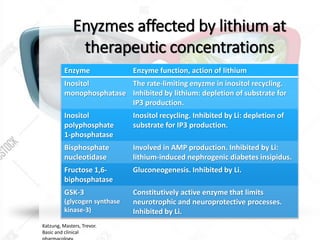
Enyzmes affected by lithium at
therapeutic concentrations
Enzyme Enzyme function, action of lithium
Inositol
monophosphatase
The rate-limiting enyzme in inositol recycling.
Inhibited by lithium: depletion of substrate for
IP3 production.
Inositol
polyphosphate
1-phosphatase
Inositol recycling. Inhibited by Li: depletion of
substrate for IP3 production.
Bisphosphate
nucleotidase
Involved in AMP production. Inhibited by Li:
lithium-induced nephrogenic diabetes insipidus.
Fructose 1,6-
biphosphatase
Gluconeogenesis. Inhibited by Li.
GSK-3
(glycogen synthase
kinase-3)
Constitutively active enzyme that limits
neurotrophic and neuroprotective processes.
Inhibited by Li.
Katzung, Masters, Trevor.
Basic and clinical
Effects on second messengers
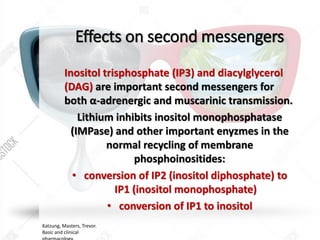
Inositol trisphosphate (IP3) and diacylglycerol
(DAG) are important second messengers for
both α-adrenergic and muscarinic transmission.
Lithium inhibits inositol monophosphatase
(IMPase) and other important enyzmes in the
normal recycling of membrane
phosphoinositides:
• conversion of IP2 (inositol diphosphate) to
IP1 (inositol monophosphate)
• conversion of IP1 to inositol
Katzung, Masters, Trevor.
Basic and clinical
Effects on second messengers
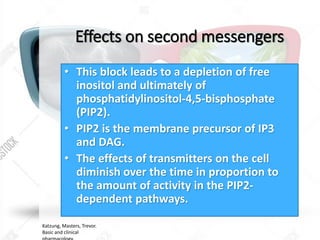
• This block leads to a depletion of free
inositol and ultimately of
phosphatidylinositol-4,5-bisphosphate
(PIP2).
• PIP2 is the membrane precursor of IP3
and DAG.
• The effects of transmitters on the cell
diminish over the time in proportion to
the amount of activity in the PIP2-
dependent pathways.
Katzung, Masters, Trevor.
Basic and clinical
Effects on second messengers
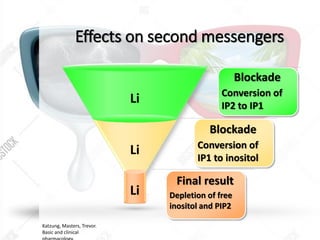
Blockade
Conversion of
IP1 to inositol
Blockade
Conversion of
IP2 to IP1
Final result
Depletion of free
inositol and PIP2
Li
Li
Li
Katzung, Masters, Trevor.
Basic and clinical
Effects on second messengers
The activity of described pathways
is postulated to be markedly
increased during a manic episode.
Treatment with lithium would be
expected to diminish the activity in
these circuits.
Katzung, Masters, Trevor.
Basic and clinical
Effects on second messengers
Lithium can inhibit
norepinephrine-sensitive
adenylyl cyclase.
Such an effect could relate to
both its antidepressant and its
antimanic effects.
Katzung, Masters, Trevor.
Basic and clinical
Effects on second messengers
• Lithium affects second-messenger systems
involving both activation of adenylyl
cyclase and phosphoinositol turnover.
• Lithium may uncouple receptors from their
G proteins.
• Polyuria and subclinical hypothyroidism
(adverse effects of Li) may be due to
uncoupling vasopressin and thyroid-
stimulating hormone receptors from their G
proteins.
Katzung, Masters, Trevor.
Basic and clinical
Effects on second messengers
• Effects of lithium on phosphoinositol
turnover leads to an early relative
reduction of myoinositol in human brain.
• Alterations of protein kinase C-mediated
signaling alter gene expression and the
production of proteins implicated in
long-term neuroplastic events: long-
term mood stabilization.
Katzung, Masters, Trevor.
Basic and clinical
Literature
• Katzung, Masters, Trevor.
Basic and clinical
pharmacology.
Katzung, Masters, Trevor.
Basic and clinical

Basic pharmacology of lithium

  • 1.
  • 2.
  • 3.
    Pharmacokinetics • Lithium isa small monovalent cation. • Absorption virtually completes within 6-8 hours. • Peak plasma levels are reached in 30 minutes to 2 hours. • Distribution: in total body water, slow entry into intracellular compartment. • Initial volume of distribution is 0,5 L7kg, rising to 0,7-0,9 L/kg. Katzung, Masters, Trevor. Basic and clinical
  • 4.
    Pharmacokinetics • Lithium showssome sequestration in bone. • It is not bind to proteins. • There is no metabolism. • Excretion is virtually entierly in urine. • Lithium clearance is about 20% of creatinine. • Plasma half-life is about 20 hours. Katzung, Masters, Trevor. Basic and clinical
  • 5.
    Pharmacokinetics Target plasma concentration is0,6-1,4 mEq/L. Dosage is 0,5 mEq/kg/day in divided doses. Katzung, Masters, Trevor. Basic and clinical
  • 6.
    Pharmacokinetics Target plasma concentration 0,6-1,4mEq/L Dosage 0,6-1,4 mEq/L Metabolism None Katzung, Masters, Trevor. Basic and clinical
  • 7.
  • 8.
    Pharmacodynamics • Lithium directlyinhibits two signal transduction pathways. • It suppresses inositol signaling through depletion of intracellular inositol. • It inhibits glycogen synthase kinase-3 (GSK-3). • GSK-3 is a multifunctional protein kinase and it is a component of diverse intracellular signaling pathways. Katzung, Masters, Trevor. Basic and clinical
  • 9.
    Pharmacodynamics GSK-3 is acomponent of diverse intracellular signaling pathways: • insulin/insulin-like growth factor • brain-derived neurotrophic factor (BDNF) • Wnt pathway GSK-3 phosphorylates β-catenin, resulting in interaction with transcription factors. Modulation of energy metabolism, neuroprotection and increase of neuroplasticity. Katzung, Masters, Trevor. Basic and clinical
  • 10.
    Effects on electrolytesand ion transport • Lithium is closely related to sodium in its properties. • It can substitute for sodium in generating action potentials and in Na+-Na+ exchange across the membrane. • Li+-Na+ exchange is gradually slowed after lithium is introduced into the body. • At therapeutic concentrations (1 mmol/L) lithium does not significantly affect the Na+- Ca2+ exchanger nor the Na+/K+-ATPase pump. Katzung, Masters, Trevor. Basic and clinical
  • 11.
    Enyzmes affected bylithium at therapeutic concentrations Enzyme Enzyme function, action of lithium Inositol monophosphatase The rate-limiting enyzme in inositol recycling. Inhibited by lithium: depletion of substrate for IP3 production. Inositol polyphosphate 1-phosphatase Inositol recycling. Inhibited by Li: depletion of substrate for IP3 production. Bisphosphate nucleotidase Involved in AMP production. Inhibited by Li: lithium-induced nephrogenic diabetes insipidus. Fructose 1,6- biphosphatase Gluconeogenesis. Inhibited by Li. GSK-3 (glycogen synthase kinase-3) Constitutively active enzyme that limits neurotrophic and neuroprotective processes. Inhibited by Li. Katzung, Masters, Trevor. Basic and clinical
  • 12.
    Effects on secondmessengers Inositol trisphosphate (IP3) and diacylglycerol (DAG) are important second messengers for both α-adrenergic and muscarinic transmission. Lithium inhibits inositol monophosphatase (IMPase) and other important enyzmes in the normal recycling of membrane phosphoinositides: • conversion of IP2 (inositol diphosphate) to IP1 (inositol monophosphate) • conversion of IP1 to inositol Katzung, Masters, Trevor. Basic and clinical
  • 13.
    Effects on secondmessengers • This block leads to a depletion of free inositol and ultimately of phosphatidylinositol-4,5-bisphosphate (PIP2). • PIP2 is the membrane precursor of IP3 and DAG. • The effects of transmitters on the cell diminish over the time in proportion to the amount of activity in the PIP2- dependent pathways. Katzung, Masters, Trevor. Basic and clinical
  • 14.
    Effects on secondmessengers Blockade Conversion of IP1 to inositol Blockade Conversion of IP2 to IP1 Final result Depletion of free inositol and PIP2 Li Li Li Katzung, Masters, Trevor. Basic and clinical
  • 15.
    Effects on secondmessengers The activity of described pathways is postulated to be markedly increased during a manic episode. Treatment with lithium would be expected to diminish the activity in these circuits. Katzung, Masters, Trevor. Basic and clinical
  • 16.
    Effects on secondmessengers Lithium can inhibit norepinephrine-sensitive adenylyl cyclase. Such an effect could relate to both its antidepressant and its antimanic effects. Katzung, Masters, Trevor. Basic and clinical
  • 17.
    Effects on secondmessengers • Lithium affects second-messenger systems involving both activation of adenylyl cyclase and phosphoinositol turnover. • Lithium may uncouple receptors from their G proteins. • Polyuria and subclinical hypothyroidism (adverse effects of Li) may be due to uncoupling vasopressin and thyroid- stimulating hormone receptors from their G proteins. Katzung, Masters, Trevor. Basic and clinical
  • 18.
    Effects on secondmessengers • Effects of lithium on phosphoinositol turnover leads to an early relative reduction of myoinositol in human brain. • Alterations of protein kinase C-mediated signaling alter gene expression and the production of proteins implicated in long-term neuroplastic events: long- term mood stabilization. Katzung, Masters, Trevor. Basic and clinical
  • 19.
    Literature • Katzung, Masters,Trevor. Basic and clinical pharmacology. Katzung, Masters, Trevor. Basic and clinical