Basil Wilson
Pharm D 5th yr
 Lithium was introduced into psychiatry in 1949 for the
treatment of mania.
 FDA approved for this purpose in the United States in
1970.
 Lithium has proven efficacy for acute treatment of manic
episodes and in the prevention of recurrent manic and
depressive episodes in bipolar patients.
 The most successful alternatives or adjuncts to lithium to
date are the anticonvulsants carbamazepine, lamotrigine,
and valproic acid.
 Lithium urate is very water soluble, and lithium salts were used
in the nineteenth century as a treatment of gout.
Lithium bromide was employed as a sedative (including in
manic patients) and as a putative anticonvulsant.
Lithium chloride was employed as a salt substitute for cardiac
and other chronically ill patients.
Cade, in Australia, while looking for toxic nitrogenous
substances in the urine of mental patients for testing in guinea
pigs, administered lithium salts to the animals in an attempt to
increase the solubility of urates.
Lithium carbonate made the animals lethargic, and in an
inductive leap, Cade gave lithium carbonate to several agitated
or manic psychiatric patients, reporting that this treatment
seemed to have a specific effect in mania.
HISTORY
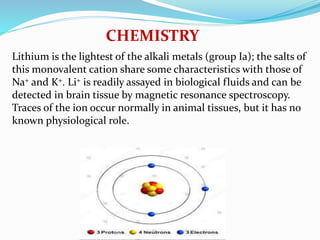
Lithium is the lightest of the alkali metals (group Ia); the salts of
this monovalent cation share some characteristics with those of
Na+ and K+. Li+ is readily assayed in biological fluids and can be
detected in brain tissue by magnetic resonance spectroscopy.
Traces of the ion occur normally in animal tissues, but it has no
known physiological role.
CHEMISTRY
MECHANISM OF ACTION
Lithium is a monovalent cation that can replace
Na in some biological processes. It can be argued that
competition by Li for active Na sites may lead to altered
neuronal functions that may account for its antimanic and
mood-stabilizing actions.
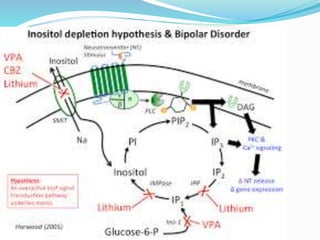
An additional action of Li is interruption of the
phosphatidylinositide cycle through an inhibitory action on
inositol phosphate metabolism
PHARMACOKINETICS
Absorption
Lithium is readily absorbed from the gastrointestinal tract,
reaching a peak plasma level in 2 to 4 hours.
Distribution
Distribution occurs throughout the extracellular fluid with
no evidence of protein binding. Passage through the blood-
brain barrier is limited, so that cerebrospinal fluid levels are
50% of plasma levels at steady state.
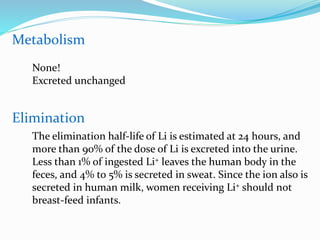
Metabolism
Elimination
The elimination half-life of Li is estimated at 24 hours, and
more than 90% of the dose of Li is excreted into the urine.
Less than 1% of ingested Li+ leaves the human body in the
feces, and 4% to 5% is secreted in sweat. Since the ion also is
secreted in human milk, women receiving Li+ should not
breast-feed infants.
None!
Excreted unchanged
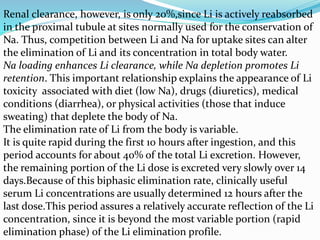
Renal clearance, however, is only 20%,since Li is actively reabsorbed
in the proximal tubule at sites normally used for the conservation of
Na. Thus, competition between Li and Na for uptake sites can alter
the elimination of Li and its concentration in total body water.
Na loading enhances Li clearance, while Na depletion promotes Li
retention. This important relationship explains the appearance of Li
toxicity associated with diet (low Na), drugs (diuretics), medical
conditions (diarrhea), or physical activities (those that induce
sweating) that deplete the body of Na.
The elimination rate of Li from the body is variable.
It is quite rapid during the first 10 hours after ingestion, and this
period accounts for about 40% of the total Li excretion. However,
the remaining portion of the Li dose is excreted very slowly over 14
days.Because of this biphasic elimination rate, clinically useful
serum Li concentrations are usually determined 12 hours after the
last dose.This period assures a relatively accurate reflection of the Li
concentration, since it is beyond the most variable portion (rapid
elimination phase) of the Li elimination profile.
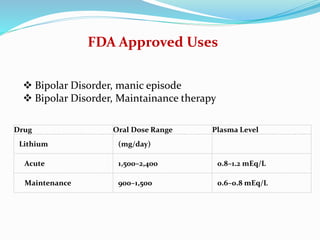
FDA Approved Uses
 Bipolar Disorder, manic episode
 Bipolar Disorder, Maintainance therapy
Drug Oral Dose Range Plasma Level
Lithium (mg/day)
Acute 1,500–2,400 0.8–1.2 mEq/L
Maintenance 900–1,500 0.6–0.8 mEq/L
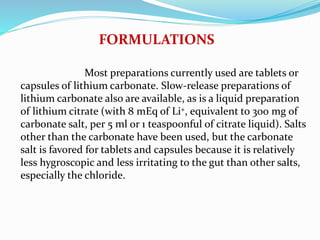
Most preparations currently used are tablets or
capsules of lithium carbonate. Slow-release preparations of
lithium carbonate also are available, as is a liquid preparation
of lithium citrate (with 8 mEq of Li+, equivalent to 300 mg of
carbonate salt, per 5 ml or 1 teaspoonful of citrate liquid). Salts
other than the carbonate have been used, but the carbonate
salt is favored for tablets and capsules because it is relatively
less hygroscopic and less irritating to the gut than other salts,
especially the chloride.
FORMULATIONS
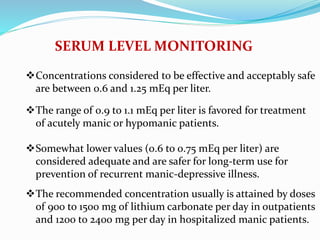
Concentrations considered to be effective and acceptably safe
are between 0.6 and 1.25 mEq per liter.
SERUM LEVEL MONITORING
The recommended concentration usually is attained by doses
of 900 to 1500 mg of lithium carbonate per day in outpatients
and 1200 to 2400 mg per day in hospitalized manic patients.
Somewhat lower values (0.6 to 0.75 mEq per liter) are
considered adequate and are safer for long-term use for
prevention of recurrent manic-depressive illness.
The range of 0.9 to 1.1 mEq per liter is favored for treatment
of acutely manic or hypomanic patients.
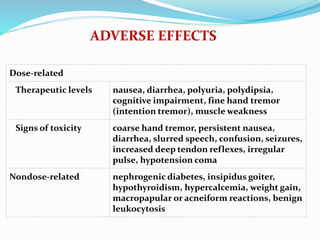
Dose-related
Therapeutic levels nausea, diarrhea, polyuria, polydipsia,
cognitive impairment, fine hand tremor
(intention tremor), muscle weakness
Signs of toxicity coarse hand tremor, persistent nausea,
diarrhea, slurred speech, confusion, seizures,
increased deep tendon reflexes, irregular
pulse, hypotension coma
Nondose-related nephrogenic diabetes, insipidus goiter,
hypothyroidism, hypercalcemia, weight gain,
macropapular or acneiform reactions, benign
leukocytosis
ADVERSE EFFECTS
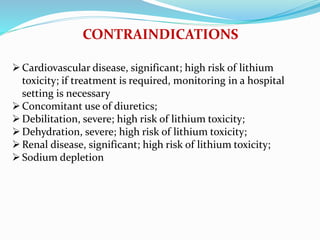
CONTRAINDICATIONS
Cardiovascular disease, significant; high risk of lithium
toxicity; if treatment is required, monitoring in a hospital
setting is necessary
Concomitant use of diuretics;
Debilitation, severe; high risk of lithium toxicity;
Dehydration, severe; high risk of lithium toxicity;
Renal disease, significant; high risk of lithium toxicity;
Sodium depletion
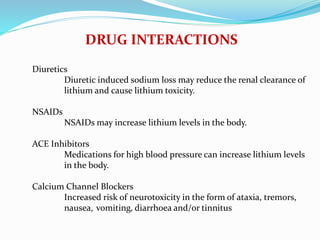
Diuretics
Diuretic induced sodium loss may reduce the renal clearance of
lithium and cause lithium toxicity.
NSAIDs
NSAIDs may increase lithium levels in the body.
ACE Inhibitors
Medications for high blood pressure can increase lithium levels
in the body.
Calcium Channel Blockers
Increased risk of neurotoxicity in the form of ataxia, tremors,
nausea, vomiting, diarrhoea and/or tinnitus
DRUG INTERACTIONS
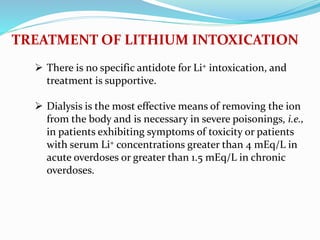
 There is no specific antidote for Li+ intoxication, and
treatment is supportive.
 Dialysis is the most effective means of removing the ion
from the body and is necessary in severe poisonings, i.e.,
in patients exhibiting symptoms of toxicity or patients
with serum Li+ concentrations greater than 4 mEq/L in
acute overdoses or greater than 1.5 mEq/L in chronic
overdoses.
TREATMENT OF LITHIUM INTOXICATION
REFERENCE
• Lippincott – Modern Pharmacology With Clinical Applications
• Herfindal Textbook Of Therapeutics - Drug and Disease Management
• Micromedex
Lithium

Lithium

  • 1.
  • 2.
     Lithium wasintroduced into psychiatry in 1949 for the treatment of mania.  FDA approved for this purpose in the United States in 1970.  Lithium has proven efficacy for acute treatment of manic episodes and in the prevention of recurrent manic and depressive episodes in bipolar patients.  The most successful alternatives or adjuncts to lithium to date are the anticonvulsants carbamazepine, lamotrigine, and valproic acid.
  • 3.
     Lithium urateis very water soluble, and lithium salts were used in the nineteenth century as a treatment of gout. Lithium bromide was employed as a sedative (including in manic patients) and as a putative anticonvulsant. Lithium chloride was employed as a salt substitute for cardiac and other chronically ill patients. Cade, in Australia, while looking for toxic nitrogenous substances in the urine of mental patients for testing in guinea pigs, administered lithium salts to the animals in an attempt to increase the solubility of urates. Lithium carbonate made the animals lethargic, and in an inductive leap, Cade gave lithium carbonate to several agitated or manic psychiatric patients, reporting that this treatment seemed to have a specific effect in mania. HISTORY
  • 4.
    Lithium is thelightest of the alkali metals (group Ia); the salts of this monovalent cation share some characteristics with those of Na+ and K+. Li+ is readily assayed in biological fluids and can be detected in brain tissue by magnetic resonance spectroscopy. Traces of the ion occur normally in animal tissues, but it has no known physiological role. CHEMISTRY
  • 5.
    MECHANISM OF ACTION Lithiumis a monovalent cation that can replace Na in some biological processes. It can be argued that competition by Li for active Na sites may lead to altered neuronal functions that may account for its antimanic and mood-stabilizing actions. An additional action of Li is interruption of the phosphatidylinositide cycle through an inhibitory action on inositol phosphate metabolism
  • 7.
    PHARMACOKINETICS Absorption Lithium is readilyabsorbed from the gastrointestinal tract, reaching a peak plasma level in 2 to 4 hours. Distribution Distribution occurs throughout the extracellular fluid with no evidence of protein binding. Passage through the blood- brain barrier is limited, so that cerebrospinal fluid levels are 50% of plasma levels at steady state.
  • 8.
    Metabolism Elimination The elimination half-lifeof Li is estimated at 24 hours, and more than 90% of the dose of Li is excreted into the urine. Less than 1% of ingested Li+ leaves the human body in the feces, and 4% to 5% is secreted in sweat. Since the ion also is secreted in human milk, women receiving Li+ should not breast-feed infants. None! Excreted unchanged
  • 9.
    Renal clearance, however,is only 20%,since Li is actively reabsorbed in the proximal tubule at sites normally used for the conservation of Na. Thus, competition between Li and Na for uptake sites can alter the elimination of Li and its concentration in total body water. Na loading enhances Li clearance, while Na depletion promotes Li retention. This important relationship explains the appearance of Li toxicity associated with diet (low Na), drugs (diuretics), medical conditions (diarrhea), or physical activities (those that induce sweating) that deplete the body of Na. The elimination rate of Li from the body is variable. It is quite rapid during the first 10 hours after ingestion, and this period accounts for about 40% of the total Li excretion. However, the remaining portion of the Li dose is excreted very slowly over 14 days.Because of this biphasic elimination rate, clinically useful serum Li concentrations are usually determined 12 hours after the last dose.This period assures a relatively accurate reflection of the Li concentration, since it is beyond the most variable portion (rapid elimination phase) of the Li elimination profile.
  • 10.
    FDA Approved Uses Bipolar Disorder, manic episode  Bipolar Disorder, Maintainance therapy Drug Oral Dose Range Plasma Level Lithium (mg/day) Acute 1,500–2,400 0.8–1.2 mEq/L Maintenance 900–1,500 0.6–0.8 mEq/L
  • 11.
    Most preparations currentlyused are tablets or capsules of lithium carbonate. Slow-release preparations of lithium carbonate also are available, as is a liquid preparation of lithium citrate (with 8 mEq of Li+, equivalent to 300 mg of carbonate salt, per 5 ml or 1 teaspoonful of citrate liquid). Salts other than the carbonate have been used, but the carbonate salt is favored for tablets and capsules because it is relatively less hygroscopic and less irritating to the gut than other salts, especially the chloride. FORMULATIONS
  • 12.
    Concentrations considered tobe effective and acceptably safe are between 0.6 and 1.25 mEq per liter. SERUM LEVEL MONITORING The recommended concentration usually is attained by doses of 900 to 1500 mg of lithium carbonate per day in outpatients and 1200 to 2400 mg per day in hospitalized manic patients. Somewhat lower values (0.6 to 0.75 mEq per liter) are considered adequate and are safer for long-term use for prevention of recurrent manic-depressive illness. The range of 0.9 to 1.1 mEq per liter is favored for treatment of acutely manic or hypomanic patients.
  • 13.
    Dose-related Therapeutic levels nausea,diarrhea, polyuria, polydipsia, cognitive impairment, fine hand tremor (intention tremor), muscle weakness Signs of toxicity coarse hand tremor, persistent nausea, diarrhea, slurred speech, confusion, seizures, increased deep tendon reflexes, irregular pulse, hypotension coma Nondose-related nephrogenic diabetes, insipidus goiter, hypothyroidism, hypercalcemia, weight gain, macropapular or acneiform reactions, benign leukocytosis ADVERSE EFFECTS
  • 14.
    CONTRAINDICATIONS Cardiovascular disease, significant;high risk of lithium toxicity; if treatment is required, monitoring in a hospital setting is necessary Concomitant use of diuretics; Debilitation, severe; high risk of lithium toxicity; Dehydration, severe; high risk of lithium toxicity; Renal disease, significant; high risk of lithium toxicity; Sodium depletion
  • 15.
    Diuretics Diuretic induced sodiumloss may reduce the renal clearance of lithium and cause lithium toxicity. NSAIDs NSAIDs may increase lithium levels in the body. ACE Inhibitors Medications for high blood pressure can increase lithium levels in the body. Calcium Channel Blockers Increased risk of neurotoxicity in the form of ataxia, tremors, nausea, vomiting, diarrhoea and/or tinnitus DRUG INTERACTIONS
  • 16.
     There isno specific antidote for Li+ intoxication, and treatment is supportive.  Dialysis is the most effective means of removing the ion from the body and is necessary in severe poisonings, i.e., in patients exhibiting symptoms of toxicity or patients with serum Li+ concentrations greater than 4 mEq/L in acute overdoses or greater than 1.5 mEq/L in chronic overdoses. TREATMENT OF LITHIUM INTOXICATION
  • 17.
    REFERENCE • Lippincott –Modern Pharmacology With Clinical Applications • Herfindal Textbook Of Therapeutics - Drug and Disease Management • Micromedex