
Emphasize the establishment and
strengthening of relationships
between the Stimulus (S) and the
Response (R) and the emphasize
role of reinforcement in the
learning process.
does not see learning as just a
stimulus response interaction.
They focus rather on the
cognitive structure of man as a
basis for learning.
Connectionism/Associationism
- It is the basic concept formulated
 by EDWARD LEE THORNDIKE.

- The findings of his studies were
 based mostly on experiments
 conducted with animals.
Human activity is based on
association between stimulus and
response.

Any activity is seen as:
1. A situation which influences or
affects the individual
2. A response which the individual
makes to the situation.
3. A connection between the
 situation and the response
 by means of which the
 former is enabled to produce
 the latter.

This connection is called the
S-R bond.
It sees the Learner vary
his responses by trial and
error until He achieves a
solution.
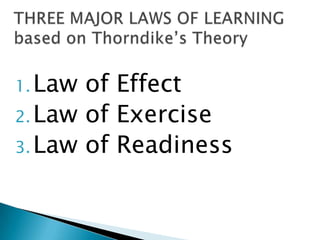
1. Law of Effect
2. Law of Exercise
3. Law of Readiness
States that a satisfying state
of affairs following the
response strengthens the
connection between
Stimulus and the behavior,
whereas an annoying state
weakens the connection.
In the classroom situation,
This Law implies that
TEACHING should attempt
to make the LEARNING
experiences of children
PLEASANT and GRATIFYING.
It describes the conditions
implied in the saying “ Practice
makes perfect.”

REPETITION of an experience
increases the probability of a
correct response.
Constant REPETITION of a
response strengthens its
connection with the stimulus.

Practical Educational practices
such as: DRILL, REVIEW, AND
EXAMINATION
It describes the conditions that
refer to “ANNOYING OR
SATISFYING” states.
It is related to the Law of
effect and accounts for the
motivational aspect of
Learning.
This Law implies that Teachers
must either:
Wait for the readiness or accept
the present level of readiness,
and be satisfied with a slower
learning rate in introducing any
new learning.

Basic learning theories

  • 2.
    Emphasize the establishmentand strengthening of relationships between the Stimulus (S) and the Response (R) and the emphasize role of reinforcement in the learning process.
  • 3.
    does not seelearning as just a stimulus response interaction. They focus rather on the cognitive structure of man as a basis for learning.
  • 4.
    Connectionism/Associationism - It isthe basic concept formulated by EDWARD LEE THORNDIKE. - The findings of his studies were based mostly on experiments conducted with animals.
  • 5.
    Human activity isbased on association between stimulus and response. Any activity is seen as: 1. A situation which influences or affects the individual 2. A response which the individual makes to the situation.
  • 6.
    3. A connectionbetween the situation and the response by means of which the former is enabled to produce the latter. This connection is called the S-R bond.
  • 7.
    It sees theLearner vary his responses by trial and error until He achieves a solution.
  • 8.
    1. Law ofEffect 2. Law of Exercise 3. Law of Readiness
  • 9.
    States that asatisfying state of affairs following the response strengthens the connection between Stimulus and the behavior, whereas an annoying state weakens the connection.
  • 10.
    In the classroomsituation, This Law implies that TEACHING should attempt to make the LEARNING experiences of children PLEASANT and GRATIFYING.
  • 11.
    It describes theconditions implied in the saying “ Practice makes perfect.” REPETITION of an experience increases the probability of a correct response.
  • 12.
    Constant REPETITION ofa response strengthens its connection with the stimulus. Practical Educational practices such as: DRILL, REVIEW, AND EXAMINATION
  • 13.
    It describes theconditions that refer to “ANNOYING OR SATISFYING” states. It is related to the Law of effect and accounts for the motivational aspect of Learning.
  • 14.
    This Law impliesthat Teachers must either: Wait for the readiness or accept the present level of readiness, and be satisfied with a slower learning rate in introducing any new learning.