CHAPTER 11
ORGANIZING TEST
SCORES FOR
STATISTICAL
ANALYSIS
Reported by : Ronalyn J. Bueza
BSEdIII-English
Acknowledgement:
Measuring and Evaluating Leaning
Outcomes
By: Carlito D. Garcia Ed.D
Test scores have to be
organized first before
they can be subjected to
statistical analysis.
Through the organizational
of test scores, teachers
can discover existing
patterns. This chapter
centers on the following
ways of organizing test
scores:
ordering, ranking, and the
use of
frequency, distribution
and the stem –and-leaf
plot.
Ordering refers to the numerical
arrangement of numerical observation s or
measurements (Gordon & Gordon, 1994).
There are two ways by which test scores can
be numerically arranged.: (1) ascending
order; and (2) descending order.
ORGANIZING TEST SCORES
BY ORDERING
•ASCENDING ORDER –
arranged from lowest to
highest
•DESCENDING ORDER –
arranged from highest
to lowest
ORGANIZING TEST
SCORES BY RANKING
Ranking is another way by which
test scores can be organized.
According to Calderon and
Gonzales, it is a process of
determining the relative position
of scores, measures or value
based on
magnitude, worth, quality or
importance. To rank test
scores, the following steps
should be observed.
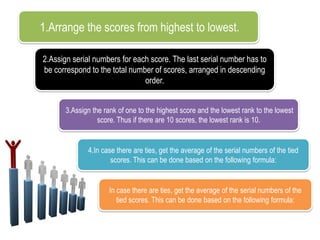
1.Arrange the scores from highest to lowest.
2.Assign serial numbers for each score. The last serial number has to
be correspond to the total number of scores, arranged in descending
order.
3.Assign the rank of one to the highest score and the lowest rank to the lowest
score. Thus if there are 10 scores, the lowest rank is 10.
4.In case there are ties, get the average of the serial numbers of the tied
scores. This can be done based on the following formula:
In case there are ties, get the average of the serial numbers of the
tied scores. This can be done based on the following formula:
Where:
R = Rank
SN1 = Serial Number of the Score
SN2= Serial number of the second score
SN3 = Other serial number
NTS= Number of the tied scores
Acknowledgement:
Measuring and Evaluating Leaning
Outcomes
By: Carlito D. Garcia Ed.D

Organizing test scores for statistical analysis

  • 1.
    CHAPTER 11 ORGANIZING TEST SCORESFOR STATISTICAL ANALYSIS Reported by : Ronalyn J. Bueza BSEdIII-English Acknowledgement: Measuring and Evaluating Leaning Outcomes By: Carlito D. Garcia Ed.D
  • 2.
    Test scores haveto be organized first before they can be subjected to statistical analysis. Through the organizational of test scores, teachers can discover existing patterns. This chapter centers on the following ways of organizing test scores: ordering, ranking, and the use of frequency, distribution and the stem –and-leaf plot.
  • 3.
    Ordering refers tothe numerical arrangement of numerical observation s or measurements (Gordon & Gordon, 1994). There are two ways by which test scores can be numerically arranged.: (1) ascending order; and (2) descending order. ORGANIZING TEST SCORES BY ORDERING •ASCENDING ORDER – arranged from lowest to highest •DESCENDING ORDER – arranged from highest to lowest
  • 4.
    ORGANIZING TEST SCORES BYRANKING Ranking is another way by which test scores can be organized. According to Calderon and Gonzales, it is a process of determining the relative position of scores, measures or value based on magnitude, worth, quality or importance. To rank test scores, the following steps should be observed.
  • 5.
    1.Arrange the scoresfrom highest to lowest. 2.Assign serial numbers for each score. The last serial number has to be correspond to the total number of scores, arranged in descending order. 3.Assign the rank of one to the highest score and the lowest rank to the lowest score. Thus if there are 10 scores, the lowest rank is 10. 4.In case there are ties, get the average of the serial numbers of the tied scores. This can be done based on the following formula: In case there are ties, get the average of the serial numbers of the tied scores. This can be done based on the following formula:
  • 6.
    Where: R = Rank SN1= Serial Number of the Score SN2= Serial number of the second score SN3 = Other serial number NTS= Number of the tied scores
  • 7.
    Acknowledgement: Measuring and EvaluatingLeaning Outcomes By: Carlito D. Garcia Ed.D