Behaviorism andSocial Learning TheoryS. Allain
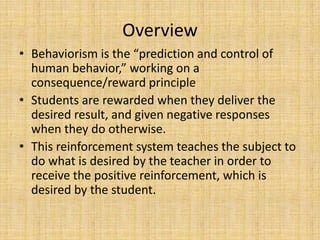
OverviewBehaviorism is the “prediction and control of human behavior,” working on a consequence/reward principleStudents are rewarded when they deliver the desired result, and given negative responses when they do otherwise.This reinforcement system teaches the subject to do what is desired by the teacher in order to receive the positive reinforcement, which is desired by the student.
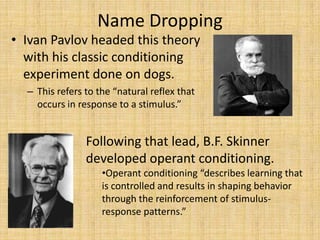
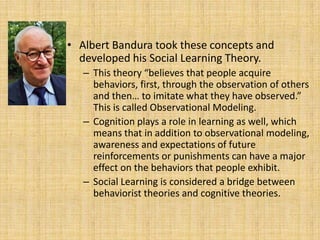
Name DroppingIvan Pavlov headed this theory with his classic conditioning experiment done on dogs.This refers to the “natural reflex that occurs in response to a stimulus.”Following that lead, B.F. Skinner developed operant conditioning.Operant conditioning “describes learning that is controlled and results in shaping behavior through the reinforcement of stimulus-response patterns.”Albert Bandura took these concepts and developed his Social Learning Theory.This theory “believes that people acquire behaviors, first, through the observation of others and then… to imitate what they have observed.” This is called Observational Modeling.Cognition plays a role in learning as well, which means that in addition to observational modeling, awareness and expectations of future reinforcements or punishments can have a major effect on the behaviors that people exhibit.Social Learning is considered a bridge between behaviorist theories and cognitive theories.
TeachersFollowing the main points of this theory, a teacher will set up an action/reward type system.Students should be made aware of the system, and will know that when they raise their hand quietly, follow classroom rules, and complete their assignments, they will be rewarded with things like a gold star, a candy, or a high grade.On the other hand, students will also be aware that when they do not meet these expectations, they will be punished with a letter home, a deduction of points, or a time out.
StudentsThese techniques will be most effective with elementary students, but also play a subliminal role with older students.Kids will work hard to get stickers and positive verbal reinforcement, and avoid losing things that are given as incentives.Older students’ rewards and punishments will be grades. Doing a good job results in good grades, whereas the opposite holds true, too.
My ThoughtsThis theory is basic and effective in early childhood setting. I would absolutely run a classroom under these principles. Kids need tangible rewards and punishments in order to stay on task. Without any goal in mind, there would be no reason to work hard, since long-term goals, like getting into college, don’t matter to young children. I feel that this is an excellent technique to employ with children.
Imageshttp://www.rcc.edu/students/images/2students.jpghttp://external.cache.el-mundo.net/elmundo/imagenes/2005/12/26/1135615507_0.jpghttp://4.bp.blogspot.com/_d8ls7V72AkA/SyvENnrkplI/AAAAAAAAAV4/KuXaFC9ylbc/S700/skinner-80s-smiling%5B1%5D.jpghttp://tonks.disted.camosun.bc.ca/courses/psyc130/Personality/Bandura2004cA.jpgReferenceshttp://teachnet.edb.utexas.edu/~Lynda_Abbott/Social.html
Allain behaviorism

Allain behaviorism

  • 1.
  • 2.
    OverviewBehaviorism is the“prediction and control of human behavior,” working on a consequence/reward principleStudents are rewarded when they deliver the desired result, and given negative responses when they do otherwise.This reinforcement system teaches the subject to do what is desired by the teacher in order to receive the positive reinforcement, which is desired by the student.
  • 3.
    Name DroppingIvan Pavlovheaded this theory with his classic conditioning experiment done on dogs.This refers to the “natural reflex that occurs in response to a stimulus.”Following that lead, B.F. Skinner developed operant conditioning.Operant conditioning “describes learning that is controlled and results in shaping behavior through the reinforcement of stimulus-response patterns.”Albert Bandura took these concepts and developed his Social Learning Theory.This theory “believes that people acquire behaviors, first, through the observation of others and then… to imitate what they have observed.” This is called Observational Modeling.Cognition plays a role in learning as well, which means that in addition to observational modeling, awareness and expectations of future reinforcements or punishments can have a major effect on the behaviors that people exhibit.Social Learning is considered a bridge between behaviorist theories and cognitive theories.
  • 4.
    TeachersFollowing the mainpoints of this theory, a teacher will set up an action/reward type system.Students should be made aware of the system, and will know that when they raise their hand quietly, follow classroom rules, and complete their assignments, they will be rewarded with things like a gold star, a candy, or a high grade.On the other hand, students will also be aware that when they do not meet these expectations, they will be punished with a letter home, a deduction of points, or a time out.
  • 5.
    StudentsThese techniques willbe most effective with elementary students, but also play a subliminal role with older students.Kids will work hard to get stickers and positive verbal reinforcement, and avoid losing things that are given as incentives.Older students’ rewards and punishments will be grades. Doing a good job results in good grades, whereas the opposite holds true, too.
  • 6.
    My ThoughtsThis theoryis basic and effective in early childhood setting. I would absolutely run a classroom under these principles. Kids need tangible rewards and punishments in order to stay on task. Without any goal in mind, there would be no reason to work hard, since long-term goals, like getting into college, don’t matter to young children. I feel that this is an excellent technique to employ with children.
  • 7.