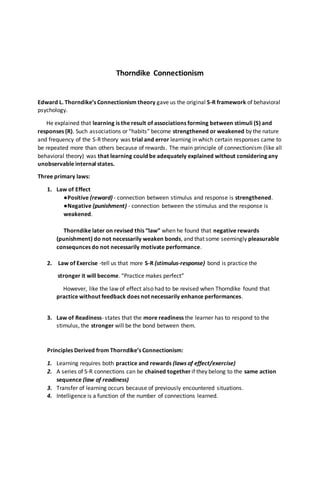
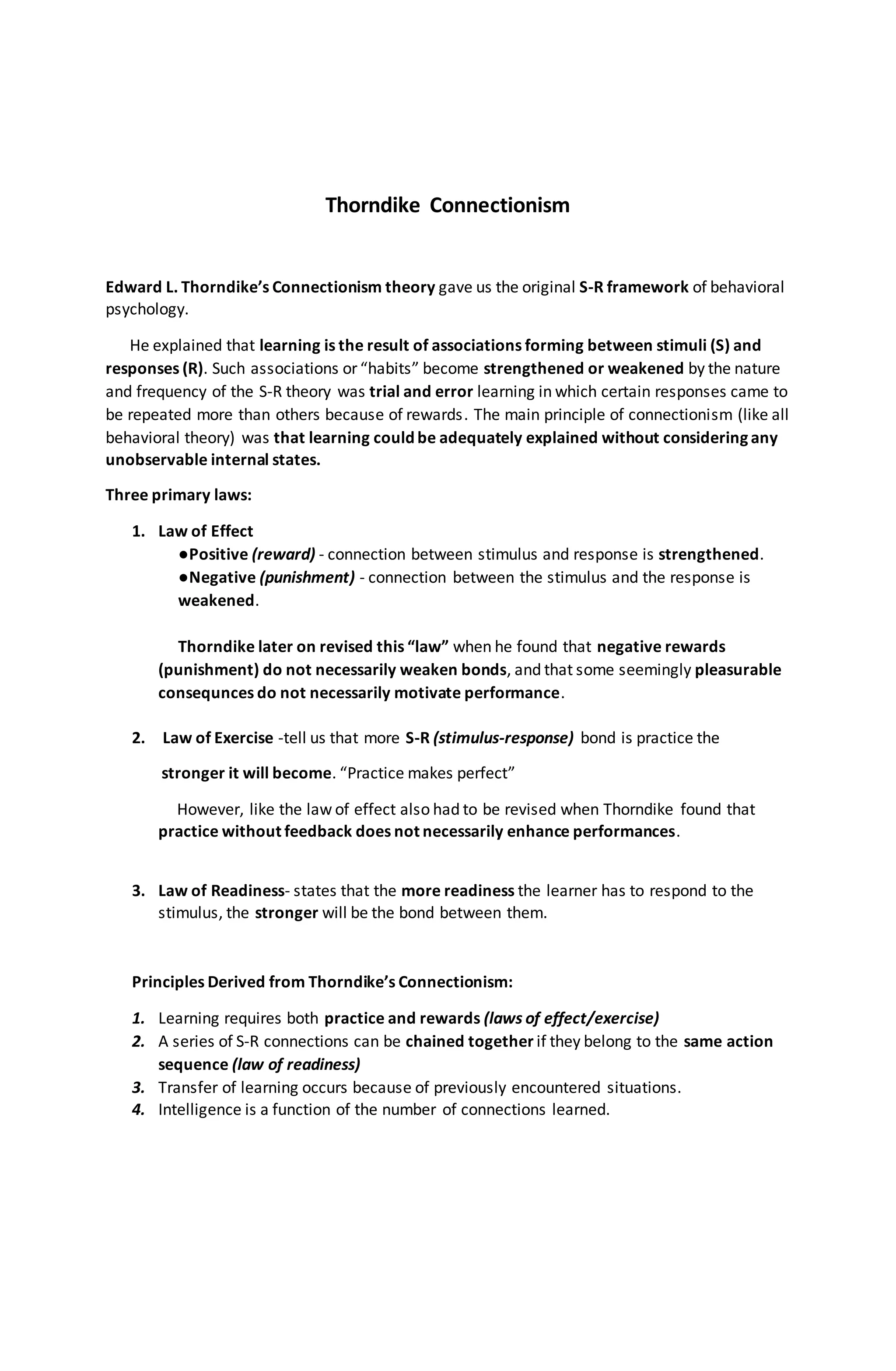
Edward Thorndike's theory of connectionism proposed that learning is the result of associations forming between stimuli and responses through a process of trial and error. According to this theory, connections are strengthened when a response is rewarded and weakened when a response is punished. Thorndike also proposed three laws of learning: the law of effect, the law of exercise, and the law of readiness to explain how associations are formed and strengthened through rewards, practice, and preparedness. The key principles that emerged from connectionism are that learning requires both practice with feedback, associations can be chained together into sequences, transfer of learning occurs through previous experiences, and intelligence depends on the number of connections formed.