
TOPICS COVERED:
1. INTERNET
2. TYPES OF CONNECTIVITY
3. OSI MODEL
4. EMAIL, SMTP, POP3, DNS, FTP.
5. INTRANET AND EXTRANET
6. WORLD WIDE WEB
7. HTML
8. SEARCH ENGINES

PRESENTATION
ON
COMPUTER
PROGRAMMING
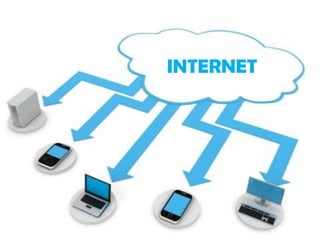
INTERNET
WHAT IS INTERNET………?
‘Internet’ is a ‘network of networks’ that
connects computers ‘all over the world’.
It is a collection of government, academic,
commercial, individual, and other sites.
The Internet mixes computing and
communication technologies.
INTERNET
INTERNET AND ITS APPLICATIONS…
E-MAIL
ONLINE EDUCATION

TELNET[telecommunications and networks]
VIDEO CONFERENCING
E-COMMERCE
E-MARKETING
E-CRM[customer relationship management]

EFT[electronic fund transfer]
SEARCH ENGINES[global data search]
TYPES OF
CONNECTIONS
ANALOG MODEMS
ISDN [integrated services digital network]

DSL [digital subscriber lines]
ADSL [asymmetrical digital subscriber lines]

SDSL [symmetrical digital subscriber lines]
HDSL [high-data-rate digital subscriber lines]
LEASED LINES
WIRE-LESS [Wi-Fi and VPN]
SATELLITE
OSI MODEL
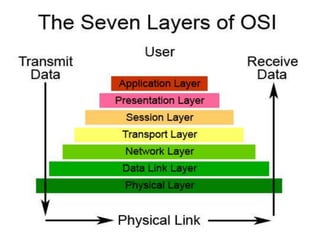
OSI MODEL [INTRODUCTION]
The OPEN SYSTEM INTERCONNECTION (OSI) model
includes a set of protocols that attempt to define and

standardization the data communication process.
The OSI model is a concept that describes, how data
communications should take place.
It divides the process into seven steps called layers.
The OSI protocols were defined by the International
Standard Organization (ISO) [INCLUDING IEEE].
E-MAIL, SMTP,
POP3, DNS, FTP
E-MAIL
Email [electronic-mail] allows the user to send
data in the form of text, pictures, sound and video
to a remote computer on the Internet.
These Email services are created by companies on
specific web services and can be accessed by
anyone anywhere in the world at anytime.
Files and data can also be sent through an Email as
like an attachment.
SMTP[simple mail transfer protocol]
SMTP is a member of the TCP/IP suite of
protocols that governs the exchange of
electronic mail between message transfer
agents.
It uses a ‘MAIL TRANSFER AGENT’ [MTA] to
transfer the commands, replies, e-mails
across the internet.
It has a set of predefined rules through
which it handles the mail traffic across a
particular network.
POP3[post office protocol {ver.3}]
Post Office Protocol (POP) is an applicationlayer Internet standard protocol used by local email clients to retrieve e-mail from a
remote server over a TCP/IP connection.

POP and IMAP (Internet Message Access
Protocol)
are
the
two
most
prevalent Internet standard protocols for e-mail
retrieval.
Virtually
all
modern
and servers support both.

e-mail

clients

POP has been developed through several
versions, with version 3 (POP3) being the current
standard.
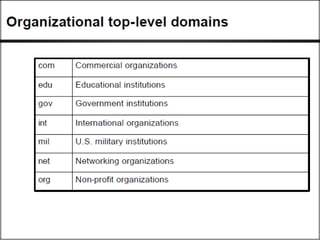
 Domain names are alphanumeric names for IP
addresses e.g., neon.cs.virginia.edu,
www.google.com, ietf.org
 The domain name system (DNS) is an Internetwide
distributed database that translates between
domain names and IP addresses
 The naming system on which DNS is based is a
hierarchical and logical tree structure called the
DOMAIN NAMESPACE.
FTP[file transfer protocol]
TCP/IP

USER

FTP
DATA FLOW

RECIEVER
[WEB SERVER]
File transfer protocol is an Internet tool for uploading
and downloading files between computers.
A file transfer must take place between a client and a
server.
FTP client software can be a separate stand alone
program.
FTP client capability is incorporated into web browsers or
provided as part of operating system.
Some files on FTP servers may be accessible to the
general public, while others are accessible only by
private users such as customers or members of the
organization that runs the server.
INTRANET AND
EXTRANET
INTRANET
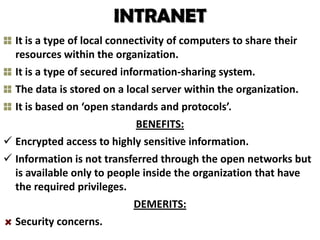
It is a type of local connectivity of computers to share their
resources within the organization.
It is a type of secured information-sharing system.
The data is stored on a local server within the organization.

It is based on ‘open standards and protocols’.
BENEFITS:
 Encrypted access to highly sensitive information.

 Information is not transferred through the open networks but
is available only to people inside the organization that have
the required privileges.
DEMERITS:
Security concerns.
EXTRANET
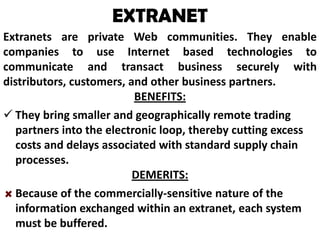
Extranets are private Web communities. They enable
companies to use Internet based technologies to
communicate and transact business securely with
distributors, customers, and other business partners.
BENEFITS:
 They bring smaller and geographically remote trading
partners into the electronic loop, thereby cutting excess
costs and delays associated with standard supply chain
processes.
DEMERITS:
Because of the commercially-sensitive nature of the
information exchanged within an extranet, each system
must be buffered.
WORLD WIDE WEB
[WWW]
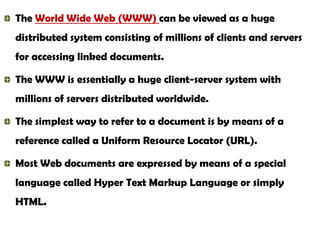
The World Wide Web (WWW) can be viewed as a huge
distributed system consisting of millions of clients and servers
for accessing linked documents.
The WWW is essentially a huge client-server system with
millions of servers distributed worldwide.

The simplest way to refer to a document is by means of a
reference called a Uniform Resource Locator (URL).
Most Web documents are expressed by means of a special
language called Hyper Text Markup Language or simply
HTML.
HTML
[Hyper text markup
language]
 Most Web documents are expressed by means of a special
language called [Hyper Text Markup Language ] or simply
HTML.

 Being a markup language means that HTML provides
keywords to structure a document into different sections.
 It is also possible to insert images or animations at
specific positions in a document.

 Besides these structural elements, HTML provides various
keywords to instruct the browser how to present the
document.
 One of its most powerful features is the ability to express
parts of a document in the form of a script [JAVA SCRIPT].
SEARCH ENGINES
VIJAY KUMAR L. SAROJ
ABHINAV AWASTHI
[S.Y.Bcom]

basic it presentation........

  • 1.
    TOPICS COVERED: 1. INTERNET 2.TYPES OF CONNECTIVITY 3. OSI MODEL 4. EMAIL, SMTP, POP3, DNS, FTP. 5. INTRANET AND EXTRANET 6. WORLD WIDE WEB 7. HTML 8. SEARCH ENGINES PRESENTATION ON COMPUTER PROGRAMMING
  • 2.
  • 3.
    WHAT IS INTERNET………? ‘Internet’is a ‘network of networks’ that connects computers ‘all over the world’. It is a collection of government, academic, commercial, individual, and other sites. The Internet mixes computing and communication technologies.
  • 4.
  • 5.
    INTERNET AND ITSAPPLICATIONS… E-MAIL ONLINE EDUCATION TELNET[telecommunications and networks] VIDEO CONFERENCING E-COMMERCE E-MARKETING E-CRM[customer relationship management] EFT[electronic fund transfer] SEARCH ENGINES[global data search]
  • 6.
  • 7.
    ANALOG MODEMS ISDN [integratedservices digital network] DSL [digital subscriber lines] ADSL [asymmetrical digital subscriber lines] SDSL [symmetrical digital subscriber lines] HDSL [high-data-rate digital subscriber lines] LEASED LINES WIRE-LESS [Wi-Fi and VPN] SATELLITE
  • 8.
  • 9.
    OSI MODEL [INTRODUCTION] TheOPEN SYSTEM INTERCONNECTION (OSI) model includes a set of protocols that attempt to define and standardization the data communication process. The OSI model is a concept that describes, how data communications should take place. It divides the process into seven steps called layers. The OSI protocols were defined by the International Standard Organization (ISO) [INCLUDING IEEE].
  • 11.
  • 12.
  • 13.
    Email [electronic-mail] allowsthe user to send data in the form of text, pictures, sound and video to a remote computer on the Internet. These Email services are created by companies on specific web services and can be accessed by anyone anywhere in the world at anytime. Files and data can also be sent through an Email as like an attachment.
  • 14.
  • 15.
    SMTP is amember of the TCP/IP suite of protocols that governs the exchange of electronic mail between message transfer agents. It uses a ‘MAIL TRANSFER AGENT’ [MTA] to transfer the commands, replies, e-mails across the internet. It has a set of predefined rules through which it handles the mail traffic across a particular network.
  • 16.
  • 17.
    Post Office Protocol(POP) is an applicationlayer Internet standard protocol used by local email clients to retrieve e-mail from a remote server over a TCP/IP connection. POP and IMAP (Internet Message Access Protocol) are the two most prevalent Internet standard protocols for e-mail retrieval. Virtually all modern and servers support both. e-mail clients POP has been developed through several versions, with version 3 (POP3) being the current standard.
  • 19.
     Domain namesare alphanumeric names for IP addresses e.g., neon.cs.virginia.edu, www.google.com, ietf.org  The domain name system (DNS) is an Internetwide distributed database that translates between domain names and IP addresses  The naming system on which DNS is based is a hierarchical and logical tree structure called the DOMAIN NAMESPACE.
  • 21.
  • 22.
    File transfer protocolis an Internet tool for uploading and downloading files between computers. A file transfer must take place between a client and a server. FTP client software can be a separate stand alone program. FTP client capability is incorporated into web browsers or provided as part of operating system. Some files on FTP servers may be accessible to the general public, while others are accessible only by private users such as customers or members of the organization that runs the server.
  • 23.
  • 24.
    INTRANET It is atype of local connectivity of computers to share their resources within the organization. It is a type of secured information-sharing system. The data is stored on a local server within the organization. It is based on ‘open standards and protocols’. BENEFITS:  Encrypted access to highly sensitive information.  Information is not transferred through the open networks but is available only to people inside the organization that have the required privileges. DEMERITS: Security concerns.
  • 25.
    EXTRANET Extranets are privateWeb communities. They enable companies to use Internet based technologies to communicate and transact business securely with distributors, customers, and other business partners. BENEFITS:  They bring smaller and geographically remote trading partners into the electronic loop, thereby cutting excess costs and delays associated with standard supply chain processes. DEMERITS: Because of the commercially-sensitive nature of the information exchanged within an extranet, each system must be buffered.
  • 26.
  • 28.
    The World WideWeb (WWW) can be viewed as a huge distributed system consisting of millions of clients and servers for accessing linked documents. The WWW is essentially a huge client-server system with millions of servers distributed worldwide. The simplest way to refer to a document is by means of a reference called a Uniform Resource Locator (URL). Most Web documents are expressed by means of a special language called Hyper Text Markup Language or simply HTML.
  • 29.
  • 30.
     Most Webdocuments are expressed by means of a special language called [Hyper Text Markup Language ] or simply HTML.  Being a markup language means that HTML provides keywords to structure a document into different sections.  It is also possible to insert images or animations at specific positions in a document.  Besides these structural elements, HTML provides various keywords to instruct the browser how to present the document.  One of its most powerful features is the ability to express parts of a document in the form of a script [JAVA SCRIPT].
  • 31.
  • 33.
    VIJAY KUMAR L.SAROJ ABHINAV AWASTHI [S.Y.Bcom]