Introduction to the Internet
content
Sl no. Title Slide No.
1 Internet 3
2 History Of the Internet 4
3 Internet Protocols 5
4 Who Governs The Internet ??? 6
5 Connecting to the Internet 7-10
6 Types Of internet Connection 11-13
7 Software 14
8 Internet- Related Terminology 15
9 Web Browser 16
10 How the Web works 17
11 Web Address 18
12 Network Classes 19
13 Uniform Resource Locator 20
Internet
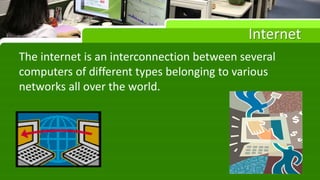
The internet is an interconnection between several
computers of different types belonging to various
networks all over the world.
History of the Internet
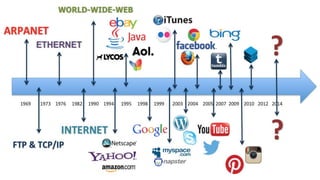
In 1969, the department of defense {DoD} of united
States of America developed a network called ARPANET.
It was started with one computer in California And
three in Utah. Later the network grew bigger and bigger
and gave birth to the present day internet.
Internet Protocols
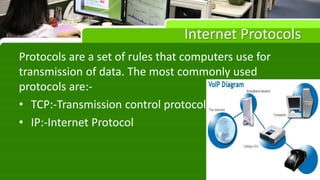
Protocols are a set of rules that computers use for
transmission of data. The most commonly used
protocols are:-
• TCP:-Transmission control protocol
• IP:-Internet Protocol
Who Governs the Internet
Different volunteer groups have been formed to
coordinate and monitor different aspects of the
internet. These groups are as follows:-
• Internet Activities Board{IAB}
• Internet corporation for Assigned Names and
Numbers{ICANN}
• World Wide Web Consortium{W3C}
Connecting To the Internet
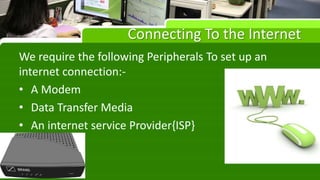
We require the following Peripherals To set up an
internet connection:-
• A Modem
• Data Transfer Media
• An internet service Provider{ISP}
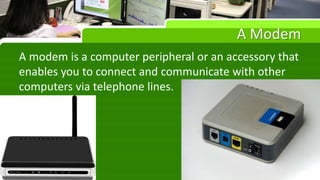
A Modem
A modem is a computer peripheral or an accessory that
enables you to connect and communicate with other
computers via telephone lines.
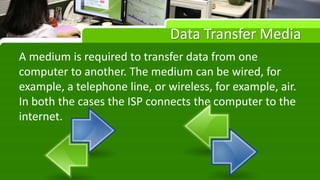
Data Transfer Media
A medium is required to transfer data from one
computer to another. The medium can be wired, for
example, a telephone line, or wireless, for example, air.
In both the cases the ISP connects the computer to the
internet.
Internet Service Provider
Internet Service Providers [ISPs] are organizations that
provide internet connections to users through their
installed servers on a payment of a fee. Some of the
popular ISPs in India are Vodafone, Bharat Sanchar
Nigam Limited [BSNL], Mobile TeleSystems India[MTS
India], Idea cellular, Aircel, Airtel and Reliance
communications.
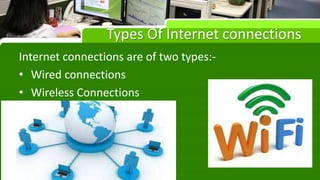
Types Of Internet connections
Internet connections are of two types:-
• Wired connections
• Wireless Connections
Wired connections
In a wired connections, Data is transmitted through
wires or cables:-
• Dial-up
• ISDN
• Broadband Services
• Wired Broadband
Wireless Connections
The internet connections in wireless connections is established
without the use of wires. Its various types are:-
• Satellite Service
• Wireless Broadband
• Wireless-Fidelity [Wi-Fi]
• WiMax
• Wireless Mobile Broadband
• 3G- The third Generation
• 4G- The Fourth Generation
Software
Once you have the necessary to access the internet,
you need to ensure that some basic software
programmes are installed in the computer for internet
access and communication through it.
Internet –Related terminology
Some important terms:-
• World Wide Web:-It is an information system of interlinked
hypertext documents that are accessed via the internet.
• Webpage:-A webpage is an electronic document in the
computer language Hypertext Markup Language [HTML]
• Website:- A website is a collection of one or more related
webpages, images, videos, and other digital assets hosted on
a web server.
• Home Page:-The first page of a website is called a homepage
• Web Server:-It’s a computer program that serves that serves
the requested pages or files.
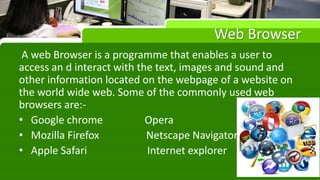
Web Browser
A web Browser is a programme that enables a user to
access an d interact with the text, images and sound and
other information located on the webpage of a website on
the world wide web. Some of the commonly used web
browsers are:-
• Google chrome Opera
• Mozilla Firefox Netscape Navigator
• Apple Safari Internet explorer
How the Web Works
The Web consists of a personal computer, the web browser
software, a connection to the ISP, servers that host digital Data,
and routers and switches to direct the flow of information. The
glue that binds the web is the hypertext and hyperlink.
• Hypertext Transfer Protocol [HTTP]:- It is a communication
protocol used to transfer all kinds information [texts, images,
sound, video and other multimedia files] on the web.
• Hypertext Markup Language:- The information on the website
is coded by using the Hypertext Markup Language [HTML].
Web Address
The Internet has millions of computers connected to it.
In order to communicate, every computer connected to
the internet has unique address format is defined by
the internet protocol [IP] addressing system. It uses two
methods for identifying computers:-
• Letter Addressing System
• Number Addressing System
Network Classes
• The first Step in the IP Addressing is to determine
which network class is appropriate for your network.
• The Second Step is to obtain a network number from
the internet Corporation for Assigned Names and
Numbers [ICANN]
Uniform Resource Locator [URL]
Uniform Resource Locator [URL] is the method by
which a document or data is addressed on the web.
Just like every computer/Network has a unique
address, every entity in the web has a unique URL to
help trace it.
Done By…….
Anamika K Rajesh
Adithya Sudesh
Upashna
R. Harini
X.A
Introduction to Internet By Anamika

Introduction to Internet By Anamika

  • 1.
  • 2.
    content Sl no. TitleSlide No. 1 Internet 3 2 History Of the Internet 4 3 Internet Protocols 5 4 Who Governs The Internet ??? 6 5 Connecting to the Internet 7-10 6 Types Of internet Connection 11-13 7 Software 14 8 Internet- Related Terminology 15 9 Web Browser 16 10 How the Web works 17 11 Web Address 18 12 Network Classes 19 13 Uniform Resource Locator 20
  • 3.
    Internet The internet isan interconnection between several computers of different types belonging to various networks all over the world.
  • 4.
    History of theInternet In 1969, the department of defense {DoD} of united States of America developed a network called ARPANET. It was started with one computer in California And three in Utah. Later the network grew bigger and bigger and gave birth to the present day internet.
  • 7.
    Internet Protocols Protocols area set of rules that computers use for transmission of data. The most commonly used protocols are:- • TCP:-Transmission control protocol • IP:-Internet Protocol
  • 8.
    Who Governs theInternet Different volunteer groups have been formed to coordinate and monitor different aspects of the internet. These groups are as follows:- • Internet Activities Board{IAB} • Internet corporation for Assigned Names and Numbers{ICANN} • World Wide Web Consortium{W3C}
  • 9.
    Connecting To theInternet We require the following Peripherals To set up an internet connection:- • A Modem • Data Transfer Media • An internet service Provider{ISP}
  • 10.
    A Modem A modemis a computer peripheral or an accessory that enables you to connect and communicate with other computers via telephone lines.
  • 11.
    Data Transfer Media Amedium is required to transfer data from one computer to another. The medium can be wired, for example, a telephone line, or wireless, for example, air. In both the cases the ISP connects the computer to the internet.
  • 12.
    Internet Service Provider InternetService Providers [ISPs] are organizations that provide internet connections to users through their installed servers on a payment of a fee. Some of the popular ISPs in India are Vodafone, Bharat Sanchar Nigam Limited [BSNL], Mobile TeleSystems India[MTS India], Idea cellular, Aircel, Airtel and Reliance communications.
  • 13.
    Types Of Internetconnections Internet connections are of two types:- • Wired connections • Wireless Connections
  • 14.
    Wired connections In awired connections, Data is transmitted through wires or cables:- • Dial-up • ISDN • Broadband Services • Wired Broadband
  • 15.
    Wireless Connections The internetconnections in wireless connections is established without the use of wires. Its various types are:- • Satellite Service • Wireless Broadband • Wireless-Fidelity [Wi-Fi] • WiMax • Wireless Mobile Broadband • 3G- The third Generation • 4G- The Fourth Generation
  • 16.
    Software Once you havethe necessary to access the internet, you need to ensure that some basic software programmes are installed in the computer for internet access and communication through it.
  • 17.
    Internet –Related terminology Someimportant terms:- • World Wide Web:-It is an information system of interlinked hypertext documents that are accessed via the internet. • Webpage:-A webpage is an electronic document in the computer language Hypertext Markup Language [HTML] • Website:- A website is a collection of one or more related webpages, images, videos, and other digital assets hosted on a web server. • Home Page:-The first page of a website is called a homepage • Web Server:-It’s a computer program that serves that serves the requested pages or files.
  • 18.
    Web Browser A webBrowser is a programme that enables a user to access an d interact with the text, images and sound and other information located on the webpage of a website on the world wide web. Some of the commonly used web browsers are:- • Google chrome Opera • Mozilla Firefox Netscape Navigator • Apple Safari Internet explorer
  • 19.
    How the WebWorks The Web consists of a personal computer, the web browser software, a connection to the ISP, servers that host digital Data, and routers and switches to direct the flow of information. The glue that binds the web is the hypertext and hyperlink. • Hypertext Transfer Protocol [HTTP]:- It is a communication protocol used to transfer all kinds information [texts, images, sound, video and other multimedia files] on the web. • Hypertext Markup Language:- The information on the website is coded by using the Hypertext Markup Language [HTML].
  • 20.
    Web Address The Internethas millions of computers connected to it. In order to communicate, every computer connected to the internet has unique address format is defined by the internet protocol [IP] addressing system. It uses two methods for identifying computers:- • Letter Addressing System • Number Addressing System
  • 21.
    Network Classes • Thefirst Step in the IP Addressing is to determine which network class is appropriate for your network. • The Second Step is to obtain a network number from the internet Corporation for Assigned Names and Numbers [ICANN]
  • 22.
    Uniform Resource Locator[URL] Uniform Resource Locator [URL] is the method by which a document or data is addressed on the web. Just like every computer/Network has a unique address, every entity in the web has a unique URL to help trace it.
  • 23.
    Done By……. Anamika KRajesh Adithya Sudesh Upashna R. Harini X.A