Chapter 10 Inside the Internet  and the Web
Topics The Internet: A Network of Networks Internet Applications: Communication and Connection Inside the World Wide Web The Evolving Internet “ It’s a bit like climbing a mountain. You don’t know how far you’ve come until you stop and look back.” Vint Cerf
The  Internet  is an interconnected network of thousands of networks linking academic, research, government, and commercial institutions. The Internet:  A Network of Networks
The Internet provides scientists, engineers, educators, students, business people, and others with a variety of services such as: Electronic mail  (send/receive mail messages) Remote login   (T elnet - access to other computers) Internet Services
Internet Services Transferring files   (FTP - accessing archives of data) Newsgroups   (Usenet - on-line public discussions) World Wide Web   (a collection of multimedia documents)
Counting Connections Today, the Internet connects computers to about every country in the world.  However, the Internet is: growing too fast to measure its growth too decentralized to quantify a network with no hard boundaries
The language at the heart of the Internet is  TCP/IP… Transmission Control Protocol/Internet Protocol Allows cross-network communication Internet Protocols
Internet Protocols TCP  breaks messages into packets Each packet has all the information needed to travel from network to network Host systems called  Routers  determine how to route transmissions
Internet Protocols IP  is the address for the packets Each Internet host computer has a unique  IP Address  Each address is comprised of four sets of numbers separated by periods, such as  123.23.168.22
Internet Addresses The host is named using DNS (domain name system), which translates IP addresses into a string of names. “ Each person on the “Internet” has a unique e-mail “address” created by having a squirrel run across a computer keyboard.” Dave Barry
Internet Addresses Top level domains include: . edu - educational sites .com - commercial sites .gov - government sites .mil - military sites .net - network administration sites .org - nonprofit organizations
Internet Addresses An Internet address includes: username@hostname.sub.dom username  is the person’s “mailbox” hostname  is the name of the host computer and is followed by one or more domains separated by periods: host.subdomain.domain host.domain host.subdomain.subdomain.domain
Internet Addresses [email_address] Examples: [email_address] User  President  whose mail is stored on the host  whitehouse  in the  government  domain User  hazel_filbert  at the server for  Lane County, Oregon, k-12  school district
Direct (dedicated) Connection Internet Access Options Computer has its own IP address and  is attached to a LAN No need to dial up Files are stored on your computer Response time is quick
Internet Access Options Dialup Connections limited connection using a modem Full access dial up uses SLIP or PPP via modem Broadband Connections DSL service is newer, faster, and cheaper than ISDN Can share phone line with voice traffic
Internet Access Options Cable Modem Connection allow Internet connections using shared TV cables can exceed DSL speeds Carry increased privacy and security risks Satellite Connections provides connections using DirecTV satellite dishes
Internet Access Options Internet Service Providers (ISPs) local ISPs provide connections through  local telephone lines national ISPs offer connections on a nationwide scale
The Internet use the client/server model  for most Internet applications.  In the client/server model a client program asks for information, and a server program fields the request and provides the requested information from databases and documents.  Internet Applications: Communication and Connection
An  email server  acts like a local post office for a particular Internet host—a business, an organization, or an ISP.  File servers   are common within LANs, but they’re also used to share programs, media files, and other computer data across the Internet.  Internet Applications: Communication and Connection
File transfer protocol (FTP)  allows users to download files from remote servers to their computers and to upload files. File compression  saves storage space on disk and saves transmission time when files are transferred through networks.  Internet Applications: Communication and Connection
An  application server  stores applications- PC office applications, databases, or other applications - and makes them available to client programs that request them.  An application server might be housed at an  application service provider (ASP) -  a company that manages and delivers application services on a contract basis.  A  Web server  stores Web pages and sends pages to client Web browsers. Internet Applications: Communication and Connection
WWW  is a distributed browsing and searching system developed at CERN System was designed to give Internet documents unique addresses HTML  language was created for encoding and displaying documents Browser software was built for viewing documents from remote locations Inside the Web
Inside the Web Web pages  are made up of text and images A  Web site  is a collection of web pages A  Home page  is the main entry to a Web site A  Web browser  like Netscape Communicator or Internet Explorer allows you to explore the Web by clicking links Web site Jargon:
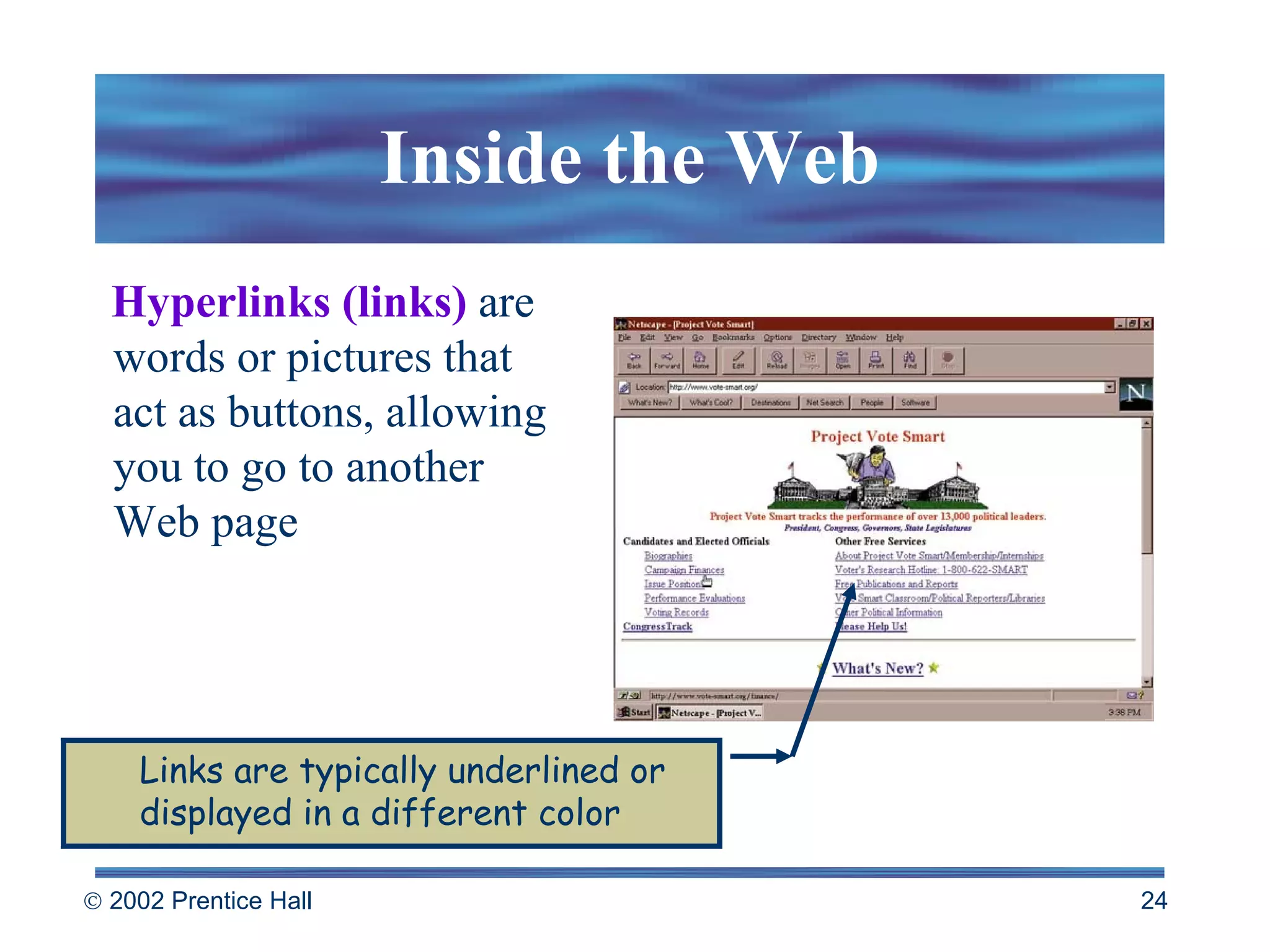
Inside the Web Hyperlinks (links)   are words or pictures that act as buttons, allowing you to go to another Web page Links are typically underlined or displayed in a different color
Inside the Web More Web site Jargon Links  allow you to locate information without knowing its exact location (it may move from time to time) Back  and  Forward  buttons let you retrace your steps Bookmarks  and  Favorites  can be set up to mark your favorite Web locations
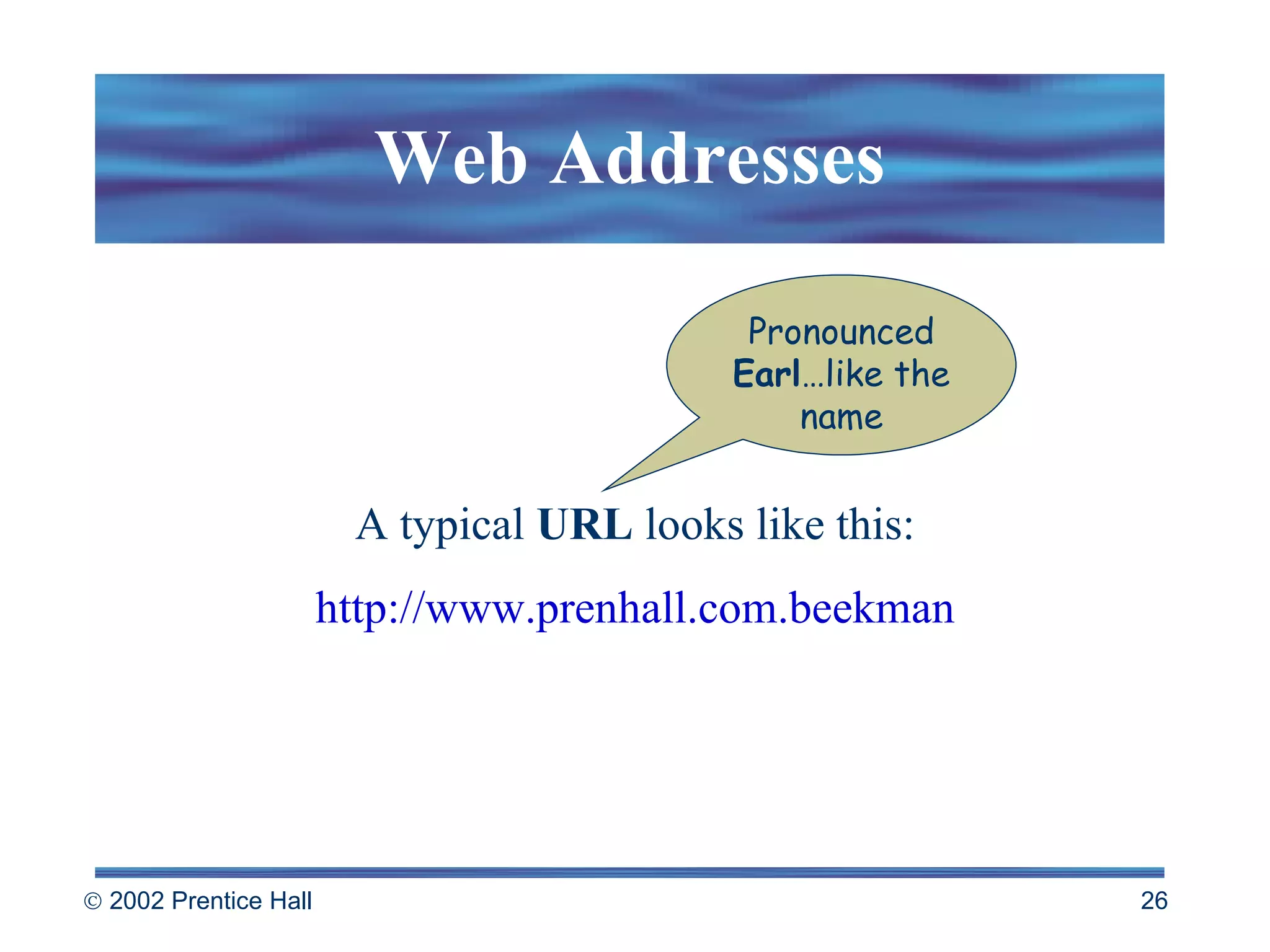
Web Addresses Pronounced  Earl …like the name A typical  URL  looks like this: http://www.prenhall.com.beekman
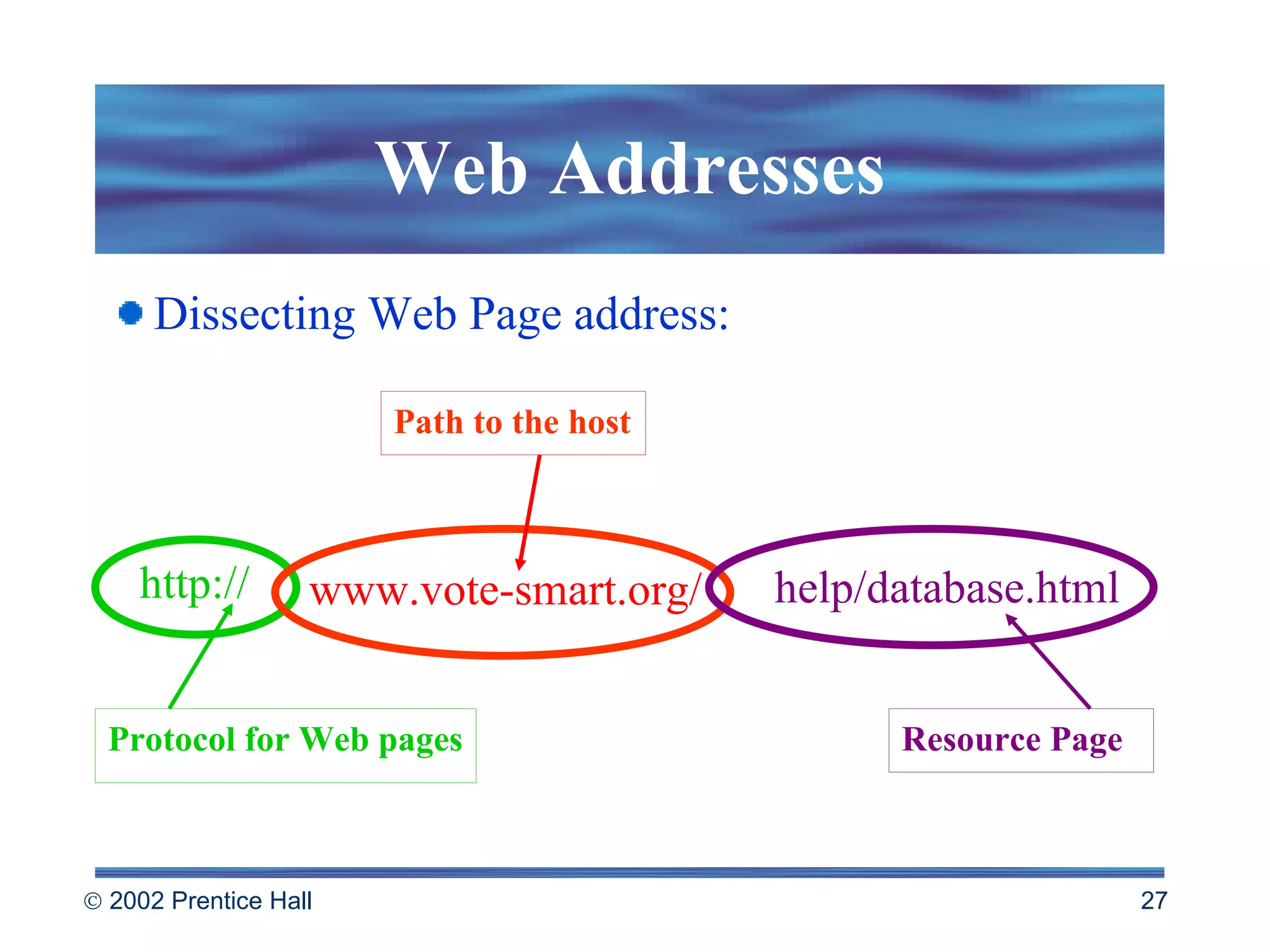
Web Addresses Protocol for Web pages Dissecting Web Page address: Resource Page http:// www.vote-smart.org/ Path to the host help/database.html
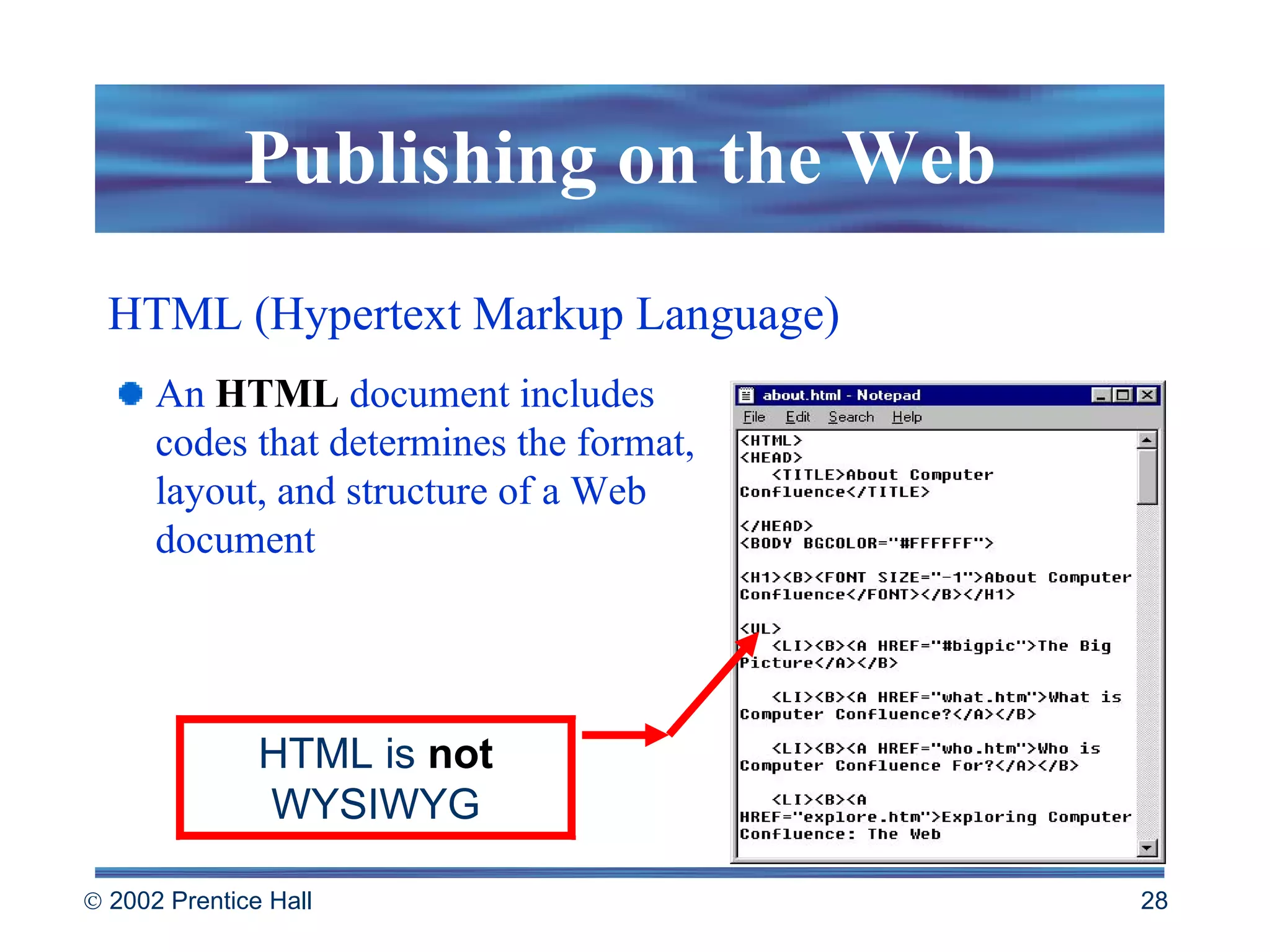
Publishing on the Web  An  HTML  document includes codes that determines the format, layout, and structure of a Web document HTML (Hypertext Markup Language) HTML is  not  WYSIWYG
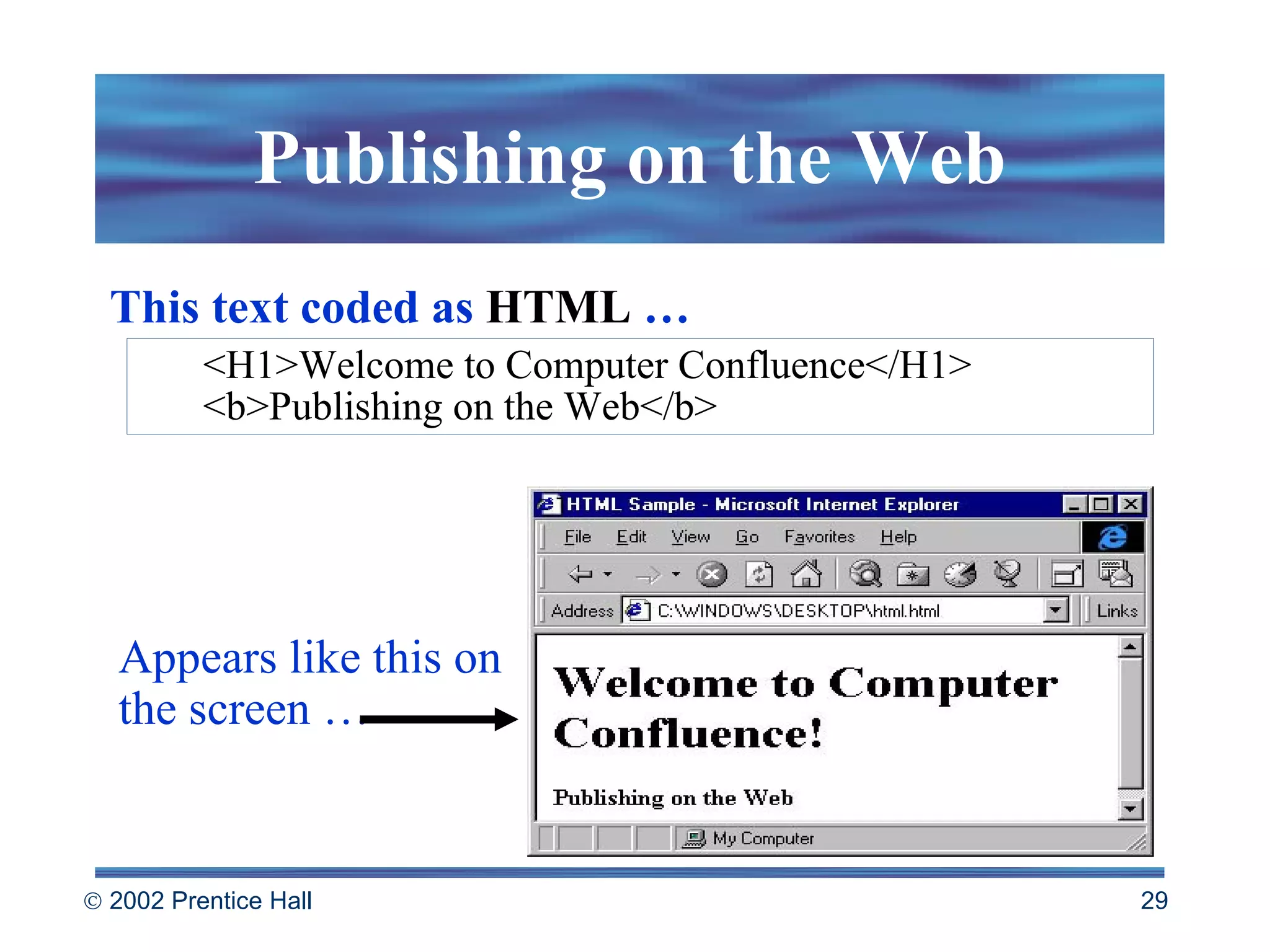
Publishing on the Web This text coded as  HTML  … Appears like this on the screen … <H1>Welcome to Computer Confluence</H1> <b>Publishing on the Web</b>
Publishing on the Web Alternatives to HTML…  Programs that convert document format features into HTML codes Microsoft Word, FileMaker Web authoring programs  HomePage,  GoLive,  FrontPage
From Hypertext to Multimedia Tables Frames Forms Downloadable  audio and video Streaming audio and video Real-time live  audio or video 3-D environments Typical Web pages can contain:
From Hypertext to Multimedia Plug-Ins  are software extensions that add new features. Examples include… QuickTime Shockwave/Flash RealPlayer Acrobat
Beyond HTML Dynamic HTML: adds more programming power to HTML by allowing code to automatically modify itself under certain circumstances JavaScript:   a simple language for enhancing HTML Web pages
Beyond HTML WML Wireless Markup Language helps create Web documents containing stock quotes, phone numbers, and other small nuggets of information XML Will replace HTML plus provide additional features and extensions VRML Virtual Reality Modeling Language creates 3-D virtual worlds
Beyond HTML Java A full-featured, cross platform, object-oriented programming language Java applets Small Java programs that can be automatically downloaded onto your client computer and can run on any platform
 

Beekman5 std ppt_10

  • 1.
    Chapter 10 Insidethe Internet and the Web
  • 2.
    Topics The Internet:A Network of Networks Internet Applications: Communication and Connection Inside the World Wide Web The Evolving Internet “ It’s a bit like climbing a mountain. You don’t know how far you’ve come until you stop and look back.” Vint Cerf
  • 3.
    The Internet is an interconnected network of thousands of networks linking academic, research, government, and commercial institutions. The Internet: A Network of Networks
  • 4.
    The Internet providesscientists, engineers, educators, students, business people, and others with a variety of services such as: Electronic mail (send/receive mail messages) Remote login (T elnet - access to other computers) Internet Services
  • 5.
    Internet Services Transferringfiles (FTP - accessing archives of data) Newsgroups (Usenet - on-line public discussions) World Wide Web (a collection of multimedia documents)
  • 6.
    Counting Connections Today,the Internet connects computers to about every country in the world. However, the Internet is: growing too fast to measure its growth too decentralized to quantify a network with no hard boundaries
  • 7.
    The language atthe heart of the Internet is TCP/IP… Transmission Control Protocol/Internet Protocol Allows cross-network communication Internet Protocols
  • 8.
    Internet Protocols TCP breaks messages into packets Each packet has all the information needed to travel from network to network Host systems called Routers determine how to route transmissions
  • 9.
    Internet Protocols IP is the address for the packets Each Internet host computer has a unique IP Address Each address is comprised of four sets of numbers separated by periods, such as 123.23.168.22
  • 10.
    Internet Addresses Thehost is named using DNS (domain name system), which translates IP addresses into a string of names. “ Each person on the “Internet” has a unique e-mail “address” created by having a squirrel run across a computer keyboard.” Dave Barry
  • 11.
    Internet Addresses Toplevel domains include: . edu - educational sites .com - commercial sites .gov - government sites .mil - military sites .net - network administration sites .org - nonprofit organizations
  • 12.
    Internet Addresses AnInternet address includes: username@hostname.sub.dom username is the person’s “mailbox” hostname is the name of the host computer and is followed by one or more domains separated by periods: host.subdomain.domain host.domain host.subdomain.subdomain.domain
  • 13.
    Internet Addresses [email_address]Examples: [email_address] User President whose mail is stored on the host whitehouse in the government domain User hazel_filbert at the server for Lane County, Oregon, k-12 school district
  • 14.
    Direct (dedicated) ConnectionInternet Access Options Computer has its own IP address and is attached to a LAN No need to dial up Files are stored on your computer Response time is quick
  • 15.
    Internet Access OptionsDialup Connections limited connection using a modem Full access dial up uses SLIP or PPP via modem Broadband Connections DSL service is newer, faster, and cheaper than ISDN Can share phone line with voice traffic
  • 16.
    Internet Access OptionsCable Modem Connection allow Internet connections using shared TV cables can exceed DSL speeds Carry increased privacy and security risks Satellite Connections provides connections using DirecTV satellite dishes
  • 17.
    Internet Access OptionsInternet Service Providers (ISPs) local ISPs provide connections through local telephone lines national ISPs offer connections on a nationwide scale
  • 18.
    The Internet usethe client/server model for most Internet applications. In the client/server model a client program asks for information, and a server program fields the request and provides the requested information from databases and documents. Internet Applications: Communication and Connection
  • 19.
    An emailserver acts like a local post office for a particular Internet host—a business, an organization, or an ISP. File servers are common within LANs, but they’re also used to share programs, media files, and other computer data across the Internet. Internet Applications: Communication and Connection
  • 20.
    File transfer protocol(FTP) allows users to download files from remote servers to their computers and to upload files. File compression saves storage space on disk and saves transmission time when files are transferred through networks. Internet Applications: Communication and Connection
  • 21.
    An applicationserver stores applications- PC office applications, databases, or other applications - and makes them available to client programs that request them. An application server might be housed at an application service provider (ASP) - a company that manages and delivers application services on a contract basis. A Web server stores Web pages and sends pages to client Web browsers. Internet Applications: Communication and Connection
  • 22.
    WWW isa distributed browsing and searching system developed at CERN System was designed to give Internet documents unique addresses HTML language was created for encoding and displaying documents Browser software was built for viewing documents from remote locations Inside the Web
  • 23.
    Inside the WebWeb pages are made up of text and images A Web site is a collection of web pages A Home page is the main entry to a Web site A Web browser like Netscape Communicator or Internet Explorer allows you to explore the Web by clicking links Web site Jargon:
  • 24.
    Inside the WebHyperlinks (links) are words or pictures that act as buttons, allowing you to go to another Web page Links are typically underlined or displayed in a different color
  • 25.
    Inside the WebMore Web site Jargon Links allow you to locate information without knowing its exact location (it may move from time to time) Back and Forward buttons let you retrace your steps Bookmarks and Favorites can be set up to mark your favorite Web locations
  • 26.
    Web Addresses Pronounced Earl …like the name A typical URL looks like this: http://www.prenhall.com.beekman
  • 27.
    Web Addresses Protocolfor Web pages Dissecting Web Page address: Resource Page http:// www.vote-smart.org/ Path to the host help/database.html
  • 28.
    Publishing on theWeb An HTML document includes codes that determines the format, layout, and structure of a Web document HTML (Hypertext Markup Language) HTML is not WYSIWYG
  • 29.
    Publishing on theWeb This text coded as HTML … Appears like this on the screen … <H1>Welcome to Computer Confluence</H1> <b>Publishing on the Web</b>
  • 30.
    Publishing on theWeb Alternatives to HTML… Programs that convert document format features into HTML codes Microsoft Word, FileMaker Web authoring programs HomePage, GoLive, FrontPage
  • 31.
    From Hypertext toMultimedia Tables Frames Forms Downloadable audio and video Streaming audio and video Real-time live audio or video 3-D environments Typical Web pages can contain:
  • 32.
    From Hypertext toMultimedia Plug-Ins are software extensions that add new features. Examples include… QuickTime Shockwave/Flash RealPlayer Acrobat
  • 33.
    Beyond HTML DynamicHTML: adds more programming power to HTML by allowing code to automatically modify itself under certain circumstances JavaScript: a simple language for enhancing HTML Web pages
  • 34.
    Beyond HTML WMLWireless Markup Language helps create Web documents containing stock quotes, phone numbers, and other small nuggets of information XML Will replace HTML plus provide additional features and extensions VRML Virtual Reality Modeling Language creates 3-D virtual worlds
  • 35.
    Beyond HTML JavaA full-featured, cross platform, object-oriented programming language Java applets Small Java programs that can be automatically downloaded onto your client computer and can run on any platform
  • 36.