FUNCTIONS OF INVENTORIES
 BASICALLY INVENTORIES ARE IDLE RESOURCES
MAINTAINED IN VARIOUS FORMS.
 RAW MATERIALS
 PURCHASED AND MANUFACTURED PARTS
 SUB ASSEMBLIES
 FINISHED PRODUCTS
Since inventories represent a sizable investment in a
logistic system, we must be aware of the functions they
perform.
FIVE CATEGORIES OF STOCK
 PIPE LINE STOCK (in process stock, in transit stock): it
can be reduced only by improved design of the system.
 CYCLE STOCKS (batch production owing to
- economies of scale
- technological requirements )
• SEASONAL STOCK(time varying requirements of an item)
• SAFETY STOCK (supply and demand un certainties, lead
time un certainties)
• STOCKS HELD FOR OTHER REASONS (-decoupling
stages of production,
price, quantity discounts and speculation)
-
INVENTORY RELATED COSTS
 PROCUREMENT COSTS:(cost per order is generally
fixed and not dependant on order quantity)
 COSTS ASSOCIATED WITH EXISTENCE OF
INVENTORIES:( supply exceeds demand):
cost/unit/unit time
iC
inventory carrying cost rate
• COSTS ASSOCIATED WITH STOCK OUTS: (demand
exceeds supply)
(cost/unit) or (cost/unit/unit time)
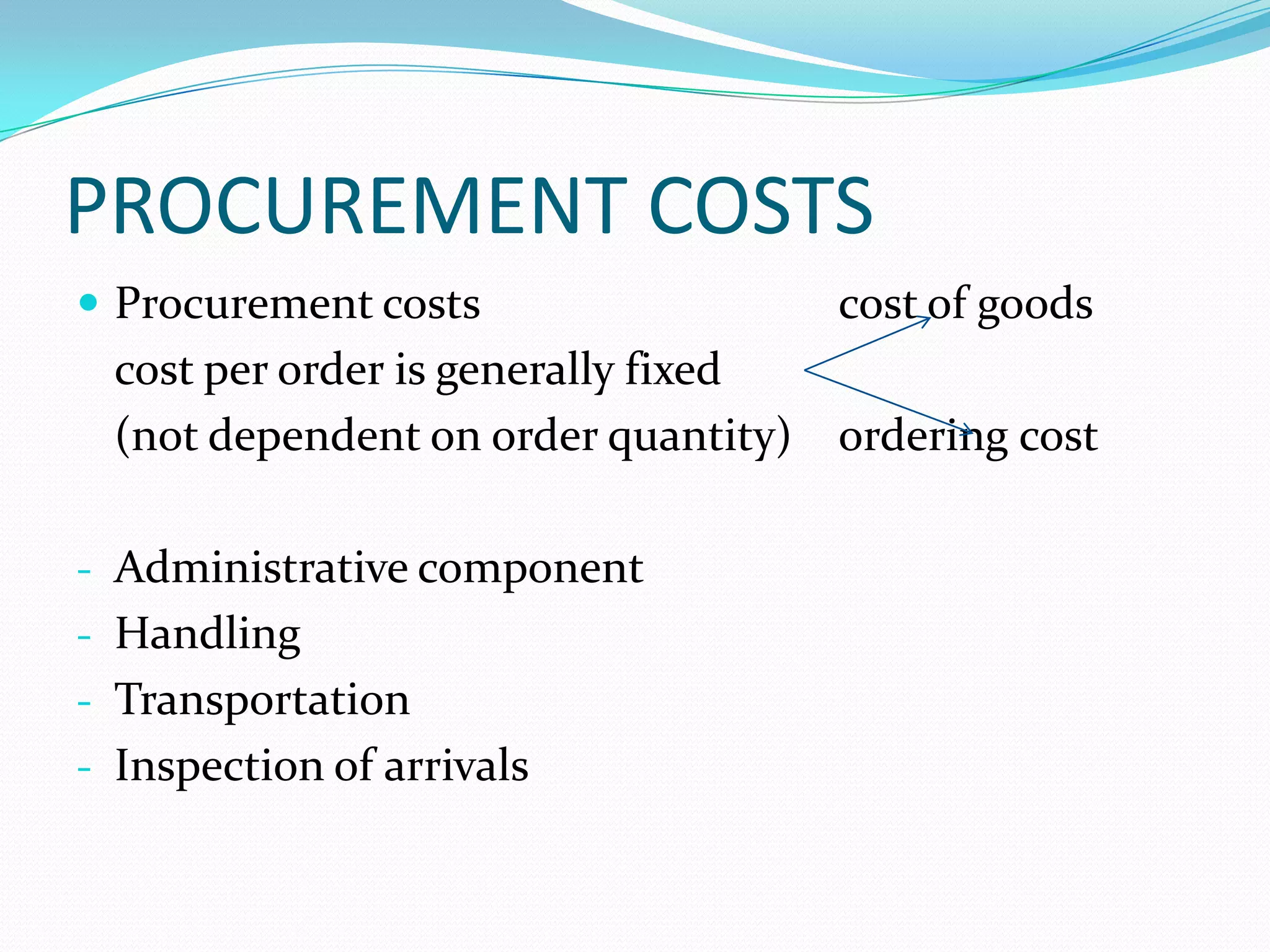
PROCUREMENT COSTS
 Procurement costs cost of goods
cost per order is generally fixed
(not dependent on order quantity) ordering cost
- Administrative component
- Handling
- Transportation
- Inspection of arrivals
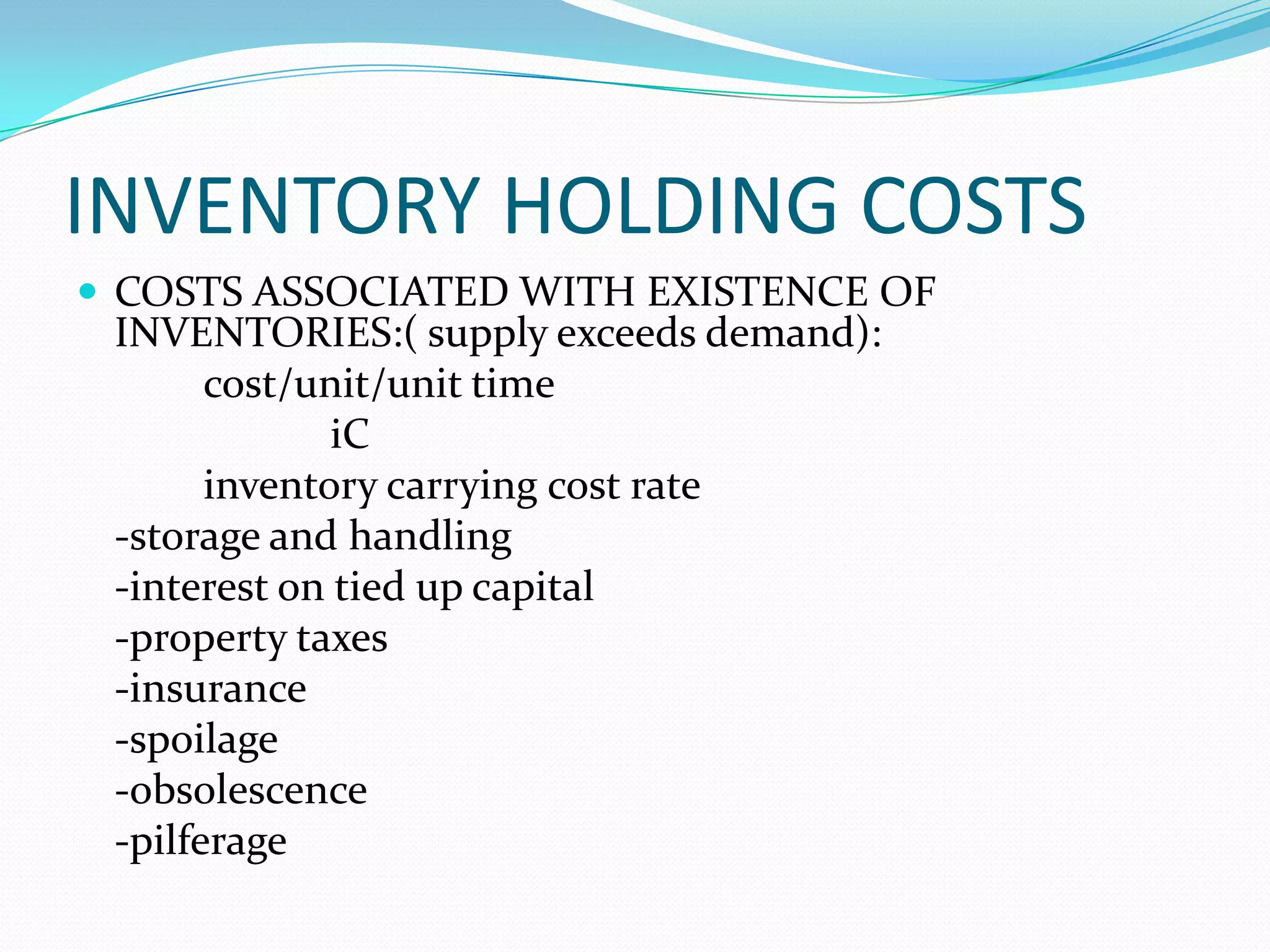
INVENTORY HOLDING COSTS
 COSTS ASSOCIATED WITH EXISTENCE OF
INVENTORIES:( supply exceeds demand):
cost/unit/unit time
iC
inventory carrying cost rate
-storage and handling
-interest on tied up capital
-property taxes
-insurance
-spoilage
-obsolescence
-pilferage
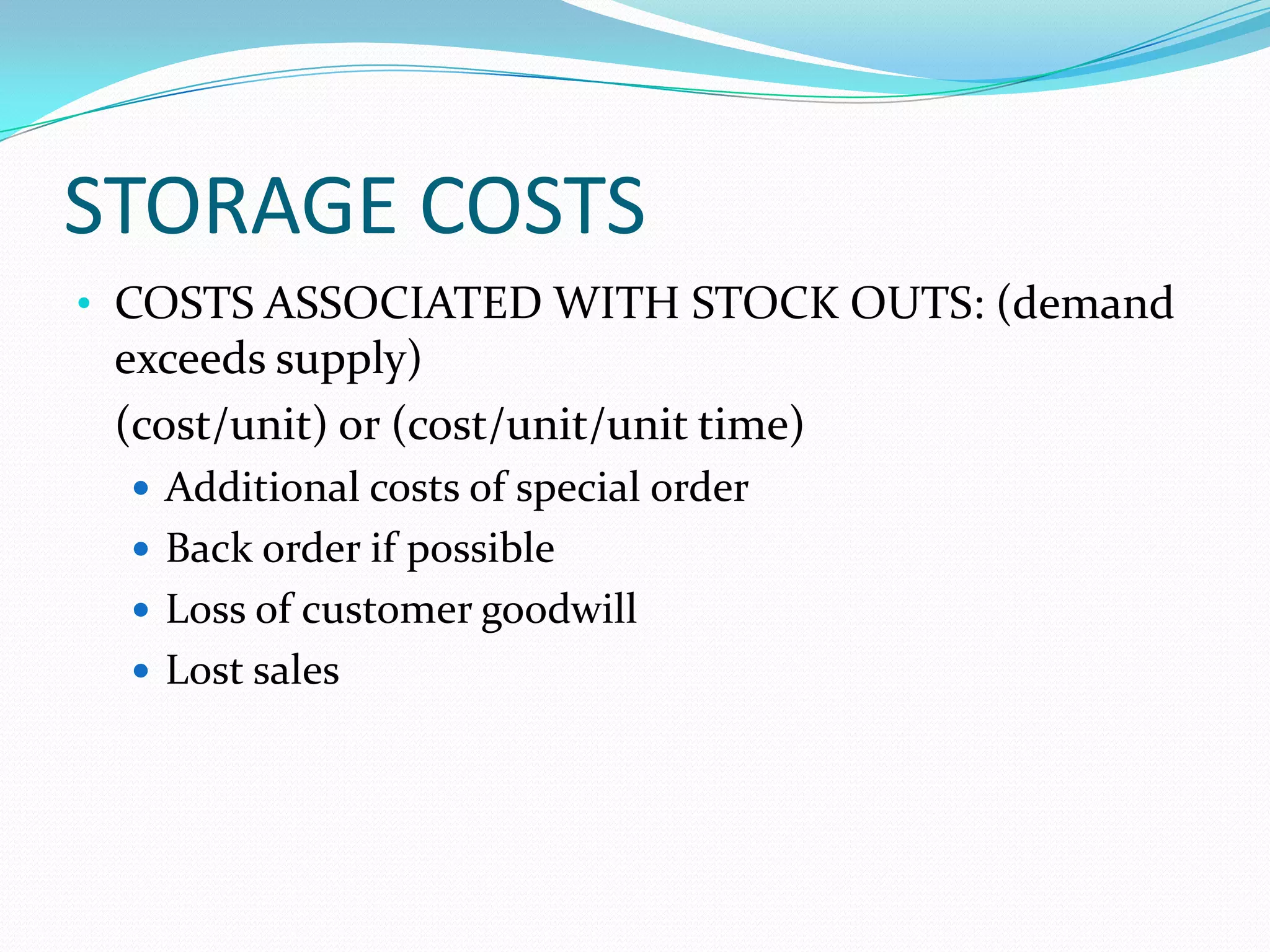
STORAGE COSTS
• COSTS ASSOCIATED WITH STOCK OUTS: (demand
exceeds supply)
(cost/unit) or (cost/unit/unit time)
 Additional costs of special order
 Back order if possible
 Loss of customer goodwill
 Lost sales
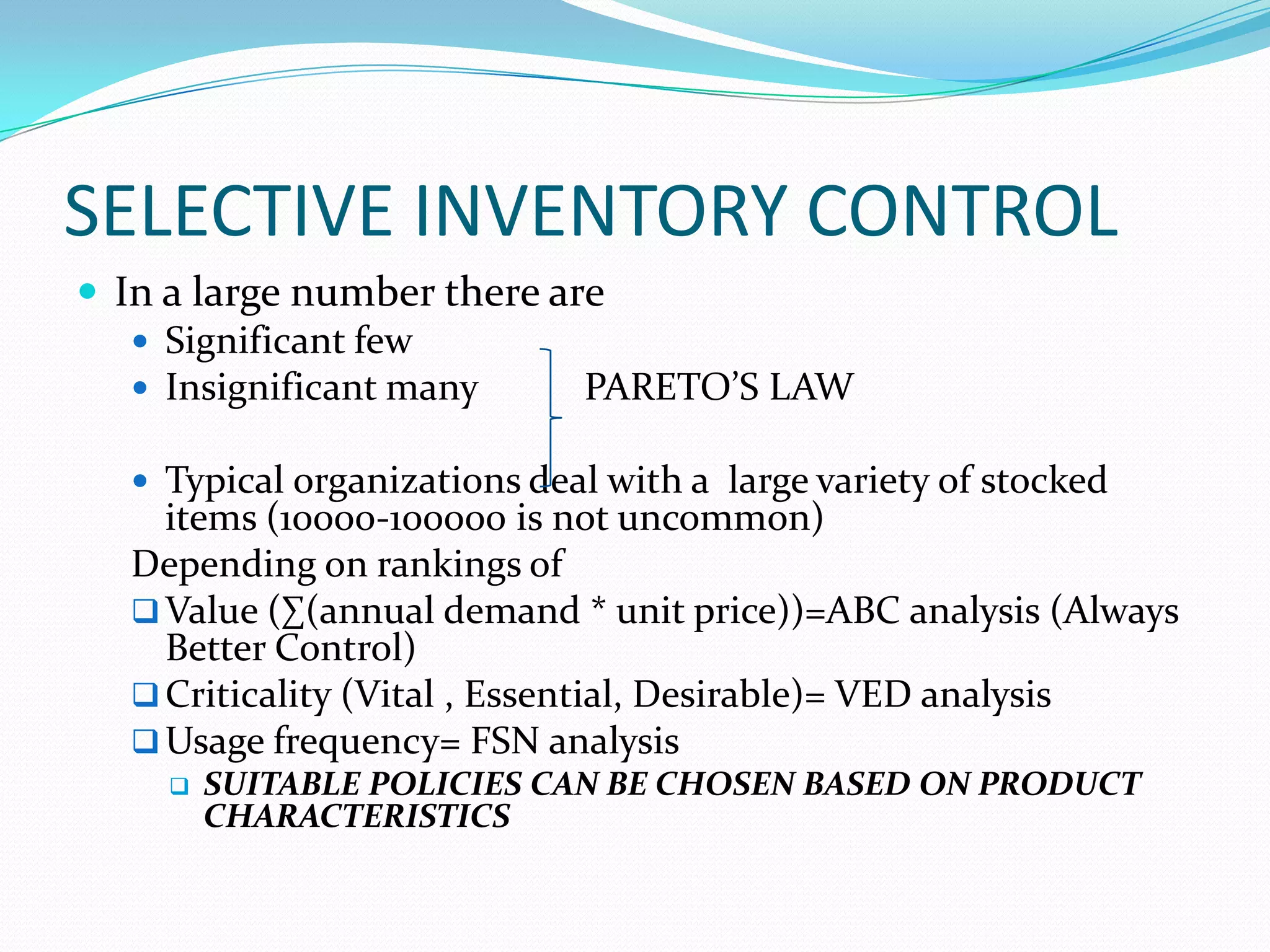
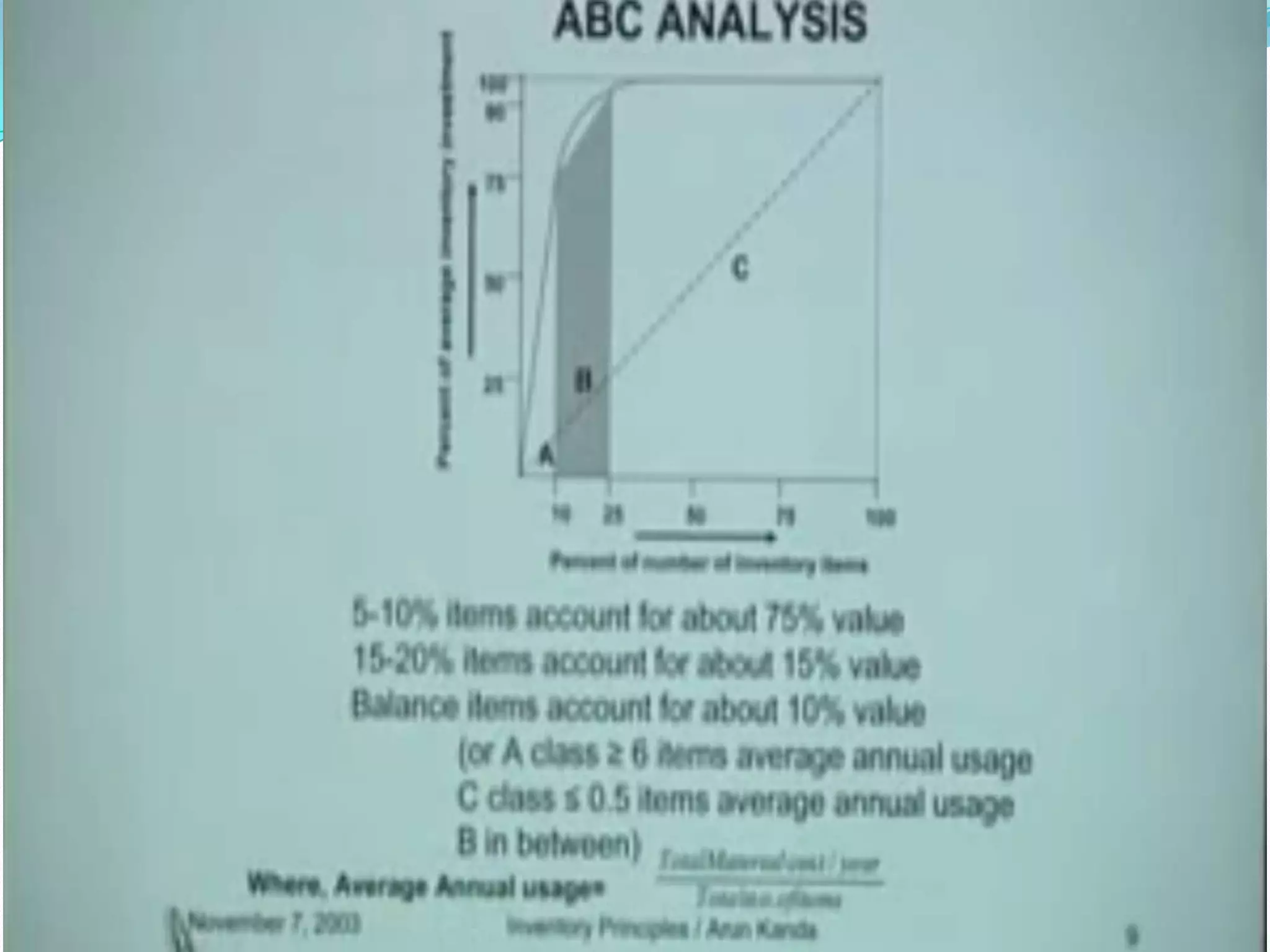
SELECTIVE INVENTORY CONTROL
 In a large number there are
 Significant few
 Insignificant many PARETO’S LAW
 Typical organizations deal with a large variety of stocked
items (10000-100000 is not uncommon)
Depending on rankings of
Value (∑(annual demand * unit price))=ABC analysis (Always
Better Control)
Criticality (Vital , Essential, Desirable)= VED analysis
Usage frequency= FSN analysis
 SUITABLE POLICIES CAN BE CHOSEN BASED ON PRODUCT
CHARACTERISTICS
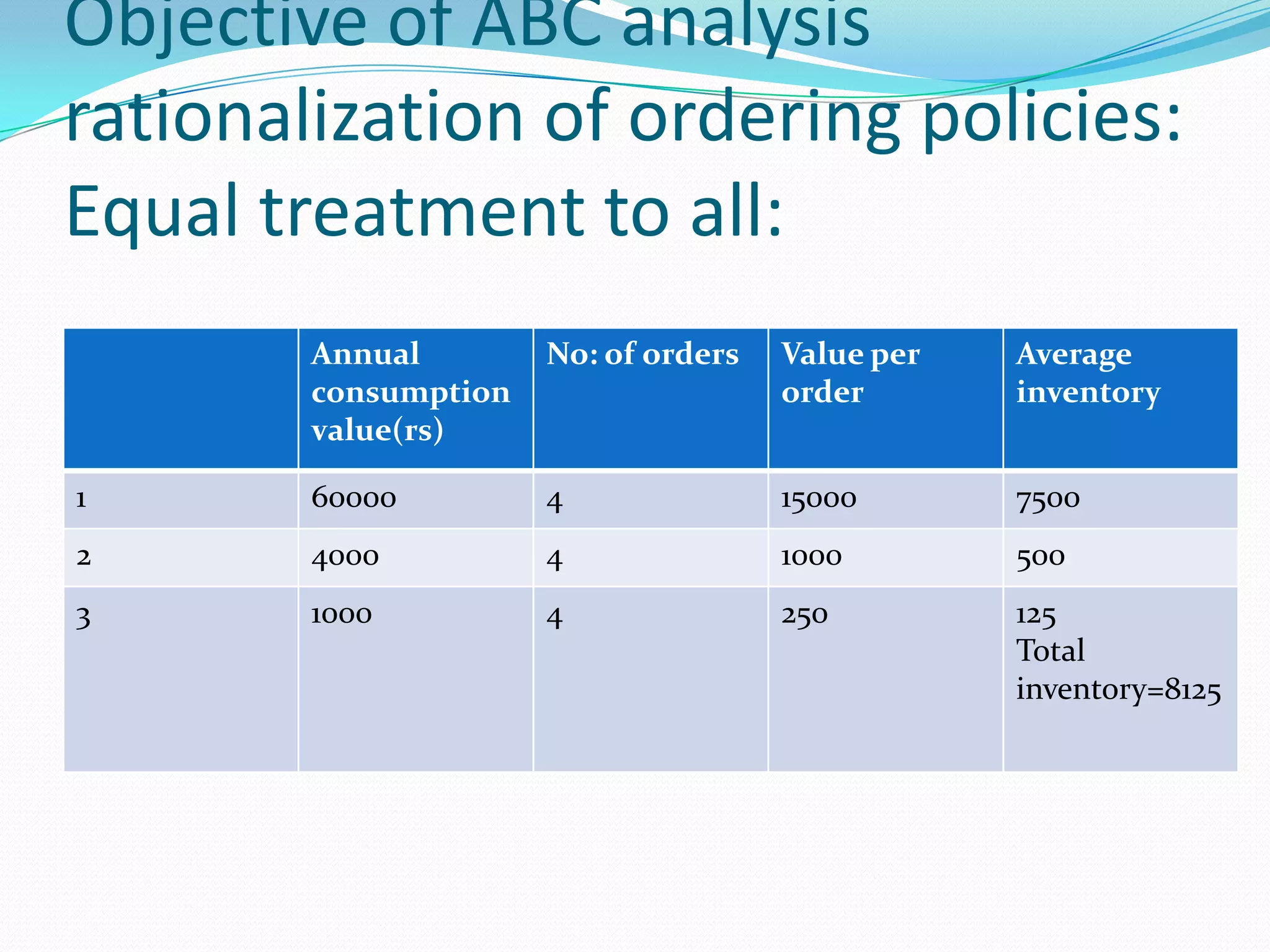
Objective of ABC analysis
rationalization of ordering policies:
Equal treatment to all:
Annual
consumption
value(rs)
No: of orders Value per
order
Average
inventory
1 60000 4 15000 7500
2 4000 4 1000 500
3 1000 4 250 125
Total
inventory=8125
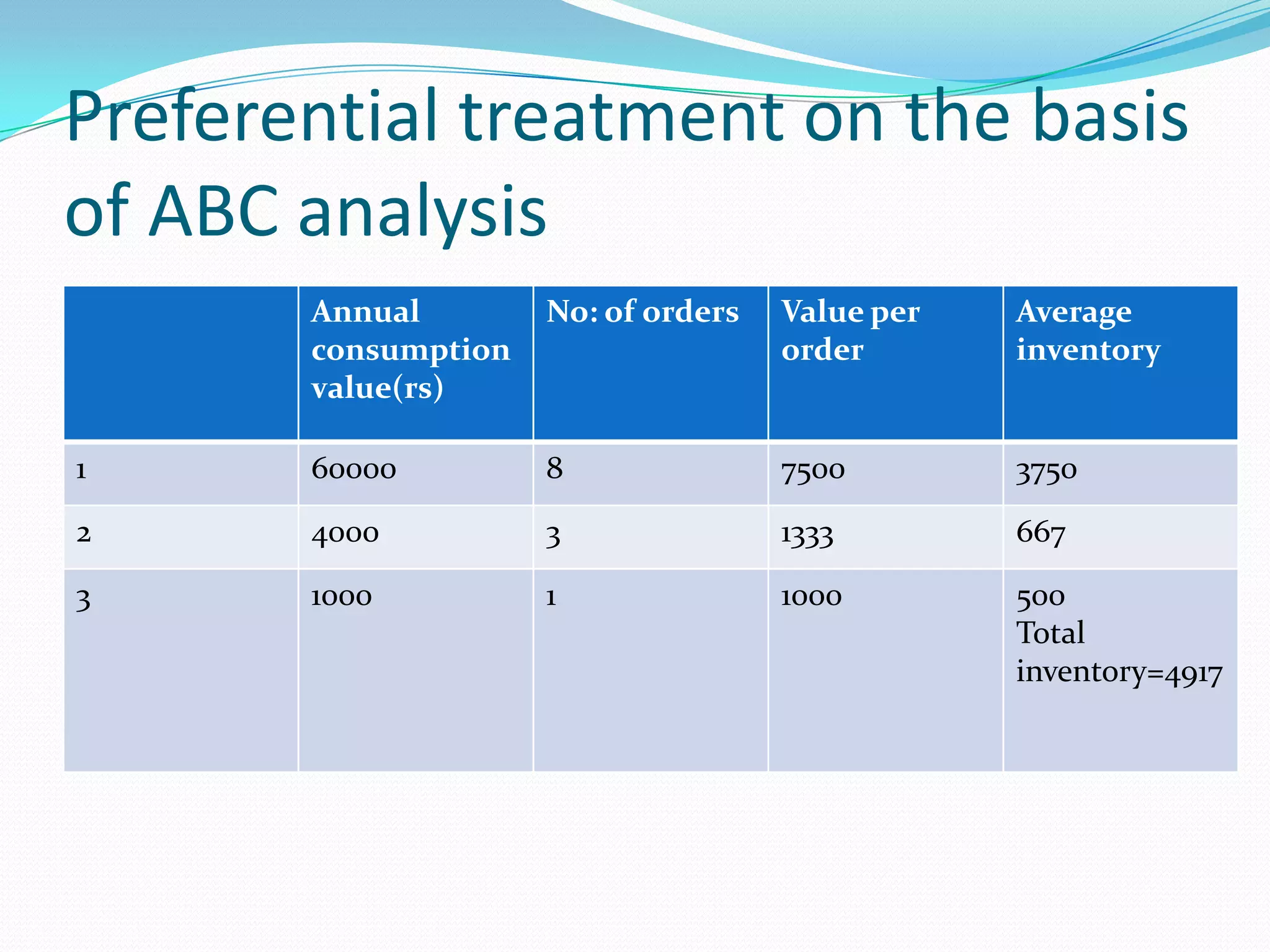
Preferential treatment on the basis
of ABC analysis
Annual
consumption
value(rs)
No: of orders Value per
order
Average
inventory
1 60000 8 7500 3750
2 4000 3 1333 667
3 1000 1 1000 500
Total
inventory=4917
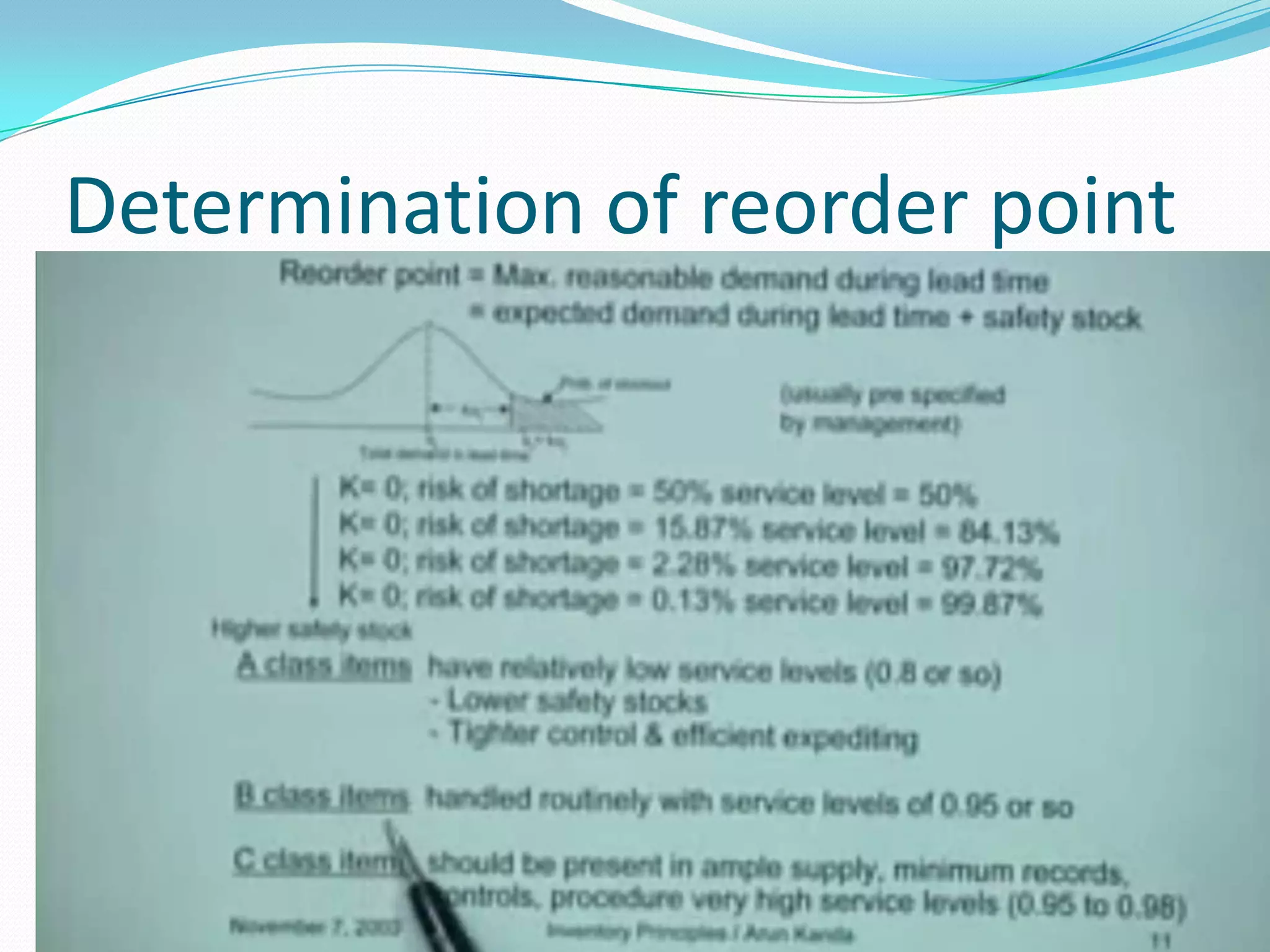
Determination of reorder point
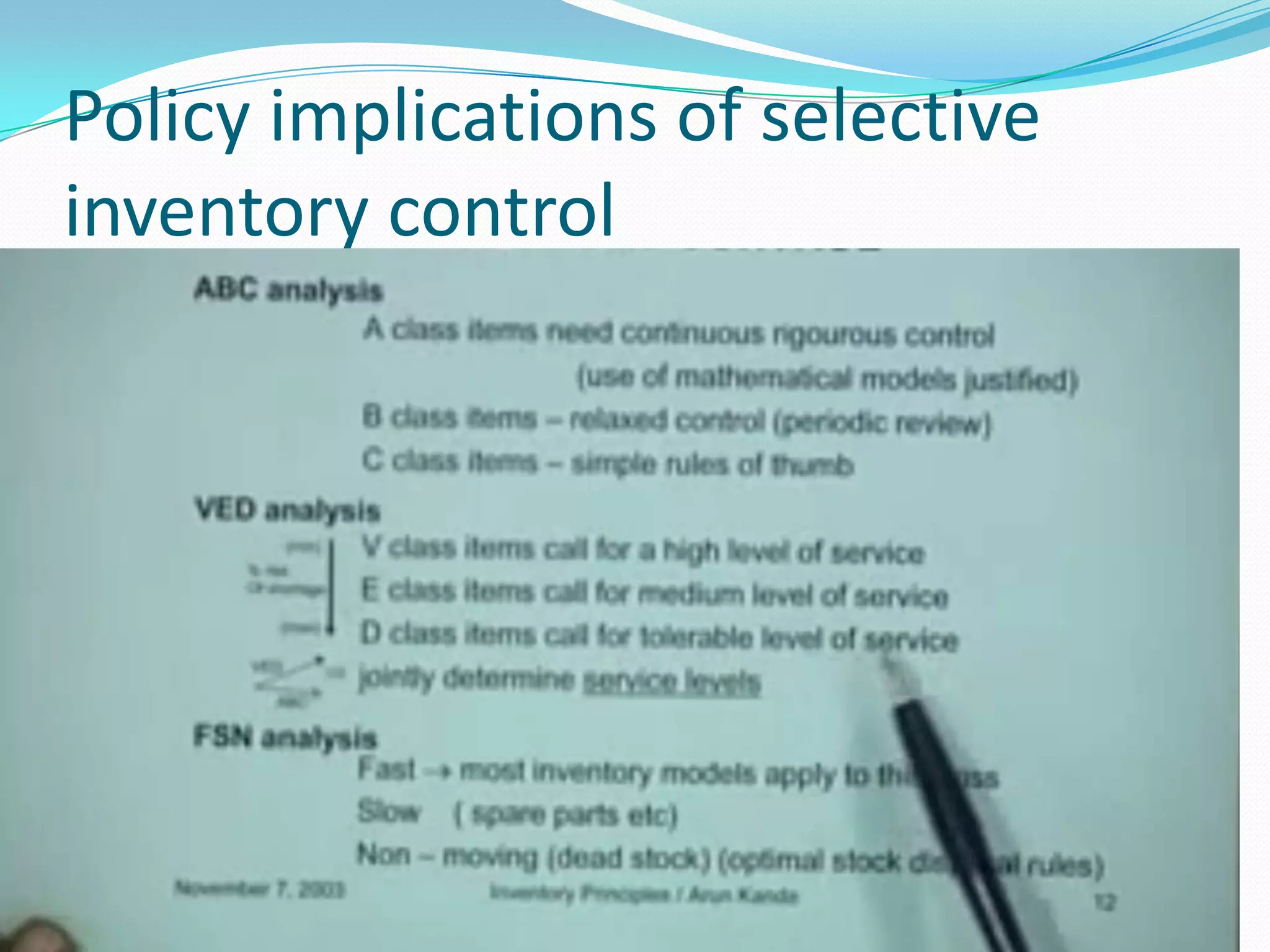
Policy implications of selective
inventory control

Basic inventory principles

  • 2.
    FUNCTIONS OF INVENTORIES BASICALLY INVENTORIES ARE IDLE RESOURCES MAINTAINED IN VARIOUS FORMS.  RAW MATERIALS  PURCHASED AND MANUFACTURED PARTS  SUB ASSEMBLIES  FINISHED PRODUCTS Since inventories represent a sizable investment in a logistic system, we must be aware of the functions they perform.
  • 3.
    FIVE CATEGORIES OFSTOCK  PIPE LINE STOCK (in process stock, in transit stock): it can be reduced only by improved design of the system.  CYCLE STOCKS (batch production owing to - economies of scale - technological requirements ) • SEASONAL STOCK(time varying requirements of an item) • SAFETY STOCK (supply and demand un certainties, lead time un certainties) • STOCKS HELD FOR OTHER REASONS (-decoupling stages of production, price, quantity discounts and speculation) -
  • 4.
    INVENTORY RELATED COSTS PROCUREMENT COSTS:(cost per order is generally fixed and not dependant on order quantity)  COSTS ASSOCIATED WITH EXISTENCE OF INVENTORIES:( supply exceeds demand): cost/unit/unit time iC inventory carrying cost rate • COSTS ASSOCIATED WITH STOCK OUTS: (demand exceeds supply) (cost/unit) or (cost/unit/unit time)
  • 5.
    PROCUREMENT COSTS  Procurementcosts cost of goods cost per order is generally fixed (not dependent on order quantity) ordering cost - Administrative component - Handling - Transportation - Inspection of arrivals
  • 6.
    INVENTORY HOLDING COSTS COSTS ASSOCIATED WITH EXISTENCE OF INVENTORIES:( supply exceeds demand): cost/unit/unit time iC inventory carrying cost rate -storage and handling -interest on tied up capital -property taxes -insurance -spoilage -obsolescence -pilferage
  • 7.
    STORAGE COSTS • COSTSASSOCIATED WITH STOCK OUTS: (demand exceeds supply) (cost/unit) or (cost/unit/unit time)  Additional costs of special order  Back order if possible  Loss of customer goodwill  Lost sales
  • 8.
    SELECTIVE INVENTORY CONTROL In a large number there are  Significant few  Insignificant many PARETO’S LAW  Typical organizations deal with a large variety of stocked items (10000-100000 is not uncommon) Depending on rankings of Value (∑(annual demand * unit price))=ABC analysis (Always Better Control) Criticality (Vital , Essential, Desirable)= VED analysis Usage frequency= FSN analysis  SUITABLE POLICIES CAN BE CHOSEN BASED ON PRODUCT CHARACTERISTICS
  • 10.
    Objective of ABCanalysis rationalization of ordering policies: Equal treatment to all: Annual consumption value(rs) No: of orders Value per order Average inventory 1 60000 4 15000 7500 2 4000 4 1000 500 3 1000 4 250 125 Total inventory=8125
  • 11.
    Preferential treatment onthe basis of ABC analysis Annual consumption value(rs) No: of orders Value per order Average inventory 1 60000 8 7500 3750 2 4000 3 1333 667 3 1000 1 1000 500 Total inventory=4917
  • 12.
  • 13.
    Policy implications ofselective inventory control