
(Process of quality management and continuous
improvement)
Presented By:
Mamta Bhola
 “Quality is fitness for use or purpose.”
-Joseph M. Juran
 “A predictable degree of uniformity and
dependability at low cost and suited to
market.” W.Edward Deming
What is quality management all about?
Try to manage all aspects of the
organization in order to excel in all
dimensions that are important to
“customers”
Two aspects of quality:
features: more features that meet customer needs
= higher quality
freedom from trouble: fewer defects = higher
quality
Cost of quality
1. Prevention costs
2. Appraisal costs
3. Internal failure costs
4. External failure costs
5. Opportunity costs
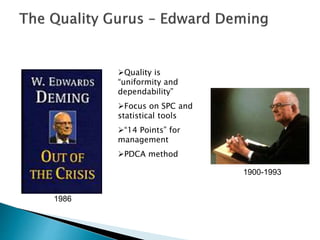
1900-1993
1986
Quality is
“uniformity and
dependability”
Focus on SPC and
statistical tools
“14 Points” for
management
PDCA method
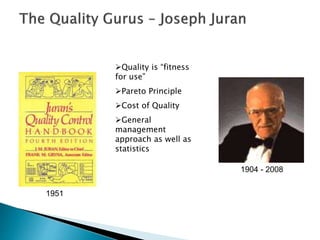
1904 - 2008
1951
Quality is “fitness
for use”
Pareto Principle
Cost of Quality
General
management
approach as well as
statistics
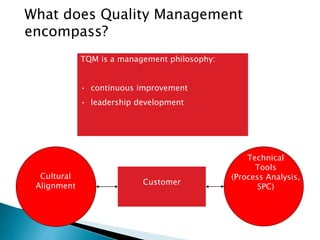
What does Quality Management
encompass?
TQM is a management philosophy:
• continuous improvement
• leadership development
Cultural
Alignment
Technical
Tools
(Process Analysis,
SPC)
Customer
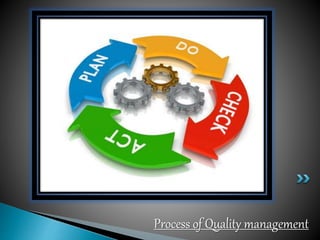
Process of Quality management
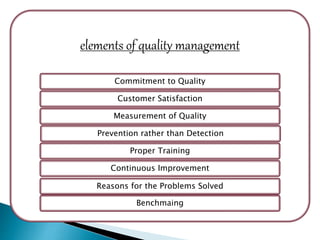
elements of quality management
Commitment to Quality
Customer Satisfaction
Measurement of Quality
Prevention rather than Detection
Proper Training
Continuous Improvement
Reasons for the Problems Solved
Benchmaing
Hotel
industry
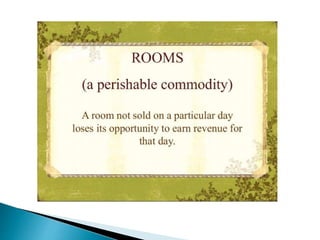
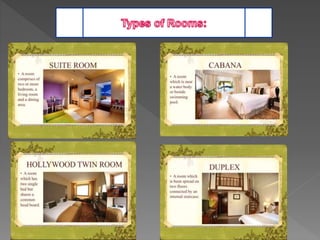
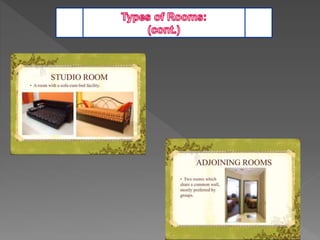
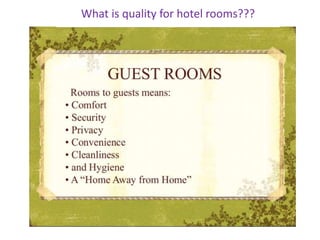
What is quality for hotel rooms???
Principle 1 – Improvements are based on small changes, not major
paradigm shifts or new inventions
Principle 2 – Ideas come from employees
Principle 3 – Incremental improvements are typically inexpensive to
implement
Principle 4 – Employees take ownership and are accountable for
improvement
Principle 5 – Improvement is reflective
Principle 6 – Improvement is measurable and potentially repeatable
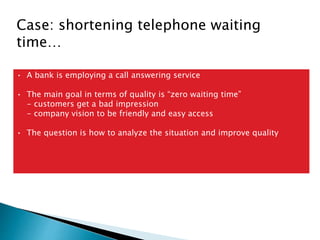
Case: shortening telephone waiting
time…
• A bank is employing a call answering service
• The main goal in terms of quality is “zero waiting time”
- customers get a bad impression
- company vision to be friendly and easy access
• The question is how to analyze the situation and improve quality
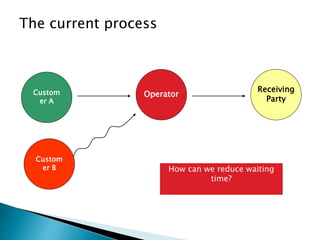
The current process
Custom
er B
OperatorCustom
er A
Receiving
Party
How can we reduce waiting
time?
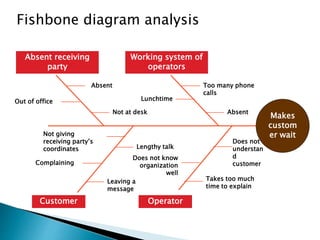
Makes
custom
er wait
Absent receiving
party
Working system of
operators
Customer Operator
Fishbone diagram analysis
Absent
Out of office
Not at desk
Lunchtime
Too many phone
calls
Absent
Not giving
receiving party’s
coordinates
Complaining
Leaving a
message
Lengthy talk
Does not know
organization
well
Takes too much
time to explain
Does not
understan
d
customer
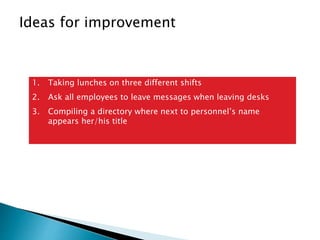
Ideas for improvement
1. Taking lunches on three different shifts
2. Ask all employees to leave messages when leaving desks
3. Compiling a directory where next to personnel’s name
appears her/his title
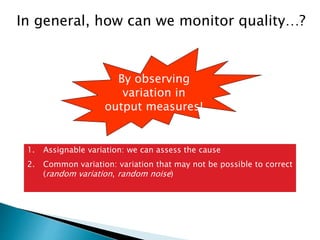
In general, how can we monitor quality…?
1. Assignable variation: we can assess the cause
2. Common variation: variation that may not be possible to correct
(random variation, random noise)
By observing
variation in
output measures!
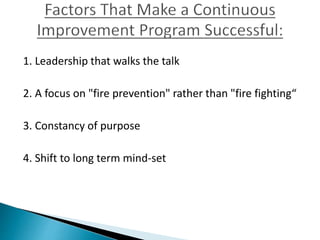
1. Leadership that walks the talk
2. A focus on "fire prevention" rather than "fire fighting“
3. Constancy of purpose
4. Shift to long term mind-set
Quality management

Quality management

  • 1.
    (Process of qualitymanagement and continuous improvement) Presented By: Mamta Bhola
  • 2.
     “Quality isfitness for use or purpose.” -Joseph M. Juran  “A predictable degree of uniformity and dependability at low cost and suited to market.” W.Edward Deming
  • 3.
    What is qualitymanagement all about? Try to manage all aspects of the organization in order to excel in all dimensions that are important to “customers” Two aspects of quality: features: more features that meet customer needs = higher quality freedom from trouble: fewer defects = higher quality
  • 4.
    Cost of quality 1.Prevention costs 2. Appraisal costs 3. Internal failure costs 4. External failure costs 5. Opportunity costs
  • 5.
    1900-1993 1986 Quality is “uniformity and dependability” Focuson SPC and statistical tools “14 Points” for management PDCA method
  • 6.
    1904 - 2008 1951 Qualityis “fitness for use” Pareto Principle Cost of Quality General management approach as well as statistics
  • 7.
    What does QualityManagement encompass? TQM is a management philosophy: • continuous improvement • leadership development Cultural Alignment Technical Tools (Process Analysis, SPC) Customer
  • 8.
  • 9.
    elements of qualitymanagement Commitment to Quality Customer Satisfaction Measurement of Quality Prevention rather than Detection Proper Training Continuous Improvement Reasons for the Problems Solved Benchmaing
  • 10.
  • 15.
    What is qualityfor hotel rooms???
  • 16.
    Principle 1 –Improvements are based on small changes, not major paradigm shifts or new inventions Principle 2 – Ideas come from employees Principle 3 – Incremental improvements are typically inexpensive to implement Principle 4 – Employees take ownership and are accountable for improvement Principle 5 – Improvement is reflective Principle 6 – Improvement is measurable and potentially repeatable
  • 17.
    Case: shortening telephonewaiting time… • A bank is employing a call answering service • The main goal in terms of quality is “zero waiting time” - customers get a bad impression - company vision to be friendly and easy access • The question is how to analyze the situation and improve quality
  • 18.
    The current process Custom erB OperatorCustom er A Receiving Party How can we reduce waiting time?
  • 19.
    Makes custom er wait Absent receiving party Workingsystem of operators Customer Operator Fishbone diagram analysis Absent Out of office Not at desk Lunchtime Too many phone calls Absent Not giving receiving party’s coordinates Complaining Leaving a message Lengthy talk Does not know organization well Takes too much time to explain Does not understan d customer
  • 20.
    Ideas for improvement 1.Taking lunches on three different shifts 2. Ask all employees to leave messages when leaving desks 3. Compiling a directory where next to personnel’s name appears her/his title
  • 21.
    In general, howcan we monitor quality…? 1. Assignable variation: we can assess the cause 2. Common variation: variation that may not be possible to correct (random variation, random noise) By observing variation in output measures!
  • 22.
    1. Leadership thatwalks the talk 2. A focus on "fire prevention" rather than "fire fighting“ 3. Constancy of purpose 4. Shift to long term mind-set